Do Not Weep

Revelation 4-8

There is much to take in with today’s reading as John describes the throne room of heaven and the events that unfold, marking the Kingdom of God being set into motion.  There are angels, horsemen, and elders, each executing and exacting the will of God.  If you are a bit overwhelmed by today’s reading, you are not alone. John, who spent more time with Jesus than most, is still awestruck by the worship of God happening before him, and he is doing his best to describe heavenly things for which there is no earthly vocabulary (something important to keep in mind as we examine the remainder of this book and prophecy).  With a resounding question, John’s attention is drawn to the hand of God:

“And I saw a mighty angel proclaiming in a loud voice, “Who is worthy to break the seals and open the scroll?” But no one in heaven or on earth or under the earth could open the scroll or even look inside it. I wept and wept because no one was found who was worthy to open the scroll or look inside.” Rev 5:2-4

John weeps, for the content of the scroll could very well never be known.  Salvation’s plan locked inside this scroll with no one on heaven or earth who is worthy of removing the seven seals that keep it shut.  This is seemingly the end of the road.  Without a Savior, life on earth has no redemption.  This is most definitely worth a weep, knowing that for some, their story stops here.  They have put everything in what they alone can achieve, yet they are like every other creature in heaven and on earth.  Without the hope delivered in the next verses, all that would remain is remorse and regret (Luke 13:27,28).

Then one of the elders said to me, “Do not weep! See, the Lion of the tribe of Judah, the Root of David, has triumphed. He is able to open the scroll and its seven seals.” Rev 5:5

Salvation is a gift of God, paid for by the blood of Jesus Christ (Eph 2:8,9).  In the moments when we are overcome with great grief, sense the defeating drift of sin, are lost or lonely, feel pressed or persecuted, let Jesus Christ step forward. Do not reach deeper into empty stores, pour out of a broken vessel, or pick up the shattered pieces; let him do what we cannot.  We need only lift our heads – to pray, to seek, to take heart – as we listen to the words of the elder that Jesus Christ, the Lamb of God, has triumphed.  He will step forward and unfurl a new banner, renewing and restoring the purpose of our life. He alone is worthy to open the scroll, yet we are indeed the beneficiaries of the prize of his propitiation.

And they sang a new song, saying:  “You are worthy to take the scroll and to open its seals, because you were slain, and with your blood you purchased for God persons from every tribe and language and people and nation.” Rev 5:9

-Aaron Winner

Today’s Bible passage can be read or listened to at BibleGateway here – Revelation 4-8.

Tomorrow we continue with chapters 9-13.

The Time is Near

Revelation 1-3

It is very likely that at the time of the Revelation of Jesus Christ to John, he was the last living apostle of Christ.  In his final days, he was banished to the Greek island of Patmos for his preaching and prophesying, both viewed as ways of stirring up unwanted rebellion in the Roman Empire.  It is here that he is delivered a vision of final days before the return of Christ.  Of the men that followed Jesus, John may have had the least cruel fate. According to scripture or historical accounts, all had been killed – stoned, clubbed, crucified, beheaded, and speared – preaching the Good News of the Kingdom of God, doing everything in their power to fulfill their commission (Acts 1:4-8) and reach the ends of the earth before the return of their friend and Savior. The disciples preached the Kingdom of God as something that would be seen by the generation they spoke to or the coming one. There was an extraordinary emergency to their message. And yet, 2000 years or so later, here we are.

I am reminded of my internal adolescent rebuttal when hearing Christ was coming soon — “If Jesus Christ has not come in the last 100 generations, why should I think that he will come in mine?” Through our reading this week, we will unpack the message of John and, like many before us, apply his words to the time and place that we live in.  We live in interesting times, but so have many generations before us.  They each had their own political unrest, plagues, and natural phenomenon.  With all the challenges of this year included, to live in the United States as a Christian is still pretty easy by comparison to many places in the world today, and most definitely effortless compared to the challenges faced by apostles of Christ.  For many of us, our ease of living has led us to share (or not) a complacent gospel.   This was already happening in the days of John; a symptom shared by many of the churches in Revelation 2 & 3.  As you read this week, consider the following to renew your sense of urgency to the Gospel message and reinstate Christ’s Kingdom as the centerpiece of your daily purpose:

1.   You are always a single breath away from the Kingdom of God.  No person knows the day or hour of his/her death. We must live our life to be found in Christ, not wait for signs of his return and scramble our way to grace.  The thing is, if you’re waiting for signs before you live out the Gospel, you will be distracted, diverted, or disconnected (Matt 25:1-13, Parable of the Ten Virgins).  “Now listen, you who say, ‘Today or tomorrow we will go to this or that city, spend a year there, carry on business and make money.’ Why, you do not even know what will happen tomorrow. What is your life? You are a mist that appears for a little while and then vanishes.” – James 4:13,14

2.  No one, except the Father, knows the day or the hour Christ returns.  The days before Christ arrival will be as in the days of Noah (Matt 24:38) –  people will be married, there will be parties, children will be born, parents will send their teens to college, couples will be building their dream homes, and many will be working hard to retire early (v.40-42).  Despite the best efforts of John to deliver his prophecy, many will be caught unaware of the harbingers of Christ’s return. Because of this, it is imperative we deliver the Gospel message wherever our feet are on the daily. “But about that day or hour no one knows, not even the angels in heaven, nor the Son, but only the Father. As it was in the days of Noah, so it will be at the coming of the Son of Man.” – Matthew 24:36,37 

3. Many of the dramatic events that unfold in Revelation will happen within a single generation.  God has been working on His salvation plan since the foundations of the world (Col 1:16) with the culmination being (spoilers ahead) the establishment of the Kingdom of God on Earth.  According to the words of Jesus and the vision of John there are compounding and intensifying events as seals are opened and the wrath of God being poured out. Natural wonders, dramatic plagues, famines, wars, and a global political climate will feed off one another and spur along the intervention and return of Christ.  If this year has taught us one thing, it is how fast the world can change with some of these elements aligned; however, the ignition point for the return of Christ is already set.  There will be a fire that follows and it will consume quickly; the temperature need only rise a bit more. “Truly, I say to you, this generation will not pass away until all these things <Matt 24:14-33> take place.” – Matthew 24:34

“Blessed is the one who reads aloud the words of this prophecy, and blessed are those who hear it and take to heart what is written in it, because the time is near.” Revelation 1:3

-Aaron Winner

Today’s Bible passage can be read or listened to at BibleGateway here – Revelation 1-3

Tomorrow we continue Revelation with chapters 4-8.

Luke 14-15

I love enjoying Sunday dinner with others. Sharing a potluck or going out to eat together is great, but in our reading we see Jesus was invited to the house of a prominent Pharisee where he was being carefully watched. Some of the leaders had been listening very carefully to Jesus, but not to learn from him. They hoped to find fault with Jesus and to catch him in something he said then report him to the authorities. Imagine being a guest at this table. You have the opportunity to sit and eat with the Son of God. You have the chance to hear his teaching. But these leaders are so blind that they are trying to set a trap for Jesus. The leaders get their wish because a man who is suffering is there. Of course, out of compassion the Lord heals the man. Rejoicing should have happened around this table, but instead Jesus has to explain that healing on the Sabbath is doing good and it is acceptable.

Jesus noticed that these guests were picking the places of honor at the table. They were self-promoting and needed to learn the importance of humility that Jesus illustrates through a parable of taking the lowest position at a feast.  Explaining that “all those who exalt themselves will be humbled, and those who humble themselves will be exalted.”  

Jesus then teaches that meals should be given for the less fortunate, which will result in the host being blessed and repaid at the resurrection of the righteous. Someone at Jesus table said to him, “Blessed is the one who will eat at the feast in the kingdom of God.”

Jesus then used a parable to explain that the “stuff of life” should never keep us from accepting the invitation we have received from the Lord to the great banquet He has prepared for us. When we count the cost of being a disciple, we realize that giving up the things of this life are a small price to sit at the Kingdom feast table. As Christ said “many will come from the east and the west, and will take their places at the feast with Abraham, Isaac and Jacob in the kingdom.” I love that he states that there are places for us at that feast (reserved seating). Each person is important to God as we see in Chapter 15. Stay close to our Heavenly Father and rejoice when those that are lost are found. Remember that we will one day celebrate like never before around our Father’s table at the Kingdom feast.

~ Rebecca Dauksas

Today’s Bible passage can be read or listened to at BibleGateway here – Luke 14-15.

Tomorrow we will read Luke 16:1-17:10.

The Shepherd

Ezekiel 32-34

Ezekiel 33 and 34 cover leadership, how Ezekiel cannot be an effective leader and how God will one day lead Israel directly and be their shepherd. 

30 “As for you, son of man, your people are talking together about you by the walls and at the doors of the houses, saying to each other, ‘Come and hear the message that has come from the Lord.’ 31 My people come to you, as they usually do, and sit before you to hear your words, but they do not put them into practice. Their mouths speak of love, but their hearts are greedy for unjust gain. 32 Indeed, to them you are nothing more than one who sings love songs with a beautiful voice and plays an instrument well, for they hear your words but do not put them into practice.” (Ezekiel 33:30-32 NIV)

Ezekiel is a leader over God’s people, but he cannot lead effectively if they will not listen to him.  Ezekiel has been proclaiming God’s word to the people for a few years now and telling them of the judgements of God and the consequences of their actions, and they have been collectively taking his messages about as seriously as you would a street performer’s.  I think that a lot of people go to church today because they want to hear nice things from the pastor and they enjoy how energetic and uplifting the speaker can be, but unless you are being pushed to change your ways and grow closer to God and step outside of your comfort zone, then you might be like the Israelites here, with the word of God going in one ear and out the other.  Hearing the word is not enough, you have to listen and change.

11 “‘For this is what the Sovereign Lord says: I myself will search for my sheep and look after them. 12 As a shepherd looks after his scattered flock when he is with them, so will I look after my sheep. I will rescue them from all the places where they were scattered on a day of clouds and darkness.

15 I myself will tend my sheep and have them lie down, declares the Sovereign Lord. 16 I will search for the lost and bring back the strays. I will bind up the injured and strengthen the weak, but the sleek and the strong I will destroy. I will shepherd the flock with justice.” (Ezekiel 34:11-12, 15-16 NIV)

I think that this looks forward to two different times.  First it looks to the time after the death of Jesus when the sins of mankind can be covered by Jesus’ blood and man can go directly to God, without the need for an earthly priest and a temple and daily sacrifices.  I think that Jesus was even alluding to this chapter when he told the parable of the shepherd who left the 99 sheep to find the one, basically telling the Israelites that God was ready to begin this new type of relationship with them that he had told them about during the time of Ezekiel.  

I think that this verse also looks forward to the Kingdom of God when he will reign as the perfect shepherd over all those who have believed.  At the time of Ezekiel this was very far away, and Jesus had not begun his ministry, and the Church was not yet established, but God still had a plan.

Revelation 21:3

3 And I heard a loud voice from the throne saying, “Look! God’s dwelling place is now among the people, and he will dwell with them. They will be his people, and God himself will be with them and be their God. 

Thanks for joining us this week as we have been going through Ezekiel.  It is not a book that we know particularly well and we are glad that we have had this time to study it.

Chris and Katie-Beth Mattison

Today’s Bible reading passage can be read or listened to at Bible Gateway here – https://www.biblegateway.com/passage/?search=Ezekiel+32-34&version=NIV

Tomorrow we will be reading Ezekiel 35-37 as we continue our Chronological Bible Reading Plan.

Isaiah 35-36

Out of his heart will flow rivers of living water.

The book of Isaiah holds many judgments against Israel, Judah, and all the nations surrounding them. Page after page contains descriptions of how God will deal with these people, because of the sin that they commit. In the midst of this, there are glimpses of a wondrous hope to come and worship God in his future kingdom. We see the beautiful future that God has prepared for all those who love him despite the brokenness of our current realities. 

Isaiah 35 describes this future in a continuation of the prophecy beginning in Isaiah 34. In Isaiah 34, Edom’s eventual punishment and destruction is described: “Edom’s streams will be turned into pitch, her soil into sulfur” (v. 9). In this place, jackals, hyenas, goats, birds of prey, and snakes will gather – all symbols of destruction and brokenness (v. 14-15). The very land has turned bitter and worthless under the consequence of sin. In contrast to this, Isaiah 35 describes the land of the Israelites as a desert that blossoms like a rose (v. 1). In this place, “the eyes of the blind will be opened, and the ears of the deaf unstopped. Then the lame will leap like a deer, and the tongue of the mute will sing for joy, for water will gush in the wilderness and streams in the desert; the parched ground will become a pool of water and the thirsty land springs of water” (v. 5-7). Unlike the land of Edom, in the redeemed land, “There will be no vicious beast, but the redeemed will walk on it” (v. 9). In fact, the places where the vicious beasts resided, like the lairs of jackals, will be turned into a meadow of grass, reeds, and papyrus (v. 7). A road will go through this land called the Holy Way; “the unclean will not travel on it, but it will be for the one who walks the path. Even the fool will not go astray” (v. 8). This path will lead up to the mountain of God where the people will come to worship God. 

We live in an incredibly broken world that seems like it is full of vicious beasts and people bent on destroying themselves and others. We can see the consequences of sin in the hurt that is being done so carelessly to everyone, including our most vulnerable. We can rest in the hope that this will not always be the way the world will be. Those that would be overlooked by society and viewed as less than are the very people that God includes in the description of his future kingdom: the blind, deaf, lame, and mute. These are the people who lead the way for praising God’s redemption of the land. We will not always live in these broken times. We can trust that one day streams of water will flow through the desert and the whole world will blossom like a rose. In fact, through the Holy Spirit, we can begin to redeem our time here for God and be his hands and feet in this broken world. How can you bring the living water to those around you? 

~ Cayce Fletcher


Today’s Bible passage can be read or listened to on Bible Gateway – Isaiah 35-36.

Tomorrow, we continue reading about the history of Judah and Israel in Isaiah 37-39 & Psalm 76 – as we continue the 2020 Chronological Bible Reading Plan.

Isaiah 23-27

God makes a way in spite of our brokenness.

Isaiah was a prophet in Israel during some very difficult times due to the fact that Israel had to a great extent departed from the true worship of God and were not keeping the commandments as God instructed.  Due to rebellion Israel was divided into two kingdoms.  The Northern Kingdom was known as the Kingdom of Israel and the Southern Kingdom was referred to as Judah in the books of Isaiah and Jeremiah.  These two divisions were adversarial toward each other.  Isaiah was a prophet in Judah over 700 years before the birth of Jesus.  It might be mentioned that Jeremiah was a prophet in Judah later over 600 years before Jesus.  The sinful departure from serving God continued during the times of both prophets.  Perhaps the sinful conditions then were much like and to the degree of the sinfulness that is prevalent in today’s world.  God through these prophets warned Israel that there would be serious consequences of their sin, but they would be greatly blessed if they returned to faithful service to God.  Unfortunately, Israel did not heed the words of the prophets and made bad choices by continuing in their sinful ways.  Indeed, there were serious consequences resulting from their sinful behaviors.  We also have to make similar choices almost daily.  There are blessings when we make choices pleasing to God.  As previously stated, the sinfulness of Judah continued until about 600 years before Jesus.  God withdrew his protection and they were attacked by the Babylonians.  About 606 BC the Babylonians conquered and took the entire population of Judah from their homeland to the land of the Babylonians where they were to be servants of the Babylonians for 70 years.  After the fall of the Babylonian Empire they were permitted to return to their original homeland and to restore their worship of God.

In spite of all the sins of Judah, God never ceased to love them.  In Isaiah 27 God promises a brighter day for Israel when they will no longer be divided and when they are turned from their sinful ways to serve and obey God.  These blessings will happen after Jesus returns and establishes the Kingdom of God.

We can learn much from the experiences of Israel.  We all have sinned and that includes everyone.  Yet, God loves mankind so much that He gave his only begotten son as a sacrifice for our sins, John 3:16.  Today we live in a world with many problems and challenges.  This week we are not at FUEL because of a very serious and deadly virus.  There is strife and unrest in our nation often leading to violence. There are a number of wars in the world.  Although we live in difficult times, we like Israel are confronted with choices.  God has something better ahead for us if we choose to serve him today and accept his son Jesus – The Wonderful Kingdom of God is promised for us!

~ Joe James


Today’s Bible passage can be read or listened to on Bible Gateway.

Tomorrow, we continue reading about the history of Judah and Israel in 2 Kings 18:1-8 & 2 Chronicles 29-31 & Psalm 48 – as we continue the 2020 Chronological Bible Reading Plan.

Sorrow, Grace & Accepting the King

2 Samuel 19-21

2 Samuel 19 1 NIV sgl

At the beginning of chapter 19, David is admonished by Joab to get his priorities in order. He is mourning the death of the son who has betrayed him. Joab explains that by mourning his son, he is actually discrediting all of the efforts that his army had made in protecting him and fighting for him. David sees the error of his ways, cleans himself up and goes out to honor his army. 

We must focus on the things that God has done for us in this life instead of living in sorrow for the things we do not have or have lost. We have to trust that God sees all that we face and will carry us through even the darkest of times. 

As the story continues, we see many instances of grace being given to some and wrath being taken out on others in order for David to be reestablished as the rightful king. We should always adhere to and respect the will and order of our heavenly father. Although we do not see in our day the same brutality that we see in 2 Samuel, he is still a jealous God and he does demand our faithfulness and devotion.

We should always seek truth and be willing to stand firm for the things that God has established in our lives. Being willing to fight for the things set forth by God is absolutely critical in our walk of faith.  We should also be willing to have mercy along the way when it is warranted, but also be willing to stand against those who we know are against God and his will even if it means we are faced with the possibility of loss. 

Our time in this life is temporary as are the relationships we establish here. The kingdom of God is eternal. The life we lead now should be preparing us for that eternal life in the Kingdom. Just as God determined that David would be King, he has established his son Jesus as the eternal King of his Kingdom. Only those who accept his son as king will share in the joys of the kingdom with him. 

No one should think that they can just determine their own path or forge a different way than what God has determined. In 2 Samuel, it is made very clear that those who do not adhere to the will of God will see his wrath. We should not think that we can stray from his will in our lives either. We will not inherit the Kingdom of God if we do not obey his commands.

Leslie Jones
Today’s Bible reading can be read or listened to at https://www.biblegateway.com/passage/?search=2+SAMUEL+19-21&version=NIV

Tomorrow’s reading will be Psalm 5, 38 & 41-42 as we continue on the 2020 Chronological Bible Reading Plan

Strike up the Band!

1 Chronicles 6

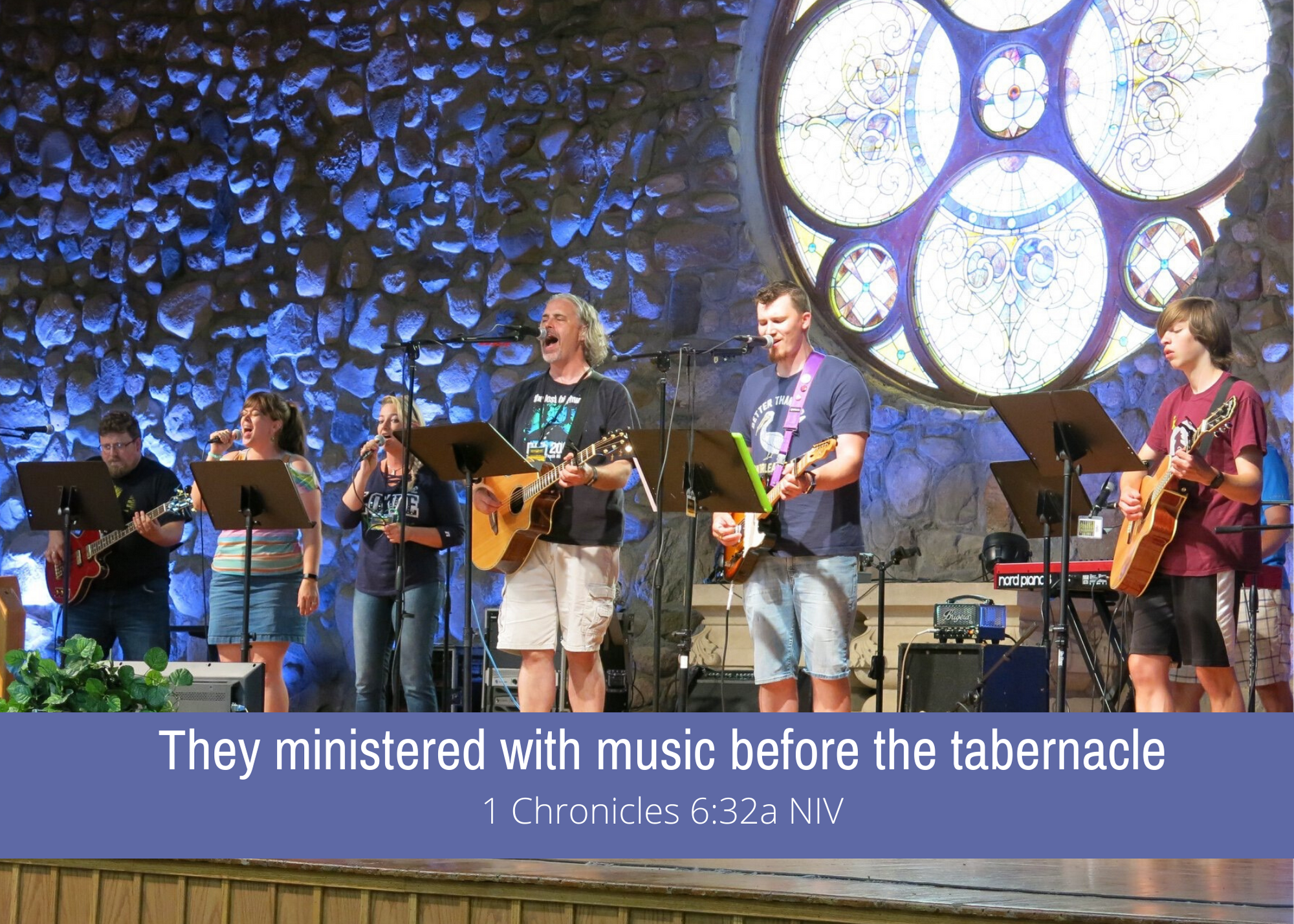
1 Chronicles 6 32a NIV

As our Bible reading today we have just one chapter in the book of 1st Chronicles (chapter 6) – still in the genealogies.  This chapter is devoted to the tribe of Levi.  Levi was one of the 12 sons of Jacob and his descendants would be the ones God chose to be the Levites for the nation of Israel.  They were set apart for service to God.  They would be the care takers of the tabernacle (where people sought God), and later the temple.  From their tribe would come the family line that would serve as priests and the most holy role of high priest, which later Jesus himself would take upon his shoulders.

But, that’s not all – some of the Levites (those listed in verses 33-47) – were given the responsibility of temple musicians.  They were to play, sing, and make music to the Lord – to lead the temple-goers in their worship of the Most High.

I love that God created us to enjoy music.  I love the power of music – just read any article on music and the brain or music therapy – or better yet – listen to the nurse as he plays his guitar in the hall of his covid-19 ward.  Or witness the miraculous turn-around of the struggling infant when his big sister sings to him the song that she always sang to the baby in her mommy’s belly.  Or hear the band play as the Titanic sinks.  Music grips us and moves us in many ways.  Let music be a source that moves you toward God as you come to worship.

As our church has gone online during this time of isolation, I miss the community lifting their voices and instruments together in worship.  But even now, music remains as a powerful means to move us closer to God.  Look up the words to an old hymn.  Pick up an instrument you have neglected too long.  Thank those who have used the gift of music to lead you into meaningful worship.  Share with your family a song that reminds you of God’s love, character and promises.  Search for Bible verses about music.  Play worship music as you go about your day.  Research how many instruments are listed in the Bible?  Post a song of Christian joy and hope on social media.  Write your own psalm of praise – maybe you will even set it to a tune.

Music was a powerful part of worship long ago, it is still today, regardless of our situation – and it will be in the future as well.  I love the verses in Revelation where the faithful will sing in worship to God and the Lamb Jesus Christ as the Kingdom of God is preparing to unfold.  Let’s get started practicing today to be a part of that choir!  God and His Son are worthy of our worship!  Sing it out!


Marcia Railton


Today’s reading can be read or listened to at https://www.biblegateway.com/passage/?search=1+Chronicles+6&version=NIV

Tomorrow we go back to the Psalms – 81, 88, & 92-93 as we continue on the 2020 Chronological Bible Reading Plan

Remember

Joshua 1-4


The message I took out of the first four chapters of Joshua is especially timely.  We are living in unprecedented times.  Not unprecedented in history, but certainly within our own lifetimes.  Obviously, I am speaking of the coronavirus epidemic.  No one knows how long the effects of this will last, or when things will get back to “normal” But do not fear.  God is still on His throne.


After forty years of wandering in the desert, God finally allows His people to enter into the promised land behind the leadership of Joshua. The pivotal moment is when the Lord held back the flood-swollen waters of the Jordan river, allowing the tribes of Israel to cross over on dry land.  Of course, this bookends the forty years in the wilderness after escaping Egypt by similarly crossing the parted waters of the Red Sea on dry land.


But after this crossing, God instructs Joshua to have each tribe take a rock from the middle of the river, and stack them up on the side of the river they were crossing onto.


Joshua chapter 4, verses 20-24 say, “And Joshua set up at Gilgal the twelve stones they had taken out of the Jordan. He said to the Israelites, ‘In the future when your descendants ask their parents, “What do these stones mean?” tell them, “Israel crossed the Jordan on dry ground.” For the Lord your God dried up the Jordan before you until you had crossed over. The Lord your God did to the Jordan what he had done to the Red Sea when he dried it up before us until we had crossed over. He did this so that all the peoples of the earth might know that the hand of the Lord is powerful and so that you might always fear the Lord your God.’ ”


Our Heavenly Father knows that we are a forgetful people.  I am an expert at it.  But certain things are worth remembering.  Like when God has rescued His people, fulfilled promises, or performed miracles.  God instructed people to remember certain events throughout history.  Thankfully, we have the history of such events at our fingertips in His word.  We know that He has fulfilled every promise that has come to pass, and so we should have confidence that the Godly promises that have not come to pass will also be fulfilled.


But what about events that are not written down in the Bible?  What about events in our own lives?  Has God ever demonstrated His power and love to you personally?  Think about such events, and how they can serve as our own monuments for us to hold onto and recount that God is there with us. If God has delivered you through difficult times before, have confidence that He will do so again.


Finally, remember that no matter what the future holds, no one can take away the promise of the future Kingdom that we will have a part in.  Nothing that ever happens on earth will take that promise away, and today, and every day going forward, God is in control.


For you parents, remember that this is a great time to model real faith to our children.  It is easiest to show faith in God when everything is going great.  But how will you model your faith and trust in God during these difficult times?  That is what matters most.


I have added some verses of encouragement below (starting with one from today’s reading), and then after that, a link to a youtube playlist I created that has songs of encouragement.


Joshua 1:9

Have I not commanded you? Be strong and courageous. Do not be frightened, and do not be dismayed, for the Lord your God is with you wherever you go.


Isaiah 41:10

Fear not, for I am with you; be not dismayed, for I am your God; I will strengthen you, I will help you, I will uphold you with my righteous right hand.


Deuteronomy 31:6

Be strong and courageous.  Do not fear or be in dread of them, for it is the Lord your God who goes with you. He will not leave you or forsake you.


Isaiah 40:31

But they who wait for the Lord shall renew their strength; they shall mount up with wings like eagles; they shall run and not be weary; they shall walk and not faint.


2 Corinthians 12:9-10

But he said to me, “My grace is sufficient for you, for my power is made perfect in weakness.” Therefore I will boast all the more gladly of my weaknesses, so that the power of Christ may rest upon me. For the sake of Christ, then, I am content with weaknesses, insults, hardships, persecutions, and calamities. For when I am weak, then I am strong.


2 Timothy 1:7

For God gave us a spirit not of fear but of power and love and self-control.


Greg Landry


Welcome to the Books of History in our

Today’s passage, Joshua 1-4 can be read or listened to at


Seek

Numbers14-15 cain

No matter how many times I read the story, it is hard for me to digest the betrayal of the Israelites in chapter 14. After they saw the land that He promised them, they wanted to return to being slaves in Egypt? What shocks me even more is that we do the same thing today. What do you think Jesus meant when he said this in Luke 9:62, “No one, after putting his hand to the plow and looking back, is fit for the kingdom of God”? This is alluding to a plow man tilling the ground to prepare it for planting. If the plow man were to look back behind him the rows would be crooked and off course. Jesus is saying that we are like plow men and if we look back and do a poor job then we aren’t fit for the kingdom. What does this have to do with Numbers 14? We can look back today the same way the Israelites did in Numbers 14. They were liberated from slavery in Egypt and given the promise of a new land that was “exceedingly good”. We were liberated from slavery under sin and given the promise of a perfect new earth. The Israelites looked back at their life in slavery and wanted its comforts once again, even knowing they would return to slavery. We can look back at our life of sin and wish we could go back to it, even if we know it will kill us in the end. Sometimes our desires can turn from God and pull us towards a life of sin.

The last two verses of chapter 15 tell us exactly what God desires from us. “Remember to do all My commandments and be holy to your God. I am the Lord your God who brought you out from the land of Egypt to be your God; I am the Lord your God.” Replace the phrase “land of Egypt” with “sin” and apply this to our lives today. Let’s not miss out on our promises because we want to look back to our old life of sin and return to slavery. Let’s keep our eyes on the goal of the kingdom and remember the God who saved us from sin and is bringing us to an “exceedingly good land.” I enjoy looking at the big picture in scripture and seeing how God works on a grand scale. Like how we see God working out the same goal for us and for the ancient Israelites.

Psalm 90 is a chapter that gives us a big picture view of the world and plainly relays potentially complex ideas into understandable language. When I read Psalm 90, a few things are clear to me. God is eternal. He views time differently than us. He sees our sin and He loves us despite our sin. Sometimes we need reminding of these big picture ideas because they help us understand the world and make us realize what is actually important. We can easily get lost in our everyday activities and bury our minds in worry, but in reality, God is still in control and willing to show us His favor.

Thank you for reading our devotions on Numbers this week. Hopefully we walked away with a renewed respect for God’s holiness, an awe for the awesome work He did in the people of Israel, and a reassurance that He is leading us towards a promise that is better than anything we can imagine. Numbers may sound like a boring math book, but in reality it is a rich record of God’s dealings with His people. As you continue to read through the book of Numbers, see how God deals with His people and make a connection to your life. Where God’s word and application meet, there is life change and understanding.

Josiah Cain


Today’s Bible reading can be read or listened to at https://www.biblegateway.com/passage/?search=Numbers+14-15%2C+Psalm+90&version=NIV

Tomorrow’s reading will be Numbers 16-17 as we continue the 2020 Chronological Bible Reading Plan