While I was in college at Ohio Northern, I was a member of their touring choir. We sang many beautiful pieces, most of them filled with Christian content and stories. Our director chose them for their beauty or technical difficulty, as he was not a man of faith. But I loved the content. One piece from my years there stands out to me to this day because our director told us the story of its composition, and it has never left me.
René Clausen, an accomplished American composer and director, wrote Set Me As a Seal after the tragic death of his unborn child. After three miscarriages, he and his wife were six and a half months into pregnancy. Because his wife was 39, and their three previous children died before birth because of birth defects, the doctor wanted an amniocentesis done. Due to misplacement of the needle, the baby was killed instantly during the process. The Clausens still had to deliver their baby, who had no birth defects and was perfectly sound, in a delivery room to the sound of crying babies being born around them.
I cannot imagine the agony. The senselessness of the loss is overwhelming to me. It was to Dr. Clausen and his wife as well. After the stillbirth of their fourth child, Clausen went home and composed Set Me As a Seal in 20 minutes.
I remember singing this song with our choir, time and again as we went on tour. It was beautiful in its simplicity of words, and complexity of notes and harmonies. It sounded like a plea from a grieving heart. The lyrics were short but profound, and straight from Song of Solomon chapter 8, verses 6 and 7.
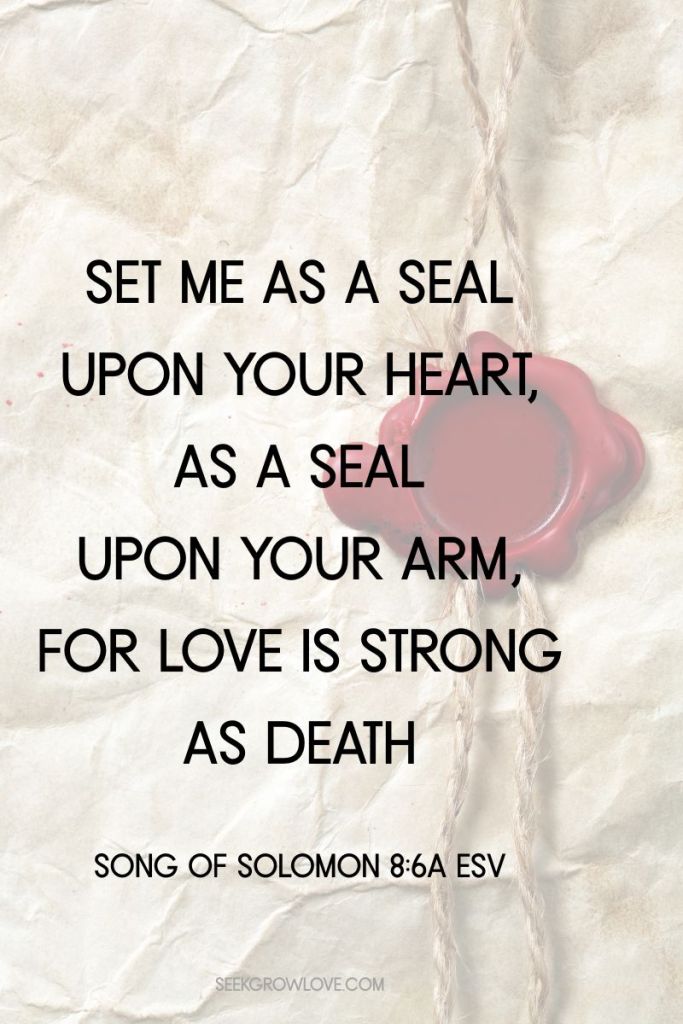
“Set me as a seal upon your heart, as a seal upon your arm: for love is strong as death.
Many waters cannot quench love, neither can the floods drown it.”
While grieving the loss of another child, Clausen turned to scripture and faith and found his inspiration in a book of love songs written for a husband and wife. But these love songs aren’t just for husband and wife. They are to mirror the love that God has for each of us, and the love we should have for him. These lines represent complete ownership and belonging. They represent a love that is to last forever, that cannot be removed or washed away.
God wants us to belong to him in such a way. He wants us to seek him first and always. And his love for us is also without end. How beautiful it is to know that a love this deep exists. When we are in our darkest hour, or in our greatest moment of joy, his love is the same. He is unwavering.
As you read through the last half of these songs today, I hope you see the beauty of God’s love for you and the relationship he longs to have with you, and also the relationship Christ has with the church. You are beautiful to him, and worthy of love. You are so worthy, in fact, that Christ died for you.
– Jenn Haynes
PS: If you would like to hear a lovely recording of Set Me As a Seal, this choir performs it beautifully:
I hope it helps you to reflect on his profound love for you
-Jenn Haynes
Reflection Questions:
Do you see yourself as beautiful and worthy of the love God has for you?
How do you think God sees you?
Take a quiet moment to reflect on the fact that God’s love for you is so deep and passionate that he desires your love above all else. The God of the universe wants a relationship with you that is deeper than any other relationship you’ve ever had. He sees you as valuable and lovely. Hold that close to you.
This collection of songs is something that, sadly, is frequently misunderstood and avoided today. At a wedding we celebrate love, yes, but certainly not like this. The beautiful imagery described in these chapters of love, desire and passion are everything we should want in a relationship with our spouse. Unfortunately, discussions of sexual desire and attraction like this are usually either twisted by an immoral society, or avoided by Christians. The world has thrown sex around until it’s dirty, misused, and undervalued. And Christian religion has gone in the complete opposite direction and has made it into something secret and almost shameful. We feel embarrassment.
But desire is not shameful at all when it is within its perfect time and place. Amidst all of this expression of love, there is one important phrase repeated again and again.
“Do not arouse or awaken love until it so desires.”
There is no rushing here. When we want to be in a relationship or long to fill our sexual desires more than we long for God’s good and perfect plan, this is when everything falls apart. The imagery stops being intimate and beautiful. It becomes cheap and our relationship is no longer the reflection of God’s love for us that it should be.
But when we acknowledge God first and seek him for our fulfillment, we restore the proper order of things. God created man and everything was good. Adam had God and relied on him completely. And in that complete reliance, God provided the perfect partner.
God knows our needs far better than we do, and that includes our need for relationships and intimacy. When we seek him first before seeking fulfillment in others, God will provide in his own perfect timing.
I hope you see the beauty reflected in these chapters! Love and desire within God’s plan is a treasure to be appreciated.
-Jenn Haynes
Reflection Questions:
For those who are unmarried: Do you find yourself growing impatient? Are you seeking fulfillment from people rather than God? How can you turn your focus more on your relationship with God and rely more fully on him?
For those who married: Maybe you’re a newlywed, or you’ve been married for years, or you’re widowed. Take some time to reflect on your love. Read through the descriptions and think about your own beloved. What do you appreciate about your spouse? How did God provide for you by bringing you together? How does your relationship reflect the relationship God desires to have with you?
My prayer for you today is that you see beauty in this passage. I pray you seek intimacy with God first, and that you rely on him fully. And for those who are/were married, I pray you are able to reflect and appreciate all of the wonderful qualities of your spouse.
As I was reading through today’s chapter in Proverbs I felt pulled in several directions. There’s so much really good stuff in this one chapter and I had a hard time choosing which of the many wonderfully wise sayings I wanted to talk about.
Verse one was tempting: “Whoever isolates himself seeks his own desire; he breaks out against all sound judgment.” We could think about the wisdom in having connection to a community of wise and trusted others to help us navigate challenges and get their feedback on important decisions.
Verse eight was also tempting: “The words of a whisperer are like delicious morsels; they go down into the inner parts of the body.” We could spend some time with that thinking about the effects of gossip and slanderous speech and how much time people invest in reading or sharing gossip about others. In fact, this chapter has a lot of little Proverbs that have to do with our speech. Those who want to live a flourishing life should pay careful attention to what comes out of their mouths.
I finally settled on verse twenty-two: ”He who finds a wife finds a good thing and obtains favor from the Lord.” I cannot resist taking the opportunity to think with you about how important this is. Dr. Dustin Smith recently published an excellent book Wisdom Christology in the Gospel of John. In his book he spends time looking at the book of Proverbs and how it lauds “lady wisdom” as being a very important part of God’s creation. He shows how the book of Proverbs refers to this lady wisdom throughout and builds to a climax in the final chapter with a description of an exemplary wife as the embodiment of wisdom. (You should check the book out, It is available on Amazon in both print and Kindle).
Throughout Proverbs there is a close connection between wisdom and a “good wife”. King Solomon who wrote or assembled much of the material in Proverbs certainly had a somewhat complicated life in relation to women or wives. His own mother, Bathsheba, became his father David’s wife in a very ungodly way. His father committed adultery with her and then had her husband killed in battle to try to cover it up. Talk about family skeletons. Solomon himself took the trapping of being a king way too far and had a whole harem of wives and concubines. As wise as he eventually was, it was a challenge to live out the truth. Perhaps Solomon came to the wise insight of this problem as he reflected on the challenges and costs of having multiple wives and a stable of sexual partners. This might appear to be the perfect life (think Hugh Heffner, the founder of Playboy magazine, constantly surrounded by beautiful young women- isn’t that the fulfillment of every young man’s fantasies?
Yet, at some point in his life, Solomon finally comes to the wise realization that having a large number of sexual partners is in fact, not very satisfying, not very wise and in fact is not the path to a flourishing life. Solomon comes to realize that true joy, true flourishing comes in finding “a wife”, one, singular woman with whom to enter into a lifetime covenant. This was God’s design from the beginning of creation. God created Adam from the earth, but recognized that Adam would not flourish in isolation. He needed a companion, someone alongside him to share his life. So God created Eve and told them to work together to bring flourishing to the earth. This was God design for flourishing.
Solomon came to wisely recognize the truth that having a wife, not 700 wives and 300 girlfriends, is the truly good thing and is a true gift from God and a sign of God’s gracious favor. It is too bad that Solomon did not learn this lesson earlier, as the Bible says his multiple wives turned his heart away from God. But at least in his honest and reflective moment he could come to terms with his own mistakes and sins and see where the truth really is in God’s design. And that is true for all of us. Wisdom is not poured into our brains, it comes by experience and we make many mistakes on the way to wisdom.
As I write this devotion I am getting ready to go on a special trip with my wife. This year we are celebrating 40 years of marriage so we are going to a beautiful place far away to celebrate our life together. During that 40 years we have been blessed with eleven children and fifteen, soon to be sixteen grandchildren. Our marriage has not been perfect. I did plenty of really stupid stuff when I was younger. (And, to be honest, I still do stupid stuff sometimes.) My Karen has been by my side throughout. She loves me, she bore, nursed, fed and clothed and cared for my eleven children. She accompanied me to each place I did ministry, packing up everything and organizing massive relocation projects. She has helped me navigate challenges in my ministry, my spiritual growth, my ongoing education and my ongoing health challenges. I can honestly say that she has made me a better person. Apart from my decision to accept Jesus Christ as my savior and follow him, my decision to marry Karen is the wisest thing I have ever done. She is a daily reminder to me that Solomon’s wise words are 100% true, ”He who finds a wife finds a good thing and obtains favor from the Lord.”
When I was young, I didn’t understand the wisdom of these words. Even when I was newly married I failed to appreciate just how true these words are. I am speaking this from the perspective of a man married to a woman. A woman’s view of her husband may be different in some respects, but I would say that there is much you can apply in your life as well. The importance is taking the time to truly appreciate the value that your spouse brings to your life and if you are unmarried, consider how truly important the decision on who you will marry is, and when married, the importance of gratitude for the one God has provided for you. They are not perfect just as you are not perfect, but they are a gift from God and a part of a flourishing life so appreciate them, value them, cherish them.
~ Jeff Fletcher
QUESTIONS:
In modern culture, we often use the term life partner when talking about spouses. Why is it so important to ‘partner’ with someone who has the same values as you?
A spouse always influences you. What are traits of a spouse that would influence you to live a godly life?
If you are already married, how can you show love and appreciation for your spouse? How can you influence each other to live a godly life?
The Pharisees ask Jesus about divorce to test him. Rather than just answer their question, Jesus directs them to God’s original design for marriage…vs 6- 9 “But from the beginning of creation, ‘God made them male and female.’ ‘Therefore a man shall leave his father and mother and hold fast to his wife, and the two shall become one flesh.’ So they are no longer two but one flesh. What therefore God has joined together, let not man separate.” There are several days’ worth of material in just that short passage.
Today, however, I want to focus on the phrase “God made them male and female”. This is a quote from Genesis 1:27, “So God created man in his own image, in the image of God he created him; male and female he created them.” Psalm 139:13-16 says of God, “For you formed my inward parts; you knitted me together in my mother’s womb….My frame was not hidden from you, when I was being made in secret, intricately woven in the depths …”. Malachi 3:6a tells us, “For I the Lord do not change…”
When you put these thoughts together, you can see that God designed each one of us. Individually, specifically, intentionally, purposefully. He chose YOUR personality, eye color, height, if you like spicy foods or not, how you will process good and bad news, what will motivate you, and what sex/gender you are. We can color our hair or learn to like certain foods, but we cannot change what we are at the core of who God made us to be. HE CHOSE your gender. HE CHOSE your gender because HE WANTED YOU.
How we bring glory to God is to be the best version we can of who He made us to be. There are lots of gray areas up for interpretation in the Bible. However, God is very black and white on the issue of gender. He created them male and female. That’s it. No other options.
Since that was so short, I feel like I have space to tackle one more piece from today’s reading. Let’s look at God’s view of marriage and sex (another area where God is very black and white in His design). In Mark 10 we read, ”…and the two shall become one flesh. So they are no longer two but one flesh. What therefore God has joined together, let not man separate.” God’s plan and desire for marriage is that one man and one woman get married and stay married until death separates them (yes, there are a few specific exceptions to this, and I’m not digging into that here, but please talk to your pastor or an elder or trusted godly person if you have questions on this.). God’s plan for sex is that it is a wonderful gift for pleasure and for procreation, only to be experienced within the boundaries of marriage as stated above.
The world today says that anything goes. The Bible says differently. It matters to God what we do with our bodies. If you have already stepped outside of the boundaries that God has set for His children, know that He will forgive you and that He will remove your sin from you as far as the east is from the west (Psalm 103:12). You need only ask Him. I know because I was there. He will not only forgive you, but help you to forgive yourself, too.
I will leave you with 1 Corinthians 6:18-20. “Flee from sexual immorality. Every other sin a person commits is outside the body, but the sexually immoral person sins against his own body. Or do you not know that your body is a temple of the Holy Spirit within you, whom you have from God? You are not your own, for you were bought with a price. So glorify God in your body.”
Amy Blanchard
Reflection Questions
Your body becomes a temple of the Holy Spirit when you choose to follow God’s plan for salvation. In short, it is belief, repentance, baptism. If you have not made that commitment, please consider speaking to someone who can help guide you there. Are you treating your body as God’s temple? If not, why not?
Repentance is an acknowledgement that what we did was wrong and a turning away from that action, attitude, inaction, etc. Since we all sin, we all need to repent. Is there anything in your life that you need to repent of today?
It is a struggle to go against what the world is telling you is good. God expects us to stand firm in our knowledge of His design. What else did these passages reveal to you about God’s character?
Are you in for a special treat today! Not just because we are discussing Song of Songs (otherwise known as Song of Songs), but also because I looked into the SeekGrowLove archives and found not one, not two, but three great devotions on Song of Solomon (and then I stopped looking). So, today is a bit of a compilation with pieces from three previous devotions. The full devotions are linked below and are all worthy of a read/re-read.
From Rick McClain:
“The visuals painted in these chapters about a bride and groom are very sexual in nature, but is that what this book is about? Some say it is an allegory of Jesus and his bride, the church. I doubt this is true because Jesus wasn’t even around in the Old Testament when this was written. I don’t think the concept of the church being the bride of Jesus was known back then so why would someone write an allegory about that? It is also believed by some that it could be an allegory about God and the people of Israel. There are no doubt similarities between the relationship of a bride and groom and the relationship between God and His people, but why would someone use such erotic sexual material to describe how God thinks about Israel and vice versa?
I believe it is love poetry and I am thrilled that the Bible has affirmed that the sexual desire I have for my wife is a good thing. I know that will make some of you squirm a bit because we don’t usually talk about this stuff, especially in church. However, I think one of the main points of this book is to show that the physical attraction between a bride and groom is a beautiful thing that God has created for them to enjoy.”
“But back to the song of all songs. I am not going to go in great detail here about this book because you should read it for yourself. I couldn’t stop thinking about how much in love these two seemed to be. It reminded me of when you see two young people in love, and their love is just oozing all over each other so much so that they don’t even notice anyone else is around. They can’t stop smiling at each other and they are on cloud nine. We usually roll our eyes at them and think they are being ridiculous, but this is exactly the kind of love that was on display in these eight chapters. Solomon gushed about her eyes, hair, neck, lips, and body parts that reminded him of fawns, but it didn’t stop there. I knew this was a story about real, intense, true love when he mentioned her teeth. He didn’t just say she had beautiful teeth, he said her teeth were like a flock of newly shorn ewes. Don’t picture dirty ewes that have been rolling around in the dirt, Solomon said the ewes had just come up from their washing. Moreover, all these ewes bore twins, and not one of them had lost their young. He said all of that about her teeth!?!? That dude was crazy in love! And she was just as ridiculous as him, which can be seen when she says her beloved is like a cluster of henna blossoms from the vineyards of Engedi.”
From Steve Mattison:
SoS 2:2 says, “Like a lily among thorns is my darling among the maidens.” Husbands and future husbands take note. Highlight what you appreciate about your wife, and make sure she knows it well and often. But the praise must be sincere. And if it’s appropriate and if she would appreciate it, make sure you extend this praise publicly. But don’t just stop with praise. Treat her like she is precious because she is.
SoS 2:4 contains part of the wife’s response, “His banner over me is love.” All by itself, this sounds pretty weird. I think this is saying that her husband is publicly proclaiming his love for her – sort of like writing it on a flag, and waving it around for everyone to see. He is not ashamed to acknowledge her publicly. Again, husbands take note.
In SoS 2:6, the wife goes on to say, “His left arm is under my head, and his right arm embraces me.” I’ll leave it to your imagination to consider their position and presumed activity. Husband’s again take note. If you shower your wife with love. If you make her a priority, and she knows it. If she knows you’re never ashamed of having her at your side. Things will go a lot better with your love life.
She goes on to say in SoS 2:7, “Do not arouse or awaken love until it so desires.” I would say that differently. I would say “save sex for marriage” – and then, it is a wonderful blessing from God for both husband and wife to enjoy to the fullest together.
In his reply, in SoS 2:15, the husband says, “Catch for us the foxes, the little foxes that ruin the vineyards, our vineyards that are in bloom”. I think the idea here is that there are always little things that can attack the relationship, and these things need to be caught and stopped. Some examples may include selfishness, pride, never admitting that you are wrong, finding fault, unforgiveness, mistrust, etc. All of these have to be dealt with and removed in order for the love to blossom and flourish.
And you have to love that part in verse 17 where she says, “until the day breaks and the shadows flee…”. It sounds like she is talking about being intimate all night long. So, husbands, if you want verse 17, you have to have to practice verses 2 and 4 and 7 and 15. In other words, if you want a great sex life in your marriage, adore your wife. Let that show in everything you do and in every way you treat her, and you will see results.
Oh yeah, and do the same with your relationship with God, and you’ll see great results there too – both now and forever.”
From Maria Knowlton:
“So how do you use SOS to make a difference in your life? How do you make this a part of your devotion? A friend of mine told me that her pastor recently preached a sermon on it and encouraged husbands to tell their wives they are beautiful. So there you go husbands! God wants you to complement your wives! Use lots of flowery words! (Check out youtube for examples on how to use King Solomon’s words to make your woman swoon!) Ok, that was a little facetious. Seriously, most woman do want to know her man desires her (but maybe not in the words of chapter 4) and God has provided an example of this along with His blessings. My friend thought of another take on SOS. She thought that since her husband was being encouraged to tell her she’s beautiful, she should make more of an effort to be beautiful. She looked at verse 1:6 when the Shulammite woman tries to hide from Solomon. So my friend decided that in addition to not wearing sweats all day, she would close the door while using the powder room and not burp or otherwise display gross behaviors in front of her husband. We all laughed when she told us that he didn’t notice but her point was that we shouldn’t take our husbands for granted and we should make an effort to be beautiful for our husbands. We also need to keep in mind verse 2:15, “ Catch for us the foxes, the little foxes that ruin the vineyards, our vineyards that are in bloom. The chorus talking here, saying not to allow anything to spoil the man and woman’s relationship. Good advice for all of us in any relationship. The world may have cheapened the physical relationship between a man and a woman, likening it to something as casual as a game of ping pong. SOS reminds us that it is truly a wedding gift from God that is to be treasured, embraced, and protected. So if you are married, read today’s reading with your spouse and have a great night! ; )”
God made sex. And He made it good. To be enjoyed by one man and one woman who are married – meaning they have committed their lives to one another til death do them part. There are a lot of verses in Song of Solomon that have never been made into refrigerator magnets or wedding invitations – but I do love 2:16a “My beloved is mine and I am his.” Such a beautiful declaration of a deep, mutual devotion to the love of your life. It is indeed perfect for a wedding invitation! But, how many couples can say the same thing 10, 20, 30, 50 or more years down the road. How do we keep the love from growing cold – which will happen when the fire isn’t tended? Marriage is complex and there is no one easy answer – but Song of Songs does have some useful tips for fanning that flame with your spouse.
If you aren’t married yet – what is the greatest take-away you found in Song of Solomon?
If you are married – what is the greatest take-away you found in Song of Solomon?
Why do you think God included Song of Solomon in the Bible?
Hebrews Introduction
The title of the book of Hebrews suggests it was written to Jewish Christians. We don’t know who wrote the book. Although some suggest the author may have been Paul, Hebrews 2:3 almost certainly refutes this. Whoever it was knew their Old Testament very well, and wrote persuasive arguments showing that Jesus is greater than everyone and everything in the Old Testament, including angels, priests, the law, Moses, sacrifices, etc.
The book of Hebrews points out that the law was only a shadow of the good things that are coming (Hebrews 10:1). Colossians 2:16-17 goes on to say that the reality is found in Christ. And Jesus became the ultimate high priest, who offered himself as the ultimate sacrifice once and for all.
The two main points of Hebrews are to encourage Christians to endure, and to warn Christians to remain faithful in following Christ.
Hebrews 11, the faith chapter, is probably the best well-known chapter in Hebrews. One of the most well-known verses is 11:4, “And without faith, it is impossible to please God, because anyone who comes to him must believe that he exists and that he rewards those who earnestly seek him.”
Paul wrote the book of Ephesians to the saints in Ephesus while he was in jail in Rome.
In chapter one, Paul pointed out that it was God’s will “to bring all things in heaven and on earth together under one head, even Christ.”
Chapter two starts out by reminding us that we were dead in our transgressions and sins, gratifying the cravings of our sinful nature and following its desires and thoughts. But because of God’s great love for us, God made us alive with Christ by grace. Paul then shared Ephesians 2:8-10, “For it is by grace you have been saved, through faith – and this not from yourselves, it is the gift of God – not by works, so that no one can boast. For we are God’s workmanship, created in Christ Jesus to do good works.”
Paul then pointed out that Gentiles had originally been excluded from citizenship in Israel – without access to Israel’s covenants and promises – without hope. But Jesus’s sacrifice abolished the law with its commandments and regulations, and reconciled not only Jews and Gentiles but also gave Jews and Gentiles peace with God.
Paul shared in 3:16-19, “I pray that out of his glorious riches, he may strengthen you with power through his Spirit in your inner being, so that Christ may dwell in your hearts through faith. And I pray that you, being rooted and established in love, may have power together with all the saints, to grasp how wide and long and high and deep is the love of Christ, and to know this love that surpasses knowledge – that you may be filled to the measure of all the fulness of God.”
I love how Paul squashed “spiritual elitism” in 4:4-6, when he said, “There is one body and one Spirit – just as you were called to one hope when you were called – one Lord, one faith, one baptism; one God and Father of all, who is over all and through all and in all.”
Paul then went on to say that as Christians, we must live as new people, “Do not let any unwholesome talk come out of your mouths, but only what is helpful for building others up according to their needs, that it may benefit those who listen. … Get rid of all bitterness, rage and anger, brawling, and slander, along with every form of malice. Be kind and compassionate to one another, forgiving each other, just as in Christ God has forgiven you.”
And if this wasn’t hard enough, Paul went on to say, “Be imitators of God, therefore, as dearly loved children and live a life of love, just as Christ loved us and gave himself for us.”
In Ephesians 5, Paul showed that the marriage relationship is a beautiful reflection of the relationship between Christ and the church. The husband is supposed to be the head of the wife, as Christ is the head of the church. And the husband should love his wife, and sacrifice himself for his wife – as Christ sacrificed himself for the church. In turn, the wife should submit to her husband – just like the church submits to Christ. (I am absolutely convinced that this is the only pattern to follow in order to be happily married.)
Paul closed the book of Ephesians with the warning that we’re in a battle against spiritual forces – so we need to put on the whole armor of God and stand firm.
In closing, I’d like to echo Paul’s words from Ephesians 1:17, “I keep asking that the God of our Lord Jesus Christ, the glorious Father, may give you the Spirit of wisdom and revelation, so that you may know him better.”
Proverbs 7 is a warning to young men and women about the dangers of sexual desires when they are not pursued properly within God’s intended design, which is within the covenant of marriage. It is written from the viewpoint of a father warning his son about not being enticed by women and drawn away after them. There is an assumption in the text that the young man is marriage, and the warning is about being lured into an adulterous affair with a woman who is not his wife, referred to as the “strange” or “foreign” woman because she is “strange” or “foreign” to his covenant of marriage—she is an outsider.
While this extended speech in Proverbs 7 is aimed at marriage faithfulness and loyalty, its application extends beyond that. Faithfulness and loyalty are not necessary in just a marriage relationship, they are necessary in any relationship, whether it is a family relationship, friendship, or even professional relationship. Anyone will quickly come to learn the importance of faithfulness and loyalty if they betray a relationship and break that bond of trust and commitment. In a family, privileges might be taken away from you. In a friendship, the other person may not confide in you any longer. In a professional relationship, you might lose responsibility, or worse, lose your job entirely.
In Proverbs 7:1-4, the father is telling his son to hold on to his teaching and instruction. The metaphor that he uses is to “bind” them on your fingers,” and “write them on the tablet of your heart.” Furthermore, the son is to treat Wisdom as like a sibling—someone who is part of your family. The purpose for this figurative language is to reinforce the attitude that the son is supposed to have toward Wisdom and living with the fear of Yahweh. Not only that, but the admonition of the father is to also build desire for Wisdom. And the explicit purpose is “in order to keep you from the strange woman, from the foreign woman who flatters with her words” (v. 5).
I think that having a heart that desires Wisdom is vitally important for young people to develop. The world is filled with foolishness, especially in regard to sexuality. It implicitly condones a “do whatever feels good” mindset that is completely opposed to God’s intended way for humans to view sex and to enjoy it. But if a young person doesn’t listen to Wisdom, but follows the ways of the world and allows themselves to be enticed and led astray into sexual passions, they will inevitably suffer and learn the hard way that the world’s way of living is not what produces healthy, loving relationships that lead to the life-long commitment of marriage where sex is intended to be fully explored and enjoyed as God designed for it to be.
-Jerry Wierwille
Reflection Questions
What dangers are warned of in Proverbs 7?
What are some examples of worldly foolishness in the area of sexuality? Why are these problems?
How can you increase your faithfulness and loyalty?
These are the words of Johnny Cash in his iconic song, Ring of Fire, that hold true for many, as many people have a desire for some form of romantic love that can lead to sexual intimacy. Our society has a pretty wide range of views on what practices are acceptable or not to fulfill that desire for sexual intimacy. Paul states that, “It is because of the temptation to sexual immorality that a man should have his own wife, and each woman her own husband,” (1 Corinthians 7:2 ESV). Marriage is the solution to the desire of sexual intimacy in Paul’s eyes.
Throughout scripture, it is a very constant concept that sexual intimacy is to be experienced between a husband and wife – nothing more, nothing less. Paul urges married couples not to deprive each other, so that our lack of self-control doesn’t lead to sexual immorality. I encourage both husbands and wives to fulfill their spouses’ sexual desires to help steer them clear of sexual immorality. If you need some extra inspiration and motivation, you can read through Song of Solomon.
For those who are not married but burn with passion, I pray that you are able to exhibit self-control. Remember the words of Paul in the previous chapter as well: “Flee from sexual immorality,” (1 Corinthians 6:18). Paul does not encourage you to stand firm in the fight against the temptation to sexual immorality. Rather, Paul encourages you to FLEE! Be aware of your triggers and run away from them!
For those who are not married and aren’t “bound by wild desire”, I encourage you with the words of Paul: “To the unmarried and the widows I say that it is good for them to remain single as I am,” (1 Corinthians 7:8 ESV). The unmarried person does not need to fret about how to please their spouse. They can spend all of this attention that many spend on pleasing their spouses, and the unmarried can devote it all to God. What a blessing!
Whatever camp you find yourself in, whether you are married, single with passion, or single with no passion, I hope you are able to dig nuggets of invaluable information from this chapter about marriage. When in doubt, you can turn to 1 Corinthians 7 for questions about biblical principles regarding marriage and the absence of marriage.
-Kyle McClain
Reflection Questions
What is your current situation? What can you do now to make the most of your situation? How will you strive to please God in your situation?
Married or unmarried, how can you flee from sexual immorality?
What do we learn about God in our Bible reading today?
Gender is a hot topic these days. We live in a society where there is much flexibility in how someone chooses to live their life, irrespective of cultural norms or the directives of our creator (let’s stick to what Peter writes about in his letter). Misogyny and radical feminism are two ways in which humans have messed up what was designed to be a tremendous blessing from God.
There is a lot to unpack here as Peter begins by addressing wives. In reading the text and then looking at commentaries it appears that foremost in Peter’s mind is a woman who has come to a saving faith in Jesus but is married to a man who does not share that faith (though we can gain something from this even if we’re not in that demographic).
The way that societies functioned, specifically the society that Peter would be writing to, did not offer much in the way of opportunity for a woman to exert influence over her husband. Her options may be quite limited in what her husband allowed her to do or permitted her to go. Where a husband and father who came to faith would be expected (even simply allowed) to bring his family along with him to religious functions, the same could not be said for the wife.
So how is a woman to minister to her unbelieving husband? How does she influence him intentionally in a way to bring him into the body of Christ? Nagging is probably not the most effective way to do this, in fact it might have the opposite effect; rather, the solution that Peter proposes is to allow the gospel of Jesus (i.e., the gospel of the Kingdom) to radically influence your way of living. Being salt and light (Matthew 5:13-14) is not just something that you are to be for people whom you may be unfamiliar with, even more importantly it is something you are to be with those who you are most intimate with. Living a life that bears the fruit of the spirit (Galatians 5:22) and exemplifies Jesus’ beatitudes (Matthew 5:3-11; Luke 6:20-26) will make you a more desirable (and influential) person.
Obviously, there is no way to guarantee that an unbelieving spouse will come to faith, but by being holistically attractive (not just externally, but internally as well) you will have a far better chance to influence them than if you were to try to get by on physical attraction (I don’t even know how that would really work) but be ugly on the inside.
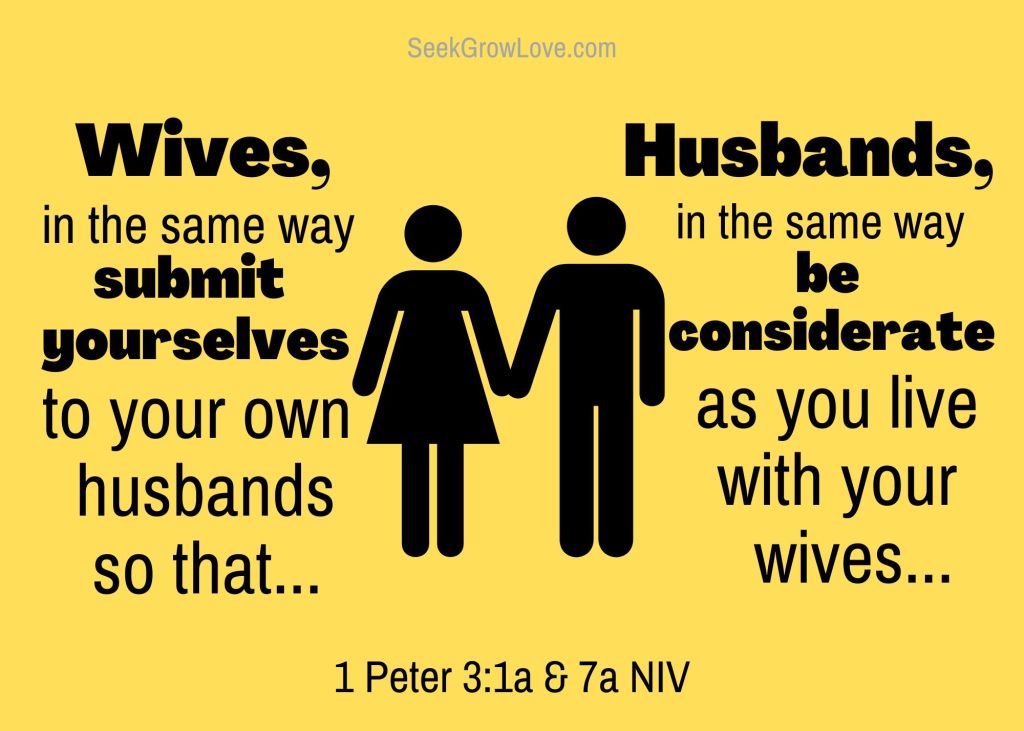
Peter addresses the ladies in verses 1-6, but he shifts gears in verse 7 and speaks to husbands. He says to “live with your wives in an understanding way” (ESV), literally living with her “according to knowledge” as opposed to living with her in “sheer thoughtlessness” as the Expositor’s Bible Commentary puts it. I can speak from experience, it is very easy to do what I want and expect my wife to pick up the slack, but that is not the way that Peter instructs husbands to operate. Instead of living in a way that could breed resentment and other problems (infidelity?), husbands are commanded to live in a thoughtful way.
Husbands are instructed to honor their wives as “the weaker vessel.” Huh? What does that mean? There are different ways to look at this… Societally women were weaker (we’ve already considered the lack of influence), typically women are weaker in physical strength (I can think of a few ladies that could probably wipe the floor with their husbands in a fight), and sometimes women are more emotionally fragile (have a wider range of feelings?) than men. The word for weaker (ἀσθενεστέρῳ) can be translated with lots of nuance, but one big take away from this is that women are not inferior to men. Whatever Peter is getting at with the idea of the wife being a weaker vessel, something is very clear: we are co-heirs of all the benefits that come with accepting Jesus and believing in the kingdom message. As objects of God’s salvation there is no distinction between male and female, just as there is no distinction between Jew or Greek. While husbands and wives may be called to different roles in their relationship and even in their roles in the church, this is not because of a lack of capability, this is the function that God has laid out. Husbands and wives are to minister to one another and to minister to others. We can use our marriages as an example and an opportunity in ministry. Authentic Christianity has done more to liberate women from misogyny and oppression than any other organization ever has; that being said, it has not changed the fact that men and women are different. We have equality in standing before God, we have equality in salvation, we ought to have equality in rights, but we are still different and that is a blessing. As the church is a body with many parts, the one flesh that we become in marriage takes into account our uniqueness as individuals and the differences in our physiology. We are to be reliant on one another (do not read as co-dependency), and we are responsible to one another to meet the needs that we have as image bearers of God and the uniqueness that we have as men and women.
-J.J. Fletcher
Action/Reflection:
To those of us who are married: We should evaluate where we are at in living as Peter instructs. Hopefully you are married to a fellow believer who you can discuss this passage with and commit to one another to implement these tactics in your union. If married to a non-believer, behave in a way that is intentional in living the gospel out to them.
To those of you who are engaged or hope to be married one day: Look for a spouse who takes scripture seriously and is willing to change their behavior to conform to what scripture dictates, both in their life as an individual and the way that they approach relationships.
For those of you who are called to a life of singleness (or just end up that way) or those of you who know someone who fits that description: I believe that the behaviors that the relational and internal things that Peter speaks of here will be beneficial in building authentic relationships that help navigate the potential challenges that a life of singleness may bring.
Yesterday, we discussed how we are called to recognize that what we want may not be what God has in store for us. It is up to us to give up our false understanding and lean on the trust we have in God. Today’s passage drums a similar beat. It contains examples of Jesus fulfilling the old law, God’s desires for us, those who will receive this message, and what can happen if we but give ourselves over to Him.
Chapter 10 begins with some Pharisees approaching Jesus on the law concerning Moses. I believe this was yet another one of their attempts to trick Jesus into going against the law of Moses, and thus giving them a reason to condemn Him. He responds by telling them that “it was because your hearts were hard that Moses wrote you this law” – Mark 10:5 (the law that a man is permitted to write a certificate of divorce if he so wishes.) He then continues with, “But at the beginning of creation God made them male and female. For this reason, a man will leave his father and mother and be united to his wife, and the two will become one flesh. So, they are no longer two, but one. Therefore, what God has joined together, let man not separate.” – Mark 10:6-9. I especially love the verbiage of not letting man separate what God has joined, because God’s way is ultimately the only way that matters, and his say is the final word.
Adding to what God has set forth, Jesus rebukes the disciples for hindering children from hearing what Jesus had to say and His blessing. (Side note: this chapter is full of teachings concerning children, which is quite important.) In Mark 10:14-15 Jesus says “… Let the little children come to me, and do not hinder them, for the kingdom of God belongs to such as these. I tell you the truth, anyone who will not receive the kingdom of God like a little child will never enter it.” Not only has God set forth that the kingdom of God belongs to the little children, but also that it is the ultimate end-goal for every person to reach. It is not, of course, only for the children, but it is a metaphor for the childlike innocence and earnestness of the heart that we should have in our attempt to reach salvation. Not out of spite or a fake face that we put on to appear like we love God.
The second part of this passage ties in well with yesterday’s takeaway; our call to give up from ourselves so that we may gain so much more in return. A beautiful verse expressing this idea is Mark 10:29-31 where Jesus says, “I tell you the truth, no one who has left home or brothers or sisters or mother or father or children or fields for me and the gospel will fail to receive a hundred times as much in this present age (homes, brothers, sisters, mothers, children and fields—and with them, persecutions) and in the age to come, eternal life. But many who are first will be last, and the last first.” That, my brothers and sisters, is a very difficult task to complete. Would you be able to give up everything in your life for your faith?
Fortunately, it is not without reward, for as much as we give, we will be rewarded 10 times 10 fold over! Perhaps the best way to think of it is that no riches we gain on earth matter in the end, because an eternal life with God is unfathomably more valuable than anything in this life. We must, however, do these things with an earnest heart and not from a realm of bitterness. What’s more is that this principle is not given without an example – Jesus’s sacrifice.
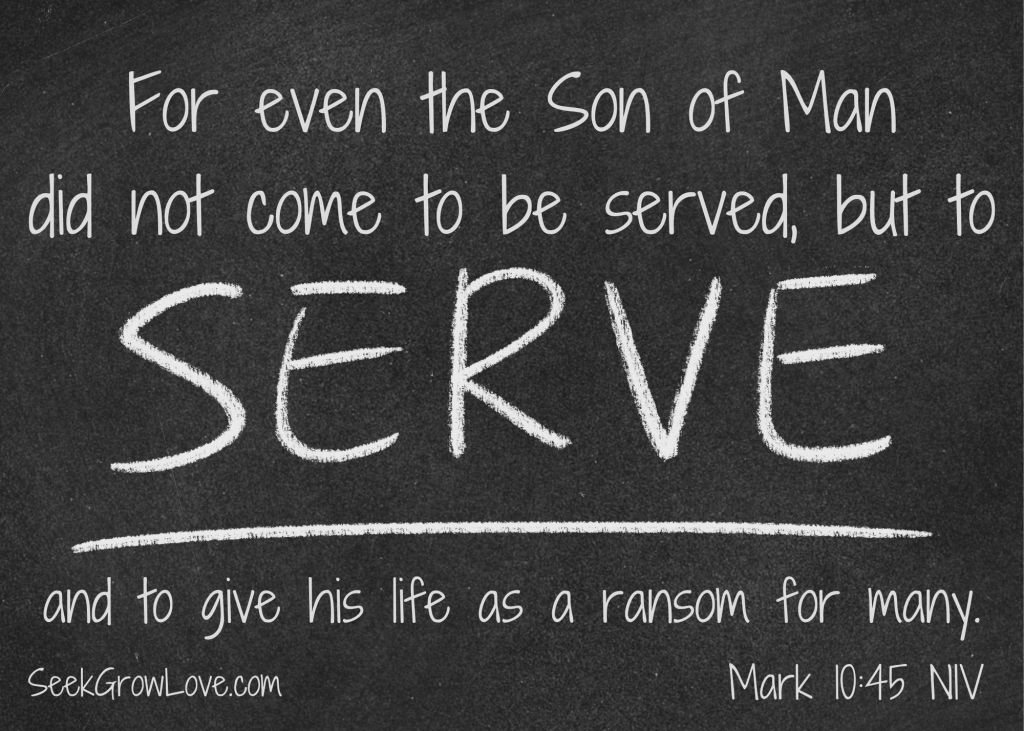
Mark 10:45 says, “For even the Son of Man did not come to be served, but to serve, and to give his life as a ransom for many.” Even Christ, the most holy of any human to walk this earth, gave of Himself for the sanctity and salvation of others.
The first step towards an eternal life is to trust that God is in control even in the most unsettling or confusing of times. The next step is to then give everything you have to Him, and to be prepared to do so for His glory every day.
-Mason Kiel
Application Questions
Jesus gave many lessons in Mark 10. Looking through the chapter, which one is the biggest challenge for you right now? Why is it difficult? What do you think Jesus would say to you regarding this challenge? What steps would Jesus have you work on to grow closer to what God wants you to be/do.
How does remembering the reward help when it is hard to surrender, sacrifice and serve?







 Seek Grow Love