First of all, let me say CONGRATULATIONS on finishing what many consider to be the hardest book in the Bible to get through due to its “repetitive rules and low relatability.” One online reader even called it, “Where Bible reading plans go to die.” (guilty!)
And I’m not going to lie. I feel like reading chapter 27 is basically reading a page out of a law book at the law offices of Dewey, Cheatum, & Howe.
The first part is a little confusing… why are they paying money for people?? They weren’t. Basically, people could dedicate themselves, their children, animals, or properties to the Lord at anytime, but if they need any of the above back, they could buy them back at the values the Lord set in this chapter. (Certainly, this was a lot clearer to the people of the time than it is to me!) The rest of the chapter is similar information that does seem repetitive and irrelevant.
So I’m sure you’re thinking, “Well, Miss Negative Nellie, why did I just bother reading this whole book?!”
We are told our whole Christian lives how Christ died to set us free from the law ( Acts 13:38-39, Romans 6:14, 7:6, 8:2, Galatians 3:25, 5:1). But do we stop and think how deep and broad the Mosaic Law was? Not easy stuff to get through, let alone emulate with your life. Reading Leviticus brings us, not only to the reality that living by works alone is nearly impossible, but also to how truly, throughly, and deeply holy is our God. I hope that reading Leviticus has done this for you.
The poetry of Psalm 14 and the prose of Matthew 27 are easier to understand if not exactly pleasant to read. Can you imagine reading the Resurrection story for the first time and stopping at the end of 27?! What a sad cliffhanger! But like reading Leviticus, you can’t understand the point of the really good stuff until understanding the tragic background. Without understanding the NEED for a savior, from the stringent laws that a Holy God commands, to the awful details of Judas’s betrayal, we will miss the complete picture of Jesus’s sacrifice for us.
So, GREAT JOB with your reading! You’ve got this! Let’s Go!! Even through the rough parts, time spent in scripture is never wasted!
Reflection Questions:
What does it mean to have a holy God?
What was the purpose of Leviticus? What is the purpose of Matthew 27?
What is the hardest part of reading Matthew 27?
Prayer:
Dear Holy God, thank you for not giving up on us – Your creation that turned our backs on You and repeatedly broke Your law. Help us see our sin for what it is and the distance that it puts between us and You. Thank You for Matthew 27. Help us see the depth of Your great love for us and the loving obedience of Your precious Son. Help me have the mind of Christ which says and lives “Not my will, but Yours be done” – even when it hurts and is so hard. Help me see what You will and follow well, like Your Son who gave his life as the perfect sacrifice so I can pray to You today and be heard as Your child.
I hold it that a little rebellion now and then is a good thing, and as necessary in the political world as storms in the physical. -Thomas Jefferson
Jefferson wrote those words to James Madison in 1787 after a group of farmers physically fought their local government to protest high taxes. His argument was that rebellion is what keeps government accountable to the people it serves.
He may have had a point and many people have used this quote to justify many acts of rebellion. However, there is one area of our lives where rebellion leads to destruction.
In all three of our readings today, people participate in vile rebellion against God.
In Leviticus, God decrees what happens when actions meet consequences.
Praise God, follow His decrees, you will be richly blessed. Deny God, either by evil acts or general apathy, you will be cursed. It seems so odd that at time God spoke directly to His people, their society was set up to follow the decrees (at least physically) and the consequences immediate, that so many people so often turned from God.
But even centuries later, people were still rebelling in Psalm 14, denying His very existence. They were so rebellious, not only did they want to sin, they wanted to take down everyone with them. Hmmmm
In Matthew 27, we see the greatest rebellion of mankind. The denial of God (or at least His rule) and consequently His son, leads to the torture and death of our savior, Jesus.
Obviously, we know the outcome of that… but what has the outcome of that meant for you?
I wish I would have written it down.. but I saw a great quote that said something like, “ Don’t continue with the sin Jesus died to save you from.” When we sin, we are in rebellion against the God of the Universe. The One who made all and yet cares about the hairs on your head.
While Jefferson was talking about imperfect people rebelling against imperfect people to maintain justice, there is no need to rebel against the perfect One who cares for our every need. Allow the Lord to be your refuge in this world of rebellion.
Reflection Questions
What do we learn about God in our readings today?
Where have you seen rebellion against God today?
How have you personally rebelled against God? Why? Have you experienced consequences from that rebellion? What would you tell others about your experience?
Prayer
Dear God – We praise You and thank You for being a just and true God of love and mercy who gave Your own Son for sinful, rebellious mankind, which includes me. I confess my times of rebellion. Help me see my own sins and rebellion and foolishness and turn from it. I seek You, Lord, and Your Way. Help me discern what is rebellion against You in the world today, and what leads to destruction. Help me speak for You, giving wisdom and warning from a heart of love for You and Your creation. Thank you for Your promises for those who follow You. May I be ready for Your Son’s return.
Yesterday’s devotion was written to those with a strong faith. Today’s devotion is written for everybody else. Perhaps, some of you are a bit wobbly in your faith and have drifted away from God. Some of you may not have decided yet to live for God instead of yourself. I suppose it is possible some of you have no interest in becoming a Christian, but I am guessing most of those folks wouldn’t be reading this. In Matthew 27, we read about the crucifixion of Jesus on the cross and the crazy events that happened right after he died.
Strangely enough, it was the religious leaders that schemed to find Jesus guilty so they could put him to death. It’s not easy finding someone guilty when they never have done anything wrong in their life, but they managed to concoct a way to make it happen. They believed in the Old Testament scriptures, but somehow ignored the many writings about a messiah that would be coming. They also saw miracles, or at the very least heard about them from many others. All the signs were there for them to easily accept the fact that Jesus was indeed God’s son, but they chose not to believe.
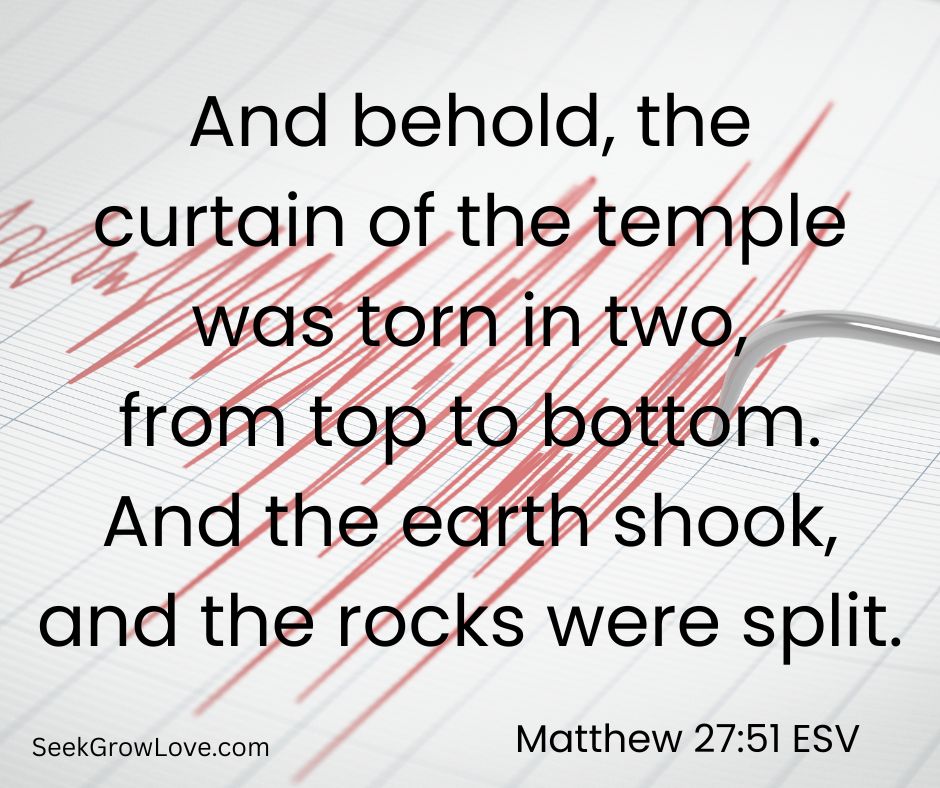
In verse 50, Jesus cried out and then died. At that moment, the curtain of the temple was torn in two, the earth shook, rocks split, and the tombs broke open. Here is the craziest part of all: bodies of holy people who had died were raised to life and started walking around town where many people saw them. Can you imagine what that scene must have been like? I’m sure there were people flipping out all over the place, including those who had put Jesus to death. In verse 54, the centurion and those with him who were guarding Jesus saw the earthquake and all that had happened. It says they were terrified and exclaimed, “Surely he was the Son of God!” Oops. Just minutes after they had crucified Jesus, they realized they had made a big mistake, but there was no going back at that point. There was no do-over; they were clearly warned, but they chose to not believe. I’m sure they felt terrible about their decision.
So, what does any of this have to do with you? Well, you have a decision to make as well. You must decide if you are going to live for God or live for yourself. It’s a big decision so don’t take it lightly. You can choose to ignore the signs if you would like, the same way the religious leaders ignored the signs 2,000 years ago. Look at the incredible masterpiece called creation and try to justify that it happened completely randomly. Read the Bible and try to convince yourself that all the ways the Bible has been proven to be accurate are just a coincidence.
Maybe you actually do believe in God, but you are putting off the decision until later. Risky, risky. You may die today, losing your chance. Moreover, Jesus says he is going to come back like a thief in the night, meaning a lot of people are going to be surprised when that day happens. In fact, on that day, I think the most said word of that day will be ‘Oops’. A lot of people are going to regret they blew their chance. Don’t let that be you.
Reflection Questions:
If you are not saved, what is holding you back from making that decision?
If you find yourself on the outside looking in after Christ returns, what thoughts will be going through your head at that point?
Let’s face it. We’ve all done things we have felt guilt over. Accepting responsibility for our actions is one of the most difficult lessons to learn.
We see in this account of Jesus’ arrest and subsequent torture and death a few different takes on acknowledging wrong done and accepting, or denying, blame.
Judas’ guilt is overwhelming. So much so, that he no longer knows how he can go on living. We don’t know what Judas said to God in his final moments or whether he sought forgiveness. But rather than trying to find repentance in living a Godly life, he decides to take his own.
The Jewish leaders who paid Judas to betray his rabbi and Christ acknowledged that the money Judas returned to them was blood money. If that isn’t a confession of some form of guilt, I’m not sure what is. And yet they, too, choose not to repent. Instead they continue on with their mission.
Pilate, warned by his wife, knows that the man before him is not guilty of any crime worthy of death. He gives the people several outs, including offering over a known, terrible criminal. But rather than stand up to the crowd, he proclaims himself guiltless and allows them to take away to torture and kill a man he knows is innocent.
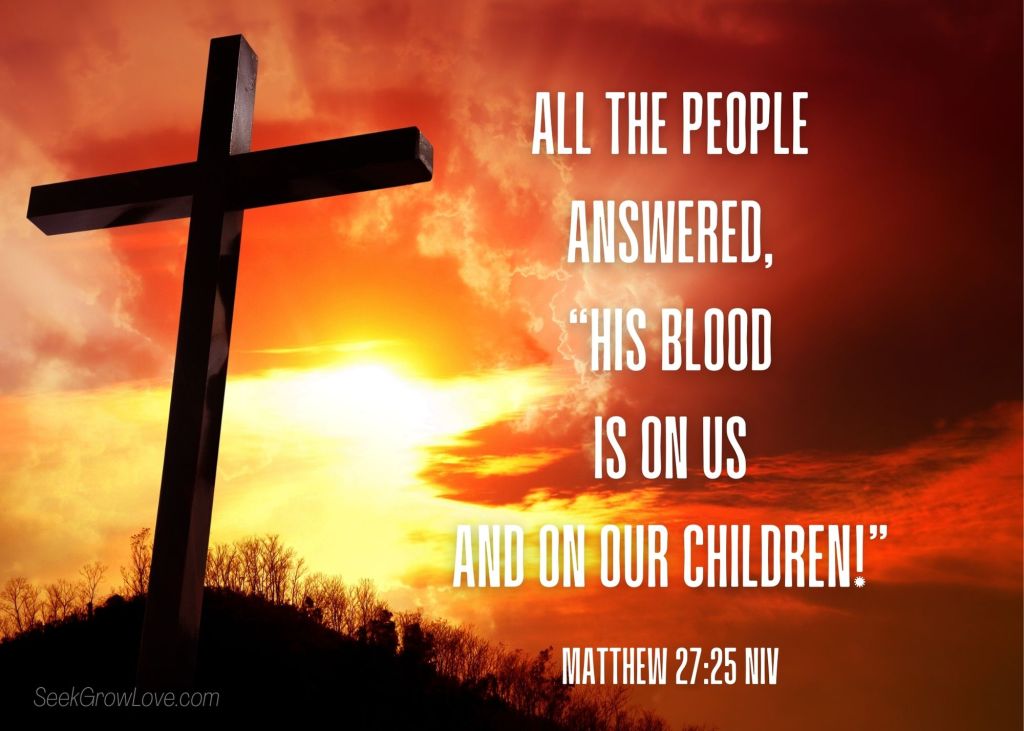
And the Jewish crowd. This one hurts me most of all, because in true mob mentality, they flippantly ignore their consciences, ignore God’s presence, and accept all guilt of Jesus’ death. And they do it without second thought, it seems. They accept the blame not only on themselves, but on their children as well!
Our savior stood before all these people, blameless and betrayed, and said not a word of condemnation or defense. How many sins have we committed that have been laid upon his shoulders?
Isaiah 53:6-8 says:
We all, like sheep, have gone astray, each of us has turned to our own way; and the Lord has laid on him the iniquity of us all.
He was oppressed and afflicted, yet he did not open his mouth; he was led like a lamb to the slaughter, and as a sheep before its shearers is silent, so he did not open his mouth.
By oppression and judgment he was taken away. Yet who of his generation protested? For he was cut off from the land of the living; for the transgression of my people he was punished.
For our transgressions, to take care of our guilt, he was punished and died.
Today is Good Friday, the day we remember Christ’s sacrifice. Take some time with me today to prepare yourself by seeking forgiveness. Ask yourself:
What sins have I committed that I have laid on my Messiah’s shoulders? There are so many, but which have I not sought forgiveness for?
Are there sins that I’m not sure how to handle, and that seem hopeless, like Judas’? How can I turn them over?
Are there sins that I’m choosing to ignore, like the Jewish leaders? How can I repent and turn the other way?
Are there sins that I could avoid or turn a blind eye to like Pilate? How can I call them out for what they are and act against them?
Are there sins that I’m willingly accepting blame for but I’m determining them inconsequential so I can continue doing them like the angry mob? How can I fully realize and accept how they are affecting my life in a negative way?
I pray that today as you meditate with me and observe Jesus’ sacrifice for all our sins, we are able to call out our sins for what they are and spend time with God seeking forgiveness and redemption. His son suffered and died for us, to cleanse us of those sins. Today is a day for reflection and repentance, so please take the opportunity for it.
We mourn the suffering of our savior today and the fact that we, and our sins, are the cause of it. But because our God is good, we know that our sin and that cross are not the end of the story.
In today’s reading, I couldn’t help but see some parallels between David and Jesus. In both of these passages, we see a crying out to God in a time of true despair or suffering.
In Psalm 28, we read David’s heartfelt words:
1 To you, Lord, I call;
you are my Rock,
do not turn a deaf ear to me.
For if you remain silent,
I will be like those who go down to the pit.
2 Hear my cry for mercy
as I call to you for help,
as I lift up my hands
toward your Most Holy Place. (NIV)
The words, “For if you remain silent” stood out to me. Up until that point, David clearly felt that God had been silent. He wanted to be reminded that God was on his side and actively fighting for him.
In Matthew 27:46, Jesus also cried out to God in distress:
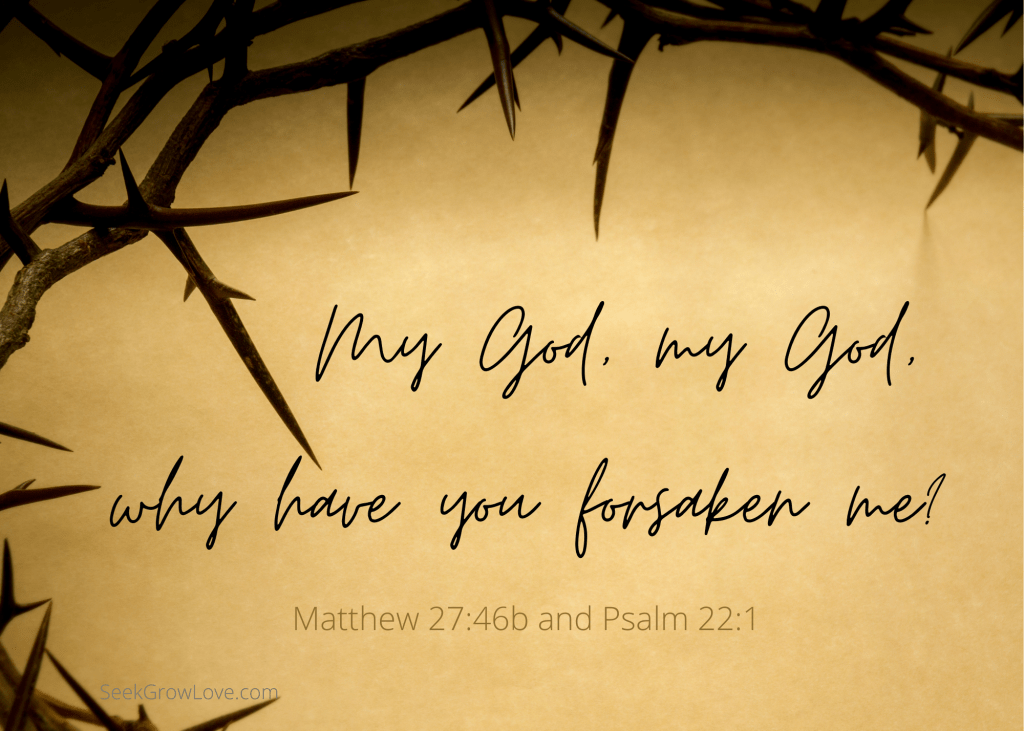
46 About three in the afternoon Jesus cried out in a loud voice, “Eli, Eli, lema sabachthani?” (which means “My God, my God, why have you forsaken me?”). NIV
To me, that sentence contains some of the most poignant words in scripture. Jesus is truly taking on the weight of the world at this moment by bearing all of humanity’s sins. The weight of it must have been crushing. It must have felt so terribly dark and cold. In this case, he alone had to pay the price and it was not the plan for God to rescue him from death; however, we know how the story ends. We know God did not forsake him in the grave. We read in Acts 2:31:
31 Seeing what was to come, he spoke of the resurrection of the Messiah, that he was not abandoned to the realm of the dead, nor did his body see decay. (NIV)
When we are in the depths of despair or metaphorically running from danger, it can seem like God is silent and turning a deaf ear to us. However, His word assures us in Romans 8:28 that He is not turning His back to us.
28 And we know that in all things God works for the good of those who love him, who have been called according to his purpose. (NIV)
In the latter portion of Psalm 28, we read David’s recognition that God came through for him.
6 Praise be to the Lord,
for he has heard my cry for mercy.
7 The Lord is my strength and my shield;
my heart trusts in him, and he helps me.
My heart leaps for joy,
and with my song I praise him. (NIV)
Notice the words from verse 7: “my heart trusts in him.” How do we cultivate trust in God? One of the best ways is to learn about Him through His word. His character radiates beautifully all throughout scripture. One aspect of God’s character that really spoke to me in today’s reading is His tenderness. In Psalm 28:9 we read: “Save your people! Bless Israel, your special possession. Lead them like a shepherd, and carry them in your arms forever.” (NLT)
Isaiah 40:11 gives us more insight into how He shepherds His flock:
He tends his flock like a shepherd:
He gathers the lambs in his arms
and carries them close to his heart;
he gently leads those that have young. (NIV)
God carries us close to His heart. Now that’s an amazing image! Where we are might feel very cold and alone in the moment, but God is there holding us close to His heart. Unlike Jesus on the cross, we never have to bear the weight of our burdens alone. He is working things out for the good for those who love Him. It might not look like how we imagined, but it will be beautiful in the long run. Trust His timing. Trust His goodness.
-Kristy Cisneros
Kristy is married to Pastor Andy Cisneros who pastors Guthrie Grove Church in Pelzer, SC. This May they will celebrate their 25th wedding anniversary! They are the proud parents of two awesome children: Brooke and Logan.
Reflection Questions:
Do you feel that you trust in God’s timing and goodness? If not or maybe not as much as you should, make it an intentional prayer that God will help you grow in these areas.
How can you use this year’s Bible reading plan to grow further in your appreciation of God’s timing and goodness? Remember this year’s plan is focused on reading with a lens for understanding God’s character more richly.
And tomorrow we will begin reading in the book of Exodus for our Old Testament reading. So, here is our introduction to the book of Exodus…
Exodus Introduction
The book of Exodus continues the story from Genesis of God’s creating a nation of His own from the descendants of Abraham, Isaac, and Jacob. These people would be different from the rest of the people on Earth. It tells of the oppression His people faced as slaves in Egypt. It then tells how God raised up a deliverer (Moses), and miraculously rescued His people from slavery – to eventually bring them to the promised land.
Many times throughout Exodus, we can recognize parallels to the way God rescued us from slavery to sin by raising up a deliverer (Jesus), so we can eventually inherit the Kingdom of God.
There are incredible parallels between God’s sparing the Israelites at Passover by the blood of a lamb, and the way we are spared death by the blood of the Lamb of God (Jesus).
The Israelites were figuratively baptized when the Red Sea parted so they could walk through on dry ground.
As if all this weren’t exciting enough, God, through Moses, led the people to Mount Sinai, where the people saw the mountain engulfed in flame, and heard the physical voice of God, as he gave them the 10 commandments. (See a parallel of this to us in Hebrews 12: 18-29.)
The Israelites were so terrified they begged Moses to talk with God, and then bring word back to the people. They thought they would die if they heard God speaking anymore. God agreed that this was a good idea, and promised to later send a spokesman, raised up from among his brothers – like Moses, who would represent God to the people. This was ultimately fulfilled by Jesus.
The rest of Exodus, as well as all of Leviticus, and part of Numbers, takes place at Mount Sinai – as God gave His laws to His people. As you read, you’ll find out that His people had difficulty obeying God’s laws.
In 1 Peter 2:9, we’re told that God has chosen us, just like he originally chose Abraham’s descendants. And He expects us to be different – to declare the praises of God. How well are you obeying?
As we move through the Gospel of Matthew one chapter per day it’s pretty amazing how quickly we move through the life of Jesus. Matthew brings us through the entire earthly life of Jesus so quickly. Think about it for a minute. Less than a month ago we were celebrating Christmas and the birth of Jesus. Just a week later we were celebrating the start of a new year, 2021 and we started the book of Matthew which summarized roughly 2000 years of Israel’s history from Abraham down to Jesus. We heard the angels announcement to Joseph that Mary was going to give birth to God’s son. We read of his birth, the visit from the magi and Herod’s attempt to have Jesus killed and his rescue to Egypt. We fast forwarded to his 12th year visiting the temple and being precocious in his questions of the learned doctors of Jewish Law. Just like that Jesus is 30 and being baptized by John in the Jordan River and going into the wilderness to be tempted by Satan. Then he’s calling disciples, performing miracles, preaching the Torah in a way that is more authoritative than the average rabbi. Before we know it 3 more years have passed and Jesus is in Jerusalem having his last supper with his disciples and preparing them for his approaching death.
Now, here we are reaching the climax of Matthew’s Gospel. Jesus is tried, condemned and crucified. This was not how any of his followers or any of the Jews for over 1000 years imagined how the story would go. They envisioned the son of David as a triumphant King leading an armed rebellion and defeating the powerful and oppressive Romans and being free to finally worship God under the rule of God’s anointed King, descended from the great King David of old. Instead, they get a meek and gentle man being falsely accused and refusing to defend himself, being rejected by his own people and, despite his complete innocence, meekly suffering and going to his death in the most shameful way imaginable: beaten, stripped naked and nailed to an execution pole for all to see and mock and serve as warning to any who might dare to defy Rome’s hegemony over the whole world.
For the Apostle Paul and most every Christian since that day, this is foundational to the entire Christian message and the central event in the history of the world.
Paul wrote in I Corinthians 15:
15 Now, brothers, I must remind you of the Good News which I proclaimed to you, and which you received, and on which you have taken your stand, 2 and by which you are being saved — provided you keep holding fast to the message I proclaimed to you. For if you don’t, your trust will have been in vain. 3 For among the first things I passed on to you was what I also received, namely this: the Messiah died for our sins, in accordance with what the Tanakh says; 4 and he was buried; and he was raised on the third day, in accordance with what the Tanakh says; 5 and he was seen by Kefa, then by the Twelve;
(Complete Jewish Bible Translation)
Paul reminds his readers that one of the first things he passed on to his students was the death of the Messiah, Jesus, for their sins as a fulfillment of the teaching of the Hebrew Bible (Tanakh or Old Testament). Matthew tells the story more or less chronologically and it builds up to this. But for Paul, this was among the first things he taught. Whether it’s shared first as in Paul or toward the end as in Matthew, either way the death of Jesus and with it his resurrection, is the most important thing for Christianity.
There is much for you to think about in this chapter but I will simply pause to name two and they both have to do with despair and death. Matthew places side by side two men who have reached a crisis in their life, Judas and Jesus. For both their crisis has brought them into great anguish and to the brink of death.
Judas is in despair because he has betrayed his teacher and friend. He sold Jesus out for 30 pieces of silver. One might try to get Judas off of the hook by suggesting that he didn’t really have a choice in the matter. It was God’s plan. I’ve even heard it suggested and even wondered myself if Judas wasn’t simply trying to force Jesus to go to war against Rome. Judas was a Zealot and growing impatient with Jesus. Maybe he assumed that when Jesus was arrested he and the other disciples would defend him and bring him into his Kingdom. When Judas realized that his plan backfired and Jesus was going to die without bringing in the Kingdom he was overcome with guilt and despair. Or maybe he was just greedy and sold out his friend for the money. Or maybe some combination of things. Sometimes we humans beings do things and we don’t even understand why we did it, but afterwards we are filled with shame and regret and despair of life.
Judas responded to his despair by taking his own life. Suicide is the final act of despair. The suicide rate in the US has been going up each year. I imagine when the deaths related to Covid are finally tallied we will see a significant number of deaths were not from Covid but because of people’s despair over Covid and the Covid related isolation, economic losses, disenfranchised grief, increased substance abuse and loss of connection with faith communities and other sources of hope and meaning. Judas’ story ends in a tragic death of despair.
Jesus is also facing his own existential despair. He’s been betrayed, denied, abandoned and rejected by his friends and followers and all his fellow Jews. Jesus was beaten nearly to death and is alone on the cross and has all of the guilt and shame of the world heaped upon him. In his agony and isolation he cries out to God in despair ,“My God, my God why have you forsaken me?” Jesus is having the worst day of his life, just as Judas did and Jesus is in extreme pain, just as Judas was and Jesus was about to die, just as Judas did. And yet, their deaths couldn’t be more different. Jesus never lost his connection to and faith in his father, even at this point of greatest pain. Even as Jesus cries out, he is praying and maintaining his connection to his faith tradition. “My God, My God why have you forsaken me” is the opening prayer of Psalm 22. This was a Lament Psalm. The Hebrews were very familiar with suffering. They had been slaves for over 400 years in Egypt. They spent 40 years traveling in the wilderness. They spent 70 years in exile in Babylon. The Hebrews knew suffering and it was in suffering that God continued to sustain them and draw them back unto himself. Every Psalm of lament, no matter how much hurt or pain they processed, no matter how angry or betrayed by God they felt, there was always a remembering of the ways God had been with them and helped them in the past, and there was the hope and trust that God would sustain them through the suffering and restore them to wholeness and joy.
Jesus never lost his connection to the father, even in the depths of pain and despair. He surrendered his life to God, but he did not take his own life as Judas did. Judas’ tragic death ends with no hope for him. Jesus’ tragic death ends with hope for him and for everyone.
We all go through periods of hurt, pain, disillusionment, brokenness, anger, shame, guilt and pain. When we go through those time we are in a moment of decision. Do we give in completely to the despair and give up on God, or do we cling to faith, remembering God’s faithfulness in the past and hope in the future. That will make all the difference in how our story ends. It doesn’t have to end like Judas. Jesus offers the path to hope and life.
After Jesus had been sentenced, flogged and mocked, He was hung up on a cross with a sign hanging over His head, reading, “This is Jesus, the King of the Jews.” This sign was another attempt to show contempt for Jesus. The sign mocks His name and labels him a heretical blasphemer. Yet in this attempt at mockery, there was truth. Jesus will return as King of the Jews and all those who followed Him. God took the shame that the Jews who crucified Jesus tried to cast upon Him and turned it into Honor for Jesus.
God constantly takes our shame and turns it into honor. In our current society, it is common to be called names for living a righteous and biblical lifestyle. Many will call you a prude, a goody two shoes, a tryhard. Their goal is to tear you down in the eyes of the world, to paint you as one who sits on an imaginary throne of righteous living and looks down on the world to condescend. This mockery is your honor. It is a testament to the effort that you put in to live as you have been called. Continue to wear your breastplate of righteousness and endure the mockery, and have your shamed turned into your honor.




 Seek Grow Love