Bread: Not Just a Comfort Food

John 6

Devotion by J.J. Fletcher (Minnesota)

Hunger is a powerful thing. It can affect your mood, and it can cause you to make poor decisions. There’s the old saying, “never go shopping on an empty stomach”. You will buy stuff that you don’t really need because your mind is affected by hunger. I can relate to that. Once upon a time, while I was at the Bible college, a friend and I decided to go on a green tea fast. On the day that we broke the fast, I went grocery shopping and spent way more money than I should have on food, and I’m pretty sure most of it went to waste. I was buying out of hunger, not necessity. I’m sure you can relate to my bad habit of stopping and getting horribly unhealthy food because you were hungry, and it was quick and convenient. Maybe you decided to stop because it was a cheap option?

We see the miracle of Jesus feeding 5000. There were a lot of extra people around because Passover was coming up soon. They find themselves in the conundrum of not having enough food for all these people who are gathered to hear Jesus. They could perhaps go buy food, but that would take a lot of time, not to mention money. And how do you source food quickly for this many people? How many people would be required to carry it back? I don’t really think there’s an avenue for coordinating food for this gathering.

Jesus ends up telling the disciples to gather up all the food that the group has collectively. What they end up with is a boy who has five loaves of bread and two fish. This is a laughable amount of food for a group of 5000 plus. Jesus prays over the food, and they start passing it out, and they pass and they pass, and they pass and they end up having leftover food after everyone has eaten their fill. What a miracle. Jesus perceives that the people being moved by this miraculous action are going to try to grab him and make him king forcibly. It is not the proper time, nor is this the proper motivation. Jesus is king because God declares it himself, not because of this miraculous meal.

Jesus withdraws to be by himself. The disciples set sail across the sea without Jesus, but encountered him walking on the water. They are freaked out, but they’re glad when they see it’s him, and once he’s on the boat, all is well. But the crowds are hungry for more and start to search for Jesus.

The people want to see more miracles, but that is not the purpose of Jesus’ ministry; rather, an attestation of the power behind him. Jesus’ message of the Kingdom of God is truly powerful. Jesus says that the crowds are not seeking him, not even after the power behind the signs that they saw, but because they had been well fed. 

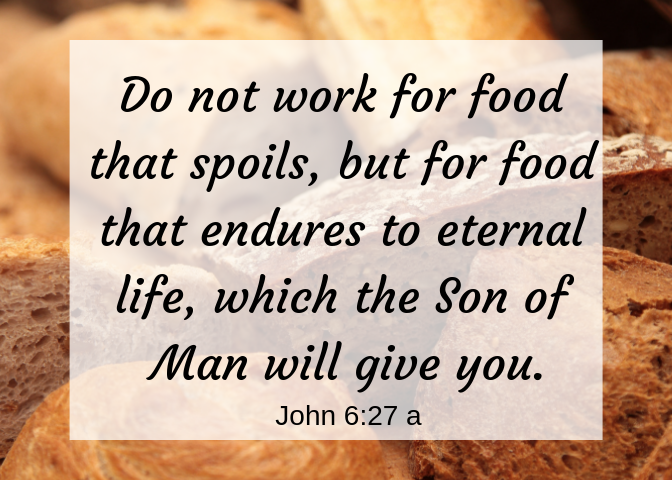
The people bring up the desire to see miraculous signs and recall that their fathers ate manna in the wilderness. Jesus, comparing his role to that of Moses, says that it was not Moses who fed the Israelites in the wilderness, but that it was God. He warns them of seeking temporal comforts and satiety; rather, they should seek after the true life-changing and life-saving power of God. Jesus’ claim that he is the “bread of life” or “bread come down from heaven” is a claim that God has ordained, empowered, and approved his Kingdom ministry and his standing as the savior. 

It is a long and winding road that leads to the cross. Many will reject the bread of life for the bread of satiety or comfort, or maybe bread leavened with the yeast of the Pharisees, but many do take Jesus up on his “the bread of life” offer and are the beneficiaries of God’s amazing power that was and is at work in the hearts of the redeemed.

Reflection Questions

  1. What significance do you see in the contrast of Jesus’ miracle, the manna of the Exodus, and the Bread of Life that Jesus speaks of?
  2. Does the metaphor of food effectively drive home Jesus’ emphasis on the importance of the Gospel for true life?
  3. In what ways can you take Jesus’ words from John 6 and apply them you your life in a way that strengthens your personal ministry?

Power in Song

Deuteronomy 32-34 & Psalm 91

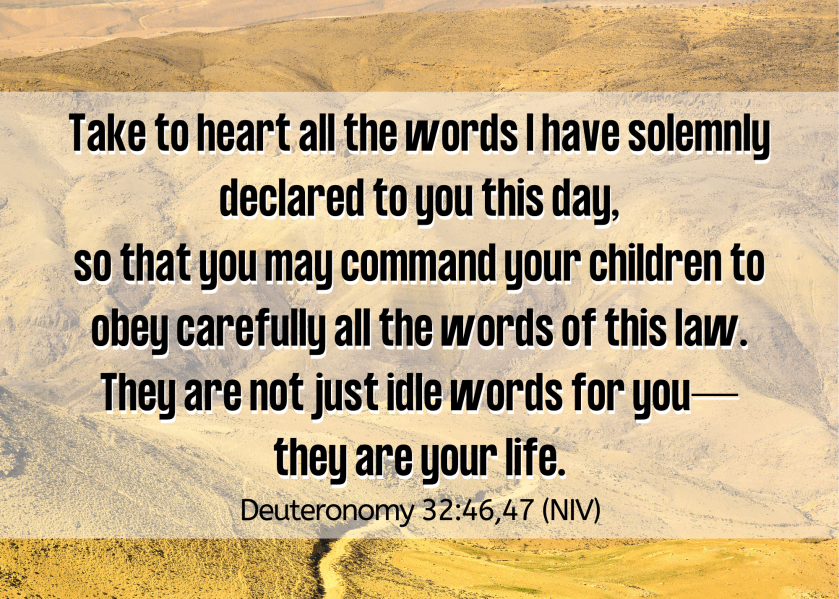
When Moses had finished reciting all these words to all Israel, he said to them: “Take to heart all the words that I am giving in witness against you today; give them as a command to your children, so that they may diligently observe all the words of this law”. Deuteronomy 32:45-46 (NRSV)

I’m a music lover.  My memory of “contemporary” music goes back about 30 years. 1995-1996 is when I first remember getting into music on the radio. It’s not just the music of my era… I grew up listening to the classic rock format as well as ‘90s rock and pop. If I were to anonymously give you a top 20 list of my favorite albums or songs (which I’d probably never be able to narrow down), you might be left scratching your head, wondering who this person is and when they were born. Powerful is the art of song and music. I love music for the notation, the way that notes and chords are put together to create melody and harmony, even dissonance, but also for the lyrics… The way that someone can convey emotion or conviction in a way that hits hard, that makes you think and feel.

Great songs come in many forms. There is much to be gleaned from a simple lyric – Jesus loves me, this I know, for the Bible tells me so; and there is much to contemplate from an imaginative and thoughtfully written gem that paints an image in the mind: “Could we with ink the ocean fill, and were the skies of parchment made; were every stalk on earth a quill, and everyone a scribe by trade; to write the love of God above would drain the ocean dry; nor could the scroll contain the whole, though stretched from sky to sky”.

The Beatles were a smash with their early simplistic songs, but also with more thought-provoking tunes toward the end of their run. Leonard Cohen’s “Hallelujah” (Jeff Buckley did it better) is one of the most gut-wrenching (in a good way) songs that I can think of. It carries the listener through peaks and valleys of emotion as it describes tensions in the human experience of love. Perhaps I have digressed too much, but I can get distracted when I get into the minutiae of music.

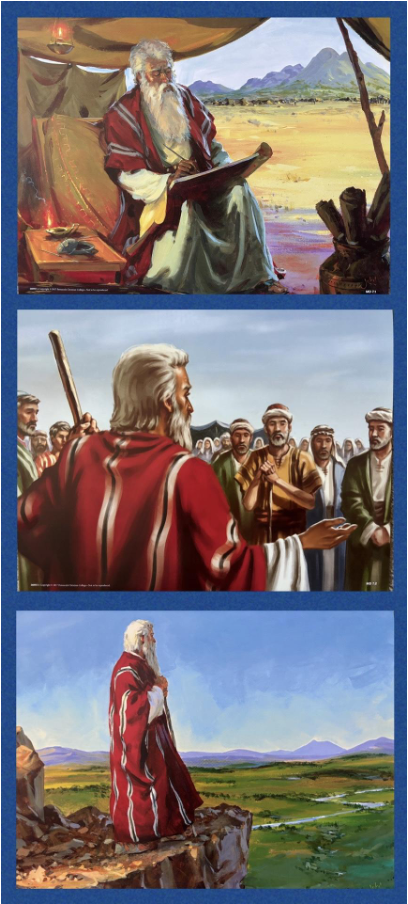
In Deuteronomy 32, we have recorded a song that Moses recited to the Israelites shortly before he went up to Mount Nebo to get a distant view of the promised land and then die. In this song, we see a variety of things addressed. Moses glorifies Yahweh, his God, but takes the people on a journey to envision their future failure and rejection of God’s ways that they are on a path toward. Challenges, encouragement, and perspective.

While Moses covers some pretty negative territory regarding the Israelites in his words, he also gives assurance that Yahweh is a God of mercy and redemption and that his people will be cleansed. Despite impending failure, there is forgiveness and mercy on the docket, and there will ultimately be protection for the people of God against their adversaries.

I find it a little curious that Moses addresses the people in song, diverging from the status quo of God’s revelation to his people up to this point, but song can be a powerful way to commit things to memory. In contrast to the ten commandments and the subsequent revelation of the full law, this presentation perhaps was remembered and recited in a way that was engaging and complementary. 

-JJ Fletcher

Reflection Questions:

  1. How has music impacted your relationship with God and Jesus?
  2. Do you find it easier to remember lyrics and scripture put to song than simply memorizing bible verses?
  3. How do we balance the desire that we might have for catchy and relatable tunes with the directive to glorify and worship God with music?
  4. What impact do you think Moses’s addressing the people in this manner had on them? (might be helpful to look back at Deuteronomy 31:19-22)

Succession Plans

Deuteronomy 30-31

Then Moses called Joshua, and said to him in the sight of all Israel, “Be strong and courageous; for you will go with this people into the land that Yahweh has sworn to their fathers to give to them, and you will cause them to inherit it. Yahweh, it is he who goes before you; he will be with you, he will not leave you or forsake you. Do not be afraid, and do not be dismayed.” Deuteronomy 31:7-8 (REV)

In Deuteronomy 31, Moses begins to reflect on the fact that his life is about to come to an end and he will not be leading the Israelites into the promised land. We see Joshua enshrined as Moses’s successor, as God directed Moses (Numbers 27).

Succession plans are important as leadership changes are critical junctures for organizations. When a known change is coming, it is easier to start laying the groundwork for succession, but that can be short-sighted. There is wisdom in succession plans that consider the unknown. No one knows how many days they have left to live in this age. Illness can come on suddenly, and tragic accidents happen frequently. By the grace of God, you reader, will live many more years to serve God faithfully, but what if the unthinkable happens? Have you ordered your house? Have you, in your role as pastor, leader, director, or church volunteer, poured into those around you and prepared individuals to do the necessary ministry of the church if, for some reason, you must vacate your position, voluntary or otherwise?

In my first year at Atlanta Bible College, I took the course Principles of Ministry and Leadership (I think that was the correct class name) with Professor Jon Cheatwood. One of the books that we used was the 21 Irrefutable Laws of Leadership by John Maxwell. While I have not touched that book in nearly twenty years, I remember clearly one of the concepts in the book: Leaders should be training their replacements, figuratively working themselves out of the job. You should ensure that those under you or around you can take over the tasks and responsibilities you are responsible for. This is not to create job insecurity but to ensure stability for an organization or ministry if unexpected departures happen.

Just as Moses was chosen by God to lead his people out of Egypt, Joshua was chosen to lead them into the promised land. Moses publicly enshrines Joshua as leader, making clear the succession plan and avoiding a power vacuum with multiple individuals striving for the top spot or fearful individuals that pick up camp and head back to Egypt.

Several years ago, there was a TV show called Succession that was loosely based on real events from a power struggle within a powerful business. I am not recommending the show, but it showcases the chaos that surrounds an organization that does not have clear protocols and succession plans in place.

About 10 years ago, my church was thrust into unexpected changes in pastoral leadership. While not without bumps in the road, the leadership of the church was equipped enough to manage a very difficult period. Clearer succession plans certainly could have made some things easier and maybe would have created some different dynamics in leadership structures than what was implemented during the transition. While you may not be able to perfectly clone yourself as a leader (and you probably shouldn’t), you can pour into the next wave or generation of leaders and begin preparing them for the joys and difficulties of ministry and leadership. Whether you are a senior pastor, a volunteer coordinator, or somewhere else on the spectrum of ministry roles, we should always be working to ensure that the ministry of the Gospel is primed to continue in our organizations, with or without us.

-JJ Fletcher

Reflection Questions

  1. Have you ever experienced a sudden change in leadership? Either as a member of leadership or someone that looked to leadership, what were some of the takeaways that you had from that experience? What could have been better in that situation?
  2. How important do you think it was that Moses made a public showing of the transition of leadership from himself to Joshua?
  3. What are some of the pitfalls of tight-fisted leadership that does not allow for the incremental growth and training of future leaders?
  4. Does God choose leaders now like he did in the times of Moses and Joshua? What does leadership selection look like now?

Test Your Memory

DEUTERONOMY 3-4

“Deuteronomy” is derived from the Greek word deuteronomion, meaning “a second law.” This whole book is meant to be a second edition of God’s laws, compiled of commandments received at Mount Sinai as well as a few additional ones. The first four chapters of Deuteronomy set the stage for these laws by providing reminders of why the Israelites serve the God of Abraham, and the importance of keeping His statutes. 

Moses begins this book emphasizing to his people the importance of remembering. He reminds them of the many instances in which God delivered them from their enemies and gave them new lands. As we read yesterday and continue to read today, chapters 1-3 serve as a brief overview of Israel’s recent happenings. In chapter 4, Moses switches gears and opens the book with a call to remembrance, and a command to obey. (Deut 4:1-5, 4:9-10, 4:14, 4:23, 4:30) 

Only be careful for yourself and watch over your soul diligently, so that you do not forget the things which your eyes have seen and they do not depart from your heart all the days of your life; but make them known to your sons and your grandsons. – Deut 4:9

Moses is reiterating that the laws provided previously in Exodus weren’t just a temporary set of guidelines or a mere suggestion; they were meant to be kept. These laws are the foundation upon which God’s chosen people will be set apart, unique from the rest of the world. (Deuteronomy 4:5-8, 4:32-40)

So keep and do them, for that is your wisdom and your understanding in the sight of the peoples who will hear all these statutes and say, ‘Surely this great nation is a wise and understanding people.’ For what great nation is there that has a god so near to it as is the Lord our God whenever we call on Him? Or what great nation is there that has statutes and judgments as righteous as this whole Law which I am setting before you today? – Deut 4:6-8

Israel’s obedience and devotion to the statutes of the LORD serve a larger purpose. Not only will these laws keep Israel on the right track in terms of their own safety and wellbeing, but they will also distinguish God’s people from the rest of humanity as a righteous and wise nation. Ultimately, despite many roadblocks and failures, these laws will sustain Israel for 400 years, allowing them to become the nation from which the Messiah is born (as prophesied later in Deuteronomy 18:15-19).

Moses makes it abundantly clear to his people that God will not forget His covenant with them, therefore it is crucial that they do not forget either. He warns them that they will stray, but that they serve a merciful God, a loving Father who patiently waits for His children to return to Him. (Deut 4:25-31)

For the Lord your God is a compassionate God; He will not abandon you nor destroy you, nor forget the covenant with your fathers which He swore to them. – Deut 4:31

Though Christ has since set a new system in place, consisting of new laws under the new covenant, the main ideas that Moses expressed in these scriptures remain true for us today. First, we must remember God’s promise to one day restore the earth (Gen 3:19), as well as the commands His Son gave generations later under the new covenant. Second, God’s commands are not meant to needlessly restrict us, but to guide us into a life of blessing and purpose. When we obey, we reflect His wisdom and goodness to the world around us. And lastly, that God knows we live in a broken world; He sees our darkest desires and our biggest downfalls. But even when we stray from His ways, He waits for us to return to Him, arms open and heart yearning to pull us into His loving embrace. 

-Isabella Osborn

Reflection Questions:

  1. How can you actively remind yourself (and others) of God’s goodness, His commands, and His promises?
  2. Moses emphasized that God’s laws were meant to set Israel apart—how does living according to God’s principles set you apart in today’s world?
  3. How does knowing that God patiently waits for us to return to Him impact the way you approach repentance and restoration in your relationship with Him? How can this truth shape the way you view both your own failures and those of others?

Looking Back and Looking Ahead

Deuteronomy 1-2

A time of reflection and recap of events as the Israelites prepare to enter the Promised Land. “For the LORD your God has blessed you in all the work of your hands. He knows your going through this great wilderness. These forty years the LORD your God has been with you. You have lacked nothing. (2:7) They’ve LACKED NOTHING?! They probably didn’t agree with that, but it shows how God provided for them the basics, which is ample for a person. He literally gave them their daily bread.

Moses reminded them, “The LORD your God who goes before you will Himself fight for you, just as He did for you in Egypt before your eyes,and in the wilderness, where you have seen how the LORD your God carried you, as a man carries his son, all the way that you went until you came to this place. Yet in spite of this word you did not believe the LORD your God.” (1:30-32)

It’s amazing that we can do the same thing like the Israelites at times, cry out to get out of a difficult situation (Egypt), then afterwards when we’re out we complain again. But if they would’ve trusted that God would fight for them they could’ve been spared the long difficult 40 years. The wilderness was the ONLY way to get to the Promised Land, and their lack of trust made it even harder (and longer).

Not one of these men of this evil generation shall see the good land that I swore to give to your fathers, except Caleband Joshua who wholly followed the LORD.” (1:35) Even Moses wasn’t allowed to enter as the LORD was angry with him too (or, had been angry and was following through with consequences).

Despite failures and difficulties Moses pressed on with the people until his departure. This reminds me of parenting! It’s difficult and rewarding! One of my main parenting verses that encouraged me over the years, besides Deut. 6:4-7, is 1 Peter 4:12,

Above all, keep loving one another earnestly, since love covers a multitude of sins.

– Shalom y’all, Stephanie Schlegel 🙂

            (From Israel and Tennessee:)

REFLECTION QUESTIONS

1. Have you had to endure a difficult situation for years? How did God sustain you through it?

2. Is there an issue you’re dealing with that if you’d wholly trust God, the situation would be better? Are you taking matters into your own hands or trusting God with it?

3. Reflect over this last month how God’s provided for you and thank Him for it!

4. How does looking back better prepare the Israelites for looking ahead? How can it benefit you?

Lessons from a 3,400 year old Travel Journal

Numbers 31-33 

Misunderstandings! Ever been misunderstood and frustrated?! It’s what happened to Moses and the people he led. The LORD told Moses to take vengeance on Midian. Among them Balaam was also killed with the sword, but the women were kept alive. This upset Moses! The women through Balaam’s counsel caused the Israelites to sin in baal worship. … Moses worked out a solution.

Then two of the tribes wanted to settle east of the Jordan River with their abundant livestock. This upset Moses again! How could their brothers go to war while they sat there?! After a lengthy response he heard their intended promise to cross over with them to help them fight and after return to their livestock and cities.

It can be frustrating to be misunderstood. That’s why it’s important to listen and be patient with others. “Know this, my beloved brothers: let every person be quick to hear, slow to speak, slow to anger; for the anger of man does not produce the righteousness of God.” James 1:19

Lastly, let’s not skip over the AMAZING travel journal of chapter 33, and like my Bible geography teacher/husband would say, “It shows these are real places and a real God.” Many of these places are still called that to this day, and it’s from some 3,400 years ago! Pictured above on the left is an aerial view of the Jerusalem/Jericho area looking to the north of Israel with snow capped Mount Hermon on the northern tip.  Did you know that there’s a ski resort up there with 14 ski runs and 5 chair lifts?! YES! One winter on the same weekend one of our boys was skiing up there with friends while the other was snorkeling in the Red Sea (on the southern tip)! Don’t misunderstand Israel, it’s a BEAUTIFUL place! 🙂

-Stephanie Schlegel

REFLECTION QUESTIONS:

1. Do you get angry when you’re misunderstood? How can you be quicker to listen to the person before responding in words and anger?

2. How do you clarify yourself? In anger? With patience? Kindly? Today, try to respond better to a misunderstanding, and ask God’s help to do so.

3. Have you ever kept a travel journal of the places you’ve been? What would people think if they found it 3,400 years later?! :0

Names

Numbers 26-27 

A census, a bunch of Hebrew names… seems difficult right?! More so in English, it’s easier in Hebrew, and the names have so much meaning! 🙂  When I first lived in Israel and learned Hebrew, names were difficult… Achinoam, Yonatan, Shaked! Hebrew names have meaning seen in the letters themselves, unlike English, so that makes it easier! It’s surprising how many adults I meet in America that don’t know what their name means.  In the Israeli hospitals where our children were born NO ONE ever asked what the new baby’s name was! The baby was identified by the mother’s first name and her mother and father. Then later named within 30 days after they were born according to their personality/character. They don’t measure the length of the baby either so as to not stretch it out after being curled up inside the womb.

Moses wasn’t allowed to lead these new people into the Promised Land. So he asked that God pick a new leader over the people. “Let the LORD, the God of the spirits of all flesh, appoint a man over the congregation who shall go out before them and come in before them, who shall lead them out and bring them in, that the congregation of the LORD may not be as sheep that have no shepherd.” (27:16,17)

The LORD chose Joshua, “a man in whom is the Spirit.”(27:18) Interestingly, the Hebrew name of Joshua is basically Jesus/Yeshua. They have the same meaning, the LORD saves. Like Joshua was chosen by God to lead the Israelites into the Promised Land, so Yeshua was chosen by God to lead all people into the Promised Kingdom to those who trust in him. Both were chosen to shepherd and lead the people.

“I am the good shepherd. The good shepherd lays down his life for the sheep.”  John 10:11

-Stephanie Schlegel

REFLECTION QUESTIONS

1. What does your name mean?! Have you seen any special connections in your name over your life span?

2. How can calling someone a bad name be hurtful? What effect does it have on people to call them a good name?!

3. What are we known for? Isn’t it a great compliment of Joshua that he was filled with the Spirit? May we be filled with the fullness of God and walk in His Spirit like Joshua did.

God’s Chosen Leaders

Numbers 15-17

So things are not going well for the Israelites. In yesterday’s reading, we see that distrust in God led to the destruction of many and the curse of roaming around the desert – which would eventually lead to the death of everyone over 20 years old when they grumbled against the Lord. In today’s reading, God first curses the people by demanding offerings brought in fractions.  Frankly, I would have found this worse than being stuck in the desert. 2/10, ⅓, 3/10, ¼ , WOW! This would definitely be a sacrifice of praise for me! 

Now you would think that having seen God’s miracles and blessings, people would accept Moses as their human leader and do what was required of them. But in Numbers 16, a man named Korah, a Levite,  decides he’s had enough. I don’t know if he blames Moses for the things that have gone wrong on this journey or he just liked picking fights with those in leadership. But long story short, God decides He’s not even going to mess around and swallows Korah, along with his cronies who sided with him and all their households and all that they owned. 

In Numbers 17 God uses the familiar rod (the same rod He turned into a snake, sent a few plagues and split the Red Sea)  to prove that Moses and Aaron are the leaders He anointed. God had Moses collect a rod from each of the 12 tribes of Israel, and write the name of each tribe on the rods, Aaron representing the Levites. He would then cause one to bloom and the one that blooms was the rightful leader.  I don’t think it’s a spoiler to tell you which one bloomed… to the point of producing almonds! I would think that seeing the ground opening up and swallowing a lot of people who had been complaining against Moses and Aaron would have been enough for me to keep my thoughts to myself. However, apparently, there was still some complaining but after the budding of the rod, no one questioned Aaron’s position after that,  Yeah…I kind of think that’s weird too!

Today’s reading ends with, “Behold, we parish, we are dying, we are all dying! Everyone who comes near the tabernacle of the LORD, must die. Are we to perish completely?” Cheery. Even cheerier… WE are all dying. The people of Israel (at that moment) finally realized they were one mistake away from death. They needed a savior. WE need a savior.  I am so grateful this is not the end of the story.

-Maria Knowlton

Reflection Questions

  1. What was Korah’s (and those who aligned with him) sin, or sins?
  2. How did Moses handle this rebellion?
  3. How do you tell who God has chosen as Christian leaders?

Lead Us in the Ways of the Lord

Numbers 10-12

The first time I ever set up a tent without my husband was when I took my  just about to be 10 year old son to Cub Scout camp.  Unfortunately, both of us were a little too short to reach all the parts we needed to secure the tent. BUT! Luckily, another parent came over and helped us out. He also gave us some tips about tent camping.  However, he forgot one small detail, or maybe he thought it was common sense. He didn’t mention that we should sweep the ground before setting up the tent so there would be no rocks underneath.  The first night was very uncomfortable (the next few nights we were so exhausted that we didn’t care)!

I suspect that the people of Israel were getting pretty good at setting up tents by the end of Numbers 10.  This chapter lays out the order in which the tribes of Israel were to move when God would lift the cloud. It is interesting to note that Moses asks his brother-in-law for assistance since he was from around those parts.  My Bible footnote states that “Divine guidance does not exclude using human help.” I think that could apply to so many areas of our life! God often puts just the right person into our lives at just the right time to carry out His will! 

But sometimes the people in our lives can bring us down. In chapters 11 and 12, we find that the people are complaining, a lot, so much that some of them want to go back to Egypt! I don’t know for sure but I think it’s reasonable to guess that it probably started with a few people and soon others followed. Of course, this caused God to get a bit aggravated, sending fire and plagues against those who complained. Even Miriam, Moses’s sister, got a plague of her own, developing an acute case of leprosy. Fortunately for her, God forgave her and healed her. 

Today’s reading really reminds me that while God does send people into our lives to better us and for His glory, there are those who will pull us away from God. When deciding who is who, look at the overall life of the person. What does their life look like? What does their relationship with God look like? If they are a mess and far from God, I guess you could learn what NOT to do! However, we would be wise to listen to the ones who will lead us in the ways of the LORD (and will remind you to sweep before setting up a tent)! 

-Maria Knowlton

Reflection Questions

  1. Does your circle of influencers include more helpful people who will help lead you in the way of the Lord, or more complainers who will arouse the Lord’s anger? Who specifically do you know who could be beneficial to spend more time with?
  2. What would others say about you? Are you more known for your complaining or for leading in the way of the Lord?
  3. When you do complain, what are you more likely to be complaining about? and to whom? Would there be a better use of your time and words?

On Your Behalf

Leviticus 1-4

At the end of Exodus, after the Tabernacle has been finally built, God’s glory comes to rest in it, but Moses is unable to enter (Exodus 40:35). However, at the beginning of the next book, Numbers, Moses is speaking with God in the Tabernacle (Numbers 1:1). This middle book, Leviticus, is the explanation about what is necessary to come into God’s presence and enjoy His fellowship. Since God is so holy and separate from us, there are things that we are expected to do in order to come into His presence. Thankfully, out of His love, mercy, and desire to be with us, God provided a way for us to come before Him, both for the Israelites back then and for Christians today.

Immediately in Leviticus 1 and 2, we find descriptions of different animal sacrifices and what is necessary to perform certain rituals in God’s presence. Since we don’t have a Tabernacle or Temple to worship in, and we don’t perform animal sacrifices anymore, how is this really relevant for us?

In Leviticus 1:4, we are told that these animals are dying in the place of the person who is offering it to God. The truth of these sacrifices is simple: sin is serious and deserves death. Whenever you do something that is contrary to God’s laws, both minor and major, it is offensive to the One who gave you life in the first place, and we deserve death for it. The mantra of our age that “everyone is naturally good in their own way” is simply not true; we are all broken, sinful, and corrupt human beings in need of God’s saving grace. For the Israelites back then, the answer to the problem was an animal sacrifice to cover their offense against God; for us today, it is the one sacrifice of Jesus Christ that is sufficient.

The New Testament continues the teaching that sin is serious, offensive to God, and deserves death: “For the wages of sin is death…” (Romans 6:23a) We cannot forget the seriousness of our situation, because when we do, we lose the power of the gospel. The good news for us is that we don’t have to die for the things that we did; Jesus died in our place, like the animal sacrifices in Leviticus. “… but the free gift of God is eternal life through Christ Jesus our Lord.” (Romans 6:23b) The sacrifice of Jesus was sufficient to cover over every sin that we have ever committed or will commit (Hebrews 10:10). We need to thank God for providing a way out of our sinfulness, both in Leviticus and today through Jesus Christ. Through this sacrifice, we can enter the presence of God and enjoy fellowship with our heavenly Father (Hebrews 4:16).

-Talon Paul

(Originally posted February 15, 2021 for SeekGrowLove)

Reflection Questions

  1. What were the duties or responsibilities of the Israelites to come before God to be forgiven? What are the duties or responsibilities of the Christians to come before God to be forgiven?
  2. How many times do you find the phrase ‘without defect’ or blemish? Why was that important to God for the Israelites? How does that apply to Jesus as sacrifice?
  3. As Christians we can bring (living) offerings and sacrifices to God, not to earn salvation and forgiveness, but to thank God and show we live for Him and He has first place. What would you like to offer/sacrifice to God and how can you do it?