The story of Palm Sunday is one of my favorites. Christ’s triumphant entry is a story about how God is greater than our expectations. The people of Jerusalem expected one thing, but God had a better plan in store.
As Jesus rode through the city, the crowds chanted “Hosanna” which means “Save us.” Right then and there, the people of Jerusalem were expecting Jesus to gloriously lead a battle to rescue them from the Romans. Except, that is not at all what Jesus or God had planned. Not long after, some of these same people shouted, “Crucify him!” Sadly, they did not see what was right in front of their noses. That Jesus was saving them. Just not in the way they had wanted or thought. They limited God. They put the Messiah in their own little box of expectations.
We are no different.
So many times do we allow our expectations to limit God. I’ve done it. I’m guilty of telling God how He can fix a problem. Throughout my young adult life, I was constantly giving God suggestions on how to give me a boyfriend. It was ridiculous, I know. The God of the Universe did not need me to offer advice on how to write my love story and thank goodness He did write it! I will be happily married six months come Friday. The man God had chosen for me was certainly worth the wait – even if it all came about in a way I wouldn’t have expected or chosen.
I’ve also found myself limiting God. In college I suffered from hip alignment issues that caused intense nerve damage. Due to this, I wasn’t able to dance like I used to do (I was trained in classical ballet for ten years). During this time, I never really relied on God for healing. Sure, I prayed about it, but I didn’t ever actually believe anything would come of it. Somewhere during the early months of my diagnosis, I had just decided that God wasn’t going to heal me. It was not that I believed he couldn’t, but rather, I thought he had bigger issues to deal with than me. I was not dying of cancer nor was I paralyzed. There were people worse off than me that needed God’s healing. I knew that wasn’t the way God operated, that He is big enough to care about all His children, but, I had allowed my bitterness to blind me of the truth. After about three years of this, a woman from church took me aside to remind me that God can heal me. I started to put in the work, got back into doing my physical therapy. I began dancing again – even if it wasn’t to the same extent as before. The following summer, I took my first dance teaching job. Since then I have worked for three different dance studios, taught countless classes, and helped produce four Nutcracker performances. I nearly lost out on the chance to do any of this because I had put God into a box. I limited His power with my own expectations.
It is amazing what can happen when we open our eyes to the vast power God has. He is an incredibly creative problem solver. Instead of having Jesus vanquish the Romans on the day of his triumphant entry, God had him enter the city on a lowly donkey. Since it wasn’t what people were expecting, they were easily led into believing that Jesus was not the promised one after all. It wasn’t what they wanted at the time they wanted it, and so, they turned away.
This week I encourage you to open your eyes, to look for the ways God is working in your life – outside the box.
Questions:
Are you limiting God?
Is there an area of your life where you’ve allowed your expectations to prevent you from seeing God’s answers?
Prayer
Dear God,
Thank you for being bigger and greater than I can imagine. Thank you for sending your son, not just to save the people of Jerusalem, but all people, including me. Open my eyes and help me see your work in my life. I don’t want to be blinded by expectations that I miss something amazing. In Jesus’ name,
One of the things taught in most of Christianity is that Jesus came into Jerusalem only one time and it was a great celebration of his kingship and carried out by all who were so glad to see him. It is commonly called “Palm Sunday”. The people calling him the “Son of David” is the same as calling him “king” by the people there. They wanted him to come to the capital there and throw out the Romans and Greeks and then set up his kingdom on earth right then and there. This record in Mark 11 is about the first day before Passover that Jesus comes into the city. I took the reading from the Revised English Bible (REV) on the Spirit and Truth’s website.
Jesus’ entrance to Jerusalem on this day is one of rejoicing and great celebrations by the people. “Hosanna” is literally “God save us”. They are saying “God save us by the one who comes in the name of Yahweh”. Heady stuff and sure to make both the secular leaders of the Jews (mostly Sadducees) and the Romans soldiers and administrators very unhappy. The Jews didn’t want to upset the cozy formula they had worked out to go along and get along. Also to keep the money train going in the Temple and with the tourists coming there. They had the money-changing tables where whatever money the people had would be exchanged for the official money to be used in the Temple, with a large profit margin going to the changers. The other commerce area set up was to sell sacrificial animals and was also in the outer court. The outer court was called the court of the Gentiles where all nations could come into the Temple area. This is why Jesus says to them that the Temple was designed to be a blessing for all nations, but you have turned it into a den of thieves.
Jesus on this entrance to Jerusalem comes into the Temple and looks around and then leaves and goes back to where he is staying in Bethany (probably at the house of Mary, Martha and Lazurus).
Mark 11:1-26 THE MINISTRY OF JESUS IN JERUSALEM (REV) The Triumphal Entry
The next day he gets up early in morning and for the second time goes on the road going to Jerusalem. On the way he sees a fig tree and because he is hungry goes to the tree expecting to find figs. The record says that when he gets to the tree it has no figs, but Mark also says curiously that the time of figs is not yet. He then curses the tree, and it dries up from the roots, also not the way that trees normally die. This is a picture of how Israel has failed in God’s purpose at this time. See this explanation from the REV commentary attached here.
(REV Commentary ) “seeing a fig tree.” The fig tree was one of the trees in the Bible that symbolized Israel. This particular fig tree was a fitting parable of Israel. It was in full leaf and looked very promising, even ahead of the rest of the trees. It should have been a source of great blessing for those who looked for early sustenance coming out of the winter months. Instead, it was a liar, promising much but delivering little, deceiving weary travelers and giving them false hope. Jesus cursed it, foreshadowing the curse and destruction that would come upon Israel.
“it was not the season for figs.”The question this verse poses to the average reader is, “Why would Jesus curse the fig tree for not having figs if it was not the season for figs?” The answer to that question lies in understanding that, although there were a couple varieties of fig trees in Israel, the common variety produces two crops of figs per year. An early fig grows on the old branch stock that grew the preceding year. This early fig often begins to grow even before there are leaves on the fig tree, although sometimes these early figs and the leaves start to grow at the same time. These early figs usually start developing in March, but may be a little earlier or later depending on the climate, and the circumstances of any given tree (Israel has many different climates, usually somewhat depending on elevation). These early figs mature in June, and the leaves grow and mature along with them. A second crop of figs starts on the new tree growth that sprouts that year, and they generally ripen in August.
Since Mark is recording events around Passover, Jesus would have approached the fig tree in April. Although it was not yet the season for figs, Jesus noticed that this particular tree was in full leaf. If the leaves were fully formed, that meant he could expect the figs of this particular tree to be early too, or at least be far enough along to be somewhat satisfying to eat. This should not surprise us. It often happens in horticulture that a plant is a few weeks earlier than the “regular season.” However, when Jesus got to the tree, the situation was not just that the figs it had were not yet ripe, it did not have any figs at all!
Jesus then cursed this tree and it died overnight. Jesus would ordinarily never curse a tree of any kind for not having fruit or buds. Often, trees go through hardships that keep them from bearing fruit in a given year. Jesus said he did what he heard from his Father, God, and this is an example of that. God gave Jesus the revelation to curse the tree, so Jesus cursed it and it died overnight, which was a miracle. Thus, this tree became a twofold teaching example: it showed that Israel was going to be cursed (which it was for rejecting its Messiah), and it also taught the apostles that when God gave you revelation, no matter how unlikely it seemed, if you trust God and believe and act on what He says, the revelation will come to pass (this is the manifestation of trust, 1 Cor. 12:9). (REV Commentary on Mark 11)
The withering of the fig tree is a symbol of the judgement of Israel and its leadership. The fig tree and olive tree are used in scripture as symbols of the nation of Israel in several places.
What a lesson in believing and faith for us to learn. We need to have “faith” which is our believing in accord with the Word and Will of God. When we confess the Word, believe it and act on it God is able to help us accomplish His purposes in life. What are the important elements of miraculous deliverance and help? We see here God’s will for us to operate as His agents here in the world today. Don’t discount His help and direction that He willingly gives us when we ask by faint heart or disbelief in spiritual help. Have a great day today in Christ.
QUESTIONS:
What do you learn about Jesus in Mark 11?
What does your faith look like today? What have you seen that has increased your faith? What have you heard that has increased your faith?
Where would you like to have more faith?
Prayer:
Father, we look to you today to give us understanding and wisdom in Your Word and intentions. We thank you for being part of the “God Story” you have made each of us. Give us today the bread we need daily and help us in our times of need. Heal our minds, hearts, and bodies in accordance with Your will. We thank you for the sacrifice of Christ that gives us life today and in the future. We pray in the Name above all Names, Jesus Christ.
As we just celebrated the triumphal entry it got me thinking about 1 aspect of Palm Sunday. The hosannas that the people yelled out to Jesus. What does that mean?
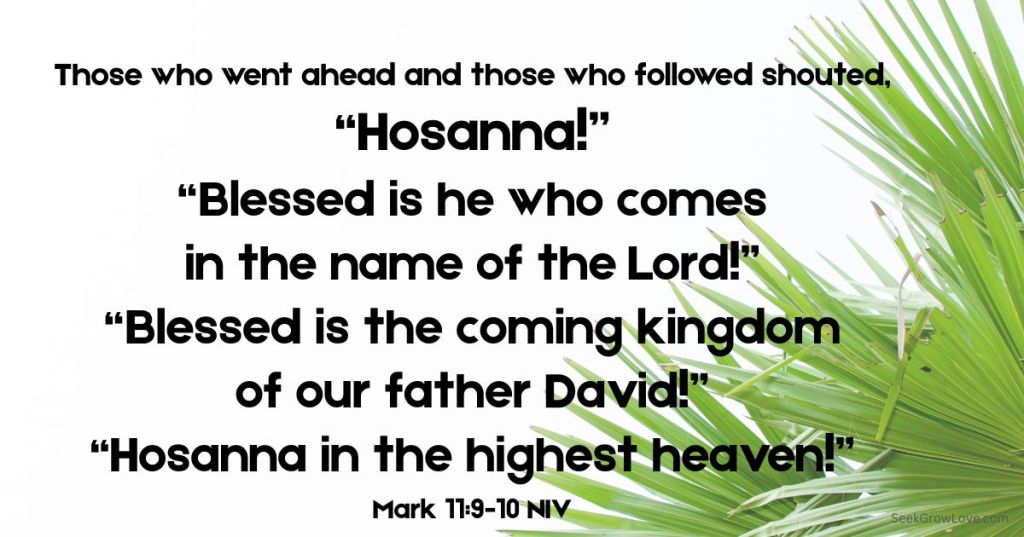
Hosanna is a word used in some songs of praise, especially on Palm Sunday. It is of Hebrew origin: “Hosanna to the Son of David! Blessed is he who comes in the name of the Lord! Hosanna in the highest heaven!” (Mark 11).
Hosanna is often thought of as a declaration of praise, similar to hallelujah, but it is actually a plea for salvation. The Hebrew root words are found in Psalm 118:25, which says, “Save us, we pray, O LORD!”. The Hebrew words yasha (“deliver, save”) and anna (“beg, beseech”) combine to form the word that, in English, is “hosanna.” Hosanna means “I beg you to save!” or “please deliver us!”
So, as Jesus rode the donkey into Jerusalem, the crowds were perfectly right to shout “Hosanna!” They were acknowledging Jesus as their Messiah, as shown in their address “Son of David.” Theirs was a cry for salvation and a recognition that Jesus is able to save.
When is the last time that you have yelled out to Jesus to save you? It’s an important question, and one that needs to be on our lips all the time.
There is nothing more satisfying in all the world than to be followers of a king like Jesus. Picture him riding toward Jerusalem, the rebellious city. A multitude praising him: “Hosanna, blessed, is the king who comes in the name of the Lord.” He knows the praise is shallow. In a few days it will fade away. But does he rebuke them? No. He defends them against the criticism of the Pharisees: “‘Teacher, rebuke your disciples!’ . . . ‘I tell you, if these were silent, the very stones would cry out.'” He knew his days were numbered. He knew their cries were not completely sincere.
The praise the people gave was not because they recognized Him as their Savior from sin. They welcomed Him out of their desire for a messianic deliverer, someone who would lead them in a revolt against Rome. These are the ones who hailed Him as King with their many hosannas, recognizing Him as the Son of David who came in the name of the Lord. But when He failed their expectations, when He refused to lead them in a massive revolt against Rome, the crowds quickly turned on Him.
Within just a few days, their hosannas would change to Crucify Him.
Those who hailed Him as a hero would soon reject and abandon Him.
The story of the triumphal entry is one of contrasts, and those contrasts contain applications to us. It is the story of the King who came as a:
servant on a donkey, not on a white horse.
not in royal robes, but on the clothes of the poor and humble.
Jesus Christ comes not to conquer by force but by love, grace, mercy, and His own sacrifice for His people.
His is not a kingdom of armies and splendor but of lowliness and servanthood.
He doesn’t conquer nations but hearts and minds. His message is one of peace with God.
If Jesus has made a triumphal entry into our hearts, He reigns there in peace and love. As His followers, we exhibit those same qualities, and the world sees the true King living and reigning in triumph in us.
If he lives in us today, we sing Hosanna. With a true and right heart. We don’t crucify him again and again with our sin.
We cry out to save us, not we can save ourselves. What do you cry out to Jesus for? Is it sincere? Is it true? Ask God to give you a sincere heart, so that your worship to God through Jesus is a saving worship.
-Andy Cisneros
Reflection Questions
What can you learn from the King who came on a donkey?
Where else in Scripture do you find humility honored? Are you more known for your humility or pride?
In what ways, at what times, have you tried saving yourself? When have you cried out for Jesus to save you?
This morning I am sitting here preparing for a message at church on the Triumphal Entry. It worked out perfectly that the verses we are using for today’s devotion is from Mark chapter 10:32-34. This set of scriptures focus on Jesus telling his disciples a third time he will die and be resurrected. The disciples are becoming fearful. Because it’s clear that many in the crowd want him dead. And Jesus is moving closer and closer to more dangerous areas.
Based on information given in Matthew, Luke, and John, we know quite a bit happened between Mark chapters 9 and 10. Included in that time frame are an attempt by the Pharisees, chief priests, and temple guards to arrest Jesus (John 7:32–52), an attempt by the Jewish leadership to stone Him (John 8:58–59), yet another attempt to either stone or arrest Him (John 10:22–39), and the decision of the Sanhedrin to figure out a way to kill Him (John 11:45–54). Even Herod Antipas wants to kill Jesus, although vaguely and without much effort. (Luke 13:31). In addition, Jesus tells the Jewish leadership their father is Satan (John 8:44) and some of them counter by claiming Jesus is possessed (John 10:21).
So, it’s no surprise that Jesus’ followers would be afraid as they walk toward Jerusalem. The wording, however, leaves us confused as to who “they”—the fearful followers—are. They may be the Twelve, trailing behind Jesus as is appropriate for disciples. But they may be other disciples following the Twelve. While Jesus had warned the disciples before that He would be killed (Mark 8:31–33; 9:30–32), this is the first time he gives the location. Combining this with the threats that have been building against Jesus, all of Jesus’ followers have reason to be afraid. Jesus, however, continues his movement toward his purpose.
Jesus shows determination, not fear. The night before the crucifixion, resolve will combine with anguish (Mark 14:34–38). Many people wonder why Jesus agonizes over the crucifixion if he knows He will come through it alive and glorified. Certainly, with the knowledge that his sacrifice will be accepted by God and cover the sins of millions – that should give him the courage to walk to Jerusalem. But he knows what is coming (Mark 10:33–34). No sane person would face mocking, spitting, flogging, and death by crucifixion without dread. Even worse than the physical pain, the betrayal by his friend Judas, his friends leaving him. Jesus must watch His Father turn away, abandoning him to the sins of the world (Mark 15:33–39). Jesus knew and understood his purpose. He knew what the father needed from him. And he did not waver from that point.
Do you know your purpose? Do you know the things that God has called you to do? Has God-given you a significant calling? I’m certain he has. Does that make you scared? Are you taking the steps that God has measured out for you? Knowing that it’ll be hard. Knowing people might not understand. But being faithful to a God who loves you and wants to use you for his good purposes. Yes it’s scary but God has called you. God has given you a purpose. You can answer it one of two ways. You can be like the disciples who tried to avoid it, ignore it. Or you can be like Jesus and be obedient, even to death. God is giving you a great purpose, a great meaning and he loves you. You can be sure the God “who has begun a good work in you will be faithful to complete it”. Whatever your purpose is, whatever your job, whatever goal you might have. May you move towards it with the renewed sense of dedication to your heavenly father. I know it’s hard sometimes, but the reward of accomplishing God’s purpose in you is greater than anything you can imagine. “Well done good and faithful servant” are the words we want to hear on that day of Christ’s return. Jesus returns victorious because he was faithful when it was hard. May we be faithful as well.
-Andy Cisneros
Reflection Questions
What was Jesus’ purpose?
Do you know your purpose? Do you know the things that God has called you to do?
Does that make you scared? What can relieve your fear? How can you replace fear with determination?
Are you taking the steps that God has measured out for you?
I love celebrating. Who doesn’t!? But my two favorite holidays are Christmas and Easter, and honestly the time leading up to those celebrations is as precious to me as the holidays themselves. The Advent of Christmas is all about preparing for the birth of the Messiah and the remembrance of that birth. And the only thing better than the birth of our Messiah, in my opinion, was his resurrection from death. This week we’ll be looking at Scriptures in the Gospels that tell the story of Christ and his followers and their days leading up to Christ’s resurrection.
And as we read along, we can prepare together for this special celebration.
Our first passage is Matthew 21. We see Christ and his disciples returning to Jerusalem. It’s packed with those who have traveled there to worship and partake in Passover, and Jesus is coming in on a colt that has never been ridden, fulfilling prophecy. And the people are celebrating! They are preparing the way for him, throwing cloaks and garments and palm branches down to create a path. Can you imagine being there? It’s packed with people and you are taking off your cloak and throwing it on the ground so donkeys can walk over them. It sounds so strange yet this was a sign of amazing respect and admiration. They were singing praises for this man who was entering in such a public, and yet very humble, fashion.
And the first thing Jesus does is ride right up to the temple and enter God’s Holy Place. And what does he find there? A market. A “den of robbers.” Have you ever been to a public, open air market? It’s loud. People are yelling to advertise, chattering, bargaining. It’s overwhelming and busy, full of animal noises and feces. This is what they have made out of God’s house. How can anyone come in prayer and worship and reverence in such a place? And Jesus cleans up in another very public display.
I love this entry. It’s full of this contrast of humility and power. It’s full of passion, from both the crowds as well as Jesus. And it’s such a perfect reflection of how I want to see Jesus coming into my life this week.
Take some time today and prepare yourself with me. Ask yourself:
How can I prepare my life and clear a path for Christ to enter into it this week?
What do I need to lay before him to honor him? My time? My focus? My attention?
How can I celebrate and praise him this week?
What, like that noisy marketplace in the temple, is creating noise and distraction in my life and in my mind?
What is dirtying up my faith and my prayer life? What do I need to oust and overturn?
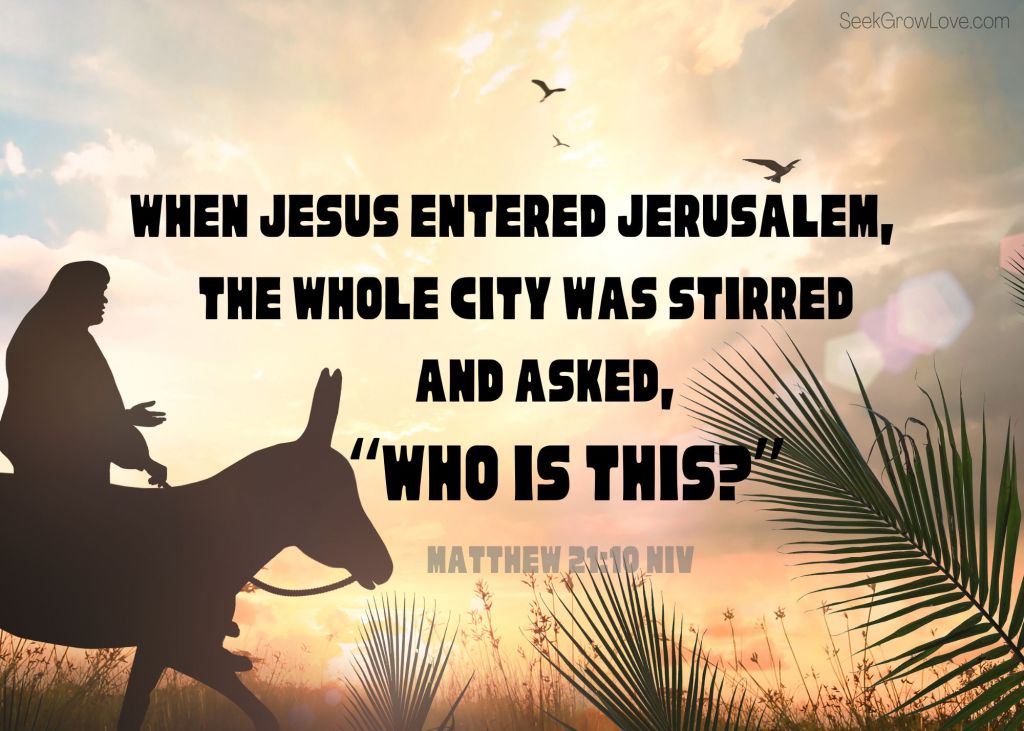
My hope and prayer for you today is that Jesus enters your life in spectacular fashion and causes a stir in your heart just as he caused a stir in Jerusalem so long ago. Happy Palm Sunday!
Jenn Haynes
Reflection Questions
Take some time with the questions in today’s devotion.
Throughout the week continue reading the Scriptures asking yourself, “Who is this Jesus?” and what is he teaching us about himself, his purpose and his Father?
I love to plan parties! I’m usually up late the night before a big party getting all the details just right—making signs, assembling favors, and arranging decorations. Meanwhile, my God plans parades centuries in advance! He planned the famous parade we commemorate each year on Palm Sunday: Jesus’ triumphant entry into Jerusalem.
Daniel received a vision about Jesus’ journey to Jerusalem, about 600 years before it was to happen:
“Know and understand this: From the time the word goes out to restore and rebuild Jerusalem until the Anointed One, the ruler, comes, there will be seven ‘sevens,’ and sixty-two ‘sevens.’” (Daniel 9:25)
It’s important to note that the ‘sevens’ described by Daniel are each periods of seven years. The math makes my head spin (not everybody used the same calendar back then… talk about confusing!), but historians have found Daniel’s vision astonishingly accurate. The time between the issue to rebuild Jerusalem went out (Nehemiah 2) and Jesus’ triumphal entry into Jerusalem is just as God said it would be, to the very year. God’s timing is perfect and His plans always prevail.
In the book of Zechariah, the world’s best party planner gives even more insight into how this day would unfold:
“Rejoice greatly, Daughter Zion! Shout, Daughter Jerusalem! See, your king comes to you, righteous and victorious, lowly and riding on a donkey, on a colt, the foal of a donkey.” (Zechariah 9:9)
And so it came to be—Jesus rode into Jerusalem on a donkey. The gospels contain several descriptions of that bitter-sweet day—Matthew 21, Mark 11, Luke 19, and John 12. Up until this point, Jesus kept his status as the begotten Son of God a secret, urging his disciples not to reveal his identity to anyone (Matthew 16:20). On that day, however, his disciples shouted among the masses, “Blessed is the king who comes in the name of the Lord!” (Luke 19:38). In that same city, in that same week, the cries of “Hosanna!” would turn into shouts of “Crucify!”
As we wave our palm leaves at church this morning, remembering Jesus’ triumphal entrance into Jerusalem years ago, let us also remember the parade still to come. Close your eyes and imagine the grandeur of Jesus’ second coming—the roar of the trumpets, the raising of the dead, and the overwhelming noise of centuries worth of believers worshipping at the feet of Jesus. No more death, no more crying, no more pain:
And I saw the holy city, new Jerusalem, coming down out of heaven from God, prepared as a bride adorned for her husband. And I heard a loud voice from the throne saying, “Behold, the dwelling place of God is with man. He will dwell with them, and they will be his people, and God himself will be with them as their God. He will wipe away every tear from their eyes, and death shall be no more, neither shall there be mourning, nor crying, nor pain anymore, for the former things have passed away. (Revelation 21:2-4)
God’s timing is perfect and His plans always prevail. 2,000 years ago Jesus journeyed to Jerusalem to die. Soon he will return to Jerusalem again to bring life everlasting.
Hosanna in the highest!
-Mackenzie McClain
Today’s Bible readings can be read or listened to at BibleGateway here – Deuteronomy 21-22 and Luke 19
Today is Palm Sunday. Your pastor probably talked about it, and the kids probably sang about. In the Christian tradition writ large, the names of the days of the week are used to express different stages of the auspicious moment. Palm Sunday kicks off everything as the day that the crowds celebrate Jesus and call him their king. Monday and Tuesday don’t have special names. Wednesday is called “Spy” Wednesday, signifying the betrayal of Judas to seek a time to sell out his master. Friday we call “Good”, not in that it is a happy occasion, but in that it was a day when the goodness of God was revealed and we were able to be saved. Holy Saturday comes next and then it is Easter/Resurrection Sunday.
Today, in John 13, we read what is traditionally associated with Maundy Thursday. Jesus takes off his outer garment and gets down and washes his disciples feet. To give context, in a culture where everyone walked it was dusty, baths were not as common as they are today and soap was less aromatic – touching feet would be gross. The disciples knew that the one who washed feet would be a servant. But Jesus, the master, the rabbi, the Christ, the King who was just regaled with Palm branches and crowds shouting his praise, is now quietly washing their feet. The disciples, being with him for at least 3 years are used to his weird antics and personal teaching style.
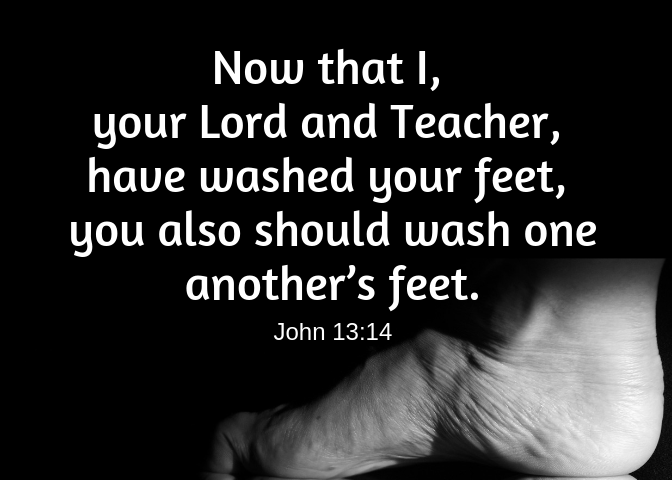
But Peter, never one to be silent, says “No way Jesus!” And who can blame him. The king doesn’t do the slaves’ work. The king has his slaves wash his feet. That’s how the world works. But Jesus lets Peter know that his kingdom works differently. The King serves, and the King’s advisors should serve, and future rulers should serve. If you want to be like Jesus, it’s not about being a King and being served. Jesus said “I did not come to be served but to serve and to give my life as a ransom for many.” He expects us to do the same. “So if I, your Lord and Teacher, have washed your feet, you also ought to wash one another’s feet. For I have given you an example that you also should do just as I have done for you.” (John 13:14-15 HCSB)
I’ve got a challenge. Actually DO it. Jesus gave us an example in this moment. Of course this means we should make ourselves servants and try to serve people everyday. But one way to make yourself humble is to grab your stinky younger siblings, or your mom or dad or grandparents or friend, and actually wash their feet. If you can, today or this week, actually get a group together and have the oldest person wash the next oldest person’s feet and down the line. It is a humbling experience. After you wash their feet and dry them off, pray for that person, and then pass the bucket and the towel until everyone has been washed. Then talk about the experience. Was it weird? Did you think it was OK? Do you think it made sense for Peter to feel a little weird? How would you react if Jesus tried to serve you?
Once you answer these questions and any others, read John 13:1-38. Remember that Jesus served people he knew would betray him and deny him; how much more should we serve those who we know love us: our friends, grandparents, aunts and uncles, moms and dads, brothers and sisters… even when they’re stinky.
Jesus is Coming! What preparations do we need to make before Jesus comes? Climb a tree to get a good vantage point? Put his money to work? Spread your cloak on the road? These were all mentioned in Luke 19 as ways people prepared for Jesus’ coming.
The wealthy, though short, tax collector Zacchaeus was curious about this Jesus who was coming into town. Not wanting to miss out he climbed a tree to make sure he could see Jesus.
In the Parable of the Ten Minas, during the master’s absence most of the servants took what had been entrusted to them (a mina – about three months wages) and put it to work to earn more – and were rewarded for their work.
When the crowd heard that Jesus was coming to Jerusalem they gathered to pay him honor as they spread their cloaks in the road in front of the colt carrying Jesus. And with loud voices they joyfully praised God for the miracles they had witnessed Jesus perform: “Blessed is the king who comes in the name of the Lord! Peace in heaven and glory in the highest”. (Luke 19:38)
This greeting reminds me of the words spoken by the great company of the heavenly host about 33 years earlier when the angels were telling the shepherds of the birth of Christ. “Glory to God in the highest, and on earth peace to men on whom his favor rests.” (Luke 2:14).
No doubt, today, Christmas Eve, many many preparations will be made – supposedly in preparation to celebrate the birth of a King. In the midst of our busyness how will we actually prepare for Jesus? What will we do and say and give and pray TODAY to celebrate his FIRST Coming in a way that will honor him? Perhaps there will be some things that we decide we will NOT do, in order to better celebrate Jesus’ coming.
And, EVERY day – how will we prepare for his SECOND coming?
Will we take the time and effort to seek out Jesus as Zacchaeus did? Will we joyfully accept his invitation to meet together and then find ourselves changed – repentant and obedient – because of the time we spend in his presence?
Will we take the talents, time, possessions and minas/money we have been given and diligently be trustworthy in using them to prepare for the coming return of our Savior – spreading the word, growing the church, and caring for the lost? Or will we be like the scared servant who just hid away the treasure that he was responsible for – and even what he had was taken from him?
Will we work at honoring Jesus, the Son of God who is indeed coming to be crowned king in a kingdom like no other. Will we give of ourselves, not afraid to get our clothes a little dirty, not ashamed to speak boldly, not persuaded to keep quiet by the Pharisees in our midst? For if we don’t speak – even the stones will tell of his greatness (Luke 19:40).
I pray we celebrate his first coming well while we wisely and diligently prepare for his even greater second coming!





 Seek Grow Love