One of the strongest building materials is steel. All the great towers and skyscrapers today are built out of steel. It is a very hard metal and very durable. But it does not start that way. It begins as a piece of iron ore. To transform the iron ore into steel, the iron must be heated to extreme temperatures and exposed to blasts of super hot air to blow out the impurities. When it is quickly cooled, the result is steel – a pure form, durable, and able to stand the test of time. It is only tough and useable because of the intense “heat and violent blasts of air” that transforms it.
The apostle Peter wrote his letters to Christians scattered out across Asia Minor (Turkey today). The Christians there were struggling because of hardship and persecution. Living a life of faith in God was very difficult and dangerous. As the Roman empire continued to persecute the Christians across the empire, the apostles, like Peter, worked hard to encourage the children of God.
Peter reminds us in his letter that we have a “living hope” (1 Peter 1:3-4). No matter what kinds of trouble we experience in life, we can be assured that the hope that we have in Jesus is true and eternal. We know this because Jesus has been raised from the dead, proving that every promise that He made is true. No matter what kinds of sorrow we face in this life, we can be assured of an “inheritance that can never perish, spoil or fade. Kept in heaven for you” (1 Peter 1:3-4). Jesus promised to return to this world to make things right. Then, our promise will be revealed before our very eyes as we enjoy eternity with God the Father and His son Jesus Christ in God’s glorious earthly kingdom.
Despite being persecuted and threatened by the Romans, Peter reminds the Christians that they are to put their faith in God and serve Him. Like the first Christians, God allows us to experience trouble and sorrow because, like heat to iron, He wants to create a tougher, more usable child of God. God desires for each of us to endure troubling times. We are a chosen people (1 Peter 2:9-10). As God’s chosen people, we can be assured that He will use hard times to strengthen us. It is God’s will that we suffer for doing good (1 Peter 3:17). Jesus suffered greatly on the cross. But the result of His suffering has brought us closer to God (3:18). Who knows what incredible things God will bring about because His people are willing to suffer for doing good?
Questions for Discussion:
Are good works the way to earn a blessing? (1 Peter 3:9-12)
Why be gentle and respectful to unbelievers? (1 Peter 3:15)
Ominous title, right? In John 15 and 16, Jesus warned his disciples that they would be hated by the world, just as he, himself, was hated by the world. His final warning makes me shudder:
Indeed, the hour is coming when whoever kills you will think he is offering service to God. (John 16:2b ESV)
Jesus doesn’t say, people might not like you. Instead, he says, when people kill you. Jesus told his disciples they would die. And, they did.
While many reports of their deaths are extra-biblical, there is a range of sources (from pretty well-verified to pretty random) that enumerate the tragic deaths of the apostles. This list includes executions by the sword (Acts 12:2), upside-down crucifixions, beheadings, stabbings, stonings, burnings, and drownings.
The point is this: the disciples knew the dangers of following Jesus, but they did it anyway. The holiness of Jesus was worth emulating. The message of Jesus was worth spreading. The splendor of Jesus was worth striving for—even when it meant being spat on, looked down upon, imprisoned, and killed. They knew the terms. And they signed up anyway.
The next time you’re called a heretic, a prude, or a member of a cult, be encouraged by the apostles who came before us. These apostles faced greater persecution but remained steadfast followers of Christ.
We know why they did it—it’s the same reason we do it. But how did they do it? I think the answer lies in having an eternal perspective, in remembering that a crown of thorns will be exchanged someday for a crown of glory. The pain is temporary, but the glory is eternal.
So we do not lose heart. Though our outer self is wasting away, our inner self is being renewed day by day. For this light momentary affliction is preparing for us an eternal weight of glory beyond all comparison, as we look not to the things that are seen but to the things that are unseen. For the things that are seen are transient, but the things that are unseen are eternal. (2 Corinthians 4:16-18 ESV)
-Mackenzie McClain
Reflection Questions
Do you feel you have experienced any persecution yet because of your faith?
Looking at some historical context of Smyrna is a bit harder than other churches, because it is only mentioned here in these verses. However, we do know that the church of Smyrna is the only church still thriving in the modern day. Reportedly, more Christians have lived in this area than any other Turkish city in the world. This is quite impressive, considering this region has experienced repeated wars, massacres, earthquakes, and plague since they first received this letter.
Smyrna was a very rich area, populated by Roman and Jewish-born people. Unfortunately, Christians were viewed as “cult followers” and often banned from being able to work, purchase needed items, and often faced social or physical persecution. This really highlights what Jesus was speaking of in verse 9 when he described their poverty and afflictions. So how could they possibly be rich? Well, because just like all of us who are baptized, they had the promise of life, and avoiding hurt in the second death (v. 10-11).
From historical records, it has been concluded that a pastor at the church in Smyrna by the name of Polycarp, refused to worship Caesar and renounce the name of Christ. Because of his choice, he was burned at the stake. From these records, it is reported that when commanded to reject Christ, he stated “Eighty-six years have I served Him, and in nothing hath He wronged me; and how, then, can I blaspheme my King, who saved me?”. From there, records indicate he was heard singing praises to the Son of God while being burned alive. It seems Polycarp truly took the words of Jesus to heart, not fearing what he was suffering, and being faithful to the point of death.
It’s hard to imagine even a fraction of the persecution that was experienced in Biblical times, living in modern day America. Even harder, we know that both social and physical persecution still exists around the world today. In a recent report from Open Doors (link below), it is estimated that 1 in 7, or 365 million, Christians worldwide faced persecution in 2023. Of those numbers, roughly 5,000 murders are recorded to be directly related to a person’s faith. Nearly 15,000 churches or Christian properties were attacked. From these reports, it has been determined that North Korea is the most dangerous place in the world to be a Christian. Despite this, Christianity continues to be the highest category across the global population, AND is projected to continue to grow even higher based on current trends. Even with the affliction and suffering, Jesus continues to touch the lives of billions around the world.
Smyrna was one of many churches to experience persecution, but because of their faith, they are considered rich and worthy of the victor’s crown. This message of reward was not meant just for them, but is for everyone who has ears to hear what the Spirit says (v.11). You will face trials in this life as a Christian, whether or not they may be as severe as others around the world. Will you remain faithful?
Reflection Questions:
Have you ever imagined yourself in the place of a Christian around the world? Contemplate how you would respond when faced with persecution. Pray today for those that experience this on a daily basis. For more information, check out the “World Watch List” found here: https://www.opendoors.org/en-US/persecution/countries/
In the passages in Jeremiah today, we see an example of God describing His restoration on earth, sharing the same promise that we also cling to in times of trials. Reading those chapters, what verse sticks out to you as most encouraging when you consider the perfect restoration we will get to experience?
What ways can you hold fast to your faith when you experience suffering in this life? What has worked for you in the past? How can you encourage and support a fellow believer who may be struggling right now?
In chapter 16, we found out that Paul was a Roman citizen. Being a citizen of this vast empire was a great privilege. There were only two ways to gain Roman citizenship; you could either purchase it (something only the rich could afford to do), or be lucky enough to inherit it from your parents when you were born. Paul was born a Roman citizen.
The reason why you would want to be a Roman citizen in the first century is that they were given rights others were not guaranteed. The rights to marry another Roman citizen, to sue and to be sued, to have a legal trial, and to not be crucified were just some of the benefits offered to those privileged enough to be Roman citizens.
As we saw in chapter 21, Paul had already used his citizenship to get out of being flogged (Romans, legally, could not be tortured or whipped). In chapter 25 Paul exercised another of his rights–the right to appeal to Caesar. Paul knew that if he was brought back to Jerusalem, the men that had pledged to kill him would probably succeed. He also knew that he had to get to Rome to testify there. Thus Paul used his privilege to get to where he needed to go, so he could do what he was required to do (though, as we shall see in the coming chapters, this journey would not be an easy one).
If you were born in the West (especially the United States), you, like Paul, are privileged. You have rights like freedom of speech, freedom of religion, and freedom of the press. But there are many parts of the world today where these rights that are taken for granted here are only the ideals of dreamers. There are Christians throughout the world who have to look over their shoulder as they travel to church (if a public place of worship is even allowed) and others who are worshiping with the knowledge that every gathering may easily be their last.
There is another privilege you share with Paul: you are a citizen of Heaven. This citizenship cannot be purchased or inherited. It is not exclusive. The Kingdom of Heaven (or, Kingdom of God) is open to anyone. The poor and the rich, the weak and the strong, the lost and the found are all welcome. The cost of this privilege was paid for by God with the blood of His Son. It is offered to any who will receive it.
Paul was first and foremost a citizen of Heaven. He lived his life devoted to advancing the Kingdom and the One who will establish it in its fullness. The rights his Roman citizenship granted him were nothing compared to those his Lord did. That being said, Paul exercised his privilege as a Roman in order to promote God’s Kingdom as a Christian. He wanted to make sure as many people as possible would become citizens of the Kingdom. You also can use your rights as a citizen of your country to further the cause of the Kingdom. Exercise your earthly privileges in a way that leads others to receive heavenly ones.
-Joel Fletcher
(originally posted March 6, 2019 for SeekGrowLove)
Reflection Questions
Do you think of yourself first as a citizen of the country you were born in/live in – or a citizen of heaven (where God dwells)? What are the differences?
How can you use your rights and privileges to promote God’s Kingdom?
Who do you know who needs to know more about how to become a citizen of the Kingdom of God? How can you share with them?
According to a study by the NORC at the University of Chicago, the last three decades have seen a rapid decline in those who confidently believe there is a God. In 1993, two-thirds of respondents answered “yes” to the claim they “know God exists and have no doubts.” In the most recent survey taken last year, this number has been reduced to 50%. That means in roughly a generation, 50 million Americans have reduced, abandoned, or failed to pass on their faith. No doubt, we are seeing the symptoms of this in our culture, where the most influential theology being preached is that each man or woman is their own idol and that their identity, narrative, or definitions supersede any relationships, including God.
“The Lord saw how great the wickedness of the human race had become on the earth, and that every inclination of the thoughts of the human heart was only evil all the time.” – Genesis 6:5
“Remember this! In the last days there will be many troubles because people will love themselves, love money, brag, and be proud. They will say evil things against others and will not obey their parents or be thankful or be the kind of people God wants. They will not love others, will refuse to forgive, will gossip, and will not control themselves. They will be cruel, will hate what is good, will turn against their friends, and will do foolish things without thinking. They will be conceited, will love pleasure instead of God, and will act as if they serve God but will not have his power. Stay away from those people.” – 2 Timothy 3:1-5
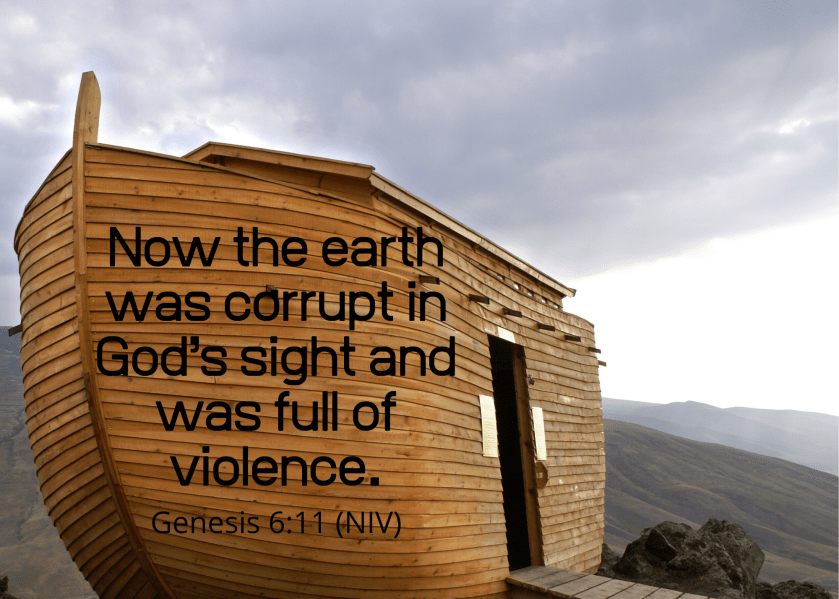
I would love to end this first week of 2024 on a more positive note, but here we are at the ministry of Noah, and I can’t help but see the correlations. I consider myself a church half-full, not half-empty type of person, so please understand I am not hanging an albatross around the neck of the place I call home. Recently, we have seen and could see more revival as people realize there is no salvation in pursuing self. Nevertheless, as it stands today, it seems like the wind is blowing hard in a different direction, and I can’t help but look at the forecast and know that the rain is coming. It may not be here or now, but it is. It is so disheartening to see people jump off the boat, abandon their God, so they can instead find their own way swimming to survive. I want none of us to be the next person overboard, so let us be ready to answer the challenges of the storm that very well may lie ahead, and be defiantly obedient as the prescriptions of Jesus in Matthew 6
Leave your righteousness at the door – Jesus says that if actions are done for the sake of being seen by others or if we are religiously pious thinking that we are worth saving and others are not, that we have already received our reward in full. Noah was the only righteous man left, but while building the boat, he did not tout his own righteousness. He preached to bring salvation to others, even if it fell upon deaf ears. We do not decide who is and isn’t worthy (see: Jonah). Our own righteousness is as filthy rags and none of us can be restored without the atonement of Jesus.
Extend the grace of forgiveness of God – If for no other reason, we should forgive because it is the measure for which we are forgiven; however, we forgive because we have the love of Christ that shows us mercy every time that we fall short. By simply listening and looking for those who thirst, we become more like Christ. A quote that has stuck with me by psychologist Russell Barkley, “The children who need love the most will always ask for it in the most unloving ways.” Do not let rhetoric or trespasses keep you from loving those who need Living Water. You can be the bearer of grace and forgiveness they are most desperately looking for if you cut through the crap and see the child of God.
Endure any suffering with joy – Those of us in the United States have enjoyed a pretty good run of Christian values as the dominant culture. While this run has been far from perfect, it has been easy to avoid persecution. It is very likely that my children will not live in this world. God, I pray that they will be able to declare you in a world that will try to snuff them out. For us all, may we endure the coming trials with joy. When we are persecuted because of the Gospel, we suffer alongside Him. What greater joy could there be than to live out the fullness of Christ?
Don’t worry about not going with the flow – God has promised to take care of our needs if we trust in Him and share His words. We may be unflatteringly categorized, lose our social standing, our job, live threatened, or the reality of violence. If God takes care of the flowers and the sparrows, He will take care of you in every single instance. Even though the traffic may be moving against you, be singularly focused on the Gospel of the Coming Kingdom, and everything else will be added unto you. Ask for your daily bread and then get to work for His Glory because the harvest is becoming more plentiful, but the workers are fewer.
-Aaron Winner
Describe the world you live in today. What similarities do you see to the time of Noah?
What do you admire most about Noah? What can you learn from him? What do you learn about God in Genesis 7 & 8?
What is the problem of going with the flow? How can you help yourself, your family, your church stay in the boat?
“You showed sympathy to the prisoners” (Hebrews 10:34). I don’t know what that phrase brings to your mind. Maybe you see something from a television program or a movie, someone behind a sheet of glass holding a telephone receiver. Perhaps you have visited a prisoner at some point, for a prison ministry, or a relative or friend. You may think of sending letters, or helping prisoners readjust after their release. The issues under discussion in Hebrews were rather different. With the Roman empire it was expected that the relatives and friends of a prisoner would provide their food and other physical needs, though there might be some small rations. Christians became known for taking care of fellow believers who had been arrested for their faith, as well as other prisoners in need. But that meant people helping Christians ran the risk of getting accused of being Christians themselves. That’s probably where the next part of the verse came in, that they “accepted joyfully the seizure” of their property – they continued with their behavior even though it risked them being identified and targeted. They didn’t shy away from risk to guard themselves. It isn’t mentioned here but Christians during the Roman empire also became known for caring for plague victims when others would not, taking in orphans, collecting clothes to give to the poor, and generally being good to others.
In the fourth century the Emperor Julian would become very frustrated about the contrast between the Christians and the pagans. In a letter he wrote: “Why then do we think that this is sufficient and do not observe how the kindness of Christians to strangers, their care for the burial of their dead, and the sobriety of their lifestyle has done the most to advance their cause? Each of these things, I think, ought really to be practiced by us.”
In Hebrews 10 we find that Herb (my choice of a simple name for the book’s author) returned to issues he addressed in chapter six about a person surrendering their faith in Jesus (6:4-8; 10:26-31). These comments are directly paired in both chapters with the statement that Herb’s audience is not like that, which is shown by the fact that they have been ministering to believers (6:9‑12; 10:32-39). For Herb to defend his audience this way should be an obvious route to take. What are Christians told to do? “I am giving you a new commandment, that you love one another; just as I have loved you, that you also love one another. By this all people will know that you are My disciples: if you have love for one another.” (John 13:34‑35). Yes, that isn’t the only thing for Christians to do, but it is a huge example: “This is His commandment, that we believe in the name of His Son Jesus Christ, and love one another, just as He commanded us. The one who keeps His commandments remains in Him, and He in him. We know by this that He remains in us, by the Spirit whom He has given us.” (1 John 3:23-24). And the call to love isn’t necessarily simple or easy, either. The very fact that Jesus said “just as I have loved you” should put this at a high level, for Jesus loves at a high level.
Hebrews 10 began by comparing the priests who stood in the tabernacle day after day offering sacrifices to Jesus and the single sacrifice he offered before he sat at God’s right hand. Herb wants us to understand that what Jesus did is much more powerful than all those earlier sacrifices. And because it is so much more powerful it calls more powerfully for our response. Herb says: “let us draw near with a sincere heart in full assurance of faith, having our hearts sprinkled clean from an evil conscience and our bodies washed with pure water. Let us hold fast the confession of our hope without wavering, for He who promised is faithful; and let us consider how to stimulate one another to love and good deeds” (v. 22-24). Those verses give a complicated image. The idea of being “sprinkled clean” plays off the sprinkling of the blood by the high priest once a year over everything that needed to be cleansed in the Holy of Holies – but Herb says that our hearts are part of what Jesus cleansed. There are no more evil consciences for us, we can have pure consciences and serve wholeheartedly, having been washed with pure water, referring to our baptisms. This is very similar to 1 Peter 3:21-22, “baptism now saves you – not the removal of dirt from the flesh, but an appeal to God for a good conscience – through the resurrection of Jesus Christ, who is at the right hand of God”. We are to hold to the confession of our hope that came with that baptism – because the fact of being baptized, to Herb, doesn’t mean what is so often called baptism today (the sprinkling of a baby, with no knowledge of what it means) but the choice made by a believer to state their understanding in front of at least one other person, confessing hope in the promises of God involving Jesus and the future. He who promised is faithful, so we should not waver in our commitment. By having made that choice each one of us becomes part of the body of Christ, which is a collective group. Recognizing that we are part of that group should remind us that we have support with each other, and also that we have responsibility and commitment for each other, so we need to think about how we can stimulate each other to love and good deeds.
One of my seminary teachers noted that there are two possible interpretations of Hebrews 10:25. It is often used to advocate for attendance at worship services using the phrase “assembling together” to refer to ‘not meeting on a regular basis,’ as a matter of habit. But the Greek word for the assembling or gathering here is the one used in 2 Thessalonians 2:1, and it has been suggested that it could be saying not to forsake our being gathered together with Jesus at his return – so not, by your choices, giving up on being a part of the resurrection with him. More like “Don’t forsake being part of the resurrection gathering, as some are in the manner of, but encourage each other to be there at that day, all the more as you see it drawing near.” Either meaning could work. (The term translated as “habit” also gets translated “manner.”)
Hebrews 10:31, which says “It is a terrifying thing to fall into the hands of the living God,” should be read along with verse 27 that refers to “a terrifying expectation of judgment and the fury of a fire which will consume the adversaries.” We are still speaking of the adversaries of God being consumed, not simply tortured in some ongoing way (as some versions of theology would have it). I see no conflict in this. Notably Hebrews 10:26 references Numbers 15:30, showing that Herb had that part of the book in his mind when he was writing this section about fire and judgment. And Numbers 16 may well be the section he was pointing his readers to for a consideration of how terrifying God could be when passing judgment. God doesn’t need to be a demented torturer to be scary. I don’t think that Korah was complacent when he faced the results of his revolt. Endless suffering is not required for God’s wrath to be respected. If all we were concerned about was what came after this life we would have no concerns about anything in this one. But we have proven ourselves well capable of being concerned about what happens now.
In the last part of the chapter Herb wants his audience to proclaim that they are not giving up on Jesus. He doesn’t want any doubt on that point. He says “do not throw away your confidence, which has a great reward” (v. 35). He quotes God saying:
“My righteous one shall live by faith;
And if he shrinks back, My soul has no pleasure in him.”
But Herb tells his audience “we are not of those who shrink back to destruction, but of those who have faith to the preserving of the soul.” (v. 39).
Lord, it really is a terrible thing to think of anyone giving up on their confidence in your son. I read the book of Hebrews and I think I understand the concern it expresses, the passion which Herb felt about his readers. He didn’t want to say that any of them might turn away, but he didn’t want to stop urging them to remain vigilant. He just really wanted them all to be safe in the end. He wanted to tell them about how dangerous it would be to turn away from the sacrifice that Jesus made, because there is only one sacrifice in the new covenant, but he also wanted to say that it is up to you to judge – because if they thought they might have stepped too far then they might despair and not turn back to Jesus. Everything was a balancing act and the focus was always on getting as many as possible to devote themselves to the Lord. I am glad for your mercy, Lord, because I know so many people who I know need it, including me. Please help us to serve you better. Please help us to grow. Help us to love. Thank you again. Amen.
-Daniel Smead
Reflection Questions
1. Do you value being at church services with other believers? Do you feel that you are a part of the worship? Are you growing? Are you open to others? If not, how could that change?
2. Herb wants his audience to be revived in their faith, to be passionate about Jesus against the risk of persecution. What if they weren’t warned about the risk of persecution when they first became Christians, and meeting opposition took them off guard, how might that affect their attitudes?
3. Are you open to challenging yourself to a Love Like Jesus Day? Of course we are always supposed to do that. But how about consciously checking your actions for one day, all your thoughts, words, deeds, measuring yourself against Jesus and trying to amp your love to Jesus-levels? What do you think it will look like?
“Do I need to be liked? Absolutely not. I like to be liked. I enjoy being liked. I have to be liked. But it’s not like this compulsive need to be liked, like my need to be praised.” -Michael Scott
This quote is not the usual wisdom you’re accustomed to reading on this blog, but it does highlight something about our human condition: we like to be liked.
In Acts 23, we see Paul being—well, to put it understatedly—not liked. He’s been arrested for his teachings about the resurrection and his open arms toward the Gentiles. Because of his Roman citizenship, he is granted the right to a trial. Some Jews are unhappy that Paul is given a fair shake for his supposed crimes, and they take matters into their own hands (and bellies).
“When it was day, the Jews made a plot and bound themselves by an oath neither to eat nor drink till they had killed Paul. There were more than forty who made this conspiracy. They went to the chief priests and elders and said, “We have strictly bound ourselves by an oath to taste no food till we have killed Paul. Now therefore you, along with the council, give notice to the tribune to bring him down to you, as though you were going to determine his case more exactly. And we are ready to kill him before he comes near.” (Acts 23:12-15, ESV)
When I put myself in Paul’s shoes, I quake. I can’t imagine a mob of forty people who hate me so much that they make a vow to not even eat until I’m dead. I’ve never experienced anything close to this magnitude of persecution. While the occasional hostility we receive as Christians does not compare to the threats made on Paul’s life, we can still emulate Paul’s response.
He wasn’t paralyzed by people’s perceptions. He was captivated by God’s purpose for his life. He continued in boldness and went on to testify in Rome, just as God said he would (Acts 23:11). Paul writes more about this in Galatians:
For am I now seeking the approval of man, or of God? Or am I trying to please man? If I were still trying to please man, I would not be a servant of Christ. (Galatians 1:10, ESV).
Speaking vulnerably, this verse is difficult to move past my head and into my heart. In my head I know that my identity, value, and purpose are found in God. But in my heart it is HARD to give up validation from my peers. It feels so good to be in their good graces, and it hurts so badly to be left out, lied about, and laughed at.
It’s hard to tune out other’s voices when it’s quiet. Imagine a humming noise. In a quiet room it would dominate your thoughts, but standing at the foot of a roaring waterfall you wouldn’t even notice it. So here’s the first step for me—and for you too, if you struggle letting go what other people think. Like Paul, be so captivated by God’s purpose for your life, that the rest of the noises just fade into the background.
Live unabashedly how God has called you to live. No apologies. No compromises. No holding back.
-Mackenzie McClain
Reflection Questions:
Have you been left out, lied about, or laughed at because of your faith? How did it make you feel? What does God say about facing persecution for your faith?
God used Paul’s persecution to give him an opportunity to share his testimony to a larger audience. How has God used the bad in your life for good?
How does knowing scripture help you counteract what others say about you?
1 & 2 Kings Introduction
The books of First and Second Kings describe the period of time between the death of King David and the exile to Babylon. They record Israel’s decline over time as a nation – as they sink deeper and deeper into idol worship.
Solomon, David’s son, started out following God and was initially blessed by God; but he eventually turned away from God. As a result of this, the kingdom was divided, with 10 tribes rebelling and choosing a new king (Israel in the North). God allowed David’s descendants to continue to rule over the Southern two tribes, collectively called Judah – because of God’s love for David (which was a direct result of David’s love for God).
One godless king after another ruled the Northern kingdom of Israel until it was destroyed by Assyria in 721 BC. While Judah declined more slowly, God finally allowed Babylon to destroy Judah in 586 BC.
2 Kings 24:3-4 records this sobering message, “Surely these things happened to Judah according to the Lord’s command, in order to remove them from his presence because of the sins of Manasseh and all he had done, including the shedding of innocent blood. For he had filled Jerusalem with innocent blood, and the Lord was not willing to forgive.”
Even though the overall trajectory of these books is depressing, there are some exciting and uplifting stories, including:
Solomon’s dedication of the Temple, and God’s appearance to Solomon
Elijah and his miracles
Elisha and his miracles
Jehoshaphat’s and Hezekiah’s faith
The destruction of Assyria’s army by the angel of the Lord
Josiah’s revival
As you read through 1 and 2 Kings, please notice the strong correlation between obedience to God and blessings from God. Also, notice the relationship between rebellion against God and punishment.
I’ll close with some of the last words of David, as recorded in 1 Kings 2: 2-3, “…So be strong, show yourself a man, and observe what the Lord your God requires: Walk in his ways, and keep his decrees and commandments, his laws and requirements, … so that you may prosper in all you do and wherever you go.”
Yesterday, we read about how the Thessalonians turned from their idols to serve the one true God. However, this caused some problems to arise for them. Those around them still worshiped the idols and chose to persecute them. But Paul has advice for them on how to continue to stand firm in their faith in the midst of all this opposition.
At the very beginning of the chapter, in the first two verses, Paul explains that they came to witness to the Thessalonians right after they had faced persecution in Philippi. Paul says that in Philippi they faced much suffering and mistreatment. He continues to say that in Thessaloniki they continued to face lots of opposition when they worked to spread the gospel.
Many people would have stopped after facing serious persecution in one city. Many more would have stopped when they saw the opposition against them in the next city. But Paul and his companions continued to spread the gospel throughout all these hardships. By telling the Thessalonians about his problems, Paul encourages them by showing that it is possible, when you have God, to stand firm in the faith and to continue doing God’s will. We should let this also encourage us because we know that Paul, in the midst of all the troubles of this world, continued to be one of the greatest witnesses to the whole world.
Paul continues by describing their attitudes in sharing the gospel, even while they were faced with persecution. In verse 7, he describes themselves as “gentle among [them], as a nursing mother tenderly cares for her own children.” Paul, later in verse 12, explains why they acted in that manner. He says that it was “so that [the Thessalonians] would walk in a manner worthy of the God who calls [them] into His own kingdom and glory.”
In the midst of suffering and persecution, many people would have acted in anger against those who were causing this. However, by doing this you are more likely to drive people away from God than you would be to bring them to Him. But, when you act as Paul and his companions did, being gentle in the midst of persecution, you become an imitator of God, showing love to those who are your enemies. Through this love, people will come to know God and walk in the way that God has called them to walk.
While this letter may have been written to the Thessalonians, it doesn’t apply only to them. We also need to make sure that we are not letting persecution stop us from doing God’s will. When we continue to do the work that God has called us to do in the midst of opposition, we need to make sure that we do it in the attitude of love and gentleness.
-Kaitlyn Hamilton
Questions for Reflection and Discussion
What encouragement do you gain from hearing Paul’s testimony?
Can you think of a time you faced opposition while spreading the gospel? Did it stop you – or did you continue, with God’s help? If you can’t think of a time you were spreading the gospel – how can you start now?
Paul says, “We are not trying to please people but God, who tests our hearts” (1 Thessalonians 2:4 NIV). Can you say the same? Are there any areas where you slip into people pleasing mode rather than concentrating on what God wants to see from you? How does this relate to spreading the gospel?
In comparison to the previous several chapters, Mark chapter 13 takes a rapid shift into a different topic. Recently Jesus has been responding to the trickery of the Sadducees and corrupt chiefs and priests, but as he and the disciples leave Jerusalem, he begins to speak on the nature of the end of times. Other than the fact that several of the disciples specifically questioned Jesus on the matter privately, I am assuming that this is sparking the point at which Jesus is coming to some sort of terms with what is about to happen. He has been warning the disciples of his death in somewhat cryptic manners, but I would imagine that seeing the state of the city and the leaders who were about to crucify him only made him feel worse.
Now of course, as is always the case, it is important to be able to read the Bible with discernment between literal and poetic/prophetic verse. Interpret with great caution for yourself what makes the most sense in the context of what is being said, so that we don’t confuse literal for metaphor or vice versa. For this reason, I will go through some of what Jesus is about to say and without completely putting a definitive interpretation to it, as much as I can (as is so difficult to do with revelational scripture), I will provide objective fruit for thought that is applicable regardless of your interpretation.
Alright, Jesus begins answering four of the disciples’ questions on what will happen at the end of days, when the stones and buildings will be thrown down. Jesus starts explaining the things that will happen, presumably in order although that is not clarified here, in detail. He first says, “Watch out that no one deceives you. Many will come in my name, claiming, ‘I am he,’ and will deceive many.” Mark 13:5-6. Already he explains that false prophets will come claiming to be the Messiah, and that we are not to believe them. This is the main delineating difference between Christians and the Jewish beliefs; they still await a Messiah. This first point is fairly simple; we must be careful that we do not accept or invite another Messiah, for the one and only has already come. Let’s continue.
“When you hear of wars and rumors of wars, do not be alarmed. Such things must happen, but the end is still to come. Nation will rise against nation, and kingdom against kingdom. There will be earthquakes in various places, and famines. These are the beginning of birth pains.” Mark 13:7-8. Is this not incredibly applicable with what’s going on in the world right now? The news, 24/7, is pumping us with the prospect of potential growing war as the war in Europe is expanding and tensions between America and China heighten day after day. Increased frequency of earthquakes and constant food shortages around the world as farmers are told to stop planting their farms… But remember, “Do not be alarmed.” Have we not already won the war? Our battle is not in the flesh but for the salvation of our souls. The world will always be a bad place, as it is destined to be, but we aren’t put here to worry and cower in fear.
The passage continues with, “You must be on your guard. You will be handed over to the local councils and flogged in the synagogues. On account of me you will stand before governors and kings as witnesses to them. And the gospel must first be preached to all nations. Whenever you are arrested and brought to trial, do not worry beforehand about what to say. Just say whatever is given you at the time, for it is not you speaking, but the Holy Spirit.” Mark 13:9-10. This is a tale as old as time, but ever more important to be prepared for as rights and freedoms around the world are being slowly and quietly removed or revoked in the heat of terror. Not only that, but believers will be brought forward within the church to be punished for the truth. We’ll be thrown in jail and persecuted for his sake. But again, we are told not to worry. What better cause is there to not worry about ridicule than the unquestionable word of God and truth? We have won the war with God on our side, have no fear in the face of adversity.
But what should we do in light of these things? Sure, we can say that we should have no fear, but it’s much easier said than done when facing the edge of tyranny’s sword against faith that is coming. Let’s continue reading to find out. “Therefore, keep watch because you do not know when the owner of the house will come back—whether in the evening, or at midnight, or when the rooster crows, or at dawn. If he comes suddenly, do not let him find you sleeping. What I say to you, I say to everyone: ‘Watch!’” Mark 13:35-37. Be prepared! Fortify your heart and soul with the truth of the word and watch for the second coming of Christ! Don’t wait until tomorrow to finally start that Bible reading plan, or tell your family you love them, or volunteer to work at that homeless shelter. We know not when Jesus is coming back, so we must be prepared at all times for when he does.
Remember, “All men will hate you because of me, but he who stands firm to the end will be saved.” Mark 13:13. Our battle is already won, in the face of all worldly adversity, so be prepared for his coming.
-Mason Kiel
Application Questions
How many times in Mark 13 does Jesus warn to watch, watch out or be on guard (or whatever terms your translation uses)?
Why is this important to Jesus? Is it important to you?
What will it look like for you to be diligently watching for the owner of the house to return?
Do you sometimes find yourself worried about the condition of the world or the end times events? What would Jesus say? What can we do to overcome these fears?
Paul leaves Athens and arrives in Corinth at the start of Acts 18. Paul meets Priscilla and Aquila and works with them as tentmakers in Corinth. Paul visits the synagogue and tries to appeal to the Jews and Greeks. He was reviled in the synagogue and then shakes out his garments and declares that he will only speak to the Gentiles. Even with the ruler of the synagogue being converted he still faces danger in the city.
Paul had been chased from the towns of Thessalonica, Derea, and Iconium. I am sure Paul must have been wondering if this was his time to get chased from this city as well. The anxiety of knowing that in every new city he came to there was a chance of being thrown out of it and physical harm coming to him would have been a lot to bear.
God comes to Paul in a vision. God giving Paul this vision is an act of grace towards Paul. God is trying to comfort Paul and give him direction. God starts out with the simple statement of “Do not be afraid”. This feels a lot like Joshua 1.9. God gives Paul two more commands; Go on speaking and do not be silent. Paul has probably realized that most of his trouble befalls him when he speaks and he is not silent. The same thing is true of me except it normally isn’t because I’m preaching the gospel. God gives three commands and the unique thing about this vision is God also gives Paul three reasons why he should do those things.
We have plenty of commands of God and God very often gives us the reasons why we should follow his command. Sometimes we aren’t willing to look hard enough for the reasons but there are almost always reasons. Sometimes we won’t find out the reasons until later or maybe we find out the reasons why in the kingdom. There is an element of faith in following Christ.
God’s reasons for why Paul should obey his commands are that God is with him. God being with you may result in a kind of fearlessness. God’s next reason why is that no one will attack Paul to harm him. This statement must have relieved a lot of anxiety from Paul. God’s third reason why is that God has many in this city.
God makes good on his promises to Paul. In verses 12-17 Paul is brought before the proconsul of Achaia, the ruler of that region, by the Jewish rulers and the new ruler of the synagogue. He is accused of persuading people to worship God contrary to the law. Just as Paul was about to speak the proconsul says that because it is a quarrel about words and there is no wrongdoing that he refuses to rule on this. The proconsul drives all of Paul’s accusers away. The mob that had formed ends up beating the new ruler of the synagogue, one of Paul’s enemies, in front of the proconsul.
When we follow God’s lead and direction it will put us into positions where we get to see God work in situations. This situation for Paul worked out well for him. He didn’t even need to do anything to get out of the situation. He relied on God and God worked it out. The proconsul responded in his favor before Paul spoke. God was clearly at work in this situation because after that his enemy, the ruler of the synagogue, ended up being killed by the mob. His enemy was killed by the people who had originally intended to kill him.
When we join God in what He is doing we will see this provision for us as well. There will be suffering and some pain but there will also be moments where we get to see God do God things and experience Him through those events. That’s part of what makes Christianity so exciting, fulfilling and awesome.
-Daniel Wall
Questions for Reflection and Discussion
Can you think of a time you didn’t speak up for God, perhaps because of fear or discomfort? What promises of God might you have missed out on with that failed opportunity?
When have you had the pleasure of “see(ing) God do God things and experience(ing) Him through those events”
What can we learn from Apollos and Priscilla and Aquila later in this chapter?








 Seek Grow Love