Why Am I Reading This?

John 20-21

Jn20

Saturday, June 3

If you are in high school, you have asked this question sometime this year. If you are in college, the question probably gives you flashbacks of finals. If you are like me, you are 300 pages deep in a 400 page textbook by the time the question comes up. By that point, you are too doggedly determined to put the book down. “By gum, I’m gonna finish it!” the stubborn, stalwart voice in my head says.
Truthfully, it is a great question. When we ask, “Why am I reading/watching/listening/responding to this?” we ask a bunch of questions at once. What do I hope to gain from this? How will this knowledge inform my future actions? In what way does this information or content contribute to my mental, emotional, physical, spiritual, or financial success and well-being? And the answers to “why am I reading this?” may be diverse. Maybe, like us college & graduate school students, you read something simply to gain the information from it for a test or project. Maybe you are reading to make wiser decisions in the future. But beyond these questions, which we ask of ourselves, this is also a question we ask of the author. We are also asking, “Why did you write this?” Why did J.R.R. Tolkien put pen to paper and craft some of the most iconic stories ever? (Lord of the Rings) Why did C.S. Lewis tell of magic (The Chronicles of Narnia), of angels and demons (The Screwtape Letters and The Space Trilogy), and teach through his lovable, accessible, British way (Mere Christianity)?
In the Bible, this question doesn’t get answered too often. The Book of Job doesn’t tell us why the author wrote it. Sure we have very informed guesses, like, “The good and righteous will suffer. That is the way of this world.” But never once does the author tell us WHY he (or she) wrote the text. The authors of Matthew, 1 Kings, and 1 Chronicles, similarly did not take the time to tell you why they wrote. Again, there is a case to be made that the purpose can be found, like “to record history.” But then, why is Matthew’s account of Jesus’ life so different than John’s, and why do 1 Kings and 1 Chronicles differ so greatly in their retelling of the same events? (There are answers to these questions. They are not easy answers, but they help us in understanding the text, if we are willing to do the work.)
All this is to point to two of my favorite verses in the entire Bible, John 20:30-31. If you have never memorized a verse in your life (John 3:16?), seriously, start with these two in John, because they could basically sum up the ENTIRE NEW TESTAMENT. Actually, there is a case to be made that the ENTIRE BIBLE could be summed up in these beautiful words.
John 20:30-31 –  Jesus performed many other signs in the presence of His disciples that are not written in this book.  But these are written so that you may believe Jesus is the Messiah, the Son of God, and by believing you may have life in His name.
The author of John completely acknowledges he left things out. It doesn’t matter to him that every single detail down the line be absolutely perfect. He does not even begin to suggest that he told the story in chronological order. There is no way to make the Synoptics (Matthew, Mark, Luke) and John compatible, with one single “correct order of the life of Jesus.” That isn’t the author’s point. The author didn’t write this Gospel to give us another “play-by-play” of Jesus’ life.
What the author does say, the reason why he put his pen to paper, what the Spirit was doing in him when it moved in and used him to write down words through the authors hand and brain, is so that YOU may believe. You reader. Not another “you”. I’m talking to you. These signs, these teachings, this crucifixion and death are written so that you may believe that Jesus is the Messiah, the Son of God. The author cares about how you deal with this. See, if at the end of the day you are done reading John and you say “Jesus was a really good man” or “Jesus was a wise teacher” then YOU’VE MISSED THE POINT. The point is not that Jesus was a pretty cool dude, or that he was a man who died for what he believed in. He was inaugurating the Kingdom of God by coming, and that we can choose to be a part of God’s Kingdom now; in other words, he is the Messiah. He came to live a perfect life, overcome the world, and be the lamb of God who takes away the sin of the world; in other words, he is the Son of God. Any other reading of John is a mistake. It is wrong. Jesus is not just another good leader, good religious teacher, good dude. He is the Messiah, the Son of God, the Only Begotten Son.
If you end up believing in WHO Jesus is, in WHO he pointed us toward, in WHAT he was doing by ushering in a new way of being, then you have hit the point of the message of Jesus. You understand what the author of John was doing in all these many chapters, in signs, teachings, moments with the Savior. Moreover, by believing in Jesus, you will have life in his name, eternal life, abundant life now that can’t help but last forever! I hope that is where you find yourself today. The reason why I write so much about John is because I love it. I am a mess. I am a broken and sinful mess. But there are a couple things I know. I see these signs, these miracles and this death and resurrection and I have to believe that Jesus is the Messiah, the Son of God. And because I believe, I know that I have life because of him. I didn’t earn it. I don’t deserve. But I’ve got it. Come, you who are also undeserving, just like me. You sinners like me. You broken messes like me. Jake, like John, calls out “Believe that Jesus is the Messiah, the Son of God, and by believing, you too can have life in his name!”
In Christ,
Jake Ballard
(Photo Credit: https://biblia.com/bible/esv/John.20.29)
How Do You Crown Your King?

John 18-19

PastedGraphic-1

Friday, June 2

(This is a longer post. Please give yourself ample time to read it and pray over the questions at the end.)
Interesting trivia: the Greek Orthodox Church fasts every Wednesday and Friday. Every single one. Why? There are reasons to believe the Jews began this practice of fasting and that they carried it on. Beyond that, they also add a religious and theological reason: on Wednesday Christ was betrayed and on Friday Christ was killed. Every single week they remind themselves that they are in some way responsible for the Son of God hanging on the Cross.
These are the chapters we read this week in John 18-19. They tell the story of Jesus’ betrayal, torture, crucifixion and death through the eyes of John. What can we learn from this?
First, Jesus said, “Am I not to drink the cup the Father has given Me?” (John 18:11) Jesus accepted that this was the way that God had given him, and did not want to resist this way with violence. We can be so much like Peter, who cut off the ear of Malchus. We can be so  quick to violence. But Jesus, even with these men sent to kill him, his worst enemies on earth, was about peace, love and healing. Luke 22:51 expounds the story by finishing up the scene. “But Jesus responded, “No more of this!” And touching his ear, He healed him.”
That’s because Jesus is not focused on the injustice of what is being done to him. He is not looking for his personal justice. Jesus is, instead, focusing on his God-given destiny and duty. When being questioned by Pilate, he says “You say that I’m a king.” Jesus goes on to say,  “I was born for this, and I have come into the world for this: to testify to the truth. Everyone who is of the truth listens to My voice.”(John 18:37) Jesus is focused, in the middle of supreme injustice and false imprisonment, on why he was born, the reason for his existing. And what is that purpose? Not to disparage any evangelical preacher, but Jesus did not merely come to do three days’ work. Instead, he came to “testify to the truth.” The truth is humans need to be saved from their sins, he is that salvation, he is the only way to salvation, eternal life and the spirit will be given to those who seek this truth.
In the midst of this, we also see a picture of the world. Now, I’m of a specific bent that says God does not control every facet of the universe. God does not predetermine or force my hand and only make me act as he wants me or wills me to act. However, this does not mean that the world is completely and utterly out of control. In a way that is completely unknown to me, a way that I daresay we should call a mystery, God controls certain events, outcomes, or situations. Here, Jesus seems to take comfort in the fact that his own torture and death is not outside of the plan of God. God knew, “If my Son goes among the Jews and tells them the truth, they will crucify him. I will give humanity the authority to do so.” God isn’t wringing his hands in heaven saying, “I wish I could do something, but I’m not strong enough!” Nor is God a puppet master with all the strings making his marionettes dance. He is working out his will inside the real, free, true choices of humanity.
Interestingly, Pilate may have gotten it. Pilate, according to all the history books was a brutal and bloodthirsty man ready to squash any rebellion with the slightest whiff. But I think he understood who he was talking to in Jesus and what the Jews were asking of him. He seems to have answered his own question “What is truth?” And he answers it with the inscription above Jesus’ head “Jesus the Nazarene, the King of the Jews” written in every common language. The truth is that in this suffering, we see the ultimate juxtaposition. A savior killed like a slave, a righteous man made wretched, a King on a cross. THAT’S the symbol we gravitate toward. That’s the symbol that defines Christianity. It is a cross that shows the greatest moment of humanity, depravity and sin, and the greatest moment of the God-granted mercy, compassion and love.
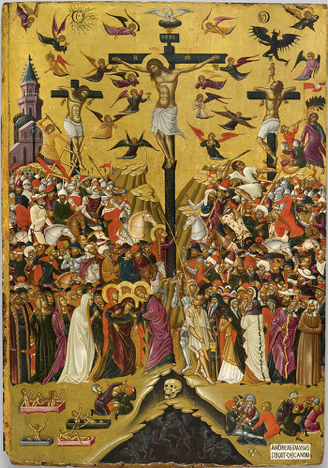
Then, Jesus dies. There’s no fanfare in the book of John. It is interesting that what happens in the other gospels, the earthquake and the darkness and the resurrection of righteous ones, are summarily overlooked or forgotten. They pale in comparison to the fact that the King of the Jews, the bread of life, the water of life, the SON OF GOD is hanging dead on a cross. This man, who only loved, who only wanted the best. Who demanded that the pharisees live the same life they demanded of everyone else. Who said “turn the other cheek” and “do not judge unless you are ready to be judged”. Who said “blessed are the meek, blessed are the poor, blessed are the persecuted.” This man who lived a life of perfect relationship and obedience to God, is hanging limp on a cross, covered in blood and bodily fluids. His arms and legs are no longer straining against the nails because he feels the pain no longer. His body bears the marks of scourging. His face is beaten beyond recognition, and above the bruises and laceration that disfigure the face of the Messiah, sits a crown of thorns, a gift from humanity to inaugurate our King.
There are many questions to ask of ourselves after this.
Do you treat your enemies with love and respect?
In times of trouble do you rest secure in the knowledge that you have a larger purpose than simply existing for today?
Do you even know what the larger purpose of your life is? Do you know specifically what the goal of your life is?
Do you rest secure in the knowledge that God is ultimately in control, whatever that might mean?
But above all of this is: what does it mean, FOR YOU, that the Son of God died on a cross? What does it mean for you that Jesus was tortured unjustly by a religious institution that couldn’t handle the fact that they were, in fact, broken and messed up and needed some saving? What does it mean for you that you were just as much responsible for the death of Jesus as Pilate and Caiaphas?
What will you do? We’ve place the crown of thorns of his head.
Will we cast our crown before him and acknowledge that Jesus is not only the King of the Jews, but the King of Kings and the Lord of Lords?
Will you commit to making him YOUR Lord, the Lord of every part of your life?
In Christ,
Jake Ballard

My Life Purpose

Luke 4-5

purpose road

May 15, 2017

Have you been on youtube lately? If you have I’m sure you may have heard this on one of the ads before your video. “Do you know your life purpose? Do you know your destiny?” (Yes, Tai Lopez has made it into my Fuel Devotion.) But regardless of who asked these questions, they are good questions to ask and to think about.

Jesus knew his life purpose, we see this in Luke 4:43 “I must preach the kingdom of God to the other cities also, for I was sent for this purpose.” Jesus was sent so he could preach the message about the coming Kingdom of God. We know today that he did that very well considering how big Christianity has become. I believe this has something to do with the fact he called other people to join him in preaching this message.

We can see Peter, James, and John joining Jesus after he tells them they will be fishing for men in Luke 5:10-11. “. .they left everything and followed him.” Peter, James, and John thought they were going to be fishers of fish their whole life. But plans changed when Jesus called them to be fishers of men.

For the entirety of my senior year of high school, I wanted to become a full-time firefighter. I was already a volunteer at my local Fire District and had already taken Firefighter 1 and 2, plus EMT-B training. It was a done deal, I was set on making it a career. Well, all I can say is be careful what you wish for because I am becoming a full-time firefighter. Someone once told me that “To be a Pastor is to be the ultimate firefighter.”. Here I am freshly graduated from ABC about to do a pastoral internship. I guess I became a firefighter after all, huh?

Just like Peter, James and John were fishermen, they kept their job title but the job was different. They thought they knew their life’s purpose and destiny but God, through Jesus, had directed them to the ministry of preaching the kingdom of God. Have you thought about your life’s purpose lately?

-Jesse Allen

Don’t Be That Guy

Obadiah and Jonah

obadiah

Sunday, April 16

Don’t worry, God hasn’t forgotten.

Obadiah is the shortest book among the minor prophets, yet it’s message is anything but minor or insignificant. To grasp the content of Obadiah we have to go through a brief history lesson. History was my favorite academic subject in school, so other history nerds, you’ll enjoy this. Also, understanding the historical context of the books of the Bible is one tool used in hermeneutics (the study of how to interpret biblical texts). In other words, to be responsible interpreters of the Bible we should always attempt to reconstruct the historical context of the passage.

Though Jeremiah attempted to convince the people of Judah to surrender to the invasion of Babylon of 586/587 BCE, they refused. The context and content of Obadiah is situated in the aftermath of the destruction and exile brought on by Babylon. Verse 1 tells us that God gave Obadiah a vision concerning the nation of Edom. Edom is the cousin nation to the people of Israel. The patriarch of Edom is Esau and Jacob is one of the patriarchs of Israel. From the time of Jacob and Esau being in the womb to long after their deaths, they and their people have had rocky interactions, including the one described in Obadiah. Verses 2-9 describe judgement and wrath awaiting the nation of Edom, however we’re not told why until verse 10.

The first line of verse 10 says “Because of violence to your brother Jacob…”. Then from verse 11-14 the phrase “on the day/in the day” shows up nine times! When Babylon ransacked Judah, the Edomites, the cousin nation of Israel, just stood on the sidelines watching and did nothing. God is telling the Edomites they will be judged for what they didn’t do “on that day!” They didn’t come to the aid of the Israelites and instead enjoyed and gloated over their doom. Obadiah is writing to those who have been left behind to encourage them and remind them that God has not forgotten the wrong done to them.

There are two lessons we can take from Obadiah. First, just as God had not forgotten the wrong done to his covenant people Israel, likewise God doesn’t forget the wrong done to you. We serve a God who takes action in the present. And even if a wrong is not vindicated in this present evil age it will certainly be reversed at the return of King Jesus. Second, we see that God equates ignoring justice and not taking action as doing “violence”. Are you someone who shies from standing up for what is right? Do you stand by idly while injustice occurs? The New Testament places a great emphasis on taking care of other believers in the body and being there for them. Do you do this? Edom didn’t take care of their family and it displeased God greatly. Shoutout to God for having a significant message tucked away in a tiny unsuspecting book.


Don’t be that guy: The Story of Jonah

            The story of Jonah we have all heard in one capacity or another. Whether it be in Sunday School, a sermon, or just having a superficial awareness of Jonah and his short yet interesting story. The four chapter story can be summed up fairly easily: Jonah is called by God to bring Nineveh, a great terrible city, to repentance. Jonah then runs away but is swallowed up by a great fish-spewed back onto land and again given the charge to preach repentance to Nineveh. He preaches and Nineveh repents and as a result God does not smite the Ninevites. Meanwhile, Jonah stews about how they were saved not demolished.

Consensus about the purpose of Jonah among Old Testament scholars is that there is none. There are a bevy of interpretations concerning the purpose and point of the book. However, there is one thread that stuck out to me the most that connects the story of Jonah to our own contemporary world. We see Jonah as someone who knows the true God and thus is part of the people of God. God gives Jonah a mission to preach repentance to the Ninevites, so that they may turn from their life of pagan idolatry and a life without knowing the true God, to living lives in a manner that is reflective of the truth of the God of Israel, the one true God. But Jonah isn’t down with this plan and flees the opposite direction.

In a parallel manner, you and I have been called to evangelize to those who do not know the truth of Jesus and the kingdom of God. Be honest with yourself, as a disciple of Jesus, do you share the gospel with those who do not know it or have not accepted it? We can think of many reasons why we can’t or we shouldn’t, but is this being faithful to the call Jesus has given us? It’s uncomfortable, I get that. It can be awkward, you’re absolutely right. It’s scary, exactly. But let’s not be Jonah and run away from the message we have been given to proclaim.

Pray for boldness, confidence, and opportunity. Get the gospel message embedded in your heart and mind so that you know where to take someone when you dialogue with them. You got this, you can do it. Don’t be Jonah, be faithful.

-Jacob Rohrer

Bio: ABC (Atlanta Bible College) grad.  Ohio native. Kingdom citizen


Peace in Our Time

 IMG_0034

Daniel 10-12

I am no expert on Biblical Prophecy, or on anything for that matter. So I’m not going to try to explain the prophecies in Daniel 10-12. Instead I want to share three things we can learn about God from Biblical Prophecy and three implications of those things for our own lives.

(1) Biblical Prophecy illustrates that God is not in time. This means that God is not bound by the same time constraints as we are. You and I can only deal with the present. We may have memories of the past and fantasies of the future, but we can see what is really happening only while it is actually taking place. God is not like this. He can see all of history at a glance; this is how He could reveal to people like Daniel the goings-on of the future.

(2) Because God is not in time He is the greatest of planners. The people we think of as planners (people like my wife) tend to have a focus on the future. This is why they plan—to be prepared for what is coming in the future. Since God can see the future He is able to plan things out in such a way as to generate best possible result. And because God loves us, those plans promote our welfare.

(3) Not only does God make plans, but those plans happen just as He promises. There are hundreds of prophecies throughout the Bible, some of which have already been fulfilled. Many of the prophecies in the Old Testament predicted that a Messiah would come. They foretold of the place of his birth, the characteristics that would define him, and the ultimate sacrifice he would have to make. When Jesus came, he was the embodiment of these promises—although many didn’t recognize this. When God makes a promise, you can bet your bottom dollar that He will come through.

(4) Because of God’s track record in promises department, we can trust that the prophecies in the Bible that haven’t yet happened will eventually happen. While it is very easy to lose trust in the empty promises of politicians, we can rest assured that God won’t let us down.

(5) Our trust in the promises of God should give us hope for the future. While the Bible does prophesy that in “the end” difficult and trying times will come, after that there will be no more pain, no more tears, and we will be with our God in His perfect Kingdom.

(6) What all this really means is that right now, in the time we are constrained to, we can live at peace. Despite the craziness of the world around us, however terrible and unbearable it may become, our hope can anchor us so that we can stand firm and live in serenity. So look at the promises God has made, see that He keeps them and that they are good, and live in peace, with hopeful expectation for the culmination of all the prophecies in the Bible.

– Joel Fletcher

Quit Something

Ezekiel 34-36

Ezekiel 34-36

Thursday, March 30


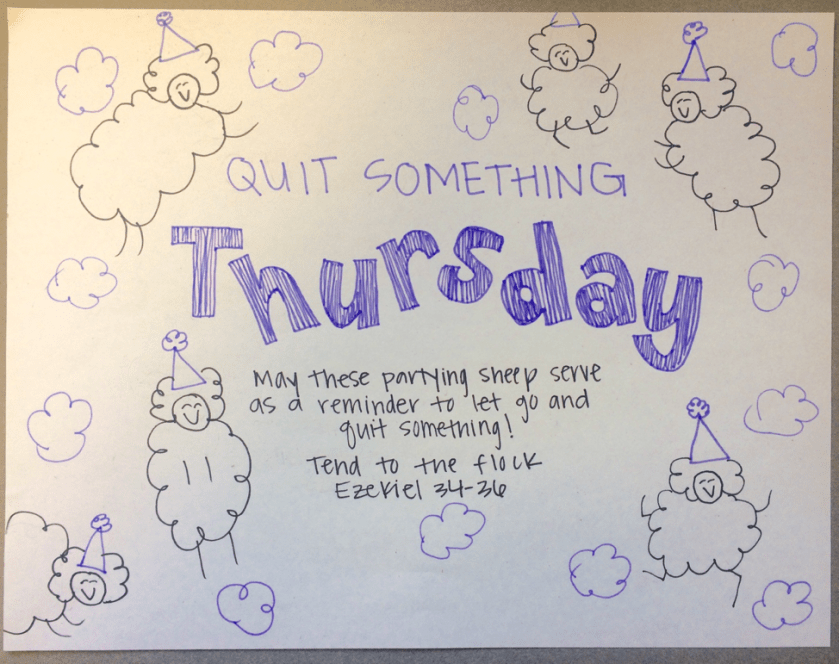
“It’s Thursday.  Quit being who you were.” – Bob Goff


Bob Goff, the author of “Love Does”, has a weekly ritual.  It’s called “Quit Something Thursday”.  Each Thursday, Bob Goff quits something to free up time or shake things up.  He has quit having an office.  He now works on a lobster boat he refers to as the Goffice.  He quit leaving phone messages to minimize the time that is wasted with the back and forth.  He throws away furniture, and has even resigned from the board of a non-profit charity.  Now the idea is not to back out of your prior commitments and become a wild-card liability for the people around you.  Instead, the idea is to give God room to show you something new. Bob Goff suggests quitting habits that keep us from being the best we can be.  On a more moderate scale, he suggests we might quit keeping score, quit sorting through our failures, or quit believing you are who you used to be.


So how does this relate to our reading today?  In Ezekiel 34 the sheep were scattered because the shepherd did not care for them; the shepherd only cared for himself.  However, we learn from Ezekiel 34:2-4 that it is the responsibility of the shepherd to care for the flock.  Instead, the shepherd “eat[s] the curds, clothe[s] [him]self with the wool and slaughtered the choice animals, but [he]did not take care of the flock. [He] did not strengthen the weak or heal the sick or bound up the injured.   [He has] not brought back the strays or searched for the lost” (Ezekiel 34:2-4).  The shepherds are too caught up in their own lives, their own ideas, their own health and fortune, that they lost sight of their purpose.  If not a shepherd, where is their identity? Thankfully God takes action and tells of the time when David (David’s line) will be the shepherd and God himself will be their God.  We see parts of the kingdom here on earth now, and we wait excitedly for the return of Jesus and the kingdom on earth.


We, too are shepherds tending to a flock.  As Christians who are no longer on milk, we have a flock to tend to.  We have a Church who needs us to show up in more ways than to simply fill a seat on Sunday.  As the shepherd cares for the flock, and strengthens the weak, we are called to do the same.


So the question becomes: what are you going to quit so that you can tend to your flock? Is your plate overfilled? How will you re-evaluate your obligations so that they align with your true priorities? It’s Thursday – quit something! I am going to quit washing my clothes because it takes up valuable time I could be investing in others…kidding mom, I really do wash my clothes.  But in all seriousness, I will quit placing so much emphasis on how others perceive me, and instead trust that the identity I have in Christ will carry me where I need to go.  What will you quit?


“We can’t change much if we don’t quit much” – Bob Goff


-Amber McClain