Who is the Son of God?


Luke 22

luke 22_46

Yesterday, in Luke 21 Jesus was warning the disciples (and those who would follow) of persecution while encouraging them to stand up under it.  And today, in Luke 22 Jesus himself is cast into a fierce storm of persecution.  He will now be showing – not just telling – the disciples, his contemporaries, and all those who would come after him how to stand up under persecution.

But first, a private dinner with his closest disciples to commemorate the Passover – when God saved his people from slavery by the blood of the lamb.  And very soon a new lamb would be sacrificed to save God’s people from slavery to sin.  Jesus tells his disciples that he will not eat the Passover meal, or drink of the cup again, until the Kingdom of God comes.  Communion services are a great reminder of this promise.  At the dinner, he uses the opportunity to remind them once again the secret to great leadership – be a servant.  Stop fighting over who is best…just serve.

I love how even though Jesus knew ahead of time that Peter would fail him, he had still prayed that Peter’s faith would not fail.  And even though Satan would have the opportunity to “sift all of you as wheat,”  Jesus saw a future for Peter in which Peter would be using those painful experiences to help strengthen his brothers.
And then, in the garden while Jesus is pouring his heart out in prayer – his disciples are sleeping.  I wonder how many times he would prod me and say, “Get up and pray so that you will not fall into temptation.”  How much better would Peter – or I – stand Satan’s arrows if he – or I – were fully filled up with prayer rather than whatever feels good or most urgent at the moment?

Enter, Judas – and the chief priests and the guards and the great betrayal!  And even in the midst of the hurt and personal persecution – Jesus gives healing as he restores the servant’s ear.

Early the next morning, Jesus is brought before the chief priests and elders and is questioned about who he is. Is he the Messiah?

Jesus answered, “If I tell you, you will not believe me, 68 and if I asked you, you would not answer. 69 But from now on, the Son of Man will be seated at the right hand of the mighty God.”

70 They all asked, “Are you then the Son of God?”

He replied, “You say that I am.”

They didn’t expect the Son of God to have appeared as a baby in a manger.  They didn’t expect the Son of God to have a rag-tag group of followers in the countryside.  They didn’t expect the Son of God to be persecuted at their own hands.  Beware of what you expect from the Son of God.  Keep reading the gospels – and all of God’s Word to see who God really is, and who the Son of God is!

-Marcia Railton


What Shall I Do? I Will Send My Son.

Luke 20

Luke 20 13

Merry Christmas!

May your day be full of sweet reminders of God’s love.  And may you pass along that love to others.

It is easy to lose sight of the whole picture of Jesus when we gather to feast and exchange presents amid the tinsel, lights, tree, and nativity scene.  A pregnant virgin, a faithful fiancé, a holy night, an angel assembly, a crew of shepherds, traveling wise men, pass the ham, and unwrap the presents.  But wait . . . why??? And then what????

It appears Jesus didn’t spend time preaching about his miraculous and incredibly true birth.  In fact, only two of the four gospels record bits and pieces of his birth story.  But here in Luke 20 Jesus taught the Parable of the Tenants.  And while it isn’t likely used in very many Christmas sermons or devotions, it actually paints a very fitting picture of why Jesus was sent – and what was “the rest of the story” – beyond the shepherds and wise men.

In this parable God plays the role of the vineyard owner.  He entrusts his vineyard (earth) to mankind as farm tenants to care for his vineyard.  The owner sends back several servants (Old Testament prophets) to the vineyard to retrieve some fruit for the owner.  Instead the selfish, greedy tenants mistreat the servants and send them back with nothing for the master.   

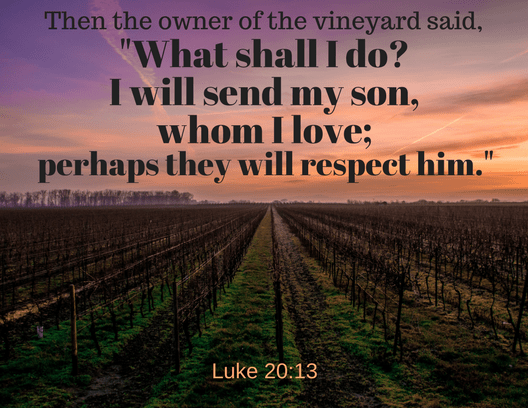
“Then the owner of the vineyard said, ‘What shall I do? I will send my son, whom I love; perhaps they will respect him.’ (Luke 20:13).  And so, the Son of God is given a mission for his Father: go to the vineyard to represent his Father to attain what belongs to his Father – the fruit of the vineyard.  God could have done this in so many ways.  He could have sent a violent and powerful son to use force to swiftly get the Father’s work done and repay the tenants for their selfish, greedy wickedness.  But instead the Son was given – a baby – as the Son of Man and Son of God.  And the angels rejoiced.   And the shepherds were in awe as they found things just as they had been told and then joyfully shared the news.

And the Son of God “grew in wisdom and stature, and in favor with God and man” – the tenants of the vineyard. (Luke 2:52).   And the son of the vineyard owner teaches and preaches and performs miracles to display and prove the goodness and sovereignty and master plan of the vineyard owner.  But, they still don’t get it.  Forsaking the master’s plan, as well as his very son, they conspire together and the tenants kill the son.  Now, they figure, the vineyard will be theirs.  There is no longer an heir.  And so, the tenants triumph for a time and seem to have free reign of the vineyard.

But, that is not the end of the story.   In his parable Jesus now switches from past tense to future tense as he says, “What then will the owner of the vineyard do to them?  He will come and kill those tenants and give the vineyard to others.”  So, too, there is a future in our Christmas story today.  And, there is a price that will be paid for all tenants who have chosen to forsake the son.  

In your celebrating today, and in your work tomorrow, in your heart and mind and actions, in your time, in your giving, in your whole living – do not forsake the son.

-Marcia Railton

The Boy who Changed – and Is Still Changing – the World

Luke 2

Luke 2 final

“Do not be afraid, for look, I proclaim to you good news of great joy that will be for all the people: today a savior, who is Messiah the Lord, was born for you in the city of David. This will be the sign for you: you will find a baby wrapped snugly in cloth and lying in a feeding trough.” Luke 2:10-12


Today, we are reading through Luke chapter 2 which contains one of the most popular accounts written in the Bible—which is the birth of the only begotten Son of God, Jesus Christ. Regardless of our religious affiliation or background, we are familiar with the story line. Mary and Joseph travel to Bethlehem to be registered under Caesar Augustus’s decree. While there, it comes time for Mary to give birth. Because there is no room in any inn, she must give birth in a stable.


For us, this narrative is important because it is the beginning of the story of a man who turned (and is still turning) the world upside down. We can skip forward and see how much of an impact Jesus had on so many, and we can also see how he works in our lives today.


But imagine being in the shoes of Mary, Joseph, and even the shepherds. They weren’t able to skip ahead, they had to live it out. For Mary and Joseph, they had to trust in God that he would see them through. They had to have strong enough faith that God would do what he said he would do. For the shepherds, imagine going from a normal day to having an angel tell you that the Son of God has been born. The Messiah is here! It is even written that they were terrified (Luke 2:9).


Why does this matter? I just think it’s important for us to realize that these heroes we read about in the Bible were more than just characters. They were real people. They didn’t get the luxury of knowing what was written on the next page. They had fears, and they weren’t perfect. They had to trust in God and his purpose. They had to believe that God was going to hold their hand through everything. Imagine the trust! Imagine the faith!


So as you read today, place yourself in their shoes. Because if we can understand what Mary and Joseph went through, maybe we can learn to emulate their faith in our own lives.


-Leslie Jones


Allow Me to Introduce You to Luke…

Luke 1_4


 “I too decided, after investigating everything carefully from the very first, to write an orderly account for you, most excellent Theophilus,  so that you may know the truth concerning the things about which you have been instructed.”    Luke 1:3-4

If you have grown up in the church like myself, you were probably taught basic theology at a young age. I sang the songs, made the crafts, remembered my memory verses, and before I realized it, I had formed beliefs. Everything seemed so simple.

As we grow older, everything becomes complicated. We look at all the denominations around us, with many differing perspectives, and that child-like belief starts to become muddled by all of the confusion. This is the point where we ask ourselves, “What do I really believe?”

This is why I love Luke. His in-depth account of the Lord Jesus Christ from his birth through his resurrection not only gives us insight into the Son of God in an intimate way, it gives us backing to the beliefs that we hold dear.

Regardless of any creed, doctrine, or ideal, I know, without a doubt, that I can sit down and read Luke’s account of the story of Jesus and know that it is true. That validity is such a faith builder and invigorates me to dive deeper into the gospel.

This week, we are going back to our roots. Let’s start from the beginning together shall we? Because, sometimes, in order to jump forward, we have to get back to the basics.


-Leslie Jones

Graysen’s Favorite Gospel

Mark 1-1


Hey everyone!  I’m excited to be back 😀  Bethany helped us move this past week from the Old Testament into the New Testament with the gospel of Mark (thanks Bethany!).  This week, we’ll be exploring the second half of the gospel of Mark and see some of the themes that Mark has been setting up come to their close.

Before we get into looking at the text itself, here’s just a bit about Mark that will be helpful for us as we read.

First, Mark is the oldest of the gospels and it sets the stage for the synoptic gospels (Matthew, Mark, & Luke).  As the church grew in the years after Jesus’ resurrection, there wasn’t any need to write down stories about his life – the people who were there and saw it were still alive and present.  It was only around the end of the first century CE that people who were followers of Jesus began to write down what they knew about his life and teachings.  Why?  Because all the witnesses were dying!  They needed to keep a more permanent record of Jesus’s words that didn’t rely on having witnesses of the events nearby.  That first written story came to be known as the Gospel of Mark.  The writers of the Gospel of Luke and Matthew would later use Mark as the skeleton for their gospels.

It’s because of this that the gospel of Mark is my favorite of the gospels.  It’s the pre-cursor and contains the most concise collected narrative of Jesus’ life and teachings.  And – the end is just great (but we’ll get there soon enough)!

So, I hope that you’ll join me as we explore what one of the earliest authors of the life of Jesus had to say about “the good news of Jesus Christ, the Son of God.” (Mark 1:1)

-Graysen Pack

The Storms of Life

Mark 4

Mark 4 41b

As I write this, masses are evacuating Florida in the anticipation of Hurricane Irma. By the time you read this, I hope that the storm has passed and that the loss will be minimal. I pray for the recovery teams who will be in the areas doing their best to help families begin to put lives back together.


In Mark 4 we read about another storm. One that scared the disciples beyond anything that they had ever experienced before. This huge squall was both a test and a teachable moment. Jesus was testing the men’s faith and trust in the Son of God. Jesus also used this time to teach the men the extent of His great power. If these men had any doubts before about who Jesus was and what He was able to do, His calming the winds and the waves certainly would have clarified any misconceptions, don’t you think?


I think that we all have to experience a storm or two in our relationship with Jesus in order to find out what our faith is made of. I can think of several of you who I personally know and the storms that Jesus has lead you through and how it has reinforced your faith. I too have been tossed about in a violent storm and the only thing I knew to do was to call out to Jesus. I’ve had my share of nights where the only thing that brought my mind enough peace was to sleep with an open Bible on my bed and my hand literally resting on God’s promises. I’ve had days when anxiety was so great within me that the only thing that could keep the negative thinking at bay was to read Scripture out loud for hours on end.


If you are not currently experiencing a storm, then now is the time to make sure that you are in the Word daily and living out your faith while the waters are calm. 2 Timothy 1:14 says, “Guard the good deposit that was entrusted to you – guard it with the help of the Holy Spirit who lives in us.”


If you are living through a storm right now, hang on tight. Hebrews 4:14 encourages us with this: “Therefore, since we have a great High Priest who has gone through the heavens, Jesus the Son of God, let us hold firmly to the faith that we profess.”


I many not know the details of your personal storm, but I do know the One who is powerful enough to keep our boats from overturning. And He certainly will bring you through to the other side. Believe. Trust. Love. Obey.


-Bethany Ligon


I Once Was Blind, But Now I See

John 8-9

Sunday, May 28

Jesus is an awesome teacher. I have read Dallas Willard’s amazing work, The Divine Conspiracy, where he discusses the Sermon on the Mount. One of the points that Willard makes is that Jesus is not just a smart guy, but the smartest guy. He is not just a wise person, but the wisest person. Jesus confirms this when he says that one “greater than Solomon is here”. (Matt. 12:42, Luke 11:31) So if anyone asks you who the wisest person in the Bible was the answer isn’t Solomon; it’s JESUS!
Jesus shows his masterful hand at teaching here in John. In these first 12 chapters of the Gospel, Jesus is performing miracles, which the author calls signs. We have already read about the sign where Jesus changed water into wine (2:1-12). There have been a couple healings, one of the royal official’s son (4:46-54) and one of a paralytic on the Sabbath (5:1-15). Then he did two where he overcame the normal laws of nature by feeding the five thousand with only a little food (6:1-15) and by walking on water (6:16-21). All these signs are connected in John, because all these signs point to an important truth: Jesus is the Messiah, the Son of God, and by believing in him, we can have life in his name. (John 20:30-31)
In John 8 and 9, Jesus connects both his teaching and a sign to point to his Messiahship. In chapter 9, Jesus and his disciples see a blind man. Instead of tying the blindness to anyone’s sin, Jesus says that God’s glory, and the glory of the One and Only Son, would be displayed in the man’s life. Jesus taught previously, in chapter 8, that he is the light of the world. He declared that if we follow him we will not live in darkness but walk in the bright light of life. He then makes his point vivid by giving this blind man sight!
The once-blind man is taken in, questioned, harassed and abused by the religious leaders of his community. Instead of listening to this man tell his testimony about the truth of Jesus, they were intent on shutting down Jesus and claiming that he was a fraud. The man’s testimony is only the truth: “I was blind, but now I see.” Jesus comes to the once-blind man and basically tells him, “You can see that I am the Messiah.” Even Jesus loves puns! Jesus teaches that the blind will see and those who think that they can see are truly blind.
This story is a wonderful picture and full of rich imagery on its own. But I also come away with three thoughts for how we live today.
First, the once-blind man was “giving a testimony” about Jesus. He wasn’t even close to a “believer” as we might define it. He trusted enough to go and wash and he came back with sight; nothing more than trust that the washing would work was asked of him. That is pretty amazing. He says nothing of faith before the miracle takes place. And when people ask him about his life, all he does is tell his story. That’s all God and Christ call you to do when they say to share the good news of the gospel. It does not mean you have to have a suave and sophisticated philosophical demonstration of the proofs of God. You simply tell people how Jesus found you, and why you are better now. Were you blind and now you see? Were you addicted to something and no longer? Are you more loving to your family and friends? THAT is your evangelism, that is the good news God calls you to share.
Second, do you feel like the once-blind man? There are times when we experience God doing something in our lives that doesn’t make sense. We CAN’T explain why something is happening. This guy just says “All I know is that I was blind, and now I see!” Sometimes, we feel God moving in ways that may make our families, our churches or ourselves uncomfortable. The people who should have celebrated this man’s miracle the most, his family and his religious leaders, turned their backs on him and cast him out. When God is moving, trust in what He is doing, keep looking for Him, and no matter who let’s go of you, God will find you. 
Third, take care that you are walking in the light of Christ so that you can see and live. Just like the people of Jesus’ day, this sign is pointing us to Jesus so that we can believe and have life in his name. Take care that you don’t lose sight of that purpose. The purpose is not for us to say “I wish I could see a miracle.” The miracle has been done. Will you believe because of it? Will you trust that Jesus is who he claimed to be? Remember, if you don’t want to believe, that is still an option. But there is a cost: rejection leads to a life of darkness, and the ultimate darkness of death. Christ offers us so much more with life in this life that leads to eternal life. He is the light of the world and he offers us himself. Praise be to God through Jesus Christ, the Light of the World!
-Jake Ballard
Jake Ballard is Pastor at Pine Grove Bible Church in Brooklyn Park, MN. He is a husband to Amber, father to Melody Grace, and proud “daddy” to a black kitty named River (for my Dr. Who and Firefly fans). Jake is a graduate student at Bethel Seminary, where he is kept busy. When he does have free time, he likes to read (Tolkien and Riordan at the moment), watch Netflix (Star Wars: Deep Space Nine), and play video and board games. (Always open for suggestions, as I am less busy in the summer). He hopes that his devotions will help you, dear reader, fall in love with the Gospel of John, because if he had to pick a favorite book, it would be this one! God bless! 
(Photo Credit: http://www.boldcupofcoffee.com/blog/i-am-the-light-of-the-world)

Seek Not to Please Myself

John 6-7

john-6-35

Saturday, May 27

As I started reading John 6 & 7 a few key quotes from Jesus recorded in the end of John 5 were still ringing in my ears:

“For I seek NOT to please myself but him who sent me.” (John 5:30)

“I do not accept praise from men…How can you believe if you accept praise from one another, yet make no effort to obtain the praise that comes from the only God.” (John 5:41, 44)

Here Jesus Christ, the Son of God and Son of Man, was saying quite clearly and repetitively – it’s not about me.  He did not seek to please himself or earn the praises of men – his goal was only and always to please God and hear the praises of his Heavenly Father.

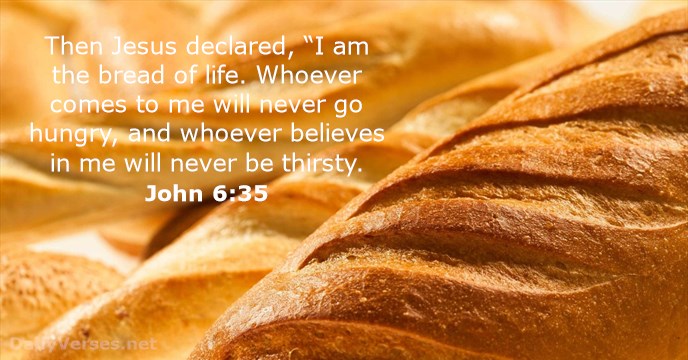
Chapter 6 begins with this same Jesus feeding the famished five thousand with five small barley loaves and two small fish – and ending up with twelve baskets of left-overs.  As the one primarily responsible for feeding my family of 5 three times a day, I have always been greatly impressed with this miracle!  And, he follows it up with walking on the water!  There is no doubt that this Jesus has just earned some serious bragging rights.

Instead, he turns it into a teachable moment and offers himself as the bread of life – the bread and body that must be broken for others to live.  This is what he offers to the world not because he is the one who dreamed it up, and not because he was looking forward to it, and not because he desired it – but because he knew he came, “Not to do MY (Jesus’) will but to do the will of him who sent me.” (John 6:38).

In Chapter 7 he continues, “My teaching is not my own.  It comes from him who sent me.” (7:16) and “I am not here on my own, but he who sent me is true.” (7:28).   While some wanted to kill him, others wanted to make him king.  And yet – none of that really mattered to Jesus.  He was teaching God’s Word and living – and later dying – God’s Will.  His one-track mind and life was centered on what his Daddy desired and had planned from the beginning of the world.

Two things seem clear.

First, Jesus was definitely NOT claiming to be God, nor did he desire to be considered as God in any way.  His repeated use of, “not me/mine…but He/His” were pointing out the differences – two beings, even though their purposes would be the same – at Jesus’ choosing.  Today, would I hold any credibility if I stated, “I do not seek to please myself, but only what I want?”  Or, if I said, “My teaching is not my own but it comes from me”, would people listen to me for long?  Over and over again, Jesus is drawing some pretty clear lines between His Father God and himself.  Two beings, united in purpose – because that is what Jesus chose – to follow His Father and not himself.

Second, how must I change my focus, my goals and my everyday life so that I, along with Jesus, can confidently say, “Not my will, but His be done,” “My teaching is not my own, but God’s.”  “I seek not to please myself, but my Heavenly Father.”  No doubt the Son of God set an example for us to follow.  It is a path that requires laying aside all selfishness and pride, as well as false teaching.    It is not an easy road.  But when we live our life to please God our Father, just as Jesus did, we won’t be disappointed in the end!

-Marcia Railton


(Photo Credit: https://dailyverses.net/john/6/35)