When a Friend is Suffering

Old Testament: Job 5 & 6

Poetry: Psalm 33

New Testament: John 13

The greatest mystery in the book of Job is not why Job suffers, but why a man crippled by suffering is forced to fight a long, drawn-out theological battle with people who are supposed to be his friends. (Mike Mason, The Gospel According to Job)

Job’s friends start out pretty good. They find out about what’s happening in his life and come from far away with the intent ‘to come to show him sympathy and comfort him.’ After emotional expressions ‘they sat with him on the ground seven days and seven nights, and no one spoke a word to him, for they saw that his suffering was very great.’

Sadly, after such a strong start, they end up kind of being the worst, saying things like:

Should not your piety be your confidence and your blameless ways your hope?

Blessed is the one whom God corrects; so do not despise the discipline of the Almighty.

Yikes. The guy just lost everything, his livelihood, every one of his children, and he himself is covered in ‘loathsome sores.’ It seems incredibly insensitive, but honestly, it’s a pretty typical Christian response to suffering. 

We often begin by sitting with people in their suffering. But maybe because it’s uncomfortable to stay there, or maybe because we feel an urge to ‘speak truth’ to them, we muck it all up by sermonizing. Like Job’s friends, we think we’re encouraging by offering reasonable answers to their situation.

And the thing is, what they’re saying (what we often say) isn’t necessarily wrong. Job’s friends are quoted in the New Testament. (5:13 is quoted by Paul in 1 Corinthians 3:19 and 5:17 is quoted in Hebrews 12:5). But while it may not be wrong, it is unkind, insensitive, and perhaps mis-applied.

I cringe when I hear a well-meaning believer simply quote scripture to a hurting brother or sister. Sometimes, often times, the most effective thing we can do as a spiritual friend is not to counsel, teach, direct, or judge. The book of Job would be a lot shorter if Job’s friends understood this.

We haven’t gotten to the part yet where God speaks. And that answers the question that most often causes me to open my big yap and offer up my meager two cents… but if I don’t speak truth to them, who will? Um… God, maybe?

How many people have our good intentions hurt?

C.S. Lewis wrote in A Grief Observed,

“Talk to me about the truth of religion and I’ll listen gladly. Talk to me about the duty of religion and I’ll listen submissively. But don’t come talking to me about the consolations of religion or I shall suspect that you don’t understand.”

-Susan Landry

Reflection Questions

  1. Have you ever been in a time of suffering and someone said or did something you found comforting and helpful? If so, what? (Feel free to leave a comment to share good examples and ideas with us.)
  2. Pray to be a sensitive and compassionate comforter to those in need.

Ask the Hard Questions

Old Testament: Job 3 & 4

Poetry: Psalm 32

New Testament: John 12

The phrase ‘the patience of Job’ is really not accurate. Job persevered for sure, but not patiently. He suffered, but not silently. The book of Job is the story of a rebel.

After his suffering begins, his saintly friends take turns explaining his problems to him with good, logical, theological phrasing. I would call their monologues churchy. Job, on the other hand, goes to God with his irreverent appeal for an explanation. And that’s the real difference between Job and his friends… Job spoke to God about his suffering while his friends spoke about God to Job.

Chapter 3 begins with Job opening his mouth and cursing the day of his birth, saying, “Let the day perish on which I was born.” He goes on at length and in great detail describing that notion.

But this isn’t a typical poor me kind of complaint. His personal lament turns to a lament for all of those who suffer through life. The poorest of the poor, those who grow up with no advantages, despised, rejected, people who are just surviving.

Why is light given to him who is in misery,
    and life to the bitter in soul,
 who long for death, but it comes not,
    and dig for it more than for hidden treasures,
 who rejoice exceedingly
    and are glad when they find the grave?

Job invites us to ask the hard questions rather than to slip into the platitudes that can come too easily. Questions about the meaning of life and about God himself. And he models to us the way to find peace in our questioning…not by talking about God, but by talking to him.

Uncomfortable? Yup. Worth it? I think Job would say so.

-Susan Landry

Reflection Questions

  1. Do you spend more time talking to God or talking about God? Which comes easier to you?
  2. Do you have a little list of hard questions you have been avoiding asking God? Talk to Him about them – and see how He answers.

Broken Pottery

*Old Testament: Job 1 & 2

*Poetry: Psalm 31

New Testament: John 11

Be merciful to me, LORD, for I am in distress; my eyes grow weak with sorrow, my soul and body with grief. My life is consumed by anguish and my years by groaning; my strength fails because of my affliction, and my bones grow weak.

Among all my enemies I am a disgrace, and among my neighbors even more. I am dreaded by my friends—they flee when they see me on the street. 

I am forgotten as though I were dead; I have become like broken pottery. 

If I told you that the above passage was from the book of Job, you’d probably believe me. But King David wrote those words in Psalm 31. He is in distress, weak with sorrow and grief, groaning and weak in his affliction. He is shamed and disgraced by those around him, broken. The description of his anguish is amazingly similar to Job’s experience.

Interestingly, while David describes himself as ‘broken pottery,’ Job uses broken pottery to scrape his oozing boils.

loathsome sores from the sole of his foot to the crown of his head. And he took a piece of broken pottery with which to scrape himself while he sat in the ashes.   Job 2:7-8

I say…Ew. But Job said,

Naked I came from my mother’s womb, and naked I will return. The LORD gave, and the LORD has taken away. Blessed be the name of the LORD.  Job 1:21

Would you be surprised to see that David echoes the wisdom of Job?

Blessed be the LORD, for he has wondrously shown his steadfast love to me when I was in a besieged city. I had said in my alarm, “I am cut off from your sight.” But you heard the voice of my pleas for mercy when I cried to you for help.    Psalm 31:21-22

Blessed be the name of the LORD.

I think that praise from the depths is maybe the most beautiful praise. It is certainly the most trusting. David, in his Psalm, invites us to join him in his trust, and I invite you to carry these words with you today:

Be strong, and let your heart take courage, all you who wait for the LORD!   Psalm 31:24

-Susan Landry

Reflection Questions

  1. What does it look like to wait for/on the Lord?
  2. What steps can we take to help our heart take courage when we are in the depths?
  3. What can we learn from the examples of David and Job?

Light. Will. Come.

Old Testament: Job Intro – found below

Poetry: Psalm 30

New Testament: John 10

Sometimes things are just hard. Life is not going our way. We’re feeling burdened, overwhelmed, or just plain sad. When we are stuck in the middle of these times, it can bring relief just to see the possibility of a light at the end of our dark tunnel. We don’t even have to see the light yet. Just knowing that it’s coming can lighten our load and bring a deep breath of hope.

I was talking with a friend recently who is feeling a lot of stress at work. My friend is doing her own job as well as another person’s job. When we talked, she told me that her company had posted the other person’s job and should be hiring to fill it soon. Even though her workload hadn’t changed, in that moment she felt a subtle lifting of her burden. The relief wasn’t there yet, but just knowing that it was coming gave her hope, and a boost to continue on until the relief actually showed up and she could go back to just doing her own job.

Weeping may last for the night, but joy comes with the morning. Psalm 30:5b

Have you ever experienced insomnia? How about being up all night with a sick child (or sick self)? We’ve all been in those situations where we wish with every fiber of our being that morning would just arrive. And it does. Every single time.

Although some nights may be long and dark, joy will come again. The darkness may even get worse but God will meet you in your darkness and the light will come.

Life is not free of struggle or pain– not even for the most faithful servant of God. But in our pain and confusion, God is always with us, working for our good.

Isaiah 43:2 reminds us of that: “When you pass through the waters, I will be with you; and through the rivers, they shall not overwhelm you; when you walk through fire you shall not be burned, and the flame shall not consume you.”

It would be nice, wouldn’t it, if God promised that he’d take away all of our burdens? Snap his fingers and make everything sunshine and rainbows. The reasons why he doesn’t are probably many and accurate.

What he does promise us, though, is that not only will he be with us in the dark times (and as someone who is still afraid of the dark, that is no small gift) but he promises us that light will come. Let me say that again for those who need to let that sink in…

Light. Will. Come.

But even more than THAT, God doesn’t simply promise to give us peace at the end of the long, dark night. He offers dancing. Dancing!

You turned my wailing into dancing; you removed my sackcloth and clothed me with joy, that my heart may sing your praises and not be silent. LORD my God, I will praise you forever. Psalm 30:11

Thanks, God. Thanks for being so kind to a dummy like me who, even though I know the morning always comes, still doubts…still fears in the darkness. And yes, thank you for asking, you may have this dance.

-Susan Landry

Reflection Questions

  1. Read Psalm 30 looking for how God is described and what He is doing/has done. Now re-read it and find how the Psalmist is responding. What image of God do you have after reading Psalm 30? What is your response?
  2. What is the darkest night/hardest struggle you have encountered so far? Are you still in it right now or have you already experienced some light/joy/and perhaps even dancing? How did you see God during the dark mourning – and also in the light morning?
  3. Who do you know who is stuck in a dark night right now and could benefit from hearing that the light is coming? How can you use God’s promises, His Word, and perhaps even this devotion to be an encouragement to this person? What/who can you also be praying for?
  4. After reading the Job Introduction below, how does it apply to today’s devotion?

Job Introduction

The Book of Job is about a righteous man named Job who remained faithful to God despite God allowing Satan to take everything from him except his life.  We don’t know who wrote this book, or even exactly when it took place.  Given Job’s age (he lived 140 years after the events recorded in the book), it’s likely Job lived around the time of Abraham, or possibly earlier.

In the first two chapters, we get a glimpse of one reason bad things happen to godly people – Job seemed to be a pawn in a cosmic battle to test Job’s integrity.  

Job had 3 “friends” who came to comfort him, but they were really more torment.  They consistently accused Job of hidden sins – otherwise, God wouldn’t be punishing him they said.  But Job consistently maintained his innocence.

Despite Job’s intense suffering, he maintained his belief in the resurrection, as is recorded in Job 19:25-27, “I know that my Redeemer lives, and that in the end he will stand upon the earth.  And after my skin has been destroyed, yet in my flesh I will see God; I myself will see him, with my own eyes – I, and not another.  How my heart yearns within me!”  (This is one of my favorite passages in the Bible.)

In the end, God Himself confronted Job, and eventually blessed Job with twice as many possessions at the end of his life as he had before his downfall – including 10 more children.

This is a good example to show us that we don’t need to understand why bad things are happening, we must just remain faithful, no matter what.  Job also shows us that we can be honest with God when we are suffering and when we don’t understand why things are happening.

Finally, no matter what happens to you, may you, with Job, be able to say, “I know that my Redeemer lives, and that in the end he will stand upon the earth.  And after my skin has been destroyed, yet in my flesh I will see God; I myself will see him, with my own eyes – I, and not another.  How my heart yearns within me!”

-Steve Mattison

He Sees

You Can, Too.

Old Testament: Esther 8-10

Poetry: Psalm 29

*New Testament: John 9

John 9 recounts a story of Jesus healing a man born blind, and how those in his community respond to his being healed. Through this account, we see not only the heart that Jesus had, but also areas for our own spiritual growth.

As he passed by, he saw a man blind from birth. 9:1

From the start, we can find assurance in the notion that Jesus notices the least of us. We’re later told that this man had been a beggar. He may have been begging as Jesus and the disciples passed by. For anyone who feels overlooked at times, isn’t it comforting to know that Jesus notices us?

So he went and washed and came back seeing. 9:7b

We also see in this man how obedience and faith work together. Believing that Jesus could heal him would not have sealed the deal, action was required. Results are nice. And most often they don’t come without some action on our part. This man could not have been healed without Jesus intervening. But even with Jesus’ intervention, his healing required his own participation.

Some of the Pharisees near him heard these things, and said to him, “Are we also blind?” Jesus said to them, “If you were blind, you would have no guilt; but now that you say, ‘We see,’ your guilt remains.  9:40

Self-righteousness blinds us. And these blind spots are roadblocks on our journey to spiritual maturity.

Have you ever been reading when the light outside is growing dim? You don’t need the lights inside the house on yet and so they are not on. But an hour later, the room is getting darker and darker and you do not even realize it. Someone may come in and ask if you need the light on. Suddenly you look around and realize how dark it is. You didn’t know you needed the light, you hadn’t recognized you were in the dark. This is the problem Jesus is identifying. The light of the world is here for those that know they need it/him. But many think they can see when actually they are sitting in the dark.

And if, when reading that, your mind immediately went to ‘those people’ who are in the dark…you’re missing the point. You’re ‘those people.’ We’re all ‘those people.’

What a great place to start today… asking for him to reveal blind spots we may have, trusting that he sees and cares for us, with a willingness to act on what he reveals in us.

-Susan Landry

Reflection Questions

  1. How do faith and obedience work together? Why are both required? Do you feel stronger in one than the other? How can you work on growing the other?
  2. When have you found yourself sitting in the dark? How can you draw closer to the light of the world to take advantage of the light he gives?
  3. After reading John 9 how would you describe Jesus.

Discerning

When and Where God Just Wants You to Stand

*Old Testament: Esther 5-7

Poetry: Psalm 28

New Testament: John 8

Esther’s boldness is often written about… If I perish, I perish.

Kind of melodramatic.

The real story here, although not presented with as much flourish, is Esther’s discernment. When Mordecai tells her what she needs to do, she doesn’t just swoon the ‘if I perish’ line and exit stage left to appeal to the king. She asks for time to pray and fast herself, and asks for others to join her.

Go, gather all the Jews to be found in Susa, and hold a fast on my behalf, and do not eat or drink for three days, night or day. I and my young women will also fast as you do. Then I will go to the king…   4:16

After this, Esther still doesn’t march into the king’s presence and boldly present her ask. What she does is be intentional with each and every action and word. She chooses what to wear, and she puts herself in the right place. And she stands there.

Esther put on her royal robes and stood in the inner court of the king’s palace.  5:1

Even after the king receives her and asks for her request, all but assuring her that the answer will be yes, she continues to act with discernment.

And the king said to her, “What is it, Queen Esther? What is your request? It shall be given you, even to the half of my kingdom.” And Esther said, “If it please the king, let the king and Haman come today to a feast that I have prepared for the king.”   5:3-4

At the feast, the king repeats his promise to give her what she desires, but still she doesn’t ask. We can’t really explain why she does what she does, but what can explain it is that she is being led by a wise and knowing God because she has taken the time to listen to him.

And as they were drinking wine after the feast, the king said to Esther, “What is your wish? It shall be granted you. And what is your request? Even to the half of my kingdom, it shall be fulfilled.” Then Esther answered, “My wish and my request is: If I have found favor in the sight of the king, and if it please the king to grant my wish and fulfill my request, let the king and Haman come to the feast that I will prepare for them, and tomorrow I will do as the king has said.”   5:6-8

And then this happens…

On that night the king could not sleep.  6:1

A-ha! His sleepless night led to him doing a little light reading which opened a door for God to speak directly into him. God didn’t put Esther in this place so she could convince the king, he put her there simply to ask. And she did, the next day…

And on the second day, as they were drinking wine after the feast, the king again said to Esther, “What is your wish, Queen Esther? It shall be granted you. And what is your request? Even to the half of my kingdom, it shall be fulfilled.”Then Queen Esther answered, “If I have found favor in your sight, O king, and if it please the king, let my life be granted me for my wish, and my people for my request. For we have been sold, I and my people, to be destroyed, to be killed, and to be annihilated. If we had been sold merely as slaves, men and women, I would have been silent, for our affliction is not to be compared with the loss to the king.” Then King Ahasuerus said to Queen Esther, “Who is he, and where is he, who has dared to do this?” And Esther said, “A foe and enemy! This wicked Haman!”   7:1-6

Far too often, I think we inflate just how much God needs us. He truly does the heavy lifting far more effectively than we can. Our job is to learn to tune in to when it’s time to speak and when it’s time to put on the royal robes and just stand.

How often do we think we’re helping God, or are certain that we’re on the path to do the most good (both positive intentions, by the way) but we’re not doing an awful lot of praying or fasting before we move, speak, or bulldoze ahead?

Maybe God’s thinking, ‘It’s great that you’re willing to perish, but all I really need you to do is just stand there today.’

-Susan Landry

Reflection Questions

  1. Have you tried praying and fasting before making a large decision or bold action? If so, did you find it beneficial? Whether you have done it before or not, what might God want you to spend time praying and fasting about?
  2. Can you think of a time you may have been to0 quick to act – not acting within God’s perfect timing?
  3. When have you seen examples of God’s perfect timing?

Ego Problems

New Testament: Esther 3 & 4

Poetry: Psalm 27

New Testament: John 7

And all the king’s servants who were at the king’s gate bowed down and paid homage to Haman, for the king had so commanded concerning him. But Mordecai did not bow down or pay homage.   Esther 3:2

When I read this description, it reminds me of a scene from a movie. In The Avengers, Loki tells a group of people outside an opera house to kneel before him. There’s one old man in the crowd who stands when Loki says to the people,

“In the end, you will always kneel.”

“Not to men like you,” the gray-haired man says.

Loki responds arrogantly, “There are no men like me.”

“There are always men like you.”

Turns out, he was right! There have always been men like Loki, people who are consumed with pride, hungry for power and so murderous in their pursuit of it that they are willing to wipe out a population of people. Genocides in Rwanda, Bosnia…the Holocaust. These modern tragedies, though horrendous, are not new.

Haman, from our passage in Esther, was so like Loki that he set out to destroy not only Mordecai, but his entire people.

Letters were sent by couriers to all the king’s provinces with instruction to destroy, to kill, and to annihilate all Jews, young and old, women and children, in one day, the thirteenth day of the twelfth month, which is the month of Adar, and to plunder their goods.  Esther 3:13

I don’t watch scary movies…but isn’t that kind of the plot of The Purge?

Haman was clearly a petty man. Willing to murder an entire race because one man didn’t give him the respect he felt he deserved.

…when Haman saw that Mordecai did not bow down or pay homage to him, Haman was filled with fury. Esther 3:5

Most of us won’t commit genocide over a slight. Most of us won’t even get filled with fury when we don’t get the recognition we deserve. But we may become filled with jealousy, or bitterness, or discouragement. Ego can take a lot of different forms.

Haman based his worth in his status, and it was easily dismantled when that status was challenged. Like Haman, we can find our worth in the wrong place. Our successes or wins, being right, our appearance, finances, being liked, our intellect… really any number of things. And when that worth is dismantled (as it will surely be) we can go the way of Haman and act out to try and earn what we have lost, or we may simply feel worthless.

I don’t think we’re any more aware of doing this than Haman was. We are deceived, and we experience the results of our deceit, causing us to react. Maybe instead of trying to change our reactions, we would be better served to dig a little deeper and expose where it is we believe our value is based. Awareness may not eliminate our bent, but shining a light on deceit is the first step in seeing the truth.

-Susan Landry

Reflection Questions:

  1. How would you describe Haman? How would you describe Mordecai? How are you like, and unlike, each of these characters?
  2. How are you most likely to react when your ego is damaged?
  3. Where do you find your worth? Is it serving you well? Are there adjustments to be made? What does God say makes you valuable?

Which is Easier?

Mark 2

Sunday, July 24, 2022

Go ahead and read the full chapter, but here’s the first 12 verses we will be discussing today.

A few days later, when Jesus again entered Capernaum, the people heard that he had come home. They gathered in such large numbers that there was no room left, not even outside the door, and he preached the word to them. Some men came, bringing to him a paralyzed man, carried by four of them. Since they could not get him to Jesus because of the crowd, they made an opening in the roof above Jesus by digging through it and then lowered the mat the man was lying on. When Jesus saw their faith, he said to the paralyzed man, “Son, your sins are forgiven.”

Now some teachers of the law were sitting there, thinking to themselves, “Why does this fellow talk like that? He’s blaspheming! Who can forgive sins but God alone?”

Immediately Jesus knew in his spirit that this was what they were thinking in their hearts, and he said to them, “Why are you thinking these things? Which is easier: to say to this paralyzed man, ‘Your sins are forgiven,’ or to say, ‘Get up, take your mat and walk’? But I want you to know that the Son of Man has authority on earth to forgive sins.” So he said to the man, “I tell you, get up, take your mat and go home.” He got up, took his mat and walked out in full view of them all. This amazed everyone and they praised God, saying, “We have never seen anything like this!” (Mark 2:1-12)

”Which is easier: to say to this paralyzed man, ‘Your sins are forgiven,’ or to say, ‘Get up, take your mat and walk’?” (Mark 2:9)

That question has always kind of thrown me for a loop because, if I’m being totally honest, my answer would be different from the one Jesus seems to be implying is correct.

Forgiveness is invisible. Anyone could say ‘Your sins are forgiven’ and we’d never know for sure. But healing someone, telling a paralytic to ‘Get up, take your mat and walk’… well, we would see pretty quickly if that took or not.

I once read that “forgiveness becomes real to you as you believe it, not as you see it.” I think what that means in this context is that the lame man couldn’t see Jesus’ forgiveness. He had to choose whether to believe it was true or not, whether Jesus was trustworthy or not. That’s very different from believing that Jesus had healed him…after he was up walking around.

And now I can see why the former would be so much more difficult. It’s harder to trust what we can’t yet see.

Kind of reminds me of the ‘we walk by faith not by sight’ (2 Cor. 5:7) and faith is confidence in what we hope for and assurance about what we do not see’ (Heb. 11:1) verses. God does not provide us with ‘grace-received’ certificates to prove our forgiveness, our salvation. We either believe it or we don’t. We either experience the joy, peace and burden-lifting that grace brings… or we don’t.

Jesus, help us to trust today that you know what’s best for us even when we can’t see it. We want to experience the lifting of burdens in our lives, and to feel the peace and joy that eludes us when we believe what we see instead of what you tell us is true. We want to drop the things that paralyze us and have the faith to get up and walk.

-Susan Landry

Application Questions

  1. Have you accepted Jesus’ forgiveness? How forgiven do you feel? Jesus has already done the hard part. What can you do to accept it, believe it and feel it more and more?
  2. What things, thoughts, attitudes paralyze your faith. Will you drop them? How? What will that look like? What will it look like to get up and walk in faith? Where might your faith lead you?
  3. From verses 13-17, are you more often like Levi or the teachers? What do you admire about Levi? What can you do this week that would be Levi-like?

Training for a Crown

1 Corinthians 9

June 10

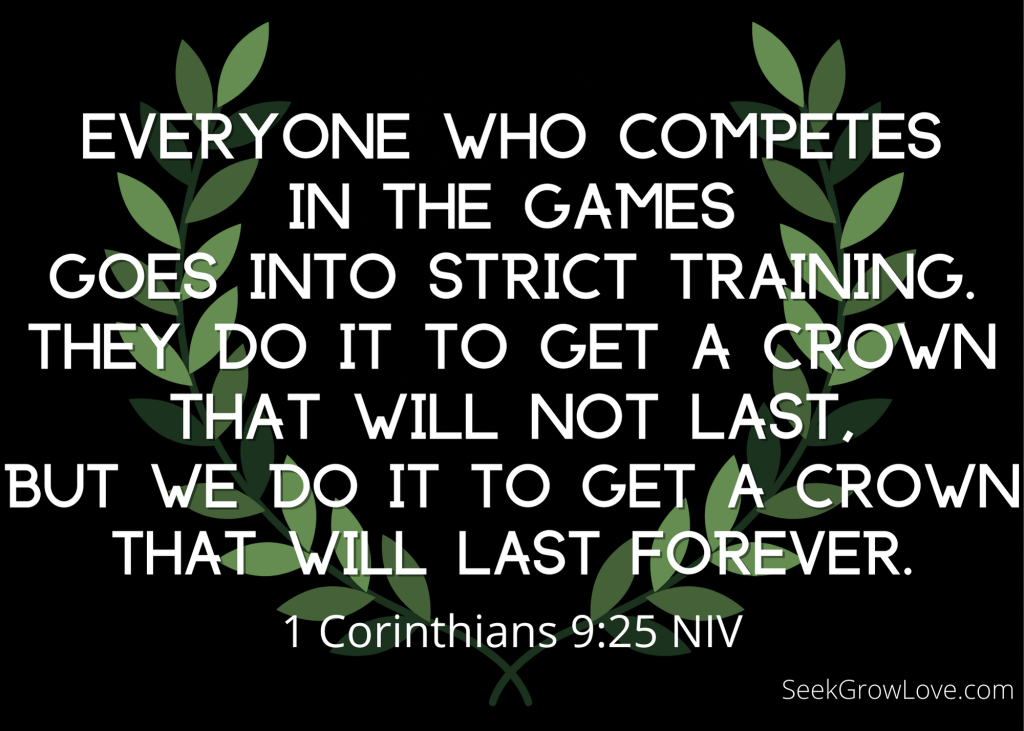
Do you not know that in a race all the runners run, but only one gets the prize?  Run in such a way as to get the prize. (1 Corinthians 9: 24)

Being competitive is sometimes presented in a negative light.  Probably because competition can bring out the ‘jerk’ in people.  That’s too bad, because in his letter to the Corinthians, Paul is telling them (and us) to lean into that competitive spirit.

Paul is using this as an analogy, by the way, he’s not telling us that we are in competition with other believers.  He uses two phrases that I hope will inspire you as you run your race.

“strict training”

Athletes preparing for a big competition don’t eat whatever they want and binge Netflix all day.  What do they do instead?  They do things that will help them succeed in their goal.  (Winning!)  Paul’s goal, and ours, is “a crown that will last forever.”

How do we train for eternal life?

The word obey comes to mind.  In order to obey we need to really know Scripture.  If we want to hear the words “Well done, good and faithful servant,” we need to know what the Master expects of us.  And we need to do it, even when it’s hard.  Just like the athlete in training gets off the couch and goes to practice, even when he’s tired, we need to obey even when it doesn’t make sense to our human sensibilities.

“do not run aimlessly”

If you’ve ever been to a kid’s sporting event, you know that there are players that do not have their head in the game.  They are wandering around the field, chatting with friends, maybe even picking flowers in the grass.  Adorable.

Not so adorable when it’s adults in an Olympic competition and not cute when we’re talking about forever.

So many of us say that we are sharing our faith by the way that we live our lives.  But how much of that is a cop-out because we’re not comfortable evangelizing?  If we are actively sharing our faith through our life, we will be intentional in planning ways to do it.  We won’t just be going about our life, wandering aimlessly along.

I encourage you today to make a training plan.  How are you getting ready for Christ’s return?  I also encourage you to make a game plan.  How are you looking for ways to share your faith with those around you?

-Susan Landry

(Editor’s Note: Sorry this was sent out later today. It’s been fun hearing from a variety of writers this week, but today’s scheduled writer ran into a health issue and was unable to write. So, we went back in time and found this great devotion from 2019 – thank you, Susan – definitely good enough to read again. God bless you as you Seek, Grow and Love!)

Questions for Reflection and Discussion

  1. How often do you remember that you are training for a crown that will last forever? If we remembered this more often how might it change our hearts, our schedules, our free time, our priorities, our training routine? What could you do differently this week, remembering the goal of your training and perhaps making it a little more “strict” than it has been lately?
  2. Are there any ways in which God may say you have been running aimlessly? What adjustments do you think Paul would suggest? Are you willing to do them?

Triumphant

John 12

April 9

The next day the great crowd that had come to the festival heard that Jesus was coming to Jerusalem. So they took branches of palm trees and went out to meet him, shouting,

“Hosanna!
Blessed is the one who comes in the name of the Lord—
    the King of Israel!”

John 12:12-13

The headings in our Bibles weren’t original to the text. I’m not sure who came up with the name “Triumphal Entry” for the portion of text we’re going to look at today, or when it was so titled, but it begs some questioning.

Triumphal implies the celebration of a great victory or achievement. And while on this day, crowds lined the streets with palm branches and shouted praises to him; within days of the hosannas, the crowd turned ugly, demanding His crucifixion.

You see, the people shouting ‘Hosanna’ had false expectations. They expected Jesus to restore Israel to its former glory, to establish God’s earthly kingdom with them at the top. What they didn’t know was that the true enemies that had to be defeated were not the Gentiles, but rather sin and death. And this could not be done on a white horse and with great armies. Instead, it took humility, a willingness to take the form of a servant and submit to the punishment that God’s people deserve for their sin.

Paul describes this perfect picture of humility in Philippians 2. He says that Jesus, “emptied himself, taking the form of a slave” and that he “humbled himself and became obedient to the point of death – even death on a cross.”

Throughout Scripture we find that humility is the path to victory and exaltation. We don’t expect to find real strength in those who are humble. But God has a way of turning our expectations upside down. He has a way of showing his glory through things we revile.

As we near our Easter celebrations, let’s prepare our hearts by seeking humility in our own life. Let’s also seek to see Jesus as he really is. Immediately after He ascended into heaven in Acts 1:9, he was seated at the right hand of the Father. He was triumphant over sin and death, he lives in triumph now, and he will return one day to triumph forever over the evil of this world.

That is something to celebrate.

-Susan Landry

Questions for Reflection and Discussion:

  1. Do you ever think about asking God to correct you if you’re wrong in any of your beliefs?
  2. How can we grow in humility?
  3. Look up the following verses about Jesus being seated at God’s right hand and discuss: Colossians 3:1, Ephesians 1:16-21