Have you noticed one of Jeremiah’s repeated themes yet? So far we have seen it in 3:17, 5:23, 7:24, 9:14, and in today’s reading in 11:8. It will surface again in 13:10, 16:12, 18:12 and 23:17. Chapter divisions were not included in the original writings of Jeremiah, but it’s interesting that throughout the first half of his book about every 2 chapters (or perhaps every column or two on his scroll), Jeremiah writes of the stubbornness of the people.
Jeremiah 5:23 – But these people have stubborn and rebellious hearts; they have turned aside and gone away.
Jeremiah 7:24 – But they did not listen or pay attention; instead, they followed the stubborn inclinations of their evil hearts. They went backward and not forward.
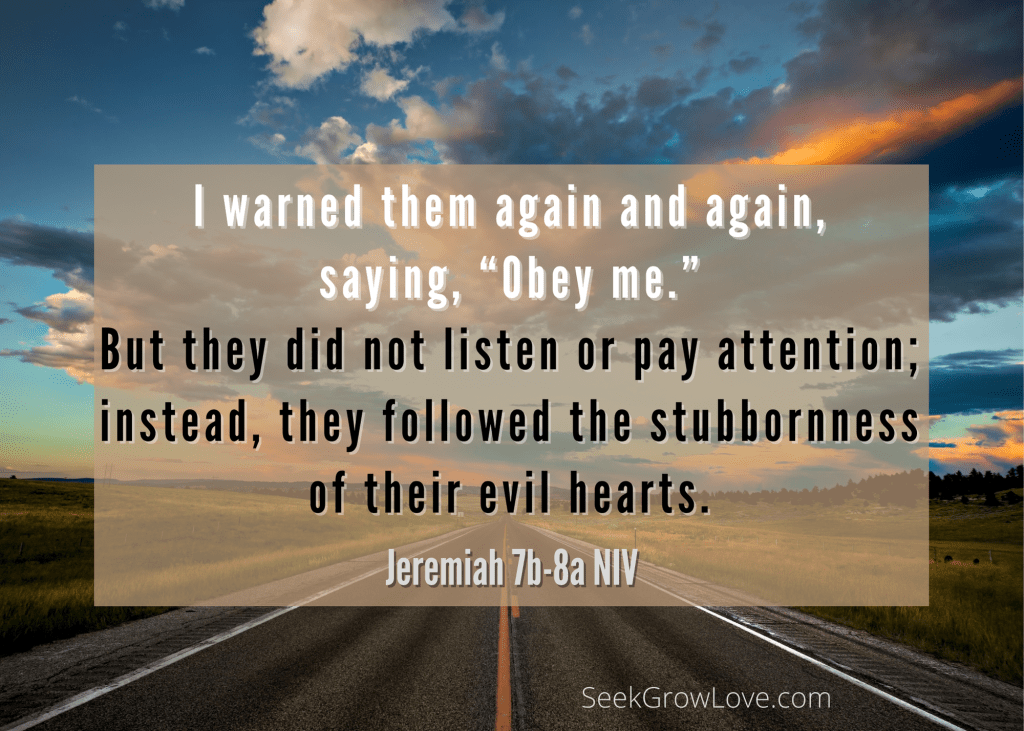
Jeremiah 11:6-8 – The Lord said to me, “Proclaim all these words in the towns of Judah and in the streets of Jerusalem: ‘Listen to the terms of this covenant and follow them. 7 From the time I brought your ancestors up from Egypt until today, I warned them again and again, saying, “Obey me.” 8 But they did not listen or pay attention; instead, they followed the stubbornness of their evil hearts. So I brought on them all the curses of the covenant I had commanded them to follow but that they did not keep.’”
I can envision some stubborn starved Hebrew men and women who have been shut up in Jerusalem as the enemy surrounds and destruction is eminent. And they are belting out Frank Sinatra’s hit song – “My Way”.
They had been determined to do what they wanted. They had shut their ears and their hearts to God’s call and His commands. They had refused to comply, agree to or give in to the terms of their Creator’s covenant. They had turned their backs on the Almighty and were going backward not forward. They had chased after pagan idols. In their pride they had elevated themselves, their pleasure, their dreams, their wants, their ways above God’s. Their evil hearts were caught up in sin. They were stubborn and rebellious and there would be a price to pay.
Do you have any stubborn streaks? Sometimes we prefer to use words like determined, headstrong, set in one’s ways. Got any stubborn children – or should I say – strong-willed and opinionated? How often do we remember that God’s opinion is the only one that matters? How often do we remember, “Not my will, but yours be done.”
Funeral homes in the UK reported that the song “My Way” is the most often requested song for funerals. A lot of people would like to be remembered as the strong, bold, unbending trailblazer who did life his/her own way. Will you be one of them?
Or will you hear God’s voice calling, “Obey Me”? Stop trying to stubbornly do life your way. Your way leads to disaster and death. My prayer is that we may be a people who surrender to God’s will and way and can say, “I did it God’s Way!”
-Marcia Railton
As an interesting note, Frank Sinatra disliked his great money-making hit, “My Way”. Songfacts.com states: “This became Frank Sinatra’s signature song, but he couldn’t stand it, saying he “loathed” the song. In his later years, he described the song as “a Paul Anka pop hit which became a kind of national anthem.” In a 2000 interview with the BBC show Hardtalk, Sinatra’s daughter Tina said, “He always thought that song was self-serving and self-indulgent. He didn’t like it. That song stuck and he couldn’t get it off his shoe.” Beware of turning your life into a catchy, popular, people-pleasing tune that is actually self-serving and self-indulgent. Thanks for the lesson, Frank.
Today’s Bible reading plan passages can be read or listened to at BibleGateway.com here – Jeremiah 11-12 and Psalm 102-103
The Old Testament prophets who spoke for God, including Jeremiah, were entrusted with preaching a lot of doom and gloom. Because God’s children had strayed from his commands, judgment would be coming and the people needed to know. I loved Jeff Fletcher’s illustration in his devotion yesterday of a doctor who could be charged with malpractice if he knew the sick condition of a patient’s insides and knew how to fix it and what changes the patient would need to make in order to cure the potentially deadly ailment, and said nothing. This would be like the Christian who sees the broken sinful world and pretends everything is okay. Don’t withhold the cure.
Jeremiah paints a very vivid picture of a world that is not okay. Chapter 9 opens with the prophet mourning the sinfulness of God’s people. He would love nothing more than to pack up and go to a desert retreat where he could get away from and forget this crowd of unfaithful people. Can you relate? But, rather than abandoning the people in their sin, Jeremiah continues passionately speaking truth for God, over and over, even though his words often seem to fall on deaf ears. He still must speak and write and hold out the cure to these wayward people.
God has had it, too. He aptly describes the situation this way:
“It is not by truth that they triumph in the land. They go from one sin to another; they do not acknowledge me,” declares the LORD. (Jeremiah 9:3b NIV)
and again, “They have taught their tongues to lie; they weary themselves with sining. You live in the midst of deception; in their deceit they refuse to acknowledge me,” declares the LORD. (Jeremiah 9:6 NIV)
It sounds to me like God and Jeremiah are describing the sad state of affairs in 2021. So many lies and deceptions abound when attempting to justify and explain and even celebrate sin and sinful lifestyles that fester and grow when individuals and nations and societies have turned their backs on God.
It is as though God is left without a choice. “What else can I do because of the sin of my people?” (Jeremiah 9:7 NIV) “‘Should I not punish them for this?’ declares the LORD. ‘Should I not avenge myself on such a nation as this?’ ” (Jeremiah 9:9 NIV). God had drawn up the rules long ago with blessings promised to those who followed and curses to those who stubbornly disobeyed. Many chances had been given. Prophets had been sent to remind the people of the deadly disease and of the cure – repentance, turning away from sin and turning back to God. But these were a very stubborn people who took delight in continuing in their sin and lies and more sin and more lies.
God had given mercy. God had given reminders. God had given prophets. God had stretched out the cure. But, to no avail. So, God says – it is time. It is time to teach your daughters how to wail – death and destruction is coming. (Jeremiah 9:20,21).
Towards the end of chapter 9 an interesting section seems almost out of place…
This is what the Lord says:
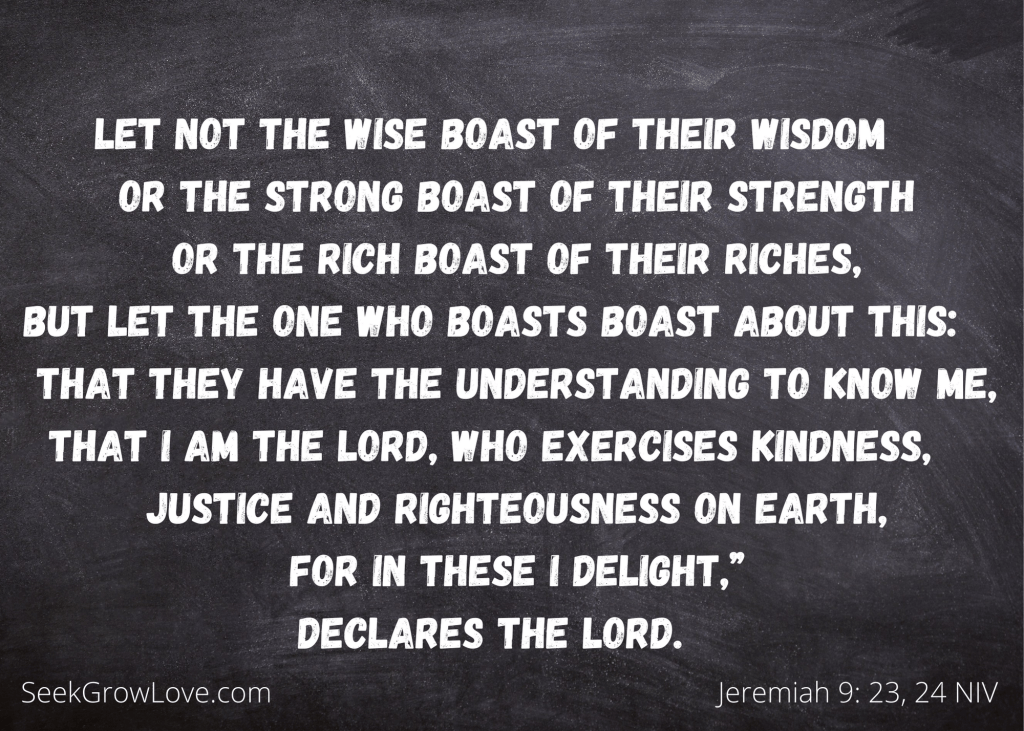
“Let not the wise boast of their wisdom or the strong boast of their strength or the rich boast of their riches, 24 but let the one who boasts boast about this: that they have the understanding to know me, that I am the Lord, who exercises kindness, justice and righteousness on earth, for in these I delight,” declares the Lord. (Jeremiah 9:23-24 NIV)
Perhaps it was written more for us who would be reading Jeremiah centuries later, to remind us of the choice we have. And, the great opportunity we have to boast about our God, our Creator, Our YHWH. He created the cure. His Son is the cure that was not yet available in Jeremiah’s day. Sin is the same and comes with the same consequences – death. People today need to know about the cure. They don’t need to hear you bragging about your dinner, your kids, your car, your job, your grades, your house, your ______ (on social media or at the checkout line). They need to know about the LORD our God who exercises kindness AND justice and always righteousness. The Psalms passages today have some great examples of boasting about our God while holding out the cure. How can you hold out the cure today to a nation and world that is unknowingly in the stages of the deadly disease of disobedience?
-Marcia Railton
Today’s Bible reading passages can be read or listened to at BibleGateway.com here – Jeremiah 9-10 and Psalms 99-101
Over 100 years ago Eleanor Porter wrote the children’s novel, Pollyanna. I like the version Disney did in the 1960’s starring Haley Mills as Pollyanna Whittier, a young girl, the daughter of missionary parents who both died. She moved to a new town to live with her rich but stern Aunt Polly (Fun Fact, in the Disney Movie Aunt Polly is played by Jane Wyman, an actress who was President Ronald Reagan’s first wife- I have a lot of trivial information in my head, sorry).
Pollyanna’s minister/missionary father had taught Pollyanna to play the “glad game” as a way of coping with life’s challenges. Essentially, she learned that no matter what happens, you should always look on the bright side. Essentially, it’s a way of life that is exceedingly optimistic in every situation. Throughout the story Pollyanna met neighbors in challenging situations and preached her gospel of positivity and as a result changed lives and made her town a much more positive place to live.
In a particularly memorable scene Pollyanna brought her positivity message to the local pastor who, at her dour Aunt Polly’s behest, had been giving his congregation a steady diet of fire and brimstone, anti-positivity. Pollyanna encouraged him to notice and begin preaching the “glad texts” of the Bible. He, listened to her counsel, changed his preaching to become more positive, and everyone in the Church became much happier. There’s more to the story, but that’s the part that is relevant to our conversation.
During the last 30 years there has been a revolution in psychology. In the past, psychologists and counselors focused on psychological pathology, all the things that are wrong: anxiety, depression, shame, anger, addiction, poor relationships etc… From Freud onwards psychiatrists were trained to dig into a person’s past to find the cause of their neurotic thoughts and behaviors. But positive psychology introduced the benefits of focusing on positive thoughts and behaviors like gratitude, hope and other glad things. This corresponds historically with a more positive oriented approach to preaching. Many pastors traded in fire and brimstone sermons warning people against sin and judgement for more positive messages. Norman Vincent Peale, founder of Guidepost magazine, wrote “The Power of Positive Thinking.” Robert Schuller, famous TV preacher of the 70’s-90’s, preached a gospel of positive thinking. Many preachers began preaching a prosperity gospel. Joel Osteen is popular today because of Norman Vincent Peale and Robert Schuller and others like them.
So the question at hand is, which is more biblical, the hellfire and brimstone preacher who speaks against sin and calls people to repent, or the positive thinking pastor who focuses on preaching all of the “glad texts” in the Bible and ignores icky verses that talk about sin and judgment? I think the answer is both, or better yet, neither.
I like the old expression that says that the preacher’s job is to “comfort the afflicted and to afflict the comfortable.” Solomon said it pretty well in Ecclesiastes 3- there’s a time and a season for everything. Sometimes preachers need to say hard things and issue dire warnings to their hearers. Sometimes preachers need to give words of comfort and encouragement. Jesus gives examples of this. Sometimes Jesus got angry and called his listeners, a.k.a. the Pharisees, a “brood of vipers”. Another time Jesus told a woman caught in adultery that he did not condemn her, while telling her also to not sin anymore. Jesus showed that one can be both firm and compassionate as they speak for God.
Today’s reading in Jeremiah 7-8 has a clear absence of the “happy texts” that Pollyanna was so fond of noticing:
“This is what the Lord Almighty, the God of Israel, says: Reform your ways and your actions, and I will let you live in this place. Do not trust in deceptive words and say, ‘This is the temple of the Lord, the temple of the Lord, the temple of the Lord!’ If you really change your ways and your actions and deal with each other justly, if you do not oppress the foreigner, the fatherless or the widow and do not shed innocent blood in this place, and if you do not follow other gods to your own harm, then I will let you live in this place, in the land I gave your ancestors for ever and ever. But look, you are trusting in deceptive words that are worthless.”
“‘Will you steal and murder, commit adultery and perjury,burn incense to Baal and follow other gods you have not known, and then come and stand before me in this house, which bears my Name, and say, ‘We are safe’—safe to do all these detestable things? Has this house, which bears my Name, become a den of robbers to you? But I have been watching! declares the Lord.” -Jeremiah 7:3-11.
God criticized their priests:
“They dress the wound of my people as though it were not serious. ‘Peace, peace,’ they say, when there is no peace.”- Jeremiah 8:11
I love Pollyanna and her innocent joyful optimism. We all need a good dose of Pollyanna to get us through hard times. But at the same time, we need to balance that with a good dose of reality and hard truth as well. We need to hear how important it is to be grateful and have hope, we need to hear how forgiving and merciful God is. And… we need to be reminded that God absolutely hates certain things and is going to bring an end to sinful actions and that those who do not repent and turn away from pursuing a life in rebellion against God will face judgment. Some of the priests in the time of Jeremiah were giving false assurance to the people. They were wrongly assuring them that because they were God’s chosen people who worshipped at the right place, the temple, and came from the right family, descendants of Abraham through his son Isaac, that it really didn’t matter how they lived their lives, they were okay with God. They were giving false hope and false assurance. “They dress the wound of my people as though it were not serious. ‘Peace, peace,’ they say, when there is no peace.” –Jeremiah 8:11.
Part of my ministry is in the hospital. Sometimes people who are in the hospital are sick and will probably get better. Sometimes people who are in the hospital are sick and will probably NOT get better. Sometimes the doctor has to tell people hard things like, “if you don’t quit your… smoking, drinking, injecting heroin, allowing your diabetes to go uncontrolled, etc… you will probably die sooner than later.” Do people like hearing those things? Nope. But if the doctor simply said to them- “You’ll be fine, just keep doing what you’re doing” that would be malpractice. Doctors need to tell people the truth. So do pastors. So do all Christians.
So as you read through your Bible, I hope you will notice all of the “glad texts” like today’s Psalm 97:1 “The Lord reigns, let the earth be glad”.
And also pay attention to the “not so glad texts” like “So beware, the days are coming, declares the Lord, when people will no longer call it Topheth or the Valley of Ben Hinnom, but the Valley of Slaughter, for they will bury the dead in Topheth until there is no more room. Then the carcasses of this people will become food for the birds and the wild animals, and there will be no one to frighten them away. I will bring an end to the sounds of joy and gladness and to the voices of bride and bridegroom in the towns of Judah and the streets of Jerusalem, for the land will become desolate.”-Jeremiah 7:32-34
Thank you for reading both the glad and not so glad texts of the Bible with me this week. I hope that God will use all of it to help you grow as a faithful disciple of Jesus.
Jeff Fletcher
You can read or listen to today’s Bible reading passages at BibleGateway.com here – Jeremiah 7-8 and Psalm 96-98
There’s a story in Genesis 18 that is kind of amusing to me (and also tragic). After God promised Abraham that he and Sarah would have a son in their old age he basically tells Abraham, “I’m going to go destroy Sodom and Gomorrah because of their great sin.” That’s not the part that’s amusing. Abraham knows that his nephew Lot and his family are living in Sodom and Gomorrah and he’s trying to persuade God not to destroy the whole city. “What about the good people in Sodom? Are you going to kill them along with all the bad people? What if there are 50 good people in Sodom, will you spare the city?” God agrees with Abraham’s request, “If you can find 50 good people in Sodom I won’t destroy it.” This is the part that I find amusing… Abraham starts to negotiate with God in the way someone might try to negotiate buying a used car. “What about 45 good people?” God says “Ok, I won’t destroy it for 45 good people.” Abraham keeps negotiating until he talks God down to 10. If there are only 10 good people to be found in Sodom, God will not destroy it. (Abraham is one fine negotiator)
Sodom is so bad it can’t even reach that low bar. God rescues Lot and his 2 daughters and everyone else dies (including Lot’s wife who turned back and became a pillar of salt.)
In today’s reading we’re not in Sodom, we’re in Jerusalem. Jerusalem, the city of God where the Temple and all its priests and religious leaders worked. Jerusalem, where the King and all his government served. You would think that with all of these important leaders of religion and government there would be lots of good people in Jerusalem, and you would be wrong. In Jeremiah 5 God says:
“Go up and down the streets of Jerusalem, look around and consider, search through her squares. If you can find but one person who deals honestly and seeks the truth, I will forgive this city.”
When I was a kid, back when music was great, Three Dog Night had a song called “One is the Loneliest Number”. (Go ahead, if you’re under 50 go check out the song on You Tube, I’ll wait).
Welcome back! God is making an offer even better than the one he made to Abraham about Sodom. 1. If you can find just one person in Jerusalem that is honest and seeks the truth, he will forgive the whole city. That would be like today God saying “Go to Washington DC. If you can find one honest person in the whole city, I’ll spare the city.” Well, maybe we can imagine that. So apparently Jerusalem was Washington DC level corrupt. Now, with politicians we can kind of get it. But this was also the religious leaders, the priests and heads of religion. Surely they were all honest seekers of truth, right? (No, I’m not biased even though I’ve been a professional clergy for the entirety of my adult life, over 35 years). Come to think of it…. “Houston, we have a problem.”
There was not a king nor a priest nor anyone else who was righteous or cared about the truth. And so Jerusalem was toast.
But here’s the good news. God sent His son, Jesus, to Jerusalem. He was the one true and righteous king. He was the one priest who cared about truth. Of course, they killed him, but God raised him. And Jesus is the only way that we can find salvation. He is our righteous messiah and holy high priest. (See Hebrews).
Jeremiah paints a painful but honest picture of the brokenness of human beings. It helps set the stage for Jesus as the true and only one able to save us. Keep this in mind as you read Jeremiah 5-6 today. It was bad, it may get badder, but one day all will be well again.
I will end with a portion of Psalm 95 “Today, if only you would hear his voice, Do not harden your hearts…” Seriously, don’t harden your heart, let Jesus in.
Jeff Fletcher
Today’s Bible reading passages can be read or listened to at BibleGateway.com here – Jeremiah 5-6 and Psalm 94-95
Occasionally, in my work as a chaplain I meet an older couple who tell me they have been married a long time. A few say they’ve been married 50 years. Still fewer 60 years. I can only think of 1 or 2 that I’ve met that made it 70 or 75 years. Think about what it takes to be married to the same person for 75 years. You have to be married at a young age, you both have to stay healthy enough to live at least into your 90’s, and you have to be able to figure out how to get along with another human being for 75 years. Those are no small feats. Statistically in the United States only about 5% of marriages make it to 50 years and far less to 60 or 70 or more. According to the US census the average marriage lasts 8.2 years and the percentage of divorce is somewhere between 40-50% for all marriages.
Marriage is a covenant. A covenant is a faith commitment between two or more persons and God. God established the covenant of marriage to be between a man and a woman till death do them part. Because of human brokenness and our propensity to unfaithfulness, God made a provision for divorce in Deuteronomy 24. Divorce is better than murdering your spouse. Call it the lesser of two evils. But it was never God’s intention for marriages to end in divorce. It’s more of an accommodation to sin and brokenness than an ideal.
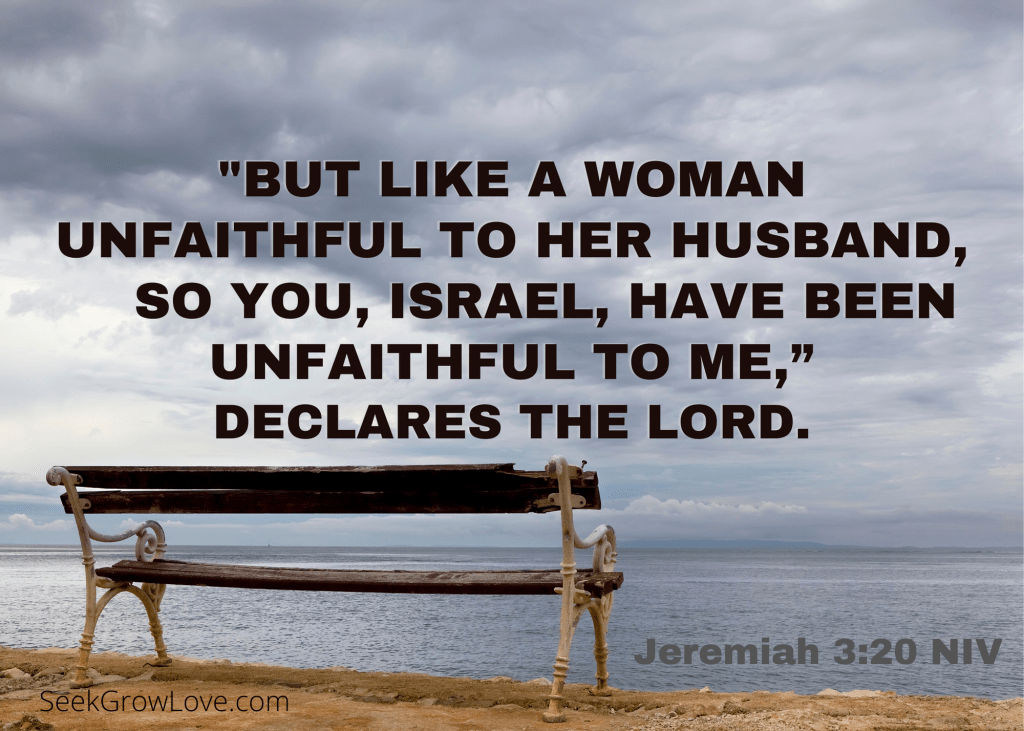
Yet, even God had to divorce his unfaithful wife. Woa, Nelly! What are you talking about? God never got married because, he’s… God, right? Actually, God uses the image of marriage to describe His relationship with Israel. God is the husband and Israel is His bride. It’s an image that appears in today’s reading of Jeremiah and it appears in many other places in the Old Testament. In fact, the book of Hosea is an entire book about this. God uses the image of an unfaithful bride because it brings an immediate, visceral response to the reader. Nobody like to be cheated on by the person that they love. It’s one of life’s most painful experiences. Go listen to Carrie Underwood’s song “Before He Cheats”. That pretty well captures the rage that comes when someone you love is unfaithful. Has anyone ever cheated on you? If so, you know how much it hurts. And God wants his people to understand how much they have hurt him by their unfaithfulness and idolatry. Read Jeremiah 3-4. That’s written from the perspective of a husband who found out that not only has his wife been cheating on him, but she’s a prostitute, selling herself out on the street. Ouch!
Jeremiah 3 begins: “If a man divorces his wife and she leaves him and marries another man, should he return to her again? Would not the land be completely defiled? But you have lived as a prostitute with many lovers— would you now return to me?” declares the Lord. -Jeremiahs 3:1
Most men in that situation would say “heck no” (or something even stronger).
And yet…even with all of that hurt and rage and betrayal and pain, God is still willing to take his bride back.
“If you, Israel, will return, then return to me,” declares the Lord. “If you put your detestable idols out of my sight and no longer go astray, and if in a truthful, just and righteous way you swear, ‘As surely as the Lord lives,’ then the nations will invoke blessings by him and in him they will boast.” –Jeremiah 4:1-2
That’s what you call mercy. That’s what you call grace. That’s what you call undeserved favor.
God called his people to a true change of heart.
The original sign of the covenant in Israel was circumcision. God told Abraham and his descendants to physically circumcise every male born in Israel as a visible sign that they were part of the covenant people of God. They were uniquely in relationship with God and offered their exclusive allegiance and worship to God. But far too often these people who were in that covenant relationship with God had hearts that were far from God.
So God spoke to them through the prophet Jeremiah:
“Circumcise yourselves to the Lord, circumcise your hearts, you people of Judah and inhabitants of Jerusalem, or my wrath will flare up and burn like fire because of the evil you have done— burn with no one to quench it.” –Jeremiah 4:4
Back in the time of Moses God spoke to Israel and said that they were to Love Him with all their heart. (Deuteronomy 6:5). What does any husband want? His wife’s whole heart. Just as any wife wants her husband’s whole heart. That’s why unfaithfulness is so painful and leads to so many broken hearts and broken marriages. God wants those in a covenant relationship with Him to give Him their whole hearts.
God criticized Judah for failing to return to God wholeheartedly: “her unfaithful sister Judah did not return to me with all her heart, but only in pretense,” (Jeremiah 3:10). God is NOT interested in our half-hearted repentance, our half-hearted worship, our half-hearted service, our half-hearted relationship. God wants our whole-hearted love.
God created us in His image. We love, we hurt, we get jealous and angry. That means that God also loves, God hurts when betrayed, God gets jealous and angry. Jeremiah shows us how heartbroken God was with his faithless bride:
“Your own conduct and actions have brought this on you. This is your punishment. How bitter it is! How it pierces to the heart!”
Oh, my anguish, my anguish! I writhe in pain. Oh, the agony of my heart! My heart pounds within me”- Jeremiah 4:18-19
And yet, God loves us so much, he invites us to return to Him.
“Return, faithless people; I will cure you of backsliding.” Jeremiah 3:22
Have you been giving your heart to someone or something instead of to the God who loves you?
Of course we can love other people, parents, spouses, children, friends. We can love our jobs and love our homes, we can love pizza and love a pet. But no love should come before that one true love, that love above all loves, the one with whom we’ve entered a covenant, God.
David loved God and wrote many love songs to God. Here’s one:
“It is good to praise the Lord and make music to your name, O Most High, proclaiming your love in the morning and your faithfulness at night, to the music of the ten-stringed lyre and the melody of the harp.” -Psalm 92:1-2
How will you love God today?
-Jeff Fletcher
PS- In November my wife and I will celebrate 37 years married- we’re almost halfway to 75!!
You can read or listen to today’s Bible reading passages at BibleGateway.com here – Jeremiah 3-4 and Psalm 92-93
This past Saturday women (and some men) gathered in front of the US Capital in Washington, DC and in state capitals across the United States to protest for women’s rights to choose to abort their unwanted babies. One of the signs held up said “Rage, Rage Against the Denial of Your Rights”.
That’s a dangerous way to begin today’s devotions. Some of you are likely offended or possibly even angry at me for what I wrote. I referred to them as unwanted “babies” and not “fetuses” or “products of conception.” Words matter. If a person says “illegal aliens” referring to those who cross the border without proper documentation and not “undocumented aliens” we know that they have an opinion about the status of those who have entered the country. “Illegal” sounds like a bad thing, like someone has broken a law and might be punished, whereas “Undocumented” sounds like some innocent mistake or a government slip up. I forgot my hall pass on my way to the bathroom and so I’m undocumented. That’s different than bringing a gun to school or taking drugs at school. Those activities are illegal and should be punished somehow, but crossing over the border without proper authorization, that shouldn’t be illegal, right? (If your sarcasm detector is now going off then it’s working properly)
Words matter, whether you say “illegal” or “undocumented” or whether you say “unborn or pre-born baby” or “product of conception.” If I refer to a “product of conception” that a woman has a right to dispose of, that’s no big deal. But if I say that it’s a human baby that is alive and waiting to exit her mother’s womb, and that we are killing that baby, that sounds pretty awful. No one wants to think about killing babies. No one should have the right to kill babies, but every woman should have a right to dispose of an inconvenient or unwanted ‘product of conception”.
Words matter. Jeremiah 1 wasn’t written specifically to address the issue of human life, and yet Jeremiah’s inspired words, given to him by God, are worthy of reflection and application to our context today.
“The word of the Lord came to me, saying,
“Before I formed you in the womb I knew you,
before you were born I set you apart;
I appointed you as a prophet to the nations.”- Jeremiah 1:4-5
Here, God is calling Jeremiah to be his prophetic voice to the people of Israel. Jeremiah is an integral part of God’s plan to prophecy against His people Israel for their worship of other gods. Before Jeremiah was even born, God had a plan for his life. While Jeremiah was still in his mother’s womb, God set Jeremiah apart to be a prophet. This is such a rich passage and we could reflect on it a hundred different ways. It speaks about God and his omniscience (that’s a technical term that means God knows everything). God is able to peer into the future and see that this tiny little cluster of cells which carries in it the DNA for a male human person who probably has brown eyes, brown hair and olive skin, will grow up to be able to speak for God 20 or 30 years in the future and be a key part of God’s plan.
This little tiny cluster of cells in that young Jewish woman’s womb would one day be born, grow up and go in the name of God to confront an entire nation with its rebellion against God.
“My people have committed two sins:
They have forsaken me,
the spring of living water,
and have dug their own cisterns,
broken cisterns that cannot hold water.”- Jeremiah 2:13
It was this tiny pre-born human, who God would use to condemn his people because: “On your clothes is found the lifeblood of the innocent poor.”- Jeremiah 2:34
God condemns Israel because her clothes are stained with the blood of the innocent and the helpless. Again, in the context Jeremiah is not referring specifically to pre-born babies who have been unjustly murdered (aborted). However, in our present context, those words have a clear application. Who are the most innocent and helpless human beings in the world today? It is the pre-born humans whose Mother’s don’t want to allow them to live. As thousands gather around the country to rage at the prospect of some states seeking to bring greater justice and defend the defenseless we must ask ourselves “How in the world did we get here?”
When God called Jeremiah it was to take a courageous stand against a wicked and corrupt nation. Is God calling His people today to take a courageous stand? I think so.
“Get yourself ready! Stand up and say to them whatever I command you. Do not be terrified by them, or I will terrify you before them. Today I have made you a fortified city, an iron pillar and a bronze wall to stand against the whole land—against the kings of Judah, its officials, its priests and the people of the land. They will fight against you but will not overcome you, for I am with you and will rescue you,” declares the Lord.” -Jeremiahs 1:17-19
If you, like Jeremiah, accept the call to speak faithfully for God against the current culture of death, and in doing so invite the rage of those who don’t want their right to murder unwanted pre-born human babies, then put Psalm 91 in your back pocket and carry it with you wherever you go:
“Whoever dwells in the shelter of the Most High
will rest in the shadow of the Almighty.
I will say of the Lord, “He is my refuge and my fortress,
my God, in whom I trust.”-Psalm 91:1-2
The Lord be with you.
Jeff Fletcher
Today’s Bible reading passages can be read or listened to at BibleGateway.com here – Jeremiah 1-2 and Psalm 90-91
What is the best way to lead people? You may be a leader in some area of your life, at school, at work, at Church, among your friends, on a sports team, in your marriage, with your children etc… Most of us have had some experience being a leader and I’m going to guess that everyone has had the experience of having a leader, probably many, in your life.
There are a number of leadership styles. Authoritarian leaders impose expectations and define outcomes. It’s a very top down approach. It’s efficient and sometimes required, but doesn’t always create a great experience for those being led. If you’re the parent of a 2 year old, it’s pretty much the only leadership style. But what works with a 2 year old doesn’t work as well with a 16 year old, or with your spouse. It might work okay if you’re the manager of a fast food restaurant with a bunch of first time teen-age employees, but probably not so well if you are managing a medical practice with a group of physicians.
Participative leadership is more democratic and helps people feel more engaged, but it can be more time-consuming and lead to poor decisions if the employees participating lack necessary information or skills.
Delegative leaders step back and let the members of the team set their own agendas, which in the right environment can produce a lot of creativity, but can also lead to disunity.
Transactional leaders use a lot of carrot and stick, reward and punishment. They give clear expectations and offer clear feedback and immediate rewards and punishments. It works well getting a 7 year old to clean her room or finish her vegetables, but doesn’t inspire a lot of creativity in capable adults.
Transformational leaders inspire with a vision and then encourage and empower followers to achieve that vision. They act as a role model. This type of leadership is not coercive and leads to high morale. To learn more check out: https://www.imd.org/imd-reflections/reflection-page/leadership-styles/
Great leaders adjust their leadership style to the appropriate context and situation. The little book of Philemon is a wonderful case study on Christian leadership. The Apostle Paul writes to his disciple, Philemon, about their mutual acquaintance, Onesimus. Paul and Philemon were brothers in Jesus Christ. Paul was responsible for Philemon coming to faith in Christ. Now, Philemon was a leader in the Church and actually had a congregation that met in his home. When he wrote the letter to Philemon Paul was in jail, probably in Rome awaiting his trial. While in prison he met Onesimus. Onesimus was a runaway slave who had been the property of Philemon. It seems that Onesimus became a follower of Jesus Christ through Paul while they were in prison. Onesimus had become a supportive helper to Paul. Paul has a dilemma. He has two Christian brothers, Philemon, a slave owner and Onesimus, a runaway slave. Paul wants Philemon to release Onesimus from his enslavement and either welcome him back not as a slave but as a fellow Christian, or allow him to return to Paul and support him while he’s awaiting trial.
So what leadership style does Paul use? He could have played the authoritarian card and said “Philemon, I’m an Apostle, I met Jesus personally, I brought you to faith, and now I order you to release Onesimus.” Under Roman law Philemon had the right to demand Onesimus’ return. He was not legally obligated to release him. Legally, under Roman law Paul had no authority to force Philemon to let Onesimus go. Paul practiced transformational leadership. He inspired Philemon and gave him a vision of how being a follower of Jesus Christ can transform a person and their values and relationships. He gave him a vision of Onesimus as more than property or an asset, but as a person, a child of God, as a fellow heir of the kingdom of God bought from slavery to sin and death through the blood of Jesus Christ.
In using this leadership style Paul creates space for the spirit of God to transform Philemon’s heart, and have a much wider impact on the Church (for nearly 2000 years). Hopefully, other Christian slave owners saw Philemon’s example and also chose to release their slaves and welcome them as brothers and sisters in Christ.
Paul uses his personal relationship with Philemon to persuade and inspire him to recognize what Paul had done for him and what Paul was inviting him to do for Onesimus. This is a great example of persuasive transformational leadership. In times when God calls you to be a leader either at school, at work, in your family, at Church, in community, or wherever you might be called to lead, remember Paul’s great example of how to be a transformational leader.
The passage in Isaiah also gives a glimpse of leadership. In this instance. God is leading his disobedient and rebellious children, Israel. God’s leadership style here might be interpreted as transactional. God has punished Israel for their idolatrous and rebellious ways. God also promises better days ahead for those who faithfully listen to God and walk in the ways of obedience. Ultimately, God is a transformational leader calling people to look to the vision of a new heaven and a new earth to inspire them to faithfulness now. God doesn’t enjoy punishing the disobedient. It’s true that the “fear of the Lord is the beginning of wisdom”(Provers 9:10), but ultimately God wants us to respond to Him out of love- to love him with all our hearts (Deuteronomy 6:5). God always leads in exactly the way we need, because He is the perfect leader. Let us follow Him and learn from Him just as Paul (and hopefully Philemon) did.
-Pastor Jeff Fletcher
Today’s Bible reading plan passages can be read or listened to at BibleGateway.com here – Isaiah 65-66 and Philemon
Life is so busy and complicated that I have to create lots of reminders for myself. Fortunately, my phone and computer and watch all have features where I can set reminders for myself. “Doctors appointment Tuesday at 3:00. Take the garbage to the dump on the way to work in the morning. Stop by the store after work and pick up some milk and bread.” I can even set reminders months or years in advance. I can set alarms to remind me that in 2 hours I have a meeting. In 1 hour I have a meeting. In 15 minutes I have a meeting. The Meeting is now starting. Maybe I’m too busy or maybe I’m getting old, but I find myself more and more needing reminders.
Do you ever need reminders? Little kids need to be reminded to brush their teeth, make their bed, do their homework. What do you need reminders for?
The Apostle Paul thought reminders were important for Christians. I guess he understood how easy it can be to forget what’s important when we are busy living life and doing what’s necessary or urgent. Do Christians ever forget important things about God, about Jesus, about how we are supposed to live? Yep, we sure do.
In Titus 3 Paul tells Titus to remind the believers of some important things.
“Remind the people to be subject to rulers and authorities, to be obedient, to be ready to do whatever is good, to slander no one, to be peaceable and considerate, and always to be gentle toward everyone.” -Titus 3:1-2
Those reminders were important in the first century when Christianity was brand new and people were still learning the basics, but it’s been 2000 years. We’ve certainly got being a Christian all figured out by now, don’t we? Do we really need to be reminded to obey people in authority? Do we need to be reminded to always be ready to do good? Don’t all Christians always do what is good? Certainly we never slander or falsely accuse someone of wrong doing. I’m always peaceable and considerate and gentle toward everyone, aren’t you? (My tongue is in my cheek- that means I’m kidding).
To tell the truth, I still need to be reminded all of those things. Just because I’ve been reading the Bible for over 50 years doesn’t mean I always remember to do good. I still need to be reminded to be considerate and gentle, and so do you. That’s why Christianity was never designed to be lived in isolation, but in community. We need each other. There’s a passage in Hebrews (a different book from today’s reading, but important) Hebrews 10:24-25 says that Christians shouldn’t get out of the habit of meeting together, because we need to encourage (I think Hebrews says “spur one another on”, like a rider spurs on a horse) each other.
Following Jesus is hard some times. Being obedient to God is hard some times. Remembering to do good and be gentle is hard sometimes. I need help, I need encouragement to keep on doing what is right. I need you, and you need me, we need each other.
I’ve read the Bible many times in my life and I need to keep on reading it to help me remember all the important things I need to remember. Today’s readings in Isaiah 63-64 and Titus 3 remind us both about God’s wrath and about God’s mercy. God has both. God hates sin, he hates it when his children are brutal to each other. He hates it when his children fight and argue. He hates sin because he loves us and he knows that sin hurts us. We hurt each other when we sin. No parent likes to see their children hurt each other. We learned that from our Father, God.
So keep reading your Bible and keep coming to Church and meeting with other believers so that you can remind them and they can remind you to keep on following Jesus.
“Hey Siri set a reminder for 7 a.m. tomorrow: be considerate and gentle to everyone.”
“Alexa, remind me to get up for Church Sunday at 8:00.”
-Jeff Fletcher
Today’s Bible reading plan passages can be read or listened to at BibleGateway.com here – Isaiah 63-64 and Titus 3
I’ve got some good news and some bad news. Which would you like first? If you’re like me, you’d prefer to rip the band-aid off and get the bad news over with and finish with the good news. So let’s get to it.
The bad news. Humans have made a pretty big mess out of this world. Yes, we’ve done some amazingly good things too, but we’ve made an awful mess of the world. One of my ministry settings is as a hospital chaplain. When I visit with patients, a lot of them are there because either they, or someone else, has made a huge mess of their lives. Sometimes it’s from drug or alcohol abuse, sometimes they are victim of crime, often they have not taken very good care of their bodies. Sometimes they’ve been in such despair that they attempted to end their life by suicide. I’m not going to spend a lot of time listing the ways human beings have made a mess out of the world, if you need proof, just turn on the news for an hour or two.
Here’s the thing about messes, you can ignore them, and they will simply get worse, or you can clean them up. Usually when you clean up a mess you preserve somethings and you discard others. You try to salvage what is worth saving and discard what isn’t. That requires some decision making. What to keep and what to discard. If you want clean dishes, you have to discard the dirty stuff that’s on the dishes. If you want a clean house, you have to purge the junk. If you don’t ever throw anything out then you become a hoarder and that’s an awful mess and no way to live a flourishing and happy life.
In today’s first reading in Isaiah, Israel had made quite a mess. They failed to be faithful to YHWH, the God who created them and called them to be His. Despite warnings and pleadings, Israel worshipped other gods. They failed to give YHWH their exclusive love and devotion. After numerous attempts to get them to stop, God finally allowed them to face the consequences of their unfaithfulness. God allowed their enemies to conquer them, destroy their beloved temple and city, Jerusalem, and they went into captivity for 70 years. That was the bad news.
Now for the good news. God was going to rescue them, restore them and return them to their beloved Jerusalem.
Isaiah 61
“The Spirit of the Sovereign Lord is on me because the Lord has anointed me to proclaim good news to the poor. He has sent me to bind up the brokenhearted, to proclaim freedom for the captives and release from darkness for the prisoners,[a] 2 to proclaim the year of the Lord’s favor and the day of vengeance of our God, to comfort all who mourn, 3 and provide for those who grieve in Zion— to bestow on them a crown of beauty instead of ashes, the oil of joy instead of mourning, and a garment of praise instead of a spirit of despair. They will be called oaks of righteousness, a planting of the Lord for the display of his splendor. 4 They will rebuild the ancient ruins and restore the places long devastated; they will renew the ruined cities that have been devastated for generations.”
Isaiah goes on to describe how much better things will be for God’s people. He uses the image of a bride being rejoiced over by her groom. God’s love for his people is great.
Toward the end of the section is the promise: ” ‘See, your Savior comes! See, his reward is with him”
Notice God’s rescue of his people is good news for some, and bad news for others. It’s both the year of the Lord’s favor and the day of vengeance.
Think about WWII for a minute. When the Allied Forces defeated Hitler and his armies and came to the internment camps like Auschwitz, it was good news for the prisoners, but bad news for the German army. Hitler chose suicide over the swift justice that was sure to come. For the men and woman who were set free it was good news but for the perpetrators of injustice it was a day of vengeance.
Jesus is coming again. In Titus 2 we are told:
“11 For the grace of God has appeared that offers salvation to all people. 12 It teaches us to say “No” to ungodliness and worldly passions, and to live self-controlled, upright and godly lives in this present age, 13 while we wait for the blessed hope—the appearing of the glory of our great God and our Savior, Jesus Christ, 14 who gave himself for us to redeem us from all wickedness and to purify for himself a people that are his very own, eager to do what is good.”
God’s purpose in allowing His people Israel to face judgement was his way of cleaning up the mess that they had made and giving them a chance to start fresh, free from the worship of idols.
God’s purpose in sending Jesus was to extend the opportunity of salvation to all people, again, to clean up the mess and rescue those who are willing to receive the grace of God. While we are waiting for Jesus to come and all the mess to be finally cleaned up, God invites us in the name of Jesus to follow him and live Godly lives, rejecting the mess of the world.
The world is a mess and God is fully and finally going to clean it up through the coming of Jesus Christ. For those who reject God’s grace and mercy it will be a day of vengeance. While we wait, God is working in our lives to clean up our messes and put us to work doing good, helping point others to God. Are you willing to say “no” to ungodliness and worldly passions? Are you willing to be different (FUEL 2019). Are you eager to do what is good? God wants to purify you and put you to work. Are you willing?
-Jeff Fletcher
Today’s Bible reading plan passages can be read or listened to at Biblegateway.com here. Isaiah 61-62 and Titus 2.
When you hear the term financial peace, you may think of Dave Ramsey and his teachings about finances. He has a lot of good advice and I recommend you read his books to discover great ways to be good stewards of your money. He will show you how to overcome your financial difficulties and will help you put your mind at ease. However, true financial peace isn’t about having enough money; it is the realization that money is not very important and God will take care of your needs. Of course, this guarantee only applies to those who trust in God and seek His kingdom first.
This is the last devotion of the week and I would like to list the reasons why people experience financial trouble and solutions to those issues. Much of this is just common sense, but I think it is important for people to realize that there may be consequences for our actions, but there is a way out of the struggle.
I believe the number one reason people stress over their finances is because they have purchased things that they could not pay for by using credit cards and taking out loans. I can relate to this one. Obviously, the first step to a solution or a way to avoid this altogether is to not use credit cards or take out loans. If you don’t have the cash to buy something, don’t buy it. This might be very difficult to do, but Hebrews 13:5 is a good verse to remember. “Keep your lives free from the love of money and be content with what you have…” If you are content with what you have, you will not be so anxious to buy something you can’t afford.
An obvious reason you may be experiencing trouble with finances is that you don’t work. We talked about the need to work earlier this week. Proverbs 10:4 says, “Lazy hands make for poverty, but diligent hands bring wealth.” Enough said.
Another reason you “think” you are having financial difficulty is that you “think” you don’t have enough money. Recall that we learned that more than a third of the world’s population lives on less than $2 per day. If you live in the United States, you are probably better off than you think, even if you are not keeping up with those around you. If you don’t worry about where your next meal is coming from and you have a place to sleep, you may just need a different perspective about your situation.
Proverbs 21:17 warns us that whoever loves pleasure will become poor. The simple solution to that is to not love pleasure, but let’s dig a little deeper. Why would someone love pleasure? People who love pleasure are living for themselves. If you live for God and not for yourself, you will not have trouble with this one.
I think the most difficult situation to deal with is a tragedy. There are many different tragedies that can wreak havoc on a person’s life. Accidents, illnesses, fires, hurricanes, crime, etc. are many times out of our control and cannot be avoided. We can take steps to avoid some tragedies or at least lessen their chances, but being a Christian does not mean you won’t experience a tragedy. There may be consequences to a tragedy that you did not deserve, but I can tell you that if you put your trust in God, He will make sure your needs are met. One way He helps people get through these tough times is to engage others to help you. I would encourage you to keep your eyes open for people that need help and to be that help that they need.
Lastly, Luke 12:29-31 says, “And do not set your heart on what you will eat or drink; do not worry about it. For the pagan world runs after all such things, and your Father know that you need them. But seek His kingdom, and these things will be given to you as well.” This is actually a pretty key concept about financial peace. If you seek His kingdom, God will take care of your needs. However, if you are not seeking His kingdom, I can understand why you are worrying about your finances. You should be worried.
I hope these devotions this week have given you some clarity about money. I was confused about money before I searched the scriptures for some answers. I now have a much better understanding of the role money should or should not play in my life. The Bible is pretty big, but I love that there is so much to learn if you take the time to search it out. Thank you, God, for sending us your words of wisdom.
-Rick McClain
Today’s Bible reading plan passages can be read or listened to at Biblegateway.com here. Isaiah 59-60 and Titus 1





 Seek Grow Love