From Death to Life!

Old Testament: Deuteronomy 9 & 10

Poetry: Job 32

New Testament: Mark 16

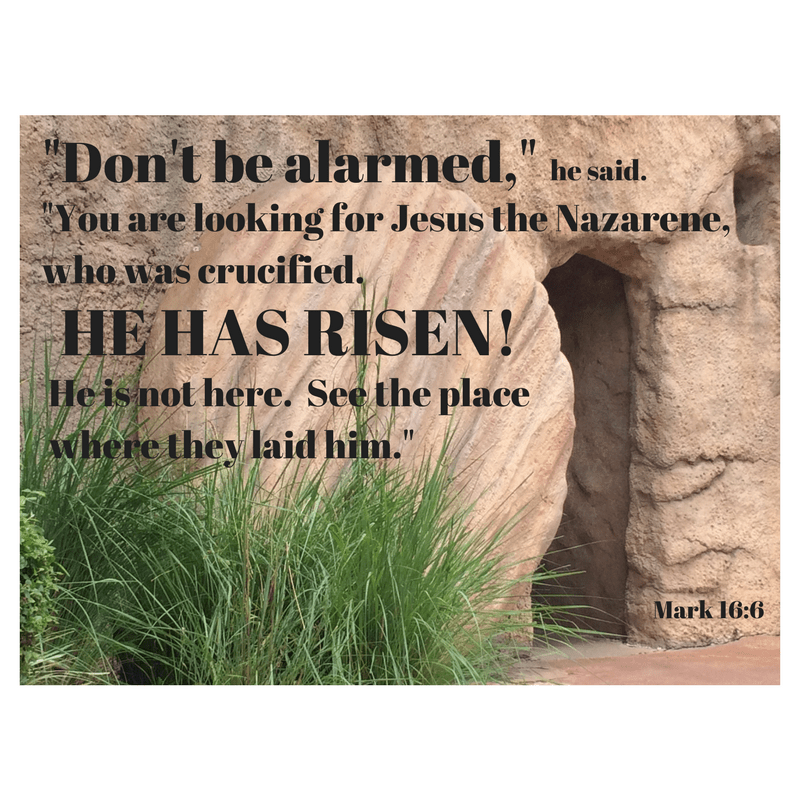
       Looking at Mark 15 allowed us to consider what Jesus suffered, and why. But the dawn has come, and now we can eagerly seek the news that our savior is raised to life. That transition from death to life is as simple for us as turning a page in our Bibles. Most Christians cannot approach Mark 16 without being aware of what should come next, which may always have been the case. Mark may not have written his Gospel primarily to tell people about Jesus, but to remind and encourage believers in their faith. We might imagine the text being read aloud in a group setting.

       We can envision the early listeners to this passage trying to put themselves in the places of Mary Magdalene, James’ mother Mary, and Salome. Certainly they understood what brought those women to the tomb: love, and mourning, and the wish to offer Jesus what support was possible by caring for his body. But from hindsight it was also clear that the tomb would be found open and empty – what a wonderful surprise for the mourners!

       And so as the account was read the listeners waited to hear of the women’s overcoming joy at learning about Jesus’ new life. It was not to be. Rather the three were left trembling, astonished, and afraid. And upon exiting the tomb they say nothing. (We know that ultimately more happened – particularly in the case of Mary Magdalene – but that is where the text stops.)

       Your Bible version, whatever version you are reading, probably does not cut off after verse 8. Perhaps it offers a footnote discussing what scholars think about the verses that follow (they doubt that the verses are legitimate). In fact different manuscripts contain four endings for the Gospel of Mark – aside from the version that simply cuts off after verse 8. That variety of endings not only shows us that some people were disappointed with the ending they had received, and tried to “fix” the issue, but it also demonstrates that the version which cuts off at verse 8 is from a pretty early date (so if there is a “real” ending of Mark lost due to damage that happened a long time ago).

       The way Mark 16 ends at verse 8 has been compared to how the book of Jonah ends. After God reprimands Jonah we never learn Jonah’s response. In Mark there may be a similar tone of leaving issues hanging at 6:52.

       So, let’s consider the possibilities. Mark may have intended to have a somewhat jarring ending to spur his audience to think about their own situations – each of them had the knowledge of Jesus’ resurrection (and had received sufficient time to get over the shock about it), so would they be silent, or would they proclaim it? Perhaps the closing line of Mark’s book was intended to open a discussion, an interactive lesson plan which is so old we have lost the details for it.

       Or it may be that Mark was unconcerned about how the ending of his book came across, because the middle of his book already set up all the promises that were needed regarding Jesus’ new life, they just need to be believed. Having arrived at the end of Mark’s gospel, we certainly have not arrived at the end of Jesus’ story. To quote from Donald H. Juel, who discussed this idea,

There is every reason to believe that the rest of his promises will be fulfilled: James and John will drink from the cup; the disciples will give testimony; the gospel will be preached to all the Gentiles. Jesus will be enthroned at God’s right hand and will one day come with the clouds of heaven so that ‘all will see’ and will send his angels to gather the elect from the four winds.

(Mark, in the Augsburg Commentary on the New Testament series.) The trust that these promises will be fulfilled is not based on human effort, and neither is the end of the story. “The story is not over and will not be until Jesus returns.” (Juel).

       Knowing if one of these possibilities about Mark is correct is not the most important thing. We know that Jesus is alive. Both of these ways of viewing Mark’s book can be useful ways for us to think about our relationship with our living savior, and to better prepare ourselves to continue serving him. We sometimes approach Resurrection Sunday as a time to think about our own future lives, but there is much to be done in the meantime to be prepared, and to invite others.

       Dear God, on this Resurrection Sunday help me recommit my heart to you and to your son Jesus, the Christ, my savior. Allow me to examine myself through the guidance of your Spirit and to determine both what I need to set aside and what I need to take up for the improvement of my service. You offered me a new life, a resurrection into immortality. Please help me be more responsible in how I live this life, so I can relay your wisdom to those around me. Make me a witness of your grace and mercy and love. In the blessed name of your son Jesus I pray these things, Amen.

-Daniel Smead

Reflection Questions

  1. Do you find it strange for a Gospel not to include an appearance of the resurrected Jesus?
  2. Might Mark have stopped where he did because he saw the alternative as a much longer book (perhaps with part of what we know as Acts)?
  3. Over 500 believers saw Jesus alive in his resurrected state (1 Corinthians 15:6), but most have needed to wait to see Jesus, and are blessed for having believed without seeing (John 20:29). What affect do you think it would have had on the church if Jesus had been taken up to heaven without appearing to anyone?
Crucified for Us

Old Testament: Deuteronomy 7 & 8

Poetry: Job 31

New Testament: Mark 15 – again

In Jesus’ time, crucifixion was reserved for the worst of criminals. The torture a person endured on a cross would last for hours, and killing Jesus in this manner likely appealed to the religious leaders who hated Him so deeply. In an effort to hide their move against Jesus from His many supporters, the Jewish leaders arrested and tried Jesus in the middle of the night. When Jesus was brought before Pontius Pilate—the only one with authority to order a crucifixion—it was still early in the morning (Matthew 27:1–2). When Pilate presented Jesus and Barabbas to the people, the chief priests whipped the crowd into a frenzy, encouraging them to call for Barabbas’s release (Mark 15:11). When Pilate asked what they wanted done to Jesus, the crowd, again influenced by the chief priests, shouted, “Crucify Him!” Pilate, the people-pleaser, gave them what they demanded. He had Jesus flogged and then turned Him over for crucifixion. After the scourging, the entire battalion of soldiers gathered around this faint and bleeding man, put a scarlet robe on him, pressed the weight of a scarlet robe onto his torn shoulders, set a reed in his right hand, knelt down before him, and mocked him, “Hail, King of the Jews.” They struck him with their hands. They spit on him. They wove a crown out of thorns—probably not the kind of thorns you see on rose bushes, but the longer kind that are more like needles. Then they not only put the crown on his head, but hit him over the head—to drive the thorns into his skull (Mark 15:17-19).

At the beginning of the week, there was a crowd in Jerusalem celebrating Jesus as the Messiah; by Friday, there was a crowd crying, “Crucify Him!” The incredible change of the people naturally causes some confusion. It’s good to remember that not everyone at the Triumphal Entry was celebrating Jesus. Most of the city was puzzled: “When Jesus entered Jerusalem, the whole city was stirred and asked, ‘Who is this?’” (Matthew 21:10), and the Jewish leaders were resentful (verse 15). Some of the same crowd who shouted, “Hosanna!” may also have been part of the crowd shouting “Crucify Him!” but we can’t be sure. If some people did join both crowds, it may be because they had grown disillusioned with Jesus when they discovered he was not going to set up the kingdom immediately—or perhaps they disliked Jesus’ insistence that they repent. Also, it’s quite possible that the crowd gathered before Pilate at that early hour had been assembled secretly to do an unlawful thing by the Jewish leaders.

In the end, it wasn’t the crowd’s cries of “Crucify Him!” that put Jesus on the cross. Our sin did that. From the very beginning, when Adam and Eve disobeyed God, the Lord had promised to send a Savior who would crush the reign of sin and death (Genesis 3:15). Throughout the ages God worked His plan to send a Savior, and that plan culminated in Jesus Christ: God’s own Son who became the perfect offering so he could take upon himself the punishment for sin. Although wicked men were involved in Jesus’ death on the cross, His sacrifice was ultimately the will of God (Isaiah 53:10; John 10:18). The shedding of Jesus’ blood fulfilled God’s promise to mankind to provide a Savior and sealed the New Covenant (Luke 22:20). Jesus would then defeat the power of death and the grave by rising again three days later and ascending to His Father’s right hand in heaven.

Do you feel the heaviness of his death? Do you understand that he died for you so you may have a chance at a new life? My hope and prayer for you this morning is that you have accepted Jesus Christ as your Lord and Savior. That because of his death you live for him. Your sin killed Jesus. But his righteousness saves you. May that truth motivate you and give you peace of mind knowing that God loves you so much that he gave his son to die for you. What will you do with this information?

-Andy Cisneros

Reflection Questions

  1. Do you feel the heaviness of his death? Do you understand that he died for you so you may have a chance at a new life?
  2. Have you accepted Jesus as your Savior?
  3. What questions do you have for God? What praise and thanks to Him and His Son? Spend some time in prayer today.

Crowd Pleaser

Old Testament: Deuteronomy 6

Poetry: Job 30

New Testament: Mark 15

We are nearing resurrection Sunday. Before we can talk about his resurrection, we must talk about his death. In our text in Mark 15 we are seeing Jesus facing his death out in the open for all to see. The Sanhedrin brought Jesus before the Roman governor, Pontius Pilate. He could not find any fault in Jesus, and he said so three times. Late in the trial, Pilate sought a way to free Jesus. It was a Passover festival custom that the governor release a prisoner to the people, so, in a ploy to satisfy the crowd of Jewish leaders who had gathered and to secure Jesus’ release, Pilate allowed them to choose between a convicted criminal named Barabbas and Jesus. Instead of choosing Jesus, as Pilate had hoped, the crowd chose Barabbas for release. Shocked that they would free a hardened criminal, Pilate asked, “What shall I do, then, with the one you call the king of the Jews?” (Mark 15:12). The crowd cried out, “Crucify him!” (verse 13).

Pilate was confused by the crowd’s reaction, for barely a week earlier the people of Jerusalem had welcomed Jesus into the city with the waving of palm branches and shouts of “Hosanna!” (Mark 11:1–11). What Pilate may not have known was the extent to which the religious and political leaders hated and opposed Jesus. Not only did Jesus point out their extreme hypocrisy on many occasions (Mark 7:1–14), but He also claimed to be the Son of God, which was blasphemy to the unbelieving teachers of the law (see Mark 14:60–64). The religious leaders wanted to destroy Jesus (Mark 3:6). Only His death would satisfy them. Over the course of Jesus’ ministry, his teachings had angered the Pharisees, the scribes, the Herodians, and the Sadducees.  But not the crowd. Not the ones who saw Jesus’ love. Who saw him heal, support, encourage, teach. Who gave dignity to those who were oppressed. How could they hear the cries of crucify him and betray him like this? How could they hear Pilate offer Barabbas and choose him over a man who has done nothing wrong? Jesus was no longer the crowd pleaser, but the scorned suffering servant spoken about in the Old Testament. They had no idea who was standing before them. They chose Barabbas. We too face the same decision these Jews had to make between Barabbas and Jesus. When I read this story its hard for me to understand why Jesus is even in this predicament. He is the son of God. Save him. Sometimes, I have a hard time understanding God. How could he let his perfect son suffer and die?

Have you ever expected Him to act in a certain way because of what you understood about Him and His nature—but He did not do things the way you thought they should be done? I have. If I were Jesus, I would be angry. All he ever did was follow what God wanted him to do and it got him killed. Have you ever been angry and disappointed in God? I have been all but convinced that He did not live up to His promise, for I was sure that I knew what He was going to do, and God let me down. My heart was filled with rage that God would act that way, even though God has told us all, again and again, ‘For my thoughts are not your thoughts, neither are my ways your ways,’ declares the LORD. ‘As the heavens are higher than the earth, so are my ways higher than your ways and my thoughts than your thoughts’ (Isaiah 55:8-9). We cannot figure out God. He will be true to Himself, He will never lie, He will never deceive us; but He is more than we can handle. He is bigger than we are. Jesus understood this. He understood the bigger picture. He understood the need for his death. While he did not want to die he gave up his will and took all of the suffering so that we might live. Sometimes I don’t understand God but then I remember God loved us so much that he gave His one and only son for a chance for us to accept his love and have a relationship with Him. Mark 12:10-11  “The stone that the builders rejected has become the cornerstone, this was the LORD’s doing and it is marvelous in our eyes.”  All these words to say, I don’t want to be like the crowd who didn’t understand God’s plan. I don’t want to live another life other than the one I can have with Jesus. I know I’m like the crowd more than I care to admit. And like this crowd, when I (we) get angry with God and don’t want to follow his son and turn from Him, there is always another Barabbas waiting in the wings for me (us) to choose. Another crowd pleaser. One that is a murderer. One that I know is not right, but I choose anyway because I don’t want to follow Jesus. But I’m thankful that God is patient and loving and I have his son as a mediator who draws me gently back to him. Who calms my fears. Who alleviates my doubts. One who is the great shepherd and high priest.

-Andy Cisneros

Reflection Questions

  1. When have you been upset with or disappointed in God’s plan or ways?
  2. When have you been reminded His ways are higher – and better – than yours?
  3. How does the path laid out for Jesus – and his willingness to walk it – remind us that God can be trusted even when we think it doesn’t make sense or isn’t “right”?

A Beautiful Thing

Old Testament: Deuteronomy 5

Poetry: Job 29

New Testament: Mark 14

“Leave her alone, said Jesus. Why are you bothering her? She has done a beautiful thing to me.” Mark 14:6

In Mark 14 we see the story of Jesus being anointed with  perfume. Jesus takes this beautiful moment and shows us just how great this event truly was. Mary’s actions may signal more than she knows. But, although she may not fully comprehend the messianic significance of her anointing, she appreciates Christ’s worth more than anyone else at the table. But Jesus receives the woman’s gift as a selfless act of love and devotion—an appropriate way to honor the Messiah. Jesus reveals that He will not be with them much longer, which references His soon death and burial.

Jesus says five things about it that mark it as an extremely beautiful act. First, he says, “she has done a beautiful thing to me”. The beauty of it lay in its extravagance. This woman did not spare any of the costly perfume but broke the flask and poured the whole quantity out on him. Judas, with his practical and corrupt mind, counted it up as worth three hundred denarii. A denarius was the day’s wage for a laborer. Three hundred days’ wages would be a tremendous sum. In the eyes of Judas, this woman wasted an enormous amount of money when she poured out the perfume on Jesus. It was such a lavish over the top act, and there lies the beauty of it. When have you done something extravagant and beautiful for Jesus?

Second, He said that it was a timely thing she had done. It was something that could only be done now. Any time you want to do good to the poor you can, because they are always around. And it is right to help the poor. But there are opportunities that come in our life that must be seized at that moment. Mary had sensed this and seized the moment to offer this gift, for such a time would never occur again. It was out of the sensitivity of her heart that she realized that the timing was right, and Jesus recognized this. I’m sure you’ve heard the phrase timing is everything. Mary is preparing Jesus for his death. The timing was now.

Third, she did what she could. She could not fix Him a meal; there was no time for that. She could not make a garment for Him; there was no time for that. There was nothing else she could do to show her love but this. She did what she could. I am sure Jesus has called our attention to that because it is so practical for us. Someone said, “I can’t do everything, but I can do something. And what I can do I ought to do. And what I ought to do, I’m available to do”. Are you doing what you can? Or are you doing what’s easy? Are you doing at least what you are capable of for God and his son?

The fourth element of this act was that it was insightful. Jesus says she has anointed my body beforehand for burying. Many times, Jesus said to these disciples that He was going to die. Not one of them believed or understood him–except maybe Mary of Bethany. She could have understood that he was heading for burial. And since she could not be sure she would ever have the opportunity later to find his body and anoint it for burial, she did it now, as a loving act of service. Of all these friends who were around Him at this time, only this one had the sensitivity of heart to understand what was happening.

Finally, what she did was deserving of being remembered. It was memorable. Jesus said, the story of this beautiful act will be told in memory of her wherever the gospel is preached in the whole world. Here we are today, two thousand years later, fulfilling this very word, telling again of the act of Mary of Bethany when she anointed our Lord’s head and feet.

I hope we can be as understanding and extravagant as Mary was. What can you do today to show your love and appreciation of Jesus? Something extravagant. Something with meaning.

-Andy Cisneros

Reflection Questions

  1. What is Jesus Christ’s worth to you? When have you done something extravagant and beautiful for Jesus? How can you – and will you – honor him?
  2. Are you doing what you can? Or are you doing what’s easy? Are you doing at least what you are capable of for God and his son?

Are you ready for the day of Christ’s return?

Old Testament: Deuteronomy 4

Poetry: Job 28

New Testament: Mark 13

After Jesus’ death and resurrection Jesus ascends into heaven in Acts 1:11. “Men of Galilee,” they said, “why do you stand here looking into the sky? This same Jesus, who has been taken from you into heaven, will come back in the same way you have seen him go into heaven.”

In Mark 13:14–37, Jesus prepared his followers for intense persecution and tribulation in the days ahead and especially during the end times. He gives them hope to endure these trials by describing his glorious return as the conquering King of the universe (verses 24–27). To keep them from despairing in dark times, the Lord wants them to live in readiness for His second coming. “However,” Jesus states, “no one knows the day or hour when these things will happen, not even the angels in heaven or the Son himself. Only the Father knows. And since you don’t know when that time will come, be on guard! Stay alert!” (verses 32–33).

“Day” and “hour” are often used in Scripture as references to time in general (see Matthew 7:22; 10:19; 24:42, 44, 50; 25:13; 26:45). But in Mark 13, Jesus focuses on a specific event in the future. Because no one knows the day or the hour of His return, Jesus stresses the need to pay attention, stay awake, and be ready at a moment’s notice. Multiple times in Mark 13, Jesus calls for people to be ready, to be watching: “Be on guard! Stay alert!” (verse 33), “Watch for his return” (verses 34), “You, too, must keep watch!” (verse 35), “Don’t let him find you sleeping when he arrives without warning” (verse 36), and “Watch for him!” (verse 37).

The disciples wanted to know when the end would come (see Mark 13:3–4). But Jesus told them that even he did not know (verse 33). Jesus acknowledges God as omniscient alone. Since no other mortal knows the time of Jesus’ return, Jesus, as the perfect son of God didn’t know the day or hour of his return, nor did the angels in heaven, only God the Father. It is possible that Jesus, now in his glorified state, knows the day and hour of his return. But at that moment, speaking with his disciples, the information was not at Christ’s disposal. Later, just before His ascension, Jesus would remind them, “It is not for you to know the times or dates the Father has set by his own authority” (Acts 1:7). Jesus accepted his human limitations, and so must we. The thing that matters is being ready every day for his return. What is stopping you from being ready?

Believers of every age have experienced persecution, natural disasters, and earthly trials. We all have our cross to bear. We all have our issues to deal with. We know how difficult it can be to live in this world. Genuine disciples must understand that these challenges are a daily reality of life in a fallen world. Yet, believers are not without hope because, in the end, our victorious King will return for us. Romans 8:38-39“For I am convinced that neither death nor life, neither angels nor demons, neither the present nor the future, nor any powers, 39 neither height nor depth, nor anything else in all creation, will be able to separate us from the love of God that is in Christ Jesus our Lord.”

 In the meantime, since no one knows the day or the hour, we are to watch and be ready for Him no matter what we must endure as we continue His mission of spreading the good news of God’s kingdom”. You don’t have to know the day or the hour. You just have to be ready. God has already supplied the victory through his son Jesus Christ

Many have tried to predict the day of Christ’s return, but Scripture is straightforward—no one knows the day or the hour. Jesus said to stay awake because his coming will be a surprise: “Look, I will come as unexpectedly as a thief! Blessed are all who are watching for me, who keep their clothing ready so they will not have to walk around naked and ashamed”. Now we might not know when Christ will return, but we should know when he has come to us and saved us. Do you remember that day? Do you remember that hour that your Lord and savior came to you? The day you accepted him? If not, I hope and pray that you search this day, this hour, to find Christ and know him completely. His day is coming soon. Are you ready?

-Andy Cisneros

Reflection Questions

  1. Are you ready for the return of Jesus Christ?
  2. What can you do to make preparations?
  3. What should we be looking for? Why did Jesus give us these warnings?

Are You Asking Good Questions?

Old Testament: Deuteronomy 3

Poetry: Job 27

New Testament: Mark 12

As we look into Mark 12 and prepare our hearts for resurrection Sunday the question that I wanna ask is Are you ready for the Kingdom? Have you put your heart in the right standing with God? Have you asked good questions? One of the questions that comes up that is a good question is from the book of Mark.

In Mark 12:28–34, Jesus has an interaction with a scribe who asked him what the most important commandment in the Old Testament was. Jesus responded by telling him that the most important commandments were to love God and love your neighbor (see Deuteronomy 6:4–5 and Leviticus 19:18). The scribe understood Jesus’ teaching and recognized that loving God and loving others were far more important than burnt offerings and sacrifices. When he heard his response, Jesus said, “You are not far from the kingdom of God” (Mark 12:34).

One reason Jesus told the scribe, “You are not far from the kingdom of God” is that the scribe faithfully interpreted Jesus’ words regarding the most important commandment in the law. After hearing Jesus’ answer to his question, the scribe didn’t correct Jesus or even challenge Him more. He simply acknowledged that what Jesus said was right and good. When Jesus heard this response from the scribe, he knew that the man was “not far from the kingdom of God” because his heart reflected God’s.

Isn’t that what we all want. To be able to reflect God perfectly? To know God’s heart and follow in it. This was a great question the scribe asked, and it moved him towards greater understanding. Are you asking good questions?

Another key reason why Jesus said to the scribe, “You are not far from the kingdom of God” is found in the last part of the scribe’s response to Jesus. The scribe said that loving God and loving your neighbor are “more important than all burnt offerings and sacrifices” (Mark 12:33). The scribe here understood that God is more concerned with whether people are loving Him and others than with how well they follow the law’s other requirements. After all, it is possible to go to church and not love God, it is possible for someone to bring a burnt offering and have hatred in his heart toward his brother. It is possible to do the right thing and still be wrong. Such a heart condition is not pleasing to God, no matter how many sacrifices one offers.

By acknowledging the importance of loving God and loving your neighbor, the scribe proved that he was “not far from the kingdom of God.” The only thing he needed to officially enter the kingdom of God was to follow Jesus. Then he would come to truly understand what it means to love God and love your neighbor, for the secret of the kingdom of God is embodied in Jesus Himself. Given the scribe’s response to Jesus, it is entirely possible that the scribe ultimately believed in Jesus after the Lord’s death and resurrection.

Today, many people talk about the importance of loving others. Some will say things like “Love is love” or “Love is all you need” to convey this message. Such beliefs and sayings show that many people understand the importance of loving others. However, until one chooses to follow Jesus—the One who performed the greatest act of love (John 15:13)—he or she will not be able to understand what it means to truly love. More importantly, our love for other people is rooted in our love for God. Jesus taught this by putting these two commands together in Mark 12:30–31.

There may be many people in this world who are “not far from the kingdom of God.” But until believers preach the gospel to them and help such people place their faith in Jesus, these individuals cannot be a part of the kingdom of God. It would be wise for you to ask this question to yourself. Have I put myself in a position to be not far from the Kingdom of God?

-Andy Cisneros

Reflection Questions

  1. What grade would you give yourself for Loving the Lord your God with all your heart and with all your soul and with all your mind and with all your strength?
  2. What grade would you give yourself for Loving your neighbor as yourself?
  3. Where do you get stuck following the laws/traditions/giving the burnt offerings, but without a heart of love?
  4. What changes can you make to love God and others more and more?
  5. Ask yourself: Have I put myself in a position to be not far from the Kingdom of God? What do I need to get even closer to the Kingdom of God?

Save Us!

Old Testament: Deuteronomy 2

Poetry: Job 26

New Testament: Mark 11

As we just celebrated the triumphal entry it got me thinking about 1 aspect of Palm Sunday. The hosannas that the people yelled out to Jesus. What does that mean?

Hosanna is a word used in some songs of praise, especially on Palm Sunday. It is of Hebrew origin: “Hosanna to the Son of David! Blessed is he who comes in the name of the Lord! Hosanna in the highest heaven!” (Mark 11).

Hosanna is often thought of as a declaration of praise, similar to hallelujah, but it is actually a plea for salvation. The Hebrew root words are found in Psalm 118:25, which says, “Save us, we pray, O LORD!”. The Hebrew words yasha (“deliver, save”) and anna (“beg, beseech”) combine to form the word that, in English, is “hosanna.” Hosanna means “I beg you to save!” or “please deliver us!”

So, as Jesus rode the donkey into Jerusalem, the crowds were perfectly right to shout “Hosanna!” They were acknowledging Jesus as their Messiah, as shown in their address “Son of David.” Theirs was a cry for salvation and a recognition that Jesus is able to save.

When is the last time that you have yelled out to Jesus to save you? It’s an important question, and one that needs to be on our lips all the time.

There is nothing more satisfying in all the world than to be followers of a king like Jesus. Picture him riding toward Jerusalem, the rebellious city. A multitude praising him: “Hosanna, blessed, is the king who comes in the name of the Lord.” He knows the praise is shallow. In a few days it will fade away. But does he rebuke them? No. He defends them against the criticism of the Pharisees: “‘Teacher, rebuke your disciples!’ . . . ‘I tell you, if these were silent, the very stones would cry out.'” He knew his days were numbered. He knew their cries were not completely sincere.

The praise the people gave was not because they recognized Him as their Savior from sin. They welcomed Him out of their desire for a messianic deliverer, someone who would lead them in a revolt against Rome. These are the ones who hailed Him as King with their many hosannas, recognizing Him as the Son of David who came in the name of the Lord. But when He failed their expectations, when He refused to lead them in a massive revolt against Rome, the crowds quickly turned on Him.

Within just a few days, their hosannas would change to  Crucify Him.

Those who hailed Him as a hero would soon reject and abandon Him.

The story of the triumphal entry is one of contrasts, and those contrasts contain applications to us. It is the story of the King who came as a:

servant on a donkey, not on a white horse.

not in royal robes, but on the clothes of the poor and humble.

Jesus Christ comes not to conquer by force but by love, grace, mercy, and His own sacrifice for His people.

 His is not a kingdom of armies and splendor but of lowliness and servanthood.

He doesn’t conquer nations but hearts and minds. His message is one of peace with God.

If Jesus has made a triumphal entry into our hearts, He reigns there in peace and love. As His followers, we exhibit those same qualities, and the world sees the true King living and reigning in triumph in us.

If he lives in us today, we sing Hosanna. With a true and right heart. We don’t crucify him again and again with our sin.

We cry out to save us, not we can save ourselves. What do you cry out to Jesus for? Is it sincere? Is it true? Ask God to give you a sincere heart, so that your worship to God through Jesus is a saving worship. 

-Andy Cisneros

Reflection Questions

  1. What can you learn from the King who came on a donkey?
  2. Where else in Scripture do you find humility honored? Are you more known for your humility or pride?
  3. In what ways, at what times, have you tried saving yourself? When have you cried out for Jesus to save you?

Purpose

Old Testament: Deuteronomy 1

Poetry: Job 25

New Testament: Mark 10

This morning I am sitting here preparing for a message at church on the Triumphal Entry. It worked out perfectly that the verses we are using for today’s devotion is from Mark chapter 10:32-34. This set of scriptures focus on Jesus telling his disciples a third time he will die and be resurrected. The disciples are becoming fearful. Because it’s clear that many in the crowd want him dead. And Jesus is moving closer and closer to more dangerous areas.

Based on information given in Matthew, Luke, and John, we know quite a bit happened between Mark chapters 9 and 10. Included in that time frame are an attempt by the Pharisees, chief priests, and temple guards to arrest Jesus (John 7:32–52), an attempt by the Jewish leadership to stone Him (John 8:58–59), yet another attempt to either stone or arrest Him (John 10:22–39), and the decision of the Sanhedrin to figure out a way to kill Him (John 11:45–54). Even Herod Antipas wants to kill Jesus, although vaguely and without much effort. (Luke 13:31). In addition, Jesus tells the Jewish leadership their father is Satan (John 8:44) and some of them counter by claiming Jesus is possessed (John 10:21).

So, it’s no surprise that Jesus’ followers would be afraid as they walk toward Jerusalem. The wording, however, leaves us confused as to who “they”—the fearful followers—are. They may be the Twelve, trailing behind Jesus as is appropriate for disciples. But they may be other disciples following the Twelve. While Jesus had warned the disciples before that He would be killed (Mark 8:31–33; 9:30–32), this is the first time he gives the location. Combining this with the threats that have been building against Jesus, all of Jesus’ followers have reason to be afraid. Jesus, however, continues his movement toward his purpose.

Jesus shows determination, not fear. The night before the crucifixion, resolve will combine with anguish (Mark 14:34–38). Many people wonder why Jesus agonizes over the crucifixion if he knows He will come through it alive and glorified. Certainly, with the knowledge that his sacrifice will be accepted by God and cover the sins of millions – that should give him the courage to walk to Jerusalem. But he knows what is coming (Mark 10:33–34). No sane person would face mocking, spitting, flogging, and death by crucifixion without dread. Even worse than the physical pain, the betrayal by his friend Judas, his friends leaving him. Jesus must watch His Father turn away, abandoning him to the sins of the world (Mark 15:33–39). Jesus knew and understood his purpose. He knew what the father needed from him. And he did not waver from that point.

Do you know your purpose? Do you know the things that God has called you to do? Has God-given you a significant calling? I’m certain he has. Does that make you scared? Are you taking the steps that God has measured out for you? Knowing that it’ll be hard. Knowing people might not understand. But being faithful to a God who loves you and wants to use you for his good purposes. Yes it’s scary but God has called you. God has given you a purpose. You can answer it one of two ways. You can be like the disciples who tried to avoid it, ignore it. Or you can be like Jesus and be obedient, even to death. God is giving you a great purpose, a great meaning and he loves you. You can be sure the God “who has begun a good work in you will be faithful to complete it”. Whatever your purpose is, whatever your job, whatever goal you might have. May you move towards it with the renewed sense of dedication to your heavenly father. I know it’s hard sometimes, but the reward of accomplishing God’s purpose in you is greater than anything you can imagine. “Well done good and faithful servant” are the words we want to hear on that day of Christ’s return. Jesus returns victorious because he was faithful when it was hard. May we be faithful as well.

-Andy Cisneros

Reflection Questions

  1. What was Jesus’ purpose?
  2. Do you know your purpose? Do you know the things that God has called you to do?
  3. Does that make you scared? What can relieve your fear? How can you replace fear with determination?
  4. Are you taking the steps that God has measured out for you?

Searching Mark 9

Old Testament: Numbers 35 & 36

Poetry: Job 24

New Testament: Mark 9

The past few weeks we have pulled up some devotions from the past 7 years of SeekGrowLove. Today, I chose two, and could have added more. The next several months we will have new devotions to share. But if you are ever curious about a passage and want to read some past devotions you can do a quick search on any passage from the right sidebar on the SeekGrowLove home page. (Hint: put the passage or topic in ” ” marks to pull up the best matches.)

Be the Very Last

In our New Testament passage that we read today is the transfiguration of Jesus. Jesus had just asked them, “Who do you say that I am?” The Jewish people revered Moses and Elijah as great prophets of God. I believe that this vision was a way to show them that Jesus is even more than a great prophet. To the Jewish people God was always associated with the cloud. In Exodus, He was in the cloud that was leading them through the desert; when He talked to Moses, He appeared in a cloud; when the glory of the Lord was in the tabernacle, it was covered in a cloud, and when they dedicated the temple, the glory of God was associated with a cloud. 1 Kings 8:10 says,”When the priests withdrew from the Holy Place, the cloud filled the temple of the Lord.”

The transfiguration is showing them that Jesus is to be more honored than both of these men. Mark 9:7 says, “Then a cloud appeared and covered them, and a voice came from the cloud: ‘This is my Son, whom I love. Listen to him!’”  God is telling them, and in essence telling us, to listen to what Jesus is saying. To take his teachings to heart. Jesus is not trying to lift himself up and tout his own glory. He is trying to glorify the Father, and teach others about the kingdom.  Acts 3:22 reads, “For Moses said, ‘The Lord your God will raise up for you a prophet like me from among your own people; you must listen to everything he tells you.” Yes, they had other prophets but they paled in comparison to the Son of God, and we are told to listen to everything that he tells us. We need to make sure that we are reading and closely following what Jesus was teaching them. Today, there is a “Be Kind” movement.  Jesus started that movement years ago, it’s just now catching on. He said to “Love God, and Love others.” Pretty simple and straight forward. The world would be a much better place if we would all listen to the words that Jesus spoke. But we can’t just listen, we also have to act on the words that he said.

Sometimes we, just like the disciples, have a hard time living what Jesus was teaching. It goes against our natural desires, which is to look out for ourselves. Jesus tells them once again about his impending death and resurrection, and he sees them having a conversation. He asks them, even though he knew, what they were disputing about as they walked to Capernaum. They would not answer him, because they had been arguing over who would be the greatest among them. This story always reminds me of one of my children and their first cousin. When they were together, they always wanted to be first at everything. The first to get their food, the first to finish eating, the first in running, etc. So one day I told them, “In the Bible it says, ‘The first shall be last and the last shall be first.’” Then they both decided they wanted to be last, so they would then be first. They may not have learned the true meaning of these words. Mark 9:35 says “Sitting down, Jesus called the Twelve and said, ‘Anyone who wants to be first must be the very last, and the servant of all.’” With these simple words, Jesus has given us a fundamental truth. So many of the world’s problems would be solved if we would take these words to heart. If we would try to make others’ lives better instead of making our life better. If we would become the servant of those around us. Jesus typified this when he washed the disciple’s feet. He could have sat down and demanded that someone wash his feet, because he was the Son of God, but instead he showed true leadership by serving them. With his death he was serving all of mankind so that we would have a chance to share in the kingdom when he comes back as the King of Kings.

-Sherry Alcumbrack

(Originally posted October 20, 2020)

A Mountain of Confusion

When I realized later that I had volunteered to write a blog over this chapter I winced. Oh, dear. There is so much confusion out there about the transfiguration. Some say it confirms the “deity” of Christ. Some say it confirms that there is no “soul sleeping” because if there were, then Elijah and Moses could not have been there. I don’t have all of the answers, of course, but I would have a couple rebuttals to each of these assertions.

I don’t see the “deity” of Christ at all for two major reasons. It’s true that Jesus is transfigured and is shown in a new and powerful way on that mountain. He is glorified, radiant and shining, and wearing shockingly white clothing all of the sudden.  However,

  1. Peter had just previously acknowledged who Jesus was. In Mark 8:29 Peter says, “You are the Christ.” The Matthew account of this has Peter saying more, “You are the Christ, the Son of the living God.” (Matt. 16:16) It seems very unlikely that Peter, James, and John thought Jesus was God.
  2. Then there is the cloud and the voice out of the cloud saying, “This is My beloved Son, listen to Him!” (Mark 9:7) They didn’t think Jesus was in the cloud. And the voice in the cloud did not say, “This Jesus is also your Father in heaven.”

I still don’t have a problem believing in “soul sleep” either. I believe Elijah and Moses were resting in peace (RIP) and were awakened for this transfiguration.

  1. We are told in Deuteronomy 34 that Moses died and was buried. And we see at the end of Hebrews 11 that Moses, and many others including Elijah, have not received what was promised yet “so that apart from us they would not be made perfect.”
  2. In 1 Samuel 28 we see that Samuel was “disturbed” after dying and being buried because Saul wanted to chat with him. In that chapter we see that he came “up out of the earth.” There is no mention of his soul floating down from heaven to meet his body coming out of the earth. And he would need his soul to have a conversation with Samuel. Just as Elijah and Moses appeared with bodies and souls.

What I would like to know is what Elijah and Moses were talking to Jesus about! And another thing that I find interesting is that Peter, James, and John seemed to recognize Elijah and Moses right away. It doesn’t look like Jesus introduced them. I suppose this is how it will be in the kingdom. 

– Melissa New

(Originally posted July 29, 2019 for SeekGrowLove)

Reflection Questions

  1. What do you find most helpful in Mark 9?
  2. If you were writing the devotion today what would you write about?
  3. How does what you find in Scripture impact or change how you live your life today?

What is It Really Worth?

Old Testament: Numbers 33 & 34

Poetry: Job 23

New Testament: Mark 8

What is the most you have ever paid for something? What is the most you have ever gotten from selling something? We value our things and we value our money. It seems that prices keep going up and up on everything that we need. Yet when we sell something it seems the price is never quite as high as we would like it to be. When we buy or sell we must ask ourselves, “What is this really worth to me?” That question will help us decide if we want to buy or sell at the price offered.

Jesus asks His followers to place value on what may be the single most valuable thing we have, our life and the choices we make in it. In Mark 8:31 Jesus teaches that He, “must suffer many things and be rejected … and be killed, and after three days rise again.” In the verses that follow He tells Peter that Peter had not set his mind on God’s interests, but his own. Then Jesus tells us, “If anyone wishes to come after Me, he must deny himself, and take up his cross and follow Me.” (Mark 8:34) Jesus is saying that we must place a value on being His follower. We must also place a value on following our own desires. We must decide which is of greater value to us. If our desires win and we choose to seek the things of this life and avoid the suffering of following Jesus it is a steep price to pay. Jesus says, “whoever wishes to save his life will lose it, but whoever loses his life for My sake and the gospel’s will save it.” (Mark 8:35) Proverbs puts it this way, “There is a way which seems right to a man, but its end is the way of death.” (Proverbs 14:12, Proverbs 16:25)

I leave you with the 2 questions that Jesus asked His disciples in verses 36 and 37, “For what does it profit a man to gain the whole world, and forfeit his soul? For what will a man give in exchange for his soul?”

-Bill Dunn

(originally posted May 10, 2017 for SGL)

Reflection Questions

  1. What did Jesus call Peter when he called him out for having in mind the things of men instead of the things of God? How often do you find yourself in the same mindset? How can we work at being more intentionally focused on the things/interests of God?
  2. Who have you seen deny themself, take up their cross and follow Jesus? What did it look like? What does it look like when you deny yourself and take up your cross to follow Jesus?
  3. What might it look like for you to “lose your life” for Jesus and the gospel?
  4. Is there anything more valuable to you than your soul? Are your life choices and daily decisions aligning with what you say you value most?