Consider the Great Love

OLD TESTAMENT: Isaiah 48-50

*POETRY: Psalm 107

NEW TESTAMENT: James 3:13-18

My family has a book at home called 52 Bible Words Every Kid Should Know by Carrie Mars, and this last week, we read about the word “Psalm.”

One thing that I appreciate about reading things like this with my children or putting together lessons for young kids (teaching preschool is my favorite), is just stopping to examine simply defined truths.  When I personally go to classes, or small group, I do feel I gain things from those – a deeper understanding of things, an opportunity for discussion to hear other viewpoints, etc., but sometimes I miss the simple wonder like I had mentioned earlier this week.

When I am working on kid lessons or readings, they aren’t filled with the in-depth explanations or discussions, they are just boiled down, trying to give kids a foundation to grow from, and circling back to those things as an adult often touches me in a simple way.

In reading this book last week, it talked about how the Psalms show us how we can share all of our feelings with God.  We feel lots of things at different times, and there are psalms that fit so many different feelings.  We don’t have to just bring our good feelings before God – we can bring absolutely everything to Him.  It ends with a simple prayer “God, I’m so glad I can tell You anything.  I praise You for being so wonderful!”  God is wonderful for so many things, and us being able to bring anything before Him is just one of those things.

So let’s look a little at this specific Psalm – the first verse is one that repeats in other psalms (and repeats slightly altered throughout this one), and is a popular (if somewhat older) song:

“Give thanks to the LORD, for he is good; his love endures forever.”

It is simple; it is basic.  But God is good!  And He isn’t good the way we might call someone a “good” person.  He is really, truly, and fully good, and one of the most amazing things is that He loves us and that love will last forever.  This isn’t a revolutionary concept if you have been a Christian for a while, but it is a simple truth that can astound you when you stop to think about that.

If you were going to teach that to a child, you would break it down, emphasize how God’s good far surpasses ours, and emphasize how amazing His love is – get them excited about it!  As adults, I find we have heard those things so many times that we often gloss over them, but stop and think.  The great, amazing, good God of the universe loves you, and that love is perfect, and lasts forever.

When I truly stop and think about that, it just blows my mind.  And thinking about that makes it so easy to give thanks to the LORD for who He is.

The psalm ends with this verse:

“Whoever is wise, let him heed these things and consider the great love of the LORD.”

So this is my suggestion to you – slow down, view it through the simplicity of a child’s eyes, and consider the great love of the LORD.

~Stephanie Fletcher

Reflection Questions

  1. What feelings will you bring before God today? Are there some feelings you have that you typically don’t bring to Him?
  2. Make a list of what God does in Psalm 107. In this psalm how do we see God displaying His love? Which ones apply to you? How else could you describe what God has done for you? How will you give thanks to God for His love and mercy?
  3. How many times does this Psalm tell us that the thankful redeemed tell others about God’s love and what He has done?
  4. How would you describe God’s love and mercy to a child you know? How would you describe His love to an adult? What and how can you share at church about God’s love? Outside of church, who and how can you tell about God’s love?
Taming the Tongue

OLD TESTAMENT: Isaiah 46-47

POETRY: Psalm 107

*NEW TESTAMENT: James 3:1-12

Reading this passage is powerful to me.  It’s only 12 verses, so take the time and read through it if you haven’t.

The imagery just really paints a picture in your mind of the kind of control being talked about.  And what has this control?  The tiny little tongue.

It is so small, yet so powerful.

The words you say have a powerful impact on others.  A kind word can lift someone from a valley, but a negative word can push someone down who may have already been knocked down.

My 3-year-old son made the joyful revelation when talking and making faces at his baby cousin this summer – “If I’m happy at her, she’s happy at me!”  Life isn’t quite always like this, but typically, if you speak kindly to someone, you are much more likely to get a positive response from them whether it is a kind word back or help in an area you are looking for.

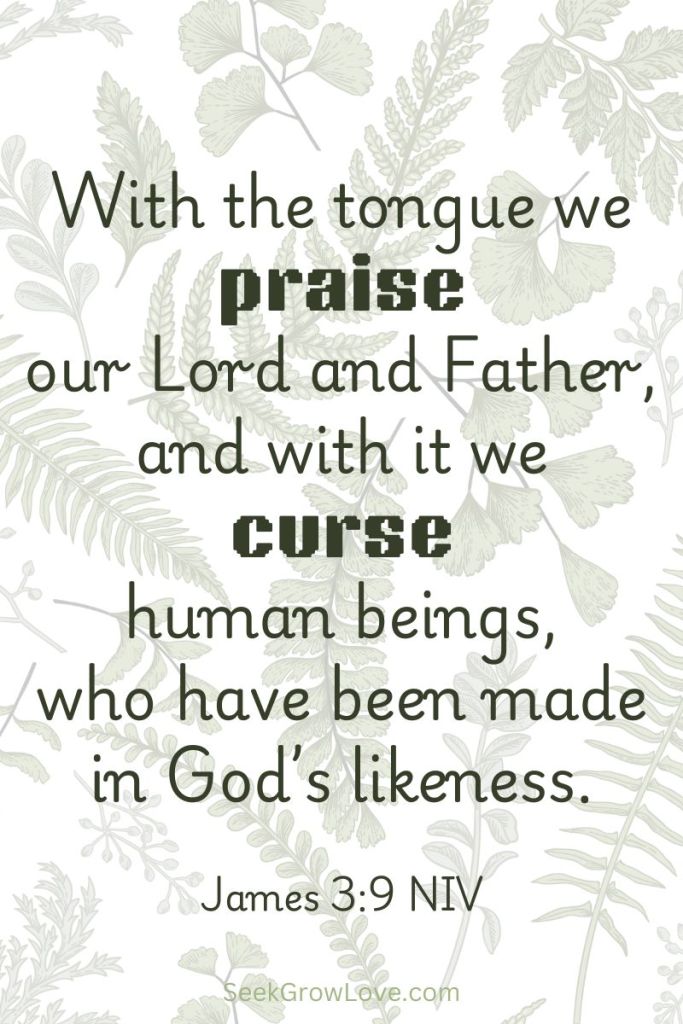
Verses 9-10 read: With the tongue we praise our Lord and Father, and with it we curse men, who have been made in God’s likeness.  Out of the same mouth come praise and cursing.  My brothers, this should not be.”

[italics added]

How can we curse someone made in God’s likeness with the same mouth we praise our God with?  Those ideas are so contradictory, yet it is easy to put people down.

For example, you may be aware that we have an election coming up soon.  There are so many negative things being said about politicians in all parties.  But how can we talk this way about someone made in the likeness of God?  I think what it boils down to is that is not how we are viewing them.  We are looking at them based on their actions or thoughts that we don’t agree with, but not looking at who they are as a person which is someone made in God’s likeness.

Let us try to view everyone in this way in order that we might better praise God. 

~Stephanie Fletcher

Reflection Questions

  1. What do you think God is thinking about those who praise Him and curse men?
  2. Watch your tongue today and see how many times you speak poorly of people – or catch yourself ABOUT to speak negatively of someone made in God’s likeness. Why do you think it is so common in the world?
  3. How can we be different? Is it possible to state your opinion about ideas without putting down people?

Heart Change

OLD TESTAMENT: Isaiah 44 & 45

POETRY: Psalm 107

NEW TESTAMENT: James 2:14-26

Faith or Works

How are we saved?  We are saved by grace alone, through our faith in Jesus Christ.  But what comes out of our faith?  Shouldn’t it be works?

If we start with works and try to earn our righteousness, we won’t get there.  We cannot earn salvation.  However, if we have faith, works should come out of that.

I think most people reading this probably know these things.  You’ve probably heard a sermon, read a devotion on it, etc.  But do we live that way?  Do we live in a way that is trying to work on all the individual things in our lives, to clean them up one by one, to do the good things we are supposed to?

Alternatively, we can focus on growing our faith.  On accepting the gift given to us and let the good works come naturally as a result of that.

The youth group at our church recently read in Romans 12 which lists many snippets on how we should be living “love must be sincere…be joyful in hope…share with God’s people who are in need.  Practice hospitality…live in harmony with one another…do not be conceited…” and many more. 

We could use this as a checkbox of good works to make sure that we are doing the right things to show our salvation.  But that doesn’t address our hearts.  If we need a checklist to make sure we are loving one another, we need to go back and look at our hearts.  What we talked about in class was to pray to have our hearts changed so that living this way would come naturally out of the overflow of our hearts.  And I think this relates to the faith vs works question. 

If our faith is sincere, our hearts are changed, and the result of that is good works.

A checklist can be a good way for you to ask yourself – am I living as one whose heart has been changed – but I don’t think it is good to be living our lives based off of a checklist.  It focuses you more on the tasks rather than the effects of what you are doing or the purpose behind it.

So maybe ask yourself if you are doing these good things, or avoiding the bad, but if you aren’t meeting the things on that list, don’t place your focus there.  Instead, pray for God to change your heart and you should start to see that happen more and more.

~Stephanie Fletcher

Reflection Questions

  1. Where have you seen faith without works? Where have you seen works without faith? Why, do you think, God is looking for both, working together?
  2. Are you living as one whose heart has been changed? Are you living out your faith daily? What evidence do you have to support your answer?
  3. What specific heart change can you pray for?

Do You Know?

OLD TESTAMENT: Isaiah 41-43

POETRY: Psalm 107 (the rest of this week)

NEW TESTAMENT: James 2:1-13

I want to jump back to Isaiah today.  Chapter 40 was actually the scheduled reading from yesterday, but it ends with some of my favorite verses – Isaiah 40:28-31

28 Do you not know?
    Have you not heard?
The Lord is the everlasting God,
    the Creator of the ends of the earth.
He will not grow tired or weary,
    and his understanding no one can fathom.
29 He gives strength to the weary
    and increases the power of the weak.
30 Even youths grow tired and weary,
    and young men stumble and fall;
31 but those who hope in the Lord
    will renew their strength.
They will soar on wings like eagles;
    they will run and not grow weary,
    they will walk and not be faint.

I don’t have much of a devotion for you, but here is my suggestion.

Read these verses again.  Let the amazingness, goodness, incredibleness of God wash over you.  Be in awe of Him.  And lean into the reminder that those who hope in Him will have their strength renewed.

Sometimes, we read large chunks of chapters or verses, and for me at least, I fall into a traditionally schooled trained pattern of just trying to absorb information to be able to answer questions.  But the wonder can pass me by when I do this. 

So stop.  Read this small section, and be amazed by the Creator.

~Stephanie Fletcher

Reflection Questions

  1. Do you know that the Lord your God is the Creator of the world? What does that mean to you? What does it mean to you that He is everlasting?
  2. What can you not fathom about the Lord God’s understanding? When has He given you strength when you were weary? How would you use His strength today? Pray for it. Thank God for it.
  3. Where do you put your hope?
  4. How many times can you read this passage today? Whatever number you said, can you read it 5-10 additional times beyond what you thought you could.

Religion that is Worthless

OLD TESTAMENT: Isaiah 38-40

POETRY: Psalm 107

*NEW TESTAMENT: `James 1:19-27

Have you ever spoken without thinking and hurt someone as a result?  Maybe you have seen this object lesson before, but think of a tube of toothpaste.  It is really easy to squeeze the toothpaste out (my kids are happy to do so in excess if they make it to the counter before me).  But once it is out, it is incredibly difficult, time consuming, and messy to get that toothpaste back in.  Once you speak, you can’t take your words back.  You can apologize, but that doesn’t change the fact of what you said.

How quickly do you become angry?  I like verse 20 which gives us a reason why we should be slow to become angry – “for man’s anger does not bring about the righteous life that God desires.”

It is easy to get angry, to speak rudely, to interrupt others’ speech.  But these things do not help us to live the life God wants us to.  It might make us feel better for a second to have an outburst, but usually, we feel worse afterwards and it has done nothing to improve our lives.

But how do we go about avoiding this temptation that is easy to slide into?

“get rid of all moral filth and the evil that is so prevalent and humbly accept the word planted in you, which can save you.”

In a small group I was a part of in the spring, there was an idea that kept coming up from discussing the sermons – if you aren’t producing good fruit in your life, take a look – are you letting sin have a hold in your life?  We have to be constantly on the lookout for where sin seeps in and push it out in order that our fruit can show.

Verse 22 – “Do not merely listen to the word and so deceive yourselves.  Do what it says[!]”  You have to act.  It is great to go to church, listen to sermons, classes, read the Bible on your own, etc.  All great things.  But if all you do is listen, it isn’t going to make a difference.  You need to actively push the sin out of your life and pursue the good.

To circle back to the beginning of this section, here is what James writes in verse 26 “If anyone considers himself religious and yet does not keep a tight reign on his tongue, he deceives himself and his religion is worthless.” 

That is strong language!  Do you thing about your words having such an impact as to make your religion worthless if you do not control your tongue?

Think about your speech – do you need to work on controlling what you say?  Is there speech you need to ask for forgiveness for?  Is there speech you need to forgive someone else for?  What moral filth do you need to get rid of in your life in order to be able to accept God’s word?

Silence has value.  In the words of Thumper “if ya can’t say something nice, don’t say nothing at all.”

~Stephanie Fletcher

Reflection Questions

  1. Do you thing about your words having such an impact as to make your religion worthless if you do not control your tongue? When might you have questioned someone else’s religion because of what they said? When was the worth of your own religion decreased due to what you said?
  2. Think about your speech – do you need to work on controlling what you say?  Is there speech you need to ask for forgiveness for?  Is there speech you need to forgive someone else for? 
  3. What moral filth do you need to get rid of in your life in order to be able to accept God’s word?

God Won’t Give You Anything Beyond…

OLD TESTAMENT: Isaiah 36-37

POETRY: Song of Songs 8

*NEW TESTAMENT: James 1:1-18

Do you feel joy when you go through trials/temptations? I would guess not as it is opposed to our natural inclinations.

But when we go through hard times, we can come out on the other side stronger. 

Have you heard Christians say that God won’t give us anything beyond what we can handle?  That is a perversion of the truth. 

We weren’t created to be able to handle this life on our own.  We were made with a need for God.  The trouble comes when we recognize our need for something beyond ourselves but turn to something or someone besides God and become dependent on that.  That is when idols are created.

God won’t put things in our life that can’t be handled with His help.  But there likely will be things in your life that you can’t handle on your own.  That is your reminder, if you aren’t already, to depend on God.

1 Corinthians 10:13 is where people get the wrong idea.  But they just read part of it.  They read “he will not let you be tempted beyond what you can bear.”  The verse continues though to say “But when you are tempted, he will also provide a way out so that you can stand up under it.”  He will provide a way!

When we try to do things on our own, we can quickly become prideful – thinking we are great, or, become depressed because we can’t do what we tried to. 

We can come out of the other side of trials and temptations with a stronger faith if we leaned into God during this time.  It should allow us to become more mature in our faith and deepen our relationship with God.

~Stephanie Fletcher

Reflection Questions

  1. What is a past trial you have gone through with God’s help? How did He help you? How did your perseverance grow during this experience? How did you mature through the process? What joys can you take away from that past trial?
  2. What joy can you find in your present trial?
  3. Consider some of the Christians that you most look up to. Have you ever met a really strong Christian who has had a really “easy” life?
  4. What will you say the next time you hear someone say, “God won’t give us anything beyond what we can handle?”

Exhortation

OLD TESTAMENT: Isaiah 34 & 35

POETRY: Song of Songs 7

NEW TESTAMENT: Hebrews 13

The end of the book of Hebrews gives an exhortation to them to listen to what was likely just read. Exhortation is a pleading with someone to act. I hope they did. I’ve been persuaded to. 

What they, and by extension we, should have understood by the end of this portion of the letter was that Jesus is a better high priest than the Levitical priests because his sacrifice was perfect. We learned that he was chosen by God. We learned that to be chosen means that you choose God back. Jesus chose God back by being faithful to his part in God’s plan of salvation, which was to shed his sinless blood on the cross to save us. This inaugurated the New Covenant through him, with better promises so that we can all partake in the Kingdom of God.

What he saved us from was being slaves to sin that kills. We learned that we are saved from sin because his sinless sacrifice takes away sins (makes people perfect). We learned that the Old Covenant sacrifices of animal blood couldn’t take away sins, but they did remind the people of God of their sin (to help them stop sinning and live well).

God is perfect because he is always faithful to do what he says he’ll do according to his promises, which are always for our good. Jesus was made perfect as a result of his faith, causing him to always do what his father asked of him, for his good, and for the good of the world. We were made perfect when we entered into the New Covenant with God through Jesus.

Remaining perfect happens by being faithful to do what we said we’d do until our race is finished, just like the people of old were required to do whatever was required of them under their covenant. What God required of them, of Jesus, and of us, is to do his will; to be faithful.  

The will of God for us is to love as Jesus loved, which is the new commandment in the New Covenant. The way Jesus loved was through self-sacrifice to save the world. Self-sacrifice saves because it demonstrates one’s love for others. Those who love others are those who will be in God’s Kingdom for all eternity. Self-sacrifice for us is doing whatever it takes (according to God’s will) to save someone; to bring them into the covenant so that they too can be made perfect. If we are doing this, we are freed from sin. We are freed from sin because we chose to do the will of God.

We read however that we can get sluggish in doing God’s will. We can even get entangled back in sin. We heard that to get out of being sluggish, sinning, and to get back to doing God’s will, that we need endurance. We learned that endurance comes through discipline.

The last chapter in Hebrews gives us a few more practical examples of how to be disciplined. We were taught that being disciplined by our father who loves us is for our good. Being disciplined helps us to adhere to our part in God’s plan of salvation. It helps us to be faithful, with endurance to the end of our race.

The Hebrews were given a grand letter reminding them of how awe-inspiring Jesus is, how much better God’s work is through him than any work he’s done before, and that it’s available to everyone who comes through Jesus. They tasted of it, but they got sluggish, and were in need of some exhortation to finish their race faithfully.

The children of God, including us, have a high calling. We’re being exhorted to endure this life race with faith all the way to the end through discipline. The stakes are high, we can’t faint back into our old ways. Said more with the desire written on my heart, we’re being exhorted to be Jesus to the world to save it.

-Juliet Taylor

Reflection Questions

1. If this exhortation has persuaded you to act, what are you going to do (how will you discipline yourself)? You can find many examples in the chapter.

2. God is pleased with what 3 sacrifices according to Hebrews chapter 13?

3. The Hebrews were exhorted to imitate the faith of the ones who taught them the word. What action stands out the most that you’d like to imitate from someone who taught you?

Endurance

OLD TESTAMENT: Isaiah 32-33

POETRY: Song of Songs 6

*NEW TESTAMENT: Hebrews 12

If you’re feeling sluggish, tired of enduring the hardships that come with choosing to be faithful to the end of your race in this age, caught in sin that’s hard to get disentangled from, then think on all of those faithful chosen of God from chapter 11. They made it! They’re going to the Kingdom!

We have to have the endurance to make it to the end to, for our own good. If that great cloud of witness doesn’t move you, consider Jesus’s faith, by which he endured the cross for you. God’s will for him involved the shedding of his blood to resist the sin of others against him and to free us from it. Has God asked you to shed blood to resist sin? That’s probably not God’s will for you, thank God, though many of his children have. I pray it never comes to that.

What’s it going to take to finish your faith race? This writer says endurance, and it comes through discipline (he may even be referencing the letter he’s penning as part of that discipline). He is reproving the Hebrews, but discipline involves more than reproof. It involves scourging (I think the definition of scourging here is “suffering”), and it takes training.

The Hebrews seem to have forgotten that they are heirs to the Most High; they are sons of God. If you’re a son, then you will be disciplined (if not, you’re illegitimate). God’s discipline is like that of a father to his child. It is like the training up of the child in the way he should go so that when he is old, he will not depart from it. The child who was disciplined experienced how to endure as an adult.

The discipline was for the child’s good, though it was sorrowful in the moment. As adults, the discipline will be sorrowful in the moment, but remember, the discipline of the Lord happens because he loves his children, so welcome it. If you’re not disciplined, you’re going to hurt yourself or others with sin. You might forfeit your entrance into the kingdom.

Discipline removes sin. It shapes us into holy people – sharing in the holiness with God (because we are transformed into people who want good for others and therefore do the will of God). It yields the peaceful fruit of righteousness (it turns you into a person who is faithful to do God’s will).

With the Lord’s leading, we can take steps to discipline ourselves to resist sin with endurance, for a whole lifetime. Here are some examples from this chapter:

Serve those in need – strengthen the hands that are weak and the knees that are feeble.

Pursue peace with all men.

Don’t let any root of bitterness spring up causing you trouble.

Don’t refuse the one who is disciplining you.

Don’t trade your birth right for food (like Esau did); God didn’t forgive that sin.

Remember, you didn’t endure what God’s firstborn son (the children of Israel) did. They were not allowed to be where God was like you are through Jesus. Through their mediator Moses, they had to stay away from the mountain where God was. And they were terrified because if they touched the mountain, they’d die. They were terrified of hearing God’s voice, sounding like thunder and lightning.

Instead, you’ve come to the church of the firstborn (Jesus). You have approached the throne room of God, with his angels, with your brothers and sisters who have all been made perfect by Jesus’s sacrifice, and you can do it without being terrified. You’re not going to die if you approach the throne room of God through Jesus.

Oh, and by the way, Jesus’s sprinkled blood as our living sacrifice speaks better than Abel’s blood that cried out for vengeance. Jesus’s blood cries out for love/sacrifice for others. Our job is to follow the cries of the one who’s better, who’s blood lets us into the throne room of God now to be in his presence. God will oblige both, but he says vengeance belongs to him.

God once shook the earth when he spoke from earth. In the end, he’ll speak from heaven, and shake both heaven and earth, so that the things that can be shaken will be removed, leaving only those things that are unshakable. What’s unshakeable is the Kingdom of God. Let’s praise God that we can be a part of that Kingdom now, showing him reverence and awe for what he’s doing. It’s a new thing, and it’s better. 

-Juliet Taylor

Reflection Questions

1. Can you think of something you endured faithfully through discipline?

2. Do you have a routine of discipline that helps you stay on track?

3. Abel’s blood cries out for vengeance. Jesus’s blood cries out for love/sacrifice to save others. God will oblige both cries, but vengeance belongs to God, not to those under the New Covenant. Our responsibility is to love, as Jesus loved because it can change hearts and allows us in God’s presence now (in spirit as we draw near). Our job is to love even those who have hurt us. How can you love someone who has hurt you?

Faithful

*OLD TESTAMENT: Isaiah 30 & 31

POETRY: Song of Songs 5

NEW TESTAMENT: Hebrews 11

By faith, everything is made better. Faith is the certainty of things hoped for, a proof of things not seen that were promised or spoken of by God. By faith, the people of old gained approval by God.

Throughout scripture, we have examples of God’s people who lived by faith, fulfilling their role in the covenant that God made with them, because they believed that God was faithful to fulfil his promises. There were some promises that were fulfilled in their time, according to the specific covenant God made with them (e.g., the Abrahamic covenant, the creation covenant, covenants of blessings, or children, or land, etc..), but all the faithful examples listed in this chapter died in faith, without receiving the promises of the New Covenant, but having seen and welcomed them from a distance.

They were people who knew that this world (the current age) is not their home. They knew they were strangers, looking for a better home, a heavenly one (that will come down to earth), whose maker was God.

By faith, Abraham offered up Isaac. He knew his God was faithful to his promise that through Isaac, the promised seed (Jesus) would be born. That can’t happen if his son is dead. So Abraham had faith that God was able to raise people from the dead.

By faith, Moses chose to suffer with his people, rather than to indulge in the temporary pleasures of sin that came with the territory of being a grandson to a rich Pharoah. He considered the shame of Messiah greater riches than the treasures of Egypt, because he was looking to the reward.

There are so many examples of faithful people of God mentioned in this chapter. If you’re lacking in faith, read about them, you won’t be disappointed! The point in reminding the Hebrew readers of this I believe, was to teach them, or to remind them, that the people of old were faithful to the end of their lives, to a God they believed was faithful in keeping his promises—even the ones they had not yet received prior to dying, and thus became pleasing to God. They were chosen because of their faith, enduring until their end.

Yet, God wasn’t willing to establish his kingdom with them in their time, because he wanted them to be with the Hebrews in this letter. By extension, he wanted them to be with us. He didn’t want them without also having you! That’s the God you chose to serve!

The promise of a better hope, the one obtained now through the New Covenant, spoken of in the law and the prophets of old, is for those pleasing to God – the faithful; the chosen. It’s for those who have gained approval through their faith (their obedience to whatever covenant God made with them because they believed he was faithful), who are made perfect with those of us who chose to enter the New Covenant with God through Jesus. The better promises are all through Jesus, and they’re available for everyone who seeks God through him, choosing God back through their faith.

And without faith it is impossible to please Him, for he who comes to God must believe that He is (exists) and that He is a rewarder of those who seek Him.

-Juliet Taylor

Reflection Questions

1. It is common for people to say, “Have faith,” but I don’t think people should have faith in something that God never promised them. The examples in this chapter seem to reflect that. What do you think?

2. Whose faith recorded in this chapter do you admire most, and why?

3. We are to have faith in promises not yet received in this age too. How will you keep your faith until the end?

Draw Near

OLD TESTAMENT: Isaiah 28-29

POETRY: Song of Songs 4

NEW TESTAMENT: Hebrews 10

I used to think that Hebrews chapter 10 was the scariest chapter in the whole Bible because it contains the scariest verses—about those willful sins that are committed. I missed the whole point of this beautiful chapter.

I missed that Jesus doesn’t have to make a sacrifice for us yearly like the priests of old did to cleanse the flesh of sin committed that year. His one-time sacrifice takes away sins for all time, cleansing the flesh and the conscience. That’s perfection that the old law could never do. Through Jesus, God’s children no longer needed that reminder that we’re slaves to sin, because we’re not anymore. We are free in Christ. We are perfect, but we have to choose to remain perfect by doing God’s will.

I missed that where there is forgiveness of sin (because of Jesus’s obedience to always do God’s will), an offering for sin is no longer required to enter the holy place of God. His role as high priest of the New Covenant is different than that of the Levitical high priests. He’s always available to save if you draw near to him; to intercede on our behalf when we sin, as opposed to sacrificing himself by dying again and again and again when we sin.

An animal sacrifice for sin is no longer required under the New Covenant law, but drawing near to Christ is required when dealing with my sin. I still need to bring a sacrifice, but it’s of repentance; a contrite heart. And I don’t have to wait outside a tent or a veil, I go right into the heavenly tabernacle where Jesus is and ask for forgiveness in his name. God will be faithful to me when I draw near to him through his son in this way. This is required of me if I entered the New Covenant with God through Jesus. I did, when I was baptized into the name of Jesus. Praise God.

The word says that by one offering (Jesus’s literal sinless body), he perfected for all time those who are sanctified. Those who are sanctified are those who have put the laws of God in their minds and have written them on their hearts because they chose to do God’s will out of love for God and others (just like Jesus did).  

Now for those scary verses:

26 For if we go on sinning willfully after receiving the knowledge of the truth, there no longer remains a sacrifice for sins, 27 but a terrifying expectation of judgment and the fury of a fire which will consume the adversaries (read through verse 31 if you want to see how scary this section is).

There no longer remains a sacrifice for sins, but what does remain is something better – drawing near to Christ through repentance when we sin. I think this is true for most sins, even willful sins IF we desire to repent of them because we know how much better God’s ways are for us and desire to get back on track.

If we don’t have that desire and don’t enter the holy place through Jesus’s torn body veil, what should we expect? If we don’t, we should expect just judgment. If we don’t, it means we are choosing to willfully bind ourselves to sin again and remain in it. It means we aren’t looking for forgiveness, because we think it was better when in slavery to sin than being freed from it (and slavesto serving God by doing his will that is good for us).

This reminds me of the children of Israel in Massah and Meribah, complaining in the wilderness, wishing they were back in Egypt. They were slaves there, and perhaps they’d die, but at least they weren’t going to die of hunger or of thirst like they would in the wilderness serving God, so they grumbled. They tested Yahweh God, as they had no faith that God would provide for them as he promised (“Is the LORD among us or not?”). This willful sin, this lack of faith that God would be faithful to do what he said he’d do for them in a time when they were enduring trials and hardship, eventually got them destroyed. The reality was that though God was faithful to uphold his end of the covenant he made with them, they weren’t willing to uphold theirs because they didn’t trust him.  

The testing of God’s faith is what I believe the scary section in Chapter 10 is referencing. If we sin because we don’t believe God is faithful to do all he promised for us, especially when times get tough, and we think it was better living the old way when slaves to sin as opposed to being slaves to God, then our entrance into the Kingdom of God is in jeopardy. It’s like saying to ourselves, “We’re slaves to sin, but at least we won’t die hungry or thirsty living in sin.”

Unfortunately, choosing to live like Christ now does come with pain and suffering, because of the consequences of the past and present sins of all people. Not everyone chooses to do what God says is good for us, so our world becomes more and more corrupt. So do our bodies. It’s hard to live for Christ in a world like that. There’s also so much confusion about what’s right and wrong, even among his followers, and so we get hurt. And of course, there is Satan, walking around like a roaring lion, trying to get us off track.  

The Hebrews were reminded of their former sufferings for Christ and commended for enduring it with joy because they once knew they had something better awaiting them. Though I’ve been through trials, I’ve never had to go through the trials that the Hebrews here had to go through for Christ. It says that they “32 …endured a great conflict of sufferings, 33 partly by being made a public spectacle through reproaches and tribulations, and partly by becoming sharers with those who were so treated. 34 For you showed sympathy to the prisoners and accepted joyfully the seizure of your property, knowing that you have for yourselves a better possession and a lasting one.” The Hebrews were being exhorted. The writer is pleading with them to behave how they once did, and to stop looking back at their old way of life.

If the people of God who went through this type of hardship needed an exhortation to get back on track, what of us? What of me?

Now that we’ve got the kick in the pants we needed to stop being babies, we can apply this information to do better with some application from the writer:

19 Therefore, brethren, since we have confidence to enter the holy place by the blood of Jesus, 20 by a new and living way which He inaugurated for us through the veil, that is, His flesh, 21 and since we have a great priest over the house of God, 22 let us draw near with a sincere heart in full assurance of faith, having our hearts sprinkled clean from an evil conscience and our bodies washed with pure water. 23 Let us hold fast the confession of our hope without wavering, for He who promised is faithful; 24 and let us consider how to stimulate one another to love and good deeds, 25 not forsaking our own assembling together, as is the habit of some, but encouraging one another; and all the more as you see the day drawing near.”

-Juliet Taylor

Reflection Questions

1. Notice that we draw near to Jesus in the throne room of God, which is God’s throne room in heaven. We do this in spirit. The bible uses figurative language like this a lot. What other figurative language do you notice in this chapter?  

2. How can you encourage one another in love and good deeds through their hardships?

3. How do you live by faith as it says in Hebrews 10:38 (quoted from the old; applied to us in the new)?