First of all, let me say CONGRATULATIONS on finishing what many consider to be the hardest book in the Bible to get through due to its “repetitive rules and low relatability.” One online reader even called it, “Where Bible reading plans go to die.” (guilty!)
And I’m not going to lie. I feel like reading chapter 27 is basically reading a page out of a law book at the law offices of Dewey, Cheatum, & Howe.
The first part is a little confusing… why are they paying money for people?? They weren’t. Basically, people could dedicate themselves, their children, animals, or properties to the Lord at anytime, but if they need any of the above back, they could buy them back at the values the Lord set in this chapter. (Certainly, this was a lot clearer to the people of the time than it is to me!) The rest of the chapter is similar information that does seem repetitive and irrelevant.
So I’m sure you’re thinking, “Well, Miss Negative Nellie, why did I just bother reading this whole book?!”
We are told our whole Christian lives how Christ died to set us free from the law ( Acts 13:38-39, Romans 6:14, 7:6, 8:2, Galatians 3:25, 5:1). But do we stop and think how deep and broad the Mosaic Law was? Not easy stuff to get through, let alone emulate with your life. Reading Leviticus brings us, not only to the reality that living by works alone is nearly impossible, but also to how truly, throughly, and deeply holy is our God. I hope that reading Leviticus has done this for you.
The poetry of Psalm 14 and the prose of Matthew 27 are easier to understand if not exactly pleasant to read. Can you imagine reading the Resurrection story for the first time and stopping at the end of 27?! What a sad cliffhanger! But like reading Leviticus, you can’t understand the point of the really good stuff until understanding the tragic background. Without understanding the NEED for a savior, from the stringent laws that a Holy God commands, to the awful details of Judas’s betrayal, we will miss the complete picture of Jesus’s sacrifice for us.
So, GREAT JOB with your reading! You’ve got this! Let’s Go!! Even through the rough parts, time spent in scripture is never wasted!
Reflection Questions:
What does it mean to have a holy God?
What was the purpose of Leviticus? What is the purpose of Matthew 27?
What is the hardest part of reading Matthew 27?
Prayer:
Dear Holy God, thank you for not giving up on us – Your creation that turned our backs on You and repeatedly broke Your law. Help us see our sin for what it is and the distance that it puts between us and You. Thank You for Matthew 27. Help us see the depth of Your great love for us and the loving obedience of Your precious Son. Help me have the mind of Christ which says and lives “Not my will, but Yours be done” – even when it hurts and is so hard. Help me see what You will and follow well, like Your Son who gave his life as the perfect sacrifice so I can pray to You today and be heard as Your child.
I hold it that a little rebellion now and then is a good thing, and as necessary in the political world as storms in the physical. -Thomas Jefferson
Jefferson wrote those words to James Madison in 1787 after a group of farmers physically fought their local government to protest high taxes. His argument was that rebellion is what keeps government accountable to the people it serves.
He may have had a point and many people have used this quote to justify many acts of rebellion. However, there is one area of our lives where rebellion leads to destruction.
In all three of our readings today, people participate in vile rebellion against God.
In Leviticus, God decrees what happens when actions meet consequences.
Praise God, follow His decrees, you will be richly blessed. Deny God, either by evil acts or general apathy, you will be cursed. It seems so odd that at time God spoke directly to His people, their society was set up to follow the decrees (at least physically) and the consequences immediate, that so many people so often turned from God.
But even centuries later, people were still rebelling in Psalm 14, denying His very existence. They were so rebellious, not only did they want to sin, they wanted to take down everyone with them. Hmmmm
In Matthew 27, we see the greatest rebellion of mankind. The denial of God (or at least His rule) and consequently His son, leads to the torture and death of our savior, Jesus.
Obviously, we know the outcome of that… but what has the outcome of that meant for you?
I wish I would have written it down.. but I saw a great quote that said something like, “ Don’t continue with the sin Jesus died to save you from.” When we sin, we are in rebellion against the God of the Universe. The One who made all and yet cares about the hairs on your head.
While Jefferson was talking about imperfect people rebelling against imperfect people to maintain justice, there is no need to rebel against the perfect One who cares for our every need. Allow the Lord to be your refuge in this world of rebellion.
Reflection Questions
What do we learn about God in our readings today?
Where have you seen rebellion against God today?
How have you personally rebelled against God? Why? Have you experienced consequences from that rebellion? What would you tell others about your experience?
Prayer
Dear God – We praise You and thank You for being a just and true God of love and mercy who gave Your own Son for sinful, rebellious mankind, which includes me. I confess my times of rebellion. Help me see my own sins and rebellion and foolishness and turn from it. I seek You, Lord, and Your Way. Help me discern what is rebellion against You in the world today, and what leads to destruction. Help me speak for You, giving wisdom and warning from a heart of love for You and Your creation. Thank you for Your promises for those who follow You. May I be ready for Your Son’s return.
Our reading in Leviticus lists the six festivals the LORD commanded the Jews to follow and observe. I thought it would be fun to take a deep dive into each. For each festival, I searched additional scriptures where it was mentioned. I also investigated how it is celebrated in today’s modern world.
Passover and Festival of Unleavened Bread
This is perhaps the most commonly known Jewish holiday. In our passage today, the festival is said to last seven days, the first and last days marked with a “holy assembly” and “no work.” This festival commemorates when the tenth plague passed over the Israelites in Egypt. This final plague ultimately led to their deliverance from Egyptian slavery. In scripture, Passover is seen as a time of rededication, purification, remembrance, and celebration. It is during this celebration the Last Supper takes place, and from this the Christian practice of communion. The reverence and sincerity in which passover is handled in the Old Testament is a reminder to us Christians of the mindset we should have when taking communion. The passover is still celebrated by Jews, today. Jewish families gather in their homes for a special meal called the Seder. During this, the story of the Israelites exodus from Egypt is read. Special food is served at this meal to symbolize aspects of the Jewish faith.
Celebration of First Harvest
This celebration is marked by bringing sacrificial grain offerings from the first fruits of the crop to be presented to the LORD. It is also referred to as the Feasts of Firstfruits and is tied into the Festival of Harvest, yet still as a separate day of celebration, according to the text. I found it much more difficult to find information of this day alone as it is so closely related to the Festival of Harvest. From what I can tell, this day is no longer celebrated on its own. Yet, God made a distinction here, in Leviticus. I think part of that purpose is to show how God desires our worship and honor. God wanted a separate day set aside just for the first fruits of a crop. This was so he could be acknowledged as creator and giver of life. One way that we as Christians can continue this theme of gratitude for provisions is to pray before our meals.
Festival of Harvest
The Festival of Harvest, or Festival of Weeks, was later referred to as Pentecost and is known today as Shavout. It is to take place fifty days after the Celebration of the First Harvest. According to our text in Levitus, this festival was marked by various offerings of “pleasing aroma to the LORD” and a day or holy assembly in which no work was to be done. In Deuteronomy 16:9-12 it is described as a time of great celebration. The focus of the holiday in today’s age is no longer agricultural but instead serves as a time to celebrate the giving of the Torah. It is a sacred time in Jewish culture. It is observed with traditional foods, decoration of synagogues, and confirmation services. I think it’s incredibly special how practicing Jews set aside a time to remember and give thanks for their scriptures. How often do we as Christians pause and give thanks for our own Scriptures? When was the last time you honestly thanked God for the Bible? Perhaps we Christians could learn something from the modern day celebration of Shavout.
Festival of Trumpets
The Festival of Trumpets is a day for holy assembly and no work. Specific offerings are to be presented. These are described in more detail in Numbers 29:1-9. During this celebration there is to be a blast of trumpets. I imagine this was the biblical version of setting off fireworks. This festival later became known as Rosh Hashanah, the Jewish New Year. It is celebrated by traditional foods, such as sweet breads to signify the hopes of a sweet new year. The specific readings during services focus on God’s sovereignty, past deeds, and anticipation of the future. The instructions in Leviticus for this festival are unique as it shows music as an example of worshipful offering. This is something each of us are capable of doing. God wants to hear our praise in song and deed.
Day of Atonement
The Day of Atonement is the second most well-known Jewish holiday. It is known today as Yom Kippur. Leviticus 16 goes into further detail of the requirements for the Day of Atonement. It is a day of holy assembly, fasting, and offerings of purification made by the High Priest. Jesus is our High Priest and his sacrifice on the cross is symbolic of the offerings made on the Day of Atonement. It is considered one of the holiest days in Jewish culture. Today, it is marked by a time of fasting and confession. The Day of Atonement shows that God is in the business of reconciliation. He provides a path of redemption for all people. The Day of Atonement was a physical reminder of God’s covenant grace with his people. Jesus has allowed that same covenant of grace to extend to all people who come to Christ.
Festival of Shelters
The Festival of Shelters is also referred to as Festival of Booths or Festival of Tabernacles. It is an eight day celebration. Days one and eight are characterized by holy assembly days and days of rest. On each day of the festival, specific offerings are to be made, detailed in Number 29:12-40. Deuteronomy 16:13-17 reveals it is to be a time of great joy and celebration, reflecting upon the good harvest. Our text, Leviticus 23, instructs families to build tiny huts from branches to live in during the week of the Festival. This is to represent their time living in shelters after being delivered from Egypt. Today, this holiday is known as Sukkot. Interestingly enough, it is still widely celebrated in a similar fashion with families gathering in small temporary huts called sukkahs. This festival reminds us of the importance of pausing to thank God for all our many blessings. It is meant to be a joyous celebration, where we are to rejoice in God’s goodness. We should have this attitude of praise daily, but it is also good to set aside time dedicated just for thankfulness.
Questions:
What do you do to prepare yourself for communion?
Do you pray before every meal? Why or why not?
Do you think Christians take scripture for granted? How can we remember to treat God’s word with holiness?
Do you sing along during worship at church? Why or why not? Do you think you should start?
In what ways is Jesus our High Priest?
Can you think of a U.S holiday similar to the Festival of Shelters? Even though Thanksgiving is a long ways away, how will you plan to make this year’s celebration a holy time?
PRAYER:
Dear Lord God, You are so worthy of our worship. Help me daily, and in special ways and times, honor and celebrate You, Your scriptures (yes, including Leviticus), Your precious Son – the perfect High Priest we need, , the good gifts that You give, the good God that You are. Thank you for life and redemption, for your perfect plans through the ages, for music, prayer, communion, church, feasts, fasting and holidays. Help me to prepare well for the celebration that will surpass them all, when Your Son returns to earth to set up Your Kingdom for eternity.
Ever see one of those warning sign where you have to wonder? What happened here that made this sign necessary. I kind of felt this way reading Leviticus 20-22…some of the laws made sense as God was establishing the Mosaic law. Especially the opening of the chapter talking about child sacrifices.
Some of it I’m a little unclear on. Previously, you could marry your step sister (Abraham and Sarah) and other family members. But God was putting an end to that. And then some of the laws, were just for specific people and some of those I don’t understand at all. Why did you have to be physically perfect in order to be a priest who could enter the temple? I don’t get that one… but I trust God has His reasons I may not understand before the coming kingdom.
As independent adults, we often question the things we’re told to do and want to know why so we can decide if we really want to do it.
But throughout the Bible, God gives us laws and tells us to do/not do things that we don’t understand. We don’t feel like it’s right.
However, that is the difference between believing in God and Christ and truly surrendering to them as the ones who control your life. You may not alway understand why God is telling you to do something, but total submission means you follow God’s word no matter what. It’s a matter of trust. Trust is hard, but vital to our relationship with God.
Speaking of total submission, we go to Matthew 26 where Jesus is fully aware of what is going to happen but continues on as he trusts in God’s overarching plan for humanity as mentioned in Psalms 12. God knows what he’s doing with humanity, we just have to trust Him.
Reflection Questions:
Are you bothered by the times you don’t understand God, His law or plans? Why or why not?
What could be helpful advice for someone who is questioning God?
Have you found God to be trustworthy? How can you build your trust in Him?
Did Jesus have the mind of God? What can we learn from Jesus’ example when it might seem like we don’t want the same things God does?
PRAYER:
Father God, I praise You because You are wise, all-knowing, all-powerful and completely trustworthy, and I am not. Thank You for Your love and for being a Good God. Open my eyes to see Your goodness in all You do, and all You ask me to do. Thank You for the incredible gift of Your Son. In all ways big and small may I echo his words and heart of surrender: “Not my will but Yours be done.”
Not to be one to copy someone else’s work, but like yesterday’s writer, today is MY BIRTHDAY!!! Really!!! And as I’m writing this, it’s the 44th anniversary of my baptism into the Family of God (of which I’m so glad to be a part)!
As I was reading our OT, Psalms, and NT passages, I was wondering how I could tie them together. Nothing really obvious jumped out at me. However, as I’m getting older, the time I have in this lifetime seems more precious as I increasingly understand its brevity. I then re-read the passages with that thought in mind and time was just as precious to those way back then.. and what a sacrifice that was and is to give to God.
In Leviticus 16, we find all the rules Aaron was to follow for making sacrifices and cleaning up after those sacrifices. I can’t imagine the time it took for Aaron and the priest to do so much cleaning. These sacrifices and cleaning were for Aaron and his family’s sanctification, but still… with no running water or Mr. Clean Erasers, that could not have been easy. It was a true sacrifice of time.
In Matthew 25, we read of some women who did not use their time wisely. We aren’t told what they were doing that kept them from preparing for the party. We just know they did not have what they needed when the bridegroom came to get them.
We are also strongly encouraged in this chapter to spend our time caring for those in need. I’d say that’s a pretty good way to give God our time!
In Psalms 11… it might be a bit of a stretch to say it’s about the use of our time, but it does say the Lord is watching what we do, so in a sense, what we do with our time.
No matter what we do with our time, it’s wise to always remember Colossians 3:23-24.
23 Whatever you do, work at it with all your heart, as working for the Lord, not for human masters, 24 since you know that you will receive an inheritance from the Lord as a reward. It is the Lord Christ you are serving.
Reflection Questions:
How have you used your time this past week? What did you do that was a good use of your time? Is there anything that you neglected to take care (such as packing your oil)?
How do we make the best use of the gifts God has given so we are prepared both to do the jobs He wants us to do (even the hard, dirty ones) and for the bridegroom’s arrival?
What can you do this week that will be a sacrifice of the time God has given to you?
Prayer:
Dear Lord, I praise You for being my Creator, sustainer, provider, and shield and strength! I thank You for the gifts of life and time and the opportunity to be a part of Your Family. I confess the times and ways I neglect to do the most important jobs You have given, and instead are wasteful with the minutes and resources You have gifted to me. Help me do what You want me to do, with a heart of love and joy, and all for Your glory. In Your Returning Son’s Name, Amen
There are a number of cautionary tales in the bible. Whenever I see a few specific characters, I mentally always add “The cautionary tale of….” and that character’s name to remind me that while every single one of us has a purpose, sometimes that purpose is just to be an example to others of what not to do. The cautionary tale of Queen Vashti is one of my favorites (See the book of Esther), about privilege and responsibility. Today’s reading is one of those, “The cautionary tale of Nadab and Abihu”, and it’s always intrigued me as well, primarily because I’ve always wondered what “strange fire” was.
First, a little background. Aaron and his descendants were designated (by God, see Leviticus 8 for details on their ordaining) to be the priests of Israel, the men who would stand before God and offer propitiation for the sins of the nation. Aaron had 4 sons by his wife Elisheba (Ex 6:23), and Nadab and Abihu were the two oldest. Aaron was the “High Priest”, and had some specific duties that only he was supposed to carry out, and his sons were all priests. All of his descendants are priests as well, but it should be noted that Nadab and Abihu did not have any children so their younger brothers stepped up to fill their role after the events in today’s reading (Eleazar and Ithamar, as noted in Num 4:4 and later in Lev 10).
Keep in mind also that these newly appointed priests were just freshly put in the position, back in Lev 8. We then have to go back a chapter from today’s reading to get the pattern of what a normal ritual should look like, going back and reading from Lev 9:1-23 for the particulars, and culminating in Lev 9:24 when “Then fire came out from before Yahweh and consumed the portions of fat on the altar. And all the people saw it and shouted out and fell on their faces.” (LSB) . I think I’d fall on my face too, it’s a pretty amazing scene. It’s also pretty important to note that Aaron as the high priest was the one who was supposed to offer the sacrifices for the nation, as noted in Lev 9:6-10 and Ex 30:7-8.
So, seemingly immediately after the miraculous fire coming out from before Yahweh and all of the people falling on their face, enter Nadab and Abihu, who “took their respective firepans and put fire in them. Then they placed incense on it and offered strange fire before Yahweh, which He had not commanded.” (Lev 10:1, LSB).. Then, as before, “fire came out from before Yahweh” but instead of burning up the offering, it burned up Nadab and Abihu.
So what is strange fire? I’ve honestly always wondered. Carefully dissecting today’s reading, there were probably a couple factors in their unfortunate demise. First off, it was presumptuous of Nadab and Abihu to offer the incense before God, since that was the job of the High Priest. Secondly, they used their own fire on the incense (Lev 10:1) instead of the “fire which came forth from Yahweh”. The word that we translate as “strange” fire could also be equally accurately translated as “profane” fire, by the way. This seems like a pretty cavalier attitude from a couple guys who just spent an entire week (Lev 8) preparing spiritually to enter the priesthood. Then Moses says to Aaron “It is what Yahweh spoke, saying, by those who come near Me I will be treated as holy, and before all the people I will be glorified.” (Lev 10:3, LSB).
While this was a bit presumptuous on Nadab and Abihu’s part, read on in Lev 10:8-11: “Yahweh then spoke…saying, “do not drink wine or strong drink…when you come into the tent of meeting, so that you will not die…so as to separate between the holy and the profane…” (LSB). It doesn’t seem likely that this was a random statement given the circumstances, but more likely a bit of preventative education from God for future priests. This seems to indicate that maybe they were impaired with alcohol as well, which might help to explain the (extremely poor) decision to offer “strange fire” on their own. There was more than one thing going on, it looks like.
What’s strangest to me in this story is that just prior to these events, both Nadab and Abihu were present with the 70 elders when God appeared to them in Ex 24:3-8. These are men that should have had an extremely healthy respect for the most high God. These are men that should have known with every fiber of their being that the Lord God Almighty is Qodesh (Holy, Set Apart, Seperated), and had seen with their own eyes the awesome and fearful power of the living God. These are men that were likely in line to be High Priests themselves, but because they did not separate in their minds and actions between the holy and the profane, the clean and the unclean, they died in a fire. They should have known better.
When we approach our God, we need to make sure that we are not offering strange fire. We should be sober (1 Pet 1:13) and focused. We need to separate in our mind between the clean and the unclean, the holy and the profane, before we approach the altar. We need to purify ourselves. Consider for a moment a tiny ant, and your relationship with it comparatively. Our role before our Creator is infinitesmally smaller than that, comparatively. When we pray, when we seek God, we need to understand that this is the most important and critical moment in our existence, every time, and not a casual conversation: we are approaching the Lord God Almighty, the Creator of heaven and earth, the master of all life who sustains us with His breath (Job 34:14-15) and we should tremble. Approaching the Lord God Most High is not something that is to be taken casually or lightly, but with awe and reverence.
Since God has sent us his Christ, we no longer need to make ritual sacrifices, the sacrifice has been made once and for all. The sacrifices that we need to make, the sacrifices that our God desires from us are righteousness (which can also be translated as “equity”), and obedience (1 Sam 15:22). We need to reflect the amazing and awesome character of our God, and love Him with our whole heart, as well as loving the rest of His creation as much as we do ourselves (Mark 12:29-31), just like He has loved us. Jer 29:13 says “You will seek me and find me when you search for me with all your heart.” (LSB). If you go seeking inappropriately and offering strange fire, be very aware that instead of finding God, God might find you. Don’t become a cautionary tale.
REFLECTION QUESTIONS
Lots of times when we pray, we basically just present God with our “to do” list. Do you pause for a few moments and consider the level of interaction between a single tiny human and the omnipotent Creator of all things in the universe before you pray? Every time?
When you open your Bible to read it, do you pause for a few moments to wonder at the amazing grace and love of the Lord God most high who has given you His words as a guide, tiny human?
Do you seek fully to know your God with the attitude of an unworthy servant seeking their hardest to please their master? All the time, or just on church days?
Consider for just a moment, every day, what am amazing God we have. It should melt your heart. He sent His own son as a sin offering, to cut a covenant with us. What are you going to do to show God how much you love Him back, today?
PRAYER
Father God, my Master and my Creator, forgive me, heal me, and teach me. I am an unworthy servant. You are wonderful and beautiful, and greater than all. Help me to be a servant who pleases his master. I was not worth the price You paid for me, have mercy on me Lord God. Help me to love as You love. Grant me your spirit, and teach me wisdom so that I can please you. Thank you heavenly Father, in Jesus’ name, Amen.
We are reading today in the book of Leviticus which is where many Bible reading plans go out the window. Tough going I admit but full of truths for us to mine if we can look past the intricacies of the law of Moses set down. Reading from Leviticus 4 and 5 today there are some words that we could examine more deeply. We read about sin offerings, trespass offerings and others. What is this all about?
Leviticus 4:2-3(NKJV) If a person sin (ha’ta Strong’s H2398) unintentionally against any of the commandments of the LORD in anything which ought not to be done, and does any of them, 3 if the anointed priest sins, bringing guilt on the people, then let him offer to the LORD for his sin which he has sinned a young bull without blemish as a sin offering.
When God talks about sin, He is talking about something much deeper and more complex than regulatory lists of good and bad behaviors or choices. He is concerned with the corruption of God’s intentions for us that show up in human relationships and choices. This can be something that we do or something that happens to us.
(ha’ta Strong’s H2398) is translated as sin but means “to miss the mark”, like shooting an arrow at the target and missing. We miss the direction that God wants and has asked us to go in, and then end up in a place He did not intend us to be. All the words in bold below are this word (ha’ta)
Leviticus 5:5-6(NKJV) And it shall be, when he is guilty in any of these matters, that he shall confess that he has sinned in that thing; 6 and he shall bring his trespass offering to the LORD for his sin which he has committed, a female from the flock, a lamb or a kid of the goats as a sin offering. So the priest shall make atonement for him concerning his sin.
Leviticus 5:17(NKJV) If a person sins, and commits any of these things which are forbidden to be done by the commandments of the LORD, though he does not know it, yet he is guilty and shall bear his iniquity. (ʿāôn Strong’s H5771)
We start down the path of sin by doing something or saying something that misses the mark, but then we are told that we must bear that “iniquity” (ʿāôn Strong’s H5771) This is a different word that starts from the missing of the mark, but then causes us to become “bent or twisted”. When we intentionally or unintentionally miss God’s standard of life, we become bent by our sin. In the Old Testament the answer was the sin offering for the original sin, or a trespass offering for the bent nature of our lives. Unfortunately, we all have missed the mark of the standards of God’s Word and have become twisted in our human natures. Examples of this type of twisted behavior include deceitfulness, violence, and other kinds of harm we might do to others.
This is the root cause of our human sin nature that no amount of self-discipline or self-chastisement can make us straight again. We are never able by our own efforts to make ourselves perfect before God, only by His grace and mercy can we come before Him.
Take a paper clip and unbend it to a more or less straight piece of wire which is what it was to begin with. Can you make it straight? Close maybe, but not really. Now bend it back into the same shape as it was before coming out of the box. Can you bend it back to the original? These are the results of our sin nature that we have in our human lives. Our sin causes us to become bent or twisted, and no amount of effort on our parts can make us straight or perfectly formed again.
Our “Good News” though is that there is an answer to our bent nature coming from the sacrifice that God gives us in the life of His Son. Look at this familiar passage from Isaiah 53.
Isaiah 53:4-6(NKJV) Surely He has borne our griefs And carried our sorrows; Yet we esteemed Him stricken, Smitten by God, and afflicted. 5 But He was wounded for our transgressions, He was bruised for our iniquities (ʿāôn Strong’s H5771)” The chastisement for our peace was upon Him, And by His stripes we are healed. 6 All we like sheep have gone astray; We have turned, every one, to his own way; And the LORD has laid on Him the iniquity of us all.
Jesus brings our sin, trespass and bent nature to the cross and takes it all on him to heal us in every way. “He has born our griefs” which is our sicknesses and “by His stripes we are healed” which is to take away our pain.
Luke 22:41-44(NKJV) And He was withdrawn from them about a stone’s throw, and He knelt down and prayed, 42 saying, “Father, if it is Your will, take this cup away from Me; nevertheless not My will, but Yours, be done.” 43 Then an angel appeared to Him from heaven, strengthening Him. 44 And being in agony, He prayed more earnestly. Then His sweat became like great drops of blood falling down to the ground.
Questions for Reflection:
How great is the grace of God in Christ to us?
What can we do to live out our walks in Christ today?
Has the discussion changed your perception of what sin is?
Prayer:
Father God thank you for straightening us out in Christ and keeping us on the straight paths to You. Give us help today to confess our sin and walk with You in the spirit that you have given us. Bless the works of our hands and keep them that they would do the good works that You have ordained for them. In the name of Jesus Christ, we pray this day.
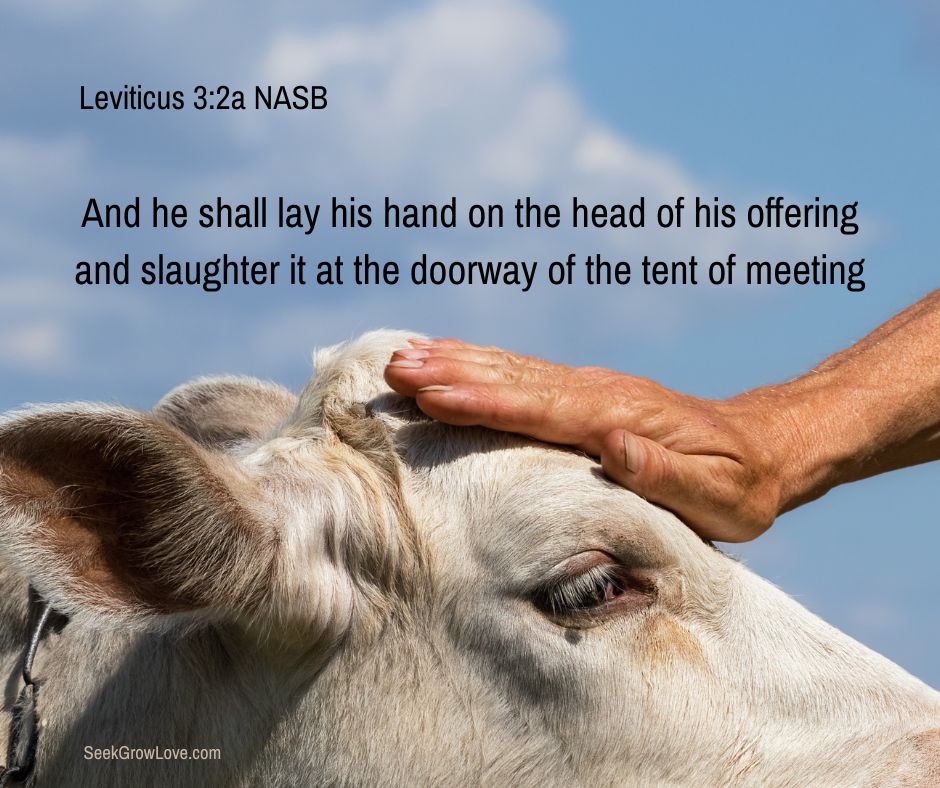
Leviticus 3:1-3(NLT) If you present an animal from the herd as a peace offering to the LORD, it may be a male or a female, but it must have no defects. 2 Lay your hand on the animal’s head, and slaughter it at the entrance of the Tabernacle. Then Aaron’s sons, the priests, will splatter its blood against all sides of the altar. 3 The priest must present part of this peace offering as a special gift to the LORD.
The peace offering is also known as the fellowship offering and one of the five types of sacrifices that are shown in Leviticus. The five types of offerings described in Leviticus are the burnt offering, grain offering, sin offering, and guilt offering. Each has a purpose but also look forward to a perfect sacrifice coming in the future where Christ will fulfill all their purposes. The peace-offering is one of communal fellowship and thanksgiving. It served as a means for the Israelites to express gratitude, fulfill vows, or seek reconciliation with God.
The sacrifice also became a communal meal with the giver, priests and other people invited to eat and enjoy the meat while the other parts of the animal were burned as the sacrifice to God. These fellowship aspects of the sacrifice are the important thing for us to look at here. We as the body of Christ have now the peace fellowship with all the believers and with our Father and His Son.
The peace offering points to the ultimate reconciliation brought through Jesus Christ. Christ is seen as the complete fulfillment of the sacrificial system, including the peace offering.
Ephesians 2:11-18(NLT) Don’t forget that you Gentiles used to be outsiders. You were called “uncircumcised heathens” by the Jews, who were proud of their circumcision, even though it affected only their bodies and not their hearts. 12 In those days you were living apart from Christ. You were excluded from citizenship among the people of Israel, and you did not know the covenant promises God had made to them. You lived in this world without God and without hope. 13 But now you have been united with Christ Jesus. Once you were far away from God, but now you have been brought near to him through the blood of Christ. 14 For Christ himself has brought peace to us. He united Jews and Gentiles into one people when, in his own body on the cross, he broke down the wall of hostility that separated us. 15 He did this by ending the system of law with its commandments and regulations. He made peace between Jews and Gentiles by creating in himself one new people from the two groups. 16 Together as one body, Christ reconciled both groups to God by means of his death on the cross, and our hostility toward each other was put to death. 17 He brought this Good News of peace to you Gentiles who were far away from him, and peace to the Jews who were near. 18 Now all of us can come to the Father through the same Holy Spirit because of what Christ has done for us.
Does this change your perception of what true peace is?
We can praise the great name of Our God who has accepted this sacrifice and made us part of His family and fellowship. When we were far away and did not know Him at all God saw you and called you to Him. Praise His name for the wonderful fellowship He has given us today and in the future.
Psalms 8 O LORD(NKJV), our Lord, How excellent is Your name in all the earth, Who have set Your glory above the heavens! 2 Out of the mouth of babes and nursing infants You have ordained strength, Because of Your enemies, That You may silence the enemy and the avenger. 3 When I consider Your heavens, the work of Your fingers, The moon and the stars, which You have ordained, 4 What is man that You are mindful of him, And the son of man that You visit him? 5 For You have made him a little lower than the angels, And You have crowned him with glory and honor. 6 You have made him to have dominion over the works of Your hands; You have put all things under his feet, 7 All sheep and oxen— Even the beasts of the field, 8 The birds of the air, And the fish of the sea That pass through the paths of the seas. 9 O LORD, our Lord, How excellent is Your name in all the earth!
In Christ we have fellowship and reconciliation with God. Jesus has broken down the walls of separation that kept us from God and given to us the position as children of God whether Jew or Gentile, male or female.
Hebrews 13:20-21(NLT) Now may the God of peace— who brought up from the dead our Lord Jesus, the great Shepherd of the sheep, and ratified an eternal covenant with his blood— 21 may he equip you with all you need for doing his will. May he produce in you, through the power of Jesus Christ,
every good thing that is pleasing to him. All glory to him forever and ever! Amen.
Reflection:
Who is the sacrifice of peace for us today?
How should we view our fellow believers today in light of what we have seen here?
PRAYER:
We pray to you God our Father this day asking for your peace on our hearts and lives, as well as the fellowship of believers that we are part of. Father, we thank you for the gift of Your Son becoming the sacrifice that we need for all parts of our lives. Help us today to see your Hand of blessing and help in all we do. Thanking you in the name of Jesus Christ.
We have finally come to the end of Leviticus and I hope that you’ve gained an appreciation for this “skipped-over” book: there is much we can learn about our God and how to serve Him within these pages, even if some of the specific details are different now under the new covenant with Jesus. One thing that will never change about our heavenly Father is something described in chapter 26: He blesses obedience and punishes disobedience.
Like most kids, I disobeyed my parents often when I was younger. If I was told not to do something, that’s immediately where my mind gravitated towards, even if there was the threat of punishment. I was also stubborn (and still am sometimes), and continued my disobedience even if the punishment was dealt out, until the punishment grew to a severity that wasn’t worth it anymore. A time-out from television didn’t mean much to me: neither did the extra chores that I was given. However, when those things didn’t work out and I was grounded from seeing my friends, I began to shape up and ask for forgiveness. My parents weren’t thrilled about punishing me, like most parents: they just needed to do something to get my attention and create an obedient spirit within me (probably the hardest job of a parent).
God as our heavenly Father is much the same way, and it is shown in Leviticus 26: He will punish the disobedience of His children until they shape up and realize the error of their ways. In this chapter, He gives the Israelite nation FIVE chances to change their ways and start listening to Him again, with increasing punishments: they unfortunately proved to be very stubborn and continued their disobedience until their nation was completely driven away from the Promised Land (which did happen). Although God warned them ahead of time, and gave them multiple chances to change, they kept acting out and disobeying until God had to go to extreme measures to get their attention.
However, despite all the disobedience and the punishments in this chapter, God says that if they will confess their sins and repent of their ways, He will forgive them (just like a good parent). He promises to bring them back to the Promised Land, restore the covenant that He made with their forefathers, love them again, and even dwell with them again: all they have to do is repent and start obeying Him again, because He knows what’s best for them.
We would do well to remember this lesson above all else: God blesses obedience, not disobedience. Far too often Christians have chosen to disobey God’s instructions and immediately expect His forgiveness because Jesus died for us. However, we cannot miss the most important part of receiving forgiveness: repentance.
“It is not those who are well who need a physician, but those who are sick. I have not come to call the righteous but sinners to repentance.” – Luke 5:31-32 NASB1995
Do you want to live a good life full of blessings? Then obey God’s instructions.
Have you disobeyed God’s instructions and are suffering for it? Ask for forgiveness and repent.
God is willing to work with us and forgive our sins, but we must do something about it. Like a good Father, He is expecting obedience and a change of heart. We cannot simply “skate by” in our Christian walk, expecting forgiveness when we have no change in our lives. We have to obey Him if we want His blessings.
-Talon Paul
Reflection Questions
How is God similar to your parents? How is God different from your parents?
What blessings does He give that make you want to obey Him? What punishments does He give that make you want to not disobey Him? If you want to obey God how do you learn what His instructions are?
In the United States, there are many holidays to celebrate and enjoy. At the federal government level, they recognize eleven holidays per year: there are even more if you include religious ones like Easter. Not only that, but we have laws that force us to take time off work every week and periodically throughout the year. Although you are allowed to work all seven days in a week, most employers are expected to pay even more money in overtime and usually prefer for their employees to simply take their days off.
These times of rest and celebration are often taken for granted: all of us have grown up in this environment of expected time-off and have never had to live in a world where we are expected to work every single day without relief. Yet, that was the world that the Israelites were coming out of when they left Egypt: there were no Human Relations department or Workers’ Union to argue against Pharaoh for their paid time off. They were slaves, and slaves were expected to work every day in extreme conditions without any sympathy. Once Moses helped free them from this oppressive world, God granted the Israelites the amazing gift of days free from work and yearly celebrations.
In Leviticus 23, we learn about all the blessed time that the Israelites were expected to rest and enjoy their lives under YHWH’s rulership. On a weekly basis, they were expected to take the seventh day off from any work (sabbath): if you were used to slavery and working every single day, how would you respond to that? What a gift from an amazing, caring God! Although there are warnings about being “cut off” if they choose to work that day, we should not get lost in the punishments and miss what a wonderful opportunity this was for the Israelites!
Not only do they receive a day of rest every week, but there are seven annual festivals that they get to enjoy: the great festivals and feasts of Passover, Unleavened Bread, First Fruits, Weeks, Trumpets, Atonement, and Tabernacles were to be celebrated every single year. Some of those celebrations are seven straight days of celebration and feasting! Can you imagine the shock and appreciation that the Israelites must have had for this generous and loving God, having come from their background in Egypt?
What stands out to me from this chapter is that, through everything God is commanding the people to do, He still is a caring Father that wants His children to enjoy the gifts He has for them. Yes, He needs them to obey His instructions (for their own good), but there can be great joy in serving Him with the right mindset. If they can see His laws as blessings, rather than restrictions, they will rejoice at the wonderful gifts that YHWH has for them. He is a God of joy and blessing, and we would do well to remember that as well when we faithfully serve Him.
“… the joy of the LORD is your strength.” – Nehemiah 8:10 NASB1995
-Talon Paul
Reflection Questions
What do you think God wanted His people to remember at each of the annual festivals and feasts He created? What was the point of each one? Which do you think would be your favorite and why?
Do you take regular days off (weekly and annually)? What is good to do on days off, according to God? How can you do more of that?
Do you see God as just a God of laws or a God of joy and blessings, too? What joy and blessings has He given you? How can you remember and celebrate these?





 Seek Grow Love