We’re going to primarily look at one verse from John 8 today. It’s a verse that offers us (perhaps) a small glimpse into Jesus as more than just the say-er of the fancy red words in our Bibles.
I love verses that give insight into what some of our beloved Bible figures were feeling. For example, some translations of Judges 14:7 tell us that a woman was ‘pleasing’ to Samson. But the NIV version (and some others) say, “Then he went down and talked with the woman, and he liked her.” It’s such a simple way to describe how he felt. No flowery language, just, ‘he liked her.’
John 8:25 isn’t quite that direct in expressing how Jesus is feeling, but still paints a picture we can relate to. Jesus has been talking with the Pharisees, and every statement he makes is countered with pushback and ignorant questions. It’s obvious that their intent is to trip him up or catch him in a mistake (unlikely). They are not really listening.
We’ve all had conversations with people who are listening only enough to pick our words apart, people who are looking for a debate more than understanding. Thinking about those experiences, perhaps you can hear the exasperation in Jesus’ voice in verse 25:
They said to him, “Who are you?” Jesus said to them, “Why do I speak to you at all?”
I can almost see Jesus doing a facepalm or simply quietly closing his eyes and shaking his head. Talking to people who aren’t genuinely interested in understanding is wearying.
I should note that some versions of the Bible translate this verse a bit differently. Your version may say:
“Who are you?” they asked. “Just what I have been telling you from the beginning,” Jesus replied.
I consulted a number of commentaries on the differences and what I found is best summed up by this commentary, which says, “the commentators are almost hopelessly divided.” All do seem to agree that regardless of which translation is correct, there seems to be some exasperation in Jesus’ reply.
And who could blame him?
-Susan Landry
Questions for Reflection and Discussion:
1 While we can probably think of times we’ve talked with others who are not genuinely interested in understanding what we have to say, it would be wise of us to also consider if we have ever been that person.
a. What types of conversations do you find yourself tuning out? Listening only to critique or correct? Or simply waiting for your turn to talk?
b. Are there things you can do to limit the frequency of this occurring?
c. Pray for God to soften your heart to seek to listen in order to truly understand the person who is talking.
2. Being a poor listener to people can damage our relationships. What about how well we listen to God?
a. Do you ever find yourself tuning out what you know God may be trying to speak into your life? Why do you think we do that?
b. What can we do to better position ourselves to truly listen to God?
This chapter starts out with an admonition to “test the spirits to see whether they are of God.” Not every teaching or spirit is true. There is a very important test which can be used to know if a spirit is from God, or not. “By this you know the spirit of God: Every spirit that confesses that Jesus Christ has come in the flesh is of God” (4:2). The test does NOT say:
that Jesus Christ has come in the flesh and yet is fully God
that God has come in the flesh as Jesus Christ, taking on a human nature
that Jesus Christ came from some pre-existent state into the flesh.
We must be very careful to read the text for what it says and not read into it what it doesn’t say! The phrase “come in the flesh” means that Jesus the Christ (Messiah) is a real human being, not just dressed up like one.
1 John 4 is actually the “love chapter” in the Bible as love is mentioned 26 times, almost three times as many times as in 1 Corinthians 13 (9 times). A friend once read this chapter as a devotional thought on Valentine’s Day, and it stuck with me as the “love chapter.” So much so that when I read it last February 14th, I thought that maybe the children’s song could also go “Yes, God loves me, yes, God loves me… the Bible tells me so.” Ultimately, it’s God’s love that ignites our love for others through His Son, Jesus the Messiah. A key verse that summarizes this chapter of love showing how love is of God is verse 9. “In this is love, not that we loved God, but that He loved us and sent His Son to bethe propitiation for our sins.”
God took the initiative, motivated by love, to remedy our sin problem.
Knowing that “God is love” (4:8,16) should motivate us to love others. But the author is not calling for a hippie kind of “All you need is love, love”. He is admonishing us to a love of other “brothers” who believe that Jesus, the human Jesus, is the Messiah/Christ (5:1). This admonition to love is a call for unity among like-minded believers, because they are family as the children of God. The way we love other like-minded believers whom we can see demonstrates how much we love God, whom we can’t see. And this commandment we have from Him, that the one who loves God should love his brother also (4:21).
Beloved, let us love one another, for love is from God, and whoever loves has been born of God and knows God. (4:7)
Bill & Stephanie Schlegel
(Originally posted for SeekGrowLove on Sept 17, 2019 – good enough to share again! Thank you Bill and Stephanie.)
Read or listen to today’s Bible reading plan chapters at BibleGateway.com here – Hosea 5-6 and 1 John 4
Some words can get you in trouble. Some words can get you beat up. Others, in the right situation, can even get you killed! You might be surprised to know that merely quoting some words from Daniel chapter 7 once got someone killed. How? When? It was only a few hours before Jesus’ death on the cross. Jesus was being examined before the high priest. They were attempting to find some guilt in Jesus. They wanted a reason to condemn Him. Finally, in Matthew 26:63, the high priest demanded of Jesus, “…tell us whether you are the Christ, the Son of God…” Jesus answered, “…you have said it yourself; nevertheless, I tell you, hereafter you will see the Son of Man sitting at the right hand of power and coming on the clouds of heaven….” Essentially, Jesus confirmed that He was the long-awaited Messiah, the Son of Man described in the book of Daniel chapter 7. As a result of this confession, the high priest concluded in Matthew 26:66, “He deserves death!” So, as I said, the words of Daniel 7 can get you in trouble. For the words of Daniel 7 are still revolutionary and they still challenge the current world order. They are dangerous and threatening words for those who would defy the will of God.
Jesus, as He appeared before the high priest, quoted in part from Daniel 7:13: “….and behold with the clouds of heaven one like a Son of Man was coming…..” Daniel 7:14 continues to describe the Son of Man, “…and to Him was given dominion, glory and a kingdom, that all the peoples, nations and men of every language might serve Him. His dominion is an everlasting dominion which will not pass away; and His kingdom is one which will not be destroyed.” The early Christians thought this was an important verse. It was directly quoted or referenced several times in the New Testament (Revelation 1:7, Matthew 24:30). Even before the birth of Jesus, Daniel 7 was thought to be a prophecy of the coming Messiah. Jesus even used the term “Son of Man” to speak about Himself throughout the Gospels. Daniel chapter 7 describes a series of empires that will rise and fall. Some of what Daniel described is now history for us. However, there is yet to arise another terrifying empire in the time of the end. This is the empire which the Son of Man will vanquish at His second coming in glory. Even the mightiest of empires will fail, but the kingdom of God and of His Messiah will stand forever.
As we enter this Advent season, we see Daniel 7 as evidence that God keeps His promises. Jesus was born. He lived. He taught us the good word of God. He died for our sins. He was raised to immortality. He sits at God’s right hand. He is coming again to reward those who believe in Him and to punish the wicked.
-Scott Deane
Today’s Bible reading plan passages can be read or listened to at BibleGateway.com here – Daniel 7 & 8 and Psalm 145-147
There’s a story in Genesis 18 that is kind of amusing to me (and also tragic). After God promised Abraham that he and Sarah would have a son in their old age he basically tells Abraham, “I’m going to go destroy Sodom and Gomorrah because of their great sin.” That’s not the part that’s amusing. Abraham knows that his nephew Lot and his family are living in Sodom and Gomorrah and he’s trying to persuade God not to destroy the whole city. “What about the good people in Sodom? Are you going to kill them along with all the bad people? What if there are 50 good people in Sodom, will you spare the city?” God agrees with Abraham’s request, “If you can find 50 good people in Sodom I won’t destroy it.” This is the part that I find amusing… Abraham starts to negotiate with God in the way someone might try to negotiate buying a used car. “What about 45 good people?” God says “Ok, I won’t destroy it for 45 good people.” Abraham keeps negotiating until he talks God down to 10. If there are only 10 good people to be found in Sodom, God will not destroy it. (Abraham is one fine negotiator)
Sodom is so bad it can’t even reach that low bar. God rescues Lot and his 2 daughters and everyone else dies (including Lot’s wife who turned back and became a pillar of salt.)
In today’s reading we’re not in Sodom, we’re in Jerusalem. Jerusalem, the city of God where the Temple and all its priests and religious leaders worked. Jerusalem, where the King and all his government served. You would think that with all of these important leaders of religion and government there would be lots of good people in Jerusalem, and you would be wrong. In Jeremiah 5 God says:
“Go up and down the streets of Jerusalem, look around and consider, search through her squares. If you can find but one person who deals honestly and seeks the truth, I will forgive this city.”
When I was a kid, back when music was great, Three Dog Night had a song called “One is the Loneliest Number”. (Go ahead, if you’re under 50 go check out the song on You Tube, I’ll wait).
Welcome back! God is making an offer even better than the one he made to Abraham about Sodom. 1. If you can find just one person in Jerusalem that is honest and seeks the truth, he will forgive the whole city. That would be like today God saying “Go to Washington DC. If you can find one honest person in the whole city, I’ll spare the city.” Well, maybe we can imagine that. So apparently Jerusalem was Washington DC level corrupt. Now, with politicians we can kind of get it. But this was also the religious leaders, the priests and heads of religion. Surely they were all honest seekers of truth, right? (No, I’m not biased even though I’ve been a professional clergy for the entirety of my adult life, over 35 years). Come to think of it…. “Houston, we have a problem.”
There was not a king nor a priest nor anyone else who was righteous or cared about the truth. And so Jerusalem was toast.
But here’s the good news. God sent His son, Jesus, to Jerusalem. He was the one true and righteous king. He was the one priest who cared about truth. Of course, they killed him, but God raised him. And Jesus is the only way that we can find salvation. He is our righteous messiah and holy high priest. (See Hebrews).
Jeremiah paints a painful but honest picture of the brokenness of human beings. It helps set the stage for Jesus as the true and only one able to save us. Keep this in mind as you read Jeremiah 5-6 today. It was bad, it may get badder, but one day all will be well again.
I will end with a portion of Psalm 95 “Today, if only you would hear his voice, Do not harden your hearts…” Seriously, don’t harden your heart, let Jesus in.
Jeff Fletcher
Today’s Bible reading passages can be read or listened to at BibleGateway.com here – Jeremiah 5-6 and Psalm 94-95
Reading for today: 2 Chronicles 35-36 & 1 Corinthians 1
“I have told you these things, so that in me you may have peace. In this world you will have trouble. But take heart! I have overcome the world.” – John 16:33
You might wonder why our focus verse for today is from John when the daily readings are in Chronicles and Corinthians. This week is FUEL, a National Youth Camp in which young people from all over the country gather to learn and grow in their faith. And the theme for the camp this week is ‘hupernikao’ … a Greek word that means ‘overwhelmingly conquer’.
Every day this week, except for today, we will pull from the daily readings as well as the daily FUEL themes, to explore this theme of overcoming or conquering.
Today, I want to focus on the big picture a bit. Overcome what? How?
“I have told you these things, so that in me you may have peace. In this world you will have trouble. But take heart! I have overcome the world.” – John 16:33
This verse in John is rich in helping to answer those questions. We might think that Jesus, who is the speaker here, is being kind of a downer if we just look at part of the verse. In this world you will have trouble? Not much of a pep talk, Jesus.
But if you’re anything like me, this is exactly the kind of pep talk you need.
The truth.
A little aside: A pet peeve of mine is people who sell things who won’t admit that their products have flaws. Their company is the best thing ever, producing the best products ever, which will of course give me the best results ever…Every. Single. Time. Am I the only one who would always be more likely to believe someone who is honest about the limitations of their product line or who is able to admit that while there are great options, there are also some weaker products to avoid? Rant over.
Jesus is laying out the truth here. “You’re a human person living in this world? Yup, you’ll have trouble. Pain. Sorrow. Heartache. Difficulty. Expect that too.”
But he doesn’t leave us there. “Yes, life is hard. Really hard sometimes. … BUT … hold on! You can make it because I have overcome all of it!”
Do you know that in other places in Scripture we’re given specific assurances of overcoming the hard stuff Jesus warned us we would face? Here are a couple of examples:
1 Corinthians 10:13 tells us that God will provide us the means to overcome temptation:
No temptation has overtaken you except what is common to humanity. God is faithful, and He will not allow you to be tempted beyond what you are able, but with the temptation He will also provide a way of escape so that you are able to bear it.
And Romans 8:31-39 paints a beautiful and poetic word picture of overcoming a variety of troubles. Spend some time while you read this thinking about what you could use some overcoming in… Are you feeling separated from God’s love? Do you feel pain, even anguish that feels unbearable? Persecuted? Hungry for something but you don’t even know what so you keep going after the wrong thing? Are you in need, bare before Him? Or even feel in danger of slipping out of His grip?
Take heart.
What then are we to say about these things? If God is for us, who is against us? He did not even spare His own Son but offered Him up for us all; how will He not also with Him grant us everything? Who can bring an accusation against God’s elect? God is the One who justifies. Who is the one who condemns? Christ Jesus is the One who died, but even more, has been raised; He also is at the right hand of God and intercedes for us. Who can separate us from the love of Christ? Can affliction or anguish or persecution or famine or nakedness or danger or sword? As it is written: Because of You we are being put to death all day long; we are counted as sheep to be slaughtered. No, in all these things we are more than victorious through Him who loved us. For I am persuaded that not even death or life, angels or rulers, things present or things to come, hostile powers, height or depth, or any other created thing will have the power to separate us from the love of God that is in Christ Jesus our Lord!
Jehoshaphat was the fourth king of the Kingdom of Judah. We are told that he “sought the God of his father and followed his commands rather than the practices of Israel.” Jehoshaphat sent out leaders throughout Judah to teach the people from the Book of the Law of the LORD. He was a good king, but we are informed of a couple of mistakes he made in his life. In one instance, he allied himself with Ahab, the evil king of Israel. He even joined forces with Ahab to enter a war even though they were warned by God’s prophet that they would lose that battle. When he returns, he accepts the correction from Jehu the seer. We can learn so much from this.
When we find that we have sinned and realize that we have messed up in our spiritual lives, it is so important for us to repent and offer our situation up to God. He will forgive and restore us. Of course, no one wants to deal with the consequences of sin, but God will also give us the courage and strength to face the consequences as well. Paul assures us that nothing can separate us from the love of God that is in Christ Jesus our Lord. Let’s remember:
We are God’s children. (Romans 8:14-17)
God is for us. (Romans 8:31)
God gave up his own son for us so He will graciously give us all that we need. (Romans 8:32)
God has forgiven us. He justifies us, declares us righteous in Christ. Do not doubt, because no one condemns us. We are in Christ. (Romans 8:33)
Christ is interceding for us. (Romans 8:34)
Christ loves us and there is nothing that can separate us from His love. (Romans 8:35-39)
God and Christ will help you overcome. We are told that in all these things we are more than conquerors through him who loved us. What does it mean to you to be “more than a conqueror” through him who loves you? Trust Him to lead you to victory!
-Rebecca Dauksas
Today’s Bible reading passages can be read or listened to at BibleGateway here – 2 Chronicles 17-18 and Romans 8
Imagine the excitement as the very great caravan of the queen of Sheba arrived in Jerusalem. Envision the camels carrying spices, large quantities of gold and precious stones. The queen brought amazing treasures, but she was in search of a different kind of treasure from Solomon. She had questions and she wanted answers. Solomon was able to answer all her questions through the God-given wisdom he possessed. She experienced the blessings that God had given to this king and his people which made her feel overwhelmed. She offered praise to the LORD and understood that God loved Israel. She discovered that out of this love, God had provided the people with a king that could maintain justice and righteousness. Her encounter with Solomon, the people and her time of worship in the temple made a lasting change for this queen.
Even Jesus states that the queen will rise at the judgment with his generation and condemn it; for she came from the ends of the earth to listen to Solomon’s wisdom, and now something greater than Solomon was there. Of course, that something greater was our Lord Christ Jesus. It is great to imagine meeting and talking with this queen in the resurrection. It is incredible to think of the people that have the opportunity to experience this resurrection because of sharing our love and faith in our God. Just as the queen encountered the LORD through the Israelites, we have the opportunity to share how amazing God is with those in our world today. What a celebration that will be when all of us are together at the resurrection!
-Rebecca Dauksas
Today’s Bible reading passages can be read or listened to at BibleGateway here – 2 Chronicles 9-10 and Romans 4
My last devotional for this week comes out of Proverbs 19:18. It says, “Discipline your son while there is hope, and do not desire his death.” After doing this for a week now, the first portion of this passage made me immediately think about Amon. Remember him? He was that king of Judah that was murdered by his servants after reigning for only 2 years. He did evil in the sight of Yahweh. His father, Manasseh, also did evil in the sight of Yahweh but eventually repented and renewed his status with God. I had commented to myself on paper, thanking God for repentance – as there’s still time for it. What if you don’t have the time like Amon? What if you don’t even know that repentance is an option? This is why we are commissioned! Find those Josiahs and let them know the good news!
Discipline your son while there is hope, and do not desire his death… Why would any good parent desire their child’s death? My studies this week have also led me to some wisdom, I think, regarding the latter portion of this verse in Proverbs. I don’t think I would have understood the latter part if I hadn’t immersed myself in the word for a week. Words mean something. This is a wise, powerful statement that lets us know we DO desire our children’s death if we don’t take action to discipline them. We’ve got a great commission in our own homes if we are parents.
I have been wanting to do a study on child-rearing for a while now. Since I desire that my children live, I started by looking into discipline as it is demonstrated in the word. I found that my idea of discipline was nothing like what discipline actually meant in the bible.
Look at the Old Testament and how God, through Moses, disciplined the children of Israel in comparison to the New Testament and how God, through Jesus disciplined.
Deuteronomy 11:1-13 (NIV)
11 Love the Lord your God and keep his requirements, his decrees, his laws and his commands always. 2 Remember today that your children were not the ones who saw and experienced the discipline of the Lord your God: his majesty, his mighty hand, his outstretched arm; 3 the signs he performed and the things he did in the heart of Egypt, both to Pharaoh king of Egypt and to his whole country; 4 what he did to the Egyptian army, to its horses and chariots, how he overwhelmed them with the waters of the Red Sea[a] as they were pursuing you, and how the Lord brought lasting ruin on them. 5 It was not your children who saw what he did for you in the wilderness until you arrived at this place, 6 and what he did to Dathan and Abiram, sons of Eliab the Reubenite, when the earth opened its mouth right in the middle of all Israel and swallowed them up with their households, their tents and every living thing that belonged to them. 7 But it was your own eyes that saw all these great things the Lord has done.
8 Observe therefore all the commands I am giving you today, so that you may have the strength to go in and take over the land that you are crossing the Jordan to possess, 9 and so that you may live long in the land the Lord swore to your ancestors to give to them and their descendants, a land flowing with milk and honey. 10 The land you are entering to take over is not like the land of Egypt, from which you have come, where you planted your seed and irrigated it by foot as in a vegetable garden. 11 But the land you are crossing the Jordan to take possession of is a land of mountains and valleys that drinks rain from heaven. 12 It is a land the Lord your God cares for; the eyes of the Lord your God are continually on it from the beginning of the year to its end.
13 So if you faithfully obey the commands I am giving you today—to love the Lord your God and to serve him with all your heart and with all your soul—
Let’s go through this passage carefully. Through Moses, God disciplined the 12 tribes of Israel (the children of Israel). He disciplined them by first showing them his majesty, or who he was (Yahweh God!). Who he was could be recognized by the works he did (e.g., signs, miracles, plagues). He rescued them (from Egypt) and defeated their enemies (Egypt in the red sea). Along their journey to the promised land, he performed miracles to sustain them in the wilderness (e.g., manna, water from a rock). He got rid of the people among them who were insolent and tried to usurp Moses (i.e., Dathan and Abiram; Korah).
He then disciplines the children of Israel by telling them to obey the commandments they were given (i.e., obey the law of Moses) so that they would have strength to enter the promised land. He entices them to obey the law of Moses by describing how wonderful their hope is. In it, they will have long life and it will be well with them. In it, they will have good things (flowing with milk and honey). It is a land they won’t have to tend themselves (like they did in Egypt) to receive the good things in it. The good things will be sustained through heaven. To me, the last verse shows God’s heart. He cares so much about that land that he desires to give to his children.
Now let’s look at the New Testament and the discipline of God through Jesus. He pretty much does the same thing but gives greater honor and authority to Jesus since Jesus literally is the one who rescues the people.
In the New Testament, Jesus disciplined the 12 disciples by showing them who he was (is) (The Son of God! The Messiah – pretty much described throughout the whole book of John). Who he was (the Messiah) could be recognized by the works he did in their presence. There were some pretty distinctive works he did that pointed to himself as the Messiah (i.e., Isaiah 35:5-6a “Then the eyes of the blind will be opened and the ears of the deaf will be unstopped. 6 Then the lame will leap like a deer, and the tongue of the mute will shout for joy.).
It is Jesus himself who rescued them from their enemy (sin and death) by his death on the cross. Once seated at the right hand of God in heaven, it is Jesus who sustains them along their journey to the Kingdom of God (KOG). Post resurrection, it’s up to them (and us) to do these final things to enter into the KOG through Jesus. Jesus is the bread of life and he is the rock of our salvation who provides living water. He chastens us by pruning us along our journey (e.g., If your right hand offends you, cut it off – get rid of the people and things in your life that try to usurp Jesus as Lord of your life because they’ll prevent you from entering the KOG).
Jesus disciplines us by telling us to obey the Law of Christ (i.e., Love God and love people like Jesus loved). We need to obey these commandments so that we will have strength (through the receiving of the holy spirit) to enter the KOG.
The love of Christ compels us to obey by enticing us with the good things in the KOG, our hope. In the KOG, we will live forever with Jesus (and eventually with God himself). God will wipe away every tear from our eye; sin and death will be no more (the incorruptible crown; the crown of life). In it, we will be rewarded with good things, positional rewards based on how we built upon the foundation that was laid for us (built upon Jesus) (the crown of rejoicing; the crown of righteousness). If you’re an elder in your church, you’ll receive a crown of glory!
Once there, we won’t have to labor like we do now to enjoy the KOG. There will be a river of the water of life flowing from the throne of God and from the lamb. In it will be the tree of life on either side of the street with 12 kinds of fruit. The leaves of the tree will be for the healing of the nations. I realize that this may not all be literal. All I really know is that it will be unimaginably good and that God and my Lord Jesus will be there, so I’d like to be there too.
And then for my correlation of the last verse. I can only imagine the joy Jesus must have when he thinks about the coming KOG. It is his reward. He’ll be ruling the whole world from the new Jerusalem. I think this was God’s plan all along, with Jesus in mind as the king of his kingdom before the foundation of the world, to a people whose desire is for them whom they love.
Going back to the Old Testament passage, we see that not all of the children of Israel were witnesses to God through Moses. Therefore, he instructs them to discipline their children who were not witnesses. An example of discipling for the children of the children of Israel who were not direct witnesses was laid out for us in Deuteronomy 11.
Similarly, not many of us were direct witnesses to Jesus’ ministry on earth. Therefore, he instructs his disciples to discipline the rest of us who were not direct witnesses. I believe that through the power of the holy spirit however, we too can be called witnesses of Jesus, and are therefore also commissioned to discipline our children and others (the Josiahs). An example of discipling for us is laid out in the new testament, beginning with the gospels.
Can you say amen?
-Juliet Taylor
Today’s Bible reading passages can be read or listened to at BibleGateway here – 1 Chronicles 5-6 and Proverbs 19
…the exact truth about the things you have been taught.
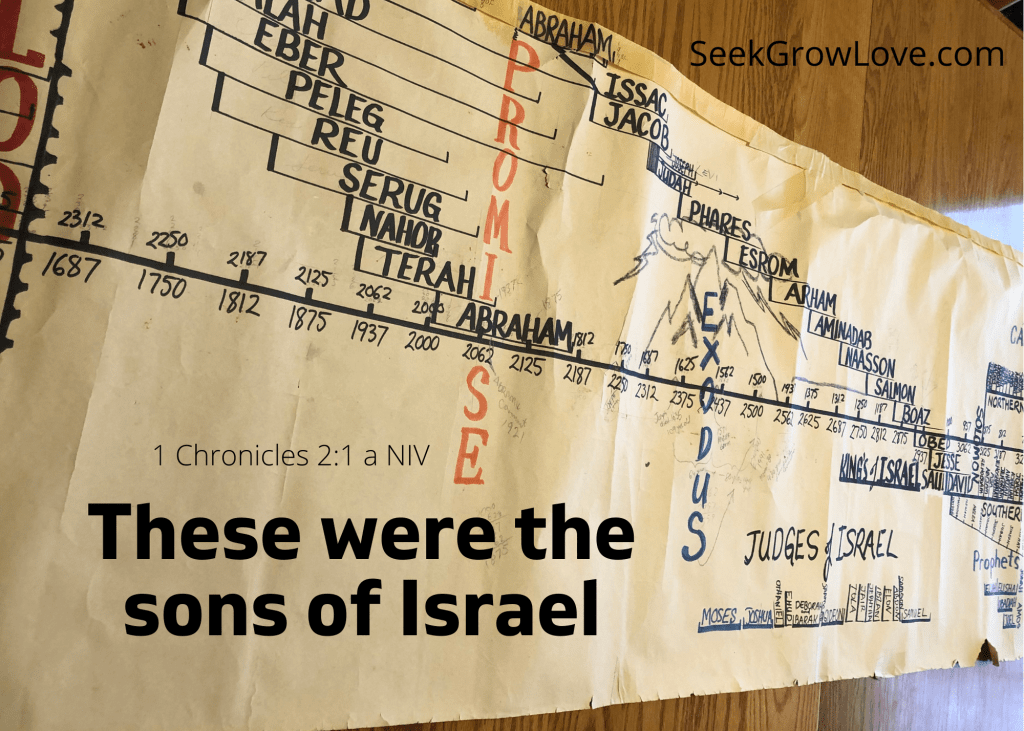
1 Chronicles 1-6
The very last class of my undergraduate education taught me something I’ve remembered for years. I was finishing up my minor and taking my last sociology class. I made a statement during a class presentation that earned me a grade that pushed me into a new academic rank that I thought was impossible to achieve. The presentation was on being a voice for change in society. “If we want to bring about societal change, we need to make some noise!”
I’m going to sound a tad irreverent here. I used to cringe every time a modern agent of societal change preached “Fact-check!” My disdain from the message grew with each passing day that the seemingly one-sided social sermon that I immersed myself in on an almost daily basis, was made light. The noise was bringing change but to me, it was not warranted change.
At first, noise is all I ever allowed myself to hear from the opposing side’s communication. My mind went straight to the need for taking the stick out of the opposing side’s eye. There may have been a beam in there too.
I had to turn off the noise and get myself immersed in something else because I wasn’t helping the situation. I was supposed to be the light that brought change, not the opposing societal view. Right around this time, I started digging into the various things Jesus was called. In the quiet I reacquainted myself with The Light of the World.
Through my continued immersion in the word, I did something I had rarely done. I actually took the time to read the genealogies of Jesus, the boring stuff, in the beginning chapters of Mathew and Luke. It dawned on me.
In the quiet, I realized that the words so often skipped over were God’s fact-checks! Through these, he made certain we knew who the Messiah was, the one who would bring about the right change. It was all in there waiting to be discovered. The Messiah is exactly who God said he’d be and exactly who Jesus said he was. There are facts that lead to him in the genealogies, the lineages, the “begats”, the “in the lands of-s”, the “in the times of-s”, through the recordings of kings of kingdoms, in the astronomical signs of the times, etc. All fact-checks leading to Jesus Messiah.
The genealogies of Jesus were written by eyewitnesses of his ministry. I love the beginning of Luke:
“Since many have undertaken to compile an account of the things accomplished among us, 2 just as they were handed down to us by those who from the beginning were eyewitnesses and servants of the word, 3 it seemed fitting to me as well, having investigated everything carefully from the beginning, to write it out for you in an orderly sequence, most excellent Theophilus; 4 so that you may know the exact truth about the things you have been taught.” -Luke 1:1-4
I took a little more time today reading through the genealogies recorded in 1 Chronicles chapters 1 – 6. They’re fact-checks. They can help us to be prepared with an answer to anyone who questions our faith.
Through this experience, I have begun to listen to the opposing side before opposing them completely. I have come to value the opposing side’s pleas for fact-checking. They are right. We need truth. But we need to fact-check society as a whole – all sides.
I’m still a bit put off by the societal noise and social pressures of our time. Although it may be true that making noise may lead to societal change, it may not be what God wants for us. There were times when Jesus spoke softly and times when Jesus rebuked. There were times when Jesus was offensive and there were times when Jesus remained silent. He always did whatever he heard from his father. If I’m going to be the light of the world like Jesus, desiring to cause societal change, I need to hear Jesus and heed his statements. I need to do it his way. His way is often the unpopular way but it is the only way that’s going to bring about change that matters.
-Juliet Taylor
Today’s Bible reading passages can be read or listened to at BibleGateway here – 1 Chronicles 1-2 and Proverbs 17
You know the feeling you get when you meet up with a couple of fellow kings, who aren’t really your fellows, but you have a common enemy, so you march on together in friendship and harmony, despite the odds that are against you, when you come to the devastating realization that your combined armies and cattle are on the road to dehydration, so you suggest finding that one prophet dude who can maybe help out in this situation, and the other kings agree, so you find the prophet dude and it miraculously turns out, yes! He, or more accurately God through him, helps you out with your water dilemma, (it’s “but a slight thing in the sight of the LORD) and not only that, but he also says that he’ll assist in the defeat your enemy!! Eeeeek, I’m practically bursting just thinking of it. Unfortunately, I can’t say I’ve actually experienced the aforementioned occurrence, but I have felt the amazing emotion that fills your heart with complete, unmatchable joy when you are assured that the most powerful, capable, fierce, wisest Being in the universe, loves you and has your back.
In 2 Kings 3, this is exactly what we see happening. Jehoram, the king of Israel, comes together with Jehoshaphat, the king of Judah, along with the king of Edom, and together they avoid dying of thirst, and totally crush the Moabites. Their epic victory wasn’t of their own works, though. It was God who provided water, and delivered Moab into the hands of the three kings. More often than we ever realize, God works in our lives too. Every single undeserved blessing, every single little victory we celebrate, is our Father’s loving presence. He is continually showing us how much He cares for us, and how deeply He loves us. He demonstrates this love not only in our lives now, but in the amazing promises He’s made to us. Promises of a perfect Kingdom in a beautiful land, where we will live eternally in absolute contentment and happiness with our wholly perfect and wholly good Father.
Notice, however, that Elisha clarified in verse 14 of chapter 3 that he would not even be seeing them if it wasn’t for the presence of the godly and faithful king Jehoshaphat. This king trusted his God, and knew to go to Him in his time of need. Back then, they had to go to God through a prophet, like Elisha, or Elisha’s predecessor, Elijah, but Jesus has since then connected us to our God, bridging the gap as a mediator between God and man. We have the ability to speak directly with God and form the relationship He so desperately wants with us, despite our utter imperfection and His divine perfection. Hold on tight to that gift, never forgetting how awesome it is that we can be so massively loved by such a great God; that He would care for us at all, even in our sin and weakness. Hold on tight to the unimaginable promises He’s made to us, and live everyday aware and thankful for the countless blessings He provides for us.
What a feeling, to know that you have such an awesome God on your side.
-Isabella Osborn
Today’s Bible reading passages can be read or listened to at Bible Gateway here – 2 Kings 3-4 and Proverbs 6







 Seek Grow Love