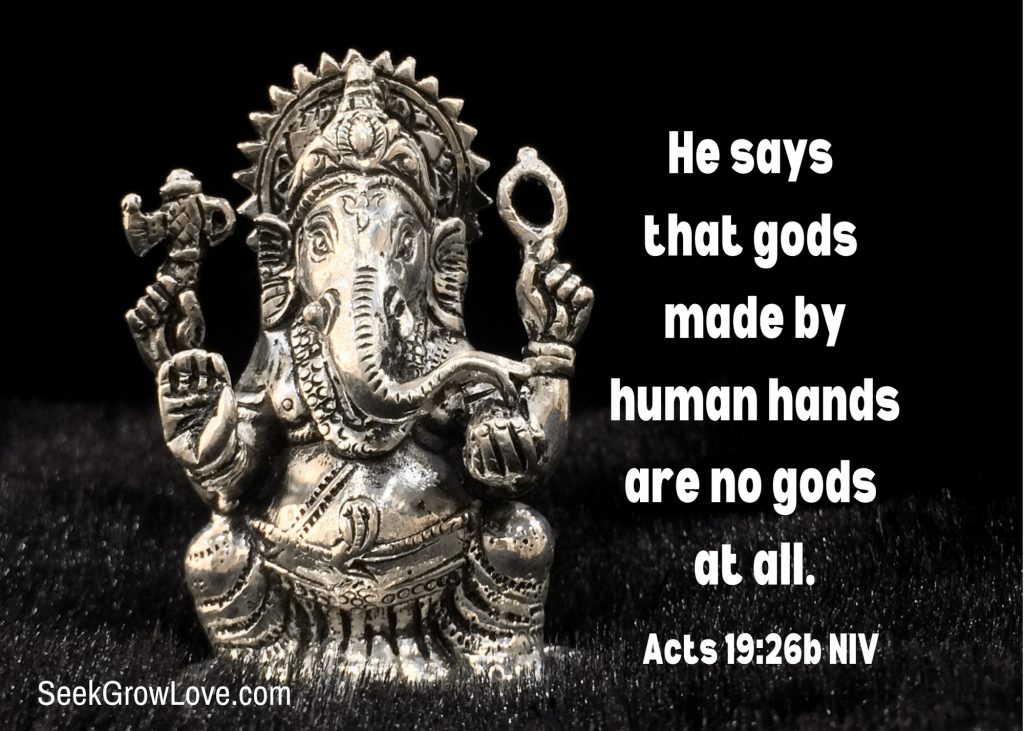
There is a saying with some truth to it that if you want to know about a matter – ‘follow the money’. This means if you look at the funding sources of a matter then you get a picture of who is pushing what (aka agenda) and who has financial gain or interest or conflict of interest in the matter. This is not a new concept, but rather, an old one. It is even present in Biblical times. The incident with Demetrius in Acts 19 is the perfect example.
Demetrius is a silversmith idol maker and has a good business going making a lot of money in Ephesus. He is afraid that the message that Paul is sharing that there is only one true God and that Jesus Christ is His son will plummet his sales in idols of Diana. Ephesus was known for its worship of the goddess Diana and the god Zeus. So he incited his fellow idol makers towards anger and malice towards Paul and the disciples in Ephesus. This snowballed into a riot where half the people didn’t even know what the issue was and just joined in rioting just because. (Sound familiar?) The authorities of the city knew that Paul and the disciples had done nothing wrong and had not stirred up this great rioting mob by anything they had done so they refused to bring them to court to try them. Ultimately Paul and the disciples decided to leave town and go somewhere else where they could share the gospel.
All of this is due to Demetrius and his fellow silversmiths being concerned that they would lose their livelihoods making shrines that they made a great profit from selling to the people. They were not interested in hearing or considering the truth – they were only concerned with the almighty dollar as we might say today. It is sad that the truth of the gospel couldn’t be openly shared in Ephesus because of a handful of greedy men. Does this happen today? In our time? You bet. The names and the livelihoods may be different but the situation still rears its ugly head. So …if you want to know about a matter ‘follow the money’ and you will find out a lot. More importantly follow Jesus and gain discernment about situations that arise. One will never go wrong when truly following Jesus.
-Pastor Merry Peterson
Today’s Bible reading passages can be read or listened to at BibleGateway here – 2 Samuel 19-20 and Acts 19
It is interesting how some people basically stay in one place all their lives and others seem to travel about quite frequently. No one can accuse the apostle Paul of being a homebody! In Acts 18 we notice that Paul travels quite extensively staying in one place for a little while, and then traveling to another place. Sometimes the places he traveled to received the gospel message with readiness and welcomed him, and at other times he received more hostile treatment. Everywhere he went he shared the gospel message. About the first thing he would do each place he went was to go to the synagogue and teach there about Jesus being the promised Messiah and way to salvation.
Among his travels he met Priscilla and Aquila and they were strengthened in the faith. So much so that later when Paul travelled on to a new location without them they were able to teach another man named Apollos more clearly about the gospel. It seems whether near to home or far away these early Christians were ready and willing to share the message with whoever would listen and believe. They were truly ready to give an answer in season for the hope they held within them.
We should be ready and willing just as they were to give an answer for the hope that we hold within us. Whether God gives us the opportunity to travel from place to place, or whether He asks us to be the light within our own community. Our willingness should always be present, just as it was with the early Christians, to share the hope we have in Christ.
-Pastor Merry Peterson
Today’s Bible reading passages can be read or listened to at BibleGateway here –2 Samuel 17-18 and Acts 18
There are so many things that I find interesting in Acts 16. Paul has a vision of a man from Macedonia asking for him to come share the gospel with him. When they get to Macedonia to the region of Philippi they meet a woman who comes to belief along with her whole household. But what unfolds next is really fascinating. Paul and Silas get into a situation and end up being severely beaten and thrown into the inner holding rooms of the prison. But what I want us to notice is their reaction – they aren’t crying, they aren’t in there feeling sorry for themselves or busy being angry or muttering threats – they are Praying and Singing Hymns to God! What a contrary reaction to what everyone would expect!
If we were in that situation, sore, and bleeding, in a dark, inner, dingy room with criminals around us would we be that confident and flat out bold? We would more likely be in there feeling sorry for ourselves, scared out of our wits, and wanting desperately to call our lawyer or mom or anybody that could help us get out of there! But Paul & Silas’ response was God focused. By praying and singing hymns to God they were communicating with the one who has all power and authority to change and alter any and every situation. Who needs a lawyer when you have God on your side? God used the situation to open the hearts of the Philippian jailer and his household to hear and accept the gospel message. Paul and Silas were also released to go free from the prison where they were being held. When Paul and Silas exhibited the right response to their unfair situation God turned their situation around for His glory.
If we were to be bold and confident in the Lord and say within ourselves as the Psalmist did in Psalm 121:2 “My help comes from the LORD, who made heaven and earth.” And keep an attitude of worship, praise, and open communication with God in our trials; maybe we would stand in the same place of victory as Paul and Silas did. One of the biggest challenges that we face in our Christian walk is keeping the right attitudes when things don’t go our way or get difficult for us. I hope we are inspired by the actions of Paul and Silas and remember to communicate with the author of life and outcomes when we face our next difficult situation.
-Pastor Merry Peterson
Today’s Bible reading passages can be read or listened to at BibleGateway here – 2 Samuel 13-14 and Acts 16
In the movie Saving Private Ryan, Tom Hanks’ character spends the bulk of the film working to save the life of one man, Private James Francis Ryan, who is slated to be sent home after his three brothers have all been killed in combat. Near the close of the film, Hanks leans in to Matt Damon, who plays Private Ryan and whispers his last words, “Earn this.”
The final scene of the movie is both touching and convicting. Ryan, now an old man, stands at the grave of the man who gave his life to save him and he weeps. He looks to his wife, “Tell me I’ve lived a good life,” he says, “Tell me I’m a good man.”
For him, the reality of living a good life in response to the sacrifice that was made on his behalf was tangible because he had looked in the eyes of the man who died in his place. I think, perhaps, we miss something because we can’t do that, don’t you?
Paul wanted us to think about doing good with our lives. It seemed to be important to him.
His letter to Titus is not long. It’s only 46 verses. But almost 1/5 of them talk about doing what is good (17.5% for you math heads out there).
“I want you to stress these things, so that those who have trusted in God may be careful to devote themselves to doing what is good.”
Our lives as believers preach louder than any Bible verses we post to our Facebook pages or how pious we consider ourselves to be. Perhaps that’s why Paul concludes his letter to Titus with the reminder that,
“Our people must learn to devote themselves to doing what is good, in order to provide for urgent needs and not live unproductive lives.”
We all know that we can’t earn salvation, but we can earn (or lose) other people’s trust.
— The way that we speak to, and about, our parents or our spouse could make someone want to know more about the God we serve…or less.
— The integrity we exhibit at work might make them want to pick up a Bible…or never set foot in a church.
— Our gentleness, kindness, and considerate behavior may be the thing that draws someone to experience the love of God for the first time…or they might come to believe that God is rude and harsh and uncaring.
To put it another way… why would your unbelieving boss want to consider Christianity if you are the laziest employee they have? Or… Do you think anyone cares how many Bible verses you know if you make everyone around you feel like garbage?
We can all fall into the self-focused trap far too easily. So here’s your reminder that (and you might need to sit down for this): It’s not about you.
I had kind of an ‘a-ha’ moment in Sunday morning worship not too long ago when we were singing the song, Awakening. Some of the lyrics say,
For the world You love Your will be done Let Your will be done in me
Praying for God’s will to be done in your life is a good thing no matter what. But it hit me over the head that Sunday morning that the purpose of Him wanting to do his will in my life wasn’t just for me. “For the world you love…”
While we can’t ever “Earn this” we can embrace the passionate and intentional living that Private Ryan embraced and regularly examine ourselves with questions like he asked…Am I living a good life?
Or more specifically… Is how I’m living drawing people towards God or repelling them from Him? Am I reflecting Him accurately?
Am I devoting myself to doing what is good?
-Susan Landry
Today’s Bible reading can be read or listened to at BibleGateway here – Titus 1-3
In the movie Elf, Buddy the Elf is taught the Code of the Elves, which the elves all recite and know by heart. Number three on the list is about spreading Christmas cheer, and by the end of the movie, Buddy has spread that message to lots of people.
In the book of 1 Timothy, Paul explicitly tells us his purpose when he says, “I am writing you these instructions so that…you will know how people ought to conduct themselves in God’s household, which is the church.”
So, in essence, Paul’s giving us the Code of the Church. And what are some of the things in that code?
Remember you’re a big fat sinner (ie: Grace)
Here is a trustworthy saying that deserves full acceptance: Christ Jesus came into the world to save sinners—of whom I am the worst. (1:15)
Before we say a word to anyone else, our perspective on ourself needs to be right.
Unfortunately, there seem to be an awful lot of believers out there who don’t seem to see themselves as Paul did. They might rephrase this verse to say, “Christ Jesus came into the world to save sinners—praise the Lord I’m not like them” or if we’re really honest, “Christ Jesus came into the world to save sinners—thankfully I’m not as bad as the worst of them.”
And although I don’t really believe most Christians would actually rephrase Paul’s writing in those ways, our attitudes do it for us. Brennan Manning, one of my favorite authors said, “Jesus came not only for those who skip morning mediations, but also for real sinners–thieves, adulterers and terrorists, for those caught up in squalid choices and failed dreams.”
The lyrics to the song, “Come to the Table” are a lovely picture of recognizing that we are all sinners redeemed, and that our unworthiness does not exempt us from a seat at the table of mercy.
Must sin be called out? Of course. With a heaping side of grace.
Grace first. Grace always.
More on that later in the code.
2. Pray for your leaders
I urge, then, first of all, that petitions, prayers, intercession and thanksgiving be made for all people— for kings and all those in authority, that we may live peaceful and quiet lives in all godliness and holiness. (2:1-2)
Pray for them (ARROW) THAT…
The code dictates that we’re praying for leaders that will enable us to live out a Biblical faith.
If anyone does not know how to manage his own family, how can he take care of God’s church? (3:5)
Chapter three is almost entirely devoted to this piece of the church code, laying out indicators of what believers should look for in church leaders. This much real estate in Paul’s letter should tell us that it’s something that he found important, and should therefore garner our attention as well.
4. Train yourself to be godly…because it doesn’t come naturally
..train yourself to be godly. (4:7)
Training involves work, often times painful work.
As we alluded to in step one of the code, identifying sin is a part of responsibility of the believer. Both in our own life and for one another.
Paul writes in other places of ‘walking in the Spirit’ vs. ‘walking in the flesh’. Walking in the flesh could be described as doing what comes naturally to us, and that is frequently (almost always) not the same as what God would call us to.
This is why we need to train ourselves in it. Despite all the Chuck Norris jokes to the contrary…Chuck Norris wasn’t born all ‘Chuck Norris-y’. He has trained and worked hard physically to attain the physical strength and skills he has.
While we do want to train hard and push ourselves and one another to greatness, the underlying foundation must always be love. It must always be grace. (See #1 of the Code)
5. The church takes care of its own
Do not rebuke an older man harshly, but exhort him as if he were your father. Treat younger men as brothers,older women as mothers, and younger women as sisters (5:1-2)
Much of chapter 5 centers on the care of widows in the church, something we may deem a waste of Paul’s time. However, it shows a real care and elevation of women. A woman whose husband had died could become desolate very rapidly, and this was to ensure that this not happen to believers.
Although the specific issue of widowhood may not be as relevant to us today, the idea that God expects believers to provide for their family has not changed. Also unchanged is the notion of the church family stepping in for believers without blood-family to support them.
Good deeds are obvious, and even those that are not obvious cannot remain hidden forever. (5:25)
Our church code of conduct may not be quite as catchy as the one Buddy the Elf learned in the North Pole, but ours has a far more lasting impact…and no tights required!
-Susan Landry
Today’s Bible passage can be read or listened to at BibleGateway here – 1 Timothy
The tagline might read: This motley crew of misfits does nothing but bicker and fight amongst themselves…is it Guardians of the Galaxy–or us?
In both cases, establishing a sense of identity leads to unity and purpose, and some big winning.
Ephesians 1-3
If Ephesians were an epic movie experience, the first half would establish how God sees us, our true identity. We’d hear our characters use words like chosen and included, forgiven, grace and saved. We would watch them go through a transformation from dead in transgressions to alive in Christ.
Somewhere in this segment, God would find an intensely personal way to show one of our characters “the incomparable riches of his grace, expressed in his kindness to us in Christ Jesus,” … and I would definitely cry.
Ephesians 4-6:
As we prepared for act two, our characters (and we, ourselves) would recognize the real meaning of it all, and we might finally “grasp how wide and long and high and deep is the love of Christ, and to know this love that surpasses knowledge.”
Taking hold of the fullness of the love that Jesus has for us. Really understanding this love that goes beyond how much we know. Big stuff. That’s why this flick is such an epic.
Knowing who we are changes how we live and how we treat others, and that’s where the second half of the story leads.
When we are able to see ourselves through the lens of this all surpassing love, we can be humble, gentle, patient, speak and act in love; and things like bitterness, anger and rage take a back seat to kindness and compassion.
There’s a scene at the end of Guardians of the Galaxy 2 (that I always rewind and watch a second time if I’m alone). It’s just a short conversation between Rocket and Peter.
Rocket : He didn’t chase them away…Even though he yelled at them, and was always mean… And he stole batteries he didn’t need.
Peter [Realizes Rocket’s talking about himself, not Yondu]: Well, of course not.
{Gulp} {Tear} This team of individuals, unable to get along at the start, becomes not only a team but a family. And this moment of tenderness makes me cry every single time. Every time!
When the struggle is no longer against one another, we can fight the real battle…together, perhaps?… and win.
The true enemy is the darkness of evil, not each other. But we can only truly realize that, truly embrace that, when we are able to see ourselves in the light of our true identity, as God sees us. Until then, we’ll keep losing ground and wondering why.
Ephesians has no talking Racoons or Trees with attitude, but there are definitely supernatural powers and epic battles. And like any good superhero movie, the heroes sometimes need little reminders now and then to live up to their potential. That just might be how this lesson will fade out…
“I urge you to live a life worthy of the calling you have received.”
– Susan Landry
Today’s Bible reading passage can be read or listened to at BibleGateway here – Ephesians 1-6.
The best movies are more than a fun way to spend a couple of hours, they leave us with something. And a film doesn’t have to be deep and dramatic to be able to find lessons in it. Analogies are everywhere. Learning can come from many places.
Our devotional trailer opens on a fleeing man, Onesimus, with the voiceover telling us, “Under Roman law, there were no limits to the punishment a slave master could inflict on a runaway slave….but sometimes redemption comes when we least expect it. ”
Onesimus somehow found Paul, and over time he grew a faith…and a friend, it seems. At some point, Paul sent a letter to Onesimus’ former owner, telling him he was sending the slave back to his previous master.
“I am sending him—who is my very heart—back to you… If he has done you any wrong or owes you anything, charge it to me.”
Charge it to me.
Do you see how Paul is mirroring the story of the cross here?
In this story we are Onesimus. Like him, each of us deserves punishment. We owe a debt. And like him, someone offered to take the punishment on our behalf, to pay our debt.
Someone has given us a second chance.
Maybe you’ve never really been in the position of needing a true second chance. Or maybe you have and you’ve just forgotten how demeaning and low it can feel. The graciousness of Paul, to speak of Onesimus as ‘my son’, ‘my very heart’, and ‘a dear brother’ must have allowed Onesimus to hold his head high as he returned to his former home.
The account of Onesimus and Philemon may be a short one, but the way that Paul used this opportunity to illustrate the gospel story is pure genius.
Maybe, in Onesimus, Paul wanted each of us to know that we are beloved. That we are worth saving. We are worth sacrificing for.
Maybe he’s telling us that knowing our true value allows us to hold our heads high as we live in our ‘former home’ until our forever home is ready for us. We are Abba’s children. We are Christ’s dear brothers and sisters.
This would be one movie that would pack an emotional punch, and you could be sure you’d leave the theater changed…if you were really paying attention.
And speaking of paying attention—the next time you are unsure of your standing, remember that you have a letter in your pocket that says, “Charge it to me,” and lift your head a little.
-Susan Landry
Today’s Bible reading passages can be read or listened to here at BibleGateway – Colossians 1-4 and the itty bitty book of Philemon
A movie trailer gives us a taste of a film but by no means covers the depth of its entirety. When we read chunks of Scripture, it’s impossible to capture the fullness of its message in a short devotion. I hope that a short peek each day at a moment in each reading will tempt you to read the passage on your own and see what other plot twists you find!
Although Paul is the main character of the film, this trailer starts with a closeup of the Centurion.
A rugged soldier, captain of 100, standing on the deck of a ship at sea. He’s worried. A storm is brewing and as he looks to the man beside him, the man says, “You should have listened to me.” The man is not a sailor, he is a Jewish scholar and a prisoner, and he proceeds to instruct the Centurion how he can save everyone on board.
“Unless these men stay with the ship, you cannot be saved.”
Scenes flash across the screen of the Centurion cutting ropes in the blowing rain, Paul praying to God, the ship running aground a sandbar, soldiers arming to kill prisoners before they can escape, and the Centurion stepping in to protect Paul.
Dry and ashore the island of Malta, we watch, from the Centurion’s vantage point as Paul is bitten by a poisonous snake with no ill effects and as the islanders come to him to be healed. Music swells and we know that this is a story of changing perspectives and growing faith, and ours is growing right along with this hardened soldier’s.
Acts 28:16 says, “When we got to Rome, Paul was allowed to live by himself, with a soldier to guard him.” If I were writing this movie, I’d take some artistic license and that soldier would be the very same Centurion from the ship. It would make a great last shot, wouldn’t it?
Really, though, I wonder how this Centurion’s life was altered having made this trip with Paul. We’re told that his name was Julius, “When it was decided that we would sail for Italy, Paul and some other prisoners were handed over to a centurion named Julius,” but not much else. The things that Julius saw and experienced must have changed him. They must have.
Along those lines, think of the ‘Centurions’ in your life. Those who live life in your peripheral. They might not be main characters, but they are on the sidelines. How is their life being altered having had you in it? What can you do to be more intentional about being a positive influence, planting a seed, showing a glimpse of the Father so that their story might be changed?
-Susan Landry
Today’s Bible passage can be read or listened to at BibleGateway here –Acts 27-28
Tomorrow we read 2 of Paul’s letters – Colossians and Philemon.
Throughout today’s reading and yesterday’s reading as well, we are told of the arrest and imprisonment of the apostle Paul while in Israel. He testifies before several different people in authority before eventually being sent to Rome to presumably face Caesar. He spends as much as two years in jail under Felix’s watch.
Why did God allow Paul to be in chains for so long before ultimately going to Rome to spend even more time in jail until his death? I am certain this time was not without purpose. One key from this passage that stands out to me is found in chapter 26, beginning in verse 25:
“I am not insane, most excellent Festus,” Paul replied. “What I am saying is true and reasonable. The king is familiar with these things, and I can speak freely to him. I am convinced that none of this has escaped his notice, because it was not done in a corner. King Agrippa, do you believe the prophets? I know you do.”
Then Agrippa said to Paul, “Do you think that in such a short time you can persuade me to be a Christian?”
Paul was afforded opportunities to influence high ranking officials that he likely would not have had were it not for him ending up in chains. He had those same opportunities in Rome. And as we know, Rome eventually became the center of the Christian world. It wasn’t until 313 AD, however, that the Emperor Constantine issued the Edict of Milan, which accepted Christianity: 10 years later, it became the official religion of the Roman Empire. So it took a while after the death of Paul (approximately 62-64 AD), but I believe the two are linked.
We have had many opportunities ourselves to influence people by our actions and by our words. Some of these times have been very intentional, as when we try to minister to someone, or very unintentional, as when perhaps someone we don’t even know notices something different about us because of our faith.
Sometimes, if we are lucky, we get to see some of the impact we can have on others. But more often than not, we will never know what fruit our actions and words will bear in others.
But that’s OK. All we can do, much like Paul, is to do the best we can, and then allow God to develop the seeds that we have spread. One thing is certain though. You have to plant seeds in order for them to grow. What are you doing to plant seeds in others? Do something! Be an encourager. Share your faith. Or just be really kind to others. You never know what kind of amazing impact you can have, even if you don’t see it.
-Greg Landry
Today’s Bible reading passage can be read or listened to at BibleGateway here – Acts 24-26.
I am a fairly humble fellow. I do not stand out in a crowd. I do not try to draw attention to myself. In fact I don’t like attention. I don’t consider myself arrogant and I am very aware of my flaws. And yet, there are still times when I allow myself to feel superior to others. Maybe we all do that at times?
No matter how many flaws we have, all of us are better at something than someone else. And in those moments where we take notice of that, it is easy to allow our egos to puff up a bit, isn’t it? Maybe that is even especially true for those, like me, that are more keenly aware of our shortcomings than our triumphs.
Paul touches on humility several times in chapter 12, and typically when I read these passages, I instantly think about people that are very arrogant, and think, “this doesn’t really apply to me,” or “I’m doing fine in this area.” But then (sometimes) I think about the thoughts that I opened with.
Beginning in verse 3, Paul says, “For by the grace given me I say to every one of you: Do not think of yourself more highly than you ought, but rather think of yourself with sober judgment, in accordance with the faith God has distributed to each of you. For just as each of us has one body with many members, and these members do not all have the same function, so in Christ we, though many, form one body, and each member belongs to all the others. We have different gifts, according to the grace given to each of us.”
There you have it. Each of us should NOT think of ourselves more highly than we ought. Well then how highly SHOULD we think of ourselves? Frankly, I would say pretty high, because we are each pretty incredible creations of God. And we have each been blessed with many abilities and talents. But as Paul points out, we have all been given DIFFERENT abilities. And it is key to remember that we have been given those abilities. We didn’t do anything ourselves to acquire natural abilities. Some people are born with great musical talent. Others with sharp intellect. Still others with amazing athletic skill. Paul here is speaking primarily of spiritual gifts, but all abilities and talents are indeed granted by our Creator. I really appreciate when I see gifted athletes giving credit to God for their abilities during post-game interviews. I am not always sure how sincere they are, but the message is true regardless.
In verse 10, Paul says to Be devoted to one another in love. Honor one other above yourselves. This is an outward extension of humility, and here, should be motivated by love. How often do you honor others above yourself?
Finally, Paul comes back to humility again in verse 16.
“Live in harmony with one another. Do not be proud, but be willing to associate with people of low position. Do not be conceited.”
We should not just be showing humility to the people we are comfortable being with, or the people that are “our kind of crowd.” We should be showing humility to, and honoring above us those whom we would consider to be of low position.
Again, this is the example Jesus left for us, and it is a humility that is motivated by love, which Paul sums up perfectly in verses 9-21.
So, think of yourselves very highly, as an amazing creation, but do not think of yourself more highly than someone else. That is when you are thinking of yourself more highly than you ought. It’s about recognizing that God has given each of us different gifts, to be used to His glory.
-Greg Landry
Today’s Bible reading passage can be read or listened to at BibleGateway here – Romans 11-13.
Tomorrow we will finish the book of Romans (chapters 14-16).






 Seek Grow Love