Exodus 31 and 32 are full of some pretty exciting stuff. There seems to be good reason why Moses is a recurring character in children’s lessons and why illustrations of these stories made the cut for one of the rare colored pictures inserted into the old Children’s Bibles of my day!
In this story, while the Israelites were busy stripping off their valuable gold to fashion it into a false god, Moses was busy encountering the LORD. Unfortunately, not only were the Israelites just doing the handicraft work of sculpting calves with gold, we also see in Exodus 32:8,
“. . .they have bowed down to it and sacrificed to it and have said, ‘These are your gods, Israel, who brought you up out of Egypt”
Umm, excuse me, who brought them out of Egypt?? The only God. The one true God. The LORD who was busy inscribing tablets for His people at this same time. God was writing. At a time where writing wasn’t something you did with a stylus on magic screens, when you didn’t highlight or color code or copy and paste. . .writing itself was more rare and precious. And while they were spouting lies and whining, God was inscribing His words in stone for them anyway.
As an occupational therapist, one thing I get to do quite a bit is assess how people write, how I might be able to make it easier, less painful, help children develop writing skills, etc. So, while I read this chapter, I couldn’t help but get intrigued wondering how He was doing it and how it looked. Is God right handed or left? Was He pointing with an index finger? Does He have an index finger? Were there any pink sparkles involved? Basically, I got distracted thinking about things through my filter and what I know. While these chapters don’t share this detail, Deuteronomy and later in Exodus tell us that these tablets were written by “the finger of God”. That is some handwriting action I would LOVE to observe! But most importantly, given the God who parted the Red Sea for this crew to miraculously flee Egypt, was writing with His finger on stone for His people, one would assume these words were treasures. But. . .
How heartbreaking to see two vastly different things going on at Mount Sinai at the same time. A God who loves His people and knows them best writing a message for them. A people who claims to be His in one breath, yet lifting a golden cow as their god in another, all the while clueless to what the true God is busy doing for them. Surely we can relate before we throw stones. We live in a world of gold, cows, false gods, lies, distractions, and people telling us other things are gods constantly. We also live in a world created by the one true God with a beautiful plan for renewal in the coming kingdom. Maybe one day we can see God write, but until then, we have His living word, His spirit, and His love available to us. Let us purge our golden idols and seek to focus our attention on Him even if it means being patient, obedient in tough things, and focused on the promised land.
Reflection Questions:
What can you learn and apply from the characters on the top and bottom of Mount Sinai in today’s story?
What can you do today to treasure God’s word?
Prayer:
Dear God, You are the one true God worthy of all our praise. Thank You for loving us through all our faults. Help us remember to seek You first and cast aside any idols we have. Amen.
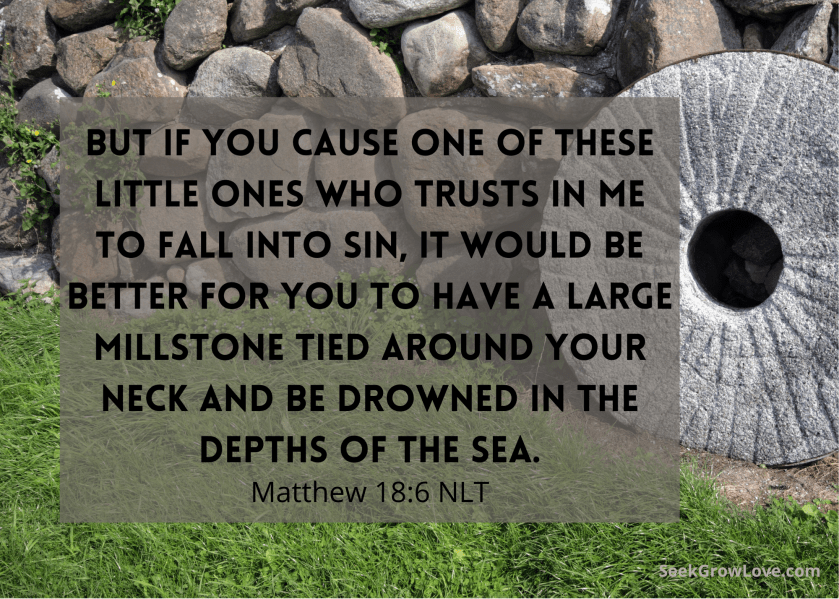
At my house, if I want to do something crazy like grind wheat or coffee beans, I turn on the Vitamix. The cat doesn’t appreciate the noise, but within about 60 seconds, the work is done. In Jesus’ day, the appliance for the same was a millstone. Extremely hard and heavy, millstones are referenced in the Bible a number of times as an illustration that would have been a familiar common item for the readers of the time. First mentioned in the Mosaic law (don’t take someone’s daily sustenance-grinder away in a pledge!), then a deadly weapon being dropped on someone’s head in Judges 9, and even a comparison to the strong chest of the Leviathan in Job…by the time Jesus is talking in Matthew 18, we get the idea that these millstones used for grinding grain were massive. So, when Jesus says it would be better to have one tied around your neck and thrown into the sea than to cause someone who believes in him to stumble…we know that is a big deal to him.
In Matthew 18:7 we are told that things that cause people to stumble are going to come, but we must guard against them. And not just casually. At an intentional, life-altering level at times. There are things that will cause us to sin. And there are people through whom they come. Woe to them per Jesus! The word for “things” used in these verses is also referenced as a stumbling block, offense, or thing that causes people to sin. Many things cause people to stumble, and the conviction or application of this passage to our individual lives is personal. But, some things are pretty common for most of us. In the New Testament time, millstones were common things apparently. In 2026, phones, social media, 24/7 internet access, and artificial intelligence are ordinary. Unfortunately, so are mental health crises, hostile and divisive spirits, unforgiveness, and addictions. Not just to chemical substances. But, also to feeds, constant information, visual input, likes, shares, and the next harder and heavier millstone than “they” have. Or maybe don’t have yet.
I say this not to suggest we should gouge out all electronic devices from our homes/cars/watches and who knows what else and throw them into the sea….. but to recognize that through them, there seems to be a profound struggle going on for our minds, our attention, and the very cognitive abilities God has created us with and given us for this type of self-reflection and sound reasoning. And through them, stumbling blocks are now available far more privately and abundantly than in the millstone days…..they are reading our eye gaze, knowing our weaknesses, designed to addict us, divide us, and distract us. All. The. Time.
However, when we stumble, and when other believers stumble, Matthew 18 showers on us a message that we all need. The shepherd looks for the lost sheep and rejoices when found. The Messiah wants the humble children who don’t know everything. We are called to welcome the lowly. The church has sinners and Jesus tell us how to deal with it. And the last 14 verses of the chapter give a vivid picture of the abundant forgiveness Jesus expects and gives.
As heavy as the millstones were, the weight of sin Jesus lifts is far greater. As we seek to purge the stumbling blocks from our lives, pray to have discernment to even recognize them in a sneaky world, and strive to not lead others astray . . . let us also forgive abundantly and return to the shepherd when we find ourselves lost.
“What do you think? If a man owns a hundred sheep, and one of them wanders away, will he not leave the ninety-nine on the hills and go to look for the one that wandered off? 13 And if he finds it, truly I tell you, he is happier about that one sheep than about the ninety-nine that did not wander off. 14 In the same way your Father in heaven is not willing that any of these little ones should perish.” (Matthew 18:12-14)
Reflection Questions:
Have you ever had someone in your life who helped you from stumbling?
What millstones or stumbling blocks might you need to be freed from today?
Prayer:
Dear God, thank you for providing us a direction to live our lives for You, and for the many teachings of Jesus which infuse wisdom and guidance. Please give us the discernment to recognize possible distractions and stumbling blocks in our lives and the strength to keep our eyes towards You. When we fail, thank you for being our deliverer in our times of trouble and for continually seeking us out. In Jesus’ name, amen.
I want you to know that my parents are amazing, wonderful, spirit-filled, and God-led people, who have strove their entire lives to live in a manner pleasing to God, and to instill in me that same holiness and humility. That being said, I want you to know that I was a truly terrible person, rebellious and narcissistic, and largely ignoring everything they said until God grabbed me and my attention. Today as a devotion, I am going to give you just a small portion of my personal testimony. This will be the “highly edited” version and summarization, but please know that I was a truly terrible person, despite my awesome parents, and my awesome God. As a spoiler alert, know also that God saved me with a mighty and miraculous hand.
Psalms 3:1-2 (LSB): “O Yahweh, how my adversaries have become many! Many are rising up against me. Many are saying of my soul, “There is no salvation for him in God.””
When I was between the ages of 18-25 I was basically a career criminal, and that is far more a reflection of my own stupidity than my parents efforts. I found that the easy way was…well…easier, so I took it. Then I kept on taking it. I was doing lots of drugs, and drinking too much, and doing things I shouldn’t. Mom and Dad could see that I was drifting away and prayed for me constantly, which is likely why I am alive. I became involved with bad people, doing bad things, for bad reasons. Then as I moved deeper into those circles, I became privvy to information that I shouldn’t have, and as a result I found myself in mortal peril. Those people I’d thought of as my friends began to seek my life. Things got dark and ugly. People that I knew and loved died. It was a hot mess, and in a moment of desperation I called Mom and Dad.
Psalms 3: 3-4 (LSB): “But You, O Yahweh, are a shield about me. My glory, and the One who lifts my head. I was calling to Yahweh with my voice, and He answered me from his holy mountain.”
Miraculously quickly, my parents sent me a plane ticket in another young man’s name, who had just cancelled a trip but not the ticket yet. This was before 9/11 so you could get away with those types of shenanigans. I escaped and moved in with them in Atlanta, where dad was teaching at the Atlanta Bible College. I was expecting to die at any moment, and so I threw myself wholeheartedly into scripture, looking for God to save me, which He did. I was the only kid in history, to my knowledge, to go to the Atlanta Bible College with a mohawk (but nicely done up in a pony tail, usually). I met some great people there, TRUE friends, who loved God and lived in a manner that was pleasing to Him. I immediately stopped doing all of the bad things I’d been doing, and started to study up on scriptures. I was really trying to seek God.
When you’ve lived immersed in a sewer for a long time, though, it’s hard to keep yourself from stinking. When I took up a professional (legitimate) career, I started to get puffed up with myself, and some of the bad habits I’d had started to look appealing to me again. Does this sound familiar, from the stories in Exodus? Even though I’d been miraculously saved, from overwhelming odds and contrary to all worldly sense, I soon began to do some of the things that I had before: namely drinking and smoking various things in my case. The issue was not what I was doing, necessarily, but that in my heart I had determined that I could decide, not God but me. I began to be what I call a CINO, a Christian in Name Only. I was living for myself, seeking advantage for myself, taking care of myself…but I’d still check all the boxes to be considered a “Christian”.
I’d still go to church (check), still pray before meals (check), sing when I was at church (check), and had a bible at the house (check)…but I forgot in my heart about the God who had saved me miraculously and without my deserving to be saved, and started trying to make my own decisions again, instead of listening to God.
Psalms 3:5 (LSB): “Then I lay down and slept: I awoke, for Yahweh sustains me.”
Then, on Feb 14, 2022, I died. I’m not saying this metaphorically, I am saying I died, for a bit over 5 minutes. Specifically, I had a widowmaker heart attack with a 100% blockage (“Wot? I got better!”-Monty Python). In retrospect, this was God tapping me on the shoulder to remind me. Any sane person would have recognized it for what it was, but me? Nope: I got up, kept checking the boxes, and kept on being stupid.
Psalms 3:8 (LSB): “Salvation belongs to Yahweh…“
About a year later, my dad went blind. Now, I knew I wasn’t a good guy…but my dad, my dad was a righteous man, who had tried his entire life to live in a manner pleasing to God, with better succcess in this endeavor than most men. Not perfect, by any means, but he REALLY TRIED. It affected me in a way that my own death did not. I got on my hands and knees and started praying and fasting, asking God to heal dad. About 3 days into a hard fast, I realized through scripture that God would not listen to the prayers of an unrighteous man, so I began to systematically get rid of everything in my life that led to unrighteousness. I burned the things keeping me from God in a fire, and said I was sorry. Then I kept fasting, and praying. I talked to God a lot. A while later, He started talking back.
So now it’s been almost 2 years since I’ve fully submitted myself to God’s will. I’m almost 58 now, but some fools are just slow learners. There have been hills and valleys in my walk, but God has taken me by the hand and leads me. Why? I don’t know, I absolutely don’t deserve it, probably because my parents never stopped praying for me. I have seen miracles. God has spoken to me. Crazy things have happened, too many to detail to you without you thinking I was absolutely insane. So many miracles that I started keeping a journal. I’m not talking about “oh, it was a miracle that I got that job” miracles, I’m talking about “oh look, the Red Sea just parted so we could go through” miracles.
Jeremiah 29:13 says “You will seek me and find me when you search with your whole heart.”Let me just tell you this with absolute sincerity and conviction: God absolutely exists and He still intercedes miraculously for those who seek Him with their whole heart. This is not a knowledge attained from books, this is an experiential knowledge that I am sharing with you, with 100% conviction. My dad is still blind, but God is opening up other things for him (and me) that we wouldn’t have suspected or expected. I live in a state of awe and wonder. I am humbled and amazed that God would seek me out, of all the terrible sheep who have gone astray…but He did.
REFLECTION QUESTIONS:
Have you ever made a conscious decision to do something different than you knew God wanted you to do? If so, why, and how did that work out?
Has God ever saved you? Was it miraculously? Are you sure?
Have you ever tried completely submitting yourself to God, to praying and fasting intently, to speaking to Him almost every moment in awe and worship and love? If you did, did you witness miracles too? If you haven’t tried yet, why not?
PRAYER:
Lord God, Father, I have failed you more times than I can count, but you have been kind and faithful to me despite my foolishness. Please God, forgive me! Help me to be the servant who pleases you. Teach me your ways, and circumcise my heart. Whisper to me the way in which I should go, and lead me by the hand. May the lips of all your creation offer you the praise you deserve, thank you God! In Jesus name, Amen.
“You do you!” This phrase is ubiquitous… I’ve seen it on social media, heard it on commercials, and tween shows my daughter enjoys watching. I’ve even heard actual people say it directly to actual people.
On the face of it, it’s a pretty positive and encouraging phrase. Don’t let others define you. Do what you enjoy. Do what makes you happy! And that’s all great and wonderful…to a point. That point is the Holy Bible. You can totally do You if the You that you do is aligned with God’s word. The problem comes when your You goes with whatever you FEEL is right, rather than what you KNOW is scriptural.
Here in Proverbs 14 (especially in verse 12) we are reminded that so many of the things, thoughts, and actions we think are right, actually lead to destruction.
Proverbs 14:1 really hit me hard in this area. Unlike the wise woman building her house, I was letting my struggle with anger threaten mine. For a season, my anger was quick, hot, and in my mind, justified. I was right to be angry. I was being taken for granted, no one understood what I was going through, why was everything up to me??? I often felt the anger from my stomach up to my jaw. Proverbs 14 repeatedly warns of the folly of anger (16, 17, 29) but I was choosing to follow my feelings over wisdom.
I thought I was right…but only because of the grace of God and a forgiving family, my “rightness” did not lead to destruction.
Everyone should evaluate their You. If doing You involves sin (Galatians 5:19-21), you must let that go. Christ goes even further to say that if we are to be his disciples, we must DENY ourselves, take up our crosses, and follow him (Matthew 16:24).
When looking to Godly wisdom, such as found in Proverbs 14, You will start to look less like you and more like Christ. That is true wisdom.
So this song came out when I was 14 (1986). Having it tucked in my head has often helped me make choices to please God.
So many choices come from those who think they know
There’s a way that seems right to a man
But it only brings him death
I want to go the way that leads to life
Till I draw my dying breath
Don’t want to be a man pleaser – I want to be a God pleaser
I just want to have the wisdom to discern the two apart
Don’t want to be a man pleaser – I want to be a God pleaser
I just want to do the things that please the Father’s heart
Some make a sacrifice and never let it show
Some make a point of letting everybody know
Some will live their lives as unto men
And they have their reward
I just want to do everything I do
With all my heart unto the Lord
I just want my life to glorify His Son
To make my Father proud that I’m His child before I’m done
No need to pat me on the back or stop to shake my hand
I just want to hear my Father say “Well done, well done”
I just want to hear my Father say “Well done”
devotion by Maria Knowlton (IN) – originally posted for SeekGrowLove on Oct 14, 2019
Reflection Questions
Proverbs 14:12 is a classic “Think Again” verse. Who are some examples from the Bible of men and women who were on the way they thought was right but it was actually leading to destruction/death? Who discovered their mistake, thought again and corrected their path before destruction/death? Who did not?
When have you found you were on the wrong way, even though at one time it appeared right. Did you correct your way before you hit a bit of destruction? In what other ways can a closer evaluation of “You”/your way save you from more destruction/death?
Do you spend the most time and effort trying to please yourself, others or God? How can you focus more on pleasing God first?
Prayer
Dear Father, You are the One with all wisdom. Thank you for sharing it with us through Your Words. We pray for Your Spirit to guide us in discernment so we will see clearly the way we are on and know where to Think Again and alter our course. Help us build our house with Your wisdom that we might look more and more like Your pleasing Son. In his name we pray, Amen
Smooth, delicious chocolate, sometimes with crunchy nuts or gooey caramel (instead of the nutritious salad fixings abandoned in my fridge). Or really sugar in just about any form.
A “well-deserved” social media break, just for a few minutes, that turns into much longer.
On-line shopping to find just the right pair of shoes for a trip, or maybe I need pants, or what about that sweater, would that color look good on me?
Those were three temptations I caved in to just last night when I was supposed to be writing this devotion! Yikes! When my sleepy husband asked why I was so late in getting to bed, I said something like I had been busy falling into temptation. No, I hadn’t spent the late night hours murdering my neighbor, stealing from the bank on the corner, or bowing down to carved idols. But, I had said ‘Yes’ to my own selfish, meaningless, unhealthy pursuits instead of being and doing what God most desired for me – what was best for me.
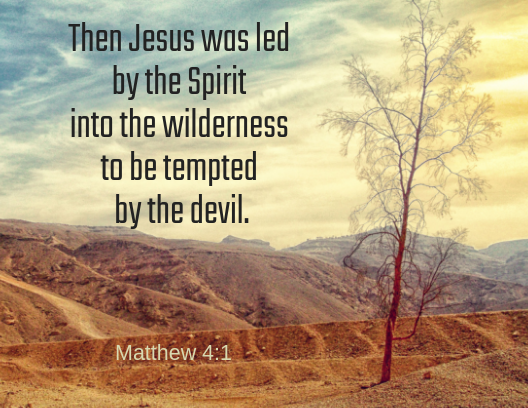
Perhaps, I should not be the one writing the devotion today. I am obviously not a specialist in standing up to temptation. I need an example to follow, I need to learn from a master – Ah, yes, thank God, He DID indeed provide the perfect example who longs to be my master. He gave us His human Son Jesus. And right after the baptism of Jesus, and right before Jesus begins his years of ministry, God’s Holy Spirit led Jesus, God’s own beloved, pleasing Son, into the wilderness where he fasted for 40 days and 40 nights.
As we are looking for clues on how Jesus faced temptation so successfully, there’s a couple great ones right there. Jesus was already open to and actively being led by the Spirit. What did God’s spirit want for him? That’s what He wanted too, even when it meant willingly going into a difficult, sometimes even dangerous space.
Compare Jesus’ location and circumstance with Adam and Eve’s when they were also confronted with choices to make. The first son of God was surrounded with God’s bounty and beauty and provision in the spectacular garden. Good, healthy, God-honoring fruit literally surrounded them when they instead listened to the deception of the serpent and chose to eat of the tree that God had already clearly said “No” to. Jesus didn’t use his harsh surroundings or difficult circumstances as an excuse to be weak. Instead, he found strength in using that time to fast and pray and draw closer to God which indeed made him even stronger and better prepared to face his adversary. Don’t get so comfortable in your pleasant surroundings that you become weak and don’t recognize temptation for what it is. Don’t fear the time spent in the harsh wilderness, but use the opportunity to cling closer and closer to what really matters – the God who is always there.
After the 40 days of fasting Jesus gives us the next big answer of how he faced each one of Satan’s three temptations in the wilderness – with the very words of God His Father, each and every time. In fact, the first Scripture Jesus quotes to Satan are strong words about the sustaining power from the words of God, and our need for God’s word, from the book of Deuteronomy: “‘Man shall not live by bread alone, but by every word that comes from the mouth of God.’” (Matthew 4:4) If we try to face temptation without the power of God’s word we will be weak. Matthew 4:4 is a great verse for me to remember today when I sit down to work on tomorrow’s devotion! Here’s a few more:
For the word of God is alive and active. Sharper than any double-edged sword, it penetrates even to dividing soul and spirit, joints and marrow; it judges the thoughts and attitudes of the heart. – Hebrews 4:12
Stand firm then, with the belt of truth buckled around your waist, with the breastplate of righteousness in place, 15 and with your feet fitted with the readiness that comes from the gospel of peace. 16 In addition to all this, take up the shield of faith, with which you can extinguish all the flaming arrows of the evil one. 17 Take the helmet of salvation and the sword of the Spirit, which is the word of God. – Ephesians 6:14-17
God’s word: read it, learn it, use it – and live (better and stronger today and also for eternity).
God’s word: neglect it, forget it, try to do life your own way – and die (but first, you will likely waste a lot of time, have a lot of self-made sorrow, and miss out on doing God’s will).
His Words are not just for gaining knowledge, they are for fighting temptation, finding truth, for making strong and giving life. Don’t miss out!
Let’s review what we have seen from Jesus about successfully facing temptation: Jesus was willing to be led by the Spirit. He used his time in the wilderness well. He fasted and drew closer to God. He recognized Satan for who he was. He discerned the lies and empty promises of the deceiver and actively chose what God said and promised instead. He wanted God’s will, not his own. He knew God’s Word. He used God’s Word as a sword to do battle against untruth, temptations and the tempter. He said, “Away with you Satan!” And he was victorious!
What about you? Do you know what temptations you face regularly? What do you crave? What do you covet? What are you jealous of? What leads you astray? What do you feel guilty about? Where do you lose self-control? What good do you neglect and why? How do you waste time? What do you say ‘Yes’ to that God wanted you to say ‘No” to? And, what do you say ‘No’ to that God wanted you to say ‘Yes’ to? What is Satan whispering in your ear or in your heart? What do you worship (with your time, money, devotion, or decisions)?
Realize you have choices, decisions to make. Big ones and little ones. It’s not just about not murdering your neighbor and not bowing down to carved idols. It’s also about how you treat the gift of the miraculous body God gave you. It’s about how you choose to spend the gift of the time God gives you. It’s about how you treat the people God surrounds you with. It’s about if you choose what you want, or what God wants.
And Satan (as well as the world and marketers today) can make the bad choice, or the selfish one, or the unhealthy one, look pretty good, that’s what makes it tempting. If it looked like the garbage it is, we would gladly turn from it. Don’t be fooled by the stone that looks like bread, the impressive view, and Satan’s promises.
God gives the perfect example of His Son. Follow that example – not mine.
God gives His Word, the Scriptures – the sword to do battle with the tempter. It worked for Jesus. I need to use it better!
God gives knowledge, wisdom and discernment – ask for it and use it.
God gives the spirit of self-control – that’s the one I want.
God gives forgiveness and new beginnings.
Prayer
Dear God – I am sorry. Please forgive me of the many times I fall to temptation. Help me do better, Lord God. Help me follow the example of your Son when I am in the wilderness and also when I am in the garden. Help me go where Your Spirit is leading. Help me forsake what I want and choose instead what You want, which is indeed the best for me. Help me see garbage for what it is, and turn from it to you and your gifts, again and again. I ask for wisdom and discernment to see what is from You and what are deceptions from the deceiver. Help me use your Word well to be strong against temptation. Thank you for your Word, your forgiveness, love and mercy and a new day to work at doing Your will better. Help me use all that you give me to stand strong against temptation. Thank you for the example and sacrifice of your Son Jesus. In his name we pray to You the Almighty. Amen.
Reflection Questions
Compare and contrast when Satan came to the garden and when he came to the wilderness? What similarities do you see? What differences? Is Satan still making visits? What does it look like?
Consider the paragraph of questions regarding what are temptations for you. What do you see about your own temptations? What temptations do you sometimes fall to?
Eating chocolate isn’t always a sin or temptation is it? But is it sometimes? When? Why? What makes the difference?
What scriptures can you find (and put in your home and in your heart) to help you face your temptations better armed with the Sword of the Spirit?
Have you ever tried fasting when facing a particularly difficult time of temptation?
It’s hunting season here in Ohio! All around the countryside, hunters are sneaking though the fields, climbing tree stands, and checking their trail cams. The deer are careful and on alert, listening and sniffing the air for the sign of trouble. Failure to sniff out the enemy can have deadly results for the hunted.
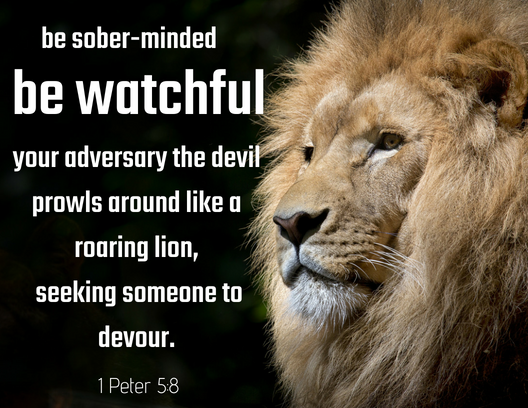
As Christians, we have to be on guard against temptations and situations that can cause us to fall away from the Lord God. 1 Peter 5:8 warns us to “Be alert and of sober mind. Your enemy the devil prowls around like a roaring lion looking for someone to devour”. Peter, in his letter to the Christians across Asia Minor (modern Turkey), has tried to encourage the believers to stand firm in the face of persecution. Instead of getting revenge or lashing out against people who have hurt us, Peter encourages us to rejoice in our sufferings and be thankful for the opportunity to do good to those who hurt us (1 Peter 3:8-12).
It is easy to want to strike back, to say something hurtful, or to defend ourselves. But God has a higher purpose in mind behind our suffering. He wants to shape and mold us into mature Christians. Sometimes, we have to endure hard times to allow that change towards maturity to occur. It is tempting to want to respond in kind to those who hurt us. We have to stand firm and resist the urge to take the bait!
Peter reminds the Christians that this is a sneaky trap, set by our enemy, the devil. We have to be on the alert, and watchful to avoid falling into the traps set by the enemy. Like deer trying to avoid the hunter, we avoid the traps of temptation by seeking to do God’s will. Peter asks us to be alert and sober minded. Resisting the temptation to lash out at our enemies or to hurt other people is not easy. But the more we resist, the easier it is to stand firm against the schemes of the devil. God wants us to trust Him. As we obey Him, He will “restore you and make you strong, firm and steadfast” (1 Peter 5:10).
2 Corinthians 7:1 “Therefore, having these promises, beloved, let us cleanse ourselves from all filthiness of the flesh and spirit, perfecting holiness in the fear of God.” (NKJV)
Devotion by Merry Peterson (Canada)
Do you remember the Sunday school chorus you may have learned when you were young that went something like this: ‘O be careful little eyes what you see, O be careful little eyes what you see. There’s a father up above who is looking down in love. O be careful little eyes what you see.’ This simple song with several more verses served as a reminder to us that what we take into our minds and what we allow our bodies to do can either lead us in good directions or bad directions and that God was looking down on us lovingly wanting us to make the best choices for ourselves.
There are bad directions we can go in that cause us to become filthy before God both in our inner spiritual life and how we outwardly conduct ourselves. In this verse we, like those first Christian believers, are being encouraged to pursue holiness in a world that is full of temptations that bring filthiness before God. In Corinth idol worship, temple prostitution and general perversion was normal in that day – all things that would be part of everyday life and could be a temptation to take part in unless you were of the new Christian faith.
Unfortunately, we live in a similar kind of culture today but the temptations are different. Today virtual reality, artificial intelligence interactions, violent gaming, tik-tok influences the whole pandora’s box on the internet present the most daily temptations to succumb to filthiness instead of pursuing holiness. Don’t get me wrong – you are reading this on the internet so not everything is an invitation to filthiness – congratulations on choosing to view something that will encourage you to pursue holiness! The Corinthians, and we, are faced with the same challenge. To pursue holiness. What does holiness look like in body and spirit anyway? Glad you asked.
Holiness means to be set apart – to choose differently. Part of holiness is choosing to fill our hearts and minds with the things that will draw us closer to the Lord and to use our bodies in ways that would be pleasing and honoring to him. A good way to keep your mind focused to pursue holiness is to follow Philippians 4:8 “Finally, brethren, whatever things are true, whatever things are noble, whatever things are just, whatever things are pure, whatever things are lovely, whatever things are of good report, if there is any virtue and if there is anything praiseworthy- meditate on these things.” If we follow this advice we are less likely to fall into the trap of allowing ourselves to become filthy before God in our thoughts and consequently our actions.
For Reflection:
Are there ways that I am allowing myself to be influenced towards pursuing filthiness before God instead of holiness? Are there habits that I should give up?
What plan can I put in place to help myself pursue choices that will help me to live a life that points towards holiness in choosing God’s best in my life?
Devotion by Pastor Jeff Fletcher – originally posted for SeekGrowLove on March 24, 2017, for Ezekiel 20-21.
In Ezekiel 20 God reviews Israel’s history. Over and over God provided for His people, over and over He warned them to get rid of their idols, keep His commands and observe His Sabbaths. Over and over Israel failed to obey God and experienced the consequences. Over and over God was compassionate and loving and forgave His people and restored them to blessings.
Israel has repeated this history again. They failed to get rid of idols, they failed to keep his commands and observe his Sabbaths, and now they were about to experience the consequences of their sins. God would once again treat them with mercy, not as their sins deserved and restore them to their land.
Ezekiel juxtaposes God’s promise to be merciful and restore His people with the threat that His judgment is coming and that both the evil and the good will be cut off from the land and the city and the temple. Yes, everyone will suffer the consequences of the evil behavior of some.
There is tension throughout Ezekiel. The wicked will suffer for their sins and the righteous will not suffer, except that at first they will suffer for the sins of others. Sometimes when God brings his judgment designed to bring people to repentance there is collateral damage. Good people suffer when bad people sin. It’s how it was then, it’s still how it is today. God’s salvation is coming, earth will one day be restored and made whole and good, but in the meantime, good people will suffer alongside the wicked. Christians are martyred in places like Pakistan and Syria. Christians sometimes suffer persecution in the United States. Trials may come to God’s people during times of judgment, but those who trust God and repent of their sins will be saved.
Reflection Questions
How often do we fall into the same cycle of disobedience that the Israelites followed for generations? What can be done to help break the cycle for you personally?
How does God’s mercy and justice coexist throughout Ezekiel and today?
What trials are you willing to persevere to avoid disobedience to God?
In Second Chronicles 22:10-12 we find the account of Jehosheba hiding her nephew, Prince Joash, when he was one year old so he is not murdered by his wicked grandmother after his father dies. Joash is hidden until he is seven years old when he becomes king, which will be included in some of next week’s readings. This is the kind of storyline we would typically find in fictional writings or movies.
Jehosheba is a hero of the Bible who saves a toddler from the evil schemes of a power-hungry authority. Consider how Moses was saved under Pharaoh’s reign, or Jesus during the time of King Herod. Even with this heroic act, we know little about Jehosheba. She was the daughter of King Jehoram and married the priest Jehoiada. These are two historical figures most people know little about. Her husband led a rebellion to instill the rightful heir of David to the throne in Jerusalem. Her father was so evil the Bible says that when he died it was to no one’s regret (2 Chron. 21:20).
I want us to consider this last fact, the daughter of a wicked king performed a righteous act that preserved the line of David. We all come from somewhere. I know some whose parents, although not perfect, may be considered by the Bible as ‘wise’ or ‘righteous’. They follow(ed) the ways of God and set a great example for their children. I am thankful that this is the experience I have. However, I also know some whose parents may be considered by the Bible as ‘foolish’ or ‘unrighteous’. They follow(ed) their own ways or the ways of the world, giving no regard to God, and setting a poor example for their children. This would have been the experience of Jehosheba. As she grew up she would have witnessed terrible things. It is very easy to follow the lead set for us by our parents.
As an adult, Jehosheba chose to do the right thing no matter the influence of others in her past. She made a choice to help rather than harm. She chose righteousness, not evil. It may be a challenge for us to move beyond the example set for us by others, even our parents, if that example was negative. However, we can see from the example of Jehosheba that we can do it. We can choose to help rather than harm. We can choose righteousness, not evil. Our past does not have to dictate how we choose to live today.
When we choose to do the right thing, it will often not look like saving a toddler from an evil Queen. This was Jehosheba’s heroic act, not ours. Sometimes our right action might be showing kindness to someone who hurts us. If our example in life has been returning an insult for an insult, then responding to an insult with kindness will be a great action! Sometimes our right action might be obeying the law, when others insist we break it. If our example in life has been disregard for authority and giving in to the pressures of bad influences, then responding with abiding the law and saying no to temptation will be a great action!
No matter our past, let’s look to Jehosheba as our heroic example!
-Michael Cisler
Reflection Questions
What other people from the Bible followed God more closely than their parents?
What are some of the ways in which they did this?
How could a person overcome some of the multi-generational dysfunctions that sometimes follow them into adulthood, and choose to live heroically instead?
But the Israelites broke faith in regard to the devoted things: Achan son of Carmi son of Zabdi son of Zerah, of the tribe of Judah, took some of the devoted things; and the anger of the LORD burned against the Israelites. Joshua 7:1 (NRSV)
As God promised, He led the Israelites to victory over Jericho. It is to be ransacked and destroyed, and there are to be none left alive, aside from Rahab and her family. There were specific items (gold, silver, etc.) that were taken from the rubble that were to be set aside and placed in the treasury of the house of the Lord.
After this great blessing of victory, one would assume that everyone would honor the directives of God and be obedient to him, but alas, we’ve been here before. Despite God proving himself time and time again to be a God of his word, both in blessing and in punishment, this knucklehead named Achan decides to take a heap of these goods for himself, and he buries them underneath his tent.
The stuff is hidden, there was so much of it, no one is going to know. The only one that this affects is him, and he’s going to keep it a secret. Maybe, eventually, it will just seem like this is some of the swag that was received from the Egyptians as they sent their ancestors out of Egypt. I don’t know what exactly was going through Achan’s mind, but I’m sure we’ve all been there, deceiving ourselves, justifying the stupid decisions that we have made to disobey or to take something that we have no business possessing.
As I sit here, I am reminded of an instance where one of my brothers took something that did not belong to him. This would have been sometime in the mid to late 90s and I’m a little fuzzy on some of the peripheral details. But we get home after a trip to the grocery store (Bohning’s in Ponchatoula, LA, I believe), and we discover that my brother has in his possession a whistle pop. After further investigation, it is discovered that he has many of them; in fact, he has a FULL BOX of whistle pops. At some point while we were standing in the check-out line, he grabbed the box off the candy shelf and shoved it under his shirt or down his pants. Now, I’m assuming that my mom took him back to Bohning’s to return it, as had happened when other contraband candy items had “shown up” in our house.
Now, a 5-year-old is not going to get arrested for petty theft and is probably going to get some sort of punishment for their misbehavior, but that action did not just affect him. There is embarrassment when a parent brings their child in to cop to a misdeed, apologize, and return the uneaten contraband. The stakes are low in this situation, but the principle is there: sin and error do not just affect the perpetrator.
Israel is feeling a kind of high as their God has just handed their enemies to them, and they are going to press forward into the land. They go make military advances on Ai, but they are driven back; they do not experience deliverance against their enemies; they are driven back and several dozen of their comrades fall to the enemy.
How? Why? Why would God deliver them a fortress and then allow them to fall to a less powerful fortification?
Because sin doesn’t happen in a vacuum. Sin affects everything. You don’t have to sin against someone for them to be affected; there are plenty of indirect effects of sin. We don’t have to go into a laundry list of sins, but different sins can cause us to behave and think in certain ways that harm others. Sin can lead to anger. Sin can lead to spousal abuse or neglect. Sin can lead to broken relationships. Sin can lead to more and more sins being perpetrated. Sin can break hearts. Sin can put a wedge between a person and God, and I’m not talking about the person that sinned.
Achan’s sin caused God to be furious, and he withheld his blessing and protection from Israel. Achan’s misappropriation of riches, which had nothing to do with the battle against the people at Ai, led to the loss of a battle. The sin affected all of Israel. In this case, Achan lost his life because of his sin.
So, if there is unrepentant sin in our homes, in our churches, in our relationships, and our individual hiding places, we can expect that it is going to affect others in one way or another. Sin cannot be reconciled with good. Jesus died to free you from sin, not to free you to sin. Yes, sin is crouching at our door; your enemy, the devil, is on the prowl like a lion to devour you with temptation that leads to sin (1 Peter 5:8). But when we sin, we are not to try to justify it or explain it away. I’ve cited it already this week, but here it is again:
“If we confess our sins, he is faithful and just and will forgive us our sins and purify us from all unrighteousness”1 John 1:9 (NIV)
Achan confessed his sin, but the damage had been done. He waited till he had been found out and others had suffered extreme loss due to his actions.
When we fall short, it is best to confess quickly before it becomes a bigger mess in our lives and the lives of those we love (or don’t even know).
-JJ Fletcher
Reflection Questions:
Why is it so easy to overlook God’s commands?
Is it difficult to read about the punishment for sin that is described in scripture? Does it lead you to a greater appreciation for the New Covenant in Christ’s blood?
What thoughts did you have on Achan’s sin as you read through today’s reading in Joshua 5-8?
Why is it easy to be blind to the way that our sin affects others?






 Seek Grow Love