Paul Preaching Jesus

Theme Week: Review of Paul – Acts 26

Old Testament: Ecclesiastes Intro (below)

Poetry: Psalm 49

            In the Movie, Forrest Gump, the titular character, Forrest Gump, met three different Presidents in the Oval office.  First, he met President Kennedy while a member of the All-American football team. He later met President Johnson to receive the Medal of Honor. Finally, he met President Nixon to receive an award for player of the year while on the national Table Tennis team.  Of course this was all fiction, but wouldn’t it be kind of cool to actually be invited to meet the president?

            As we review Paul this week, today we read in Acts 26 that Paul was given a chance to meet, not the president, but the King.  Paul appears before King Agrippa.  The back story is interesting and you can read about it in Acts 21-26.  Here’s the Cliff Notes version:  Paul came back to Jerusalem after his third missionary tour, he was accompanied by several people including some Gentile believers in Jesus.  Paul went to the Temple to offer a sacrifice of purification (he was still Jewish and did not want to be offensive to his fellow Jews).  The Jews who opposed Paul for being a Christian used this event as a chance to try to get rid of Paul and falsely accused him of bringing a Gentile into the temple.  Paul was arrested and given multiple trials in several different locations.  This gave him a chance to keep giving his testimony and preaching Jesus Christ in all kinds of high places including before the Jewish ruling court, the Roman Governor, the King of Israel and Paul hoped to ultimately be sent to Rome where he could preach the good news of Jesus Christ to Caesar. 

In today’s reading Paul is on trial before King Agrippa, but he’s using this as an opportunity to proclaim the Gospel to the King.  It’s no small irony that in trying to silence Paul and prevent him from preaching Jesus Christ, his enemies actually gave him a huge platform to preach Jesus Christ.

This reading is helpful in that it shows us an example of how Paul preached Jesus Christ.  He begins by drawing a point of connection between himself and his audience.  He begins by talking about those points that he and King Agrippa both have in common.  He shows respect to Agrippa.  I think this is so important, especially in today’s world where people are so divided and confrontational.  The person of God who seeks to share Christ should treat others with respect.  The only difference between you and an unbeliever is faith.  You may be the first one who is proclaiming Jesus Christ to another.  Don’t demean or put down your audience.  Show them respect.  Honor what truth they already have, even if it isn’t all the truth that you have.  Try to find areas where you can connect with them.  Attempt to build a bridge and not a wall.

Paul talks about his credentials as a faithful Jew who followed the Torah all his life.  He claims his past and who he was, and then he shares how God has brought something new into his life through faith in Jesus Christ.

-Jeff Fletcher

Reflection Questions

  1. What key points can be learned from Paul about how to preach Jesus Christ? Of those you list which is an area you you could use some experience or refinement?
  2. How well do you show respect to unbelievers? Why is it important? What happens when we don’t?
  3. How are your bridge-building skills? Think of a specific unbeliever you would like to have a conversation with about Jesus. How can you show them respect? What do you have in common already? What pieces of truth might they have that you can acknowledge? Why do they need Jesus? Why do they need you to tell them?
  4. Where has God placed you to share about His Son?

Ecclesiastes Introduction

Solomon (the teacher), the son of David wrote the book of Ecclesiastes to probe the meaning of life.  Solomon attempted to find fulfillment in every pleasure he could imagine – only to find that everything was meaningless.  He then pursued accomplishments, and found that they were meaningless as well.  In fact, without God, everything is utterly meaningless.

Most of the book is pretty depressing until we get to chapter 12, where Solomon finally revealed his insights in verses 13 and 14, “Now all has been heard; here is the conclusion of the matter:  Fear God and keep his commandments, for this is the whole duty of man.   For God will bring every deed into judgment, including every hidden thing, whether it is good or evil.

-Steve Mattison

Ring Out!

Old Testament: 1 Chronicles 19-21

Poetry: Psalm 146

New Testament: 1 Thessalonians 1

How often does the Lord’s message ring out from you? How often do you mention and talk about the return of Jesus Christ? Have you had the joy of seeing someone you told about Jesus telling others about Jesus even in the midst of trial and persecution?

Before we jump into 1 Thessalonians, let’s back up a minute to consider the city of Thessalonica, its church, and the missionary, Paul , who would be writing this letter to them. We know from Acts 16 that Paul had not necessarily planned to include this Macedonian (northern part of Greece) city in his second missionary trip. He had wanted to go into the province of Asia but was prevented from traveling there by the Holy Spirit. Then Paul received the vision at night of the man from Macedonia calling out for help – and Paul and his companions went right away.

First stop – Philippi, which ended with a jail stay with Silas, complete with a hymn sing, an earthquake and a saved jailer. It was time to move on. Next stop, Thessalonica. When Paul answers the call of the Macedonian man in his vision he answers big. Thesssalonica was the largest city, the capital city of Macedonia. It was known for its seaport as well as its major highway, commerce, wealth, and strong Greek (pagan) character which all combined together to create a booming city of sin. A city of sin in need of the message of Jesus. A city of sin in need of the message of Jesus and needing to know that Jesus is coming back.

Thessalonica did have the benefit of a Jewish synagogue and community with some God-fearing Greeks as well. So as was his custom, that is where Paul would start. Acts 17 tells that Paul spent three Sabbaths in the synagogue teaching about Jesus from the Scriptures. Some believed, others were jealous of this new missionary with a new message about the Messiah who had come once and would come again. They created a mob which you can read about in Acts 17:5-9 but the end result was that Paul and Silas fled from Thessalonica that night (sent by the brothers) and would travel on to meet and minister to the Bereans (who were more noble than the Thessalonians because they examined the Scriptures daily to see if what Paul said was true. Acts 17:11) Perhaps that daily searching in the Scriptures could be one of the reasons why we don’t have a letter or two from Paul to the Bereans in our New Testament?

Anyway, that’s the background information we are given on Paul’s ministry to Thessalonica. He likely hadn’t been there too long – perhaps only 3 weeks, perhaps a little longer -but he spent that time teaching them the Scriptures about Jesus. The newfound Christian church there would definitely see more persecution as those in the city had not only persecuted Paul while he was there but even sent agitators to Berea when they heard Paul was preaching there. They would not stop just because Paul was out of town. It wasn’t an easy town to be a new Christian in – maybe you can relate.

Fast forward a few months and Paul is now in the city of Corinth. In his first letter to them Paul would tell the Thessalonians he had wanted to come see them again and again to see how they were standing up- but Satan had prevented it. So, he did the next best thing – he had sent Timothy to go check things out. Timothy had just returned to Paul with overall good news about the church in Thessalonica, as well as a few things to iron out in their understanding and actions – and so Paul would take the occasion to write a letter to them – and thus we have the the book of 1 Thessalonians. What would he tell them that we should hear, too?

-In prayer, thank God always for those who are standing strong in the faith.

-To be one others will thank God for, your faith must produce work, your love must lead to labor, and your hope in your Lord Jesus Christ must give you endurance. How are you doing in those areas?

-Realize that God’s message is for all those loved and chosen by God – share it, don’t hoard it.

-People are imitating you – make sure you are imitating Jesus.

-Keep doing what Jesus (and Paul) would do – even in the midst of suffering.

-The Holy Spirit wants to see the message spread and gives power and joy when the message is received and welcomed.

-Let the Lord’s message ring out from you! Everywhere! Let your faith in God be known! Everywhere! (Pick a spot to start today – you can’t start with everywhere – but you can start somewhere.)

-Change! Turn away from your idols (self, pride, worldly attitudes and actions, sin) to serve the living and true God.

-God raised Jesus from the dead to rescue us from the coming wrath at the time of judgment. Wait faithfully for God’s Son to return from heaven. He wants to rescue you, but not just you.

It is a great time to note that each of the 5 short chapters in this letter from Paul to the church in Thessalonica will end with teaching and encouragement regarding the return of Jesus Christ – and why it makes a difference in how you live your life today. How will you live your life today because Jesus is coming back?

-Marcia Railton

Reflection Questions

  1. Does the Lord’s message ring out from you? If so, how and when? If not, what can – and will – you do to make it so, how and when?
  2. Who do you know who needs to be saved from wrath? Who may God be calling you to spread the good news to -perhaps its not who you were thinking of first? Ask God to show you who and how and have a stronger passion for sharing the good news. Remember – Jesus is indeed returning and it is closer today than ever before. Why is this important?
  3. How are your work, labor and endurance holding up? Do you need to fine-tune your faith, love and hope in order to see more/better work, labor and endurance?
  4. What do you love about 1 Thessalonians 1? It’s so short re-read it a couple of times today.

Are you Zealous for God?

Old Testament Reading: Exodus 22 & 23
Psalms Reading: Psalm 40
* New Testament Reading: Romans 10

Paul starts Romans 10 like he started Romans 9, wishing that Israelites would be saved.  He lamented in verses 2-4, “For I can testify about them that they are zealous for God, but their zeal is not based on knowledge.  Since they did not know the righteousness that comes from God and sought to establish their own, they did not submit to God’s righteousness.  Christ is the end of the law so that there may be righteousness for everyone who believes.”

Are you zealous for God?  If so, great!  But as Paul pointed out, zeal is not enough.  Do you try to establish your own righteousness (through rigidly following a bunch of rules or making up your own rules)?  That didn’t work out too well for the Israelites, and won’t work out well for you either.

Fortunately, Paul revealed what *is* needed in Romans 10:9-10, “If you confess with your mouth, “Jesus is Lord,” and believe in your heart that God raised him from the dead, you will be saved.  For it is with your heart that you believe and are justified, and it is with your mouth that you confess and are saved.”

This sounds too simple to be true, but it is.  We need to publicly proclaim “Jesus is Lord” – and live it, not just say it.  And we need to believe that God raised Jesus from the dead – not just head knowledge, but knowledge that will transform our lives.  If we do this, we will indeed be saved!  Praise God!

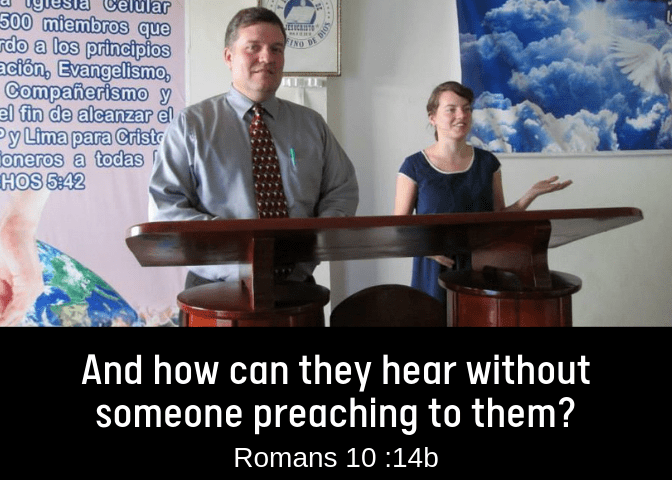
Since this is true, evangelism is critical!  Paul points out in Romans 10:14-15, “How then can they call on the one they have not believed in?  And how can they believe in the one of whom they have not heard?  And how can they hear without someone preaching to them?  And how can they preach unless they are sent?  As it is written, “How beautiful are the feet of those who bring good news!”

If we have the right relationship with God, we will have the love of God in our hearts.  And just as God doesn’t want anyone to perish, we too won’t want anyone to perish.  But how can people be saved if they don’t know about God and Jesus?  And how can they know unless someone tells them?  In the “Steve Mattison” translation, this passage pretty clearly says that you and I have a responsibility to tell others about the good news of the gospel, and you and I have a responsibility to send missionaries to tell even more people.  How are you doing with that?

A lot of people who dabble at Christianity need to get serious about going all in with God or quit pretending.  In Revelation 3:15-16, Jesus said, “I know your deeds, that you are neither cold nor hot.  I wish you were either one or the other!  So because you are lukewarm – neither hot nor cold – I am about to spit you out of my mouth.”

You may be wondering how does this apply to you?  I’m glad you asked.

Have you made a public confession that Jesus is your Lord?  If so, does your life reinforce or contradict that confession?

Do you believe in your heart that God raised Jesus from the dead?  If so, does your life bolster or refute that head knowledge?

Are you actively spreading the gospel and/or funding missionaries so they can spread the gospel?

-Steve Mattison

Reflection Questions

  1. See Above!
  2. What has God revealed about Himself today?

Sharing the Victory

1 John 5

Wednesday, October 19, 2022

One more song this week – 1 John 5:4-5 “for everyone born of God overcomes the world. This is the victory that has overcome the world, even our faith.Who is it that overcomes the world? Only he who believes that Jesus is the Son of God.”

Those two verses are the song, but verse 4 picks up in the middle of a sentence & thought, so backing up a couple verses:

This is how we know that we love the children of God: by loving God and carrying out his commands. In fact, this is love for God: to keep his commands. And his commands are not burdensome, for everyone born of God overcomes the world. This is the victory that has overcome the world, even our faith. Who is it that overcomes the world? Only the one who believes that Jesus is the Son of God.

When we have faith, we can overcome this world.  Our faith that Jesus is the son of God gives us victory and makes God’s commands not burdensome thereby helping us to keep His commands.  And by keeping His commands, we can love one another – the children of God.

Verse five is also a reminder that the victory is exclusionary.  Who overcomes the world?  Only those that believe that Jesus is the Son of God.  We have to strike a balance in our love for others.  Because if we love based on the world’s terms, we accept anything.  But to do that would not be love.  Because only those who believe that Jesus is God’s son overcome this world.  So if we in our “love” just leave our friends alone because we don’t want to make them feel uncomfortable, or we don’t want to feel uncomfortable, we put them in a position of not having that victory.  That isn’t real love.

We give a lot of reasons not to share the love of God with other people and I think fear forms the basis of a lot of it – fear of rejection, fear of being ostracized, fear of losing money/power, etc…

But when we read verses like this, we should be reminded that we have to push through that fear.  To show our love in actions (chapter 3), we need to share with others that while we have been separated from God, God provided an atoning sacrifice for our sins (chapter 4), and with this sacrifice, if we believe, we can overcome and have the victory (chapter 5).

And what is that victory?  As he wraps up his letter, John tells his audience – 13 I write these things to you who believe in the name of the Son of God so that you may know that you have eternal life. 

We need to believe in Jesus as the Son of God to be a part of that eternal life, and if we are loving others, we should be telling them so they can have that victory too.

~Stephanie Fletcher

Reflection Questions

1.”Who is it that overcomes the world?” (1 John 5:5a – see 5b for the correct answer). Who thinks they are overcoming the world? What are they missing? Do you fall into the overcoming category?

2. Who do you know who does not believe that Jesus is the Son of God? How can you truly love them?

3. What is the victory that you have to share? How would you explain it? How will you share it?

Imitate Those Who Inherit the Promises

Hebrews 6

Saturday, September 24, 2022

Do you have any Christians that you look up to? Lately I’ve been learning about a pastor named Tim Keller who has really inspired me. Much of his teaching is sound, and he is a great preacher. He is also incredibly successful at bringing Jesus to new people. He has grown his church in New York City (a rather hostile environment for Christianity) and has helped plant over 700 new churches in 75 cities all over the world through a church planting organization that he founded called Redeemer City to City. This to me is exactly what Jesus wants to see his church doing. When he said, “Go and make disciples of all nations,” he meant it, and this is what it can look like.

If you tried to take Tim Keller, or your local church’s pastor, and teach him about how to baptize, repent or pray for people, you would look silly. These guys have been around the block a time or two and they shouldn’t be relearning these basics of the faith. I think that is what is being said in Hebrews 6. It’s just inappropriate to take the first step of the faith and then keep taking it repeatedly, walking in a circle. Jesus has a mission, and once you have come to believe in him, your next steps should always be towards the fulfillment of that mission. That isn’t to say that these topics shouldn’t be taught, but rather they should be taught as a foundation for a new Christian and other beliefs should be built on top of them. However, strong condemnation is given to those who witness the works of the Holy Spirit and yet fall away from the faith. It says it is impossible to restore again to repentance. It also says that if land bears thorns and thistles then it is worthless and will be burned. Beware of people like this, who have seen the power of God and yet never take the next step, never bear fruit and don’t help further the mission of Christ.

Instead, be an imitator of those who inherit the promises through faith and patience. Imitate people like Jesus, who taught, healed and loved. Imitate people like those Christians whom you look up to. Imitate people who never cease spreading the gospel. These people have seen the promises of God and make every effort to give back to the one who loved them first. God has been making promises to mankind for a long, long time, and his promises are true. We see the promise that he made to Abraham to multiply him, and we see the fulfillment too, albeit long after Abraham may have thought it possible. That’s where patience comes into play. God’s timeline isn’t your timeline, but his promises are true just the same. Continue to imitate Christ in all things, since he is our forerunner, the one who goes out before us. Learn his ways and walk in them. He, after having suffered, entered into the Holy of Holies, the place where God resides, and there he prepares a place for us, too.

-Nathaniel Johnson

Questions for Reflection and Discussion

  1. Who has been a great role model for you in displaying faith and patience while waiting for what God has promised?
  2. What can you do today, and this week, to practice showing “diligence to the very end” (vs 11).

Preach It!

2 Timothy 4

Wednesday, September 14, 2022

A few of my children became very skilled at working the system: if I said no to their request, they simply asked Dad! It only took a few incidents for us to catch on, and from then on, my husband spoke an automatic reply: “What did Mommy say?” This, of course, would result in a frowning, drooping head as the child was forced to reveal Mom’s veto. “Then that is my answer too. We are one.”

As humans, we search for permission, validation, and affirmation from numerous sources. If we believe or want justification for (fill in the blank), we can usually find sources to confirm that idea, no matter whether or not the data are manipulated. Usually, we don’t even want to know the other side. 

I’ll never forget sitting in my college classroom as a nervous freshman, disagreeing with the biblical doctrine that was being presented as fact. Having strong beliefs to the contrary, I politely asked the professor a question about his belief that really didn’t make sense to me. Even though I believed his position was not true, I wanted to try to understand how he came to that conclusion. He was very polite in return, and we had a good dialogue as he allowed me to share my beliefs. I hoped that the discussion would spur my classmates to search the scriptures for truth as well, but my new friend behind me basically just said, “I’ve always been taught this, and I don’t really want to be confused with facts.” 

In 2 Timothy 4, Paul urges Timothy to keep on preaching carefully and patiently, always being prepared to correct, rebuke, and encourage. “For the time will come when people will not put up with sound doctrine. Instead, to suit their own desires, they will gather around them a great number of teachers to say what their itching ears want to hear. They will turn their ears away from the truth and turn aside to myths.” Though people will turn from their faith and seek affirmation of their erroneous beliefs and desires, He reminds Timothy to keep focused on his ministry and push through the challenges. 

I think Paul was aware as he penned this letter that his time in this life was drawing to a close. He pronounced in verse 7: “I have fought the good fight, I have finished the race, I have kept the faith.” What a powerful epitaph! I, too, want to be remembered in this way, don’t you? Paul continues in verse eight the hope that we share as followers of Jesus, awaiting the Kingdom: “Now there is in store for me the crown of righteousness, which the Lord, the righteous Judge, will award to me on that day—and not only to me, but also to all who have longed for his appearing.” Keep focused on the goal, my friends. The challenges we face will pale in comparison to the reward waiting for us in the Kingdom. 

Though Paul was left alone many times, deserted by his friends and co-laborers, he did not harbor unforgiveness toward them, nor lose hope. Instead, Paul focused on the positive: “But the Lord stood at my side and gave me strength, so that through me the message might be fully proclaimed and all the Gentiles might hear it. And I was delivered from the lion’s mouth. The Lord will rescue me from every evil attack and will bring me safely to his heavenly kingdom. To him be glory for ever and ever. Amen.” (verses 17-18) 

May the Lord also stand by you and give you strength as you continue to share in this most important work of the Gospel. 

-Rachel Cain

Reflection Questions: 

Consider your legacy, how you will be remembered, your epitaph. How do you want people to remember you, and what steps do you need to take to create such a legacy? 

What are some things that your “itching ears” want to hear? Are you focusing on the Bible and God’s truth to guide you, or the ways of the world? 

Rapid Spread

2 Thessalonians 3

Sunday, September 4

There is no doubt the last couple years have been in disarray. Mainly because of the Coronavirus. One of, if not the fastest, spreading viruses that has existed in the modern era. Since its unveiling, the world has shut down, economies have crashed, people have died and overall the world has changed. All because of one rapidly spreading disease.

I realized something today as I read the passage for today, 2 Thessalonians 3, if something so negative could change the world so much, why couldn’t something good change it even more. The first verse of 2 Thessalonians 3 reads, “Finally, brethren, pray for us that the word of the Lord will spread rapidly and be glorified, just as it did also with you;”

Now you may see where I am going with this illustration. If a disease can be so impactful why would the Gospel not be even more impactful? Since Jesus was revealed to us by God as the Messiah, the world has changed but for the better, and people are finding more life than ever with his message. We have an opportunity to spread the Gospel, and I know that it is way more beneficial to the world than some dumb virus. With the power of God I hope that you will remember to spread the word just as fast if not even faster than any disease that exists. It is ultimately the Gospel that wins in the end.

-Jesse Allen

Application

  1. Even the great evangelistic missionary Paul asked for prayers in spreading the gospel. Who will you ask to be praying for your efforts to spread the gospel? Who will you be praying for?
  2. What value do you put on the gospel message?
  3. What other instructions did Paul leave with the Thessalonians in this chapter?What were they to do with believers who did not follow these directions?

Even in the Face of Strong Opposition

1 Thessalonians 2

Monday, August 29, 2022

Yesterday, we read about how the Thessalonians turned from their idols to serve the one true God.  However, this caused some problems to arise for them.  Those around them still worshiped the idols and chose to persecute them.  But Paul has advice for them on how to continue to stand firm in their faith in the midst of all this opposition.


At the very beginning of the chapter, in the first two verses, Paul explains that they came to witness to the Thessalonians right after they had faced persecution in Philippi.  Paul says that in Philippi they faced much suffering and mistreatment.  He continues to say that in Thessaloniki they continued to face lots of opposition when they worked to spread the gospel.


Many people would have stopped after facing serious persecution in one city.  Many more would have stopped when they saw the opposition against them in the next city.  But Paul and his companions continued to spread the gospel throughout all these hardships.  By telling the Thessalonians about his problems, Paul encourages them by showing that it is possible, when you have God, to stand firm in the faith and to continue doing God’s will.  We should let this also encourage us because we know that Paul, in the midst of all the troubles of this world, continued to be one of the greatest witnesses to the whole world.


Paul continues by describing their attitudes in sharing the gospel, even while they were faced with persecution.  In verse 7, he describes themselves as “gentle among [them], as a nursing mother tenderly cares for her own children.”  Paul, later in verse 12, explains why they acted in that manner.  He says that it was “so that [the Thessalonians] would walk in a manner worthy of the God who calls [them] into His own kingdom and glory.”


In the midst of suffering and persecution, many people would have acted in anger against those who were causing this.  However, by doing this you are more likely to drive people away from God than you would be to bring them to Him.  But, when you act as Paul and his companions did, being gentle in the midst of persecution, you become an imitator of God, showing love to those who are your enemies.  Through this love, people will come to know God and walk in the way that God has called them to walk.


While this letter may have been written to the Thessalonians, it doesn’t apply only to them.  We also need to make sure that we are not letting persecution stop us from doing God’s will.  When we continue to do the work that God has called us to do in the midst of opposition, we need to make sure that we do it in the attitude of love and gentleness.

-Kaitlyn Hamilton

Questions for Reflection and Discussion

  1. What encouragement do you gain from hearing Paul’s testimony?
  2. Can you think of a time you faced opposition while spreading the gospel? Did it stop you – or did you continue, with God’s help? If you can’t think of a time you were spreading the gospel – how can you start now?
  3. Paul says, “We are not trying to please people but God, who tests our hearts” (1 Thessalonians 2:4 NIV). Can you say the same? Are there any areas where you slip into people pleasing mode rather than concentrating on what God wants to see from you? How does this relate to spreading the gospel?

Eternal Perspective

Philippians 1

Saturday, August 20, 2022

Philippians 1:10 – For I want you to understand what really matters, so that you may live pure and blameless lives until the day of Christ’s return.

Perspective is everything. As a junior high school science teacher, I got to teach students about galaxies within the universe and molecules and atoms; from the macro to the micro and everything in between. And what we learned is that depending on your perspective, your observations and conclusions may vary. 

It’s very easy (at least for me) to get wrapped up in the business of each day. Which means I sometimes lose sight of the bigger picture. What I appreciate about this specific letter from Paul to the church in Philippi, is that it’s a wonderful reminder to keep the most important things at the forefront of our thinking at all times. 

When we view life with an eternal perspective, instead of a right here, right now point of view, we are able to consider what really matters. Life becomes less about grabbing drive through dinner after a long day of work and more about being pleasant to the fast food worker. It becomes more about continuing to give to your family even though you’re exhausted from making tough decisions earlier in the day. It becomes more about being grateful and expressing joy because you’re making a difference in the lives of others. 

When we live with an eternal perspective it becomes easier to give even when we don’t feel like we have much to offer. It becomes more important to meet up with your neighbor to extend assistance for a need that they have when you understand the potential impact it might bring. It becomes a joy to worship, a pleasure to study Scripture, and a relief to rest in the shadow of our Rock when we are mindful that nothing is more important than seeking Him through whom all blessings flow. 

May today be your reminder to take some time to understand what really matters, so that you may live pure and blameless lives until the day of Christ’s return.

-Bethany Ligon

Application Questions

  1. What is most important to you?
  2. How does your life show what is most important to you?
  3. What situations cause you to forget your eternal perspective? How can you renew your dedication to the eternal perspective?

How Do You Save the World?

Tuesday, August 9, 2022

 Galatians 2

            The following story is based on a Poem by Loren Eiseley called The Star Thrower:

Once upon a time, there was a man walking along the shore. As he looked down the beach, he saw a human figure moving like a dancer. He smiled to himself to think of someone who would dance to the day. So he began to walk faster to catch up. As he got closer, he saw that it was a young man and the young man wasn’t dancing, but instead, he was reaching down to the shore, picking up something and very gently throwing it into the ocean.

As he got closer, he called out, “Good morning! What are you doing?” The young man paused, looked up and replied, “Throwing starfish into the ocean.”

“I guess I should have asked, “Why are you throwing starfish into the ocean?”

“The sun is up and the tide is going out. And if I don’t throw them in they’ll die.

“But young man, don’t you realize that there are miles and miles of beach and starfish all along it. You can’t possibly make a difference!”

The young man listened politely. Then bent down, picked up another starfish, and threw it into the sea, past the breaking waves. “It made a difference for that one!” https://starthrower.com/pages/the-star-thrower-story

            How do you save the world?  One starfish at a time.  That seems to be how God does it.  When you look at the history of salvation as revealed in the Bible, God often begins the work through a single person.  When God decided to create one special nation who would enter into a personal, covenant-based relationship with Him, He began with one man, a man named Abram (later Abraham).  God entered into a special bond with Abraham and promised to make him into a great nation that would eventually bring blessing to all the earth.  Abraham was the father of the nation of Israel, God’s chosen people.  Israel’s mission as God’s people was to be a light to all the nations of the world. 

            Israel struggled to fulfill that calling from God and became very inward-focused.  They elevated their unique relationship with God and emphasized their “set apart” status, worn as a badge of superiority.  They lost the mission imperative that God first gave to Abraham.

            God always had the heart to reach all people, not just descendants of Abraham by birth.  When the time came to expand his relationship with all humans and open the doors of salvation to the nations not descended from Abraham, God again started small.  Through one man, Jesus of Nazareth, God’s only begotten Son, God would open the doors of salvation to people from every nation.

            It was difficult for many of Abraham’s descendants to grasp that in Christ, God was extending his saving hand to all people.  One of the issues the early church wrestled with was “what is necessary for one who is not a descendant of Abraham, not from the nation of Israel, to do to become a member of God’s chosen people?”  The church agreed that they needed to be baptized into Jesus Christ and be obedient to Christ as their Lord and observe the basic commandments to not worship idols, not steal, kill, commit adultery or misuse the name of the Lord.  But still, for many of the descendants of Abraham who had lived separated lives, eaten special kosher food, and not shared meals with Gentiles, it was very difficult for them to imagine embracing those Gentiles, whom they had previously considered to be nothing better than dogs, as equals in the sight of God.

            While Peter, James, and the other Apostles continued to make their primary focus on sharing the message of Jesus Christ died and risen and coming again as King with their fellow Israelites, the Apostle Paul was called by God to bring that same message about Jesus to the Gentiles.  Through Paul’s preaching and missionary work, God’s kingdom was expanding to include people from every nation, and language on earth.  God made it clear to Peter in a vision that the dietary laws that they followed as Jews and the physical act of having all males circumcised were not to be a requirement for Gentiles coming into the Church.  You didn’t have to become a Jew in order to become a Christian.  But this did not sit well with many Jewish Christians who found it challenging to let go of those old prejudices and barriers.

            Paul’s letter to the Galatians was written to correct his fellow Jewish Christian and convince them to change their attitudes and practices in relation to Gentile Converts.  When they tried to make the Gentiles become Jews when they became Christians, Paul called this a “different gospel”.  They were creating unnecessary barriers to salvation.

            Do we today put up unnecessary barriers to salvation for people who are outside of the Church?  Sometimes we place our cultural preferences and traditions in the same category as the message of Jesus Christ and require others to jump through those hoops in order to be accepted into the Church.  When we create extra requirements beyond the basic teaching of the gospels and expect people to meet our cultural expectations in order to be saved, we are preaching a different gospel and keeping people away from Jesus and his saving love.

-Jeff Fletcher

Questions for Discussion:

1.  What can the young man in the Star Thrower teach us about going about the overwhelming task of rescuing the world from sin?

2.   What are some unnecessary barriers to salvation that you have observed in church or in your own witness to unbelievers?