Witnesses

Mark 16

Sunday, August 7, 2022

After numerous chapters devoted to preparing for the death and subsequent sacrifice of Christ, we finally reach the glorious reward of the Resurrection! Mark chapter 16, compared to the other gospels, is quite sparse in descriptive details of the Resurrection and Ascension of Jesus. However, what it does depict breathes a message of hope and love for the future of the church, as well as a final instruction.

               When Mary and Mary were given the message to tell the remaining disciples that Christ had risen, the disciples couldn’t believe it. “When they heard that Jesus was alive and that she had seen him, they did not believe it.” Mark 16:11. In fact, it seems like one of the things the disciples are best at is not believing something until they see it. They did not have faith that the thing they had been listening to Jesus predict for the past several years would come to fruition. Don’t worry because Jesus rebuked them for not believing when he found them again. Do you struggle to believe what Jesus has promised us? Sometimes it’s difficult to imagine a world where we all get along, where there is no longer pain. But without faith, we will never see this world; not because it won’t exist, but because we lack the faith to see it. Have faith!

               The final message Jesus gives the disciples is to “Go into all the world and preach the good news to all creation. Whoever believes and is baptized will be saved, but whoever does not believe will be condemned.” Mark 16:15. That is our grand mission! What are you doing today to increase the Kingdom of God? Some of us are not called to verbally preach the word, and some of us are blessed with such a gift. But not being good at public speaking is no excuse to not spread the word.

               Actions can speak significantly louder than words. In fact, that’s often the best way to spread the word; by living it out. To speak the message of Christ with empty words whilst living a life completely contrary is almost worse than to have never spoken a word at all. It is by watching the lives of those who follow Christ that we will be living examples of the love he provides us. In your joy, in your struggles, in your sadness, and in your blessings, praise God that you have been given this life to live. Focus on becoming the people that God has instructed us to become and devote your successes to Him. Live your life with the purpose of praising and worshipping Him, and He will reward you. As Christ commands it, do not simply speak the word; live it. Amen

-Mason Kiel

AND

2 witnesses are better than one! Today we have TWO writers for you – so below is your second devotion on Mark 16. Thank you Mason AND Jeff for writing for today. Keep sharing the good good news! Jesus is Alive!

            Have you ever been a witness who was called on to testify in court?  I have.  It was an interesting experience.  I had seen a crime committed, I reported it to the police, the criminal was arrested, I was asked to give a written statement to the police and I was later called on to testify at their trial.  I will say that when you witness something that causes excitement, gets your heart pounding, and puts you in “fight or flight” mode, it affects your thinking and perspective.  Everything seemed to be going faster than it really was.  Normally it’s more believable when several people give their eyewitness testimony.  Of course, no two witnesses agree on every detail.  Each person sees different things from different vantage points.  Each person remembers different details.  Each person recalls the sequence of events in a slightly different order.  These variations in detail are actually normal and good.  If every witness testified exactly the same details in the same way the lawyers for the other side would be arguing that they were unreliable because they obviously got together and rehearsed their testimony, which is a big no-no.

            When people read the Gospel accounts of Jesus they are seeing the story of Jesus unfold through the eyes of a variety of different witnesses.   The Spirit of God is the inspiration behind each of the writers, but God works through human beings and through different witnesses.  So it should come as no surprise when we read the four Gospels, Matthew, Mark, Luke, and John, and also the writings of Paul, Peter, James, and others, that while they are telling basically the same story, they do so from different perspectives.  The Gospel writers are either reporting what they themselves witnessed or what other eyewitnesses reported to them.  They tell the same story with different perspectives and often emphasize different parts of the story or place the events of the story in slightly different orders in keeping with the overall theme of their account.  Each story has different audiences in mind, different themes, and is not carbon copies of each other.

            One very important rule that is repeated throughout the Bible is that there must be a minimum of two or three witnesses. (See Deuteronomy 19:15, Matthew 18:16, John 8:17, and several other passages).  We’ve already noted that there are four Gospel accounts in the New Testament which fulfill that important principle.

            It is also interesting to note the background of who is qualified to be a witness.  Jewish law has a list of different types of people who are not permitted to be called as witnesses: “women, slaves, minors, lunatics, the deaf, the blind, the wicked, the contemptible, relatives, and the interested parties (Yad, Edut 9:1).” https://www.jewishvirtuallibrary.org/witness .  The Talmud, which is a Jewish Commentary from ancient times gives more details about who the “wicked” are who cannot testify.  At one point in ancient Jewish history, shepherds were included in the list of people disqualified from witnessing. “As a class, shepherds acquired a bad reputation as being lawless, dishonest, and unreliable, above all because of their habit of trespassing on other people’s lands to graze their flocks.” https://www.churchtimes.co.uk/articles/2015/20-february/regulars/out-of-the-question/shepherds-character-reference.

            Here’s what I find very interesting: two categories of people who were not permitted to act as witnesses were shepherds and women.  I’m not interested in debating the fairness of those exclusions, but simply note that at the time of Jesus’ birth, life, and death, some of the people who were not accepted as reliable witnesses were shepherds and women.  Why is this important? Consider, who were the first eyewitnesses who heard the angelic announcement about the birth of Jesus?  Luke says it was “Shepherds living out in the fields keeping watch over their flocks at night” (Luke 2:8).  It was to these “unreliable witness” shepherds that the angels appeared.  And it was these unreliable witness shepherds who went and reported to Mary and Joseph all that they had seen and then went out and “spread the word” about all that they had seen. (Luke 2:17)

            Now, maybe that was just a fluke… but maybe not.  In today’s reading, Mark 16, we fast forward to just after the death of Jesus.  Who is it who first go to the tomb after Jesus died?  Once again, it was to “unreliable witnesses” – this time it was women.  To whom did the angel appear announcing that Christ had risen?  “Unreliable witness” women.  Maybe it wasn’t a fluke after all.  Maybe it’s a part of God’s deliberate plan to choose people to be witnesses of these important saving acts of God, which the world normally rejects.  Does God choose to reveal His great acts of saving to the lowly people the world rejects?  It seems He does.  In fact, now that you know to look for it, pay attention when you read the Gospels and notice how many times the witnesses God uses come from the ranks of the supposed “unreliable witnesses.”  How many times does God use women, or tax collectors (another category of unreliable witness) or slaves, the blind, the deaf, or just plain sinners to be His witnesses?  You’ll find that from beginning to end, the Gospel is filled with “unreliable witnesses” who turn out to be very reliable.  And in a giant flip-flop of societal expectations, it is the lawyers and religious professionals from the reliable witness class who are the ones who bring false charges against Jesus.

            But the real question that each of us needs to ask ourselves today is, am I a reliable witness for Jesus?  Am I willing to tell the truth about what I have seen, heard, and known firsthand about Jesus in my own life?  Am I willing to tell “the truth, the whole truth, and nothing but the truth” about Jesus?

-Jeff Fletcher

Questions for Discussion:

  1.  Why do you think God chose “unreliable witnesses” to be the witnesses to Jesus’ birth and resurrection and other key events?
  2. When was the last time you told someone else “witnessed” what you have seen,  heard, or experienced about Jesus?
  3. Who is someone whom you could witness to today?

Training for a Crown

1 Corinthians 9

June 10

Do you not know that in a race all the runners run, but only one gets the prize?  Run in such a way as to get the prize. (1 Corinthians 9: 24)

Being competitive is sometimes presented in a negative light.  Probably because competition can bring out the ‘jerk’ in people.  That’s too bad, because in his letter to the Corinthians, Paul is telling them (and us) to lean into that competitive spirit.

Paul is using this as an analogy, by the way, he’s not telling us that we are in competition with other believers.  He uses two phrases that I hope will inspire you as you run your race.

“strict training”

Athletes preparing for a big competition don’t eat whatever they want and binge Netflix all day.  What do they do instead?  They do things that will help them succeed in their goal.  (Winning!)  Paul’s goal, and ours, is “a crown that will last forever.”

How do we train for eternal life?

The word obey comes to mind.  In order to obey we need to really know Scripture.  If we want to hear the words “Well done, good and faithful servant,” we need to know what the Master expects of us.  And we need to do it, even when it’s hard.  Just like the athlete in training gets off the couch and goes to practice, even when he’s tired, we need to obey even when it doesn’t make sense to our human sensibilities.

“do not run aimlessly”

If you’ve ever been to a kid’s sporting event, you know that there are players that do not have their head in the game.  They are wandering around the field, chatting with friends, maybe even picking flowers in the grass.  Adorable.

Not so adorable when it’s adults in an Olympic competition and not cute when we’re talking about forever.

So many of us say that we are sharing our faith by the way that we live our lives.  But how much of that is a cop-out because we’re not comfortable evangelizing?  If we are actively sharing our faith through our life, we will be intentional in planning ways to do it.  We won’t just be going about our life, wandering aimlessly along.

I encourage you today to make a training plan.  How are you getting ready for Christ’s return?  I also encourage you to make a game plan.  How are you looking for ways to share your faith with those around you?

-Susan Landry

(Editor’s Note: Sorry this was sent out later today. It’s been fun hearing from a variety of writers this week, but today’s scheduled writer ran into a health issue and was unable to write. So, we went back in time and found this great devotion from 2019 – thank you, Susan – definitely good enough to read again. God bless you as you Seek, Grow and Love!)

Questions for Reflection and Discussion

  1. How often do you remember that you are training for a crown that will last forever? If we remembered this more often how might it change our hearts, our schedules, our free time, our priorities, our training routine? What could you do differently this week, remembering the goal of your training and perhaps making it a little more “strict” than it has been lately?
  2. Are there any ways in which God may say you have been running aimlessly? What adjustments do you think Paul would suggest? Are you willing to do them?

A Scary Word

1 Corinthians 2

June 3

Here at the Oregon church we have really been focusing on evangelistic outreach. No other word puts quite the fear in the heart of a Christian like the world evangelism. There are many anxieties that come with the idea of evangelism: sharing the good news of Jesus Christ. There is the fear of rejection. There is the worry that you might look foolish. There is maybe a concern that you won’t say the right things. Maybe there’s a worry that you don’t know enough about the Bible and therefore you aren’t qualified to reach out to people about Jesus and the kingdom. There is just a lot of worry that goes into it.


A lot of the fear and anxiety that comes from sharing the good news of Jesus Christ with people is that we can make it about us. Look above at what was said about the fear of sharing the gospel: every fear and anxiety that was mentioned about sharing the gospel is because we focus on how it affects us. We make it about our rejection, or our feelings or our knowledge. God has made the gospel so simple and yet we can be so afraid of it. And when I say we are afraid, I’m talking about me too. Just because I’m a pastor doesn’t mean that I don’t have fear and anxiety about sharing the gospel. You don’t need a PhD in theology to share the gospel with people. You don’t need to have a deep understanding of Levitical dietary laws, or a complete understanding of ancient Greek. The gospel was made understandable so that no matter who we talk to they can grasp it. We tend to make it more complicated than it has to be.


Paul makes this very point in 1 Corinthians 2. He says: “And I, when I came to you, brothers, did not come proclaiming to you the testimony of God with lofty speech or wisdom. For I decided to know nothing among you except Jesus Christ and him crucified. And I was with you in weakness and in fear and much trembling, and my speech and my message were not in plausible words of wisdom, but in demonstration of the Spirit and of power, so that your faith might not rest in the wisdom of men but in the power of God” (1 Corinthians 2:1-5).


Paul was an extremely well educated man. He was well studied and well read. He knew the Hebrew Bible in profound detail. He was someone that could have really made the gospel presentation more complicated than it should have been. But instead of making a mess of things he says to the Corinthian church that he didn’t come with lofty speech or wisdom. He decided to know nothing besides Christ and him crucified. What Christ accomplished on the cross is of chief importance. Christ died as a substitute for you and me and he rose on the third day. He did this so that one day we can be in the kingdom of God forever. The components of the gospel are easy to remember this way: the kingdom, the cross and the resurrection. The other doctrines of the Bible are important but only believing the gospel is what saves us. The good news of the kingdom of God and our entrance being purchased by the death and resurrection of Jesus is what matters above all else.


Paul continues in the section by saying that we don’t use lofty wisdom and persuasive arguments in order that we aren’t relying on the wisdom of man. Wisdom is important, but ultimately the best and truest wisdom comes from God. The gospel is simple in order that we can fully rely on the power of God to work through us to share to those around us. God is saving the world through His gospel and we should want to be a part of that.


We don’t need to make the gospel more complicated than it is. The simple message of the death and resurrection of Jesus purchasing our gift of eternal life if we believe in him is as easy as it gets. Sharing the gospel doesn’t have to be scary either. It comes from the concern and urgency of wanting people to be in God’s kingdom. It comes from the outpour of our lives as a demonstration of the saving power of God working wondrously through us. Let’s choose to know nothing but Christ and him crucified and share that to a hurt and broken world. Let’s be the people that God works through to reconcile His creation back to Himself.

-Nathan Massie


Application:

  1. To remember that the gospel has been made simple so that we can share with everyone: the kingdom, the cross and the resurrection.
  2. To realize that God is the one who is working through us to share the gospel to the world. It’s His power and not our wisdom that makes the gospel effective.
  3. To realize that the gospel is the power of God and it is of chief importance since believing the gospel is what saves us.
  4. To pray about our anxieties and fears about sharing the gospel and to ask God to give us the strength to share even when we are afraid.
  5. To recognize that when we share the gospel we are making an eternal difference in the life of the hearer.

With All Boldness

Acts 28

May 16

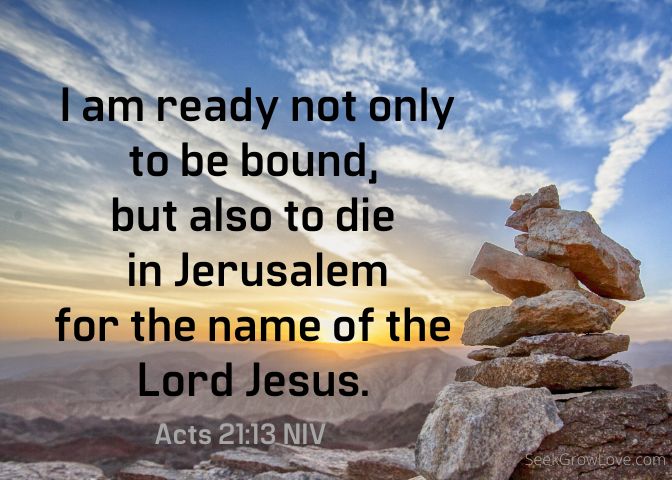
In Acts chapter 28, Luke continues the detailed account of his and Paul’s journey to Rome. We read about their encounter with the kind people of Malta, as well as the not-so-kind viper who didn’t seem to cause Paul much distress, all the way to their long awaited arrival in Rome. This arrival was a big deal. Paul had been determined for a long time to find his way to Rome, (as seen in Acts 19:21 and Romans 1:15) and not only fulfilled this promise to himself, but also Christ’s prophecy that his disciples would be witnesses to the ends of the earth (Acts 1:8). 

Paul spent every bit of his time there (two years waiting for his case to be heard before Caesar) teaching everyone who came to him, sharing the message with Jews and Gentiles alike, welcoming anyone who would listen. Two whole years “proclaiming the kingdom of God and teaching about the Lord Jesus Christ with all boldness and without hindrance.” (Acts 28:31) Even in this season of waiting and uncertainty, God did not waste a minute of Paul’s time. In fact his ministry continued “without hindrance” – despite every trial they faced, from storms to snakes, the will and word of God was unhindered; no trial, no amount of unfair treatment, nor the passing months of captivity mattered as much as the immeasurable good Paul could be doing in the lives of others. Imagine the amount of soldiers he spoke to, the amount of brothers and sisters in Christ he met in Rome, every Jew eager to meet Paul, whose famous letters they had previously received, every Gentile curious about or zealous for Christ, and eventually Caesar himself. He made a profound impact, even while in chains.

The book of Acts doesn’t have a grand finale; this story continues even today. Paul said “Yes” to God time and time again, and every person who’s said “Yes” since continues his ministry, bringing the Kingdom message to the ends of the earth. Surrender your life and boldly say “Yes” when you hear God’s voice calling you; His plans will not be hindered. 

-Isabella Osborn

Discussion Questions:

  1. In what ways can you proclaim the kingdom of God even when you find yourself in a period of trials or uncertainty?
  2. What do you hear God calling you to do to further His Kingdom today? 
  3. How did Paul continue forward with such courage and boldness despite the many tests of faith he faced? Similarly, how can we?

Your Story

Acts 22

May 10

A personal story is an effective way of connecting with others, often opening doors to intimate conversations.  I often felt that I was missing out on something by not having a “come to Jesus” moment to tell others.  Raised in church, I knew right from wrong.  Though I didn’t always choose wisely, I never veered too far from the path.  What’s encouraging about that?! 

I found some pointers for writing a faith story…

Think about your life before your baptism.  What was missing? 

What did you do to feel fulfilled and accepted?       

What led up to your decision to be baptized? 

Was there a person, event, scripture that opened your heart?        

How has your life changed? 

How is God meeting your needs? 

What is your relationship with God today?

And this tip from 1 Peter 3:15-16 “Always be prepared to give an answer to everyone who asks you to give the reason for the hope that you have. But do this with gentleness and respect, 16 keeping a clear conscience, so that those who speak maliciously against your good behavior in Christ may be ashamed of their slander.”

-Annette Osborn

Questions for Reflection and Discussion

  1. See questions above… 🙂
  2. Who do you personally know who could benefit from hearing your story? How will you make opportunities to tell them?
  3. How can you share your story (or pieces of it) with others beyond your closest friends and family? When? Where?

One Goal

Acts 21

May 9

Unlike many Jewish leaders, James and the elders were not jealous of Paul’s success among the Gentiles.  But they were aware that not everyone was so accepting.  To head off problems, the elders asked him to pay the costs of men completing a vow.   Likely a Nazirite vow, this voluntary, temporary commitment to total dedication to God required extensive sacrifices, including a female lamb, a male lamb, unleavened bread, loaves of bread, crackers, oil, and a grain and drink offering.   

Paul wasn’t buying acceptance. In 1 Corinthians 9 he writes “19 Though I am free and belong to no one, I have made myself a slave to everyone, to win as many as possible. 20 To the Jews I became like a Jew, to win the Jews. To those under the law I became like one under the law (though I myself am not under the law), so as to win those under the law. 21 To those not having the law I became like one not having the law (though I am not free from God’s law but am under Christ’s law), so as to win those not having the law. 22 To the weak I became weak, to win the weak. I have become all things to all people so that by all possible means I might save some. 23 I do all this for the sake of the gospel, that I may share in its blessings.”  He had one and only one goal….to win others to Christ.  Let’s be as focused as Paul.

-Annette Osborn

Questions for Reflection and Discussion

  1. If people who knew you were to guess what your main goal was, what might they guess? Would they be right?
  2. How have you become “like others” (while remaining true to Christ’s law) in order to be able to share the good news with them?
  3. What group(s) of people would you want to be accepted by, so that they are willing to hear from you about Jesus Christ? How can you go about this mission?
  4. What was Paul willing to do, and willing to give up, in order to reach more people with the saving gospel? What are you willing to do, and willing to give up, for the same purpose?

So Much to Share

Acts 20

May 8

Paul has so much to share and so little time to share it.  His ministry has taken him from Ephesus to Macedonia, to Greece, to Troas.  It’s a farewell tour.  He preaches all night, knowing it’s his last chance to convey the essentials of salvation.

I’m struck by the caring urgency that Paul has.  He’s spent weeks (even years) with these people and developed relationships.  Shared joys and sorrows.  He wants to be sure they “get it”; the truth of the kingdom of God.   The shared hope of eternal life binds us together over time and distance.

Blessings abound when God’s people gather.  Whether for a long weekend at a retreat, a few days at a camp or a conference, we build friendships that last. “What grieved them most was his statement that they would never see his face again.”  We’ve all experienced that pang of parting.    But oh the joy of knowing we WILL see each other again as we reign with Christ in his glorious kingdom.

Feel the urgency!

-Annette Osborn

Questions for Reflection and Discussion

  1. What do you most admire about Paul?
  2. What attachments have you made to Christian brothers and sisters that have bound you together through time and distance?
  3. How would you rate your “Caring Urgency”? If it’s a little low, what can motivate you to bump it up?

Scatter and Preach It

Acts 8

April 26

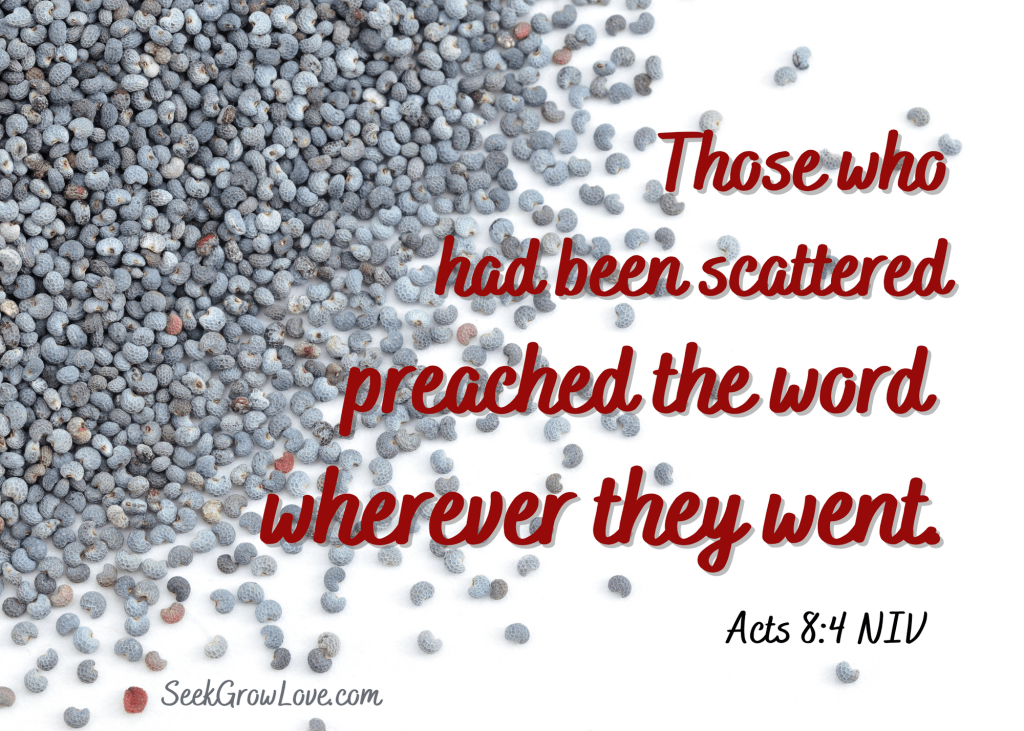
Acts 8:4 – Those who had been scattered preached the word wherever they went.

I once went on a mission trip that included an evening of street evangelism. It was one of the most overwhelming and intimidating experiences I’ve had. For some people, walking up to strangers and asking them “How’s your relationship with God?” is exciting and effortless. For me, it was incredibly awkward – I stumbled over my words, I felt panicked and I just wanted to run back to our bus. 

As I read through Acts chapter eight, verse four caught my attention. My imagination runs wild with scenes of the disciples speaking with random people at the market, or attending a synagogue to share the radical gospel of Jesus Christ, or even standing at the center of the town square and preaching to anyone and everyone who passes by. 

I don’t think that I would employ similar evangelism tactics as the disciples did back in the day or even as some continue today in our modern culture. 

For me, it’s about building authentic relationships with others. Getting to know others and letting others get to know me. And while this is much more in my zone of comfort, I still sometimes get hung up on how much I share with others about my faith. I greatly admire people who seamlessly weave the gospel into their daily conversations with others. It’s an area of growth for me, I know. But if I genuinely care about others, I must get over my own insecurities in order to share the best news of all – the gospel of Jesus Christ and the kingdom of God! 

We have been scattered into the workplace, schools, community organizations, as well as our online associations with others for a purpose. Let’s not waste the opportunity to preach the word wherever we are!

-Bethany Ligon

Questions for Reflection and Discussion

  1. Why share the gospel? Is that just a preacher’s job?
  2. How would you rate yourself when it comes to how often or how well you share the gospel? If you want to improve in this area, what 2-3 specific steps can you take?
  3. Consider your circles (work, school, family, church, community & online). How can you share God’s love, what Jesus means to you and your kingdom hope in each of these circles?

Come and See

John 1

March 29

There is so much theology, hope, and amazing insight we could unpack from John chapter one, but I want to focus on a detail that is perhaps overlooked. At verses 35 and 36, we see that John the Baptist saw Jesus and shouted, I’m sure with plenty of excitement, “Behold, the Lamb of God!” There were two of John’s followers with him. One was Andrew, Peter’s brother. Out of joy and wonder, the disciples rushed toward Jesus and wanted to know where he was staying for the night. Jesus’ response was simple, inviting, even a little odd, “Come and you will see.” Keep that interesting response in mind. 

Later in verse 45, we see a conversation between two of Jesus’ disciples, Philip and Nathanael. With excitement, Philip is breaking the news that the promised one that Moses spoke about long ago is actually here, his name is Jesus, and he comes from Nazareth! By the way, Nazareth was a very small village that was looked at as a run down place where nothing exciting or important happened. That is why Nathaneal responds the way he does: “Can anything good come out of Nazareth?” How does Philip respond? “Come and see.” 

Now, I want to come back to both Jesus’ response earlier and Philip’s response to Nathanael. Jesus was just starting his ministry on earth. He knew that he needed to grow a following of people so that they could observe the things he taught and the way he lived. Jesus just met two strangers; he could have told them to stay somewhere else and come back and see him tomorrow. Instead, we see Jesus taking every opportunity he could to invite people into his life for one main purpose: so they could see what it truly means to be made in the image of God. We also get to see how Philip used this approach with Nathanael. Philip is evangelizing to his friend and he is met with skepticism. Rather than trying to make sure he had the right wording or seeing if he could win the debate about whether or not anything good can come from Nazareth, he decided to simply let the power of God, through Christ, speak for itself. “Come and see”.

That simple response speaks to the heart of how we should tell the gospel to those around us. We often are nervous when it comes to evangelism, because we too often try to sell the gospel to people rather than having the gospel sell itself! We need to remember that it is God who gives the increase, not ourselves. Rather than trying to come up with the perfect strategy, we simply need to bring people to the spot where they can “come and see” the incredible things God is already doing. I promise you whatever God has planned will be better than what you have planned. Do what Jesus did and invite people into your life in hopes they can see the Kingdom. Do what Philip did by pointing people towards the One who actually is worth seeing. The Kingdom seed’s growth is not dependent on you, but on God. All we need to do is ask others to “come and see.”

-Isaac Cain

Questions for Reflection and Discussion

  1. How can Philip motivate you? Did he wait to introduce Nathaneal to Jesus until he knew all the details and could quote every sermon of Jesus’ backwards and forwards? How can you do the same as Philip with enthusiasm and urgency?
  2. Who do you know who needs to meet Jesus?
  3. Specifically how can you invite people into your life with the purpose of introducing them to Jesus and His Heavenly Father?
  4. Don’t wait to make the introductions until you know everything there is to know about Jesus – but how can knowing more about who He is excite you into action and evangelism? What can we find out about Jesus in this chapter – what names and titles is he given? What is the meaning of each? Does this sound like a person the world (and our family, friends and neighbors) should get to know?

Not Fair!

Matthew 20

January 20

That is not fair!

Have you ever found yourself saying this very same thing? A coworker or classmate does not seem to be doing their share of the work but they get the same pay or grade as you, maybe even better. Maybe you say it when nothing seems to be going your way; car troubles, relationships fractured, bad grades, your sanity cracking. We all experience situations that make us want to scream at what we perceive as an unjust life.

But what makes one thing fair and another unfair?

In Jesus’ parable of the workers in the vineyard, everyone was paid the same. Is that not fair? The first workers agreed to a set amount, reasonable pay for a day’s labor. The other workers only agreed to work for what was right. They left it to the discretion of the landowner. In his generosity the most recent hires received what he had promised the original workers. Those who were hired first said nothing as the landowner began to dole out the money. Because of his generosity towards the newer workers, they expected more.

And that is the key concept that strains so many aspects of our life; what we expect. Our expectations make it difficult sometimes to see God answering our prayers or His hand actively working in our lives. Our expectations may set us up for failure in our schools, our jobs, our relationships with one another, and certainly in our relationship with God through Jesus. If our expectations are not met then, “I guess I did not really need to learn that,” “It will not matter in the ‘real’ world,” “I will just find a new job,” “I do not need anyone else.”

Our expectations, our limited understanding of all that is makes us think that God must have failed to answer our prayers, He is not here with us, He does not care. The reality is that could not be farther from the truth! God loves us all! He is with us in every moment but rarely how we would expect.

This parable has a double lesson to teach. The first is that God is just. God alone rightly discerns what is fair and unfair. The wages of sin is death (Romans 6:23). If we truly want life to be fair, we would all be dead the first time that we sinned. If that were the case, I doubt that humanity would exist and we would not even be here to debate the fairness of life.

God’s justice is tempered by His abundant love. In His love for us He is merciful and forgiving. Those who come to God through Jesus, will all receive the same wage when the days are done: eternal life and citizenship in God’s Kingdom, to be called His children!

This message is reiterated as Jesus addresses the request of James and John’s mother. They have an expectation of their place in God’s Kingdom and their mother wants assurance that it will be so; after all they were among the first disciples to be called by Jesus. Jesus answered this question through the parable before it could even be asked, and still it was asked.

The second lesson to learn from the parable takes us to Matthew 9:35-38 and 28:18-20. We are the workers, called to go out into all of the world and make disciples of all the nations. We have been given a task, a responsibility, a privilege to live our life for God and preach the Good News of His Coming Kingdom so that everyone would have the opportunity to choose to come to Him through Jesus, our savior!

This is not easy but it is immensely satisfying. What we do and say here in this age can open people’s eyes to see the glorious future our amazing God has planned for all who enter His vineyard. We may never give the physically blind back their sight but thanks to God’s love and power we can heal the spiritual blindness of those we encounter each day. Rely on God’s power, His plan, and His will. Trust in Him with all of your heart, soul, and mind and rejoice in knowing that the God of all creation will wipe away your tears and call you son or daughter!

-Jeff Ransom


Questions for Reflection and Discussion

  1. What are your expectations of God as you pray? Do you have a preconceived notion of what an answered prayer looks like? Can you think of times when you missed His answer initially only to see it later on?
  2. Do you see circumstances in your life as being unfair? Think about how they might be helping you to grow stronger in your relationship with others and especially with God through Jesus. It is difficult sometimes but how can you turn your view of these circumstances around? Our response to situations is often more powerful than the situation itself.
  3. What does your work within the vineyard look like? How are you working to spread the Gospel message of salvation through Jesus and the Coming Kingdom of God? Is there someone specific that you can think of who is blind to God’s love? How can you help them to finally see?