Not Fair!

Matthew 20

January 20

That is not fair!

Have you ever found yourself saying this very same thing? A coworker or classmate does not seem to be doing their share of the work but they get the same pay or grade as you, maybe even better. Maybe you say it when nothing seems to be going your way; car troubles, relationships fractured, bad grades, your sanity cracking. We all experience situations that make us want to scream at what we perceive as an unjust life.

But what makes one thing fair and another unfair?

In Jesus’ parable of the workers in the vineyard, everyone was paid the same. Is that not fair? The first workers agreed to a set amount, reasonable pay for a day’s labor. The other workers only agreed to work for what was right. They left it to the discretion of the landowner. In his generosity the most recent hires received what he had promised the original workers. Those who were hired first said nothing as the landowner began to dole out the money. Because of his generosity towards the newer workers, they expected more.

And that is the key concept that strains so many aspects of our life; what we expect. Our expectations make it difficult sometimes to see God answering our prayers or His hand actively working in our lives. Our expectations may set us up for failure in our schools, our jobs, our relationships with one another, and certainly in our relationship with God through Jesus. If our expectations are not met then, “I guess I did not really need to learn that,” “It will not matter in the ‘real’ world,” “I will just find a new job,” “I do not need anyone else.”

Our expectations, our limited understanding of all that is makes us think that God must have failed to answer our prayers, He is not here with us, He does not care. The reality is that could not be farther from the truth! God loves us all! He is with us in every moment but rarely how we would expect.

This parable has a double lesson to teach. The first is that God is just. God alone rightly discerns what is fair and unfair. The wages of sin is death (Romans 6:23). If we truly want life to be fair, we would all be dead the first time that we sinned. If that were the case, I doubt that humanity would exist and we would not even be here to debate the fairness of life.

God’s justice is tempered by His abundant love. In His love for us He is merciful and forgiving. Those who come to God through Jesus, will all receive the same wage when the days are done: eternal life and citizenship in God’s Kingdom, to be called His children!

This message is reiterated as Jesus addresses the request of James and John’s mother. They have an expectation of their place in God’s Kingdom and their mother wants assurance that it will be so; after all they were among the first disciples to be called by Jesus. Jesus answered this question through the parable before it could even be asked, and still it was asked.

The second lesson to learn from the parable takes us to Matthew 9:35-38 and 28:18-20. We are the workers, called to go out into all of the world and make disciples of all the nations. We have been given a task, a responsibility, a privilege to live our life for God and preach the Good News of His Coming Kingdom so that everyone would have the opportunity to choose to come to Him through Jesus, our savior!

This is not easy but it is immensely satisfying. What we do and say here in this age can open people’s eyes to see the glorious future our amazing God has planned for all who enter His vineyard. We may never give the physically blind back their sight but thanks to God’s love and power we can heal the spiritual blindness of those we encounter each day. Rely on God’s power, His plan, and His will. Trust in Him with all of your heart, soul, and mind and rejoice in knowing that the God of all creation will wipe away your tears and call you son or daughter!

-Jeff Ransom


Questions for Reflection and Discussion

  1. What are your expectations of God as you pray? Do you have a preconceived notion of what an answered prayer looks like? Can you think of times when you missed His answer initially only to see it later on?
  2. Do you see circumstances in your life as being unfair? Think about how they might be helping you to grow stronger in your relationship with others and especially with God through Jesus. It is difficult sometimes but how can you turn your view of these circumstances around? Our response to situations is often more powerful than the situation itself.
  3. What does your work within the vineyard look like? How are you working to spread the Gospel message of salvation through Jesus and the Coming Kingdom of God? Is there someone specific that you can think of who is blind to God’s love? How can you help them to finally see?

Love and Truth

Matthew 15

January 15

We have used the word love to describe Jesus and his ministry many times in the last few days. And that is certainly true. But we would be creating a grievous error if we thought love was all that mattered to Jesus. Jesus’ ministry was about love and truth. Truth and love.

In Matthew 15 (and throughout the gospels) we don’t see a soft and cuddly pushover full of love and open arms. Indeed, Jesus is still love, but that includes love for the truth and love for those being led astray by deceit and human traditions. And sometimes love looks a little harsh when it is armed with truth.

The teachers of the law in Jerusalem were so curious about this Jesus. A delegation was sent to find him and question him. It would have been an 80-90 mile hike, or a 4-7 day journey from Jerusalem to the Gennesaret valley west of the Sea of Galilee. They were committed to this search for answers. How will they be received by Jesus?

There were a lot of Jewish laws and traditions about what to eat and not eat and what needed to be done surrounding the meal (like ceremonial washing of hands). The disciples and Pharisees were shocked to hear Jesus say that it wasn’t what goes into a mouth that makes you unclean, but what comes out of it. The disciples were also a bit surprised, I think, that Jesus answered the Pharisees the way he did, asking him, “Do you know that the Pharisees were offended when they heard this?” (Matthew 15:12). It is certainly NOT our purpose to try to be as offensive as possible when in religious discussion. And, it is wise to remember we don’t have all the wisdom of the Son of God. But, neither ought we be willing to keep the saving truth from those that might disagree with us, just because it would be more polite – or loving – to be silent.

How will you mix love and truth as Jesus did?

-Marcia Railton

Questions for Reflection and Discussion

  1. Jesus warned against following traditions of men that lead you to break the commands of God. What are some examples of how this could happen today? What are the benefits and drawbacks to following the traditions of men? What are the benefits and drawbacks to following the commands of God? Which would you rather follow? What will that look like this week?
  2. When is tradition a good thing? When is it a bad thing? Are there any traditions you are currently following that are not helpful in drawing you closer to what Jesus wants to see in your life?
  3. How can you bring truth and love into the lives of your family and those you are closest to? How can you bring truth and love into the lives of those who may not understand you or may outright oppose you?

Taking God’s Message to the Rebels

Ezekiel 1 & 2

When I think about responding to God’s direction to “go and make disciples of all nations”, the last place I want to go is into a hostile community. 

And yet this is exactly what God commands Ezekiel to do.

Israel is described as being rebellious. They know what God requires of them, but they flat out refuse. Instead, they partake in all sorts of immoral acts that God detests. 

But God sees Ezekiel as one whom he can trust to deliver a message. And God tells Ezekiel to not be afraid; that whether or not Israel listens, Ezekiel needs to be bold and speak. 

Have you ever had to deliver a difficult message to an individual or a group? You know what you have to say won’t be received well, but you still have to say something? Maybe it’s to a friend at school or work. Maybe you’re a supervisor and you have to correct your employee. Maybe it’s a family member who isn’t doing what they should be doing.

Holding others accountable for their actions can be very challenging, especially, when the others haven’t asked for you to do so. It’s even more stressful if you’re seen as the enemy. 

So how do we go about entering a hostile environment to deliver a difficult message?

The first thing you can do is to pray. Confirm that it is indeed a message that God wants you to give. Pray that you’re given the words that God needs you to say. Pray that the recipient of the message will be soft-hearted. 

Second, remember to be compassionate. This isn’t the same as “giving in”, but you do want to remind the recipient that you are there to help and support them. 

Third, keep the message brief, to the point and honest.

The recipient will most likely not react well, so you will also want to acknowledge their frustrations, while helping them see a way forward. 

Finally, remind the individual of God’s love for them. They can have forgiveness if they are willing to repent. If they are open to it, offer to pray with them.

There will undoubtedly be times when God asks us to have difficult conversations with others. Do not be afraid to speak the truth in love.

-Bethany Ligon

Today’s Bible reading passages can be read or listened to at BibleGateway.com here – Ezekiel 1-2 and 1 Peter 2

Don’t Withhold the Cure

Jeremiah 9-10 and Psalms 99-101

The Old Testament prophets who spoke for God, including Jeremiah, were entrusted with preaching a lot of doom and gloom. Because God’s children had strayed from his commands, judgment would be coming and the people needed to know. I loved Jeff Fletcher’s illustration in his devotion yesterday of a doctor who could be charged with malpractice if he knew the sick condition of a patient’s insides and knew how to fix it and what changes the patient would need to make in order to cure the potentially deadly ailment, and said nothing. This would be like the Christian who sees the broken sinful world and pretends everything is okay. Don’t withhold the cure.

Jeremiah paints a very vivid picture of a world that is not okay. Chapter 9 opens with the prophet mourning the sinfulness of God’s people. He would love nothing more than to pack up and go to a desert retreat where he could get away from and forget this crowd of unfaithful people. Can you relate? But, rather than abandoning the people in their sin, Jeremiah continues passionately speaking truth for God, over and over, even though his words often seem to fall on deaf ears. He still must speak and write and hold out the cure to these wayward people.

God has had it, too. He aptly describes the situation this way:

“It is not by truth that they triumph in the land. They go from one sin to another; they do not acknowledge me,” declares the LORD. (Jeremiah 9:3b NIV)

and again, “They have taught their tongues to lie; they weary themselves with sining. You live in the midst of deception; in their deceit they refuse to acknowledge me,” declares the LORD. (Jeremiah 9:6 NIV)

It sounds to me like God and Jeremiah are describing the sad state of affairs in 2021. So many lies and deceptions abound when attempting to justify and explain and even celebrate sin and sinful lifestyles that fester and grow when individuals and nations and societies have turned their backs on God.

It is as though God is left without a choice. “What else can I do because of the sin of my people?” (Jeremiah 9:7 NIV) “‘Should I not punish them for this?’ declares the LORD. ‘Should I not avenge myself on such a nation as this?’ ” (Jeremiah 9:9 NIV). God had drawn up the rules long ago with blessings promised to those who followed and curses to those who stubbornly disobeyed. Many chances had been given. Prophets had been sent to remind the people of the deadly disease and of the cure – repentance, turning away from sin and turning back to God. But these were a very stubborn people who took delight in continuing in their sin and lies and more sin and more lies.

God had given mercy. God had given reminders. God had given prophets. God had stretched out the cure. But, to no avail. So, God says – it is time. It is time to teach your daughters how to wail – death and destruction is coming. (Jeremiah 9:20,21).

Towards the end of chapter 9 an interesting section seems almost out of place…

 This is what the Lord says:

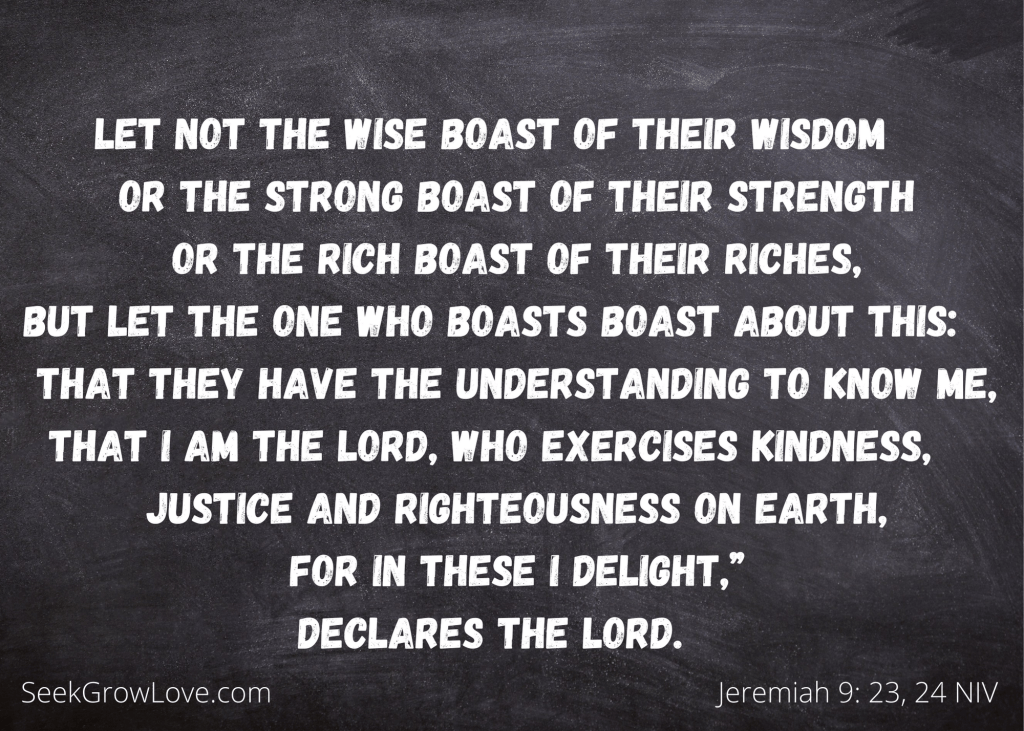
“Let not the wise boast of their wisdom
    or the strong boast of their strength
    or the rich boast of their riches,
24 but let the one who boasts boast about this:
    that they have the understanding to know me,
that I am the Lord, who exercises kindness,
    justice and righteousness on earth,
    for in these I delight,”
declares the Lord. (Jeremiah 9:23-24 NIV)

Perhaps it was written more for us who would be reading Jeremiah centuries later, to remind us of the choice we have. And, the great opportunity we have to boast about our God, our Creator, Our YHWH. He created the cure. His Son is the cure that was not yet available in Jeremiah’s day. Sin is the same and comes with the same consequences – death. People today need to know about the cure. They don’t need to hear you bragging about your dinner, your kids, your car, your job, your grades, your house, your ______ (on social media or at the checkout line). They need to know about the LORD our God who exercises kindness AND justice and always righteousness. The Psalms passages today have some great examples of boasting about our God while holding out the cure. How can you hold out the cure today to a nation and world that is unknowingly in the stages of the deadly disease of disobedience?

-Marcia Railton

Today’s Bible reading passages can be read or listened to at BibleGateway.com here – Jeremiah 9-10 and Psalms 99-101

Our God is an Awesome God

Isaiah 41-42 and 1 Timothy 2

Good morning! (Or afternoon, or evening…)

Our God is an awesome God, and He has no problem telling us that!  Isaiah 41 is all about God telling the nations who is in charge.  In certain places, it can seem a little harsh… calling the Israelites weak worms, putting them in their place knowing that their work is worthless compared to God, etc.  HOWEVER, there are also multiple verses where God’s comforting love shows through as he reminds the Israelites not to fear, and that He is there to help and strengthen them (v. 10, 13, 17).  While the passage can be blunt at times, it ultimately is God simply speaking truth to a group of individuals that He cares deeply about.  He wants them to understand how great He is, and how much He cares for them!

In chapter 42 God provides a little more reasoning behind his passionate words towards the Israelites, He reminds them that they are a chosen people dedicated to being a light to the nations (v. 6).  Isaiah has been tasked with sending this message to the Israelites despite the way they continue to reject God.  I can almost feel his exasperation as he does his best to help them understand that they have a purpose, that God has a plan, and that they keep ignoring it! (v. 20) Do you ever feel like Isaiah trying to convince people that God has the best plan for their life?  It can be difficult to speak truth into the lives of others who are not receptive, and it can be hard to see them ignore the need for God in their life.  We must know that it is not our job to convince individuals they need God, He can do that all His own!  Our job is to share the information, model how God can change a life, and continue to pray for their eyes, ears, and hearts to be opened to the truth.

In reality, I think we end up being most like the Israelites ourselves!  We continue to disobey, ignore, or rebel against the purpose God has for us even though we may know exactly what God wants from us.  We all have sin in our lives.  It looks different in everyone!  That is why it is so incredible that God still includes us in His chosen people, and that we all have the same opportunity for salvation and an eternal life with Him in the Kingdom. 

Unlike Isaiah, we are fortunate to live in the time that we don’t have to just tell people salvation is yet to come; we get to share that a Savior has already come, already been put to death for our sins, and has already rose from the grave with a promise of eternal salvation!  We are told in 1 Timothy 2 that God wants everyone to be saved, to come to the knowledge of the truth (v. 4) and that Jesus was a human who gave himself as a ransom for all (v.5-6).  Who can you share some knowledge with today?

-Sarah (Blanchard) Johnson

Today’s Bible reading plan passages can be read or listened to at BibleGateway here – Isaiah 41-42 and 1 Timothy 2

Let the World See

1 Timothy 1

Welcome!

Today’s passages seem to have some different main themes, so while all of these are valuable, we will be focusing mainly on 1 Timothy 1 for the purpose of keeping this devotional to a reasonable length 😊

1 Timothy 1 is written by a very dedicated and enthusiastic believer, Paul.  Paul is a very impressive man with an incredible testimony (that we get to see a little bit here) and clearly has a passion for the Kingdom.  This is why I sometimes have to re-read his messages to better comprehend just how deeply he cares for people and soak up all the energy for spreading the gospel he has!  Paul tells Timothy that God’s plan operates by faith (v. 4) and that our role as believers is to have love that comes from a pure heart, a good conscience, and a sincere faith (v. 5).  I LOVE that description of who Christians should be in the world!  Loving, Good, and Sincere.  Do you think the world today has that view of Christians? Or do you think that unfortunately, the world has the view of Christians who turn to fruitless discussions regarding the law (v.6-7)? 

It can be hard to swallow verses like 1 Timothy 1:9 where it says “the law is not for the righteous, but for the sinful”, if you are a sinner and know a Christian who has fruitless discussions about the law.  However, if more Christians today took their righteousness and expressed the “glorious gospel” that has been entrusted to them (v. 11), I have a feeling that it would be much easier to reach those who do not know the law!  The implied context in this passage is not expressing the idea that once you are a believer you don’t have to follow the law, but rather that once you are a believer your focus should shift off yourself and your “good works”, and move towards reaching others who need to know the law.  Paul models a great example of how to approach others about Jesus, by telling them that Christ came to save ALL sinners, including the worst of them all, which was himself! (v.15) When we openly share the impact Christ has in our lives and humbly recognize that we are all sinners, it becomes much easier to reach those who need salvation just as much as we do.

This is not to say that discussions of the law should not happen amongst believers!  Paul tells Timothy to strongly engage in battle to avoid having a shipwrecked faith (v. 18 -19).  To be prepared for battle, it’s important to know what you are up against and how to combat it!  What is key here is that our battle is not one meant to destroy arguments or put down people by boasting of our own righteousness, but rather our battle is against the evil one who is dedicated to keeping people out of the Kingdom.  Our battle is fighting for the citizenship of an eternal Kingdom, for ourselves and for everyone we meet.  The law is one tool we use to win that battle!  Another tool is our own testimony, another is the story and purpose of Jesus’ life, death, and resurrection, and yet another is simply sharing how amazing our God truly is.

Isaiah 40:28-31 provides a great passage to reach others with; I encourage you to memorize it for the sake of winning the battle!

“Do you not know?  Have you not heard?  Yahweh is the everlasting God, the Creator of the whole earth.  He never grows faint or weary; there is no limit to His understanding.  He gives strength to the weary and strengthens the powerless.  Youths may faint and grow weary, young men stumble and fall, but those who trust in the LORD will renew their strength; they will soar on wings like eagles; they will run and not grow weary; they will walk and not faint.”

-Sarah (Blanchard) Johnson

Today’s Bible reading plan passages can be read or listened to at BibleGateway.com here – Isaiah 39-40 and 1 Timothy 1

The Apostle Paul Refused to Mask Up!


1 Thessalonians 2

If you’ve not read Marcia’s devotion for yesterday, it would be good to give it a quick scan now.  She sets us up well for I & II Thessalonians.  By the way, thank you Marcia, for all the work you do with SeekGrowLove!  These readings and devotions are a great ministry!  It is amazing how often the Old and New Testament readings complement each other.  Isaiah did speak a great deal of judgment, but as always, God never wasted an opportunity to lay out hope for his people.  Isaiah also had much to say about the coming Messiah.  I appreciated Marcia’s suggestion that we note what Paul alludes to at the end of every chapter in I Thessalonians.  If I had known that before, I had forgotten.  


At any rate, let me note just a few highlights in I Thessalonians 2 . . .


Paul was literally driven to preach the gospel, the good news of the Kingdom of God and the Name of Jesus the Christ.  Neither opposition, nor disagreement, nor persecution could dissuade him.  He was a straight shooter, told it like it was.  He would have nothing to do with masking, hiding anything, or any impure motives (See V. 5).  He provided for his own needs, toiling at his own profession, rather than to be a burden in any way upon the church.  Actually, on another occasion he apologized for that very practice, realizing the church needed to understand and meet their responsibility to care for those who provided for their spiritual needs.  The context of the situation would evidently dictate what is right.  


Notice the tenderness of Paul’s love and concern for the brethren.  He was gentle with them, like a mother caring for her little children (V. 7).  Then in Vs. 11,12, he dealt with them as a father deals with his own children – encouraging, comforting, and urging them to live lives worthy of God who calls us into his kingdom and glory.  He was thankful for them, and proud of them as they served and obeyed.  Who are your spiritual mentors, men and women who have taught you, encouraged you, comforted you, and challenged you spiritually?  May we make them proud.  May we walk in their footsteps.  May we build on the foundation others have laid before us!  May we minister to others!  May we be true as we wait and watch for the coming of Jesus!    

-John Railton

Read or listen to today’s Bible reading plan passages at BibleGateway.com here – Isaiah 25-26 and 1 Thessalonians 2

Identity in Christ: You are loved!

Ephesians 2

When you think of the word “love,” what comes to mind?

Our culture would like for us to believe that love is found in sappy movies, romance novels or certain songs on the radio, but that’s simply not the reality.

1st John 4:7-11 reads, “Dear friends, let us love one another, for love comes from God. Everyone who loves has been born of God and knows God. Whoever does not love does not know God, because God is love. This is how God showed his love among us: He sent his one and only Son into the world that we might live through him. This is love: not that we loved God, but that he loved us and sent his Son as an atoning sacrifice for our sins.”

God created each of us with a desire to love and be loved, but He did that so He could be the one to fulfill that desire and work through us. But His love reaches even deeper.

Ephesians 2: 1-10 “And you were dead in your trespasses and sins 2 in which you previously walked according to the ways of this world, according to the ruler of the power of the air, the spirit now working in the disobedient. 3 We too all previously lived among them in our fleshly desires, carrying out the inclinations of our flesh and thoughts, and we were by nature children under wrath as the others were also. 4 But God, who is rich in mercy, because of his great love that he had for us, 5 made us alive with Christ even though we were dead in trespasses. You are saved by grace! 6 He also raised us up with him and seated us with him in the heavens in Christ Jesus, 7 so that in the coming ages he might display the immeasurable riches of his grace through his kindness to us in Christ Jesus. 8 For you are saved by grace through faith, and this is not from yourselves; it is God’s gift— 9 not from works, so that no one can boast. 10 For we are his workmanship, created in Christ Jesus for good works, which God prepared ahead of time for us to do. “

Let’s unpack this passage a bit. First, while we were still sinners and walking in accordance with our own will and what we wanted to do, God reconciled us to Himself through Jesus, even though we didn’t deserve it, out of pure grace. We did nothing on our own to earn that privilege. Secondly, God’s purpose for this was for us to reflect His love and grace to the world so that we could one day enjoy fellowship with Him and Jesus in the Kingdom.

So now that we have received love and grace from God to the point of Him choosing to sacrifice his only Son to bring many of his sons to glory, (as the song How Deep the Father’s Love for Us points out) what are we supposed to do? How do we go about letting our Father’s love radiate though us?

1) Spend time with Him through prayer, Bible reading and worship. Just as a bond is strengthened with your best friend whenever you go out for lunch or whatever you may do to spend time with them, our bond is strengthened with God when we make it a priority to spend time with Him.

2) Invest in your personal relationships, whether that is with brothers and sisters in Christ, or people you may know that are not Christians. We are called to the breaking of bread and fellowship (Acts 2:42) but we’re also called to evangelize and share the Gospel (1st Peter 3:15, 2nd Corinthians 5:20).

3) Finally, tell your friends and family that you love them through words and actions. I know this seems obvious, but in today’s society, social media and text messaging takes away from hearing a verbal “I love you.” When we have a friend or family member that is struggling, quite often we assume that just because we see them online, they must be okay instead of going over to their house to check in and keep them company (with their permission of course). So, I encourage you to ponder how you can show your love and God’s love to those around you.

-Caitie Wood

Read or listen to today’s Bible reading plan passages at BibleGateway here – Song of Solomon 3-5 and Ephesians 2

Identity: Purpose

Continuing on with our theme of identity for this week, today we will talk about purpose, of which there are two kinds: collective and individual.

Having a collective purpose means that we all work together to achieve a common goal. In relation to God, our collective purpose is to evangelize and make disciples of all nations as Matthew 28:18-20 tells us. We also have the responsibility of serving others (1st Peter 4:10-11), and both of these things apply to brothers and sisters in Christ and those outside of our faith.

Let’s discuss some practical examples of how we can love God and love people while striving to make disciples and further the Kingdom:

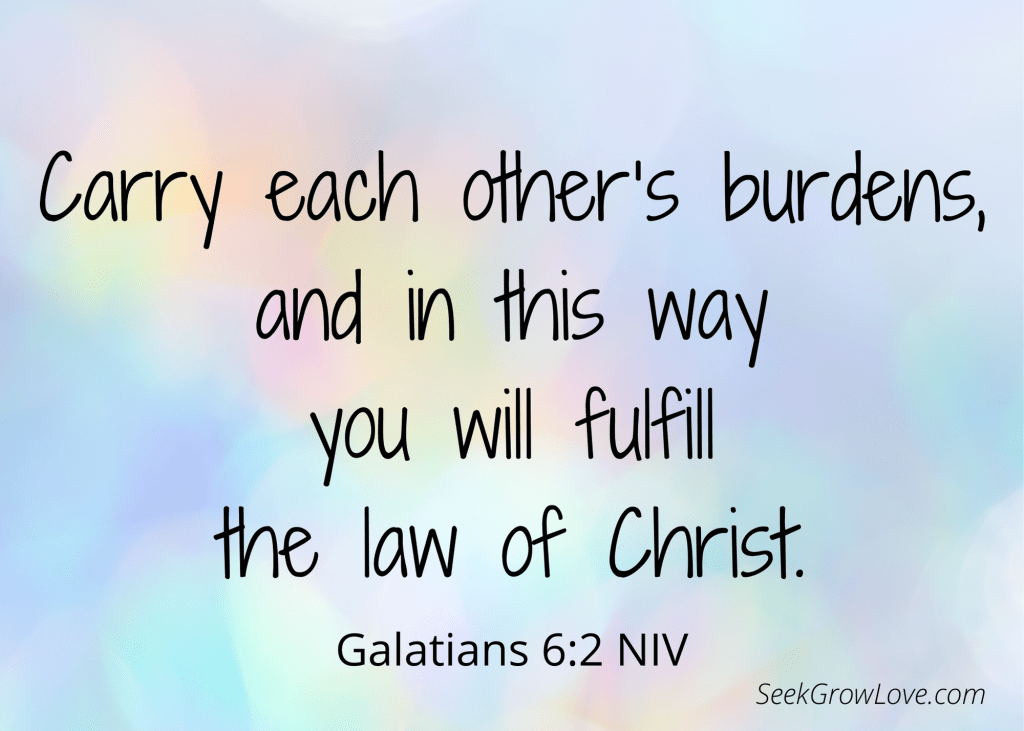
Most importantly, we are to love each other! (1st Corinthians 13:2, 1st Corinthians 16:14, John 13:34-35). We are also instructed to gather together in fellowship (Acts 2:41; Matthew 18:20). Additionally, we must confess our sins and hold each other accountable (James 5:16, Proverbs 27:17). Finally, Galatians 6 tells us to bear each other’s burdens, lovingly correct those who are struggling with sin and to work for the good of all.

In Jeremiah 1, we find a beautiful example of individual purpose. Let’s look at verses 4-8:

4 The word of the Lord came to me, saying, 5 “Before I formed you in the womb I knew you, before you were born, I set you apart; I appointed you as a prophet to the nations.” 6 “Alas, Sovereign Lord,” I said, “I do not know how to speak; I am too young.” 7 But the Lord said to me, “Do not say, ‘I am too young.’ You must go to everyone I send you to and say whatever I command you. 8 Do not be afraid of them, for I am with you and will rescue you,” declares the Lord.

Jeremiah’s individual purpose was to be a prophet and be a vessel for God to speak through, though there are many examples of individual purpose in the Bible. We have the Apostles. We have John the Baptist. We have Jesus himself! All of these people had a different individual purpose, but their unique purpose all worked toward the common purpose of furthering the Kingdom. Just like Jeremiah who was chosen, set apart, and appointed before he was even born, God created us with the same intention. Just like He did for Jeremiah, God will be here guiding our steps as we fulfill whatever He has called us to.

Maybe you don’t know what your individual purpose is yet, and that’s okay. But if you continuously trust in God’s plan for your life, you will find out what your purpose is in His timing. However, I challenge you this week to ponder and pray about how you have seen God’s love displayed in your community and/or how people have ministered to you. I also encourage you to seek God’s guidance about what you can do in your personal life to show His love to others in the spirit of bringing our Father’s lost children back to Him.

-Caitie Wood

Read or listen to today’s Bible reading plan passages at BibleGateway here – Ecclesiastes 11-12 and Galatians 6

Asaph’s Prayer List

Psalm 83

How often are your prayers only requests for God? How many times, if those requests were fulfilled, would they help others come to know God? In Psalm 83, Asaph thought about how his requests would help others to come to know the one true God.

At the beginning of Psalm 83, Asaph asks God to intervene on Israel’s behalf in the face of their enemies. Asaph continues by listing many grievances against their enemies as to why God should deliver Israel from their enemies. After listing all the problems that Israel is having with their enemies and listing who those enemies are, Asaph asks God to completely destroy their enemies.

Asaph asks God to destroy their enemies as He did in the past during the times of Gideon and Deborah and Barak. He continues to ask God to destroy them to the point that they are like whirling dust or chaff in the wind. In Psalm 83:16-18, his list goes on to ask that God would make their enemies humiliated, ashamed, and dismayed. He says,

16 Fill their faces with dishonor,

That they may seek Your name, O Lord.

17 Let them be ashamed and dismayed forever,

And let them be humiliated and perish,

18 That they may know that You alone, whose name is the Lord,

Are the Most High over all the earth.”

In these verses, Asaph not only asks for their enemies to be ashamed, dismayed, and humiliated, he also explains why he asks for this. Everything Asaph asked God to do to their enemies, he asked so that they would seek God and know that He alone is Most High over all the earth.

Asaph could have just asked God to destroy their enemies because Israel was God’s chosen people. He could have just asked for protection from their enemies because Israel knows God is all-powerful. He could have just asked for deliverance from their enemies because Israel worships God. But Asaph didn’t. He asked for deliverance so that God would be praised by their enemies and that they would come to know God.

In the same way, we need to be a light in this world that would bring others to glorify God. Matthew 5:14-16 says, “‘You are the light of the world.  A city set on a hill cannot be hidden; nor does anyone light a lamp and put it under a basket, but on the lampstand, and it gives light to all that are in the house.  Let your light shine before men in such a way that they might see your good works, and glorify your Father who is in heaven.”  Israel was created to be a nation that would worship God, even when the nations around them didn’t.  Through this, they had an opportunity to spread the truth about God.  Asaph knew this and wanted Israel’s light to shine before their enemies so that they would come to know God and glorify Him.  Similarly, we also are surrounded by people who do not know the truth about God.  We were called to be a light to the world so that we could spread the good news with others and to shine our light before the world so that God would be praised and that others around us would come to know God.

-Kaitlyn Hamilton

Today’s Bible reading passages can be read or listened to at BibleGateway here – Job 35-36 and Psalm 83-84