Destroying the Division

Ephesians 1-3

Devotion by Jenn Haynes (OH)

I will be the first to admit that I struggle to let go of hurt. I don’t like to hold grudges. Having bad feelings towards others eats away at me. It gives me an upset stomach. And yet, I still fixate on those feelings and my relationships with those that hurt me never seem to be the same. I cling to that hurt, and that hurt divides us. 

Hurt and grudges don’t seem to have much to do with our passages today, I know. But it’s where my heart went. What stood out to me the most in these scriptures was the idea of division. I don’t know many Jewish people and so I don’t think I can fully appreciate what it meant to be united in grace and salvation with a group of people who were so radically separate from me. But there are others who ARE radically separate from me. We are separated by pain and broken relationships.

Read Chapter 2:14-18:

 For he himself is our peace, who has made the two groups one and has destroyed the barrier, the dividing wall of hostility,by setting aside in his flesh the law with its commands and regulations. His purpose was to create in himself one new humanity out of the two, thus making peace,and in one body to reconcile both of them to God through the cross, by which he put to death their hostility.He came and preached peace to you who were far away and peace to those who were near. For through him we both have access to the Father by one Spirit.

Have you ever felt yourself so divided from another person or another group of people that you felt there was no fixing that gap? I have. But the divide wasn’t a matter of nationality or to what group of people I belong. The divide was pain, hurt, betrayal, pride, and heartache. 

I don’t know what your divide is, but I’m willing to bet that most of you have felt separated from others like I have. It’s painful, and it doesn’t feel like it could ever be mended. 

And yet, Jesus Christ destroyed the division. You are a sinner and you have done wrong and yet he died for you. The ones who hurt you? They are sinners and they have done wrong. And he died for them too. 

“He came and preached peace to you who were far away and peace to those who were near.” We all got the same message. We all got the same forgiveness. We all got the same grace. Yes, they hurt you. And you’ve probably hurt someone else. 

Verses 21-22 continue: 

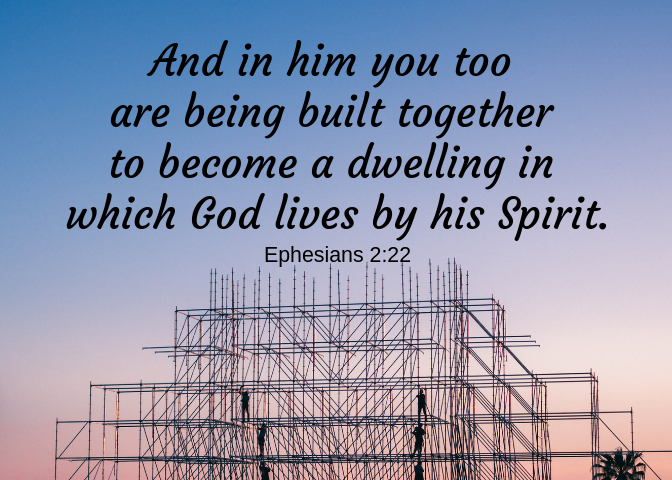
In him the whole building is joined together and rises to become a holy temple in the Lord.  And in him you too are being built together to become a dwelling in which God lives by his Spirit.

In Jesus Christ, we are joined together with those on the other side of that wide divide of hurt. We are to rise as his holy temple. We are to be united as his church. The divide that was too wide for us to cross on our own has been made small by the grace freely offered to all of us sinners. The divide may be hurt or betrayal or a sin done against one side or another. But the people on each side of that divide are equally guilty of sin. And they are equally forgiven. 

Reflection Questions: 

From whom are you divided? Really examine your heart. Do you want to be a united family of God? Do you want to be the temple God wants you to be, or would you rather hang on to your hurt? 

What sins of yours did Christ die for? What sins against you did Christ die for? If Christ died for those sins, and they have been paid for and are no longer yours or theirs, why are you still holding on to them? 

Prayer: 

My prayer for you today is that you find healing. Pray that God softens your heart and fills it with love for him that is so great, there is no room for hurt and division. Pray that you recognize God’s children as your own family, and that you be united in Christ. Pray for peace to settle on you all. 

A Short Appeal

Philemon

Devotion by Jenn Haynes (Ohio)

I’m amazed at how the book of Philemon came to be included in the Bible. I mean, this is a personal letter from one man to another. It wasn’t addressed to a group. And it was giving a simple, short message. It was just a note, really. But sometimes short and to the point is what we need, especially when the message is as radical as what Paul says to Philemon. 

In this short letter, we see people in three positions in which every one of us has probably found ourselves. 

We have Paul, who shows us how to encourage others towards love and forgiveness. He encourages Philemon not only to forgive Onesimus, but to accept him as a brother. And Paul does this with such love and gentleness. Paul reminds Philemon of their bond and implores him to show love to Onesimus and treat him as he would treat Paul. And he says that whatever debt that Philemon still feels Onesimus owes, should be considered Paul’s debt instead. Paul is showing us how to be Jesus to others. 

Then we have Philemon, the wronged party. We’ve all been hurt by someone before and we see here how we should handle it – with love, grace, and forgiveness, just as Christ showed us. And Paul knows that’s hard. When you’ve been wronged and hurt, it’s hard to let that go. But here Paul asks us to not only forgive, but to also love the one who hurt us, just as Christ loves us. 

Finally we have the one I think we can relate to the most: Onesimus. Onesimus has run from the one he wronged, and Paul knows that it isn’t enough to ask for forgiveness from afar. He sends Onesimus back to Philemon to do the hard thing. He sends him back to reconcile. Making things right is uncomfortable and even painful. But Paul knows that it must be done for true healing. We have all been Onesimus. We have all needed forgiveness. 

And what these three thankfully have in common is that they are all saved by Christ and they are no longer what they once were. Their relationship is new. They aren’t slave and master or teacher and student. They are equal brothers in Christ. 

Reflection questions: 

When have you been Philemon lately? Is there anyone you’re struggling to forgive? 

When have you been Onesimus? With whom should you be reconciling? 

How can you remind others of Christ through your speech and your example, just as Paul does here? 

Prayer:

I pray that you don’t let awkwardness or hurt or unforgiveness stand in the way of your relationships with other believers. I pray we are united in an effort to spread the gospel message to the world by showing others the power of love and forgiveness. 

The Big Picture

Matthew 16, Mark 8, Luke 9:18-27

Devotion by JJ Fletcher (Minnesota)

It can be easy to get into the weeds when discussing and debating theology. There are many years behind us of writing and interpretation of the scriptures, and we can easily lose focus on the big picture when we’re bogged down in the minutiae. One could simply read scripture and take away that Jesus died for the sins of the world and that whoever believes in him will be saved. On the flip side, books have been written digging into how Jesus’ death and resurrection functionally deal with sin. Atonement theories such as Penal Substitution, Christus Victor, and Scapegoat Theory (among others) are ways to try to understand exactly the process through which God forgives through Jesus. The main thing we should remember is that the blood of Jesus brings forgiveness, regardless of the thoughts that we might have about how exactly God reconciles everything through Jesus.

The Pharisees were very much concerned with the letter of the law. Now I believe we should strive to understand scripture, but sometimes I can allow my views on specific doctrines or practices to overshadow others. We need to be striving to see the big picture and get to the spirit behind the words of scripture.

In today’s text, we see Jesus’ warning against the leaven of the Pharisees. This calls out things like false doctrine and hypocrisy that were present in the lives of the Pharisees that clashed with Jesus. This bad leaven will corrupt the “bread” that comes from it.

Jesus recognizes that there are key things that the disciples need to know and understand, specifically relating to his death and resurrection. But also, the big picture needs to be in view. Jesus asks Peter, who do people think that Jesus is, and he spits off a few theories, but then Jesus asks Peter who he thinks Jesus is, and he answers: You are the Christ, the Son of the living God.

Big Picture. None of the things that Jesus shows and teaches Peter and the disciples will be impactful without this pig picture. Jesus is the Son of God. Jesus is the Messiah. This confession is the foundation of the Church. We’re not always going to agree on everything, but we must agree on this primary fact: Jesus is the Savior, and in Him we must put our faith and hope. 

Reflection Questions:

1.        What distracts you from the big picture?

2.        Does your need to know how sometimes distract you from simply accepting what you read in scripture?

3.        Have ingrained habits or false things that you have been taught stood in your way of implementing your faith in every aspect of your life? Take a step back and look at the big picture in scripture and weigh your thoughts against what you see in the Bible.

Ask Not for Justice, but for Forgiveness

Nehemiah 13 and Malachi 1-4

Devotion by Telva Elwell (SC)

Oh, how Nehemiah must have wished for a happy ending.  Jerusalem seemed to have been on the right track. The people were singing songs of praise and worship as they marched on the newly rebuilt wall of Jerusalem.  Joy filled the streets of Jerusalem and the hearts and souls of the people.  Fast forward to the future by about 11 or 12 years, and during that time the people had jumped off the wall and were up to their eyeballs in the filth of sin and rebellion to God and His laws.  Nehemiah had gone back to Shushan to his previous position, but when he heard the news of the sad state of affairs in Jerusalem, he returned to Jerusalem once again.  How could things have gone so terribly wrong?

If Nehemiah had prepared a list of things the people were doing wrong, it would have looked something like this.

Things you are doing wrong:
Nehemiah 13
  1.  You are mixing it up with outsiders like the Ammonites, and Moabites, who are enemies.
  2. You are allowing Tobiah to live in a large room in the temple.  Eliashib, a high priest, has given him a room because one of his relatives was married to Sanballat’s daughter, and Sanballat and Tobiah were friends.  (I know, it’s a bit confusing.  But we all know who Sanballat and Tobiah are, and this just can’t be good.)
  3. Tobiah is literally living in a room of the temple dedicated to the storing of the offerings used by the Levites.  (Umm, not good.  Where are the offerings kept now?)
  4. Where ARE the offerings?
  5. You are allowing your daughters and sons to marry people from Ashdod, Ammon and Moab, which you promised NOT to do.  Many of their children even speak foreign languages.
  6. You have stopped paying taxes!  You have stopped giving tithes and offerings to the priests and can’t even provide wood for the altar. (13:32-39). (Guess that is why “room” previously used for storage and offerings had opened up for Tobiah in the temple.)
  7. You are working and selling on the Sabbath, which you promised not to do! (10:31).
  8. Need I continue?
Signed:  Nehemiah

Sounds like Nehemiah had his work cut out for him.  Apparently so did Malachi, the prophet.  Malachi’s words against the people of Israel sounded hauntingly similar to Nehemiah’s words when describing the sins of the people of Israel.

Things you are doing wrong:
  1. You doubt the love of God (Mal 1:1-5) (see also Deut. 6:4,5).
  2. The priests are cheaters who offer polluted, lame, sick and blemished offerings to God (1:6-14).
  3. You divorce your wives then marry pagans (2:1-16).
  4. “You have wearied God with your words saying, everyone who does evil is good in the sight of the Lord, and He delights in them” (2:17-3:6).
  5. You are thieves.  You are keeping your tithes and offerings (3:1-8).
  6. “You have spoken against God by saying that it is vain to serve Him, and what is the profit of keeping His commandments? You call the arrogant blessed” and say that “evildoers prosper”. (3:13-15)
  7. You ask, “Where is the God of justice?” (2:17)
        Signed:  Malachi, the Prophet

What Israel did not realize was that they did not need justice as much as they needed forgiveness.

Whereas Nehemiah took a more hands on approach to the problems, even to the point of throwing furniture, hitting and cursing certain men, and pulling hair from their heads (Neh 13:25), Malachi would debate them, beginning with an accusation, then Israel would dispute that accusation, but in the end, God would have the final word. 

Israel demanded to know “Where is the God of justice?”  What they wanted was justice for their wicked enemies and they wanted it now. They claimed that “everyone that doeth evil is good in the sight of the Lord, and He is pleased with them” (2:17). How can a just God do such things?

And so, God Almighty responded! “I will send my messenger, who will prepare the way before me. Then suddenly the Lord you are seeking will come to his temple; the messenger of the covenant, whom you desire, will come. (3:1) He then asked a question: “Who can endure the day of His coming, and who can stand when He appears?” (3:2) For “He will purify the sons of Levi and refine them like gold and silver” (3:2,3) “So I will come to put YOU on trial…says the Lord Almighty.” (3:5).

This is not where Israel expected the debate to go. They wanted God to deal with their enemies now. Instead, Malachi is telling them that they need to be cleansed and purified now.

 “Return to Me, and I will return to you.” (3:7) Will they accept that cleansing?   Will they return to Him?  Will they accept His forgiveness? Oh, how Nehemiah and Malachi must have longed for the people to return to God, and “to assemble with fasting, and with sackcloth and earth upon them.  And for the seed of Israel to separate themselves from all strangers, and stand and confess their sins, and the iniquities of their fathers”, as they did when the wall was rebuilt. (9:1-2).

Hope and a Promise

God, the God of Justice, assured them that He will take care of the evil ones.  “Surely the day is coming; it will burn like a furnace. All the arrogant and every evildoer will be stubble, and the day that is coming will set them on fire,” says the Lord Almighty. “Not a root or a branch will be left to them.  But for you who revere my name, the sun of righteousness will rise with healing in its rays.  And you will go out and frolic like well-fed calves.  Then you will trample on the wicked; they will be ashes under the soles of your feet on the day when I act,”’ says the Lord Almighty. (4:1-3) But for Israel it depended upon them deciding now which group they belonged to—the arrogant and evildoers, or those who revere His name.

 “Return to Me”, He pleads.

 He then ends with this promise: “I will send the prophet Elijah to you before that great and dreadful day of the Lord comes.  And he will turn the hearts of the parents to their children, and the hearts of the children to their parents” (4:5).

 As for us, just like Israel, it all depends upon taking accountability and confessing our sins because He is faithful and just and will forgive. (1John 1:9)

Reflection Questions

  1. Did jealousy play a role in the sins of Israel?  If so, does it still play a role in our lives and sin today?
  2. Why do you think it was so easy for Israel to fall back into sin repeatedly?  Were they sincere when they walked the wall of Jerusalem singing praise and thanksgiving?
  3. Do you find it difficult to stay away from sin?  Why?  Can you relate to Paul’s struggles in Romans 7:7-25? In what ways?

Amazing Grace

Nehemiah 8-10

Devotion by Telva Elwell (South Carolina)

This chapter, Nehemiah 9, contains the longest prayer in the Bible.  No, prayer is not a contest, but sometimes it takes a lot of words to get things off your chest.  Other times it only takes a few words to speak your heart to God.  When Jesus hung on the cross, he only needed 10 words— “Father, forgive them for they know not what they do.”  But in Nehemiah’s day in Jerusalem, it took a lot of words to get everything out so that God’s people could express their forgiveness and experience restoration.

And so, they prayed.

Sometimes we need to express our heart in different ways.  In Nehemiah 9 it is written that the people expressed their sin, their shame, and their remorse in many ways.  They fasted; they wore sackcloth and ashes.  They threw handfuls of dirt on their heads; they separated themselves from others; they confessed their sins along with the sins of their ancestors. They even signed a binding contract promising obedience to God.  All of these things were important, but it was what they expressed from their hearts that was probably the most meaningful. Often those feelings are expressed without words, but with tears. Peter remembered Jesus’ prophesy, “Before the rooster crows, you will deny me three times,” and after his third denial, Peter “went out and wept bitterly” (Matt 26:75). (See also Rom. 8:26). Tears speak a language our tongues cannot.  Nehemiah understood.

When Nehemiah received the report from his brother, Hanani, that the Jewish remnant was in “great trouble and disgrace” and that “the wall of Jerusalem is broken down and its gates have been burned with fire…he sat down and wept…” (1:3.4)

And then he prayed:

“I confess the sins we Israelites, including myself and my father’s family have committed against You. We have acted very wickedly toward You. We have not obeyed the commands, decrees and laws You gave your servant Moses.” (1:6,7)

As I read this prayer, I noticed that these people acknowledged failing their God six times, by disobeying and betraying Him.

  •  “Our fathers acted presumptuously and stiffened their neck and did not obey your commandments. (9:16)
  • “They had made for themselves a golden calf and said, “This is your God…” (9:18)
  • “They were disobedient and rebelled against You and cast your law behind their back and killed your prophets…and they committed great blasphemes.” (9:26)
  • “They did evil again before You.” (9:28)
  • “Yet they acted presumptuously and did not obey your commandments but sinned against your commandments.” (9:29)
  • “Even in their own kingdom, and amid your great goodness that You gave them, and in the large and rich land that You set before them, they did not serve You or turn from their wicked works.” (9:35)

And six times they came crawling back, probably wrapped in their sackcloth and covered with dirt and grime.  Each time they acknowledged the goodness and greatness of God!

  • “But You are a God ready to forgive, gracious and merciful, slow to anger and abounding in steadfast love, and did not forsake them.” (v17)
  • “You in your great mercies did not forsake them in the wilderness.” (v19)
  • “Forty years You sustained them in the wilderness, and they lacked nothing.” (v21)
  • “According to your great mercies You gave them saviors who saved them from the hand of their enemies.” (v27)
  • “Many times, You delivered them according to your mercies.” (v28)
  • “Nevertheless, in your great mercies You did not make an end of them or forsake them, for You are a gracious and merciful God.” (v31)

He did not forsake them.

 But when will He despair of their sins and wickedness?  When will God decide He has had enough?  When will He turn His back on His people?  When will He turn His back on ME?  When will He stop listening to MY prayers of confession?  Never.  Because that is who He is! He is “a forgiving God, slow to anger and abounding in love.” (9:17) “Nevertheless, in your great mercies You did not make an end of them or forsake them for You are a gracious and merciful God.” (9:31).

“For He will never leave you or forsake you,” (Duet.31:8) NEVER. So, every time that you mess up and dishonor God, pray.  Because God forgives.

 Every time.  

Reflection Questions:

  1. The people choose to fast when they prayed.  Have you ever fasted when you prayed?  Did it ever change the experience for you?  If you have, what kind of occasions do you think are appropriate for fasting and praying? 
  2. Why do you think the Jews acknowledged God’s greatness and mercy in their prayer of forgiveness? 
  3. Remember Judas’ sin of betrayal of Jesus and later his suicide?  Did he show signs of regret?  If so, was that the same as confession?  Do you think the outcome would have been different if he had confessed, as the Jews did, and then acknowledged the mercies of God?  Or was he just too depraved?  Did he feel he was beyond being forgiven? Was he too ashamed?  Have you ever felt that way?

The Day of the LORD – Past & Future

Joel 1-3

Devotion by Sherry Alcumbrack (South Carolina)

When we have something important to tell someone and we want to make sure they understand, we will repeat it many times. In the small book of Joel, “the day of the Lord” is mentioned five times, so we know that this is its central theme. That lets us know that what he is telling us is important to understand, he wants to make sure we get it.

There are two “Days of the Lord” mentioned. One is a past event, Israel had been ravaged by locusts: gnawing locusts, swarming locusts, creeping locusts, and stripping locusts. This was a judgement against Israel and the sins against God that they committed. In Chapter 1:14 to gain repentance Joel suggests that they: “consecrate a fast, proclaim a solemn assembly, gather the elders and all inhabitants of Israel to the house of the Lord, and cry out to the Lord.” He understood their need for repentance.  Chapter 2: 12-13 says “’Yet even now,’ declares the Lord, ‘Return to Me with all your heart, And with fasting, weeping, and mourning; and tear your heart and not merely your garments.’ Now return to the Lord your God, For He is gracious and compassionate, slow to anger, abounding in mercy and relenting of catastrophe.” He tells us that we have to do more than tearing our clothes (an outward sign), we need to change our hearts, if we do that, God will forgive us.

It even says that he will make up for the years that the locusts have taken and that his spirit will be poured out on all mankind. That verse is very important to all of us. Chapter 2:28 says “It will come about after this that I will pour out My Spirit on all mankind; And your sons and your daughters will prophesy, your old men will have dreams, your young men will see visions.” This is no longer just to the Israelites, he is talking to all of us about a future “day of the Lord.” The people of Israel had to go to the temple to receive forgiveness of their sins with an animal sacrifice. God made a new way when he gave us Jesus as our sacrificial lamb, so now we can repent and be baptized and our sins are forgiven. We look forward to the future “day of the Lord”, when Jesus will return to the earth, and will usher in the Kingdom of God. What a glorious Day that will be!

Reflection Questions

  1. Why is repentance – and how we do it – important to God? What gets in the way of our true repentance?
  2. Contrast the mood in the beginning of Joel to the mood at the end. What makes the difference?

A People for God

1 Kings 8 & 2 Chronicles 5

God’s covenant with His people is a continued theme throughout the Bible. It is confirmed with some of the greatest Old Testament leaders, such as Abraham, Moses, and David. Generations have been taught about God and all He has done for them. Though they have some faults, they have remained faithful to God as His people. The completion of the temple by Solomon further signifies a desire to worship God and be His people. After years of planning and construction the temple is finally used for its intended purpose and the glory of God fills the temple. In dedication, Solomon offers a prayer and addresses the people of Israel regarding the relationship between God and the people.

His prayer is a powerful plea for the LORD to remember His people and be their God. He begins by praising God and thanking Him for keeping His promises. Solomon prays that God will remain with them and hear their prayers. More importantly, he urges God to forgive them when they mess up. Solomon was wise enough to know that even if they tried their best they would sin and require God’s forgiveness. This applies to a variety of situations Solomon covers in his prayer, such as drought, famine, plague, war, and captivity. He argues that they have been God’s people for years and that He should continue to remember them for God’s glory. 

Then Solomon turns to the Israelites with him and requests that they keep their side of the covenant. Speaking to the people, Solomon says, “may your hearts be fully committed to the LORD our God, to live by His decrees and obey His commands” (1 Kings 8:61). God has fulfilled his agreement of the covenant in the past, so it is up to the Israelites to follow the covenant they agreed to. They must remain faithful to God to enjoy the benefits of being God’s people and having a hope for the future. There are many false gods that can be worshiped, but Solomon’s desire is that the LORD who brought their ancestors out of Egypt remains their God. 

That is easy to agree to in good times, but history has proven that is not always the case. There are numerous examples of the Israelites turning away from God for a period of time. Although Solomon’s reign was successful for the Israelites, they would not enjoy the same prosperity and unity for long. Solomon prayed that God be with them in all situations and advised the people to remain faithful to God. No matter what happens, wisdom suggests making a conscious decision to develop a relationship with God and be a people for Him.

-Josiah Railton

Reflection Questions

  1. What do you find in Solomon’s Dedication Prayer that would be wise to add into our prayers today?
  2. When did you last make a conscious decision to develop a relationship with God and be a person for Him? How is it going?
  3. Solomon was wise to know we would and will all need forgiveness. When have you veered off the fully committed and living by his decrees path? Have you experienced His forgiveness? What did that look like?

Reconciliation

2 Samuel 13-15

Have you ever been in a conflict where you feel extremely wronged in a situation? Everyone is like yes and amen. The story of our lives. Haha. Now secretly, to a really close friend you may be able to admit that you also did some wrong stuff, too; but there ain’t no way that anyone else is finding out about that. In fact, to all your friends you portray yourself as something resembling Jesus in the situation. I hope that you aren’t so disillusioned that you actually believe this has never happened to you. We really enjoy this social feedback loop.

There are other situations that come up in life where you have a single incident and then everything spirals out of control and that one incident ends up messing up everything in that relationship. I have totally had one of those.

It seems that there is nothing new under the sun because that is exactly what has happened with Absalom and David. The worst and most ridiculous thing about this story is that the catalyst to this relational tension didn’t even involve them. As you’ve read, this caused years of tension and problems and separation between father and son.

I am not going to speculate on whether David was right in not sentencing Amnon to death after rapping Tamar or whether Absalom should have killed his brother. There comes a certain point at which what has happened in life has happened. There is nothing you can do to change it and now you just need to live your life with the future in mind. In most of these cases keeping the tension and the bad blood in the relationship isn’t profitable to our own spiritual health and doesn’t promote godliness.

The section of today’s reading that I would like to discuss is 2 Samuel 13.37-39 and 2 Samuel 14.21-24, 28.  After Absalom killed Amnon, in worry and anxiety he fled to Geshur. It says that David mourned for his son in 2 Samuel 13.37. I am not sure which son he was mourning for but I believe that given the context of the paragraph and the verses around it the verse is telling us that David mourned for Absalom. This is also supported by v.39 where David says he longed to go out to Absalom. So why didn’t he?

David didn’t go out to seek his son Absalom, even though, he wanted to. He left him out in Geshur for 3 years. In fact, it wasn’t even David’s prompting that brought him back. Joab had to step in as mediator and be the counselor in this situation for Absalom to return. I think the responsibility falls on David to take the initiative to mend the relationship with his son instead of just leaving the situation in the wind. David essentially stuck his head in the sand and ignored the problem. Ultimately, this just caused problems between David and Absalom later on.

Finally, after Joab’s prompting David brings Absalom back to Jerusalem but tells Joab that Absalom can’t enter his presence. Absalom spends 2 years in Jerusalem before any action is taken in this relationship and the initiative once again wasn’t taken by David. It took Absalom saying it would have been better if I hadn’t left Geshur than to live like this and I would rather just have David do to me what seems right to him. Absalom hit the point where he would rather die if he had any guilt in him than live with this relational separation.

Surveying this whole situation, we see problems on both sides but I think the judgement ultimately lies with David. He took none of the initiative to repair this relationship. There is a real danger to leaving things unsaid that should have been said. I believe David’s longing to see his son at Geshur should have moved him to take action and confront the problems in relationship instead of just waiting. David longed for his son but out of pride or anger or stubbornness didn’t take the initiative to reconcile with Absalom.

When you consider the intensity of distress Absalom must have felt at the tension and loss of relationship that he would be willing to die if he had any guilt it is obvious that this weighed heavily on him. The two men’s reconciliation is sweet but was so long overdue that I think irreversible damage was done to the relationship given what happens in Chapter 15.

So, what can we draw from this? Firstly, to not let our conflicts go on forever. Secondly, when it is on your heart to apologize or you are longing for someone who you are in conflict with, it may be God working on your heart to repair the relationship. Thirdly, get a mediator or a counselor involved if needed. Don’t wait until someone else feels like something needs to be done. Fourthly, you are responsible for taking the initiative to reconcile or apologize for what you have done. Fifthly, don’t be afraid to let someone have the ability to go second. In this final scene where Absalom goes to his father, his father embraced him and kissed him. I have a feeling that David had longed for this moment. I can remember a moment in my relationship with my wife where we were in conflict and I had my defenses up to keep myself from over apologizing or taking too much of the blame. I remember so vividly her apologizing first and immediately all the weight was lifted, my defenses dropped, and I was no longer looking out for myself but I was looking for the good of the relationship. It gave me the freedom to really say the things I wanted to say when, at first, I may have even been hostile.

Finally, our relationships will only be as good as our communication in them. Remember it is wise to address conflicts as soon as possible. Do not leave things unsaid or problems unaddressed. They don’t just go away.

Daniel Wall

(originally posted May 14, 2020 for SeekGrowLove)

Reflection Questions

  1. How do you typically deal with conflict with someone close to you? What are the advantages and disadvantages to this approach? What would be better?
  2. What is the best response to our own sin? What is the best response to someone else’s sin?
  3. What was Joab’s role? How did he do it? Do you think God was pleased with Joab?
  4. Is there a situation where you might be able to help work towards reconciliation? (first in your own life, and then perhaps in someone else’s)

A Psalm of Repentance

Psalm 32, 51, 86, 122

Create in me a clean heart, O God, and renew a right spirit within me. Psalm 51:10 ESV

Yesterday, we looked at the narrative and the outcome of David’s tryst with Bathsheba. We see David essentially commit murder to cover up his affair, and we see the prophet Nathan come and confront David about the evil that he has perpetrated.

David could have been dismissive. He could have just shrugged off Nathan’s confrontation and said, “This is where my heart led me.” He could have said, “God wants me to be happy.” But he does not deflect. Despite his error, David still desires to do what God desires of him. He wants to be right before God, and when the clarity and gravity of his treachery sink in, he shows contrition. Not combativeness. Not excuses. Contrition.

David knows that what he has done is wrong, and he knows that he is not capable of fixing himself and reorienting his life and priorities alone. He cannot wash himself clean of his sin, but God can forgive him and cleanse him of the sin that has come forth from him.

David sees what would later be written: God does not desire sacrifice, but repentance. Not a cheap get me out of this mess offering, but a recognition of the sin done and the brokenness of recognizing the gravity of the separation from God that sin causes. God accepts sacrifices, but he accepts these sacrifices from a clear conscience; he doesn’t desire sacrifices from a guilty one.

-JJ Fletcher

Reflection Questions

  1. Why do we struggle to see the gravity of our sin?
  2. How can we truly show contrition, not just be sad that we’ve had our sin found out?
  3. What can we learn from Psalm 51, a psalm of repentance?

Wrong Place, Wrong Time

2 Samuel 11-12
1 Chronicles 20

And in the spring of the year, at the time when kings go out to battle, David sent Joab, and his servants with him, and all Israel, and they laid waste the children of Ammon and besieged Rabbah, but David stayed at Jerusalem. – 2 Samuel 11:1 (REV)

                  In today’s reading, we see two realities. Both happened, but at different times and represent different things. In 2nd Samuel, we see David, king of Israel. Where do we see David? At home. Sitting on his keister and not doing what a king would normally be doing: overseeing his generals as they go out to battle.

                  David is not where he is supposed to be. He should be meeting with his generals. He should be motivating his armies. He should be praying and fasting and seeking out God’s direction for the safety and prosperity of Israel, but he’s back in Jerusalem. Twiddling his thumbs? Playing his harp? We don’t know what he was doing at all hours of the day when he held up in his palace.  We do, however, know what he was doing on one specific evening.

                  David is out walking on the roof, where he shouldn’t be, and he sees Bathsheba bathing. David does not turn away from seeing the nakedness of this woman whom he is not married to. He stares. He dwells. He obsesses. She’s beautiful. He needs to meet her. To be with her.

                  David ends up having her come into his home, and he has sex with her and gets her pregnant. We may have seen this story happen in the lives of some people we know, but this is high profile. This is a problem. A bunch of people are going to know what has happened, and this is going to be hard to explain to Bathsheba’s husband, Uriah, who is out at war, where he is supposed to be: fighting for the armies of the people of Yahweh. While the king is out preying upon the wife of his soldier.

                  David finds himself in a sticky situation, so he sends for Uriah and does his best to get Uriah to go have sex with his wife and cover his… keister. Uriah, however, cannot fathom such a thing while his comrades are off fighting a war. He refuses to even go visit his wife. This poses a major problem. People are going to know that Bathsheba is expecting, and they are going to know that Uriah hasn’t been with her in months, maybe longer. David tries multiple times, but no dice. Uriah is a man of honor and conviction, and that is not going to fly in this situation. David needs an out. David essentially puts out a hit job on Uriah. David cannot control his urges, so a good man dies.

The story unfolds. Uriah is dead. David marries his baby mama, and then the baby dies. Nathan the prophet comes to confront David and gets David worked up with a parable. David wants vengeance for the perpetrator in the story, but then the tables are turned when David is revealed to be the bad guy in the tale. David grieves, David repents, but the baby does not survive. It’s rough.

In 1 Chronicles 20, we see that it is the time when kings go out to war. And David goes out to war. And his armies thrive. He gets an awesome new crown. God blesses the armies of a king who acts in good faith. David is more than capable of doing the right thing, but even a man after God’s own heart can allow himself to fall off the rails.

Here’s the rub: Sometimes we get complacent. Sometimes we get lazy. Sometimes we do things, go places, consume content that we know we shouldn’t, but we’ve allowed ourselves to be in the wrong place at the wrong time, and we fall victim to the allure of the temptations of sin around us.

We’ve all allowed ourselves to be in bad situations that we could have avoided. Sometimes we may come out on top, but given enough opportunities to sin in the situations we create, we are bound to fall. We play with fire… and you know the cliché, but it’s true, we get burned.

-JJ Fletcher

Reflection Questions

  1. Can you recall some times you allowed yourself to be in a place you shouldn’t have been? What was the outcome? How could you have avoided putting yourself in that situation? What did you learn from it?
  2. What do you think of Nathan’s tactics of getting David to see the gravity of the wickedness that he had perpetrated?
  3. What does the story of David and Bathsheba teach us about grace, repentance, and forgiveness?
  4. If David can be forgiven for this travesty, who can you forgive that may have done much less harm in the way that they have wronged you?
  5. How does the contrast of 2 Samuel 11-12 and 1 Chronicles 20 sit with you? Does it give you any insight or change the way you perceive David’s sin?