Identity in Christ: You are God’s Child!

I think we’ve all experienced chapters in life that were just difficult. Maybe you’re going through one of those times as you’re reading this. Maybe you feel like nobody understands you or hears you. Maybe you’re just looking for a hope to cling to or something to ease the aching hole in your heart.

The good news is…there is someone who knows you more intimately and loves you more deeply than any human ever could.

His name is YHWH. Or, as we call Him, Father God.

It may be true that Father God is just a title and not a technical name, but Abba is the Aramaic Hebrew word for “Father.” Jesus referred to God this way as he was battling with his anguish in the Garden of Gethsemane.

Mark 14:32- 36

32 Then they came to a place named Gethsemane, and He told His disciples, “Sit here while I pray.” 33 He took Peter, James, and John with Him, and He began to be deeply distressed and horrified. 34 Then He said to them, “My soul is swallowed up in sorrow —to the point of death. Remain here and stay awake.” 35 Then He went a little farther, fell to the ground, and began to pray that if it were possible, the hour might pass from Him. 36 And He said, “Abba, Father! All things are possible for You. Take this cup away from Me. Nevertheless, not what I will, but what You will.”

“What, exactly, is the significance of Abba,” you may ask.

This title shows how God works in the context of being in relationship with His children.

Romans 8:14-15

14 All those led by God’s Spirit are God’s sons. 15 For you did not receive a spirit of slavery to fall back into fear, but you received the Spirit of adoption, by whom we cry out, “Abba, Father!”

Galatians 4:6

6 And because you are sons, God has sent the Spirit of His Son into our hearts, crying, “Abba, Father!”

Do you see it? The faith, love, and trust we can put in God are similar to the love and trust we put in our earthly fathers. As awesome as our dads can be, God’s love and knowledge of you runs even deeper. Crazy, right?!

With this comes the comfort and peace of knowing that God hears and understands our hearts, even when we don’t always feel seen and heard because God knew everything about you even before you were born!

Psalm 139: 13-16 is a beautiful account of that. “For it was You who created my inward parts; You knit me together in my mother’s womb. I will praise You, because I have been remarkably and wonderfully made. Your works are wonderful, and I know [this] very well. My bones were not hidden from You when I was made in secret, when I was formed in the depths of the earth. Your eyes saw me when I was formless; all [my] days were written in Your book and planned before a single one of them began.” (CSB)

Another example is one of my favorites, Ephesians 1 verses 4 though 6 which read, “Even before he made the world, God loved us and chose us in Christ to be holy and without fault in his eyes. God decided in advance to adopt us into his own family by bringing us to himself through Jesus Christ. This is what he wanted to do, and it gave him great pleasure. So, we praise God for the glorious grace he has poured out on us who belong to his dear Son.” (NLT)

The scriptures say it all. So, to conclude, may I quote one of my Atlanta Bible College professors for a moment, the wise Dr. Joe Martin: “Hallelujah, praise God, AMEN!”

-Caitie Wood

Read or listen to today’s Bible reading plan passages at Bible Gateway here – Song of Songs 1-2 and Ephesians 1
Identity: Purpose

Continuing on with our theme of identity for this week, today we will talk about purpose, of which there are two kinds: collective and individual.

Having a collective purpose means that we all work together to achieve a common goal. In relation to God, our collective purpose is to evangelize and make disciples of all nations as Matthew 28:18-20 tells us. We also have the responsibility of serving others (1st Peter 4:10-11), and both of these things apply to brothers and sisters in Christ and those outside of our faith.

Let’s discuss some practical examples of how we can love God and love people while striving to make disciples and further the Kingdom:

Most importantly, we are to love each other! (1st Corinthians 13:2, 1st Corinthians 16:14, John 13:34-35). We are also instructed to gather together in fellowship (Acts 2:41; Matthew 18:20). Additionally, we must confess our sins and hold each other accountable (James 5:16, Proverbs 27:17). Finally, Galatians 6 tells us to bear each other’s burdens, lovingly correct those who are struggling with sin and to work for the good of all.

In Jeremiah 1, we find a beautiful example of individual purpose. Let’s look at verses 4-8:

4 The word of the Lord came to me, saying, 5 “Before I formed you in the womb I knew you, before you were born, I set you apart; I appointed you as a prophet to the nations.” 6 “Alas, Sovereign Lord,” I said, “I do not know how to speak; I am too young.” 7 But the Lord said to me, “Do not say, ‘I am too young.’ You must go to everyone I send you to and say whatever I command you. 8 Do not be afraid of them, for I am with you and will rescue you,” declares the Lord.

Jeremiah’s individual purpose was to be a prophet and be a vessel for God to speak through, though there are many examples of individual purpose in the Bible. We have the Apostles. We have John the Baptist. We have Jesus himself! All of these people had a different individual purpose, but their unique purpose all worked toward the common purpose of furthering the Kingdom. Just like Jeremiah who was chosen, set apart, and appointed before he was even born, God created us with the same intention. Just like He did for Jeremiah, God will be here guiding our steps as we fulfill whatever He has called us to.

Maybe you don’t know what your individual purpose is yet, and that’s okay. But if you continuously trust in God’s plan for your life, you will find out what your purpose is in His timing. However, I challenge you this week to ponder and pray about how you have seen God’s love displayed in your community and/or how people have ministered to you. I also encourage you to seek God’s guidance about what you can do in your personal life to show His love to others in the spirit of bringing our Father’s lost children back to Him.

-Caitie Wood

Read or listen to today’s Bible reading plan passages at BibleGateway here – Ecclesiastes 11-12 and Galatians 6

Being the Church Jesus Wants to Return To

My boss recently traveled to Turkey with his father who is a Biblical unitarian pastor to see some Biblical historical sites and came back with lots of stories. He did not bring me back any Turkish delight, but he provided a pretty neat church history lesson in the middle of our therapy department this week. He talked about Constantine, the Roman Catholics, church disputes and the historic structure he toured called the Hagia Sophia, that has apparently withstood centuries of empires/turmoils in what is now Istanbul. Though I know a little bit about Constantine and find history pretty interesting, this place he mentioned was completely new to me. Hearing it was from the 400’s and some of the history behind it had us all talking about the nature of conflict that is always a part of world history and church history. And some if it explains a lot.

Arguments and divisions are nothing new in societies or religious organizations. I use the term religious organization because sometimes I hate to even taint the word “church” more than it already is. As followers of Christ we are part of the greater church. The true church. Not the Sunday morning entertainment center or tax exempt non-for-profit club. We are part of the body of Christ/church family that transcends state lines, continents, races, and generations. And within that church we are to be unified in truth/purpose and actively loving one another more while serving ourselves less.

When we think of “church” today, any number of ideas might come to our minds, though I am not sure much of them are what the New Testament church would have hoped for centuries later. If anyone wants a very convicting laugh…..check out the YouTube video “Drive Thru Church”.  A friend shared this with me and it just rang so true. But, maybe we’d have less of a consumer-driven attitude if we, as the body of Christ, were consistently doing what we were called to do. And that calling is high, but worth it. There is a day coming sooner rather than later when it seems that the true church is going to need to become more and more distinct from those who slap that name on their seeker-sensitive organizations or lukewarm social gatherings Jesus tells us he wants to spit out of his mouth. But, this isn’t the time for the pot to call the kettle black. It is the time to ensure that each of us is prioritizing his/her relationship with God and His family, loving the “one another” of the church body, and together upholding the inerrant Word of God as representatives of His kingdom.

Let us not give up meeting together as some are in the habit of doing, but encouraging one another-and all the more as you see the Day approaching”  Hebrews 10:25

“I pray that all of them may be one, Father, just as you are in me and I am in you. May they also be in us so that the world may believe that you have sent me.” John 17:21

–Jennifer Hall

Keep at the Bible reading plan. Today’s passages can be read or listened to at BibleGateway here – Job 21-22 and 2 Corinthians 12

Tough Love

1 Corinthians 13

The simplest truth about human relationships is that if we just loved one another a bit more, we would have fewer problems.  I know, it is a bit cliche, but it doesn’t make it any less true. Our focus would be consistently outward.  We would be ready to listen and meet the needs of others. God has made it pretty clear that the most hardened heart can soften by showing the quality that embodies who He is, yet it is a weapon we often leave unwelded.  We often list our harshness or judgements under the guise of “tough love”, and this may or may not be true on a case-by-case basis. However, we must stick closely to the prescribed path in 1 Corinthians 13.  It actually might be simpler to love “toughly”, but if you simply write people off, or find a way to punish them, or speak your mind without backing it up with the many other qualities listed here, you are a hollow box and a lot of noise.  What’s tough love, really tough love, is to love someone who isn’t concerned in the slightest with being like God at the moment, or even ever. Love never fails. So you must love. You absolutely must.  And your love must be like God’s love.  Below I reworded one of the most famous passages of scriptures (v.4-7) that coincides with our reading and, most likely, one of the last handful of weddings you attended.  My goal isn’t to add to the list, only to reword it to give it novelty in hopes to make it challenging or convicting instead of a rehearsal of familiar words.  If it helps tune your mind to God’s love, wonderful.  If it is a confusing mess, don’t read it.  My concern is that you know loving is tough, especially those whose actions betray your love.  That shouldn’t stop you.  But THAT is tough love.  And THAT is what God shows to each one of us on the daily.

For God to come in and change the “unlovable” (mind you, this can be and has been you), you must sit and listen. Listen to their problems and hear them say what they think, even if you don’t agree. You have to include them, share with them, and treat them with dignity, even if they are not concerned in the slightest about having any.  To love, you have to let others be great and cheer them on.  Sometimes this means the spotlight will come off of you, or you are treated as less important.  If you are loving, you’re not concerned with that, because in love, others come first.  Love holds back the insults, name-calling, and doesn’t attack a person made in the image of God.  True love can be shown without expecting anything in return and can be left unreciprocated.  On rare occasions, you can have angry love.  You can be mad at someone because they are doing some serious sin damage to others or even him/herself.  But you don’t start there.  You don’t live there.  You are truthful with someone, because lying is not loving.  But you retreat quickly from the fight, and fill the space with mercy, more patience, and more kindness.  That means love is forgiveness, and not holding grudges.  We can love those who have wronged us.  We can love those who have besmirched our reputation, injured our family through carelessness, or hate us because of our beliefs. We may know their wrong to us as a historical account, but not as an emotional one, and we thank God we have an opportunity to show love to them in such a way.  In fact, loving like God means that you would actually stand-up for this person who has done you the greatest harm.  Loving someone means that you are trusting without “but.” And that can be so hard. But trusting in God first and foremost allows you to do that.  Believe in people.  Never give up on people.  Much easier said than done. It’s tough. So tough. But don’t let it stop you from trying. Your efforts are to help others see God, and they will know His love because it has been extended to and shown through you.

-Aaron Winner

Today’s Bible reading passages can be read or listened to at BibleGateway here – Esther 1-2 and 1 Corinthians 13

What do you want to be known for?

2 Kings 23-25; Proverbs 16

Life is fleeting. We’re all passing through this age like the grass of the field. Today we live. God holds tomorrow.

As I’ve finished the last three chapters of the book of 2nd Kings and read another chapter in Proverbs, I’ve thought about our time in this age. This age is short compared to eternity. What we do in it matters.

The lives of the final kings of Judah mattered and were recorded for us all to see. We know what each of those last 5 kings was forever known for. They can be summed up into two basic categories. A good king and evil kings.  

All but one of the last 5 kings of Judah were known for doing evil in the sight of Yahweh. If we included the whole lot of the kings of Judah and Israel to this list, there wouldn’t be a significant pendulum swing in the opposing direction towards Yahweh God.

When we come to the end of our earthly lives, what will we be known for? Will we be known for doing good or evil in the sight of God through Jesus Messiah?

The good kings, like Josiah were known for their hearts and humility, practicing obedience to God’s Law. Good kings did stumble but when they repented, they renewed their status with God.

If we want to be known for doing good in our day and age, similar qualifications apply. Good disciples of Jesus will be known for their hearts and humility, practicing obedience to the Law of Christ (aka producing fruit). 

The whole law can be summed up with one word. Love. Our “goodness” can be measured to the extent that we love as Christ loved. How did he love? He loved his God and served him alone with all of his heart, with all of his soul, with all of his mind, and with all of his strength. He loved his neighbor to the point of death on the cross.

When I come to the end of my life, I want to be known as a good disciple of Jesus Messiah. I want to hear my master say, “Well done, good and faithful servant!” If this is my heart, my life will reflect that.

-Juliet Taylor

Today’s Bible reading passage can be read or listened to at BibleGateway here – 2 Kings 23-25 and Proverbs 16

Love Your Enemy

2 Samuel 1-2 and Acts 10

How do you treat people you don’t understand, people who are different than you, people who have hurt you, people you feel threatened by, people who are troubled, those who have become your enemy?

Both our Old Testament and our New Testament reading today offers some options.

The relationship between King Saul and David began back in 1st Samuel 16. “Now the Spirit of the Lord had departed from Saul, and an evil spirit from the Lord tormented him.” (vs 14 – NIV). His advisors had heard of a fine young man who spoke well, played the harp well and bravely fought well. David was brought to the king and Saul liked him very much. It began as a helpful, mutually beneficial relationship. The shepherd boy David received a royal position as armor-bearer and musician. And Saul received relief from the evil spirit when David played his soothing music. It was a win-win – until the little harp-playing armor-bearer bested the Philistine giant and EVERYONE in Israel went gaga for the good-looking brave young hero. Saul became jealous and it isn’t long before Saul is pursuing and trying to kill David. How does David respond? He could have very likely led a successful revolt right from the start. He had many faithful followers at a time when Saul’s popularity was greatly declining. He also had many strong and logical reasons to oust the king. Wouldn’t the whole country of Israel be better off if led by a hero favored by the Lord rather than a has-been tormented by an evil spirit? He even had the support of the king’s son Jonathan. How long can you be loyal to a mentally unstable person who is trying to kill you?

But David, who made a practice of inquiring of the Lord, would not respond as so many others would have. Even when given the opportunity (at least twice) to kill Saul, he instead protected his life. David saw and respected Saul as God’s anointed king and so it didn’t matter how Saul treated him, he would not harm Saul. Revenge was not even in his vocabulary. He placed God’s desire above his own, even when it was hard and didn’t make sense to the rest of the world.

In 2nd Samuel 1 the Amalekite brings word that Saul and Jonathan are dead. He even takes credit for ending the life of the severely wounded king (even though this isn’t mentioned in the passage of Saul’s death in 2nd Samuel 31). But whether he did or he didn’t, he took the crown that had been on Saul’s head and brought it to David, the logical new king. I am sure he was expecting to be rewarded. It seems a logical thing to expect. It seems David would now be relieved, he didn’t have to kill the king personally, but it was done and he no longer had to hide and fear for his life. He could now become king. What good news!

But, no. His loyalty had been no act. He sincerely loved and cared for and wanted what was best for the tormented king, regardless of how he had been treated personally. The peaceful reconciliation he had hoped for had not come. David was in deep grief for his faithful friend Jonathan and for the troubled king who had been the Lord’s anointed. Rather than doing what had been expected of him long ago – killing the king – he now had the messenger who took credit for killing the king killed. And, in his grief he turned again to music, writing a lament to teach Israel to grief the deaths as he did.

In Acts 10 we see a different kind of fractured relationship – one that had never been allowed to develop – because Jews had always seen Gentiles as unclean. Jews and Gentiles had different upbringings, different religions, different nationalities, different goals, different understandings. God had been sanctifying the Jews – removing them from their worldly surroundings to keep them the holy, chosen people of God, untainted by others. And, so there had been many Jewish rules about not associating with Gentiles and with good reason at the time. But times were changing…and God was about to show what entering the new covenant was going to look like. The grace, love, and spirit of God was now going to be poured out on all who believed and followed Jesus, the perfect lamb and Son of God sacrificed for all regardless of whether they were a physical descendent of Abraham and Isaac and Jacob (a Jew) or not (a Gentile).

It is hard to overcome centuries of isolation and distrust. Different is different and too often it becomes a barrier to compassion, understanding, brotherhood, and working together for a common goal – sharing Jesus with the world. It took the good Jewish Peter 3 visions from God and a perfectly timed God-ordained appointment with the devout and God-fearing Gentile Cornelius to be willing to accept that God indeed wanted him to change his view of Gentiles and reach out to them with the saving news of Jesus as well.

How are you doing in your view of those different from you? Do you see their need for Jesus and what you can do to bring Jesus to them? Do you react with compassion, eager to share the good news of Jesus to all, not full of judgement and isolation? How do you react to those you might have once considered impure or unclean? Do you want what is best for those who have hurt you or misjudged you? Does God’s desire and love for the troubled and lost motivate you to put off selfish desires and rise above what others expect of you? How are you doing at loving your enemies?

-Marcia Railton

Today’s Bible reading passages can be read or listened to at BibleGateway here – 2 Samuel 1-2 and Acts 10

All You Need is Love

Ruth 3-4 and John 15

            “All you need is love.”  That song, written by John Lennon and sung by the Beatles in June 1967 (during the so-called “summer of love”)   was broadcast live and seen by over 400 million viewers in 25 countries at the time.  It was a kind of sappy, feel good, hippie anthem/anti-war protest song (this was during the height of the war in Viet Nam).

            The late 60’s was a time of radical change in America.  Young men were coming back from Viet Nam in body bags and people were burning their draft cards.  Desegregation was making strides through Dr. King’s call to non-violent protest and some progress was being made, until Dr. King was assassinated in Memphis in 1968 and peaceful protest turned to violent mobs.  As the 60’s gave way to the 70’s and 80’s many of the hippies grew up and became yuppies trading their free love,  pot and “make love, not war” peace signs for cocaine and dollar signs on Wall Street.

            Now we’re in 2021 and the BLM movement tells us that racism is still alive and well.  All that love that John Lennon said  was all we needed seems to be in short supply these days.

            Ruth is an interesting kind of love story that we need to study today.  It shows that true love makes sacrifices and takes risks for the benefit of others.  After Ruth’s husband dies and her father-in-law dies Ruth is encouraged to go back to her people and find another husband, but she loves her mother-in-law enough to sacrifice doing what is most convenient for her.  She goes to a foreign land where she lives a very marginal existence of grabbing the scraps of life.  She is a foreign woman without a husband living far from her family.  It was a perilous existence full of danger and risk, yet she does it out of love for Naomi.

            There are lots of interesting details to the story that no doubt get lost in 3000 years of cultural distance. Kinsmen redeemer is a foreign concept in our society.  In ancient Israel there were two things that mattered most- having an heir and having land that belongs to the family and stays in the family for generations.  When a man died without leaving behind a male child to continue the family name and inherit the land and care for the women in their old age it was up to the next available unmarried male relative to marry the widow and their child would actually be the heir of the son who died.  Many men didn’t like this set up and refused to participate in it.  It was a sacrificial act for a man to take on that responsibility for his dead relatives family and legacy.

            Boaz was a man of great character.  In many ways he could have taken advantage of Ruth’s helplessness and dependency and used her to his advantage.  He did not, instead, he looked out for her and her mother-in-law by making sure they received more than enough food.  He didn’t take advantage of her sexually, instead, he did what was right and at personal cost he took over the role of the kinsmen redeemer and made Ruth his wife and took care of Ruth’s mother-in-law, Naomi.  He acted in a very loving way toward Ruth and Naomi.  Ruth acted in a very loving way toward Naomi.  Naomi was protected and cared for.  Ruth was protected and cared for.  She and Boaz were blessed with a son.  That son, Obed was the grandfather to David who later became the King of Israel, and they were ancestors of Jesus.

            “All you need is Love.” There’s a lot of love in the story of Ruth. Love really is important, it’s foundational to everything.  But love must be rightly understood.  It’s more than what we typically think of as love – warm feelings, romantic notions and sappy songs are not what love is about.  Love is about commitment and sacrifice, it’s about doing what is hard in order to benefit the person you love.  Love is a willingness to take the less easy route.  Love is doing the right thing even when it would be easier and less complicated to do the wrong thing.

            Jesus takes up this theme of love in John 15.  He was about to go to the cross and suffer and die.  He is giving a message to his friends and disciples to sustain them through the difficult hours and days ahead.  The foundational message he gives them is love: “12 My command is this: Love each other as I have loved you. 13 Greater love has no one than this: to lay down one’s life for one’s friends. “

            Jesus teaches about love and exhorts them to love and then he shows them what love looks like by sacrificing himself as an offering for the sins of the world, his friends the disciples, and for us as well.  This love that Jesus demonstrates is a reflection of God’s love for us that is shown in giving his son, Jesus that we might have eternal life (see John 3:16).

            “All you need is love?”  Yes, if we mean the kind of love modeled by Ruth and Boaz which ultimately led to Jesus.  “All you need is love?”  Yes, if we mean the kind of love modeled by Jesus who gave his life for our sins and by God who gave His only begotten son for our salvation.  Love is not just peace signs and romantic songs- it’s commitment and sacrifice and placing the needs of others ahead of our wants and desires.  Who and how can you and I love today?

-Jeff Fletcher

Today’s Bible reading passages can be read or listened to at BibleGateway here – Ruth 3-4 and John 15

Your Reputation

John 3

What’s your reputation? The Bereans were known for checking Paul´s words against Scripture. Thomas was the doubter. Saul had a reputation for persecuting the Christians before he became Paul. The Pharisees were hypocrites.

The Pharisees were the religious leaders of the day, and at the time were esteemed by many. But in the eyes of God they were dangerous men who didn’t get it. Matthew 16:12 ¨Then at last they (the disciples) understood that he wasn’t speaking about the yeast in bread, but about the deceptive teaching of the Pharisees and Sadducees.¨ What a common misconception, right? The Pharisees had all the knowledge of the scriptures and Jewish traditions and laws. They were the teachers and leaders of the Jews. Yet Jesus rebukes them because they were missing a love for God.

This type of thinking reminds me of chapter 5 of Matthew where Jesus keeps on telling the people  that they have all heard what the law says but Jesus comes along and ¨tightens¨ up the law, by changing the outward focus inward- off of the laws and onto the heart. The Pharisees had all the knowledge of the scriptures and Jewish traditions and laws but no matter how much they seemed to do they missed the point- following God, not just the laws.

 From what the Bible tells us about the Pharisees we see them continually trying to trick Jesus into messing up, or catch him red handed going against God´s law. They are the ones who plotted and killed Jesus! With the exception of Gamaliel and Nicodemus and Paul, the Pharisees are recorded as hypocrites, blind guides, lovers of  money, and a brood of vipers. (Matthew 23:23-24, Luke 16:14, 12:34) The Pharisees´ hated Jesus and everything he did and said.

In John 3 we see Nicodemus, a Pharisee, come to Jesus at night. Even to come at night had to have taken guts. But when Jesus tells him that one must be born again before they can see the Kingdom of God, he is stuck in his thinking as a Pharisee. But he knows Jesus is different from the rest of the Jewish teachers. Later on in John, Nicodemus makes steps in not following the Pharisees when he convinces his colleagues to allow a trial for Jesus, and when Jesus was laid in the tomb, it was Nicodemus who provided the myrrh and aloes and worked with Joseph of Arimathea to care for the lifeless body of Jesus.

What do you want to be known for? Nicodemus could have been a stereotypical Pharisee but he stepped out to learn from Jesus, the Son of God. He wanted to follow God instead of people. 

-Makayla Railton

Today’s Bible passages can be read or listened to at BibleGateway here Joshua 23-24 and John 3

Known & Loved

Luke 22:39-71

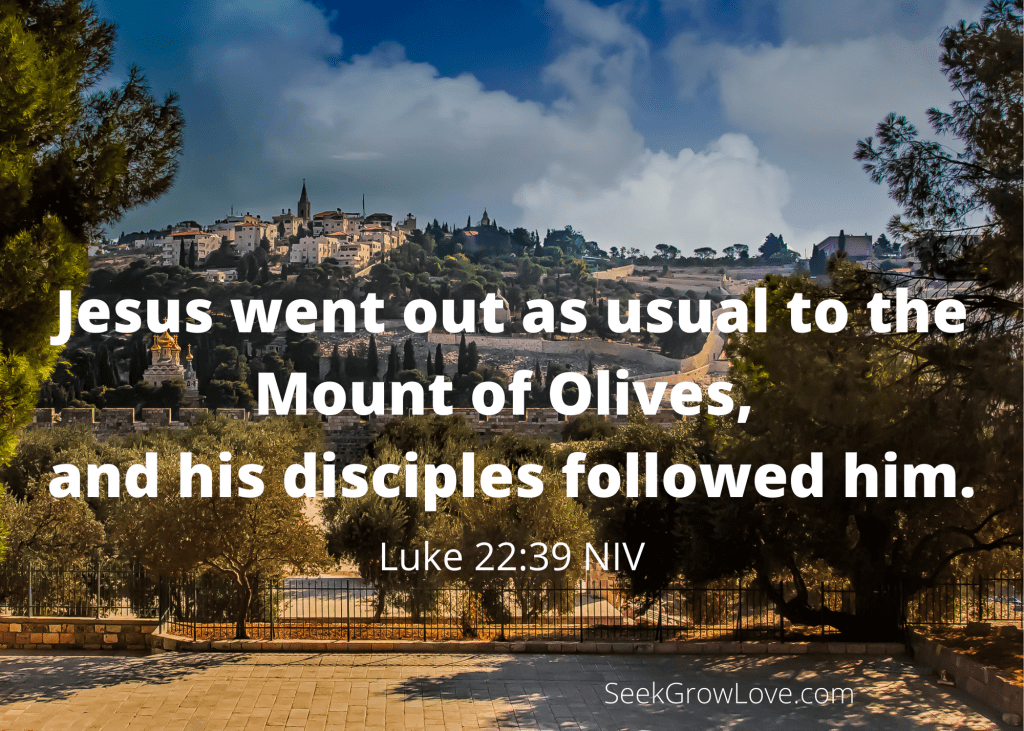
After Jesus finished the Passover meal with his disciples, he retreated to the Mount of Olives, which is just outside of Jerusalem, to pray. While there, he was arrested by a crowd led by Judas, one of his own disciples. Jesus’s choice to stay at the Mount of Olives was significant for two reasons: 

  1. Jesus knew Judas would betray him. 

In a previous conversation among the disciples, Jesus predicts that one of the twelve would betray him, even calling out Judas by name (John 13). The very night of the Last Supper, he makes a similar remark: 

“The hand of him who is going to betray me is with mine on the table” (Luke 22:21). 

  1. Judas knew Jesus would be at the Mount of Olives. 

During the week leading up to Jesus’s death, he and his disciples had spent every night at the Mount of Olives: 

Each day Jesus was teaching at the temple, and each evening he went out to spend the night on the hill called the Mount of Olives” (Luke 21:37). 

Judas surely knew where Jesus would be on this particular night, yet Jesus didn’t try to hide. 

Instead, Jesus invited Judas to his table to eat dinner together. 

Jesus stayed the night in the very place Judas knew he would be. 

You and I were a lot like Judas. We were full of ugly thoughts, misguided intentions, mixed-up priorities, and shameful feelings. Jesus saw our filthy sin, yet he invited us into his presence to give us freedom from it. The greatest irony is that the person who knows our flaws best, loves us the greatest. 

You are fully known, and yet you are deeply loved.

But God demonstrates his own love for us in this: While we were still sinners, Christ died for us. (Romans 5:8)

-Mackenzie McClain

Today’s Bible reading passages can be read or listened to at BibleGateway here – Deuteronomy 29-30 and Luke 22:39-71.

Loving the God who Loves You

Deuteronomy 13-14

You have been hand-selected to be a highly-valued and cherished child of the Most High and living God, the Creator of the ends of the earth. 

Do you believe that? I mean, do you truly and wholeheartedly accept that this is true?

So many people long to have confirmed that they belong and that they have purpose.

You, my friend in faith, have been confirmed for both! 

As if the verses from today’s reading don’t state it plainly, let’s look elsewhere in the New Testament. According to Ephesians 2:19, You are a member of God’s household.

And in the same chapter, just 9 verses before, it declares that you are God’s workmanship, created in Christ Jesus to do good works, which God prepared in advance for you to accomplish! 

If you accept your position and your purpose, then you need to start acting like it. 

  • Honor God by worshipping Him alone; avoid and get rid of anything, or anyone, that could lead you astray. (Deuteronomy 13)
  • Honor God by taking care of your body. (Deuteronomy 14:1-21). While this section of the chapter is referring to clean and unclean foods, something that the Israelites had to pay close attention to, we can extend the meaning to modern times and consider what we put into our bodies. 
  • Honor God with your stuff and by being generous to those in need. (Deuteronomy 14:22-29) 

Friend, God loves you more than you can possibly imagine. Love Him back, with all that you are. 

-Bethany Ligon

You can read or listen to today’s Bible passages at BibleGateway here – Deuteronomy 13-14 and Luke 15