What Does Jesus’ Death Mean?

Matthew 27 & Mark 15

Why is this devotion being written? Why are you reading this devotion? Why have you experienced supernatural life change in the name of Jesus? It’s all because of what we read in today’s section of Matthew and Mark, the crucifixion of our Lord Jesus Christ. The gospel accounts give us a point of view perspective of the final moments of the Messiah’s life. Why did Jesus die? According to Jesus it’s because it was the purpose of his life (Mk. 10.33-34), Judas betrayed him, and the Jewish leadership sought out his execution. 

But when we leave the gospels and enter Acts, the epistles, and the apocalypse (Revelation) new light is shed upon old truths about what happened at the cross of Christ. The rest of the New Testament, if you will, tills the soil of what we read in the gospels to reveal truths and realities bound in the death of Jesus. The cross is like a diamond when held up to the light. Depending on which way you hold the diamond the light will refract differently and reveal different aspects of the diamond. The cross is a multi-dimensional event with a number of faith-building, worship-inducing, Christ-glorifying truths and realities for the believer to soak up in the scriptures and to be consumed by the love of Jesus and the Father. 

This morning we will look at three meanings of the cross:

1. Jesus died to demonstrate the righteousness of God (Romans 3.25)

According to Paul in Romans 3.25 Jesus’ death demonstrated or put on display the righteousness of God. What is the righteousness of God? The righteousness of God is God’s own holy, perfect, blameless, and just character and being. Sin is a capital offense against God. Because he is holy, just, and good he cannot allow sin and rebellion to go unpunished. If he did this, he would then be unjust and not good. When Jesus died his blood covered every past, present, and future sin. Jesus’ death satisfied the wrath of God. When we look at the cross it tells us not only how much God loves us, it also shows us how much God hates sin and the penalty for sin. The death of Jesus demonstrates God’s perfect judgement and character. The cross says God will not let sin go unpunished. 

2. Jesus died to disarm the powers of Satan and darkness (Col.2.13-15)

When Jesus’ blood was shed the power that satan and darkness had over humanity was relinquished. The biggest weapon Satan and spiritual darkness can have against you is your own sin and from that, guilt, shame, and other consequences of sin. But when Jesus’ blood was shed the power and slavery that sin held over humanity was broken. The blood cancelled out our certificate of debt (list and penalty of sins) therefore, the power Satan once had was taken away. This is similar to Jesus’ teaching in Mark 3.22-27. The way Jesus conquered victoriously over the power of satan and spiritual darkness is through his death. Paul says in I Corinthians 2, that had the “the rulers of this age” (spiritual powers of darkness) had known what would have happened after Jesus died they “would not have crucified the Lord of Glory”. The death of Jesus breaks the yoke of slavery and oppression over our lives, we are rescued from the power of satan. 

3. Jesus died to provide us an example to follow in our own Christian walks (I Pet. 2.21)

Jesus, though he was tried and executed unjustly, still endured the cross to save his sheep (John 10). He surrendered his privileges and his rights and humbled himself for the eternal benefit of others. Likewise, we as Christians should consider the plight of Jesus and imitate him. When we are treated unjustly and unfairly we should not return evil with evil but instead love. When we suffer for doing the right thing we ought to entrust ourselves to God as Jesus did to his Father. 

When you read Matthew 27 and Mark 15 these three realities among others are present when Jesus breathed his last on the cross.

-Jacob Rohrer

Today’s Bible reading passages can be read or listened to at BibleGateway here –Matthew 27 & Mark 15

Tomorrow’s reading will be Luke 23 and John 18-19.

Love Like Jesus

Luke 22 & John 13

John 13 is the only chapter in the four gospels that record Jesus washing his disciples’ feet. In John 13.34 Jesus teaches “A new commandment I give to you, that you love one another, even as I have loved you, that you also love another”. What is the newness of this commandment Jesus gives his disciples and to us? I believe it is the phrase “even as I have loved you”. The way believers are to love each other is no longer patterned after how we would want to be loved (Lev.19.18) but there is a new way to love each other. The new pattern of love is Jesus himself. 

What does it mean to love other Christians like Jesus? This is a very tall order! Where do we start?! I believe the washing of the disciples feet provides a framework for what Jesus had in mind when he said love each other as I have loved you. 

There are two lessons/principles we can learn from Jesus in this account that we can emulate in our lives towards other believers. The first one can be read in John 13.4-5,12-15. Jesus illustrates humility. Jesus as Lord and teacher took the position of a common house servant when he got on his hands and knees and girded himself with a towel to wash feet. If anyone’s feet should have been washed it was Jesus yet the holy selfless Lord and teacher put aside his rightful privileges to serve his students. Jesus humbled himself. Likewise we as Christians are called to humble ourselves before each other and seek out the interest of others before ourself (Eph. 4.2, 5.21, Phil. 2.3-5). 

The second lesson we can learn form Jesus is that to love each other involves humbling ourselves before each other and serving one another in practical ways. The act of washing feet in antiquity served a very practical purpose. Most people wore open-toed shoes or sandals and people walked everywhere. The result was people’s feet would easily become dirty, rough, and caked with filth. No one would want to track the dirt through someone’s home so either the homeowner or a servant would wash the guests feet as they came in. It was practical for the guest and the homeowner. 

What is involved in loving other Christians as Jesus loved us? Looking at the real life illustration of Jesus washing his students’ feet, we learn to love one another involves humbling ourselves before others and serving them in practical ways. 

-Jacob Rohrer

Today’s Bible passages can be read or listened to at BibleGateway here – Luke 22 & John 13

Tomorrow we will read John 14-17.

Test Yourself!

Matthew 25

Today as we look at Matthew 25 we should take notice that though we are starting a new chapter the context surrounding this chapter is the same as that of chapter 24. Matthew 24 and 25 are a single unit of thought. This can be seen in verse 1 with the word “then” (the NIV says “at that time”) indicating what Jesus was speaking about in chapter 24 is continuing into chapter 25. The focus of the chapter is about the end of this age when Jesus returns and the judgement that he will enact. 

There are three pictures of judgement in chapter 25. The first two are parables (the parable of the ten virgins and the parable of the talents) and the last one is a description of the judgement scene. 

In the first parable there are ten virgins who wait for the bridegroom. The bridegroom delays in appearing and all fall asleep but suddenly the bridegroom appears but only five are ready for the bridegroom while the other five are not ready and they are denied entrance into the wedding feast. The virgins denied entrance are then told by the bridegroom he never knew them. 

The second parable is about a master and his slaves. The master gives each slave a talent (an amount of money) and went on a journey. When the master returns only two of the three slaves honored the master with what they were given. The third slave squandered his talent and is rebuked by the master and the slave is thrown out into the outer darkness.

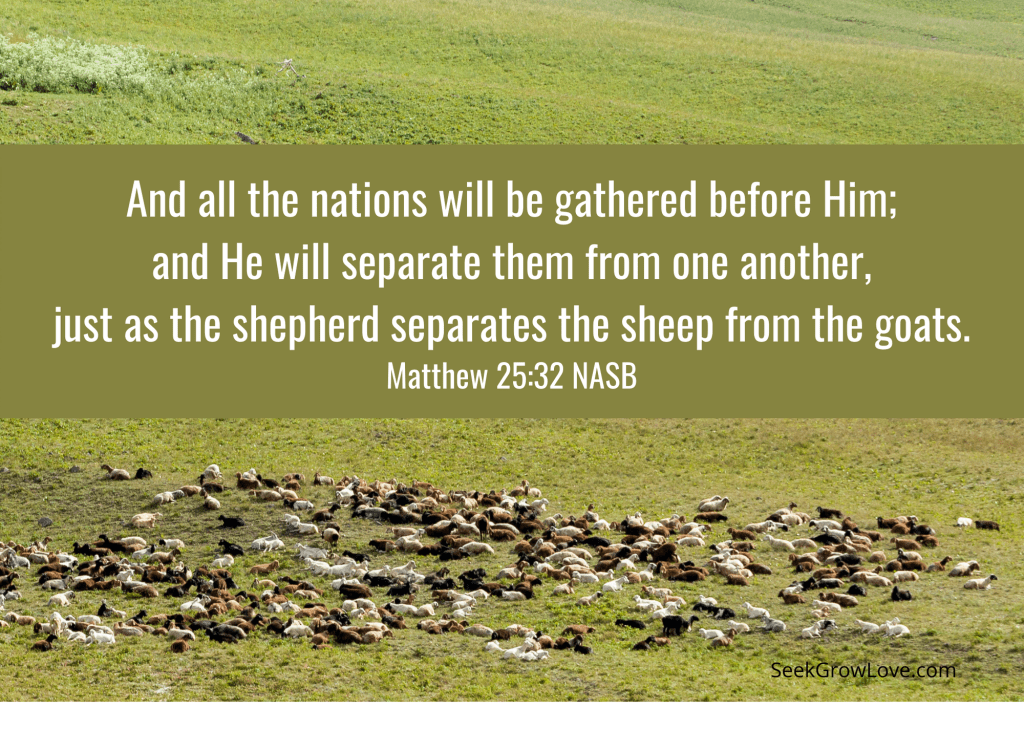
The third picture of judgement involves Jesus separating goats from sheep among the nations. The sheep and goats represent those who belong to Jesus and those who do not. The sheep (believers) are rewarded with the kingdom and the goats (non-believers) are cast into hell with satan and his demons. 

What are we to make of this chapter? What does Jesus want us to learn from these three pictures of judgement? I believe it is this.

There is a judgement coming and not everyone who calls themself a Christian will enter into life. The reality is, not everyone who calls themself a Christian is a true believer. In all three teachings there is one group of people who are then divided into those who are accepted and those who are rejected. Many people comprise the Church but not everyone who attends church is a true believer. The judgement of Christ sorts out the self-deceived from the real believers. Jesus himself teaches this earlier in Matthew 13.24-30, 36-43 in the parable of the tares. And he also teaches this in Matthew 7.21-22. 

Who are you? Are you deceived or a true believer in Christ? The five virgins were accepted into the feast because they were ready and prepared. The 2 slaves were honored by the master because they were faithful with what the master had given them. And the sheep entered the kingdom because they loved and served other Christians in need. 

A true believer will have evidence of salvation in their life. A true believer bears the fruit of the spirit, they grow in holiness, they grow in their disdain for sin, they hunger for the scriptures, they serve other Christians and people. A real believer matures and grows in Christ.

Paul tells the Corinthians in II Cor. 13.5 to test themselves against the scriptures to see if they are in the faith. Compare yourself to scripture and to the words of Jesus. Have you really received salvation from God? In addition to this, talk with mature believers closest to you about this serious matter if you question your salvation.

-Jacob Rohrer

Today’s Bible passage can be read or listened to at BibleGateway here – Matthew 25

Tomorrow we will read Matthew 26 and Mark 14.

The Greatest Commandment

Matthew 22/Mark 12

There’s a song on K-Love (Christian radio station) called “Love God and Love People” by Danny Gokey. The chorus goes “Gotta keep it real simple, keep it real simple bring everything back down to ground zero, cause it all comes down to this love God and love people”. The song is very catchy, yet while this command is simple at the same time it takes an entire lifetime to grow and mature in living out the greatest command God has given to his people. 

The greatest commandment is found in today’s passage and it comes from the lips of the greatest teacher who ever walked the earth, our Lord Jesus Christ. I could say much on this topic yet I will keep it brief and to the point. The two commandments Jesus states as the first and second most important come from the Old Testament. The first and greatest commandment, love God, comes from Deuteronomy 6.4-5. The second commandment, love people, comes from Leviticus 19.18. These two texts Jesus sees as the greatest commandments because the whole law of God can be summed up in these two commands. Also, Jesus not only tells us the two most important commandments but he gives us the divine priority of Christian love. God comes first and only then people. As Christians we do not love people first and then God. We love God first in priority then our neighbor. A blessed Christian life is one that seeks to love God before all else.

For the rest of this devotion, I want to focus on the first and greatest commandment. What does it mean to love God? To love God means to love him with our entire person or being. There are three aspects of our person that we are to love God with in Deuteronomy 6.4-5. These three are; the mind, the soul, and our might. 

To love God with our mind means primarily that we engage with the truth God has revealed about himself in scripture. In short, we love God when we read, study, and meditate upon the Bible. To love God with our soul means to love him with our emotions, affections, and desires. If we say we know God yet are unmoved by him, we don’t know him. It is impossible to love God and remain cold and indifferent. Our emotions do not form the foundation of our relationship with God but they do accentuate and enhance our experience of God. Lastly, to love God with our might is to love him with our physical body and ability and the resources he has given us. To love God with our body can mean using it for serving other people. 

To love God means to love him first in priority and to love him with every area of our life and being.

-Jacob Rohrer

Today’s Bible passages can be read at BibleGateway here – Matthew 22 and Mark 12

Tomorrow we will read Matthew 23 and Luke 20-21.

Be the Very Last

Matthew 17, Mark 9, and Luke 9:28-62

In each of our passages that we read today is the transfiguration of Jesus. Jesus had just asked them, “Who do you say that I am?” The Jewish people revered Moses and Elijah as great prophets of God. I believe that this vision was a way to show them that Jesus is even more than a great prophet. To the Jewish people God was always associated with the cloud. In Exodus, He was in the cloud that was leading them through the desert; when He talked to Moses, He appeared in a cloud; when the glory of the Lord was in the tabernacle, it was covered in a cloud, and when they dedicated the temple, the glory of God was associated with a cloud. 1 Kings 8:10 says,”When the priests withdrew from the Holy Place, the cloud filled the temple of the Lord.”

The transfiguration is showing them that Jesus is to be more honored than both of these men. Mark 9:7 says, “Then a cloud appeared and covered them, and a voice came from the cloud: ‘This is my Son, whom I love. Listen to him!’”  God is telling them, and in essence telling us, to listen to what Jesus is saying. To take his teachings to heart. Jesus is not trying to lift himself up and tout his own glory. He is trying to glorify the Father, and teach others about the kingdom.  Acts 3:22 reads, “For Moses said, ‘The Lord your God will raise up for you a prophet like me from among your own people; you must listen to everything he tells you.” Yes, they had other prophets but they paled in comparison to the Son of God, and we are told to listen to everything that he tells us. We need to make sure that we are reading and closely following what Jesus was teaching them. Today, there is a “Be Kind” movement.  Jesus started that movement years ago, it’s just now catching on. He said to “Love God, and Love others.” Pretty simple and straight forward. The world would be a much better place if we would all listen to the words that Jesus spoke. But we can’t just listen, we also have to act on the words that he said.

Sometimes we, just like the disciples, have a hard time living what Jesus was teaching. It goes against our natural desires, which is to look out for ourselves. Jesus tells them once again about his impending death and resurrection, and he sees them having a conversation. He asks them, even though he knew, what they were disputing about as they walked to Capernaum. They would not answer him, because they had been arguing over who would be the greatest among them. This story always reminds me of one of my children and their first cousin. When they were together, they always wanted to be first at everything. The first to get their food, the first to finish eating, the first in running, etc. So one day I told them, “In the Bible it says, the first shall be last and the last shall be first.” Then they both decided they wanted to be last, so they would then be first. They may not have learned the true meaning of these words. Mark 9:35 says “Sitting down, Jesus called the Twelve and said, ‘Anyone who wants to be first must be the very last, and the servant of all.’” With these simple words, Jesus has given us a fundamental truth. So many of the world’s problems would be solved if we would take these words to heart. If we would try to make others’ lives better instead of making our life better. If we would become the servant of those around us. Jesus typified this when he washed the disciple’s feet. He could have sat down and demanded that someone wash his feet, because he was the Son of God, but instead he showed true leadership by serving them. With his death he was serving all of mankind so that we would have a chance to share in the kingdom when he comes back as the King of Kings.

-Sherry Alcumbrack

Today’s Bible passage can be read or listened to at BibleGateway – Matthew 17, Mark 9, and Luke 9:28-62

Tomorrow’s passage will be Matthew 18 as we continue on our Bible reading plan. It’s not too late to jump on board to learn more and more about this King of Kings!

To Wash or Not to Wash?

Matthew 15 and Mark 7

Well, that was the question the Pharisees and teachers of the law asked Jesus: Why don’t your disciples wash their hands before they eat? Good question, most of us would agree it’s a good thing to wash your hands before you eat, and when you return from the marketplace, and several other times of the day. This Jewish delegation (comparable to today’s church leaders) were very curious about Jesus and his followers. They had traveled all the way from Jerusalem to Galilee (approximately 70 miles over rough terrain, most likely walking for 2 or more days) to check out this Jesus. They had heard about his many miracles and teachings, and had probably been around long enough to witness some as well. They were watching him closely to decide what they were going to do with this man. And then they saw a problem they could attack: Jesus’ disciples didn’t wash before they ate. It is interesting that Matthew says “your disciples”, Mark says, “some of your disciples”, but it does not say that Jesus didn’t wash – so it doesn’t appear the Pharisees could personally attack Jesus for his own uncleanliness – but what of his disciples? They asked Jesus, “Why do your disciples break the tradition of the elders? They don’t wash their hands before they eat!” (Matthew 15:2 – even with exclamation!)

Jesus quickly flipped the question around – “And why do you break the command of God for the sake of your tradition? (Matthew 15:3). And then he gave an example of how they enticed people to break God’s law which said to honor their parents. It appears they were encouraging people to give large showy gifts to God even when it meant they no longer had the means to provide for their aging parents. Jesus shows how the Pharisees had majored in the most minor issues (like pointing out someone’s dirty hands) and left the most important things neglected.

I think of my daycare children and all the potty-training and hand-washing I have taught over the years. I can certainly attest that hand-washing is very important. However, supremely more important is that child’s love for God and others. Imagine a child who is a beast all day long. Fighting with the other children, biting, ripping toys out of their playmates’ hands, yelling at authority, and screaming during lunch time prayer. But, they washed their hands very well before coming to the table. When I give a report to the parents at the end of the day how foolish it would be for me to congratulate them on a child who follows well the rules of man and has clean hands to eat.

Likewise, at the end of the day, we will stand before Judge Jesus. Some will expect to be commended. They did a really great job of following the laws of the land or the traditions of the church, they loved their family, excelled in their business and other man-made expectations. They always washed their hands before they ate. They were good people.

But, that is not what will matter. Jesus will be rewarding those who truly love God and love people – not just in their words but in their actions and sacrifices and daily priorities. Did they keep God’s law first, even when society said they should follow man’s law instead? Did they accept God’s son as the only way to salvation, even when the world said there are many different roads to salvation? Did they carry their cross, even when the world mocked and pointed fingers and threw accusations?

Beware of following the wisdom of this world and the traditions of men. It won’t get you where you want to be in the end. Instead, consider carefully God’s way, every time, and walk in it. In what areas of your life would God have you turn your back on the traditions of men and human rules and expectations to instead dive deeper and deeper into His way – love God, love others, accept Jesus, prepare for the Kingdom.

-Marcia Railton

Today’s Bible reading can be read or listened to at BibleGateway here – Matthew 15 and Mark 7

Tomorrow we will read Matthew 16, Mark 8, and Luke 9:18-27 as we continue reading God’s Word.

One Hand Washes the Other

2 Kings 5-8

2 Kings 5 16 NIV sgl

Over the course of the past few months, it would not be presumptuous to say that many of us have amended our handwashing technique; however, we have most likely been using one hand to wash the other for quite some time (hopefully with warm water and soap, too).  It is a mutually beneficial relationship, which makes both hands equally clean, each part repaying the debt to the other. This has become a beautiful analogy for many who do favors in expectation of a return. No matter how you say it, “one hand washes the other” or “you scratch my back, I’ll scratch yours” (which you will definitely need to wash your hands if you scratch someone’s back), going out of our way and doing the right thing can be advantageous to a relationship, a caching of IOUs, or marking our debt paid. Handwashing itself is definitely a biblical, Levitical principle, but is this tit-for-tat the way God works?  Should we expect a return when we have lived out the moral will of God? Should we be cleanly rewarded because we have taken a risk on someone else’s mess?


Today’s reading challenges us to think differently about the expectations of doing a good deed.  Naaman is healed of leprosy by the instructions ordained through Elisha.  Naaman was indeed searching for a cure, but as the many who came up to Jesus looking for healing, he had a curiosity about the God of Israel.  Overwhelmed by the healing, he asked Elisha if there is anything He can do in return? For a moment, think of your hospital bill if you were healed of a flesh-eating disease that could ultimately take your life, much less the deep appreciation you might have for your new quality of life.  Both would be truly astronomical.  Elisha could have asked for enormous amounts of wealth, power or favor in Syria, or even asked for a vow of protection from an enemy captain.  He wanted part of no such thing.  His whole purpose in helping is so that men, specifically Naaman, would know and confess “…Now I know that there is no God in all the world except in Israel…” – 2 King 5:15.  If we needed any further confirmation of this truth, Elisha’s servant is struck with leprosy after turning back to essentially say Elisha had changed his mind and would be happy to take a few things in return (2 Kings 5:26,27).


The Gospel of Jesus Christ is not a message of hand washing hand.  It is a message of hands washing feet. We are to be servants of God, and in turn, servants of those He loves, people.  We do not do these things because we can earn our spot in the Kingdom of God, or buy our way into his favor (Rom 6:23).  Our debt is so enormous, we could never repay it.  We become the beneficiaries of this gift when we humbly accept the healing instructions God offers us; that we would be made clean by the waters of baptism and know and live that there is no other god in our life, except the living, one true God of Israel.  When we act as God, meaning, when we act as an agent of His attributes (love, kindness, patience, truth, faithfulness, forgiveness, grace) we are not offering something that is from us.  We are offering God.  God’s terms have already been agreed upon; we do not have any additional conditions to bring to the table.  We are not owed, nor should we expect a return on such an investment we make with our life or provisions. God is the rewarder. Every good and perfect thing flows down from the Father (James 1:17).  Ultimately, we should not ever extend our hands out to expect a reward from God or anyone else. As we serve the Lord in whatever capacity he has called us to, we should extend our hands upward to give Him the praise because He is rewarding us in a literally astronomical way that will reshape the structures of heaven and earth.  We may lose all we have or be thought of as fools as we try to serve like Jesus, but we can truly never settle the score, or wash the hand of God, and that is an awesome, powerful, wonderful thing.

Aaron Winner

Today’s Bible passage can be read or listened to at https://www.biblegateway.com/passage/?search=2+Kings+5-8&version=NIV

Tomorrow’s reading will be 2 Kings 9-11 as we continue the 2020 Chronological Bible Reading Plan

Don’t Be a Hater

Proverbs 10-12

Proverbs 10 12 NIV sgl

I have a lot of thoughts and emotions swirling in my head after the death of George Floyd and all the events surrounding it afterward.  There is a lot to dig into and talk about, but I am going to keep this devotion simple by sharing some very pertinent verses from our reading in Proverbs today.

Proverbs 10:12 starts out by saying that hatred stirs up conflict.  Well, that has certainly been proven true.  If you want to dig to the core of this whole problem, racism, you will find hatred there.  People have chosen to hate someone based on the color of their skin.  Some of this hate is intense, and unfortunately leads to death at times, but there are also many people that carry with them a milder form of hate that still makes the problem worse even though it may not be so blatant.

So how should we combat hatred?  The second part of verse 12 says that love covers over all wrongs.  Love is what is needed to make this situation better.  Considering everything that has happened, you might not be feeling that right now.  There is a lot of anger out there, and it is ok to get angry sometimes.  Some things are worth getting angry over. However, that anger can’t last.  It will ruin you and those around you if you hold on to anger for too long.  There have been many wrongs through the years that can’t be undone, but love can cover those wrongs, and forgiveness needs to be part of that love.  The wrongs can be forgotten with forgiveness and love.

You have a choice to make.  Are you going to be part of the problem or part of the solution?  Proverbs 12:18 states, “There is one who speaks rashly like the thrusts of a sword, but the tongue of the wise brings healing.”  You can speak harshly and blame people for their wrongdoings.  You might even be accurate about what you are saying, but if your tone is cruel and insensitive, it is like piercing them with a sword.  A wise person’s words are softer, gentler, loving, and empathetic, which brings healing.

I think it is safe to say that most people have been feeling anxiety over what has been happening.  The first part of Proverbs 12:25 says that anxiety weighs down the heart.  I’m sure many of you have experienced that during these trying times lately.  The good news is that there is a cure for your heart.  The second part of verse 25 says a kind word cheers it up.  Again, you can choose to speak harshly to others about what they have done wrong and make the wounds worse, or you can say something kind to help make their heart glad.

Proverbs 12:20 goes one step further by saying those who promote peace have joy.  Peace feels so good and it is what most of us strive for.  If you can promote peace, even in very small ways, it will bring joy to your heart.  The only thing that will completely end racism is the return of Jesus, but that doesn’t mean we should just give up until then.  I encourage you to make this world a better place one person at a time.  You can’t solve this whole problem by yourself, but you can make it better by being a light to the individuals you come into contact with in your daily life.

I am not saying we all need to pretend nothing happened and try to live happily ever after.  There are many conversations that need to take place and changes need to occur.  I am saying that we need to embrace the wise words from scripture and go into those conversations with love, not with hate boiling on the inside.  You also need to search your own heart to see if there is any hatred there, no matter how strong or mild it may be, and rid your heart of that hatred.  Hatred stirs up conflict, but love covers all wrongs.

Rick McClain

Today’s Bible reading can be read or listened to at https://www.biblegateway.com/passage/?search=Proverbs+10-12&version=NIV

Tomorrow’s reading will be Proverbs 13-15 as we find more of God’s wisdom on our 2020 Chronological Bible Reading Plan

Ooh La La

Song of Songs 1 to 8

Song of Songs 7 10 NIV sgl

Song of Songs…it’s in the Bible, and since we are going through the whole Bible, someone needs to write about it.  I know Marcia was probably a bit apprehensive when she saw that I was the one that signed up for this book, but I am very experienced with this topic, so I think it is a good fit.  When I was much younger, I wrote a poem about my girlfriend and gave it to her, and she is now my wife.

You may know this book of the Bible as Song of Solomon, but in the original Hebrew it was called Song of Songs.  It is saying that this is not just a song, it is the song of all songs, like King of Kings and Lord of Lords.  I must admit, it is a very unforgettable song and I was a bit surprised to learn such a book was in the Bible when I first read it long ago.  For some reason my Sunday School teacher did not cover this part of the Bible with us when I was a child.

The visuals painted in these chapters about a bride and groom are very sexual in nature, but is that what this book is about?  Some say it is an allegory of Jesus and his bride, the church.  I doubt this is true because Jesus wasn’t even around in the Old Testament when this was written.  I don’t think the concept of the church being the bride of Jesus was known back then so why would someone write an allegory about that?  It is also believed by some that it could be an allegory about God and the people of Israel.  There are no doubt similarities between the relationship of a bride and groom and the relationship between God and His people, but why would someone use such erotic sexual material to describe how God thinks about Israel and vice versa?

I believe it is love poetry and I am thrilled that the Bible has affirmed that the sexual desire I have for my wife is a good thing.  I know that will make some of you squirm a bit because we don’t usually talk about this stuff, especially in church.  However, I think one of the main points of this book is to show that the physical attraction between a bride and groom is a beautiful thing that God has created for them to enjoy.

I could be very wrong about this, but how much does that matter in this case?  What if it turns out it is about Jesus and the church?  It is perfectly ok for people to have different opinions about topics such as this because it will not affect your salvation if you are wrong.  I really look forward to the day when we will be able to sit and talk with the authors of the Bible and ask them to explain what they were writing about.  I can’t wait to be in the same room as God and Jesus and listen to them talk about so many things we weren’t totally sure about.  That does not mean we should twist meanings and be wrong about things that are plain to see, but you must admit that you don’t completely understand everything.  It is sometimes ok to say “I think” something is true without being 100% positive it is true.

But back to the song of all songs.  I am not going to go in great detail here about this book because you should read it for yourself.  I couldn’t stop thinking about how much in love these two seemed to be.  It reminded me of when you see two young people in love, and their love is just oozing all over each other so much so that they don’t even notice anyone else is around.  They can’t stop smiling at each other and they are on cloud nine.  We usually roll our eyes at them and think they are being ridiculous, but this is exactly the kind of love that was on display in these eight chapters.  Solomon gushed about her eyes, hair, neck, lips, and body parts that reminded him of fawns, but it didn’t stop there.  I knew this was a story about real, intense, true love when he mentioned her teeth.  He didn’t just say she had beautiful teeth, he said her teeth were like a flock of newly shorn ewes.  Don’t picture dirty ewes that have been rolling around in the dirt, Solomon said the ewes had just come up from their washing.  Moreover, all these ewes bore twins, and not one of them had lost their young.  He said all of that about her teeth!?!?  That dude was crazy in love!  And she was just as ridiculous as him, which can be seen when she says her beloved is like a cluster of henna blossoms from the vineyards of Engedi.

We might shake our head if we saw a bride and groom going on and on about each other like that, especially since they focused so much on the physical aspects of love, but this is not a trashy book from the local bookstore, this is a poem about love in the Bible.  The Bible teaches us that true love is on the inside, but this book teaches us that true love can be on the outside as well.  Our world has made a complete mess of love on the outside; not all love between any two people on the outside is good.  However, when a bride and groom love each other on the inside, God created another way for them to show that love.  Song of Songs is not a ridiculous poem to shake your head at; it is a beautiful expression of how much two people can love each other.

Rick McClain


Today’s Bible reading can be read or listened to at https://www.biblegateway.com/passage/?search=Song+of+Solomon+1-8&version=NIV

Tomorrow we begin the book of Proverbs – chapters 1-3 – as we continue the 2020 Chronological Bible Reading Plan

Extreme Grace

2 Samuel 8-9 and 1 Chronicles 18

2 Samuel 9 3 NIV

I somewhat recently took a job as a Residential Counselor at Residential Treatment Facility for youth in the teenage age range. These kids have had severe traumas in their lives and have had terrible things done to them and happen in their lives. Most of them have terribly dysfunctional families that have hurt them in extreme ways. In order to cope and also survive through learned behavior they verbally and sometimes physically abuse staff for reasons as simple as being told “No.” There are times they will use all the ammo on you to try to hurt you or get a rise out of you. This isn’t normal teenage behavior like saying I hate you or You are dumb. Think the worst things that people have ever said to you. Now I want to be super clear that these behaviors are not entirely these kids’ faults. They’ve simply been dealt an unfair hand and do not entirely have the capacity to behave in ways other than this.

One night, I was handling a situation with a kid where other kids had lied to a girl, I will call Ivery, and told her the lie and how I reacted to the situation. In an attempt to advocate for the youth on the unit she proceeded to call me every name under the sun. She called me a pervert. She made fun of me in every way she could think of and then because she knew I had a girlfriend started to say anything to get a rise out of me in that area of my life. Finally, when she was running out of ammunition to get me off kilter, she threatened to kill me, my family and my girlfriend. Now, I knew she couldn’t actually pull that off but it was quite an experience to be threatened like that. I responded as best I could and didn’t try to discuss anything when she was just looking for an argument. After the fact I was definitely hurt that anyone would say those things about me.

I would love to say my next shift I just showed up and loved her and it all went away but those feelings stuck with me longer than I would have liked them to.

2 Samuel 9 is a great example of a man who despite what was done to him didn’t let the actions of other people affect how he treated overs. In this chapter David is looking for someone from the house of Saul to bless on account of Jonathan, Saul’s son. If you remember, this is the same Saul who had chased David through the desert and caves all over Israel seeking to kill him. This wasn’t just a brief period of time. Some scholars imagine this time period to be 7 years!! I can’t imagine what I would feel toward my oppressor after being chased under threat of death for even 3 years. All the same, I feel David’s desire to try to find someone from Saul’s house to bless is an amazing story of forgiveness. I could probably write a whole devotion about that but I want to focus on one particular verse of this awesome story.

In verse 3 David is talking to Saul’s former servant and asks him, “Is there not still someone of the house of Saul, that I may show the kindness of God to him?”. This whole line is crazy to me. David is asking and even seeking out someone to bless from the house of Saul. I’ll be honest, most my kindness doesn’t go past the people I interact with. It stays in my world. I am not seeking out people that I can bless.

Let alone am I seeking out people from the family of the man who had just tried to kill me for 7 years and literally only by his death could I return to my home country. But that is David, the man after God’s own heart. This is extreme grace, thoughtfulness and care that he would go out of his way to search out a man from Saul’s house to bless.

The phrase “that I may show the kindness of God to him?” says once again so much about David and how he viewed everything. David releases in this simple phrase any form of ownership to how he was going to bless Saul’s relative. He points it directly back to God. He didn’t try to take the credit and say look at my kindness to my enemy. He identifies back to God.

This line continues to show just how much David acknowledged the fact that what he had wasn’t his. He lived in continual recognition that what he had been given to him was by God. He acknowledges his forgiveness isn’t from himself. His kindness isn’t his. His life isn’t his. His kingdom isn’t his. It is God’s.

He viewed the world not “how can I be kind to people” but rather “how can I show God’s kindness to others.” While the difference is oh so subtle, one is making our good deeds about us and the other is pointing the kindness back to God. David recognized as a servant to God it was no longer him doing it. It wasn’t his resources that he was using to bless this descendent of his enemy it was God’s that he was temporarily in possession of.

Now, in the same way I had the opportunity to show God’s kindness to Ivery the next day by overwhelming her with love or by showing her kindness. Don’t let opportunities slip by in your own life to give away something that isn’t ours. Rather, give away what God has given you to give away.

Daniel Wall


Today’s Bible reading can be read or listened to at https://www.biblegateway.com/passage/?search=2+Samuel+8-9%2C+1+Chronicles+18&version=NIV

Tomorrow we return to the Psalms (50,53,60,75) as we continue the 2020 Chronological Bible Reading Plan