Have there been times in your life where you’ve been taken somewhere you didn’t expect? Last spring, I was taking a drive when I became lost on some of the backroads. I was filled with uncertainty about my location and starting to get anxious about finding my way back. As I found myself where I didn’t expect to be, a lost lamb appeared on the road. It was nearly hit by oncoming traffic as it frantically sprinted down the pavement. The cream and brown spotted lamb was panting from exhaustion. It was scared and confused. Because I was at this unexpected intersection, I was able to get the lamb off the road and put it in my truck. After searching for its farm and calling the sheriff, eventually it was reunited with its home. Sometimes it is the places that we don’t see coming, where we prove to be the most useful.
In Acts 28 we learn about Paul’s experiences on the island where he and the rest of the people on his ship came to be shipwrecked. As we read yesterday, Paul’s journey was quite wild. But God had delivered them safely to this Island called Malta. When Paul left for Rome, he probably never expected to make a pit stop, let alone be shipwrecked at this place. Yet, this was where he was taken, and it was not without purpose.
On this island, in the middle of the Mediterranean, Paul was able to interact with the people. These inhabitants of Malta saw something different about Paul as they had witnessed him being delivered from the sea and from a snake bite. And then Paul was able to pray for and heal their sick. An island that might not have been a priority for people of that time to take the gospel to had nonetheless witnessed it through Paul’s unexpected stay there.
So, although this time and stay in Malta had been unexpected, it proved useful and it exposed others to the One True God. So, while you may at times find yourself in an unexpected place, do not be discouraged. Sometimes it is the most unexpected places in our lives that God uses us for an unexpected purpose.
-Hannah Deane
Today’s Bible reading passages can be read or listened to at BibleGateway here – 1 Kings 13-14 and Acts 28
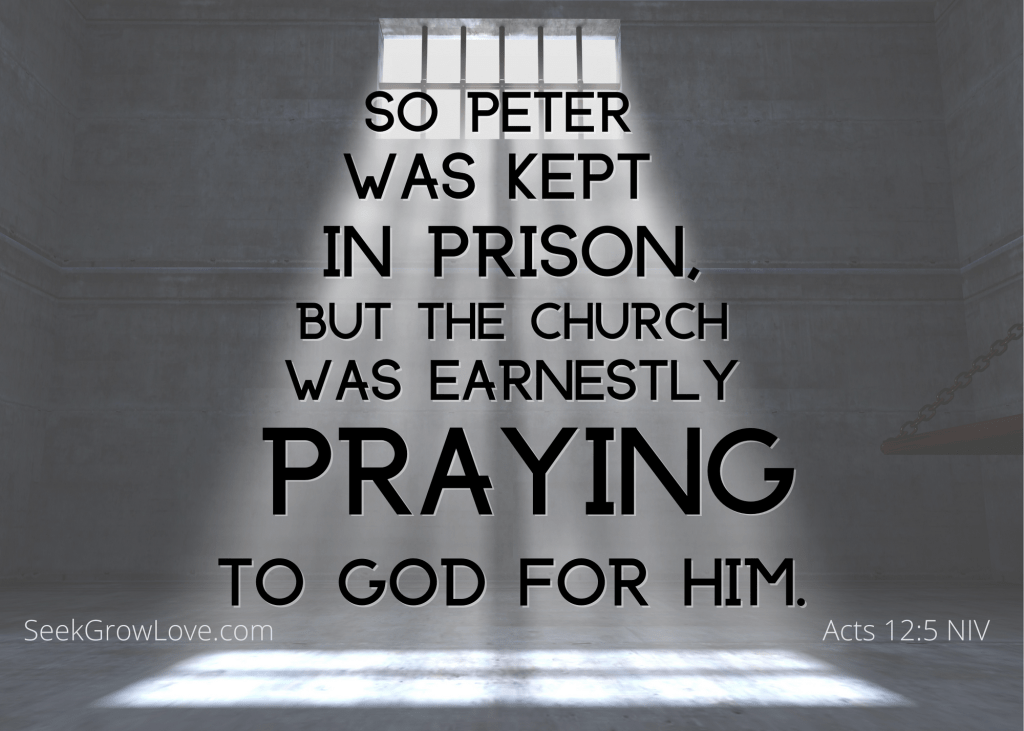
You know that feeling when things are going so well that you question if you’re dreaming? Maybe you ask someone nearby to pinch you or maybe you pinch yourself. Either way, this is the feeling I imagine Peter had the night before Herod was going to bring Peter to trial. I’d encourage you to listen to Acts 12. As you listen, visualize what this could have looked like. Go ahead and use a little bit of imagination, as we’re not given pictures to accompany the stories in the Bible. If I’m being honest, I sometimes forget that the Bible is a literary text, but this chapter allows me to pick out some details and things that make me consider the (historical) story, and smile.
I’ll mention a couple parts that I really like about this chapter, but other parts might jump out at you.
v. 7 – Peter must’ve been a heavy sleeper! First the angel appeared, with a light. That didn’t wake Peter, so the angel struck (or smote) him. A gentle, “Hey Peter, time to wake up” with a rub on the shoulder didn’t cut it…
v. 9 – Peter didn’t know what was happening. He thought it was a vision. I like how he follows the angel’s instructions though. I think this is a good example for us to follow. Even when we may be a little confused about what God wants us to do, we should still obey and follow through with whatever it is.
v. 11 – “Now I know without a doubt”. I like how confident Peter is at this point. Before he thought it could be a vision. Now he knows that this is real life, and this is all part of God’s plan.
v.14-16 – I understand Rhoda was excited, but it makes me giggle how she didn’t even open the door for Peter. She was so excited that Peter had to keep knocking! 🙂
I like this chapter a lot. I will be working at being confident while following God’s plan for me and I will work at being as excited as Rhoda about what God is doing in my (and others’) lives!
-Moriah Railton
Today’s Bible reading passages can be read or listened to at BibleGateway here – 2 Samuel 5-6 and Acts 12
Today, I’d like to focus on two more aspects of the church, both of which defined the church in its earliest days: purity and persecution.
Purity
Yesterday, we read how God used his church to care for the least fortunate. No one in the church had any need. One of the ways this was accomplished, remember is that those who had property would sell it and give the proceeds to the church. There was no demand or command to do this, but those who did were honored by the church. In Acts 5:1-11, we read about a husband and wife duo who tried to buy the affection of the church. They sold a piece of property, but kept back a portion. But that wasn’t the problem. In verse 7, Peter asked Sapphira whether this was ALL the money they received for the land. THAT was the lie. They wanted everyone to think they were just as good as those who gave ALL their money to the church.
But the church is not about building up our own ego. The church is about caring for those who need help. When Ananias and Sapphira lied, they lied to the Holy Spirit and they lied to God! In our world, some use church or religion for their own status. God has shown since the birth of the church that he’s not fooled. He desires to keep his people pure, focused on his mission, his goals, and not on themselves.
Persecution
The disciples kept proclaiming Jesus. Those who were powerful were being told there was someone more powerful. Those who denied the resurrection were shown there was a resurrection. Those who considered themselves righteous were proven to be wicked. That is going to make people mad. They had told them that they couldn’t preach in the name of Jesus, but the apostles reply “We must obey God rather than human beings!” What an AMAZING testimony. They are not worried about people. They aren’t worried about the commands of men, of governments, of those who can kill the body but not the soul.
God said “Go!” and so they go. Jesus said “Disciple others!” and so they disciple. The Holy Spirit gives them words and so they speak.
Because of this, they were flogged (v40) and ordered not to speak. And the reaction of the disciples is fascinating. They were rejoicing. Rejoicing because they were counted worthy to suffer disgrace. Counted worthy to suffer. God thinks of them highly enough to be humiliated.
Because in our humiliation, in our suffering, in our rejection, we look most like Jesus. God reverses our fortunes in the same way that he raised Jesus from the dead and sat him at his right hand.
In our humiliation, God gives glory.
In our suffering, God gives joy.
In our rejection, God gives acceptance.
In our weakness, God gives Jesus.
May you, my brothers and sisters, be more like the early church, today.
May the message fill your mouth and the mission compel your feet.
May the Spirit of God give you power and the love of God give you passion.
May the dedication of the apostles and the purity of the church define your own worship of God.
May you do all this so that God is glorified, Jesus is honored, and many find faith.
-Jake Ballard
Jake Ballard is pastor at Timberland Bible Church. If you’d like to hear more from him, you can find Timberland on Facebook (https://www.facebook.com/TimberlandBibleChurch/ ) and on Instagram (https://instagram.com/timberlandbiblechurch?igshid=t52xoq9esc7e). The church streams the Worship Gathering every Sunday at 10:30. Besides studying and teaching God’s word, he is raising three beautiful children with the love of his life, plays board games and roleplaying games with amazing friends weekly and recently celebrated both Cinco de Mayo and May the Fourth (Be with you). If you’d like to reach out to talk Bible, talk faith, or talk about Star Wars, look Jacob Ballard up on Facebook (https://www.facebook.com/jacob.ballard.336 )or email him at jakea.ballard@yahoo.com. God bless you all!
Today’s Bible reading passages can be read or listened to at BibleGateway here – 1 Samuel 21-22 and Acts 5
To be a follower of Jesus means a life of swimming against the current. What does it mean to swim against the current? Think of a salmon. It is born in a river, follows the current out to the ocean when it is young and grows stronger and then with valiant effort it swims against the current up the river back to the spawning ground where it multiplies by laying or fertilizing eggs.
Followers of Jesus spend their lives swimming against the current in order to be fruitful and multiply by sharing the gospel and making more disciples. Disciples have to resist the forces of nature that want to carry us the opposite direction (along with the rest of the world) and resist the predators (for salmon it’s bears and fishermen- for Christians it’s the evil one and sinful temptations of the world.)
Because we are swimming against the current of society we often find ourselves doing the opposite of what everyone else is doing. Today’s story of Hannah gives a good illustration of one who was swimming against the current of her day. As you read the story it’s important to remember that parts of the Bible are descriptive and parts of the Bible are prescriptive. It’s like when you go to the doctor with a health issue. The descriptive part comes when you tell the doctor what’s going on…. where does it hurt, and when the doctor runs test to evaluate what is causing your symptoms. The prescriptive part is when the doctor tells you his recommendation of the best way to treat the problem. Take a pill, do an exercise, cut something out etc… In the story of Hannah one of the descriptive parts is that the man Elkanah has 2 wives- Hannah and Peninnah. The Bible is describing what was commonly practiced at that time- multiple wives. It is not prescribing polygamy, having many wives, as a good or right practice. It would be a mistake to read this story as giving sanction for the practice of polygamy today. Note that there are prescriptive passages in the Bible that clearly state that marriage should be between 1 man and 1 woman. It’s important to clear this up because many errors come when we confuse a descriptive passage in the Bible for a prescriptive one.
One can also note here why polygamy is not a good idea from a relational standpoint. One wife was fertile and able to have children and one was not. The fertile wife Peninnah bullied Hannah because of her infertility and this caused poor Hannah a lot of emotional pain. (Note in other descriptive passages in the Bible where polygamy is practiced it always includes jealousy and strife so we should learn the importance of monogamy by observing all the bad that comes when it is not rightly practiced).
Israel was a pretty immoral place at this time. This comes at the end of the period of Judges, if you recall Sunday’s devotion it was a time of lawlessness when “everyone did what was right in their own eyes.” They carried over even in the realm of the sacred. The high priest, who at this time in Israel’s history lived in the town of Shiloh, had 2 sons who were thugs. They bullied people into giving them the best parts of the sacrifices, the parts that were supposed to go to God. They were also sexually deviant and used their power as priests in Israel to force young women to have sex with them. Meanwhile, their Father, Eli the high priest allowed his sons to carry on their immoral thuggery with no correction or consequences. They were pretty much all going with the flow, following the stream of everyone doing what was right in their own eyes like the rest of society.
Elkanah was going with the flow with his multiple wives, Peninnah was going with the flow by using her blessing and fertility as a weapon against her rival wife, Hannah. They were pretty much all flowing strongly away from God’s will and ways.
By contrast to all those going with the flow, swimming against the stream’s current like a good salmon, was Hannah. She came to Shiloh, she fervently prayed to God for help. She promised God that if He gave her a son she would give him back in service to God. She prayed with such emotion that Eli the priest thought she was drunk (she wasn’t, she was just passionately mourning her infertility and the abuse she was receiving while seeking God’s grace and mercy- people who are swimming against the stream are often mistaken for being drunk or crazy, think about the Apostles on the day of Pentecost, or Jesus, whose own family thought that he had lost his mind).
The high priest, Eli, came to Hannah and asked God to grant her the request. God was listening and “He remembered her.” Hannah gave birth to a little boy, she named Samuel, and as she promised, when he was old enough she gave him back to God. Samuel would grow up to be a priest and serve God in worship.
Hannah’s prayer in chapter two is a beautiful song of thanksgiving to God. From one who was swimming against the currents of her time, when everyone else was laughing, she was weeping. But now, God has heard her cries and pleading and God has visited her with blessing and turned her tears into songs of praise.
Jesus takes this same theme in some of his final words found in John 16. For three years Jesus has been teaching his disciples how to follow him. They are to take up their crosses daily. Jesus teaches them to take the narrow path that leads to life instead of the wide path that ends in destruction. Jesus teaches them how to be good salmon, swimming against the current of society on the way to judgment. Jesus warns them that they will be going through some painful times in the days ahead. While everyone else is celebrating his rejection, condemnation and crucifixion, they will be mourning. But Jesus also promises that afterwards, their sadness will be turned to joy:
“Very truly I tell you, you will weep and mourn while the world rejoices. You will grieve, but your grief will turn to joy. A woman giving birth to a child has pain because her time has come; but when her baby is born she forgets the anguish because of her joy that a child is born into the world. So with you: Now is your time of grief, but I will see you again and you will rejoice, and no one will take away your joy.” – John 16:20-22
Friend, being a salmon can be tough. It requires a lot of effort. As Dallas Willard once correctly pointed out, salvation is free and cannot be earned, the gospel is opposed to earning, but it is NOT opposed to effort. It takes a lot of hard work to be a salmon and a disciple. Swimming against the current, when everything is working together to try to pull you in one direction can be painful and exhausting. Like Hannah and like the disciples of Jesus, when everyone else is celebrating, you could find yourself crying. But take heart and keep swimming against the stream, because one day your sadness will turn to joy, and no one can take that away from you. Following Jesus is the way that leads to life, true life, everlasting life and joy.
-Jeff Fletcher
Today’s Bible reading passage can be read or listened to at BibleGateway here – 1 Samuel 1-2 and John 16
If you’ve not yet read today’s scriptures, especially Judges 19-21 you should read them now. Right now! Go ahead, I’ll wait patiently while you read this very disturbing story. (Be sure to read it in an easy to read version like the NIV or ESV and not KJV so you don’t get lost). Did you read it? How did you feel while reading it? Disgusted? Angry? Sick to your stomach? To be honest I felt all of those things and I feel all of those things whenever I read it. It is like watching a Netflix docuseries about horrible rapes and murders, only it gets much worse because it goes from rape and murder to all out warfare…a virtual bloodbath. Made worse by the fact that these are cousins fighting each other.
How sick is it to see a bunch of thugs demanding to gang rape a houseguest? How sick is it that a young woman is given to the sex-crazed angry mob who end up raping her and murdering her and leaving her body on the front door? How truly bizarre that the husband then cuts up her dead body and sends it all over the country? How crazy is it that this results in war with thousands of cousins killing each other? And how truly bizarre that the war is resolved by encouraging a bunch of warriors to kidnap virgins and drag them home and force them to be their wives? You couldn’t make up this kind of sick, twisted, debauched behavior… and yet here it is in the Bible? What on earth is going on?
Two verses stand out- the first verse and the last verse. It begins with Judges 19:1: “In those days Israel had no king.” The last verse is Judges 21:25 “In those days Israel had no king; everyone did as they saw fit.” Those two verses essentially explain all of the chaos, vile and disgusting behavior that goes on throughout the story. Human beings do not survive very well in situations of complete anarchy. In school you may have read the book The Lord of the Flies. It’s about a group of young boys during WWII in England who are taken away from the country for their own safety to protect them from the war. Their plane crashes on an Island and the boys survive with no adult supervision. What happens when you have a bunch of schoolboys together with no adult supervision? Absolute chaos. What happens when you have a country where there is no leadership, no law and order? Absolute chaos. That is what was going on in Israel at the time of our story in Judges. “Everyone did as they saw fit.” That’s a recipe for lawlessness.
Those of you living in the United States have gotten a little taste of this during the past year. In places where demonstrations and protests turned into riots, in places where all law and order broke down, and for a few minutes at the US Capitol on January 6, 2021 we saw examples of what happens when “everyone did as they saw fit.”
After God brought His people out of slavery in Egypt, one of the first things that he did to help form them as a community was give them 10 commandments for how they were to live. He also gave them instructions for how to worship, what foods to eat and not eat, and instructions for how to respond to infectious diseases and how to properly dispose of human excrement and dead bodies. He gave them rules about who you could and could not have sex with: you can have sex with your husband or wife of the opposite sex. You cannot have sex with your sister, your mother, your aunt, your neighbor’s wife, people of your own gender or your animals. God did His best as Israel’s king to create order and stability within their communities so that they could be healthy, have strong families and communities and live long and prosperous lives as His chosen people.
Some people followed God’s instructions for their lives and prospered. Others rejected God as King and His instructions. By the time we get to Judges 19-21 we arrive at a place of near anarchy where “everyone did as they saw fit.” And that is how we get the story of the tribe of Benjamin trying to gang rape a cousin, murdering his wife, the man cutting her to pieces and it leading to a civil war that ends only after a bunch of virgins are sex-trafficked (abducted and taken by force to be wives). That’s how lawlessness worked then, and that’s how it still works today and if you don’t believe me just watch a Netflix documentary (or the news every day on tv.)
Jesus shows us a better way in John 13. Jesus is God’s choice to be Israel’s king. He is worthy to be king because he is both humble and loving and also obedient to His father and His God. Jesus shows his humble love by kneeling down and washing the feet of the people over whom he will serve as King. Jesus the king loves his servants enough to wash their dirty feet, and to die for them. That is a king we can follow. That is a king we can love. That is a king who will one day restore order and bring a final end to lawlessness and chaos and make all things right. This is a King whose words and example and life we can follow.
-Jeff Fletcher
Today’s Bible passages can be read or listened to at BibleGateway here – Judges 19-21 and John 13
As I was reading through Judges chapters 3 and 4 I had visions of Chuck Norris. If he was armed with just one wooden pole with a metal tip (an oxgoad) could he take down 600 men like Shamgar did to save Israel? (Judges 3:31)
And, have you ever seen Forged in Fire, a competition between craftsmen who make handcrafted weapons and then put them through various tests to see which will be judged the best? I bet the judges would be impressed with the 18 inch double edged sword left-handed Ehud made that sliced through King Eglon’s belly until even the handle sank in surrounded by fat and the blade came out the back. A pity to have to leave such an impressive sword behind as Ehud cleverly escapes with his life and then leads an impressive rebellion against Eglon’s Moabites. 10,000 Moabites were killed that day and Israel victoriously rules over them for the next 80 years. (Judges 3:15-30)
And it’s hard to decide who should get the Wonder Woman award of the Bible. Both Deborah and Jael are incredibly strong and worthy candidates. Deborah, the wise judge of Israel who is bolder than Barak. She agrees to ride into battle alongside the captain of the army who wouldn’t go without her. And when the exhausted commander of the enemy army thinks he’s found safe haven in the tent of Jael, he sleeps, and she drives a tent stake through his temple and into the ground. Those, are some strong, brave ladies! (Judges 4:8-22)
God did indeed provide some very tough, courageous, wise, strong and capable men and women to fight for Israel when they were in need, surrounded and afflicted by their enemies, if they called out to Him. But, what got the Israelites into these messes over and over again? Hadn’t Joshua helped them clear the land and give them rest? The problem is – they didn’t stay faithful to the Lord. “They forgot the LORD their God and served the Baals and the Asherahs.” (Judges 3:7b NIV).
How could they forget God? After all that God had done for them, over and over again through the generations. What caused their falling away, over and over again? The verse immediately preceding explains what happened. Judges 3:6 says (with my added pronoun descriptions), “They (the Israelites) took their (the unbelievers they lived amongst) daughters in marriage and gave their own (Israelite) daughters to their (the unbelievers they lived amongst) sons, and served their (the unbelievers they lived amongst) gods.” They forgot God because of who they chose to marry. Their spouses brought false and foreign gods into their marriage, into their homes, and before long into their hearts and minds and children and future generations, too. You can’t become one with an unbeliever, or a false god worshiper, and have it not negatively impact the way you love and serve the One True God. And when they served false gods it wasn’t long before God’s anger brought devastation, invaders and great trials upon them.
We all know what to look for in the perfect mate – we’ve watched the Hallmark Channel, too! She/he makes me feel special and happy, has a great sense of humor, would make a fantastic mom/dad, loves all the things I love, makes me want to be a better person, has a lot of social media friends, is super polite and friendly, has a great shoulder to cry on, shares my political and moral persuasions, even my parents like this one, has a great work ethic, we agree on the correct number and kinds of kids and pets, is so much fun to be around, is talented and smart, is quite romantic, will be a great provider, is kind to the earth, speaks my love language, is a fabulous cook and likes to clean toilets, is even good-looking, doesn’t mind my (fill-in-the-blank), and we are madly in love soul-mates.
Nope. Not a good match. Don’t tie the knot. Try again.
This time, first and foremost look for and insist upon one who loves and serves the One True God, just like you.
Period. That’s the most important. It is not a negotiable. It is not a character trait you just hope develops with more time. It is not worth the risk when the wrong spouse so easily leads to forgetting and falling away from God. It’s not worth the risk of falling into God’s wrath. “Don’t be unequally yoked with believers”, Paul said (2 Corinthians 6:14). Moses said, “Do not intermarry with them. Do not give your daughters to their sons or take their daughter for your sons, for they will turn your sons away from following me to serve other gods, and the Lord’s anger will burn against you and will quickly destroy you.” (Deuteronomy 7:3-4). If she/he isn’t serving the One True God they are serving false gods, even if you don’t know what those gods are named, just yet. It will leak unto you and your children and the generations that follow. Save yourself the heartache. Don’t even look at, date or consider as a mate one who doesn’t make the grade in God’s number one trait for your soul-mate spouse – he/she most love the Lord your God first and most.
I want to end today with a quick look back at what we started with today…God sending some very tough, courageous, wise, strong and capable men and women to lead and save His people. I suggest that the toughest, most courageous, wisest, strongest and most capable of them all is Jesus. These are not the adjectives most often associated with Jesus. We first think of him as a gentle, loving, humble, innocent, accepting, nice, merciful, meek, forgiving, helpful servant, a king who rides on a donkey and is crucified. And while those are not wrong, they don’t reveal his full character. Jesus was tough. We have only read the first few chapters of John and we have already seen him make a whip (impressive skill to have), overturn the moneychangers’ tables and forcefully clear the temple courtyard of the dirty animals and greedy, irreverent men. He wasn’t a wimp! He has questioned Israel’s teachers (and will use some pretty rough descriptions for them). He was wise and discerning and told it like it was. He has called out the Samaritan woman by pointing out how many husbands she has had. He wasn’t blind to sin and sinful lifestyles. And in today’s reading of John 5, after he heals the invalid of 38 years, he says, “See, you are well again. Stop sinning or something worse may happen to you.” (John 5:14). He didn’t accept sin. He called people to repent and leave behind their sinful ways. And, when they did, he was full of forgiveness. Jesus is tough on sin and chosen by God to offer salvation to God’s children. But not all will receive it. Jesus is no gentle push-over. Are you ready to meet the real Jesus?
-Marcia Railton
Today’s Bible reading passages can be read or listened to at BibleGateway here –Judges 3-4 and John 5 .
What’s your reputation? The Bereans were known for checking Paul´s words against Scripture. Thomas was the doubter. Saul had a reputation for persecuting the Christians before he became Paul. The Pharisees were hypocrites.
The Pharisees were the religious leaders of the day, and at the time were esteemed by many. But in the eyes of God they were dangerous men who didn’t get it. Matthew 16:12 ¨Then at last they (the disciples) understood that he wasn’t speaking about the yeast in bread, but about the deceptive teaching of the Pharisees and Sadducees.¨ What a common misconception, right? The Pharisees had all the knowledge of the scriptures and Jewish traditions and laws. They were the teachers and leaders of the Jews. Yet Jesus rebukes them because they were missing a love for God.
This type of thinking reminds me of chapter 5 of Matthew where Jesus keeps on telling the people that they have all heard what the law says but Jesus comes along and ¨tightens¨ up the law, by changing the outward focus inward- off of the laws and onto the heart. The Pharisees had all the knowledge of the scriptures and Jewish traditions and laws but no matter how much they seemed to do they missed the point- following God, not just the laws.
From what the Bible tells us about the Pharisees we see them continually trying to trick Jesus into messing up, or catch him red handed going against God´s law. They are the ones who plotted and killed Jesus! With the exception of Gamaliel and Nicodemus and Paul, the Pharisees are recorded as hypocrites, blind guides, lovers of money, and a brood of vipers. (Matthew 23:23-24, Luke 16:14, 12:34) The Pharisees´ hated Jesus and everything he did and said.
In John 3 we see Nicodemus, a Pharisee, come to Jesus at night. Even to come at night had to have taken guts. But when Jesus tells him that one must be born again before they can see the Kingdom of God, he is stuck in his thinking as a Pharisee. But he knows Jesus is different from the rest of the Jewish teachers. Later on in John, Nicodemus makes steps in not following the Pharisees when he convinces his colleagues to allow a trial for Jesus, and when Jesus was laid in the tomb, it was Nicodemus who provided the myrrh and aloes and worked with Joseph of Arimathea to care for the lifeless body of Jesus.
What do you want to be known for? Nicodemus could have been a stereotypical Pharisee but he stepped out to learn from Jesus, the Son of God. He wanted to follow God instead of people.
-Makayla Railton
Today’s Bible passages can be read or listened to at BibleGateway here – Joshua 23-24 and John 3
When I first read today’s passage and the opening verse of Joshua 13 I chuckled out loud thinking how inappropriate we would deem this opening remark, if it had come from anyone other than God. The verse says, “When Joshua was old and well advanced in years, the LORD said to him, ‘You are very old, and there are still very large areas of land to be taken over.'” (Joshua 13:1 NIV). Who wouldn’t love to open a Hallmark greeting card that says , “You are VERY old, and there are lots of things you haven’t been able to accomplish yet “? Thanks, God. I can always count on you for telling the truth. I am now ready to just curl up and die.
But, the more I thought about it, the more I am sure that is not what God was saying.
Sadly, we have become a culture that doesn’t honor the aged. We all want to be told how young we are, or look or act. We love to have others in awe of how much we have accomplished already in our few short years of life thus far. We sell products that will fix that devastating gray hair and wrinkles so you can look like you did 20 years ago so no one will ever have to know just how old you really are.
Joshua was there as a young aide to Moses when the 10 Commandments were given and the people were told that if they followed the commandments and feared the Lord they would be blessed. They would be able to cross the Jordan, increase greatly, prosper in the Promised Land and enjoy long life (Deuteronomy 6, specifically verse 2 for long life). Getting old is a blessing. And VERY old, a double blessing! “The Lord commanded us to obey all these decrees and to fear the LORD our God, so that we might always prosper and be kept alive, as is the case today.” (Deuteronomy 6:24 NIV). When God told Joshua he was VERY OLD, this was definitely not a put-down as some would read it today. It was a compliment to Joshua and a testimony of God’s faithfulness.
We would do well to regain a thankfulness for every day we are “kept alive”, rather than constantly trying to turn back the clock. As well as, looking up to those who have been kept alive longer.
Job 12:12 — Is not wisdom found among the aged? Does not longlife bring understanding?
Proverbs 16:31 —Grayhair is a crown of splendor; it is attained in the way of righteousness.
Remember too, that God was not saying this to Joshua in the final verse, final chapter of Joshua’s life. We are still in chapter 13 and Joshua won’t be dead and gone until chapter 24 (at the ripe old age of 110). Yes, a lot of the ACTION of the book of Joshua, as well as the life of Joshua has been completed by chapter 13…but God is certainly NOT done putting Joshua to work! Biblehub.com gives a timeline of Joshua’s life and they suggest that Joshua will live 24 more years from this point. We can’t give away everything that is yet to be done in the rest of Joshua’s life and book, but God has a lot more direction and guidance to give to His servant Joshua and Joshua does it. Just a few verses down from God’s VERY OLD comment, we read how God says HE himself will continue the work of driving out the inhabitants of the Promised Land, and He wants Joshua to “Be sure to allocate this land to Israel for an inheritance, as I have instructed you, and divide it as an inheritance among the nine tribes and half of the tribe of Manasseh.” (Joshua 13:6 NIV). It doesn’t help to have taken the land, if no one will be there to justly divide it and distribute it. Even though Joshua’s work at the thrilling battle front just may be winding down, there is still a lot of important work to be done. Going from the front lines to the desk job isn’t a demotion. Your ministry may look different through the years. Be thankful for the long life and listen to see what He wants you to do next!
“Praise be to the Lord, to God our Savior, who daily bears our burdens. Our God is a God who saves; from the Sovereign LORD comes escape from death.” (Psalm 68:19-20)
If God helps you escape death today, praise Him for it and be thankful for yet another day to dig in His Word, to serve Him and watch Him carry your burdens.
-Marcia Railton
Today’s Bible reading passages can be read or listened to at BibleGateway here – Joshua 13-14 and Psalm 67-68
Joshua and the Israelites are getting things done and cleaning up Canaan land. Piece by piece, city by city, town by town, they are accepting their inheritance – the Promised Land that God has been preparing for them the past 430 years.
Beginning with the promise made to Abraham, the old man with no offspring, that if he followed God he would be made into the father of a great nation that would occupy the land. The promise was passed down to Isaac his miracle child, and given again to Isaac’s son Jacob, the father of 12 sons/tribes. It was these brothers that were saved by Joseph when he brought his family to Egypt to survive the famine in their land. A new pharaoh brought the Israelites into slavery and for the next few generations their numbers continued to grow in Egypt. Then Moses entered the scene with the 10 Plagues and “Let My People Go”.
This hasn’t been the easy way to grow a nation. But, God doesn’t have to go the easy route. He was not just creating any nation, but creating a holy nation that called on Him and relied on Him and followed Him.
In Joshua 11:15-16a it is recorded, “As the LORD commanded his servant Moses, so Moses commanded Joshua, and Joshua did it; he left nothing undone of all that the LORD commanded Moses. So Joshua took this entire land…”
The work passed on to the next generation and the promise passed on to the next generation. And here they were, back in the land where Abraham had pitched his tent. They were seeing the fulfillment of so many years of waiting and watching to see how God would make His promises come true. They had seen the waters of the Jordan stop flowing at flood stage so they could cross into this land. They had felt the ground shake when the walls of Jericho came down. They had witnessed the sun standing still! This was not a usual way to create a nation, because they did not have a usual God!
I love that this same awe of God is found about 200 years later in the writings of David. David is still writing about when God “turned the sea into dry land” (Psalm 66:6), as well as His majestic creation, His forgiveness, His care through rain and crops, and His “awesome deeds of righteousness” (Psalm 65:5).
I especially love a passage from yesterday’s Psalm reading – Psalm 62:11-12
“One thing God has spoken, two things I have heard;
that you, O God, are strong,
and that you, O Lord, are loving.
Surely you will reward each person according to what he has done.”
We serve a strong and loving God who rewards his faithful children. It is not enough for God to just be powerful (that could be scary). It is not enough for God to just be loving (that is also scary if you consider a loving but powerless God). But a loving and powerful God is the one I want to follow. He will have good things for His children and the strength to deliver them. Just as He delivered in mighty ways for the children of Israel as they entered the Promised Land under the outstretched arm of Joshua, God is now preparing the fulfillment of all His promises in the Coming Kingdom of God which will be ushered in at the return of His Son Jesus. And that is an event you don’t want to miss.
-Marcia Railton
Today’s Bible reading passages can be read or listened to at BibleGateway here – Joshua 11-12 and Psalm 65-66
The lessons for us today just keep coming in the book of Joshua! In the last few days we’ve learned from Joshua: arm yourself daily with God’s word for strength and courage and success; God’s will, way and day leads to victory; and stop blaming God when we ought to be dealing with the sin amongst us which will then help us to overcome defeat.
Today we learn valuable intel on how to distinguish friend from foe, how to guard oneself from being deceived, and the all important how to get more hours added to your day. The answer to all three – Ask God. Don’t try to do it on your own. Trust His way and His understanding and His power, not your own.
The Canaanite neighbors have heard how Joshua and the Israelites have destroyed Jericho and Ai (on the second attempt). Some are ready to fight. Others find it easier to deceive. The sly Gibeonites, who live just over the next hill, came to Joshua. Pretending to have just made a long journey from a far off country, with worn-out clothes and old food, they convince the Israelite leaders to make a peace treaty with them. Three days later the Israelites learn they have been tricked. They have just signed a treaty protecting the lives of those who should have been their next targets.
What went wrong? They had been so careful. They had even tasted the Gibeonites’ stale bread! All their senses and intuition and prior knowledge told them this was safe and trustworthy and reliable and in their best interest. Scripture tells us, “The men of Israel sampled their provisions, but did not inquire of the Lord.” (Joshua 9:14 NIV).
I believe it is even harder today to distinguish friend from foe. Satan would love to have the world believe that what and who is actually an enemy of God is harmless, trustworthy or far-off. When actually this danger is at our doorstep, dressed in a disguise. And, since it looks good and convincing and seems to make sense Christians take the bait and sign the peace treaty and align themselves with the enemy. Because they did not inquire of the Lord.
Deception abounds on so many fronts. Who is God? Who is Jesus? What happens when you die? What is the value of a life? Who really has your best interest in mind? Who can be trusted? Who is on God’s side? And who is not?
God knows. And He wants to reveal the answers to you. Ask Him – not your own heart. Seek His wisdom – not man’s. Read His word. Spend time in prayer. Listen – to the Lord. Don’t sign the treaty without His okay.
Our reading in Psalms includes many great verses that would have been great refrigerator verses for the Israelites at that time – if only they had refrigerators.
“My soul finds rest in God alone; my salvation comes from him. He alone is my rock, and my salvation; he is my fortress, I will never be shaken.” Psalm 62:1
“My salvation and my honor depend on God; he is my mighty rock, my refuge. Trust in him at all times, O people; pour out your hearts to him, for God is our refuge.” Psalm 62:7-8
Don’t be deceived. Trust God alone.
-Marcia Railton
Today’s Bible reading passages can be read or listened to at BibleGateway here –Joshua 9-10 and Psalm 62-64










 Seek Grow Love