When your life is over, how would you like to be remembered? After ruling over the Kingdom of Judah for 25 years, it was written that Jehoshaphat “did what was right in the eyes of the Lord.” As we have learned, the king was not perfect, but he set his heart on seeking God. He went out and turned people back to the Lord. He appointed judges and setup a judicial system based on God’s Law. He also humbly sought God’s deliverance against a vast army. God delivered the King and his people. It would be great if that were the end of the story. The King was good-the end. But no, in the truthfulness of the scriptures we find out a huge blunder made by Jehoshaphat near the end of his life. He once again makes an alliance with another wicked king of Israel. This time he agreed to construct a fleet of trading ships. Of course, the ships were wrecked and these trading ships were never used.
From Jehoshaphat’s example, we should realize that it is so important that we use godly discernment in forming our relationships with others. Paul the apostle’s warning is “Do not be misled: Bad company corrupts good character.” (1 Corinthians 15:33) We want to influence others for good and to show them the way to God. We never want them to adversely affect our relationship with God. It is easy to pick up habits and behaviors from our social group, but we are to be imitators of the Lord. Our relationship with God and Christ should be the most important relationship in our lives. May you be blessed as you read the scriptures and spend time with our Father and our Lord Jesus Christ.
-Rebecca Dauksas
Today’s Bible reading passages can be read or listened to at Bible Gateway here – 2 Chronicles 19-20 and Romans 9
Jehoshaphat was the fourth king of the Kingdom of Judah. We are told that he “sought the God of his father and followed his commands rather than the practices of Israel.” Jehoshaphat sent out leaders throughout Judah to teach the people from the Book of the Law of the LORD. He was a good king, but we are informed of a couple of mistakes he made in his life. In one instance, he allied himself with Ahab, the evil king of Israel. He even joined forces with Ahab to enter a war even though they were warned by God’s prophet that they would lose that battle. When he returns, he accepts the correction from Jehu the seer. We can learn so much from this.
When we find that we have sinned and realize that we have messed up in our spiritual lives, it is so important for us to repent and offer our situation up to God. He will forgive and restore us. Of course, no one wants to deal with the consequences of sin, but God will also give us the courage and strength to face the consequences as well. Paul assures us that nothing can separate us from the love of God that is in Christ Jesus our Lord. Let’s remember:
We are God’s children. (Romans 8:14-17)
God is for us. (Romans 8:31)
God gave up his own son for us so He will graciously give us all that we need. (Romans 8:32)
God has forgiven us. He justifies us, declares us righteous in Christ. Do not doubt, because no one condemns us. We are in Christ. (Romans 8:33)
Christ is interceding for us. (Romans 8:34)
Christ loves us and there is nothing that can separate us from His love. (Romans 8:35-39)
God and Christ will help you overcome. We are told that in all these things we are more than conquerors through him who loved us. What does it mean to you to be “more than a conqueror” through him who loves you? Trust Him to lead you to victory!
-Rebecca Dauksas
Today’s Bible reading passages can be read or listened to at BibleGateway here – 2 Chronicles 17-18 and Romans 8
When I was a child, I had the chance to make some extra money in the summer. About 8-10 of us would work in the fields around our neighborhood. It was hard work in the hot summer sun and our wage was .50 an hour. Some of the older kids made a dollar an hour. No, we didn’t care about minimum wage laws, because we received a bonus of a free soft drink after a couple of hours of work in the fields. That was exhausting work in the heat, but at the end of the day we received our wages. Our wages were exactly what we earned and deserved. We knew ahead of time what we would be paid for our work.
I was reminded of this by today’s reading. The first part of Romans 6:23 states, “For the wages of sin is death.” We understand that sin means missing the mark. It is from a Greek archery term meaning to miss the bulls-eye. Everyone has sinned and fallen short of the glory of God (Romans 3:23). We all realize that we deserve punishment for our sin, but living in a life of sin can deceive us. When we open ourselves to sin, we start believing the lies. We justify and reason away our wrong behavior. Remind you of some kings we have been reading about? We read their stories, and say to ourselves, “What are you doing? Just stick with God. He will deliver your nation like He has done before.” God would give the kings victory and peace, but they forsook Him because of sin and pride.
We know that sin leads to death, so let’s make a commitment to a life that is interwoven with God. When we are close to God, we are going in the right direction and following His commands. We are experiencing His love and blessings every day.
The rest of Romans 6:23 continues “but the gift of God is eternal life in Christ Jesus our Lord.” Thank you God for this gift!
-Rebecca Dauksas
Today’s Bible reading passages can be read or listened to at BibleGateway here – 2 Chronicles 13-14 and Romans 6
Solomon died and his son, Rehoboam became king. The people requested that he lighten the harsh labor and the heavy yoke that the king was requiring of them and they would serve him. It takes a lot of taxes and hard work to support the extravagant lifestyles of a family of 700 wives and 300 concubines. By following the poor advise of his peers, he unwisely threatened to increase the harsh labor and make the peoples’ yoke heavier. He arrogantly pronounced “My father made your yoke heavy; I will make it even heavier.” Nope. That was it. No more. The people had enough. They refused to support the king any longer.
The united kingdom of Israel was divided. There was now a northern Kingdom of Israel and the southern Kingdom of Judah which included Jerusalem and was ruled by Rehoboam. Jeroboam, the king’s rival becomes the king of Israel.
We can learn a lot from Rehoboam’s mistakes. We can take advice from godly individuals with more life experience and we can sympathize with others who are experiencing difficulties especially if we are leading those individuals. But perhaps the most important thing we should learn from his example is that Rehoboam “did evil because he had not set his heart on seeking the LORD.” Our life purpose should be to experience a loving relationship with God through Jesus. What portions of our lives might be torn apart because we reject God? What portions of our lives will receive blessings by seeking the LORD?
-Rebecca Dauksas
Today’s Bible reading passages can be read or listened to at BibleGateway here – 2 Chronicles 11-12 and Romans 5
Today we celebrate the many freedoms that we have in our country. We are so blessed to live in a country that allows us to worship God and so freely profess our belief in Christ. The scriptures explain that through Christ Jesus the law of the Spirit who gives life has set you free. We are also free from the law of sin and death. (Rom. 8)
From the beginning, God has given human beings freedom in the form of free will. He allows us to choose. We can choose to follow Him and His Son or we can reject them because we want to go our own way. It is so clear to see this choice when it is placed before the people in the scriptures. Their own evil desires will result in sin and death or they can follow God as He leads them and others to life. Life that is described as abundant and everlasting.
Solomon had been making some great choices for God. He was honoring Him. God’s temple was being dedicated and Solomon was using his influence for good. As always when people draw near to God, He draws near to them. God assures them that He is there with fire from heaven and His glory filling the temple. The people praise the LORD by saying, “He is good; His love endures forever.” After this the LORD even appears to Solomon. God presents a choice that Solomon has to personally make. Solomon can walk before the LORD faithfully following everything that God commanded or reject God by doing his own thing.
Unfortunately, as Solomon’s life unfolds, he begins breaking the laws that he was given. One by one he breaks the few laws that he was asked to follow as the king. He continues following some of God’s laws while ignoring others. His heart was led astray, just as the LORD told him it would be.
Solomon had wealth, fame, power, and wisdom, but none of that mattered because he allowed people and things to replace his love for God. Let’s examine our own hearts today and freely give them completely to our God. We know that “He is good; His love endures forever.”
-Rebecca Dauksas
Today’s Bible reading passages can be read or listened to at BibleGateway here – 2 Chronicles 7-8 and Romans 3
Reading through Chronicles it is easy to skim past large sections that seem to drone on for hours. But the fact that the whole book of Chronicles was true history of the Israelites, that was written down for us to read thousands of years later is truly fascinating. The book of Chronicles which starts off with the genealogy from Adam, shows how much the Israelites appreciated and treasured their heritage and lineage. They viewed their history as all the ways God provided for them over the years.
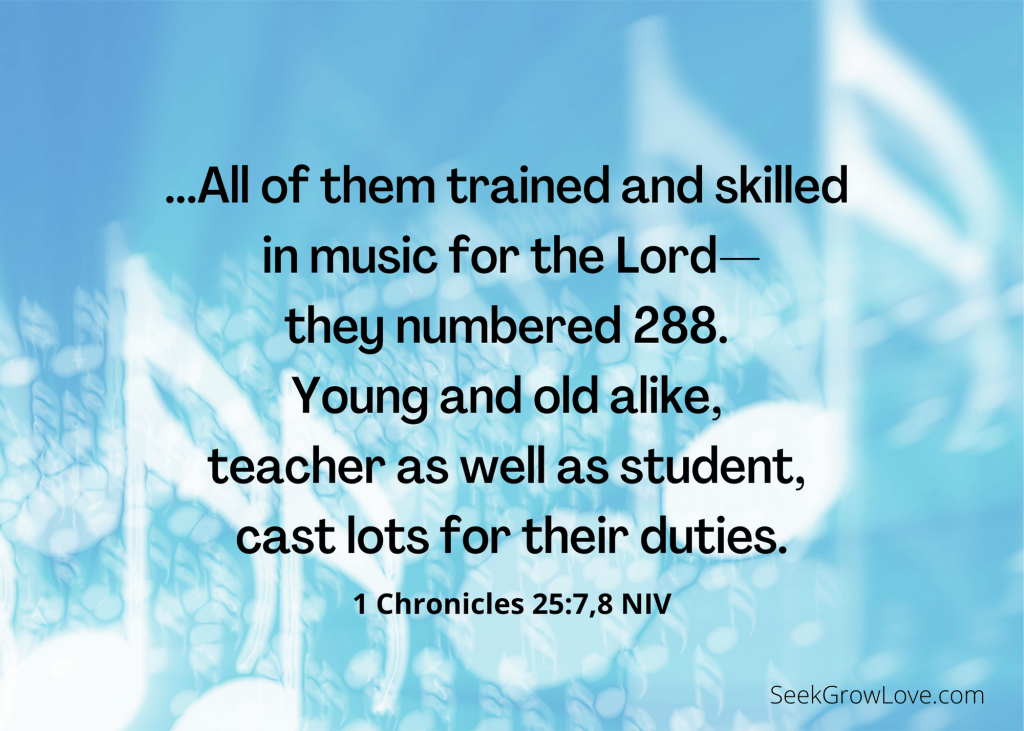
Chapters 23-26 are devoted to the organization of the temple. It tells in detail the families who served in the temple and how God chose the people to be servants of the temple by being musicians, gatekeepers, treasurers, and temple officials. These positions were cast by lot. The high priest who wore the special ephod was able to cast lots using the urim and thummim. This was one way God communicated with his people. It allowed God to give the Israelites a direct yes (urim) or no (thummim) answer.
There are many times in the Bible where it tells us that something was determined by lot. For example, Saul was appointed King of Israel by lot, and the lot was cast on Jonathan when he ate the honey he wasn’t supposed to eat according to Saul’s orders (1 Samuel 14:42), and Matthias was chosen as the apostle to replace Judas by lot (Acts 1:26), and to make decisions on how to divide the land to each of the 12 tribes (Joshua 18:6). The Bible records many other times when the people used lots to seek God’s counsel.
So what can we take away from all of this? God loves his people, He wants to show us His plans for our lives. Part of God’s character is that he is immutable- never changing through the ages. In most cultures today, casting lots is often overlooked as a means of receiving communication and answers from God, but we must not overlook His word given to us – including Chronicles- which show God’s continuity and love to His people. God knows that we are a forgetful people who don’t remember all the many things God has done over the years. Through Chronicles we see a God who kept his promises to the Israelites and who organized the temple and determined its leaders by lot. This same God is involved in our lives as well. It’s filled with the history of God providing for and keeping true with his promises to his people. It was used to remind the Israelites of these things and it can remind us as well how God was working through their lives and how He is and was and will work in ours. And knowing this helps us Stand Firm for Him.
As Marcia mentioned in yesterday’s devotion, many of us were at Midwest Family Camp last week, where the theme was “Stand Firm”. In a nutshell, if we don’t have a relationship with the Lord, it is critical that we repent and come into a relationship with Him. If we already have a relationship with the Lord, we need to strengthen that relationship, and stand firm in the faith – no matter what.
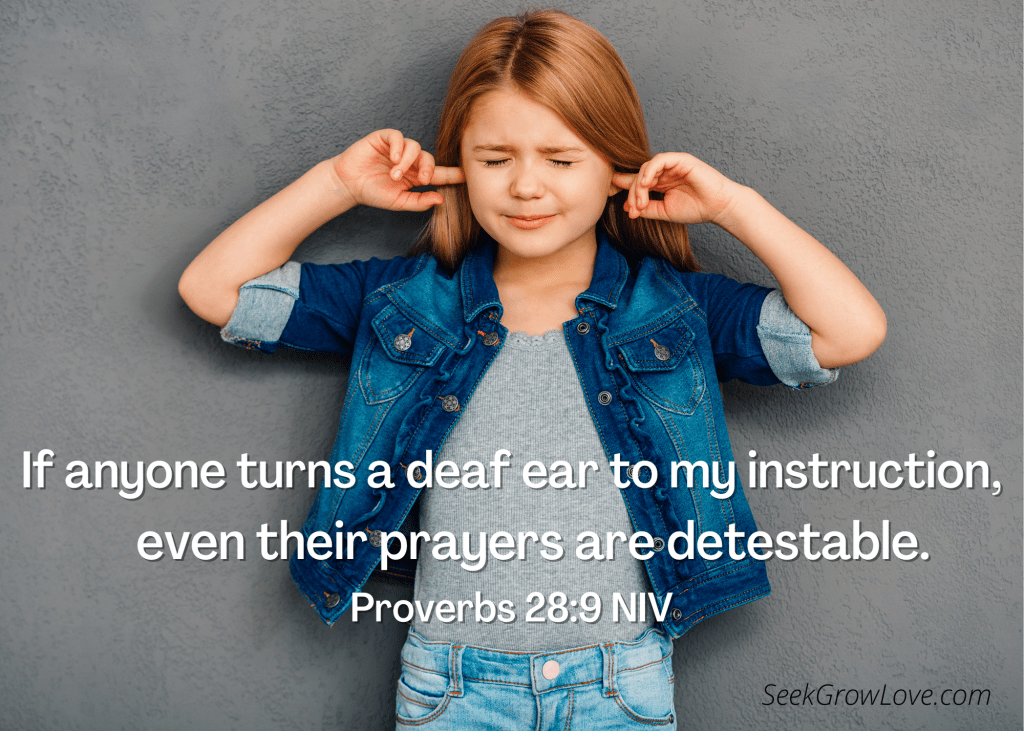
In today’s reading in Proverbs 28, there are a few verses that jumped out at me which reinforced that message. The first is found in Proverbs 28: 9, “If anyone turns a deaf ear to the law, even his prayers are detestable.” This proverb tells us that if we’re not doing everything to live the life God called us to live, if we’re not following his rules, then He won’t listen to our prayers. Since many of our prayers are about asking for God’s help with various things, if we selfishly want Him to answer our prayers, then we need to obey His rules, and live for Him. As we grow in relationship with Him, we come to long for an even deeper relationship with the Lord. Then we learn that prayer is powerful, and we don’t waste it just asking for superfluous things.
Proverbs 28:13 goes on to say, “He who conceals his sins does not prosper, but whoever confesses and renounces them finds mercy.” This is saying if we pretend to be Christians, we won’t prosper (you can’t fool God). But if we confess and renounce our sins, and turn completely to God, we will receive God’s mercy. I don’t know about you, but I would much rather have His mercy than to have Him holding me back from prospering.
As we continue to read through this chapter, we get to verse 20, which says, “A faithful man will be richly blessed, but one eager to get rich will not go unpunished.” I’ll take a detour here and comment on the health and wealth teachings we often hear from people who don’t know better. The theory goes sort of like this… “if someone follows God, God will bless every aspect of their life. They will be rich, healthy, and blessed.” Many people who call themselves Christians subscribe to this false belief. Jesus told us in John 16:33, “…In this world, you will have trouble. But take heart, I have overcome the world.” We have to remember this life isn’t our reward. This life is the test to see what reward we will receive when Jesus returns. If we are faithful to the Lord now, we will enjoy peace with God now, and eternal life when Jesus returns. If we are just trying to get rich, we are actually worshiping money, not God — our reward is in this life, and we will forfeit eternal life.
1 Tim 6:9-11 says, “People who want to get rich fall into temptation and a trap and many foolish and harmful desires that plunge men into ruin and destruction. For the love of money is a root of all kinds of evil. Some people eager for money have wandered from the faith and have pierced themselves with many griefs. But you, man of God, flee from all this, and pursue righteousness, godliness, faith, love, endurance, and gentleness.”
Instead of trying to get rich, we need to follow the advice given in Proverbs 28:27, “He who gives to the poor will lack nothing, but he who closes his eyes to them receives many curses.” Again, I think the idea is that if I’m greedy, wanting to keep all my money for myself, I’m not trying to please God, I’m just greedy for money, and God will curse me for not following Him. But if I’m generous with the things God has given me by giving them to the poor — this mimics God’s generosity to me. When I am imitating God, God loves that. In fact we’re commanded in Ephesians 5:1, “Be imitators of God, therefore, as dearly loved children.”
So the bottom line is this. We need to do everything we can to reconcile ourselves to God. We need to confess and renounce our sins, obey His laws, be faithful, and be generous. All these things are required to live in close relationship with God. And if we live in a close relationship with God, we will have peace with God in this life, and an amazing reward in the life to come. In Rev 21:4, we’re told, “He [God] will wipe every tear from their eyes. There will be no more death or mourning or crying or pain…” Rev 21:7 goes on to say, “He who overcomes will inherit all this, and I will be his God and he will be my son.”
My family, several of my church family, and many friends and family from across the Midwest and beyond just returned home from a week of church camp for the whole family where the theme was Stand Firm. So, I am seeing Stand Firm everywhere. Sometimes good examples, sometimes bad examples, but always examples to learn from.
1st Chronicles 21 starts right off with “Satan rose up against Israel and incited David to take a census of Israel.”
One evening at Family Camp our theme was Stand Firm against Evil and many warnings were given of the roaring lion who seeks to devour – not just nibble at your toe. I found it interesting that in this passage (which is one of the few Old Testament passages besides those in Job that uses Satan’s name) Satan’s target is not an individual but a whole country and his means of attack is through their leader. Thanks to Stephanie Schlegel, our writer last week, I know that Israel is about the size of New Jersey and I can much better picture this beautiful land that God chose for His people and that Satan wanted to bring down.
It reminds me of the importance of praying for our leaders who are in vulnerable positions and are themselves perfect targets through which an entire nation or church can be attacked by spiritual evil. And the laws and policies they put in place are sometimes actually brought about by the devil’s deception, as we see in the case of David.
In this case I believe Satan saw David’s ego as a possible chink in his armor through which Satan could attack a whole country. David, unprompted by God but deceived by Satan, decided it would be a good idea to number the fighting men in Israel. His army commander, Joab, tried to talk David out of it. He pleaded with David to be content just knowing that ALL the fighting men were loyal to him and God was watching over them, regardless of how many or few they were. But that wasn’t enough for a man deceived by Satan, he needed to know exactly how large and vast his kingdom had grown. It’s better for bragging rights to be able to say, “The nation I built has one million one hundred thousand fighting men.” But God wanted him to be content saying, “The nation God built is large.” God was disappointed in David and there was a price to pay – by the whole nation. One man’s sins can reap a punishment for a whole nation. And it is a sin to let your pride grow, especially when it grows greater than your trust in God.
The Proverbs have much to say about pride and humility, including Proverbs 27:1-2
“Do not boast about tomorrow, for you do not know what a day may bring forth. Let another praise you, and not your own mouth; someone else, and not your own lips.”
How can you Stand Firm this week – in humility. Never get puffed up about how well you are standing firm, or how large your army or influence is. Resist the devil and his attacks. Don’t be deceived. Stand firm – trusting in God alone.
Life is fleeting. We’re all passing through this age like the grass of the field. Today we live. God holds tomorrow.
As I’ve finished the last three chapters of the book of 2nd Kings and read another chapter in Proverbs, I’ve thought about our time in this age. This age is short compared to eternity. What we do in it matters.
The lives of the final kings of Judah mattered and were recorded for us all to see. We know what each of those last 5 kings was forever known for. They can be summed up into two basic categories. A good king and evil kings.
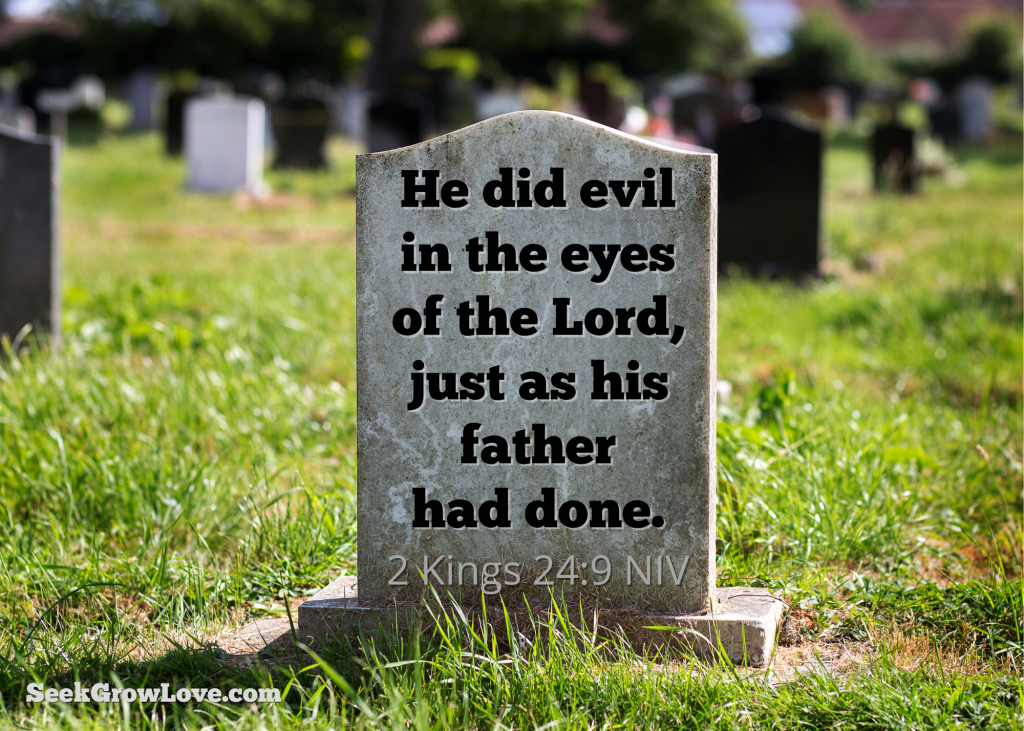
All but one of the last 5 kings of Judah were known for doing evil in the sight of Yahweh. If we included the whole lot of the kings of Judah and Israel to this list, there wouldn’t be a significant pendulum swing in the opposing direction towards Yahweh God.
When we come to the end of our earthly lives, what will we be known for? Will we be known for doing good or evil in the sight of God through Jesus Messiah?
The good kings, like Josiah were known for their hearts and humility, practicing obedience to God’s Law. Good kings did stumble but when they repented, they renewed their status with God.
If we want to be known for doing good in our day and age, similar qualifications apply. Good disciples of Jesus will be known for their hearts and humility, practicing obedience to the Law of Christ (aka producing fruit).
The whole law can be summed up with one word. Love. Our “goodness” can be measured to the extent that we love as Christ loved. How did he love? He loved his God and served him alone with all of his heart, with all of his soul, with all of his mind, and with all of his strength. He loved his neighbor to the point of death on the cross.
When I come to the end of my life, I want to be known as a good disciple of Jesus Messiah. I want to hear my master say, “Well done, good and faithful servant!” If this is my heart, my life will reflect that.
-Juliet Taylor
Today’s Bible reading passage can be read or listened to at BibleGateway here – 2 Kings 23-25 and Proverbs 16
In our previous readings, there were examples of two choices that could be made when faced with trouble. One could follow the one true God or follow their own god. Hezekiah was the king of Judah who chose to follow God, and we should too. However, Hezekiah was not exempt from later circumstances with choices to be made. The choice to follow God or not was – and is – ongoing.
At the end of Chapter 18, we see that Hezekiah stumbled. He accepted defeat from the Assyrian army after years of conquering and standing strong with his God. He gave the king of Assyria what belonged to his God (gold from the temple of Yahweh). Even after meeting their demands, it was not enough. The enemy desired everything of Hezekiah and his people. He desired their worship.
The king of Assyria sent armies to Jerusalem and surrounded it. The leader of the army told the people to accept defeat because their God would not deliver them from the king of Assyria. He went on to offer the people great things such as a land full of plentiful good food and drink. It could be theirs if only they would forsake their God.
This time (it was over the course of a few repeated circumstances with the same choice – following God), Hezekiah made the right choice. He prayed. He proclaimed the majesty of his God and asked that all would know that Yahweh alone was God. What a prayer. And then what a response from God! What an outcome! Yahweh heard and delivered.
Yet again, God prospered Hezekiah. While all the cities around him, even the northern kingdom of Israel, had been desolated and the people carried away into exile, God did great things in Jerusalem under King Hezekiah. The great things (good food and drink) that were offered to the people of Judah if they would just forsake their God and follow the king of Assyria became abundant in Jerusalem and a remnant was spared for years when they chose to follow God. Remarkable!
It is clear to me that Yahweh God alone wants our worship. He wants our hearts. When we are faced with a choice to follow him or not, he rewards those who choose him.
The people in Hezekiah’s kingdom were seeing defeat all around them. They knew what taking a stand against the king of Assyria might mean for them. The northern kingdom had starved to the point of eating their own dead children before they accepted defeat (as we read in other places, the king of Israel was told by God to surrender. Instead, he allowed his people to die). For Hezekiah’s people, having the temptation of a land full of food and drink dangling above them would have been hard to resist. Yet they did resist. In the face of temptation, they listened to their king and remained silent.
I thought about Jesus when I read this passage and how he was led by the spirit to be tempted when he was hungry. The very last thing he was tempted with was being placed on a high mountain (maybe like the Asherah?) and given a choice to have all that he saw from that high place if he only worshipped the devil. Jesus said “Go, Satan! For it is written, ‘You shall worship Yahweh your God, and serve him only.’”
If our Lord Jesus was not exempt from temptation in his time of need, neither should we expect to be. We all have a choice to make. Will we serve God in our times of trouble? Will we serve God when tempted with pleasure or even with our basic needs? Know what Yahweh has done for his people when they choose him. “Have you not heard?” (2 Kings 19:25). In our time, he has supplied every need through our Lord Jesus Christ. Choose him! He has already won. If we follow him, we’ve won too. Pray like Hezekiah. Command the enemy to flee like Jesus. When difficult circumstances arise again, keep choosing God. Tell Satan to Go!
-Juliet Taylor
Today’s Bible reading passages can be read or listened to at BibleGateway here – 2 Kings 19-20 and Proverbs 14