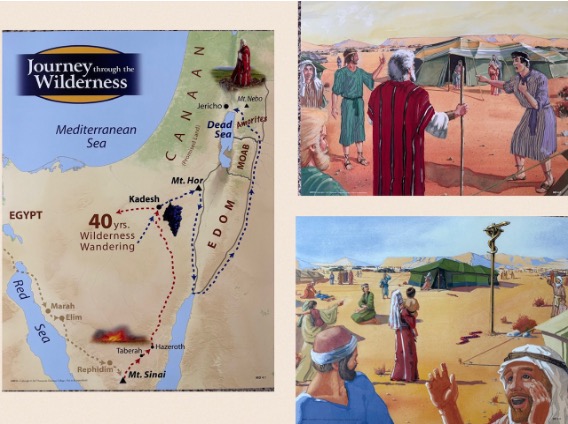
“Be My Holy People”

Exodus 22-24

                Social transformation is often a long and painful process.  Think about efforts at equality within the United States.  The founders’ vision was for a society where everyone had the right to life, liberty and the pursuit of happiness.  The Declaration of Independence expressed this in 1776.  Yet it took nearly a century and a Civil War to bring an end to slavery.  It took nearly 150 years for women to be able to vote and nearly 200 years and a lot of blood, sweat and tears to make significant strides toward racial equality.

                How does one take a community that has been enslaved for over 400 years and transform them into a nation that shines a beacon of light to all other nations in the world pointing them to the true God.  How does an entire nation become holy, set apart for God’s service and God’s glory?

                This is the challenge that was before God, Moses and the nation of Israel.  They were leaving behind one type of structure, slavery, to enter into a new way of living.  They needed a new structure to help them know how to live.  They had to be taught how to live in community.  They had to be taught how to work, and how to rest, how to care for their neighbors, and how to punish wrongdoing that threatened to destroy their community.

                In today’s reading we see how God begins to organize and structure the transforming community of Israel.  He teaches them how they are to live and become a holy nation and a royal priesthood.  This transformation would not come quickly or easily.

                They had to be taught how to show respect for personal property: “Whoever steals an ox or a sheep and slaughters it or sells it must pay back five head of cattle for the ox and four sheep for the sheep.” (22:1)  Those who steal must give restitution.

                They had to be taught to respect the family structure and to place their sexuality within proper boundaries: “If a man seduces a virgin who is not pledged to be married and sleeps with her, he must pay the bride-price, and she shall be his wife. If her father absolutely refuses to give her to him, he must still pay the bride-price for virgins.” (22:16-17)

                They had to be taught that there were severe consequences for failing to follow appropriate sexual boundaries: “Anyone who has sexual relations with an animal is to be put to death.” (22:19).

                They had to be taught to have empathy and to show kindness to strangers and people who were different: “Do not mistreat or oppress a foreigner, for you were foreigners in Egypt.” (22:21).

                They had to be taught to have compassion for people in the community who had suffered major losses: “Do not take advantage of the widow or the fatherless. (22:22).

                They had to be taught to show respect both to God and to their earthly leaders: “ Do not blaspheme God or curse the ruler of your people.” (22:28)

                They had to be taught how to live as a just community by not giving false testimony, and by neither showing favoritism toward the poor nor withholding justice from the poor (23:1-6).

                They had to be taught to care for their bodies and minds by getting appropriate rest. (23:12).

                It was also important that everyone be taught these and other guidelines for how to live in community as God’s people and that they verbally acknowledge that they understand and intend to follow “Everything the Lord has said we will do.” (24:3)

                Israel’s transformation from slavery to covenant people of God living a set apart life as the community of God’s people was a slow and challenging process.  It was painfully difficult, but necessary.  In the end, people failed more often than they succeeded in carrying out their assignments.  And yet, somehow, despite tremendous opposition from aggressive and hate filled neighbors, the Nation of Israel survived.

                As Christians, we can learn much from studying how God worked with His people Israel to bring about their transformation.  It is important to note that they were God’s people first, and then they were given this particular set of laws.  In the same way, as Christians, we become God’s people first, through faith in Jesus Christ, and then we commit to following Jesus and obeying Jesus’ commands.  We do not become God’s people by following laws, but by following Jesus Christ.  However, when we follow Jesus Christ, we do not descend into lawlessness.  Structure is still required.  So Jesus spends three years teaching his disciples how to live as the people of God who are called to be holy, set apart to be a light to all nations.  We complete the mission that the nation of Israel began, and we do so following the yoke or community guidelines as laid down by Jesus Christ.  The foundational teaching of Jesus is to Love God and Love our Neighbors.  That is a good place for each of us to start each day.

Jeff Fletcher

(originally posted February 6, 2020 for SeekGrowLove)

Reflection Questions

  1. What is the purpose of rules for your country, work/school or family? What is the purpose of God’s rules for His people?
  2. Does God still want a holy people today? What does a holy people look like?
  3. Which characteristic of a holy people do you want to especially work on developing more this month?

A Kingdom of Priests

Exodus 19-21

Today’s reading is probably one of the most familiar passages in the whole Bible for it includes the Ten Commandments.  It is important to understand the context of these commandments.  God entered into a covenantal relationship with Abraham and Abraham’s descendants through Isaac and Jacob and Jacob’s sons who became the twelve tribes of Israel.  God promised to bless and provide for his people and in exchange His people promised to be faithful and obedient to God and worship God alone.

After 400 years of slavery, Israel has grown from 12 sons and their immediate family to millions of people.  These people, God’s covenant people, will be settling in a land where they will need to live in community.  They are no longer slaves.  They are now responsible to live in that community in peace and productivity.   They need help to know how to live together.  God provides His people with the structure of how to live together as God’s people.  The Ten Commandments and subsequently nearly 600 additional laws were all designed to help them be healthy and blessed representatives of God to the rest of the world.

God loves all people.  We must never falsely believe that God only loves certain people.  God considers all human beings His children and loves them all.  God wants to be in a right relationship with all of his children; however, many are disobedient and have no willingness to be in a relationship with God and many deny that God even exists.

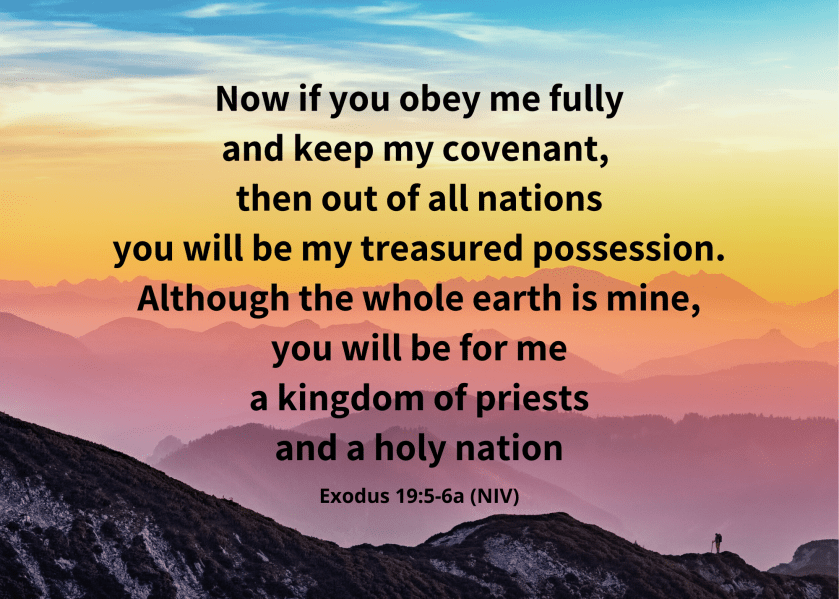
So God needed to start with one group of people and prepare them to be a special, chosen people who would bring the knowledge of God to others.  Exodus 19:5-6 says, “Now if you obey me fully and keep my covenant, then out of all nations you will be my treasured possession. Although the whole earth is mine, you will be for me a kingdom of priests and a holy nation.”

Israel was to be a kingdom of priests and a holy nation.  A priest is one who helps connect people and God.  God would go on to designate priests in Israel to help the people connect with God, but His expectation for Israel was that the whole nation serve as priests to help other nations connect with God.  Because the whole nation was being set apart by God to be priests for the world, they needed to live holy or set apart lives.  There were behavioral expectations that they were to follow.  They had to  be exclusively loyal to God, they could not murder, steal, lie, cheat, they were to be respectful and honoring of parents and not misuse God’s name.

Now we are completing what God began in Israel.  Through Christ we have entered into a covenant with God.  We are now the covenant people, we are called to be a kingdom of priests and a holy nation.  That is the Church’s role.  And God expects us to live lives of holiness as we are set apart to serve God.  As you read through the many laws in the Old Testament, recognize that some applied very narrowly to the Nation of Israel and do not necessarily apply to us.  Dietary laws and sanitary laws were important in Israel at the time they were given but are no longer applicable.  However, some of the laws which pertain to morality have been reaffirmed by Jesus Christ for the Church.  In other words, as Christians we are free to eat pork and worship on Sundays, but we are not free to practice polygamy or murder.

God is truly a God of grace and mercy, but God is also a God who hates sin and punishes sin.  In this way we are still to live in fear of the Lord: Exodus 20:20 “the fear of God will be with you to keep you from sinning.”

Jeff Fletcher

(originally posted for SeekGrowLove on February 5, 2020)

Reflection Questions

  1. What are the duties and responsibilities of a holy nation/kingdom of priests? How would you rate how well/poorly Christians in your nation are doing this job? How would you rate how well/poorly you are doing this job? What can you improve upon this week?
  2. How can we mirror God’s grace and mercy? How can we remind the world (and ourselves) of God’s rule book and judgment? What is the problem with doing just one but not the other?
  3. What does it look like to live in fear of the Lord? Is this only an Old Testament concept or do we find it in the New Testament, too?

And , here is the February Calendar!

God at Work

Exodus 13-15

In our devotion yesterday Jeff Fletcher was describing the Dark Night of the Soul when it seems like God is distant. Certainly being enslaved for 400 years in a foreign land could have that effect. I wonder if even through all those years of painful toil if many or some Hebrew parents were still faithfully telling their children of the God of Abraham, Isaac and Jacob who had promised Abraham that his descendants would come out of that land of slavery after 400 years with great possessions and God’s judgment upon their former masters (Genesis 15:13). Was anyone still counting the years in anticipation? Were they talking to God about how He would show up? Were they watching to see how God might be acting on their behalf day after day while in slavery? I don’t know. But I hope so. In our reading today, there can be no doubt, God is at work and He shows up in some major ways – and also in some small surprising ways, too – but always faithful.

I will assume that you already have some knowledge of these events from Exodus 13-15. So, you already know of the amazing way God chose to lead the Israelites on their journey out of Egypt – with a pillar of cloud by day and a pillar of fire by night – spectacular! And you already know of God’s strong east wind that split the Red Sea with a wall of water on their right and a wall of water on their left as His cherished people crossed on dry land – astounding!

So, today I will focus on two of the smaller things – wheels and logs.

I don’t know about you – but I take great delight (maybe a little too much) in the picture of God at work in Exodus 14:25. Here the great God of the universe who has been directing the winds to create great mountains of water is watching from the pillar of fire/cloud which He specifically moved from in front of the Israelites where it had been guiding to the rear where it was protecting. So this great all-powerful God of the universe reaches down from on high to clog the chariot wheels of the advancing Egyptians who want to take back their slaves. Is there an adversary chasing you who wants to make you or someone you know a slave again? God is good at protecting His children, sometimes in ways I wouldn’t even think of. In big and small ways. God so loved the world. But we know everyone is not going to listen and play on His side. Some will play the role of adversary, but do not fear, our God knows how to clog their chariot wheels. Oh, and, make sure you are playing on the right team because the God who clogged their wheels also sent the mountainous walls of water crashing down on the Egpytians and none survived. His judgment is right and sure and coming at God’s perfect time not ours. And the whole world will know He is the Lord.

The second little example of God at work even in small ways in His big plans comes at the end of our reading today. The Egyptians are no longer a problem. Now, thirst is. They have traveled three days and have not found water. And when they finally reach water at Marah, they find the water is bitter, not just unpleasant to drink but likely unhealthy and perhaps deadly as well. The people grumble, Moses cries out to the Lord, and the Lord answers by showing Moses a log.

Thanks, God. This will help – if we want a campfire or need to start building a log cabin. But we really need water now. The Bible doesn’t record that Moses questioned God, but I might have. I love the partnership between Moses and God. God could’ve fixed the problem any way He wanted to. And if He wanted to sweeten the water with a log He could have easily picked up the right log and thrown it in himself – after all we just saw Him displace how many gallons of water and clog chariot wheels without any help from human hands. But more to His “normal” working – He shows Moses which log – and Moses simply steps up, pitches it in the water and God makes the waters sweet and healthy and life-giving.

Today, whether God is displacing the sea for you to walk through on dry land or clogging some chariot wheels to protect you, or showing you which log He wants you to pick up to sweeten your bitter surroundings – follow Him. He is at work, in big and small ways, guiding and protecting and sustaining.

-Marcia Railton

Reflection Questions

  1. What inspiring words did Moses have for the people at the edge of the Red Sea in Exodus 14:13 & 14? Which phrase do you need to hear today? What words does the Lord God have for Moses in Exodus 14:15? Where do you think God is calling you to go forward?
  2. Exodus 15 includes the first recorded hymn of the Hebrew people. If you were to create a hymn or worship song praising God for who He is and what He has done for you what would you include?
  3. Where do you see God at work – in big and small ways? Like Moses picking up the log God showed him – what might God be showing you to do to change bitter to sweet and help sustain the weary, thirsty children of God?

Be with My Mouth

Exodus 4-6

Oh Dear Lord, please be with my mouth and teach me what I shall speak! Because my mouth is not eloquent.

Sometimes it is downright rude. Sometimes it lies. Sometimes it gets angry. Sometimes it hurts people.

Oh Dear Lord, please be with my mouth and teach me what I shall speak! Sometimes it stays shut when it should open to speak your words. Sometimes it forgets to give you praise. Sometimes it prefers to be grouchy or selfish instead of thankful.

Oh Dear Lord, please be with my mouth and teach me what I shall speak! Sometimes it doesn’t speak up for the oppressed. Sometimes it misses opportunities to spread joy and hope and your love. Sometimes…

Oh Dear Lord, please be with my mouth and teach me what I shall speak!

In Exodus 3 & 4 Moses is giving God lots of reasons (excuses) why He should pick someone else for the job of delivering God’s first-born child (the Israelites) out of slavery in Egypt.

  • I am nobody special
  • I don’t even know your name
  • The elders won’t believe me
  • I am not eloquent
  • Somebody else can do it better

God has answers for it all. I love the Lord’s words in Exodus 4:12 (ESV): “Now therefore go, and I will be with your mouth and teach you what you shall speak.” What a beautiful promise! Yet, Moses still pleaded with Him to just send someone else! God got angry at that one. How many times does this child of God need to be reassured that his God is bigger than any fear that comes with doing His Work. The maker of your mouth can teach you how to use it – when you step up and GO where He wants you to GO! Did you notice that little two letter word at the start of God’s promise to be with Moses’ mouth and to teach him what to say? You’ll never know what words God is waiting to teach you to say if you say no and don’t go.

God graciously compromised with Moses and rather than sending someone else instead of Moses, He sent someone else to go along with Moses, his brother Aaron who was not ‘coincidentally’ coming out to the wilderness to meet Moses.

Maybe it’s time I spend less time on my excuses and instead say YES, step out and GO and trust God to do what He says He will do – be with my mouth and teach me what I shall speak!

-Marcia Railton

Reflection Questions

  1. What excuses have you tried giving God for not stepping out to do a job He wants you to do? How do they stand up to your GREAT BIG GOD?
  2. How can you be someone’s Aaron and come alongside him/her to do a job for God that perhaps neither of you would feel you could do “on your own”? Though, you are of course never “on your own” when you are doing the Lord’s work!? What are some other instances that God used the buddy system and what were some advantages to having a partner?
  3. So – the big question is – where does God want you to go? If you aren’t sure yet, be praying. And then, thank Him for being with your mouth and teaching you what you shall speak.

Love Your Kids – Obey God

Genesis 24-26

Abraham was a man of incredible faith.  God made astounding promises to Abraham, and Abraham believed God – and this was credited to him as righteousness.  Abraham lived a long and faithful life of service to God, then, as recorded in Genesis 25, Abraham died.

We’re picking up the story in Genesis 26 – after Abraham was dead and gone.  Genesis 26 starts by telling about a famine in the land that was so bad that Isaac (Abraham’s heir) had to move to have enough food to eat.

Then we find this amazing encounter in Genesis 26:2-6, “The Lord appeared to Isaac and said, ‘Do not go down to Egypt; live in the land where I tell you to live. Stay in this land for a while, and I will be with you and will bless you. For to you and your descendants I will give all these lands and will confirm the oath I swore to your father Abraham. I will make your descendants as numerous as the stars in the sky and will give them all these lands, and through your offspring all nations on earth will be blessed, because Abraham obeyed me and did everything I required of him, keeping my commands, my decrees and my instructions.’ So Isaac stayed in Gerar.”

God promised:

  • To give Isaac and his descendants all these lands
  • To confirm the oath God has sworn to Abraham
  • To make Isaac’s descendants as numerous as the stars of the sky
  • To bless all nations on earth through Isaac’s offspring (Jesus)

And did you notice why God extended all of these promises to Isaac?  “Why” is recorded in verse 5: “because Abraham obeyed me and did everything (emphasis added) I required of him, keeping my commands, my decrees and my instructions.”

Did you catch that?  Isaac was promised that he would receive incredible blessings because his dad had obeyed God and had done everything God required.  

A couple of years later, in Genesis 26:24, we read, “That night the Lord appeared to him and said, “I am the God of your father Abraham. Do not be afraid, for I am with you; I will bless you and will increase the number of your descendants for the sake of my servant Abraham.”

Again, God extended blessings to Isaac because of Abraham’s faithfulness.

And oh yeah, most of that obedience to God was before Isaac was even born.

We’ve heard about the blessings for ourselves if we follow God – especially eternal life in the Kingdom of God.  We don’t often think of the blessings for our descendants because of our faithfulness to God. 

When I was young, my dad would have us memorize scripture.  One of those verses he had us memorize was Psalm 37:25 which says, “I was young and now I am old, yet I have never seen the righteous forsaken or their children begging bread.”

I think the point my dad was trying to make was that we needed to be righteous, and God would never forsake us.  But I remember thinking something like this at the time: “I’m glad my dad is righteous, because in spite of my not necessarily being righteous, I will be blessed because of my dad’s righteousness.”

Now that I’m old, I recognize that the decisions I made, and the example I demonstrated had an impact (for good or for bad) on my kids.  As a result, they have picked up both some of my good traits and some of my bad traits.  I wish now that I had demonstrated more good examples and fewer bad examples – not only for my own benefit, but also for the benefit of my children.

Now let’s talk about you.  It doesn’t matter if you’re a teen, a parent, a grandparent, young, or old.  The most important thing you can do with your life is to obey God, and do everything He requires.  This will guarantee you eternal life in God’s coming kingdom, and may also give you many blessings in this life (not necessarily including health and wealth).  But in addition to your blessings, you may also pass along an inheritance of faithfulness to God to your kids – even those unborn.  And then they too can have incredible blessings.  

So, if you love your kids, obey God.

-Steve Mattison

Reflection Questions

  1. What are all the benefits/blessings you see to obeying God? Which have you already enjoyed? Which are you still looking forward to?
  2. How are you doing in the faithfulness department? Will God be able to tell your descendants that you obeyed Him, did everything He required, and followed His laws?
  3. What did God reveal about Himself to you today?

(originally posted for SeekGrowLove January 16, 2023)

Praise His Name – and Follow Him

OLD TESTAMENT: Nehemiah 12-13

POETRY: Psalm 149

NEW TESTAMENT: John 20:19-23

Just so you know how much of a rebel I am… I spent my tween years secretly dancing in my basement to the new DC Talk cassette tape, questioning why such a powerful kinesthetic connection with God was forbidden. At the church I attended at the time (not associated with our General Conference), dancing was considered a sinful act;  a few years later they started allowing limited choreography to Christian songs called “interpretive movement,” which was really just dancing with a much less scandalous name. While I definitely agree that mainstream secular dance is often inappropriate, there are so many ways we can glorify God through dance with these bodies he has given us, and Psalm 149 encourages us to dance and sing before the Lord! I love the story of King David’s wife Michal lashing out in anger because he was dancing in the streets, but his reply was simply, as the Crowder song paraphrases, “I’ll become even more undignified than this!” (see 2 Samuel 6:22). David unabashedly praised God by dancing with abandon because he loved God so much that he just couldn’t hold it in! 

I bet there was a lot of dancing and praise at the dedication of the new wall of Jerusalem, too! There were choirs and instruments, and “the sound of rejoicing in Jerusalem could be heard far away” (Nehemiah 12:43). Then Nehemiah returned to his work with the king. However, when Nehemiah returned a while later, he found many people straying from the laws they had so very recently vowed to keep. Among the offenses was that Tobiah (remember him? A sidekick to the antagonist Sanballat from earlier in this book?) had been allowed to live within the temple, occupying one of the sacred rooms. This could perhaps be likened to elevating Tobiah above God or allowing a wolf to dwell among the flock. Nehemiah took care of that problem when he returned! Then he purified everything and helped the people recognize the ways in which they were not – but should be – following God. 

I can’t help but wonder if Nehemiah felt like the people would never get it or that all his work was futile, like herding a hundred cats or tidying up a play room full of busy snacking toddlers. I wonder if Nehemiah felt defeated by the end of the book. And yet, he faithfully completed the work that God called him to do, so the rest was left in God’s hands. Likewise, sometimes it feels like a never-ending task to keep focused on God, to clear the impure thoughts and actions from our hearts and minds, to stay away from temptations that threaten to overpower us. But we must continue focusing on God and the work he has given us to do in this particular season while encouraging others to do the same (Hebrews 10:25)! 

The book of Nehemiah concludes abruptly with a simple plea, which can also be our supplication as we strive to live for God each day: “Remember me with favor, my God.” 

-Rachel Cain

Reflections: 


That temple-dwelling abomination seems foreign to us, but consider this: if our bodies are temples (I Corinthians 6:19-20), what unholy things are we permitting to occupy the sacred places of our hearts and minds? What Tobiahs are we allowing to influence us – those seemingly innocent thoughts or behaviors or relationships that will ultimately threaten our relationship with God, or are taking the place of God in our priorities and hearts? The reading in John today reminds us about the Holy Spirit, God’s power and guidance, that will help us follow Him; pray that God will show you what Tobiahs are in your life and that His Spirit will give you the power to make necessary changes. 

Here is a neat article that discusses the ending of Nehemiah, along with how the book could be a foreshadowing of the Messiah and more: https://jesusplusnothing.com/series/post/nehem13

Stop the Slow Fade!

SEEK & SHARE

OLD TESTAMENT: Nehemiah 9

POETRY: Psalm 148

NEW TESTAMENT: John 20:1-9

“Freedom is a fragile thing and it’s never more than one generation away from extinction… it must be fought for and defended constantly by each generation…”

~ President Ronald Reagan. 

Reagan spoke these famous wise words during his inaugural address. It was a call for the country to not take our freedom for granted, to continue fighting to keep our freedom alive.

That reminds me of the instructions following the Shema, a major tenet of Jewish faith and our faith, found in Deuteronomy 6. The Shema states: “Hear, O Israel! The LORD is our God, the LORD is one. You shall love the LORD your God with all your heart and with all your soul and with all your might.” 

Those words are super important, but is that the end? Is that all we need to know and do? A big, resounding NO! Immediately following these core words, we are instructed to pass along our faith deeply to the next generation and embed it into our daily rhythms: “These commandments that I give you today are to be on your hearts. Impress them on your children. Talk about them when you sit at home and when you walk along the road, when you lie down and when you get up. Tie them as symbols on your hands and bind them on your foreheads. Write them on the doorframes of your houses and on your gates.”

If I am interpreting this scripture correctly, it seems like we are supposed to be thinking and teaching about God, like, all the time, right? We need to be in a state of constant communion with God not only in our own hearts, but also sharing that with our children and others around us. 

Nehemiah 9 describes Israel’s repentance, return to faith, and reinstallment of their covenant in a religious and legal document. Throughout the chronicle of their rebellion, they remember God’s covenantal love: “You are a forgiving God, gracious and compassionate, slow to anger and abounding in love” (v 17). They realize, though, that it is because of their sin that they are presently enslaved under Persia. 

We can’t let the next generation forget! This happened too many times in Israel’s history, and it continues to happen with us. Oh, sure, we don’t intend to not grow our relationship with God and teach our kids to do the same, but there’s just so much vying for our attention: school and work and sports and sleep and Netflix. It’s a slow fade, a side effect of busy-ness and forgetfulness and complacency, but ultimately it’s an abdication of our responsibilities as followers of Jesus. However, it is vitally important, in our farm-out-all-our-chores-to-someone-else culture, that we don’t assume someone else will teach our children about Jesus, someone else will share the love of God with our restaurant server, someone else will volunteer to meet the needs of our local church and community, someone else will…

We are called to be seeking and sharing about God from the time we wake up until the time we go to bed, whether we are at home or in another place. We are especially commanded to teach “them” to our children. (“Them” refers to commandments, but I think it means even more than that; I think it includes knowing and loving God enough to WANT to follow his commands, and passing that depth of understanding and passion onto the next generation.) 

In Nehemiah 9, with the Feast of Tabernacles fresh on their minds, the people were still  remembering their history of being slaves in Egypt, then finding freedom, and then following a cycle of rebellion and enslavement… rinse, lather, repeat. After their work with Nehemiah, they were hungry to return to God and understand the scriptures. Again, this is why the Shema and the instructions following the Shema are important – we can’t let the next generation forget who God is and what He has done in our lives! 

If we really peer outside our Christian bubbles, we will see a hurting and perverse world that is far from God. But it doesn’t have to stay that way! You can greatly influence your existing circle. Evangelist Gypsy Smith shared the secret to revival: “Go home. Take a piece of chalk. Draw a circle around yourself. Then pray, ‘O Lord, revive everything inside this circle.’” Start with yourself; renew your own relationship with God. Teach your family, and learn to follow Him better together. Then you won’t be able to keep it all inside! 

Connections to the other readings: 

In John, the disciples discover the empty tomb, but they seem confused about the whole event. Though Jesus had told them he would rise again, they didn’t fully understand until it really happened. Like the nation in Nehemiah longed to be free from Persian rule, Jesus’ peers wanted to be free from Roman rule. When Jesus didn’t save them in the way they wanted, they turned on him because they did not understand that Jesus was saving them in an even better, eternal way! 

Psalm 148 is a song of praise! The people in Nehemiah praised God for his faithfulness throughout this chapter. 

-Rachel Cain

Reflections: 

*Listen to this encouraging song. Be intentional to start a revival in your home and community today! https://www.youtube.com/watch?v=NlQQcQc0eHU

*Read the Psalm as a prayer of praise and gratitude to God. 

Set His Heart to Study

OLD TESTAMENT: Ezra 7-8

POETRY: Psalm 142

NEW TESTAMENT: John 15:1-17

About 60 years after the first Babylonian exiles returned to Jerusalem, Ezra, appointed by King Artaxerxes, returned to Jerusalem with a new wave of exiles. His mission was to renew Israel’s commitment to following God’s Law. 

For Ezra had set his heart to study the Law of the Lord, and to do it and to teach his statutes and rules in Israel. (Ezra 7:10)

For Ezra had set his heart…

At the time this passage was written, there was no Hebrew word for brain and no concept of its role in the body. Instead, biblical authors used the word heart (lev or levav) to describe both our emotions and thoughts. Here, when Ezra says he “sets his heart” on studying the Law, he means dedicating his entire being to knowing and following God’s Word.  

You will seek me and find me, when you seek me with all your heart. (Jeremiah 29:13 ESV)

…To study the Law of the LORD…

The Law, or Torah, refers to the first five books of the Old Testament. It contains 613 laws that establish a covenant between Israel and God. God promises that following His way will lead to blessing. 

This Book of the Law shall not depart from your mouth, but you shall meditate on it day and night, so that you may be careful to do according to all that is written in it. For then you will make your way prosperous, and then you will have good success. (Joshua 1:8 ESV)

…And to do it… 

While being able to recite all 613 laws would be impressive, knowledge without application is futile. It’s significant that not only does Ezra know the Law, but he also commits himself to following it. 

But be doers of the word, and not hearers only, deceiving yourselves. For if anyone is a hearer of the word and not a doer, he is like a man who looks intently at his natural face in a mirror. For he looks at himself and goes away and at once forgets what he was like. But the one who looks into the perfect law, the law of liberty, and perseveres, being no hearer who forgets but a doer who acts, he will be blessed in his doing. (James 1:22-25 ESV)

…And to teach his statutes and rules in Israel.

This is where Ezra’s preparation meets his ministry. As a “scribe skilled in the Law of Moses” (Ezra 7:6), his knowledge of the Torah is complete. His mission is to teach the Torah to restore Yahweh’s rule and reign in Jerusalem.

And these words that I command you today shall be on your heart. You shall teach them diligently to your children, and shall talk of them when you sit in your house, and when you walk by the way, and when you lie down, and when you rise. You shall bind them as a sign on your hand, and they shall be as frontlets between your eyes. You shall write them on the doorposts of your house and on your gates. (Deuteronomy 6:6-9 ESV)

May we be like Ezra. May we set our hearts to study God’s Word, to live it out, and to teach its message to a world in need of revival. 

-Mackenzie McClain

Reflection Questions

  1. What have you set your heart on? What is your entire being dedicated to? How is this displayed in your life?
  2. What is the value of setting your heart on studying the law of the Lord (and now the whole word of the Lord made available throughout the 66 books not just the first 5 Ezra had the privilege of knowing)?
  3. Do you find it easier to study God’s law or to do it? Can you have one without the other?
  4. What ministry has God called you to? Who do you know that you can teach what you know about God and His Word?

Sheep Care

OLD TESTAMENT: Ezekiel 34 & 35

POETRY: Psalm 130

NEW TESTAMENT: John 4:43-54

I love petting zoos, seeing the animals at the 4H fair, and anytime I’ve been up close and personal with a sheep, I’ve been impressed! How soft and gentle, how amazing their wool coat really does feel, and for a non-farmer gal like me, how tricky it is to tell a sheep from a goat sometimes?  How someone can tell a llama from an alpaca is also beyond me!  I’ve never raised sheep or had a sheep of my own to care for. But, over the years, I’ve heard lots of sermons/teachings on sheep and shepherds, and a few takeaways I’ve learned are:  sheep are mentioned a lot in the Bible!, sheep are reportedly dumb animals, and shepherds doing their dirty work were not considered the high class of society.

In today’s reading in Ezekiel 34 and 35, we encounter some Israelites being compared to shepherds though who perhaps thought they were the high class of society. And, they are being reproved harshly. In fact, even modern translations use a little “woe to” language in Ezekiel 34:2 ….”Woe to you shepherds of Israel who only take care of yourselves!

This verse caught my attention right away, making me think of a little phrase called “self care.”  As an occupational therapist, these are words that for years were common in my “work language”, and it was a phrase referring to the self care tasks we need to do for basic daily living (dressing, toileting, hygiene, eating, etc.).  Part of my job was to evaluate and work to help people with their self care tasks which can often be impacted by injuries, developmental disabilities, mental health challenges, etc.  It wasn’t a phrase I heard out and about much in “non OT chit chat” for the first 10 years or so that I was working. And then it seemed to me that … kaboom….the phrase meant something new and was used all over social media, taught from preschool to college, and it was something emphasized as crucial for being able to function, be healthy, etc. But, it meant something different. It meant…..perhaps abstractly taking care of oneself…..but some of the examples I saw were more things like…..massages, vacations, get a degree, do a puzzle, prioritize  “me time”,  yoga, mindfulness breathing, and then maybe some camping weekends to “just relax” if your self care app found you lacking that week.  I am kinda glad the term caught my attention because I became aware of some discrepancies that are out there on this subject.

Most definitely, it is beneficial for all aspects of our health to have adequate nutrition, sleep, cleanliness, time in nature, etc. And those of us who live in a free country, have a safe and comfortable place to sleep, the ability to look outside a window and see a tree and bird, the opportunity to be over-fed and clean should not take that for granted. But, it seems to me, these shepherds mentioned in Ezekiel would have loved the “self care” movement of today. A quick internet search regarding  “self care” will  lead you to terms emphasizing “self reliance”, “self defined”, “listening to you”, “self love”, “self esteem”, etc.  Non of these terms are inherently bad if coupled with a Biblical world view, but combine them with some of the lists of things the internet tells me I should do daily for my self care , and my guard is up for a reason.  I see some sneaky belief systems creeping in all over that I think are meant to destroy and not heal. The shepherds in Ezekiel were engaging in self care, but they were not doing anything for sheep care. Their job was to care for the sheep.

Should not shepherds take care of the flock? You eat the curds, clothe yourselves with the wool and slaughter the choice animals, but you do not take care of the flock. You have not strengthened the weak or healed the sick or bound up the injured. You have not brought back the strays or searched for the lost.  (Ezekiel 34: 2-4)

In today’s world, there are so many pressing challenges negatively impacting every area of health, and the image Ezekiel 34 ends with provides a beautiful thought for both self care and sheep care. They are words revealing a hope beyond ourselves because my “self” isn’t going to get me through this alone. My mental health benefits from knowing that God cares for his sheep, that I am grafted into the vine through Jesus, and that as Christians, we are also heirs to the promises of Abraham.

They will no longer be plundered by the nations, nor will wild animals devour them. They will live in safety, and no one will make them afraid. 29 I will provide for them a land renowned for its crops, and they will no longer be victims of famine in the land or bear the scorn of the nations. 30 Then they will know that I, the Lord their God, am with them and that they, the Israelites, are my people, declares the Sovereign Lord. 31 You are my sheep, the sheep of my pasture, and I am your God, declares the Sovereign Lord.’”   (Ezekiel 34: 28-31)

Interestingly, so many studies show that one of the best ways to improve mental health or physical health is by doing things to help others, so self care and sheep care really are aligned. On days we are struggling with our own baggage and carrying weights Jesus doesn’t want us to carry alone, one of the best ways to engage in true self care is by engaging in sheep care. Ironically, one of our therapy students at work recently told her supervising therapist that she couldn’t see the next patient yet because she had had a stressful day, could tell she needed some “me time”, and proceeded to sit down on a mat in the middle of a patient care area of the hospital and begin scrolling on her phone. I am not sure who needed a bubble bath or pursed lip breathing most at that moment, but I firmly believe asking for help from a shepherd and serving people instead of scrolling would have genuinely helped. However, the memory provides comical relief at work for the rest of us still, and we appreciate that.

Whatever we do to pursue physical, emotional, and spiritual health, let’s be careful it is rooted in scripture and the example we see in Jesus and his followers rather than the latest blog, book, or meme.

-Jennifer Hall

Questions:

  1. Imagine you are home alone sick in bed. How can you participate in sheep care?
  2. Imagine that you have been on a path too indulgent in self care and too lacking in sheep care. How could you improve things?
  3. Imagine a restored earth under Jesus’ reign where all of God’s sheep are gathered in a perfect “pasture”. Take a few moments of prayer and reflection seeking first his kingdom.

God Holds You Accountable for Their Blood

OLD TESTAMENT: Ezekiel 1-3

POETRY: Psalm 121 (all week)

NEW TESTAMENT: Revelation 18

The prophet Ezekiel was among the Jewish exiles taken to Babylon.  While there, he had amazing visions of God, which are recorded numerous times throughout the book of Ezekiel.  In chapter 1, we read about his first vision.  He started by describing four cherubim inside a fire in great detail, including each of the four faces per cherub, and what their feet looked like (not what you might expect), he went on to describe in detail what their wheels looked like. And that was just the introduction.  He then went on to describe God’s throne, sitting on a platform above the cherubim, and then he went on to describe the glory of God that he saw sitting on the throne.  If you want the details, you’ll have to read Ezekiel chapter 1.

During this encounter, God told Ezekiel that He was sending Ezekiel as a prophet to the people of Israel.  God told Ezekiel in 2:7, “You must speak my words to them, whether they listen or fail to listen, for they are rebellious.”

Then, in 3:18-19, we read this, “17 “Son of man, I have made you a watchman for the people of Israel; so hear the word I speak and give them warning from me. 18 When I say to a wicked person, ‘You will surely die,’ and you do not warn them or speak out to dissuade them from their evil ways in order to save their life, that wicked person will die for their sin, and I will hold you accountable for their blood. 19 But if you do warn the wicked person and they do not turn from their wickedness or from their evil ways, they will die for their sin; but you will have saved yourself.”

Wait a minute.  Does verse 18 really say that God will hold Ezekiel accountable for the blood of the wicked if he doesn’t warn them?  Yes it does.

God demands obedience.  And there is always punishment for disobedience.  That disobedience can range from eating forbidden fruit in a garden, to doing things He prohibited, to not doing things He requires.  In this case Ezekiel is commanded explicitly to warn Israel to return to the Lord, and he is warned that if he disobeys, there will be consequences.  As we read throughout the rest of the book, we will find that Ezekiel obeyed faithfully, but it cost him dearly.

We have been given some similar commands.  Jesus told his followers to, “Go into all the world and preach the gospel.”  In 1 Peter 2:9, we find, “But you are a chosen people, a royal priesthood, a holy nation, a people belonging to God, that you may declare the praises of him who called you out of darkness into his wonderful light.”

Remember, as we’re told in 1 John 2:4, “The man who says, ‘I know him,’ but does not do what he commands is a liar, and the truth is not in him.

Will you obey?

Steve Mattison

(originally posted August 26, 2020 for SeekGrowLove)

Reflection Questions

  1. How do you view the role of watchman?
  2. How does God view the role of watchman?
  3. Who do you know who needs to be warned of God’s judgment?