The Proverbs are, in many cases, fairly self explanatory. Don’t be lazy, don’t be a wicked ruler, don’t be foolish but be wise, be a righteous ruler, be diligent in your work. Each Proverb has it’s own meaning but they go along those lines. But some are not so self explanatory. They are counterintuitive.
A short example is found in 28:27. If you want to be prosperous and blessed, to never be in want, then we give our money to the poor. The world, our own sinful heads, and many economists believe that the way to grow our wealth and not be in want is to hoard our money. But that’s not the way God works. It is only in generosity and giving that we will be blessed. This comes from the fact that God will bless and many times he blesses us through the care of others in our time of struggle and hardship.
Also, 27:5-6 doesn’t seem to be true in the moment. I don’t like to be rebuked. I don’t like it when a friend calls me out on the garbage way I am acting. But the Proverb teaches us that we should delight when a friend rebukes us because their correction comes from a place of love and they want our life to be one of wisdom and righteousness. This is especially true for our brothers and sisters in our local church. Many times, we may feel judged by the people of our church, but more often than not, they are wanting the BEST for us. The “wounds” they give are better than any kisses of those who tell us we have nothing wrong with us. There could be people who act like a friend and hurt you in terrible ways, but here we mean TRUE friendship, TRUE companionship, TRUE love from a brother or sister in Christ. That true love is shown in forgiveness and compassion, especially in our moments of weakness and humility. Many times, when we are sinning and are fearing the rebuke of those people, we hide our sin away, like 28:13 says. But counterintuitively, by hiding our sins, we only hurt ourselves more when they are brought to light in some other way. We need to confess our sins and turn away from them. When we do, compassion and forgiveness are waiting for us from the people of God and from God himself.
Jake Ballard
(originally posted for SeekGrowLove June 17, 2020)
Reflection Questions
What other proverbs have you run across that seem counterintuitive and the opposite of how the world thinks or operates? How is God’s wisdom better than the world’s?
Can you think of a time a true friend gave you correction or a rebuke? Can you think of a time you, as a true friend, gave correction or rebuke? What is the value of correcting a friend? What problems can develop if we don’t correct in love, or if we don’t accept the correction given in true love?
Our God is a God of restoration. There will ultimately be a full restoration, but full restoration can only happen when the world is once again the beautiful, perfect place God created it to be, when His Kingdom is established on earth. Partial restoration, however, has been happening ever since the beginning of time. We read about restoration countless times in the Bible, and if you look, you can see it in our lives today, too. God constantly restores what has been lost to His people, whether it be a physical ability, such as sight, or movement, or a spiritual restoration, such as that of faith, or even the restoration of life.
Today, we read in 2 Kings chapter 8 about a Shunammite woman who lost everything she had during a 7 year famine, but because of her faith in God and willingness to obey, it was restored to her. Now this woman was not new to witnessing God’s ability to restore what was lost. In chapter 4 of 2 Kings, we read about how Elisha rewarded the Shunammite woman’s kindness with fertility, and she bore a son. Sadly, the son later died, but she had faith in God’s power, so she sought out Elisha. Elisha came, and the son was brought back to life; he was restored.
It is clear that this woman had remarkable faith. Perhaps this is why Elisha warned her about the famine that would come on the land for 7 long years, and advised her to leave. So without question, she and her household left their home and stayed in the land of the Philistines for 7 years, until the famine was over. When they returned, she had to appeal to the king to get back her home and all her land. The crazy thing is, right as she was coming to appeal to the king, Elisha’s servant, Gehazi, (who in chapter 5 was cursed with leprosy, and left Elisha… so perhaps these chapters are not necessarily in chronological order) was telling him the unbelievable story of the miracle Elisha performed in the resurrection of the son of the Shunammite woman. The woman, who just happened to show up during this particular story time, also gave an account of what happened, and the King was so impressed that he instantly granted her the land and all that she left 7 years ago.
This story speaks volumes of God’s perfect timing, and adds to the common theme we see throughout the Bible of God’s willingness to restore what has been lost to those who are faithful. Look closely at the different ways in which God restores things in your life, and let it remind you to live everyday for the ultimate restoration that’s coming.
-Isabella Osborn
(originally posted for SeekGrowLove on June 8, 2021)
Reflection Questions
In 2 Kings 8 what does God do for restoration to take place? What did the Shunammite woman do? What did others do?
Where have you seen restoration? Did faith play a part in the restoration you witnessed? What did God do? What did the recipient of the restoration do? What did others do?
How can you be a part of God’s great restoration project? What restoration can you be praying for? What restoration can you be working towards, with faith in God, that He will act in amazing, restorative ways?
Reading today’s passage in Luke 8, I was surprised at how many incredible stories of Jesus are packed into just one chapter. It really shows the power that Jesus holds. He preaches messages to large crowds, he calms the storm, and heals a sick woman just from being touched. There are even multiple accounts of people being cured of evil spirits. Additionally, we even get to hear the miraculous resurrection of Jairus’ daughter. Jesus’ power is stronger than the ties of death. A common theme among these stories is the presence of faith or the lack thereof. Jesus asks his disciples, “Where is your faith” when they were scared and stuck in a storm. Some would point to Jesus’ ability to give commands to the winds and the waves and his power over death as evidence that Jesus is greater than who he says he is. But when we look at other accounts in the Bible of God using men to do his work and will, we can easily see that God is powerful enough to work through humans. Our reading today in 2 Kings 5 tells the story of Elisha performing a miracle through the power of God and healing a man of leprosy. There are many other examples of great miracles that could only be through the hand of God, such as in 1 Kings 17 when Elijah raised the widow’s son.
God is omnipotent and His power is not diminished when He works through humans. This same idea also extends to the fact that Jesus’ death on the cross covers the atonement for the sins of the entire world. How can this be since Jesus is a man? Through the power of God. This was part of God’s plan of salvation. Since sin and death came through a man (Adam), life and righteousness also come from a man (Jesus). Jesus could not have done it on his own accord- but through the power of God his sacrifice was sufficient. Therefore, it has nothing to do with Jesus’ qualifications and everything to do with the qualifications of God. This is great news for us because it means that God can use us in unimaginable ways because our God is greater and more powerful than we would be able to accomplish on our own and is waiting to use us when we offer ourselves to him.
Throughout the Gospels we can see the faithfulness Jesus shows to God. This is an important step to being used by God. Luke chapter 8 shows the importance of having faith. Jairus’ daughter was raised WHEN Jairus had the faith that Jesus could do it, the woman who was sick was healed WHEN she had the faith that touching Jesus would be enough. We can even see that the demons had faith in Jesus that he could command them to leave the man. The demons even acknowledge who Jesus is and recognizes that Jesus gets his power from the Most High.
Not only do we need to have our faith in God but we also need to be close to him and have a relationship with God. The parable of the sower likewise teaches us how a firm foundation in God keeps us rooted in God and His ways. We can believe in God for a time but if we are not continually seeking Him then we will not be listening for God when He tries to use us to accomplish His work.
-Makayla Railton
Questions:
Have you been building your firm foundation on God so that you can withstand life’s temptations and troubles and still be rooted in God?
Do you feel like you are waiting for God to qualify you before He can use you? Whose power are you relying on?
You are a powerful man in ancient Israel. You hear about a miracle worker and rabbi. This guy, in just the last couple days reportedly saved a slave of some centurion without even being near him. More than that, he brought the dead back to life! Could such a thing be? Nothing like it has happened in your lifetime. This man reminds you of Moses, Elijah, and the prophets that you have grown up hearing about and spent your life studying. You know that such a man must be holy, must be from God. You invite this man to eat with you, so you can see for yourself how this holy, miraculous man interacts with people.
So you see him. And he’s shorter than you expected. Actually, he’s quite unremarkable in appearance. He is not wealthy, he does not come from money or make much when out teaching. He is lean from walking and fasting. He has an entourage of men with thick accents, no training, and a certain lack of decorum. They look and act like fishermen. To your surprise, you learn they ARE fishermen. One is even a tax collector. It’s only natural to begin to doubt. But when he opens his mouth to teach, it intrigues you. The passion with which he speaks. The intensity in his eyes. The compassion in his touch, to all people, draws you in, and you invite him over for dinner. Doubts gnaw at your mind, but surely in a personal setting those will fall away.
However, at dinner, things get really out of hand. As per usual, you have your home open to use by the people of the city, because God has blessed you for your devote life and upright character. Everyone, all thirteen (and more) of this teacher’s usual crew start to relax, kick back their feet, and eat. But, in the middle of dinner, she comes in. The years of hard life, of acting in such impolite, anti-social, uncouth, wicked and sinful ways, of trying and failing to do better, showed in every movement in the presence of this teacher. But instead of running like she should have, she bends down, weeping, and cries on his feet, wipes his feet clean with her tears. She takes his barely washed feet and anoints them with the sweetest perfume, the smell wafting over you all. She is making a scene, at YOUR dinner. And you know what kind of person she is. She doesn’t deserve this attention, she only wants to ruin your hospitality, because that’s the kind of person she is.
No, no this man must be a phony. How could a man who raises the dead not know what this woman does every day? How could such a “holy man” allow so much uncleanness to caress his feet? Why let someone like her defile someone like him?
Then he says your name and breaks you out of your reverie. He calls your name. He tells you about two debtors, both forgiven – one much and one little. He asks “Who will love the forgiver more?”
“The one who was forgiven much,” you answer wisely.
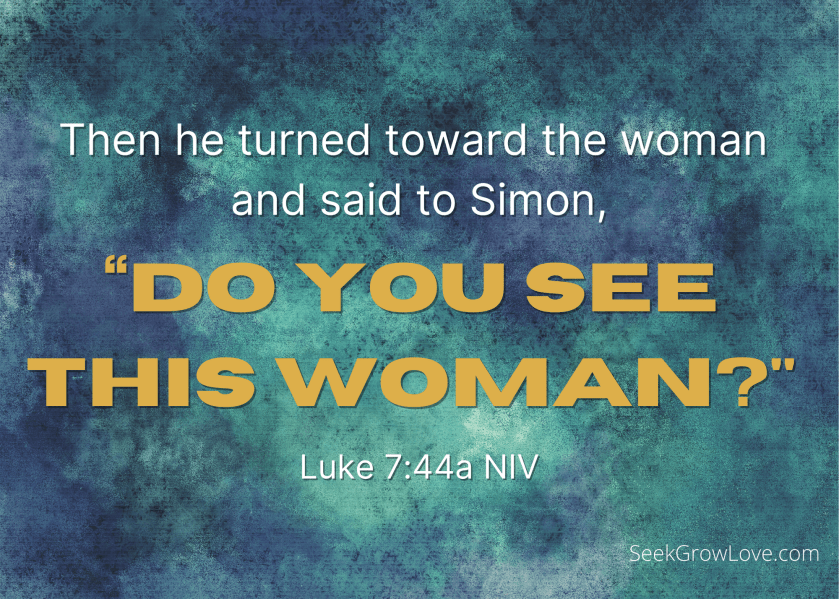
He turns to the woman and takes her worried, nervous, anxious trembling hands in his own. He turns his soft but piercing eyes to her own, red from weeping. He says to you, “Do you see this woman?” He lets the words hang in silence for a moment. She rubs her nose. For the first time you notice that some of her hair is starting to turn gray. You notice that she is not old, but the lines come from stress. You notice that she must have washed to come, as she looks cleaner than you have seen her in a long time… You see yourself seeing this woman, who you see everyday, in a new way. She is a whole person. She is more than the sum of her mistakes. She is loving this teacher. She is showing him honors “She has done for me what you have not,” he says. “She has much to be forgiven for, and so she loves, knowing now that she is forgiven. In your own eyes, your sins are so much smaller, and so your love is so much less.”
The rest of the table murmurs about the teacher forgiving sins, but as they talk he says to the woman “Your faith has saved you, go in peace.” She smiles at him with gratitude and joy…
Do you see this woman?
Or do you see the sins? The immorality? The wickedness? The hardness of life? The addictions? The abuse?
Jesus opened the eyes of the blind, and more importantly, causes the spiritually blind to see the world. May this imaging open your eyes. This man who raised up the dead, more importantly, raised up the living to new life. May this story cause you to raise the living to new life.
And may this question reverberate in your head all day :
Do you see this woman?
(Optional note for those confused about the devotion : spiritual imagining, putting ourselves in the story, is an ancient spiritual tradition. One great example that is often used is in Luke 15, the parable of the “Lost/Prodigal Son”, or better “The Lost Sons” or best “The Searching/Prodigal Father”. You may see yourself as the son who runs off, the servants rejoicing, the son who is angry for forgiveness, or the father looking for his boys. It says much about ourselves and our relationship with God and others to see who we identify with, and to put ourselves in strange places in the story. Today we looked through Simon’s eyes in Luke 7, not because it is the best, but because of course he would doubt Jesus. Of course he would question him. Of course he would be offended at the woman. And of course, all of that is undue, because Jesus overcomes our doubts through miracles, our questions through answers and better questions, and our offense by unending grace. May this story take a new meaning to you as you ask yourself: Do you see this woman?)
-Jacob Ballard
(originally posted for SeekGrowLove March 16, 2021)
Reflection Questions
Would you more often see yourself as the sinful woman or as Simon the Pharisee?
What do each of these 2 characters need?
Jesus initiates the discussion with Simon after Simon had just “said to himself”. What recent thoughts of yours might Jesus question if he were in your house today? What do you think he would ask/say/explain to counter your thoughts?
In Luke 7:1-10 we find the story of the centurion’s servant. The centurion was a conqueror and a foreigner, but despite this we find that he is a God fearing man who supports the Jews by building a synagogue for them. He has a servant who is dying so he sends messengers to Jesus to have Jesus heal the servant. He shows great humility and faith in Jesus through his actions and the servant is healed because of his great faith. Faith unequalled in all of Israel according to Jesus.
I think there are a couple of important lessons in this.
First, maybe you are like the centurion, maybe you didn’t grow up in the church and are a new believer, and maybe you are looking at Christianity from the outside and wondering if you can even be a part of this community. Of course you can! Salvation and God’s work in the world is based on faith, not upbringing or culture or works. So don’t worry about your past, because God can work powerfully in your life no matter what is in your past!
Second, maybe you are like the Israelites in this story, you grew up in church or have been a Christian for a while and are maturing in your walk with God. I think for you this story has an encouragement and a warning. I encourage you to be like the Jewish people that the centurion sent to Jesus that were able to see past the fact that the centurion was a foreigner and conqueror and see the faith he had and to then recommend that Jesus help him. We should always be ready to welcome new believers based on their faith, and not judging them the way the world might judge them.
I also warn you to not be complacent or lukewarm like much of the Jewish community was when Jesus was with them. Jesus said that this centurion had more faith than any other in Israel. Many in Israel missed out on being healed and having their sins forgiven in Israel because they were out of tune with God and were not able to see when he was moving. I encourage you to be disciplined in your prayer life and in reading the scriptures so that your relationship with God will not grow stale.
-Chris Mattison
(originally posted Dec 10, 2017)
Reflection Questions
What healings (physical and/or spiritual) have you witnessed?
What do you think Jesus found most amazing about the faith of the centurion?
Would Jesus find anything amazing about your faith? How can you work at growing your faith?
Ephesians 6:17b – “…and the sword of the Spirit, which is the word of God.”
We have been given the most powerful weapon of all – God’s Word. It’s so powerful that Jesus used the Word of God as he engaged in battle during his forty days in the wilderness. Three times, the devil proposed a tempting offer to the Son of God. And three times, the Son of God used the Word to fight back. After strike three, the devil turned tail and left Jesus alone.
Have you ever used the Word of God while experiencing a spiritual attack? There have been nights where I have been lying in bed consumed with wonders and worries not able to sleep. I laid my Bible open on the edge of my bed, placed my hand upon the written word and eventually drifted off to a peaceful sleep.
One particular day, anxiety was getting the better of me and the only thing that kept my mind from spiraling out of control was reading aloud 2 Samuel 22. I must have read that chapter twenty-two times that day. That day wasn’t easy, I was emotionally exhausted by the time the sun went down. But with the help of God’s Word, I managed to fight back and extinguish the flaming arrows that bombarded my mind.
The author of Hebrews declares that “the word of God is living and active”. This is not just any sword, it is a double-edged sword that does damage going in and coming out of its intended target. It’s not a sword that will go dull or become irrelevant, it’s a sword that has withstood the test of time. It’s not just a sword for the elite warrior, it’s a sword that someone on the front lines of battle would use for both defensive and offensive maneuvers. It’s not a sword that is meant to be a decorative display, it’s a sword that is meant to be used.
An experienced soldier isn’t someone who has just seen a lot of battles. A soldier of high caliber is one who took their “basic training” seriously and continues to practice and hone their skills, even when they are not on “active duty”.
Any professional athlete knows that their off season is not a multi-month vacation. It’s an opportunity to recover from injuries, cross train in other physical activities, continue with proper nutrition, and work on the finer skills of their game.
Likewise, when we find ourselves in a period of peace, it is not time to lay aside our swords and eat grapes all day long. We need to be preparing for the next attack. If the Word of God is living and active – then we must also be living and active. Daily engagement with the Word is crucial, but so is being part of a church fellowship. Staying involved in local ministry, putting your spiritual gifts to good use is a way to stay ‘living and active’.
While I am thrilled that you are reading these words, have you opened up your Bible today? It is a powerful weapon, forged with priceless materials, intended to protect and defend against the enemy’s attacks. Use it in times of battle. Use it in times of peace. Know this weapon inside and out. And may you be victorious as “you stand your ground, and after you have done everything, to stand.”
-Bethany Ligon
Reflection Question
How can you use the Sword of the Spirit during times of war? And in times of peace? What has God’s Word provided for you at different times?
Can you tell of a time that God’s Word was exactly the weapon you needed? What did you find there? What did it provide for you? How did it change the battle? Who can you share this testimony with?
Where do you tend to turn when you don’t turn to the Bible? How do those battles go?
Here’s a disquieting fact to start our devotion today: According to the International Brain Injury Association, 5.3 million Americans are living with some kind of disability due to a traumatic brain injury. 5.3 million is the population of South Carolina! Of course there are varying degrees of injury, but most are due to car accidents and sports-related incidents.
And while 5.3 million is a staggering number, I’m willing to bet that there are so many more people living with spiritual battle scars in their minds.
Our minds are such a vulnerable space and it’s one of the enemy’s favorite areas to attack. At least, that’s been my experience. Anyone else struggle with random thoughts popping up that obviously aren’t from God?
But why attack the mind? Why not make the heart the primary target? Because our thoughts turn into words, which turn into actions, which turn into habits, which turn into our character. James, the half brother to Jesus, said it this way, “It is the evil that a person wants that tempts him. This desire causes sin. Then the sin grows and brings death.” (James 1:14-15, ICB) This is why it is imperative to protect this part of our body.
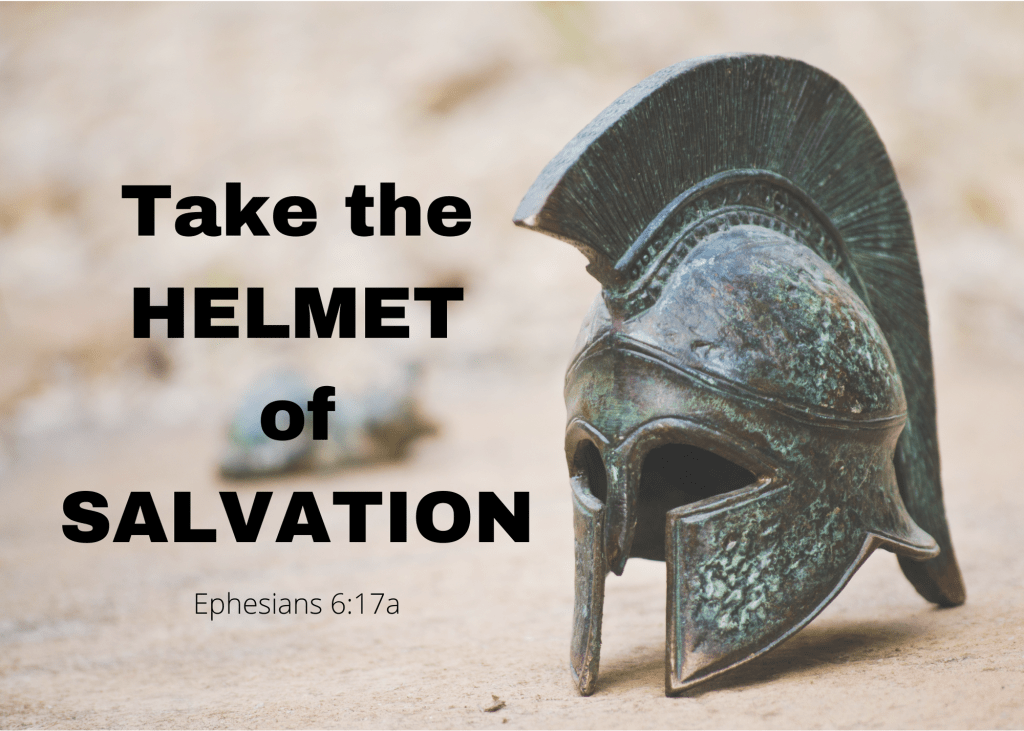
For the apostle Paul, the author of this Epistle, the helmet was the perfect metaphor; after all, he was under house arrest when he wrote this letter. He probably had a lot of face time with a Roman guard who most likely wore some kind of helmet. Each piece of the helmet added another layer of protection against injury or death.
Paul calls this piece of the armor the helmet of salvation. The Greek form of the word for salvation is used only in this verse in all of the New Testament and it means “peace”. As we don this piece of armor, we can have the “peace of God that transcends all understanding will guard your hearts and your minds in Christ Jesus”. (Philippians 4:7)
Where does this salvation or peace come from? It comes from being in the Word of God daily: reading, studying, meditating, and memorizing it. We need to be intentional about the media that we consume and the conversations that we participate in. We need to be aware of entertaining the thoughts that seem to come out of nowhere. Protecting our minds against the thoughts that flow in and out should be something that is carefully monitored as we go about our daily living.
If you want to be in God’s Shalom peace while you engage in spiritual battle, be sure to wear the helmet of salvation.
-Bethany Ligon
Reflection Questions
How do you think the enemy attacks minds? What about yours in particular?
Describe the progression from thoughts to words to action to habits to character. Give an example that leads to ungodly character. Give an example that leads to godly character. Which type of thoughts do you work at thinking most?
What protection is available to you against the thoughts that lead to ungodliness and death? In what ways can salvation and peace mean the same thing? What can you do (today) to strengthen your protection that God has made available to you?
Do you ever feel like you’re being bombarded with issues, concerns, or worries? Have you ever heard yourself saying, “If it’s not one thing, it’s another”? Maybe you’re just having a typical ‘Monday’ even though it’s Thursday. Or maybe you find yourself clumsy dropping things, forgetting why you walked into a room, or having to deal with “that one person” more often than normal? It’s not so much one big thing, it’s just one little thing after another that really tests your patience.
My friend, those big things, those small things, those things in quick succession, those repeated things…those very well could be “flaming arrows of the evil one”.
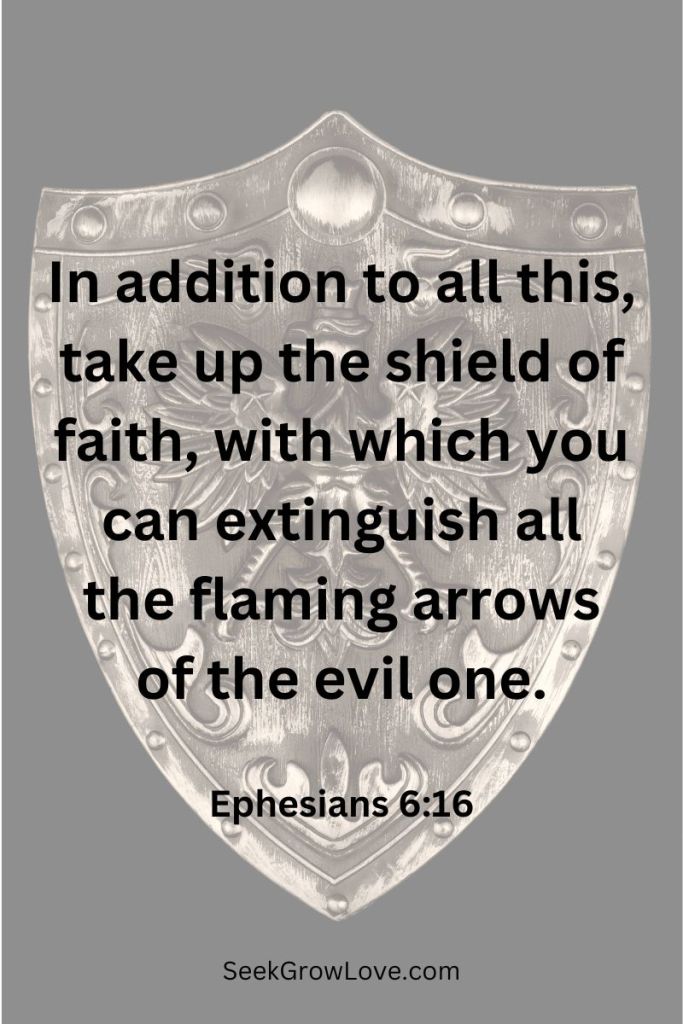
So why does the author of Ephesians, Paul, specifically use the term “flaming” arrows…why not just regular arrows? If a vulnerable soldier were hit by a normal arrow, it would likely only cause damage to himself. But if a flaming arrow hit him, the flame could catch onto nearby flammable material and cause significant damage.
The comparison leads us to think about how these spiritual attacks affect us and those around us. When we’re experiencing trials and tribulations, how are we treating others? Are we still kind and compassionate or do we take our frustration out on others? When the challenges are mounting up all around us, do we hide out and disengage or do we press on with our commitments and ministries? When the attacks start coming from every angle, are we able to keep our head on straight and make responsible decisions, or are we tempted to act recklessly with our resources and health?
You see, from the evil one’s perspective, the more damage that can be done with a single flaming arrow, the more successful the attack. It’s not just you and your personal faith; it’s your physical and spiritual health, your relationships and ministries that are under attack.
This is why taking up the shield of faith is so vital when engaging in spiritual warfare. A Roman soldier would have his wooden shield soaked in water so that when a flaming arrow hit its intended target, the flame would be extinguished and not cause collateral damage.
Likewise, when we are soaked in the Word of God, those attacks become a little less hazardous to how we choose to carry on in the battle.
In John 7:38, Jesus says, “Whoever believes in me as Scripture has said, rivers of living water will flow from within them.”
The more of the living water that we have flowing through us, the more protected we are from the enemy’s attacks on our faith. We need to stay spiritually hydrated by engaging in the Word of God on a regular and consistent basis. This will build up our faith and protect us from the flaming arrows that are pointed in our direction.
-Bethany Ligon
Reflection Questions
What do you see and recognize as flaming arrows of the evil one? How can recognizing them as flaming arrows of the evil one improve your response to them? Which ones have attacked you or caught you off-guard most recently?
Where/when have you seen a flaming arrow in action – with the potential of injuring or taking down more than just the one it hit? How can we guard against the effect of the flames of these arrows?
How strong is your shield of faith? Does it have weak spots that make you more vulnerable? What can you do to strengthen your shield?
When was the last time you regretted wearing a pair of shoes? I recently was on the hunt for a pair of gray sandals and I found some that I thought I might like from an online store. I ordered them and at first, they seemed to be very cushy and comfortable. As I wore them throughout the day, I noticed that the straps were rubbing the bottom of my ankle. It never caused a blister, thankfully, but it was just irritating.
Anyone who is on their feet all day can tell you the value of having comfortable and supportive shoes. Whether it be someone in the medical field, law enforcement, military, food service industry, or in the classroom, having a good pair of shoes is a necessity.
But what does having supportive footwear have to do with the Armor of God? A soldier’s boots (or sandals as ancient Roman soldiers would wear) are likely the one piece of their attire that they use for hours on end, every single day. They train with their weapons while wearing their boots. They go on marathon-long hikes while wearing their boots. They eat their meals while wearing their boots. And sometimes, they will even sleep while wearing their boots. If a soldier’s feet are sore or tired or have blisters, he or she becomes limited in what they can do – at least without any pain.
Our verse today talks about being “fitted with readiness”. A soldier must be ready to go at any given moment. Likewise, as believers fighting in a spiritual battle, we must be prepared to take action at any point in time.
And just what are we to take action with? The Gospel of Peace. This gospel includes the message of salvation and the Kingdom of God. As warriors in a spiritual battle, we need to remember whose army we fight for. When we are laser-focused on what we’re fighting for, we can be empowered and strengthened to fight against anyone or anything that is our opposition. So when temptation or persecution comes our way, we can make sure that we are in the ready position, set to take our Commander’s orders.
But also, the Gospel of Peace is something that we should be comfortable sharing with others who have not yet discovered it for themselves. Being ready to explain to others what we believe and why we believe it is another way to wield this piece of armor. Conversations with our friends, family, work buddies, and even random people you encounter in your day-to-day life can sometimes lead to discussions about our faith. When we are ready to share the Good News, we are showing ourselves to be prepared soldiers in the Lord’s army.
So let’s lace up our boots, and get ready to share the Good News of the Gospel of Peace!
-Bethany Ligon
Reflection Questions
The gospel is only called the “gospel of peace” here in a passage about the spiritual war we are in. How would you describe the gospel of peace and why do you think this wording was chosen for this passage?
Do you feel like you are ready to take action to follow your Commander’s orders today? What do you think could happen if you ARE ready? What could happen if you AREN’T ready for action? What could you do now to be more prepared? Do you think you have ever used an excuse of not being ready when God wanted you to do something?
How can you share the gospel of peace with others this week?
As we continue our study on the Armor of God, we come across two terms that are not frequently used in our day to day vernacular: breastplate and righteousness. So let’s dig a little deeper in order to come to a better understanding.
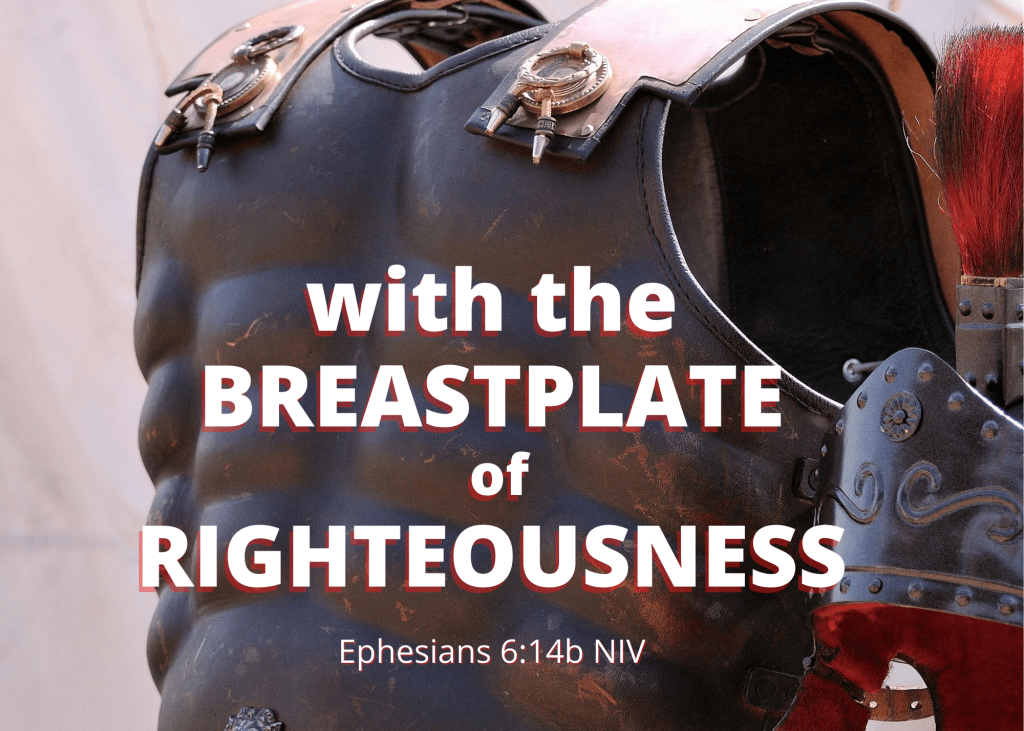
The breastplate is the piece of armor that goes directly on top of the chest, protecting the heart, lungs, spleen, liver, and even the stomach. Longer breastplates would also cover and protect the intestines. Without this vitally important piece of the armor, any direct impalement by a sword, spear, or arrow could prove to be fatal.
In modern warfare protection, soldiers wear vests made of a material called Kevlar. Invented by Stephanie Kwolek in 1965, its usefulness is not limited to body armor, but extends to brake pads, space suits, and drum heads. It’s been tested to be ten times stronger than steel, is capable of absorbing high-velocity impacts, and withstand extreme hot and cold temperatures. (Thanks Google AI for the information!) Today’s warriors don it knowing that their life could depend on it!
Righteousness is a word that is typically limited to “churchy conversations”. (Unless you were in high school in the early 90’s and claimed that something thrilling was “totally righteous”.) But what does this word really mean? Basically, it means to be in right standing before God; morally and ethically sound; to do the right thing with a pure heart.
So how does a person become righteous? Romans 3:22-24 says, “This righteousness from God comes through faith in Jesus Christ to all who believe. There is no difference for all have sinned and fall short of the glory of God, and are justified freely by his grace through the redemption that came by Christ Jesus.”
Let’s try to tie this together. When we wear the breastplate of righteousness, we are literally layering on spiritual protection upon our hearts. Without this gear, we are vulnerable to the attacks from the enemy that could prove to be fatal. When we wear this armor of righteousness, we are able to stand before God and be seen worthy and faithful. His Holy Spirit will protect us.
Some may be tempted to try to shortcut the cost and find cheap substitutes for this level of protection. Whether it be trying to buy our own righteousness by being a “good person” or living an inauthentic lifestyle, where your words and actions cover up a deceitful heart, the Bible is clear that there is only ONE source for a legitimate breastplate of righteousness. We must have faith in Jesus. Faith that accepts Jesus as Savior and Lord. Faith that believes the Lord will fight for us. Faith that commits to standing firm when everything around us crumbles. Faith that submits everything, our hopes and dreams, our plans and purposes, our resources and relationships, our past, present and future to the One who is called Jesus, the Christ, the Son of the Living God.
Yes, it is costly. But the protection and confidence that it provides is invaluable for the fight that we must fight. “For our struggle is not against flesh and blood, but against rulers, against the authorities, against the powers of this dark world and against the spiritual forces of evil in the heavenly realms.” (Eph 6:12)
-Bethany Ligon
Reflection Questions
How would you rate your righteousness: “to be in right standing before God; morally and ethically sound; to do the right thing with a pure heart”?
How would you rate your faith in Jesus? What happens if you try to have righteousness apart from faith in Jesus? What does faith in Jesus lead you to be and do?
How does a breastplate of righteousness protect you from the powers of this dark world? What would Satan want you to believe about the breastplate of righteousness? Where do you see this attitude/belief in the world?






 Seek Grow Love