1 Chronicles 7-10
I believe today’s reading will be the last of the genealogies for awhile. There are a lot of names, a lot of generations. Father to son. Father to son. Father to son – and sometimes a daughter. Father to son. A whole lot of heritage. A whole lot of passing along from one generation to the next. It reminds us that our life is not just what we see and experience today. We have a past that has shaped us and we (and our children) have a future for which to prepare.
I am reminded of a passage in Psalm 78 that we read last week but didn’t have time to discuss directly.
My people, hear my teaching;
listen to the words of my mouth.
2 I will open my mouth with a parable;
I will utter hidden things, things from of old—
3 things we have heard and known,
things our ancestors have told us.
4 We will not hide them from their descendants;
we will tell the next generation
the praiseworthy deeds of the Lord,
his power, and the wonders he has done.
5 He decreed statutes for Jacob
and established the law in Israel,
which he commanded our ancestors
to teach their children,
6 so the next generation would know them,
even the children yet to be born,
and they in turn would tell their children.
7 Then they would put their trust in God
and would not forget his deeds
but would keep his commands.
8 They would not be like their ancestors—
a stubborn and rebellious generation,
whose hearts were not loyal to God,
whose spirits were not faithful to him.
Psalm 78:1-8
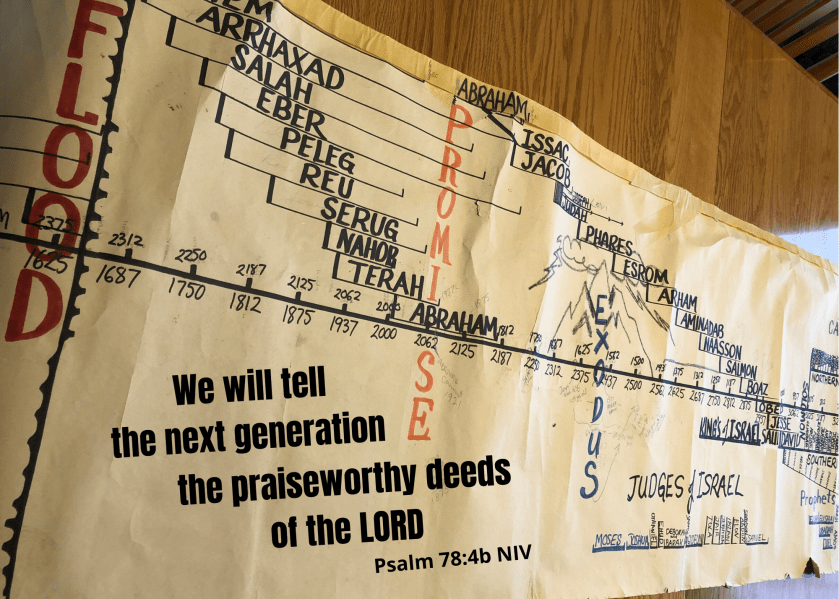
I am thankful for a father who passed along to me the spiritual heritage he received from his father and grandfather. Both of my parents brought their children up to seek and serve the Lord first – it is by far the most important life lessons that they taught. In fact, today’s photo is a Bible timeline that I inherited from my dad, and one of my favorite treasures from him. He spent hours researching and meticulously drawing out this timeline to help illustrate for his Bible students (including his children) God’s faithfulness and plan for the ages. And, he lived it out with his life, too.
So, now it is my turn to pass along what I have heard and learned. How do I do that with the words I speak, with the priorities I set and with the life I live? How do I help my children seek God, grow in faith and love Him more and more?
There are so many negative influences and evil that would love to help us and our children forget God’s great deeds, His law, His faithfulness and His plan for the ages. But we must not forget. Nor is it enough to just remember for ourselves. We have a great responsibility to hand these truths down to the next generation so they can hand them down to the generation after them, etc…until Jesus returns.
Maybe you cannot celebrate an upright Godly spiritual heritage in your genetic past. You don’t have the benefit of an antique family heirloom Bible timeline rolled up in your closet. That’s okay. Paper rips and ink fades, but if you have a love for the LORD you have priceless spiritual mentors you can call mom and dad. And, then, we must in turn create a spiritual heritage rich in God’s goodness, laws, and plan for salvation for those around us: our children, grandchildren and those children of all ages and colors and countries who need to know what God’s Word says and who God is.
God’s genealogy doesn’t end here in 1st Chronicles. It is continuing today, and into the future. Will it be recorded that you passed along what is of the most importance to those that came after you? Don’t let yourself, or your children, be listed as the ones that forgot. Tell of His goodness. Put God first. Pass it on.
Marcia Railton
Too important to not mention: I love verse 6 in Psalm 78 (above) where we see the value and great worth of, “the children yet to be born”. Whether the children are conceived or not, born or not, they were planned to play a part in God’s design of the passing along of family and faith. How tragic that this link has been broken time and time again when the children yet to be born are killed for convenience before they even get a chance to hear, learn and share of their Creator. Tell of His goodness. And His Word and His law. Do not forget. And do not ignore the evil that rejoices when God is forgotten. We need to speak louder since voices in the chain are silenced.
Today’s Bible reading can be read or listened to at https://www.biblegateway.com/passage/?search=1+Chronicles+7-10&version=NIV
Tomorrow’s reading will be Psalms 102-104 as we continue the 2020 Chronological Bible Reading Plan

 Looking to Jesus, how can we be ready to do battle with temptation? First, he knew the word of God. It is how He responds not only to the temptation, but even when the word of God is seemingly being used against Him. How can you know the will of God? It is as ironically simple as losing weight: diet and exercise. Consume the right thing, His word, and practice it daily, so you will be spiritual healthy. Next, do God’s business. Know that temptation can come at any moment, but comes easier when we are idle (Prov 16:27-29). Keep your eyes on God and your hands and feet busy to his work. Like the old adage, “if you’re going through hell, just keep going,” Jesus faced the temptation, but immediately moves onto His ministry. Temptation IS NOT sin. No guilt required; pick up and move on. Finally, be on guard. Relapse can setback or even kill your spiritual life. Removing unnecessary temptation from our lives is a must. Even if we are in the word every day, engaging in spiritual disciplines, or deeply involved in a ministry, at the very height of our endeavors, it only takes a moment to go back to sin and fall harder and faster than we ever did (the very nature of relapse). If you can’t hang out with your friends without getting drunk, then don’t hang out with them. If you can’t be on the internet without looking at inappropriate sites, then don’t get on it. If you can’t use social media without bridling your tongue and speaking in love, then stop. Jesus uses hyperbole to illustrate the practical advice when he states, “it is better to cut your hand off” or “pluck your eye out” (Matt 5:29, 30) than to be lost to sin, and ultimately the kingdom of God.


 If you are in that moment, remember that God does not leave Elijah there, and he doesn’t want to leave you there either. Instead, he says, “Get up and eat (v. 5). After Elijah eats twice, he goes on a journey forty days and forty nights to the mountain of God. There, Elijah waits, first through a great wind, then through an earthquake, and lastly through a fire. In each of these places, he does not hear God’s voice. Finally, he hears it in the soft whisper, as God asks him “What are you doing here Elijah?” (v. 13) Elijah responds by saying, “I have been very zealous for the Lord God of Hosts, but the Israelites have abandoned your covenant, torn down your altars, and killed your prophets with the sword. I alone am left, and they’re looking for me to take my life” (v. 14). Elijah feels this despair because he had forgotten what God just showed him. In the desert when he was hungry, God was there with provision. He had forgotten that in the showdown, God was there with provision. When we turn our eyes from God to focus on our fractured circumstances, it can lead us to doubt. But, one remedy for that doubt is not only to remember the character of God but also to remember how God has exhibited that character in previous actions of faithfulness. We can trust in him not only because of what we know from the Bible but also because of what we know from our own lives. So, if you are in a wilderness period in your life, pause and remember God’s past faithfulness instead of dwelling on your despair. These reminders can help us to remember that even in our darkest times, God will carry us through.
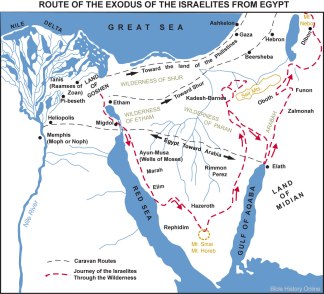
 Over the next few days, we’re going to look at four wilderness stories in the bible to learn a lesson about what the wilderness is and what it can teach us. The first Wilderness Wandering Lesson is this: