Why do bad people seem to succeed in this life? Why do the righteous suffer while the wicked seem to get away with everything? And if God sees it, why doesn’t He step in right away?
That’s exactly where the book of Habakkuk begins. The prophet cries out to the LORD, confused and hurting, asking why injustice is allowed to go on. It’s a reminder that God isn’t afraid of our concerns. He wants us to bring our pain, our doubts, and even our “why” straight to Him.
God answers Habakkuk in a way he doesn’t expect. He says He will use the Chaldeans (a powerful and wicked people) to bring judgment on Judah (a less powerful and less wicked people). But He also makes it clear that their strength is nothing compared to His, and their own judgment is coming.
Habakkuk learns that affliction is part of living in a broken world. God’s justice is not absent just because it isn’t immediate. His plans are bigger than what we can see, and even while Habakkuk was praying, God’s answers and plans were already in motion, just not in a way he could yet understand.
In the middle of this, God gives Habakkuk a promise. “The righteous shall live by his faith” (Habakkuk 2:4). Paul quotes this later in Romans 1:17, reminding believers that faith is the foundation of a right relationship with God.
By the end of the book, Habakkuk’s tone shifts. His questions turn into worship. Chapter 3, written as a song, closes with
“Yet I will rejoice in the LORD; I will take joy in the God of my salvation.” (Habakkuk 3:18)
That’s the kind of faith we’re called to, not just praising God for what He’s done, but trusting in Him even when the outcome is still unseen.
Reflection Questions:
What does Habakkuk’s honesty in prayer teach you about how to approach God in hard times?
How does “the righteous shall live by his faith” (Habakkuk 2:4) challenge your response to unanswered prayers?
What would it look like for you to rejoice in the LORD this week, even in uncertainty?
“You will be hated by everyone because of me, but the one who stands firm to the end will be saved.” (Matthew 10:22).
In chapter 26, Jeremiah experienced hate on account of obedience to God. He was obedient to telling the people God’s message and they wanted to kill him for it. In our current day, the world is trying very hard to normalize certain sins and they spew a lot of vitriol toward Christians for not supporting it and promoting it. We see in certain areas of the world where Christians are even being killed for their beliefs.
Did Jeremiah crumble under the threat of death? He absolutely did not. In the face of the threat of death, he stood his ground and continued to be obedient to God’s call to warn the people. God wants us to not have a spirit of fear and timidity but to be bold—even in the face of danger. Thankfully, we don’t need to rely on our own limited power, because we have a far greater source of strength. 2 Timothy 1:7 says, “For the Spirit God gave us does not make us timid, but gives us power, love and self-discipline.”
If we are practicing obedience to God’s word, we can be sure that we will receive push back from the world. We need to be resolute like Jeremiah and not conform to the wickedness of the world, but instead call it out so that we can help bring as many people as possible into God’s kingdom.
-Kristy Cisneros
Reflection Questions
What might you be thinking and feeling and doing if you were in Jeremiah’s shoes? Is there anything you find particularly admirable about Jeremiah?
What is the purpose behind speaking up (not omitting a word) even when it is not positively received?
Have you ever faced a potentially fearful situation because of your faith? How do you think you (with help from the Spirit of God) might handle it today if you ran into persecution for believing in and speaking for God?
What might you be able to do today to strengthen your faith in order to speak every word from God AND perhaps handle persecution better in the future?
When my son was little, we spent a lot of time watching Thomas the Tank Engine and Friends. One of Thomas’s friends was an engine named Percy. Percy was good at his job, but sometimes he just felt he was given way too much work and it was unfair. “I feel put upon!” Percy would declare at various times. While reading today’s chapters, I think Jeremiah was saying the same thing (but in Hebrew 😀).
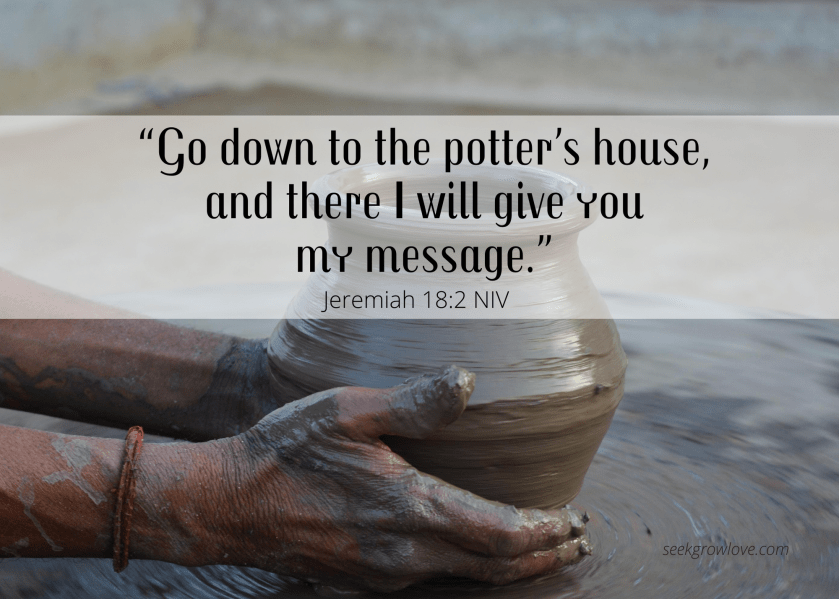
And really, I don’t blame him. God had him observe a potter creating and destroying vessels at his pleasure to demonstrate what God will do with His people. Then He had Jeremiah buy a clay jar and smash it in front of the leaders of Judah to demonstrate what God will do to Judah. And what does Jeremiah get for his obedience? Beaten and mocked. Not only that, but Jeremiah saw that nothing was happening to the evil people, in fact, they seemed to be doing quite well. He was frustrated and felt defeated. I think I would have, too. Any half-way mature person knows that life isn’t fair, but sometimes it’s hard not to be frustrated when you always seem to be on the unfair end of things and that’s where Jeremiah is here. But despite his anger and frustration, he still acknowledges that no matter what, Jeremiah would praise Him and continue to prophesy in His name. Which is probably a good thing because after years of warnings, God begins moving His hand against Judah.
In chapter 21, we see that the warning of destruction of kings was no longer a vague, general mourning. People are being named. King Zedekiah was told he would be captured by the Babylonians, King Josiah’s eldest had been exiled, and his next son, Jehoiakim’s death was predicted to be un- mourned and dishonorable. Then it’s Jeremiah’s job to try to convince the people to surrender to Babylon so they will go “easy” on them and not kill them. No wonder this guy wasn’t very popular. I hadn’t really given it much thought before but in verse 20:18, Jeremiah mentions his friends. They certainly aren’t good friends as they are plotting to kill him. But unlike Jonah who was commanded to go and preach to a far off nation, Jeremiah was preaching to the people he grew up with and lived around. The people he traded goods with, the people he talked to while on the way to the temple, people who had been a part of his everyday life. Between being scorned for delivering these messages and knowing what was in store for his community, no wonder Jeremiah was down and depressed. He WAS put upon.
We’ll have to keep reading to find out what happens to Judah and Jeremiah. But in the meantime, think about the times you’ve felt “put upon” by the Lord. What happened? Did He stay with you? Like Jeremiah, did you praise Him anyway?
Prayer:
Dear Lord,
There are times in life when You have given us a burden and we feel “put upon”. Help us to have an attitude of peace and contentment at these times because You have chosen us to carry that burden. Please give us the strength to do it with pleasure.
In Christ’s Name,
Amen
-Maria Knowlton
Reflection Questions
“Think about the times you’ve felt ‘put upon’ by the Lord. What happened? Did He stay with you? Like Jeremiah, did you praise Him anyway?”
Have you ever delivered warnings from God to someone you know? What was the hardest part? What did this person think of you? What do you think God thought of you? What happens when no one warns?
Do not be like the rest of society, not obeying, not trusting, and not drawing near to the Lord (3:2) Instead, seek out the Lord, do what He commands, and seek righteousness and humility (2:3)
“Those who cannot remember the past are condemned to repeat it.” This quote by philosopher George Santayana has famously been reiterated by Winston Churchill and probably every history teacher you’ve ever had. It just makes sense, right? We can avoid so many problems if we learn from the mistakes of others, whether it’s personally or corporately. Unfortunately, as Santayana noted, even those who DO learn history repeat it.
Sadly, as a society, we’re not doing any better than the people of Israel in the book of Zephaniah.
In the very short book of Zephaniah (we’re going to call him Zeph for short), Zeph is giving a warning to the people of Judah to turn from idols, stop their violence and evil, and most importantly, TRUST the LORD! In my short amount of google research, it seems most Biblical scholars believe Zeph was a cousin and possibly a friend of King Josiah. Zeph was most likely preparing the people for the coming revival of faith and obedience brought by King Josiah.
Not to spoil it, but Judah does turn from their wicked ways and turn to the Lord! Yay!
But, not remembering the warnings and history, they forget and are later captured by Babylon. Sigh.
But are we any better? Zeph prophesies to the people way back in 640 BC. One of the major problems Zeph preached against were those who knew God exists but that He “will not do good, nor will He do evil.” (1:12) This is ambivalence.
This ambivalence continued into the Roman Empire. In 1776, Edwin Gibbon wrote in his book, “The Decline and Fall of the Roman Empire” about the religious attitudes in the last day of the Roman Empire around 476 AD.
-The people regarded all religions as equally true.
-The philosophers regarded all religions as equally false.
-The politicians regarded all religions as equally useful.
(Enduringword.com)
These were the attitudes of the people of Judah some 1100 years before. And they are exactly the same attitudes of our society 1550 years later! We do not learn. Even with history laid out before us.
However, as Zeph wrote in his book, there were those in Judah who did not go along with everyone else and they will be rewarded. We need to be like that “remnant of Judah” (2:7).
We may not live in a society that learns from its history, but we certainly can be individuals and a church that does.
Prayer:
Dear Lord, please open our minds to allow us to not only learn history, but to avoid actions we have seen that lead to destruction. Please let us be a light to those who know you exist but deny your goodness in their lives. Thank you for allowing us to come before you to seek righteousness and humility.
In Christ’s name, Amen
-Maria Knowlton
Reflection Questions
What similarities do you see between the people of Judah in Zephaniah’s day and the people of your world today? Any differences?
What is the problem with being ambivalent toward God? What could/would/will you say to someone who is ambivalent toward God?
If you were to write a letter of warning to the people today what do you think God would want you to say?
In 2 Kings 20, we see King Hezekiah, a ruler who (mostly) honored the Lord and brought reform to Judah. When he fell ill, he prayed earnestly, and God mercifully extended his life by fifteen years. Yet even this godly king displayed flaws and selfish pride, especially during the end of his rule. After his recovery, he proudly showed off his treasures and bragged to the Babylons, failing to seek God’s wisdom instead. This prideful act led to Isaiah’s sobering prophecy and indeed Babylon would one day carry all of his riches away. Hezekiah also showed a lack of care or concern for the people who would come after him. He was pleased just to know that the Lord’s wrath wouldn’t fall upon Jerusalem during his lifetime. He did not set up future generations for success.
In chapter 21, we meet Hezekiah’s son, Manasseh, who reigned for 55 years. Unlike his father, Manasseh rejected the Lord completely! He rebuilt pagan altars, was engaged in every form of occultism, including black magic, fortune-telling, demon contacts, and even child sacrifice. Manasseh led Judah deeper into sin than the nations God had driven out before them. The history of God’s people was a history of disobedience toward the Lord. With the reign of Manasseh, the sin of God’s people climaxed, God’s patience was withdrawn, and the judgement of exile became inevitable.
The contrast is striking: King Hezekiah sought God yet stumbled in pride; King Manasseh abandoned God altogether. This contrast reminds us that faith must be personal, it cannot be inherited. Hezekiah’s faith didn’t guarantee Manasseh’s obedience. Likewise, partial obedience or past faithfulness doesn’t excuse compromise. God calls each of us to a life of daily trust and surrender.
Prayer:
Lord, help me walk humbly before You, not resting in yesterday’s faith, but living in daily obedience. Keep me from pride and arrogance and please lead my heart to fully trust in You and Your precious son, Jesus. In his name we pray, Amen.
Reflection Questions:
• Where might you be relying on past spiritual victories, rather than seeking renewed dependence on God today?
• Are there areas in your life where pride or compromise have crept in?
• Are there “treasures” that you show off, revealing misplaced confidence?
• What legacy of faith are you building for those who come after you?
Isaiah 54-58 paints a beautiful picture of God’s mercy, restoration, and covenant faithfulness. While written in the context of Israel’s exile and return, these words convey God’s love and faithfulness for all generations and people. They offer hope of the New Covenant, which is fulfilled in Christ and graciously extended to all who call upon His name.
In Isaiah 54, God speaks to a people who feel forgotten and barren. They have lost trust in God, and betrayed him numerous times. Yet, He invites them to sing with joy and promises to enlarge their tents! Why? Because He is about to fulfill His promise of restoration. Though they had strayed, His covenant of peace stands firm:
“With everlasting kindness I will have mercy on you,” says the Lord. (Isaiah 54:8)
“My unfailing love for you will not be shaken.” (Isaiah 54:10)
God knows exactly what He intends his people to become. He knows exactly what circumstances, both good and bad, are necessary to produce that result in our life. Will we trust him through it all, with greater faith and obedience than the Israelites?
God himself grants an invitation to the weary and empty in Isaiah 55.
“Come, all you who are thirsty, come to the waters.” (Isaiah 55:1)
It’s important to note, that this is not a transaction but a gift. The gift of life, of forgiveness, and of purpose. Isaiah points us to a “Davidic covenant” made new: an everlasting covenant for all who will listen and obey God’s Word. His promises are not vague hopes, rather they are declarations backed by His unchanging character.
In the New Covenant, Jesus is the Living Water and the Bread of Life. The “free” offer in Isaiah 55 becomes the gospel invitation: “Come to Me, all who are weary and burdened, and I will give you rest.” (Matthew 11:28)
Isaiah 55:8-9 reminds us that God’s thoughts and ways are far above our own. This doesn’t mean He is indifferent to our suffering, rather that His plan is bigger than what we can see or understand. In our limited perspective, we often can’t fully understand what God is doing. But Isaiah assures us that God is always at work, even when we can’t fathom his ways.
In Isaiah 56, God declares that the foreigner and the eunuch (those who were once excluded), now have a place in His house. The New Covenant throws the doors wide open! No one is too far gone, too broken, or too different. In Christ, all are welcomed and made new. That is excellent news for us, as Gentiles!
Isaiah 57 declares that God dwells in two places: the high and holy place, and with the contrite and lowly in spirit. That’s the mystery of grace. He’s not looking for spiritual perfection, but for hearts that are humble and honest. The New Covenant brings God near, not because we’ve earned it, but because Christ has made the way.
The New Covenant doesn’t reward the proud or the religious elite. It finds its home in the hearts of those who know their need and bow before God in humility, repentance, and dependence.
Religion says, “I messed up, my Dad is going to kill me!”, whereas Sonship says, “I messed up, I need my Dad’s help!”
Isaiah 58 makes it clear that God isn’t impressed with hypocritical, half-hearted religion. He desires hearts that reflect His justice and compassion. Fasting, prayer, and worship are empty if they’re disconnected from love for the Father and love for others. Proper fasting humbles us, blesses others, and honors God. This echoes the heart of Jesus’ ministry. The New Covenant reshapes our worship, not just as acts of ritual and obedience, but as a life poured out for others, empowered by the Spirit of God, and rewarded with blessings of salvation and the Messiah’s kingdom!
Let us live as grateful recipients of the New Covenant. Set apart and motivated not by religious performance, but by a relationship with our loving Creator. May we display trust, obedience, and confident hope in the one true God, our loving and merciful Father, who always keeps His promises.
Prayer:
Father in heaven, let me receive Your grace freely and trust that Your Word will bear fruit in my life. Come and dwell in me, not because I am worthy, but because You are full of mercy. Father, teach me to worship You in truth, not just with words, but with action. May my life reflect the love, kindness, and action that You desire. In your son, Jesus’ precious name, Amen.
Reflection Questions:
• Where in your life have you doubted God’s faithfulness?
• Is your faith more about ritual (religion) or relationship (sonship) ?
• Do you believe that God’s ways are better than yours, even when life hurts?
• What areas of life do you need to surrender to God, allowing Him to turn your brokenness into beauty, for his glory?
Isaiah 38:2 – “Remember, O LORD, how I have walked before you faithfully and with wholehearted devotion and have done what is good in your eyes.”
My 21-month old nephew is already practicing his independence. Just the other day, my brother shared in our family chat a video of the little guy outside on their patio, in his diapers, figuring out how to make the sprayer on the lawn hose work. It was amazing to see him inspect the sprayer as he held it in his hands. He eventually discovered that if he applied enough pressure on the handle, water would come out. And then he went to town spraying everything on the patio, including the arcadia door where my brother was on the other side capturing the moment.
As amazing as it is to watch a child grow and develop, they are still very much dependent on the adults in their lives for providing for all of their basic needs. And if those needs are not met in a timely manner…cries and tears are bound to surface.
As an adult, I’d like to think that I’m more mature than a child, but in all reality, I’m not. I am independent to a fault until something doesn’t go my way or I need help. And even then, I’m reluctant to admit as much. Life is great…until I’m criticized…until my supervisor decides to take an alternative course of action after I have spent hours preparing for something different…until money that I’ve saved up for a vacation has to be spent on expensive AC repairs…until I cut my foot by dropping a plate on it and the ability to walk or drive inhibits my mobility. It’s only then do I pout and admit that I can’t do everything on my own; I need assistance, from my family, from friends, from my heavenly Father.
As I read through Isaiah chapters 37-38, I couldn’t help but notice that when King Hezekiah was in dire straits, he immediately turned to God and worshiped Him, and made his case for why God should show His mercy and grace. This is exactly what God desires from His children. He longs for us to depend on Him for all of our needs, from daily and minor inconveniences to the major and potentially life changing circumstances.
However in Isaiah chapter 39, King Hezekiah’s attitude is much different. Life is good; in fact he gets a bonus of 15 more years to live! He’s so confident in his situation that he becomes arrogant and shows off all of the kingdom’s wealth and prosperity to mere strangers. Where has his dependence on Almighty God gone? And for the king’s actions, the prophet Isaiah gives him a heads up that trouble will indeed come. But does Hezekiah care? Nope. He’ll be dead by then and it will be someone else’s problem. Whaaaat??? How is this even the same guy?
But before I become too critical, I have to remember that my human tendencies can easily do the same thing.
So how can we avoid the temptation to rely on our own wits and wisdom? Jesus gives us a clue in Luke 9. “Then he said to them all: If anyone would come after me, he must deny himself and take up his cross daily and follow me. For whoever wants to save his life will lose it, but whoever loses his life for me will save it.” (v. 23-24)
It’s this daily submission that keeps us humble and dependent upon our heavenly Father for all of our needs. So whether it is a dire diagnosis, threats from an enemy, or even on the best of days when everything is running smoothly, we would do well to remember that it is God who is to be remembered, praised and given all the glory.
Reflection Questions:
When faced with unexpected hardship or crisis, what is your first instinct – independence or dependence?
When life is going smoothly, what helps you stay grounded in humility and gratitude rather than slipping into self-reliance?
What does “taking up your cross daily” look like for you right now? What small act of surrender can you practice today that will remind you of your dependence on God?
Isaiah 35:1 – “The desert and the parched land will be glad; the wilderness will rejoice and blossom…”
There is often a misconception about what defines a desert. The temperature is not what makes a desert ecosystem; it’s the amount of precipitation, or should I say the lack thereof. It’s not uncommon to go 100 days without any significant rainfall. And by significant, I’m talking about 0.01 inches. The second longest rainless streak the Phoenix area had was just this past winter. January 29, 2025 ended 159 days without rain. Another fun fact is that this past June 1, it rained for the first time on that date in 114 years. It was so wonderful that my family decided to eat lunch on the patio of Culver’s after church. The breeze and the coolness of the air was just too good to hide inside.
So when I read the words from Isaiah 35 about the “desert and parched land will be glad”, it’s certainly relatable.
However, a lack of rainfall isn’t what the prophet Isaiah was talking about. The Assyrian army was knocking on Judah’s door and it was going to get bad for God’s people. Judgment was coming. Those who survived the enemy’s attack would feel like they had been stranded in the desert, with no provisions, no shelter, no rain. And they would often wonder, “Will it ever get better? Will relief ever come? Where is God in all of this?”
This chapter was written as a message of hope. God will rescue. God will redeem. God will restore. And not only will God show up, He will provide a highway for those who stand blameless. This Way of Holiness will be reserved for all who stood firm in their faith even when circumstances were the most difficult. This path will be protected against any threat and will lead directly to a place of plenty, of refreshing, of beauty and splendor. Gladness and rejoicing will be the response of those who enter Zion.
This chapter of hope was not only written for the people of the day, but for us in modern times as well. If you are experiencing a season of stressful relationships, or of financial instability, or of illness, or of grief for a loved one, or of doubt and uncertainty of faith, let Isaiah’s words encourage you. This is not all that there is. It will get better; relief is on its way; God sees you and will rescue, redeem, and restore you.
So take heart my friend. “Gladness and joy will overtake you, and sorrow and sighing will flee away” (Is 35:10).
Reflection Questions
Are you currently going through a “desert” season? In what areas of your life do you feel dry, weary, or without hope?
How have you experienced God’s rescue or refreshment in the past?
What might it look like for you to “walk in the Way of Holiness” in your present circumstances?
Life is full of challenges and problems, and people are always looking for a quick fix to get them by. But a quick fix that the world promises often turns out to be no fix at all, just another problem on top of all of our existing problems. When we leave off trusting in God, and put our trust in ourselves or the quick fixes that the world has to offer, we set ourselves up for disappointment.
In Isaiah 31-32 we see how the Israelites were afraid of the impending Assyrian army and were looking at Egypt as a solution for the protection they needed. But God said, “Woe to those who go down to Egypt for help, and rely on horses, and trust in chariots because they are many, and in horsemen because they are very strong, but they do not look to the Holy One of Israel, nor seek Yahweh!” (Isaiah 31:1, REV) At the time this was written, chariots were a big deal, the latest and greatest military technology. Placing their hopes and trust in these, the Israelites were essentially telling God, “Don’t worry God; we can take care of this; we don’t need you.” And, of course, this is all wrong. God is concerned and invested in his people, he wants to participate in their salvation, and they really do need Him.
The reality is, sometimes we are a lot like the Israelites of Isaiah’s time, we are looking for solutions in all the wrong places instead of trusting in God. We are not threatened by the threat of an invading army, but we have plenty of challenges and problems that we need solutions for. We don’t look to chariots anymore, but we do depend on modern technology, like cars and cell phones to carry us through. But we should ask ourselves if we are putting our trust in God or in ourselves and the solutions of the world. It is a question about our hearts. Is your cell phone your tool for distraction, connection, and maybe a false sense of safety? Are you running away from something? Have you prayed to God about whatever it is that you are feeling, facing, or going through? Just like Egypt couldn’t provide the security the Israelites were searching for, neither can our devices or distractions fix what’s going on inside us.
God deals with the real problem, not just the symptom. “The Assyrian will fall, but not by the sword of people; and the sword that is not of humankind will devour him. He will flee from the sword, and his young men will become subject to forced labor.” (Isaiah 31:8) With Yahweh our massive problems are no problem at all. It’s not the situation itself, but where we place our trust that makes all the difference.
“The work of righteousness will be peace, and the effect of righteousness will be quietness and confidence forever.” (Isaiah 32:17, REV) Quietness and confidence really stand out to me in this verse. Regarding quietness, I think of how, when a city is quiet, generally nothing bad is going on. And regarding confidence, that’s a kind of safety you feel when you’re not afraid of an impending disaster.
I used to have an old Jeep Cherokee that routinely broke down and on more than one occasion left me stranded on the side of the road, waiting for a tow truck or laboring to fix it under the hot summer sun. Of course, after multiple episodes of this, the Jeep lost my trust and I eventually sold it and purchased a newer Toyota. Since then, I’ve had more confidence that I’ll actually make it to my appointments without breaking down. When I placed my trust in that old, unreliable Jeep, the result was disappointment.
When we choose to follow and obey God, we can experience the quietness and confidence that only he can give. It is fundamentally a heart issue. God wants us, and he is persistent again and again, calling His people back to Him for peace and safety. Just like his promise to the Israelites, when we look to God for salvation, he will be faithful to deliver us.
-Bridger Grable
Reflection Questions
“But we should ask ourselves if we are putting our trust in God or in ourselves and the solutions of the world. It is a question about our hearts. Is your cell phone your tool for distraction, connection, and maybe a false sense of safety? Are you running away from something? Have you prayed to God about whatever it is that you are feeling, facing, or going through?”
What, or who, have you put your trust in, and then were disappointed?
What does it look like to put our trust in God?
What do you think of Bridger’s statement, “God deals with the real problem, not just the symptom”? Where have you seen this to be true?
If you desire to transfer your trust from self, others, things to God what steps could be helpful? What should you avoid? How can you work at this heart change?
In Second Kings chapter 4 we find the account of four miracles. These miracles impacted people in big ways and in small ways. The first miracle is of replenishing oil that a woman used to sell and pay off debts and live on the remainder. The second miracle is the healing of the Shunammite’s son. The third miracle is the poison removal from a bad stew. The fourth miracle is the feeding of a hundred people with an amount of food that does not seem sufficient. Where each of these miracles is different from the others, I see from the four miracles combined how God provides for His people in their times of need and typically in ways that seem unexpected.
Some of these miracles may sound familiar to other miraculous events. The replenishing oil reminds me of the widow of Zarephath in First Kings 17, whose oil and flour did not run out throughout an extended famine. The healing of the Shunammite son reminds me of the healing of the son of the widow of Nain in Luke 7. The feeding of the hundred reminds me of the feeding of the 5,000 in Matthew 14. Each of these miracles is similar to other times in the Bible in which God provided miraculously. However, I’m stumped to find another account quite like the poisonous stew. The closest I can come up with is the water to wine from John 2. However, that miracle does not change the undrinkable to the drinkable.
Therefore, I’d love to consider this miracle of the poisonous stew for a moment and consider a couple things we can learn from it. One that may go without saying is the public service announcement to not eat unfamiliar items we scavenge from outside. There are many healthy food products in nature, but there are some that are inedible or even poisonous. Unless we are certain of their edibility, we should stay away from mushrooms, berries, seeds, and plants.
A spiritual lesson to consider is the lesson of dependence on God and His provision in ways we might not expect. Proverbs 3:5 says, “Trust in the LORD with all your heart and lean not on your own understanding”. There are times God provides a miracle that would seem to align with what we are most hoping. I think of a mass or tumor found which miraculously shrinks in size. However, there are also times in which God provides the miraculous when things do not align with what we are most hoping. I think of a person who dies, but their spouse, in their mourning, responds with honor and dignity, pointing people to the God who gives strength, peace, and salvation. This can be truly miraculous. It is God providing far beyond the strength or understanding of a person. God’s provision is so personal and so specific. He meets our needs in ways that go beyond our understanding, even when it is not the outcome we want or expect. This is why our proactive approach to life ought to be to trust in the LORD with all our hearts!
It is a blessing that God reveals in the Bible how He consistently works personally in the lives of His people. He even uses the often-forgotten miracles like restored poisonous stew to show His graciousness to us personally. He is a God we can trust!
-Michael Cisler
Reflection Questions
What are some of the ways you have seen God work in your life?
What is a way in which you have experienced a miracle?




 Seek Grow Love