Fellowship

Romans 14-16

There are a couple of verses in this section, paired with a verse from Chapter 1 that really stand out to me right now, under our present circumstances.  Many, perhaps most of you reading this are presently cut off from some of your brothers and sisters in Christ.  Either you are not attending services in person for obvious reasons, or maybe you are able to attend services yourself but are missing some members who are choosing to stay home right now.  It’s a tough time for many of us in that regard, myself included.

We are still able to meet in person at our church (though we were not allowed to for a couple of months this past Spring), but several members have not met in person with us for some time due to health concerns.   When we are cut off from each other, it hurts. 

I recently read about a study led by pyschologist Alfred Tomatis regarding a group of clinically depressed monks.  After much examination, he concluded that the group’s depression resulted from the abandonment of the twice daily gathering to sing Gregorian chants.  They lost the sense of community that came as a result of them coming together to harmonize in song.  Coming together to sing was a formal recognition of their connection and a shared moment of joy.  Many of us have been missing that.

Paul shares how important fellowship with other believers was for him, in his letter to the Roman church:

Chapter 1:11-12 I long to see you so that I may impart to you some spiritual gift to make you strong— that is, that you and I may be mutually encouraged by each other’s faith.  Similarly in Chapter 15, verse 32, Paul speaks of wanting to see his friends in order to be refreshed.

We believers are important to one another.  When it seems there are fewer and fewer examples of decency and morality in the world around us, we need each other to be reminded that we are still on the right track, despite what is happening all around us.  The most encouraging times for me are when I am able to spend the week with fellow believers at places like Midwest Family Camp and FUEL.  I always feel like I get a little bit of a taste of the Kingdom during those weeks, by being able to spend so much time surrounded by so many fellow believers.  Returning to the “real world” at the end of those weeks is often quite jarring and unwelcome for me.

Paul finishes his letter in chapter 16 by asking to have his greetings sent to several individual people in the church there.  Barring being able to see these people in person, he still was able to send them encouragement from afar.

Are there fellow believers you know that you have not seen for a while because of this pandemic?  What about other believers, or even non-believers that you know who could use some encouragement right now?  And who couldn’t really?  Today, it is so much easier to reach out to someone to give encouragement than ever before.  So there’s no excuse other than the excuses we create.  And though it is not as easy, Paul’s old fashioned method of reaching out to those far away, by letter, is still worthwhile today, and probably the most meaningful to boot. 

 I really think there has never been a better time to try to reach out and encourage others, especially those that we have been cut off from.  Try to take the time, today, to reach out to at least one person.  You may be surprised about how much impact that can make in someone’s life.

-Greg Landry

Today’s Bible reading can be read or listened to at Bible Gateway here – Romans 14-16.

Join us tomorrow as we read Acts 20:4-23:35.

Not a Blind Faith

Romans 1-3 (& Acts 20:1-3)

This is the first of 5 straight days going through the book of Romans.  That’s not much time for a book loaded with so many great refrigerator verses.  This is also my favorite book to read through, and something different stands out to me almost every time I read from it.  So my intent is to share one or two things that stood out to me THIS TIME from each section.

Romans 1:16 says, For I am not ashamed of the gospel, because it is the power of God that brings salvation to everyone who believes: first to the Jew, then to the Gentile.

I hope you are not ashamed of the Gospel.  I do understand the temptation to be somewhat embarrassed or secretive of it.  Many of the ideas and truths in scripture are no longer “acceptable” in today’s progressive world.  That’s not really new, but it seems to be more true than ever before.  I think we also are often afraid of appearing foolish for believing many of the miraculous aspects of scripture, up to and including the existence of a Creator God.

1:17 For in the gospel the righteousness of God is revealed—a righteousness that is by faith from first to last, just as it is written: “The righteous will live by faith.“

We as believers must live by faith.  We have never seen God.  We did not witness the mighty miracles recorded in the Bible.  But thankfully, we do not have a blind faith that is not backed up by evidence.  We have had life changing experiences due to our decision to accept Christ.  We have had direct answers to prayers.  We have an abundance of historical documents and artifacts that confirm scripture.  We also have evidence of our faith all around us and even inside of us.

1:18-20 The wrath of God is being revealed from heaven against all the godlessness and wickedness of people, who suppress the truth by their wickedness, since what may be known about God is plain to them, because God has made it plain to them. For since the creation of the world God’s invisible qualities—his eternal power and divine nature—have been clearly seen, being understood from what has been made, so that people are without excuse.

Simply put, we can know there is a Creator because we reside in His creation.  You can know there is a Creator because you are reading this right now, and YOU were created!  Well, at least that’s what scripture tells us.  But the secular world has different ideas, doesn’t it?  The secular world is only interested in what can be proven.  Or at least that is what they claim.  This is where the foolishness comes in.  We Christians are viewed as foolish for believing “a big guy in the sky” made everything in nature, when science has clearly shown that all living things have evolved from a common ancestor over millions of years.  Those who deny Darwinian evolution are mocked by its adherents.

Either the world was created or it wasn’t, and those who fall on the wrong side of belief in this area probably are foolish.  So which side does the actual evidence back?  As a side note, I have presented this very topic at churches and camps in the course of hours and sometimes days, so this is going to be a VERY abbreviated version of that.

As a Creationist, my confidence in the world being created is because everything actually appears to be created.  Staunch evolutionist Richard Dawkins even admits that (though he proposes that possibly aliens created our world).  Again, if everything appears to be created, then there is likely a Creator.

Perhaps the best evidence that living things specifically are created is the DNA found within every living cell of every living thing, including you.  This DNA is essentially a programming code, much like your computer uses, but DNA is much more complex.  Bill Gates has said that DNA is a more complex code or programming language than any of his best programmers could have created.  Languages and codes do not arise by chance, and to suggest otherwise is actual foolishness.  Beyond that, living cells themselves, as well as the systems that they combine to create, are so unbelievably complex, that they are beyond the law of probability to have evolved by chance.

So to believe in a Creator does still require faith, because we have not seen our Creator.  But it is not a blind faith, because we have ample evidence that we reside in His creation.

On the other hand, if you do not believe in a Creator, then you also must have a large amount of faith.  You must have faith that something can come from nothing (even though this has never been demonstrated to be possible) because this is how big bang theorists imagine the universe started.  You must have faith that living things can come from non-living things (even though this has never been demonstrated to be possible) because this is how most secular thinkers imagine life began.  And you must have faith that less complex organisms can become more complex over time, completely by chance (even though this has never been demonstrated to be possible) because this is the essence of a belief in Darwinian evolution. 

Do not be ashamed of the faith that we hold dear.  It is indeed a faith-based belief system, but not a blind faith.  And keep in mind that those that do not share our faith have also been created by our Great God, and are also loved by Him.  If we have opportunities to share our faith and the reasons we believe with non-believers, I sure hope you will take them.  In the end, they will be without excuse if they have not accepted Christ, but what a shame it would be if they had an opportunity to hear truth from someone like you, and you passed on that opportunity.

-Greg Landry

Today’s Bible passage can be read or listened to at BibleGateway here – Acts 20:1-3 and Romans 1-3.

Tomorrow we will continue with Romans 4-7.

We are the Temple of God

Mark 11 & John 12

Tracing the history of the temple of God throughout scripture is a fascinating study. The temple of Jerusalem and Jesus’ pronouncement of judgement on it comes into focus in our passage today. Before we look at this pericope in Mark and John, I want to give a brief overview of the history of God’s temple leading up to this point. 

The first time we hear of a structure that God dwells in is the tabernacle in Exodus (read Ex. 25-40). This was not a temple but a portable structure that represented God’s presence among his people. This was used for hundreds of years until the time of Solomon. David (Solomon’s father) desired to build a temple for God but God wanted Solomon to build it. The construction and dedication of the first temple can be read in I Kings 6-8. However, after Solomon the people of Israel engaged in generational sin and idolatry for hundreds of years and in 586 BC, the glorious temple that was erected was utterly destroyed by the Babylonians. Roughly 70 years later (516 BC) a second temple was constructed and it is in this second temple that our passage takes place in. 

Why does Jesus flip tables over and make a ruckus? Because the temple was originally meant to be a sanctuary of holiness and worship to God. However, it morphed into a commercial center for trade, business, and politics. The glory and holiness of God was lost. So Jesus as the rightful king of Israel pronounced God’s judgement upon the temple. Forty years later (AD 70) the temple would be destroyed again, this time by the Romans. 

You may be wondering – was another temple built? No. But Paul teaches in his letters, the church, the group of redeemed human beings in the Messiah, now become the temple of God. Whereas God’s presence filled the tabernacle and previous temple, now his presence dwells among his people by means of his holy spirit. Whereas the previous temples were places of worship and holiness now the church is the epicenter of worship to God. Listen to the apostle Paul:

“Do you not know that you are a temple of God and that the spirit of God dwells in you? If any man destroys the temple of God, God will destroy him, for the temple of God is holy, and that is what you are” – I Cor. 3.16-17

-Jacob Rohrer

Today’s Bible passage can be read or listened to at BibleGateway here – Mark 11 & John 12

Tomorrow we will read Matthew 22 and Mark 12.

2 Fathers?

John 7-8

Okay, let me start by saying, it was SO hard deciding where to even start when I was writing today’s devotion. There is just so much meat in these two chapters, and I highly recommend that you set aside enough time today to really dig into these scriptures.

In today’s first chapter, John 7, we watch as Jesus instructs his disciples to go to the feast without him, because the Jews do not hate the disciples as they do Jesus. Eventually Jesus goes, but in secret. He went to the temple and began teaching, aware that if he were to make himself known to too many people, things wouldn’t end well. Which of course, in the long run, they didn’t – but let’s not get ahead of ourselves. As Jesus said, his time had not yet fully come. This is one of the reasons he was often so discreet. He couldn’t yet draw too much attention to himself, because he knew that would almost immediately lead to his death. This is important to note because he was not done with his time on earth; he knew there was more to accomplish before fulfilling the prophecy. And so he did, showing as much love and kindness as possible,
and bringing thousands and thousands of people into the light. (And in doing so, setting an example for us to do the same.)

We could, of course, continue to talk about this one chapter for days and days,
however, there’s also a ton of good stuff worth addressing from the next chapter, John 8. This one’s actually jam-packed with wise words and food for thought… so let’s dive in.


The first little section in John 8 is the story of the adulterous woman, which is
definitely a good one and can teach us a lot. However if you don’t know already, this story was not in early manuscripts of the book of John, and was likely not written by him. Regardless, the important take away of this story is that none of us have the right to judge another, for we all sin, and we all deserve forgiveness. What stood out to me most though, is that Jesus said “I do not condemn you, either. Go…” which of course is the point of the story, but then he said, “From now on sin no more.” We can’t forget this part in Jesus’ line of thinking. Yes, we can be forgiven, but that doesn’t mean just getting away with something and then going and doing it again. It’s also about repentance; turning yourself around and doing things different from there on out. That’s maybe the most important step: what you do after the fact.


In the next few sections of chapter 8, we’re walked through a series of conversations between Jesus and the Pharisees/Jews. Repeatedly, Jesus (humbly) says something authoritative, and repeatedly, the Pharisees have some illegitimate reason to disagree. Jesus describes himself in many ways over chapter 8: the Light, the Son, the Truth, etc. This is who he is, always, but it is in this chapter that these attributes resulted in so many people coming to believe in him, and so many people coming to hate him. What the Pharisees failed to understand was that Jesus truly did have authority over them. He is the Mediator between God and man. When he claims all these things about who
he is, it’s not to glorify himself, it’s simply the truth, God’s truth. As the Son of God he speaks God’s truth, not on his own initiative, but as the Father teaches him (John 8:28).


Jesus has to repeat himself many times in chapter 8, because his audience is really not getting it. At one point he even asks, “Why are you not understanding what I am saying?” which I always imagine was said in slight exasperation. From this point on, he really begins spelling it out for them, and for us. In verses 38-47 Jesus refers to two fathers, ours and his. At first the Jews think he means their descendant, Abraham. He proceeds to tell them that if they were truly children of Abraham, they would be acting like Abraham, but they’re not. Then they try to refute this by saying, oh well actually no, God is our one Father. Jesus then replies with, well if God was your Father, you would love me, because He’s the one who sent me. Then he reveals that the father he was really referring to as theirs was the devil, which had to have stung, but should
really make us think. Who are we allowing to lead our lives? As children of God, are we fully giving ourselves to Him- our Creator, our Potter, our Abba.

Lastly I want to quickly mention something about 8:58. Jesus says, “Truly, truly, I say to you, before Abraham was born, I am” (NASB). Many times trinitarians take this verse and try to claim that this means Jesus was around forever, making him one with God. However, it was really translated wrong, (as many verses are, due to the overwhelming amount of biased translators) and if translated correctly, would read something more like, “I am he,” or “I am the one,” which in this context, would just be referring to himself as the Messiah, existing not physically in Abraham’s time, or before, but in God’s plans for the world.

As you go through the rest of your week, pray that, being of God, you may hear the word of God, because followers of God WILL hear Him, and will know the truth (John 8:45-47), and the truth will set you free (John 8:32).

– Isabella Osborn

It’s a treat to hear from Isabella today. She is a wise and caring home-school student from South Carolina who loves loving God and others.

Today’s Bible passage can be read or listened to at BibleGateway here – John 7-8

Tomorrow we will read John 9:1-10:21 as we continue on our journey through God’s Word. Come follow along!

Who Do You Say He Is?

Matthew 16, Mark 8 and Luke 9:18-27

As we read through the gospels we see so many different responses to Jesus: awe, fear, mocking, belief, anger, laughter, and obedience, to name a few. Some dropped everything to follow him, some were scared of the unknown and asked him to leave. Similarly, today, there are many varied responses to Jesus as well as much question and argument over who Jesus really is.

Jesus knew of the confusion when he asked his disciples – “Who do people say I am?” (Mark 8:27) Our parallel passage in Luke has similar wording. In Matthew he asks “Who do people say the Son of Man is?” (Matthew 16:13) – which is also the same question since Jesus used the phrase ‘Son of Man’ for himself 28 times in the book of Matthew.

The disciples had lots of answers, just as you would receive lots of answers if you asked a multitude of people today who Jesus was.

But, more importantly – Jesus next asked who THEY, his disciples, thought Jesus was. These were the men who had already sacrificed to get to know Jesus better. They had followed him night and day. They had seen his miracles and heard his teaching. They had been confused MANY times by this man they had been observing and what he was teaching. But, they kept asking questions and sought to understand more and more.

So, when asked, bold Peter was ready with an answer. “You are the Christ, the Son of the living God.” (Matthew 16:16). And he was commended for his correct answer.

There are so many things Peter didn’t say. He didn’t say you are God the Son. He didn’t say you are the son of Joseph. He didn’t say you are a wise teacher that will probably be forgotten in a few centuries.

He said, “You are the Christ, the Son of the living God.” Christ was not Jesus’ last name. Christ is a Greek term for the Messiah (in Hebrew) – both of which refer to the Anointed One. The Messiah was the long anticipated hero savior God had promised to send to the Jews. He is the Anointed One to rule over God’s new creation.

At the time Jesus commended Peter for his correct answer, but warned them not to tell others – YET. There was still so much of Jesus’ ministry to happen – including his crucifixion, resurrection and ascension into heaven.

But, now is the time to tell! Jesus is the Christ, the Son of the Living God!

There is still more to happen in the exciting timeline of Jesus. He will return to earth. He will judge the world and reign over God’s new creation. A time is coming when, “At the name of Jesus every knee shall bow and every tongue confess that Jesus Christ is Lord, to the glory of God the Father.” (Philippians 2:10-11 NIV). Don’t wait until then to find out who Jesus really is! Don’t blindly accept what others say about Jesus . Sacrifice and follow him as the disciples did, night and day, look into the Scriptures that reveal who he is, ask questions. Keep searching until you can say with the confidence of Peter, “You are the Christ, the Son of the Living God.” And then, tell the world to prepare them for his second coming.

For a deeper study into who Jesus is, check out the following websites as they work through many Biblical texts and scholarship seeking a clear understanding of who Jesus is:

21st Century Reformation – 21stcr.org

One God Report (which also includes an excellent list of other helpful blogs, websites and podcasts) – OneGodReport.com

-Marcia Railton

Today’s Bible passage can be read or listened to at BibleGateway – Matthew 16, Mark 8 and Luke 9:18-27

Tomorrow we will continue on in each of these gospels with Matthew 17, Mark 9 and Luke 9:28-62.

Jesus Talks with a Samaritan Woman

John 2-4

You may be familiar with the story of the “Good Samaritan”.  But do you know the story of the “Bad Samaritan”?  You might know this better as the story of the woman at the well.

In Jesus’ day, Jews thought very little of Samaritans.  It may not be an overstatement to say the Jews hated the Samaritans.  The origin of this animosity dated back to the Assyrian invasion of Israel around 721 BC.  The Samaritans were of mixed race, partially Jewish, and partially who-knows-what.  They weren’t welcome in the Temple in Jerusalem, so they worshiped in their own temple in Samaria.  And, as Jesus pointed out, they worshiped what they didn’t even understand.

In John 4, we find Jesus arriving at a well near Sychar around noon.  Jesus waited at the well, while his disciples went into town to buy some food.  As Jesus waited, a woman came up to draw water.  I’ve heard this would have been a very unusual time to draw water – and she probably came then to avoid having to interact with others – because even the people in town would have looked down on her.

Anyway, Jesus started up a conversation with the woman, asking her for water.  In doing this, Jesus cut across all the social norms of his day.  First, Jesus was a Jew, and the woman was an “inferior” Samaritan.  Second, as I understand it, men of the day felt superior to women, and again, wouldn’t typically strike up a conversation.  Finally, Jesus was holy and the Samaritan woman wasn’t.  And religious leaders of his day felt superior to common sinners, and wouldn’t associate with them.  Jesus cut through all of those norms to interact with this woman.  The obvious reason given was because Jesus was thirsty, and the woman could draw water from the well.  I believe the ulterior motive was to share salvation with this woman and ultimately with the whole city.

Right from the beginning of the conversation, the woman was surprised that Jesus would even talk with her, since he was a Jew.  Jesus pointed out that if she understood who it was she was talking with, He could offer her something amazing – water welling up to eternal life.  Jesus told her to get her husband, to which she replied, “I don’t have a husband.”  When Jesus told her that she had had 5 husbands and that she wasn’t married to the man she was living with then – she recognized Jesus was a prophet. She said, “I know that Messiah is coming.  When he comes, he will explain everything to us.”  Jesus told her directly, “I who speak to you am he.”  The woman left her water jug and immediately went into town to tell everyone that she had found the Messiah.  The whole town came out and ultimately believed – first, because of the testimony of the woman, then eventually because of their experience with Jesus.

Often, when we read a story like this, we associate with Jesus.  We may think, “I should follow Jesus’ example, break social norms, and associate with those who are “inferior” to me.”  

While this may be true, I’d like to focus on the woman, and see what we can learn from her.  Although presumably “unworthy”, and probably a social outcast, Jesus revealed Himself to her – little by little.  She first recognized he was a Jew, then a prophet, and finally the messiah.  Once she recognized that Jesus was the messiah, the savior, she immediately dropped what she was doing to go tell everyone about her experience with Jesus. Then she literally led the people of the town to meet Jesus.  Think of how little theology she knew – how few spiritual truths.  But she had found the Lord, and she wanted to tell everyone. Her enthusiasm and eagerness to tell others of her experience with the Lord puts us to shame. 

When you were introduced to Jesus, what was your reaction?  Did you tell everyone you knew about Jesus, and what he had done for you?  Did you do everything you could to bring as many people as possible to encounter Jesus?

Jesus pointed out to his disciples, “Open your eyes and look at the fields!  They are ripe for harvest.”  He wasn’t talking about agriculture, he was talking about a crop for eternal life – people needing to come into a saving relationship with the Lord.

I challenge you to first, truly develop a relationship with Jesus.  And once you do, tell everyone you know about the good news, so they can be saved too.  The consequences are literally life and death – for eternity.  What are you waiting for?

–Steve Mattison

Today’s Bible passage can be read or listened to at BibleGateway here – John 2-4

Tomorrow we will read Mark 2 as we continue Seeking God, Growing our Faith, and Increasing our Love on our 2020 Bible reading plan.

John the Baptizer, a baptism for the repentance of sin

Matthew 3, Mark 1, Luke 3

We mentioned on Wednesday (John 1 and Luke 1) why and how John the Baptizer played such a key role in announcing the coming of Jesus the Messiah. John the Baptizer was such an influential figure in 1st century Israel that many people thought he may be the Messiah. But the Baptizer and the authors of the New Testament made it clear: this prophet of God was not the Messiah, but came to bear witness that Jesus of Nazareth was the Messiah and the Lamb and Son of God.

Mark 1:2 and Luke 1:17 tie the coming of John the Baptizer to a declaration of the last prophet of the Old Testament, Malachi (Mal. 4:46; cf. Matt.17:12, Mark 9:12). But all four of the Gospels quote a passage from Isaiah 40 in connection to the ministry of John the Baptizer (John 1:23 is the Baptizer’s own testimony).

“The voice of one crying in the wilderness;

Prepare the way of the Lord, make his paths straight”

Did the Prophets Isaiah or John the Baptizer think and proclaim that the LORD, Yahweh was literally to come to earth as a human being? This is the way much of traditional Christianity interprets this verse. However, it is clear that both prophets understood that the LORD Yahweh would come, and His glory be revealed, through the circumstances of events that were about to unfold. In Isaiah’s case the restoration of Israel from Babylon would be a second Exodus in which Yahweh the LORD is understood to come and lead Israel, displaying His glory.

For the prophet John the Baptizer, Yahweh, the LORD, would break into human history and reveal his glory by sending the Messiah, the one who “comes in the name of the LORD Yahweh” (Psa. 118:26, John 12:13). The Messiah is Yahweh the LORD’s messenger, Yahweh’s agent. To receive Yahweh’s messenger was to receive Yahweh.

And how were the people to prepare for the one who was to come after John the Baptizer, to whom John testified “I’m not worthy to carry his sandal”?

Repentance. Both John the Baptizer and Jesus preached a baptism of repentance for the forgiveness of sin. “The time is fulfilled, and the king of God is at hand; repent, and believe the good news of the kingdom” (Mark 1:4, 14-15, Matt. 4:17, 23).

-Bill Schlegel

Bill Schlegel is the author of the Satellite Bible Atlas and general editor of the One God Report podcast.

Today’s Bible passage can be read or listened to at BibleGateway here – Matthew 3, Mark 1, Luke 3

Tomorrow we will read John 2-4 on our way through our Bible reading plan.

With Great Joy

Nehemiah 11-13 & Psalm 126

Now that the wall’s been built, the city secured, and they’ve read from the Book of the Law to relearn God’s ways, it’s time to dwell in Jerusalem and the

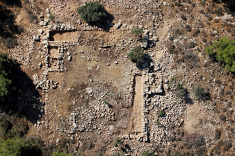
cities.  The leaders were designated to live in Jerusalem and the people cast lots to see which one out of every 10 would dwell in Jerusalem.  The rest would dwell in cities surrounding Jerusalem.  I lived in Israel 25 years and for most of the time we lived in a little village 10 miles west of Jerusalem.  It’s a mountainy and rocky area forested with some trees.  Most villages and Jerusalem were built around a water source, perhaps some type of spring.  Pictured is a photo of ruins of a Nehemiah period fortress in the hills of Judah near Jerusalem. (This photo courtesy of Israel Department of Antiquities.)

            It was a time of rejoicing.  Singers had built themselves villages all around Jerusalem (12:29). Also, two large Thanksgiving choirs with specific names and place locations are listed.  It’s amazing the record we still have today of the detailed descriptions of their locations. Also, great sacrifices were offered for God had made them rejoice with great joy.  The joy of Jerusalem could be heard from afar.  It’s amazing on the quiet of a shabbat or holiday when places are closed the noise that can be heard from a greater distance.  Psalm 126 says with singing they returned from captivity.  There must have been a joy to be back in the land of Israel again after being exiled. Though they “sow in tears, they’ll reap in joy.” At our oldest daughter’s wedding I told this to people as I wept, that I sowed in tears (such hard work raising kids overseas) and now I was reaping and weeping in joy, not out of sorrow but gladness that we made it to that day!! 😊


        Nehemiah returned after some time to Jerusalem and like a good parent had three firm corrections to make.  First, Eliashib, the priest, allowed Tobiah (Ammonite official) to have a large storeroom for himself, where articles and supplies for the Levites, singers, gatekeepers, were to be kept.  Thus, he threw out Tobiah’s things and cleansed the storeroom for proper use.  Then he asked God to remember him. (13:14) Secondly, he contended with the people for buying and selling on Shabbat and commanded the gates be shut and not open until after the Shabbat.  In current the state of Israel, every Friday afternoon stores, including all the malls shut down all over the country and remain closed until after sundown on Shabbat (Saturday), once two stars are visible.  Some weeks with holidays, the malls are closed for THREE full days!… Nehemiah prayed that God remember him. (13:22) Lastly, he contended with some of them, cursed them, struck some of them, and pulled out their hair, and made them swear not to give their children to foreigners!  That’s quite aggressive and zealous. Imagine the uproar he’d receive from all kinds of people and media today for those actions! But he prayed and asked God remember him for good. (13:29,30)

-Stephanie Schlegel

Today’s Bible passage can be read or listened to at BibleGateway here – Nehemiah 11-13 & Psalm 126

Tomorrow’s reading will be our last book of the Old Testament – Malachi – as we continue on our 2020 Reading Plan. God has great things in store! Come follow along!

Prophecy and Promise: A Reason to Hope

Ezekiel 46-48

This is what the Sovereign Lord says: “These are the boundaries of the land that you will divide among the twelve tribes of Israel as their inheritance, with two portions for Joseph. You are to divide it equally among them. Because I swore with uplifted hand to give it to your ancestors, this land will become your inheritance. Ezekiel 47:13-14 (NIV)

Congratulations! You’ve reached the end of one of the longest books in the Bible. It was a struggle, with ups and downs along the way, but you made it! Hopefully the positive outweighed the negative, and you came away with the same feelings and thoughts the author hoped to invoke from his readers. Ezekiel, as was mentioned previously, was written to the Jews while they were in exile. They had rebelled against God repeatedly and in increasingly worse ways. God warned the people that they would be exiled if they didn’t straighten up…and they didn’t straighten up. So God, through the prophet Ezekiel, set out to inform the people once again, that their wicked ways deserved punishment and this exiled life they were living was a fulfillment of his previous proclamations. But Yahweh didn’t want to kick Israel while they were down, He wanted to show them that He still held to His covenantal promises and would redeem His people, despite their rejection of His covenantal love.

So, in the last three chapters of Ezekiel we get another reminder that, though God has been angry with His people for their unfaithfulness, He will remain faithful and fulfill what He promised to the patriarchs and their descendants. The God who took the Israelites out of the Promised Land will establish the twelve tribes there. Not only will they receive their inheritance of land, but they will have a city with a river of life flowing through the land, with the name: Yahweh is There. Ezekiel ends with a push for the reader to have hope. Hope in a faithful God who always fulfills His promises.

We should also come away from reading Ezekiel with hope on our minds and joy in our hearts. For don’t we have a much greater reason to hope than the Jews in exile? God has made a new covenant through the blood of His own son, which offers a better deal to us. We don’t have to sacrifice the blood of animals to cover our sins–Jesus has already done that. And we don’t have to wait for God to redeem the earth or be a priest in the temple to feel His presence–God dwells in us through His Spirit. But God does expect us to be His representatives here and now and live lives that reflect His holiness and the character of His son. We are to offer ourselves as living sacrifices, holy and pleasing to God (Romans 12:1). We can do this knowing that with every challenge we face, every difficulty we overcome, every time our faith gets us through, we are that much closer to the return of Jesus and the establishment of God’s perfect kingdom. This has been promised through prophecy and Yahweh is a promise keeper. It is a reason for joy and a reason for hope. 

– Joel Fletcher

Today’s Bible passage can be read or listened to at BibleGateway here – Ezekiel 46-48

Tomorrow Joel will lead us through the book of – Joel – as we continue on our

The evil people will not gloat

Ezekiel 24-27

Ezekiel 25 6 7 NLT sgl

In Ezekiel 24-27 things start to get rough for Israel and then God starts handing out judgements for the enemies of Israel right away.


“In the ninth year, in the tenth month on the tenth day, the word of the Lord came to me:  “Son of man, record this date, this very date, because the king of Babylon has laid siege to Jerusalem this very day.”  (Ezekiel 24:1-2)


This occurred around 588 BC, when the siege of Jerusalem began.  This siege lasted between 18-30 months, and was horrific for those involved.  So that Ezekiel can understand how this feels for God to have his people destroyed completely, God allows Ezekiel’s wife to die.  This is very rough, but many people were dying in Jerusalem at this time.  While Ezekiel and God are going through some very rough times in the middle of this God starts to deal out judgments to the nations around Israel that were enemies and took advantage of Israel’s plight, and were happy to see Israel brought low.  Ammon, Moab, Edom, Philistia, and Tyre are all mentioned as part of the curses in chapters 25 and 26.  These nearby nations would have known about the God of the Jews and would now be mocking him, since it did not appear that he could protect his own people.  For the sake of his name God will bring down harsh judgement on them so that they will not forget to fear him.


“For this is what the Sovereign Lord says: Because you have clapped your hands and stamped your feet, rejoicing with all the malice of your heart against the land of Israel,  therefore I will stretch out my hand against you and give you as plunder to the nations. I will wipe you out from among the nations and exterminate you from the countries. I will destroy you, and you will know that I am the Lord.’” (Ezekiel 25:6,7)


This is a low point for Israel, and for the surrounding nations, and we will see that the bad times will only continue for some of these nations.

Chris & Katie-Beth Mattison


Today’s Bible reading can be read or listened to at BibleGateway here – Ezekiel 24-27

Tomorrow’s reading will be Ezekiel 28-31 as we continue with Ezekiel and our 2020 Chronological Bible Reading Plan