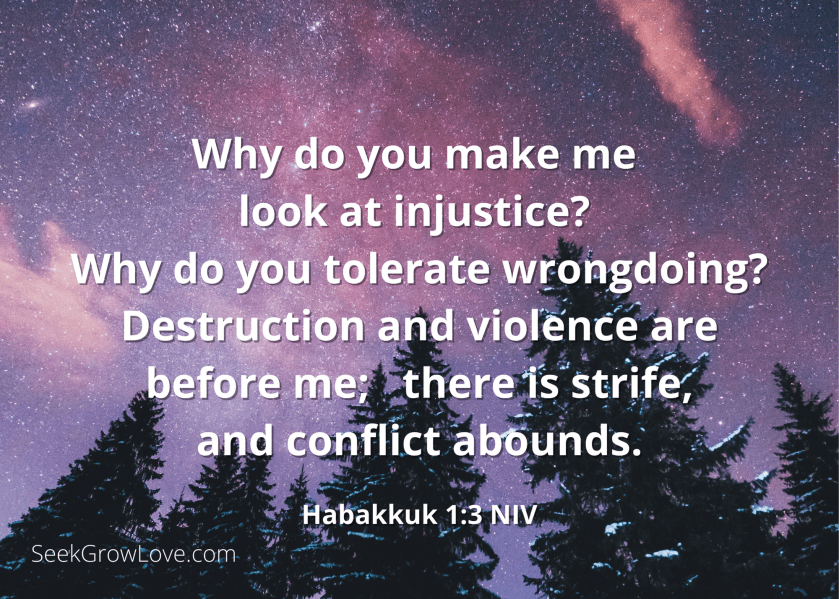
Seeking God, His Justice and His Victory

OLD TESTAMENT: Habakkuk 1

POETRY: Psalm 119:145-152

NEW TESTAMENT: Revelation 12

Habakkuk 1:2-4 (LEB):

“How long, O Yahweh, must I cry for help,

and you do not listen?

I cry out to you, ‘Violence!’

and you do not save.

Why do you make me see iniquity,

and why do you look idly at wrongdoing?

Destruction and violence are before me;

strife and contention arise.

Therefore the law is paralyzed,

and justice never goes forth;

for the wicked surround the righteous;

therefore justice comes out perverted.”

Psalm 119:145-152 (LEB):

“I cry out with my whole heart; answer me, O Yahweh!

I will observe your statutes.

I cry out to you; save me,

that I may keep your testimonies.

I rise before dawn and cry for help;

I hope in your words.

My eyes are awake before the watches of the night,

that I may meditate on your promise.

Hear my voice according to your steadfast love;

O Yahweh, according to your justice give me life.

They draw near who persecute me with evil purpose;

they are far from your law.

But you are near, O Yahweh,

and all your commandments are true.

Long have I known from your testimonies

that you have founded them forever.”

Revelation 12:10-11 (LEB):

“And I heard a loud voice in heaven saying,

‘Now the salvation and the power

and the kingdom of our God and the authority of his Christ have come,

for the accuser of our brothers has been thrown down,

who accuses them day and night before our God.

And they have conquered him by the blood of the Lamb

and by the word of their testimony,

for they loved not their lives even unto death.'”

The book of Habakkuk begins with a profound sense of lament and confusion. The prophet cries out to God, questioning why He seems silent in the face of injustice and violence. Habakkuk’s raw honesty reflects the struggles many of us face when we encounter suffering, evil, and a lack of justice in the world. He sees the wicked prospering while the righteous suffer, and he cannot understand why God allows this.

In our own lives, we may find ourselves in similar situations—crying out to God for answers, feeling like our prayers go unheard as we witness injustice. Yet, Habakkuk’s cry serves as a reminder that it is okay to bring our questions and struggles before God. He desires honesty in our relationship with Him.

In Psalm 119, the psalmist embodies a similar urgency in seeking God. He cries out with his whole heart for God to answer him, showing a deep reliance on God’s word and a yearning for His guidance. The psalmist acknowledges the darkness around him and the threat from those who persecute him, but he clings to the truth that God’s commandments are near and true.

This passage emphasizes the importance of persistent prayer and meditation on God’s promises, especially when we face trials. The psalmist rises early and stays awake at night, seeking the Lord’s assurance and strength. It is in these moments of desperation that we must remember God’s steadfast love and justice. The psalmist’s faith is rooted in the belief that God is near, and His promises endure forever.

Revelation 12 offers a powerful proclamation of victory amid the spiritual battle that believers face. The voice from heaven announces the establishment of God’s kingdom and the defeat of the accuser, the one who brings charges against God’s people. Through the blood of the Lamb and the word of their testimony, believers conquer the enemy, demonstrating that faith in Christ triumphs over every accusation and hardship.

This passage assures us that even in the face of persecution and struggle, we have the victory through Christ. The acknowledgment that the accuser has been thrown down is a reminder that God’s justice prevails. As we navigate our own trials, we can hold on to the assurance that Christ has already won the battle for us.

-Jeff Ransom

Reflection Questions:

In what areas of your life do you feel like God is silent in the face of injustice? How can you bring these concerns to Him honestly?

How does the psalmist’s commitment to prayer and meditation inspire you to seek God more fervently in your own life?

What does it mean for you to conquer through the blood of the Lamb and the word of your testimony? How can you share your story of God’s faithfulness with others?

Reflect on the assurance that God’s kingdom is established and that the accuser has been defeated. How does this truth impact your daily walk with Christ?
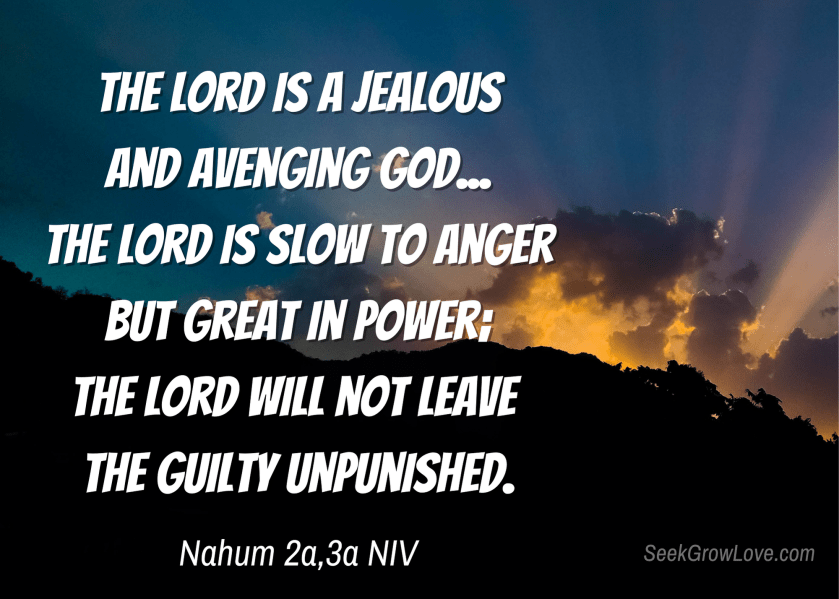
Past, Present and Future

OLD TESTAMENT: Nahum 1-3

POETRY: Psalm 119:137-144

NEW TESTAMENT: Revelation 11

Nahum 1:2-3 (LEB):

“A jealous and avenging God is Yahweh;

Yahweh is avenging and has wrath.

Yahweh takes vengeance on his adversaries

and reserves wrath for his enemies.

Yahweh is slow to anger and great in power,

and he will not leave the guilty unpunished.

In whirlwind and storm is his way,

and clouds are the dust of his feet.”

Psalm 119:137-144 (LEB):

“Righteous are you, O Yahweh,

and upright are your judgments.

You have commanded your testimonies

in righteousness and exceeding faithfulness.

My zeal has consumed me,

because my enemies have forgotten your words.

Your word is very pure,

and your servant loves it.

I am small and despised,

yet I do not forget your precepts.

Your righteousness is an everlasting righteousness,

and your law is true.

Trouble and anguish have found me out,

but your commandments are my delight.

Your testimonies are righteous forever;

give me understanding, and I will live.”

Revelation 11:15-16 (LEB):

“And the seventh angel sounded the trumpet,

and there were loud voices in heaven, saying,

‘The kingdom of the world has become the kingdom of our Lord and of his Christ,

and he will reign forever and ever!’

And the twenty-four elders who were seated before God on their thrones

fell on their faces and worshiped God.”

The book of Nahum reveals God’s sovereignty over the nations and His fierce justice against those who oppose Him. Specifically, it proclaims God’s impending judgment against Nineveh, a city known for its wickedness and cruelty. The opening verses declare God as a “jealous and avenging God,” emphasizing His commitment to righteousness and the protection of His people. God’s slowness to anger highlights His patience, but His ultimate justice is assured; the guilty will not escape unpunished.

Nahum reminds us that while God is loving and merciful, He is also just. His judgment against Nineveh serves as a reminder that evil cannot persist forever without consequence. This gives us hope, especially in a world where injustice and oppression often seem rampant. As we witness suffering and wrongdoing, we can trust in God’s righteous judgment and His commitment to setting things right in His perfect timing.

In Psalm 119, the psalmist expresses a deep love and reverence for God’s law and testimonies. The declaration of God’s righteousness sets the foundation for understanding His judgments. The psalmist’s zealous love for God’s word is driven by the reality of his enemies and the challenges he faces. Despite being small and despised, he finds delight and strength in God’s commandments.

This passage encourages us to anchor ourselves in God’s word, especially during trials. The psalmist recognizes that while trouble and anguish are inevitable, God’s commandments are a source of delight and guidance. When we immerse ourselves in Scripture, we find wisdom, comfort, and a reminder of God’s faithfulness. The law becomes a light in our darkness, guiding us toward a path of righteousness and understanding.

Revelation 11 culminates in the triumphant announcement of God’s kingdom. The seventh trumpet sounds, proclaiming that the kingdom of the world has become the kingdom of our Lord and of His Christ. This proclamation signifies a pivotal moment in redemptive history—where God’s reign is fully established, and the powers of darkness are defeated.

The response of the twenty-four elders, who fall on their faces in worship, reflects the rightful reaction to God’s sovereignty and majesty. In this vision, we see the culmination of God’s justice and the fulfillment of His promises. As believers, we are invited to participate in this celebration, anticipating the day when God’s kingdom is established forever.

-Jeff Ransom

Reflection Questions:

How does the concept of God’s jealousy and justice in Nahum impact your understanding of His character? In what ways does this knowledge provide comfort during difficult times?

Reflect on the importance of God’s word in your life. How can you cultivate a deeper love and delight for Scripture, especially when facing challenges or opposition?

How does the promise of God’s kingdom in Revelation encourage you in your daily walk with Christ? In what ways can you live in anticipation of the kingdom?

Consider the response of the twenty-four elders in Revelation 11. How can you incorporate worship into your daily life, acknowledging God’s sovereignty and majesty?

Wonderful Statutes. Wonderful God.

OLD TESTAMENT: Obadiah

*POETRY: Psalm 119:129-136

NEW TESTAMENT: Revelation 10

When’s the last time you paid God a compliment? We all like to be complimented, even if it’s just about our new shoes, nice watch, or friendly smile. In Psalm 119:129 we see a beautiful example of a compliment to God. The psalmist says, “Your statutes are wonderful…” What a beautiful place to connect with our God in relationship. Often the distractions that infiltrate every aspect of our lives, push out what should be a natural response to the greatness and goodness of God.

What naturally follows from the fact that God’s statutes are wonderful is that we obey them. That is what the Psalmist says, “… therefore I obey them.” This is something I have found hard to do with all that the world has to offer. On the outside the world’s handouts appear innocuous, but they are often a distraction that take us off course from following God, or even acknowledging Him. Is God our priority? Do we love and cling to his word? Are we ready to obey him?

 “The unfolding of your words gives light; it gives understanding to the simple.” (Psalm 119:130 NIV) The first part of the verse uses the well-known example of light representing good. (Sorry Star Wars fans, the light versus dark paradigm predates George Lucas by a few thousand years.) We also see that God’s word can be understood by the simple-minded. You do not need your PhD to discern the light that the Bible contains. All you need is a heart longing for God and a willingness to open his word.

In verse 131 the psalmist uses the metaphor of opening one’s mouth and panting to show the severity of how much he longs for God’s commands and authority. And yet, it is more than just commands and rules to be followed but it is about a relationship with God.

In verse 132 we see that he imparts grace to those who love him. Earlier in the Old Testament we see examples of when people did not love his name but rather chose to follow a path without God. A doozy being Sodom and Gomorrah when God not only withheld grace but also doled out punishment for the sin of the city by obliterating the whole place.

The psalmist shows his heartbreaking emotion for the people who do not keep his law. Everyone who has experienced God’s changing power within them knows the heart aching emotion the psalmist is going through. God is the center of all creation, the source of true happiness, and the one we should be living for.

-Bridger Grable

Reflection Questions

  1. How does the Psalmist compliment God? How can you compliment God today?
  2. What is the Psalmist’s response to God? What is your response to God today?
  3. Which verse in today’s section of Psalm 119 would you like to post in your home and work on memorizing?

The Rightful Judge of the Universe

OLD TESTAMENT: Lamentations 4-5

POETRY: Psalm 119:121-128

NEW TESTAMENT: Revelation 9

We pick up this Friday by finishing off the final 2 chapters of the book of Lamentations—one of the most poetic cries to God in despair, pain, and anguish that is recorded in the Bible. Jeremiah has spent the previous 3 chapters weeping to God about the destruction of both Jerusalem and Judah, and the horrific circumstances it has thrown His people into. Besides the outright attack from the Babylonians, they also suffered siege and famine. Death was inescapable at every turn, from starvation and thirst to even resorting to cannibalism. Amongst all this, Jeremiah has seen it all. 

He questions why God had abandoned His people, and why they must suffer. At a certain point he recognizes it is because of the sins of the people of Jerusalem, and that God’s wrath is His own to disperse—that it is by God’s hand justice is determined.

“Who can speak and have it happen if the Lord has not decreed it? 

Is it not from the mouth of the most high that both calamities and good things come? 

Why should the living complain when punished for their sins?” (3:37-39)

I think about times in my life where it has felt as though I have been left alone—seemingly abandoned. In these moments, my first thought may be to question why God has abandoned me, and why I have to suffer. Why can’t it always be good times? Why would God allow this suffering?

But that thought is unfounded—it forgets the very essence of God’s nature, and does not take on the perspective that Jeremiah takes. God is the one and only rightful judge of this universe. What good would a judge in a court of law be if they let every person who’s done wrong off Scott free? 

God is not the source of sin, just as light is not the source of darkness. Rather, where there is no light, there is darkness. Without God and His righteousness, we fall back into sin and into that darkness. Thankfully, because of the sacrifice He sent for us, through the death of Jesus Christ, we can now live under a new covenant of salvation! And because of this gift, we ought to recognize the power and might of our God, as Jeremiah did. In both high and low, fire and ice, joy and pain, we owe everything to God, the creator of both the mountains and the seas.

“You, Lord, reign forever; your throne endures from generation to generation.” (5:19)

-Mason Kiel

Reflection Questions

  1. What suffering have you witnessed or endured that perhaps made you question what God was doing or why?
  2. What sins had Jerusalem and Judah committed? What sins do you see in your society? What sins do you see in your life?
  3. What do you gain by recognizing God as the just God of the universe?
  4. Suffering is sometimes brought about by God’s judgment on sin. Are there other explanations for some suffering?

The Right Side of the Law

OLD TESTAMENT: Lamentations 3

POETRY: Psalm 119:113-120

NEW TESTAMENT: Revelation 8

“For the Lord is our judge, the Lord is our lawgiver, the Lord is our king; it is he who will save us.” — Isaiah 33:22 NIV

Hate is a strong word. I tend to avoid using it because it feels so absolute. There’s no wiggle room for love when you use the word hate. Sure, I don’t love waiting in the drive thru of McDonald’s for half an hour when I only ordered a large number 7 with a Diet Coke, but I do love listening to Spotify. In thirty minutes I can listen to maybe ten songs, and those ten streams made the lucky artist approximately $0.04! It’s all about perspective… (I was not lovin’ it)

Verse 13 in Psalm 119 makes two things absolutely clear, “I hate double-minded people, but I love your law.” I put the reference to Isaiah at the top of this post because today’s selection of poetry calls to mind one of the titles we use to address God: the Judge. Lawful diction is used throughout the passage with words like statutes, decrees, and commands. We are reminded that our God is a just one, so imagine the blessings in store for us if we keep on choosing to honor the laws he laid out for our life.

If that doesn’t light a fire under you, then I recommend rereading the end of the selection, which states, “You reject all who stray from your decrees, for their delusions come to nothing. All the wicked of the earth you discard like dross; therefore I love your statutes. My flesh trembles in fear of you; I stand in awe of your laws.” (Psalm 119: 118-120 NIV) 

There are two sides on the coin of justice. I don’t always know which side my decisions land on but I know that I don’t want to be rejected by Him, so it’s important to continue studying Scripture and to develop a relationship with the Lord. Then we can stop relying on probability, flipping a coin with every choice, and just rest in his sustaining power.

— Austin Kizer

Reflection Questions

  1. Are there areas of your life that have “wiggle room” for more of the Lord? Consider how you can invite God into those moments and listen for Him.
  2. It’s easy to focus on our wrongdoings, so ponder and celebrate times you felt like you brought honor to God. How are you honoring the Lord on a daily basis?
  3. What “evildoers” do you need to stay away from? How are you keeping up your shield and taking refuge in Him?

Revelation 7- Gifts & Rewards

OLD TESTAMENT: Lamentations 1-2

POETRY: Psalm 119:105-112

NEW TESTAMENT: Revelation 7

Chapter 7 is one of the passages in Revelation which can seem like it reverses or unworks what God had done before. God had called out a people for His own, setting Israel apart. Then God sent Jesus and brought up an upheaval in the relationship of God and humanity. The events of Pentecost launched the church, and while it took some time for Jews and Gentiles to be combined in one organization it can be a surprise for people to find Israel identified here again, and not just as a nation but with 12 tribes. But even in this context the tribes are set together with the peoples of the world, based on their common acceptance of God and the Lamb.

 At the start of the chapter a period of calm is established. Perhaps this does not follow chronologically from the events that were described just before, we may be stepping away from that part of the vision to get another angle on things. We are told about four angels who have been authorized to bring destruction with the four winds of the world – from the four main directions – but for now the angels are keeping the winds still at the instruction of another angel holding the seal of God. In this time of calm that angel seals 144,000 people, 12,000 each from 12 tribes of Israel. This is a vision so perhaps the sealing process passed quickly, as can happen in a dream.

The identities of the tribes who were sealed create a small puzzle. We are used to reading of Joseph’s blessing being passed to his sons Manasseh and Ephraim (for the ‘half-tribes’), forming a set of 12 tribes only when Levi is excluded from the normal count. Levi gets excluded because Levi’s descendants gained a special role with God in the time of Moses and that was treated as their inheritance instead of land. But here Ephraim is excluded, and we have the “Tribe of Joseph” and the Tribe of Manasseh joining the Tribe of Levi. We lose Dan, the northernmost tribe, instead. Why? It might be because Ephraim’s name is so associated with the line of kings who brought idolatry to Israel, and that Dan was the tribe first associated with idolatry in the time of the judges (Judges 18:30-31). But we also have in Ezekiel 48:2 the prophecy that Dan will be in the kingdom and receive land, so there is something symbolic happening here rather than something permanent.

The larger point is that God continues to have a portion of people who are sealed for Him – God never gave up on Israel, never gave up the promises made to Abraham, Isaac, Jacob, David, etc. The results may not look like what people were expecting at different points along the way, but God does not forget to give gifts (just as God does not forget to give punishments, which the previous chapter was establishing). The significance of the seal itself in the Revelation vision doesn’t come up until chapter 9, but in marking those who are with God it provides protection (at least). I see this as being rather like the Passover in Egypt, but rather than being told to remain safe within certain buildings marked with blood the people themselves were marked for God and therefore able to travel with protection. And unlike those earlier Hebrew people they were not being told to separate themselves from everyone else, the context pairs them with a crowd “beyond count” from every nation and people.

The crowd in white robes sounds much like those who had been slain (6:11) who were “waiting” for their fellow servants who were to die. We are told that these many “came out of great tribulation” (7:14) but are not told how many (if any) survived it. This may be another reference to the souls from under the altar. Or others may have been added to the number. What is clear is that God rewards His servants. It says they shall hunger no more, thirst no more, and no longer will the sun beat down on them. It sounds like we are being told that the curse on the soil doesn’t apply to them anymore; they no longer must be concerned about working by the sweat of their brow to eat. Springs of living water are being offered, and God Himself will wipe the tears from their eyes. Pain and struggle is being reversed – permanently. You can see why I think this chapter may step out of the chronology of the vision to give an overview of promises that are being offered, refreshing our memory of joy.

Lord, you keep your promises, even the ones I don’t fully understand. Please help me to take seriously what you have said to me, and what I say to you. Thank you that you love so much better than I do. Let me be committed to learning from you, not simply facts or ideas, but growing as a person and growing in my relationships with others and with you. Help me to remember that you never want anything bad for me. Help me trust you to show me right paths. Thank you, Amen.

-Daniel Smead

(originally posted for SeekGrowLove on Nov 22, 2022)

Application & Reflection Questions

  1. Who will receive the punishments of Revelation 6? Who will receive the rewards of Revelation 7?
  2. What do we learn from Revelation 7 about worship, commitment and faithfulness?
  3. What are some gifts and rewards God has already given to you? What gifts and rewards are you still looking forward to? Give thanks to God for what He has done, is doing, and will do!

Vengeance is the Lord’s

OLD TESTAMENT: Jeremiah 51 & 52

POETRY: Psalm 119:97-104

NEW TESTAMENT: Revelation 6

In Jeremiah 51-52, we continue to read about the rise and fall of one of Israel and Judah’s greatest adversaries – Babylon. Most would think they had it coming; after the ruthless destruction of Judah and years of the children of God being held in captivity, how else would Yahweh react? One might even wonder why it took so long for Him to free His people from these evil, power-hungry conquerors. As we’ve seen throughout the Old Testament, (particularly Judges, 1st and 2nd Kings, and Isaiah) the Israelites had their own series of mishaps and repeated sin. As a result, God – in His perfect timing – used Babylon to bring retribution to His people. However, He did not let Babylon’s wickedness go unpunished. Eventually, their arrogance and sin led to their ruin. Through Jeremiah, God declared that Babylon would be punished for its pride and cruelty. This was not just a political event, but a fulfillment of God’s divine justice and plan.

Our God’s ways are not to be challenged, nor is His wrath to be evoked. Vivid imagery is painted throughout the 64 verses of chapter 51, which follows the previous 46 verses in chapter 50 (in which the proclamation of Babylon’s grim downfall was only getting started). The LORD our God has a fierce vengeance, one that nobody should desire to face. Our God is a God of love, but as seen in these chapters, He does indeed declare enemies. And to be an enemy of the one true God is pretty much the worst place you could possibly find yourself in. These scriptures serve as a powerful reminder of God’s complex and perfect character. He is surely abounding in love, kindness, and mercy, but He is also a God of justice, holiness, and righteous wrath. This understanding brings to mind two important truths:

1. We can rest assured that justice is ultimately in the hands of God, and punishment will be bestowed upon His enemies on the day of judgment. We don’t carry the burden of deciding who is worthy of God’s love, and instead have freedom in Christ to love everyone God places in our lives – choosing to love the person and not the sin. In a world filled with brokenness and division, we can be a light of grace, knowing that God’s justice will prevail.

2. I do not want to be an enemy of God, and I know you don’t either. These chapters challenge us to examine our own hearts and lives. Live each day knowing fully that you are fearfully and wonderfully made, you are a servant of Christ, you are the beating heart of the church, you are the hands and feet of God, and you are His beloved child. In a fervent endeavor to avoid ever being known as an enemy of God, anchor your identity instead in these things, and place your trust in the unshakable Kingdom of God. For the empires of this world will fall, but His is everlasting.

To be a part of God’s everlasting kingdom means surrendering our own desires and aligning ourselves with His greater purposes. It means that we are called to walk in obedience, trusting that His plans are far beyond our comprehension. Babylon fell because it was built on the shaky ground of pride, greed, and corruption. But as followers of Christ, we stand firm on the solid foundation of God’s eternal kingdom—a kingdom defined by love, justice, mercy, and truth.

-Isabella Osborn

Reflection Questions

  1. Are there areas in my life where I am relying on my own strength or worldly systems instead of trusting in God’s good and perfect ways?
  2. How can I actively align my daily choices and actions with God’s kingdom values?
  3. In what ways can I guard my heart against pride and self-reliance, ensuring that my foundation is rooted in Christ rather than the fleeting things of this world? 

My Delight

OLD TESTAMENT: Jeremiah 49-50

POETRY: Psalm 119:89-96

NEW TESTAMENT: Revelation 5

We see that God has founded the earth and established himself on it. God’s reign will not perish, and His words won’t be changed. The Psalm says “Forever, O LORD, your word is firmly fixed in the heavens.” (Psalm 119: 89 ESV). This is something that is easy to forget as we live our busy lives. He made the earth, and he is still here, performing works all the time. He has given us the ability through prayer to connect with him and access his presence. 

In verse ninety one the psalmist writes “By your appointment they stand this day for all things are your servants.” As God’s creation, we are made to love God and follow his commandments just as a son should love and obey his father. As the scriptures later reveal through Jesus, our lives should be a constant act of servitude towards God. The Psalmist wants to bring glory to God through the obedience of the law. We should conform our lives to God’s will by following His commandments.

“If your law had not been my delight, I would have perished in my affliction”(Psalm 119:92 ESV) He made laws and commandments not out of selfish reasoning to show his dominion over us but for our good. Just as a parent tells their child not to touch the stove when it is hot, God likewise gave his people commandments to protect them. It is not hard to see in modern culture what it looks like when we mess up. Living our lives selfishly, not following God’s Law. The world stays in turmoil with great nations constantly at war, families being divided, and sin taking over. It Has been like this since The Fall in Genesis 3. If we follow God’s word, he will bless us and be with us.

-Bridger Grable

Hi, my name is Bridger Grable. I am 19 years old and live in Southern California. I have 8 siblings so it’s always a party at my house. I love hiking and the outdoors.

Reflection Questions

  1. How can you keep in mind today that God and His word are firmly fixed in the heavens? What can happen when we forget this?
  2. How can you bring glory to God through obeying His Word today?
  3. Is God’s law your delight? Explain what that does (or would) look like? What afflictions can you handle better when His law is your delight?

Just Discipline and Then Restoration

OLD TESTAMENT: Jeremiah 46-48

POETRY: Psalm 119:81-88

NEW TESTAMENT: Revelation 4

Today we remember that God is not just the God of the Jews – but the God of the world – all the nations.  And as God has watched the sins of these nations – so will He exact discipline on these nations.  Jeremiah writes what God tells him to write regarding the coming destruction that God will oversee and orchestrate against Israel’s neighbors.

Jeremiah uses vivid imagery to describe these events:

“The sword will devour till it is satisfied, till it has quenched its thirst with blood.”  (Jeremiah 46:10 NIV)

“Moab is disgraced for she is shattered.” (Jeremiah 48:20 NIV)

His descriptions show not only how scary and total the destruction will be – but also what a sad state of affairs these societies had become.  The most powerful passage that got my attention was in the message against the Philistines, “Terrified fathers run madly, without a backward glance at their helpless children.” (Jeremiah 47:3b NLT).  Where have the strong, brave protectors and defenders of their families gone?

We would do well to pay special attention to the passages that point to the reasons for this judgment.  All of these neighbors are being punished for their mistreatment of God’s chosen people, as well as for their own sins. “Since you trust in your deeds and riches, you too will be taken captive…We have heard of Moab’s pride – her overweening pride and conceit, her pride and arrogance and the haughtiness of her heart…In Moab I will put an end to those who make offerings on the high places and burn incense to their gods…Moab will be destroyed as a nation because she defied the LORD” (Jeremiah 48:7, 29, 35, 42 NIV).   How many similarities do you have to Moab, which was just one of the countries that would feel the burn of God’s discipline?  How do you treat God and His people?  Is your pride in check?  Where do you put your trust – in your job, your finances, your teachers, your doctors, yourself – or in God?  When have you defied the Lord God? Do you offer your best and first time, talents and resources to God or to selfish pursuits and false gods?

After 46 verses of judgment against Moab, the final verse of chapter 48 says, “Yet, I will restore the fortunes of Moab in days to come.”   Hope and restoration is coming – at least for those judged worthy.  Amongst all the condemnation of these chapters, Jeremiah includes a beautiful word from God for Israel as well,

“But do not be afraid, Jacob, my servant;
    do not be dismayed, Israel.
For I will bring you home again from distant lands,
    and your children will return from their exile.
Israel[f] will return to a life of peace and quiet,
    and no one will terrorize them.
28 Do not be afraid, Jacob, my servant,
    for I am with you,” says the Lord.
“I will completely destroy the nations to which I have exiled you,
    but I will not completely destroy you.
I will discipline you, but with justice;
    I cannot let you go unpunished.” (Jeremiah 46: 27-28 NLT)

God sees and will not let the guilty go unpunished.  But His deepest desire is to find and reward faithfulness in His children so He can live with them in peace.  God still judges in His love today – as a wise and caring parent.  There will yet be a time of unequaled punishment for those who appeared to get away with evil with a proud heart, relying on themselves and turning their backs on God.  This is discipline with justice.  And, then, there will be restoration and peace for those faithful to God.  Which camp will you be in? Come Lord Jesus Come – may he find us faithful.

Marcia Railton

(Originally posted Aug 21, 2020 for SeekGrowLove)

Reflection Questions

  1. Just as last week we asked if you could see yourself in any of the 7 churches in Revelation, today we ask, can you see any little bit of yourself in the descriptions of the sins of Israel and her neighbors during the time of Jeremiah?
  2. As asked above, how do you treat God and His people?  Is your pride in check?  Where do you put your trust – in your job, your finances, your teachers, your doctors, yourself – or in God?  When have you defied the Lord God? Do you offer your best and first time, talents and resources to God or to selfish pursuits and false gods? What other similar questions can you create from the sins and offenses given in today’s reading?
  3. What might God’s just discipline look like? Why is it just?

Dear Church in Laodicea – and You

OLD TESTAMENT: Jeremiah 43-45

POETRY: Psalm 119:73-80

NEW TESTAMENT: Revelation 3:14-22

Rev. 3:14-22 – Letter to Laodicea

You’ve made it to the last letter!   Thank you, as always, for joining me as we grow in our faith walk.  It is always a pleasure and a growth experience for me as well!

Laodicea is one church briefly mentioned outside of these Revelation verses.  While writing to the Colossians, Paul also mentions the church in Laodicea, encouraging them throughout his letter there, and reminding the Colossians that this letter was meant for the Laodiceans as well (Colossians 4:16).  By some verses, it seems that Paul himself did not travel there, but did have fellow believers he was connected with that traveled there on his behalf and supported the ministry.  There is some scholarly debate as to if Paul ever wrote Laodicea a letter directly that may be hidden in one of the other New Testament books, or lost, or simply is a misunderstanding of translation.  A mystery you could choose to explore yourself… but not our main point for today.

Laodicea was a very wealthy, abundant city.  When destroyed by an earthquake, they refused to take Roman funds but instead paid themselves to rebuild it back to its prosperous state.  It was full of strong, independent, rich people.  And yet, it is listed as a church with no positive attributes and only rebuke from Jesus. In fact, Jesus writes of his desire to spit or vomit them out (v.16). Ouch.  

So, what’s so bad about being lukewarm?  At least they weren’t called spiritually dead like in Sardis, right?? Well, Sardis was at least doing something, and there were a few members still actively living out the truths of Jesus’ ministry.  It seems that Laodicea was truly doing nothing… they weren’t being useful in any capacity, and were so inflated with their own sense of self that they didn’t even notice they were really poor, blind, and naked (v.17)!  They had turned their hearts so far towards their own wealth and recognition, that they truly just abandoned their faith.  Maybe they still met at church for a social gathering, but there was no discussion, no action, no edification, no growth.  They weren’t doing one thing wrong, they were doing absolutely nothing.

To correct this, Jesus gives them advice to buy gold from him that has been refined by fire, clothes to cover their nakedness, and salve to heal their blindness (v.18).  In the context of this particular church and city, this probably felt a bit like a slap in the face.  They had their own gold, they made their own beautiful linens, and they even were known for their medicinal salve! Why would anyone tell them they needed to go anywhere else to get those things?  Well, Jesus was trying to point out the fact that what he was “selling” was nothing they could find in their own material possessions. He was intending to knock them down a few notches and realize what they needed was God’s grace, and that wasn’t something they could just buy at one of their various stores around town!

In verse 19, Jesus reminds this church that he rebukes and corrects the people he loves.  One thing this church has going for them, that really every single person has, is that Jesus loves them enough to call them out!  In this letter he reminds them that he is present, he is knocking at their door, calling for them, with an invitation to spend time with him (v.20).  Jesus is actively pursuing this group of people with a desire to include them, to lift them up to a place of majesty (v.21).  He deeply wants them to be part of the Kingdom, but they needed to first recognize how much they needed him to get there.  There is a destruction coming that they aren’t going to be able to pay for themselves… and Jesus wants them to be on the side of redemption instead.

When we experience worldly wealth and success, we run the risk of becoming lukewarm in our faith, because we lose the recognition of our true need for God.  We must have a level of humility and respect (or fear!) for the Creator of all things in order to really put our faith in action daily!  We are dependent on God for so much more than we may consciously think throughout our days, but when we ignore how we desperately need His Grace, His Son, and His plan for salvation, we miss out on the opportunity to be in His Kingdom.  Not to mention so many other blessings we could experience in this current life!

My prayer for anyone reading these devotions this week is that you were able to find something that spoke to you.  Whether it was conviction, encouragement, or an idea for how to apply it in your home and church, I hope you found something in it for you.  I pray it was a blessing and that you continue to dive deeper in Scripture to continue strengthening your faith!  

Reflection Questions:

  • Have there been seasons in your life where you “forgot” to rely on God?  Have there been seasons where you were reminded of just how much you needed Him?  What were the biggest differences in your life at those times?
  • What barriers do you see in your life that prevent you from relying on God, and may get in the way of you focusing too much on your sense of self?
  • If you’re anything like me, you probably saw a bit of yourself in each letter.  When reflecting on each letter, which do you resonate with the most?  Re-read Jesus’ correction for the church you feel most like, and see how you can apply that rebuke to your life this week. 

-Sarah Johnson