Romans 4-7
Wednesday, June 14
I really don’t like tribulations but I do like what they produce in my life. When I think about the hard times that I have been through, I see how God proved himself to me over and over again. It is those times that have built my faith in an invisible God.
Romans 5:1-4
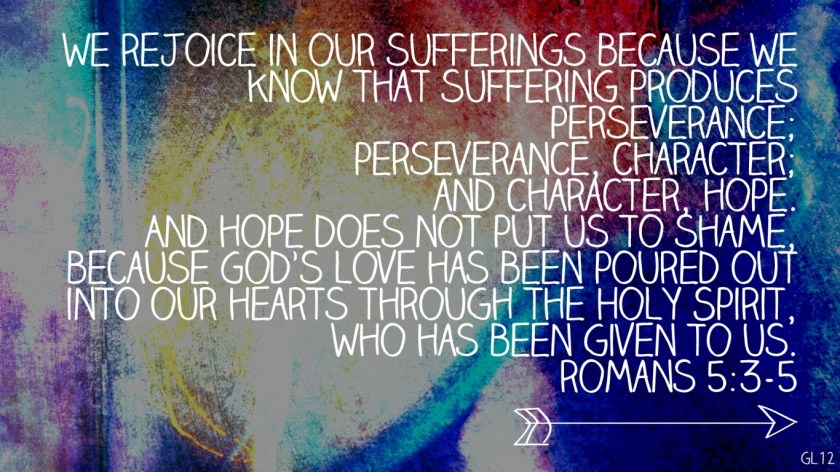
Therefore, having been justified by faith, we have peace with God through our Lord Jesus Christ, through whom also we have obtained our introduction by faith into this grace in which we stand; and we exult in hope of the glory of God. And not only this, but we also exult in our tribulations, knowing that tribulation brings about perseverance; and perseverance, proven character; and proven character, hope;
Looking back, the trials and tribulations that I have suffered were well worth it. Of course, at the time, in the midst of the storm, I was filled with angst and anxiety. What often helped me was prayer. I know my limitations and how powerless I am but God has no limits and He intervenes on our behalf. Now when I look back at those hard times, I don’t feel the sting of stress but I see the power of perseverance! I persevered with prayer and God answered me. Whatever the situation was, God helped me and my faith grew stronger and stronger each time. This helped me to mature as a believer and it changed my character for the better.
I also see, as I reflect back, the strength I have gained from seeing God prove himself time and again, and knowing and believing that the promises He has made will come to pass. This is hope. This hope is what helps us to push through the trials and not give up. We have hope that God will hear our cry, incline His ear to our prayers, and touch our lives. I am reminded of the section in James where it talks about joy in tribulation…what?? That can’t be right, can it?
James 1:2-4
Consider it all joy, my brethren, when you encounter various trials, knowing that the testing of your faith produces endurance. And let endurance have its perfect result, so that you may be perfect and complete, lacking in nothing.
I will be completely honest. I am not there yet. I do not view trials with joy, not even in the slightest. I wish I could encounter a trial with a smile and look forward to what it will produce in me. I only smile when it is over and some time has passed and then the joy part sets in. So, I have some work to do and I am sure that I will have plenty of opportunities to get better at this.
This whole section of scripture we read today is also about faith…each trial and tribulation has strengthened my faith. Even when my faith was shaken, I came out the other side stronger. My brother John and his wife Grace, almost 9 years ago, found out they were expecting a baby. We were so excited! Early on in the pregnancy, they found out there were some complications, all was not right. We quickly went from excited to shaken and scared. This doesn’t happen to us, this could not be.
My mom, myself, and Grace decided that we would pray together every day until the baby was born. We prayed and prayed and prayed. I had never prayed so diligently before this. We were certain God was going to perform a miracle. Grace felt God was leading her to name the baby Jeremiah.
Jeremiah was born and we did not get the miracle we prayed for…in fact his condition was worse than we expected and he would continue to have more challenges as he grew. This shook our faith and tore us up inside. I won’t go through all the questions I hurled at God and the sorrow we felt but I will say, that through it all, God was with us. Jeremiah may not be like everyone else, but he is a miracle and he has given our family such joy. In the end, my faith is stronger because I know that we live in a broken world and that bad things happen…even to us. But, then I think of this scripture:
Isaiah 35:6
Then the lame will leap like a deer,
And the tongue of the mute will shout for joy.
For waters will break forth in the wilderness
And streams in the Arabah.
One day, all will be made right and we just need to have faith. Faith to keep going, to tackle each trial with hope and perseverance and that will mold our character for the better. Take some time to reflect on your life and your hard times. What did they produce in you? Do you have a stronger appreciation of the hope we have because of your trials?
This is Jeremiah. He is full of joy, laughter, and kindness. He is nonverbal, has low tone, and other issues but one day, when our Lord returns, he will run fast like the wind and talk up a storm.

– Ruth Finnegan
(Photo Credit: http://www.godswordimages.com/wallpaper/hope/romans-5-3-5/)


 If you are in that moment, remember that God does not leave Elijah there, and he doesn’t want to leave you there either. Instead, he says, “Get up and eat (v. 5). After Elijah eats twice, he goes on a journey forty days and forty nights to the mountain of God. There, Elijah waits, first through a great wind, then through an earthquake, and lastly through a fire. In each of these places, he does not hear God’s voice. Finally, he hears it in the soft whisper, as God asks him “What are you doing here Elijah?” (v. 13) Elijah responds by saying, “I have been very zealous for the Lord God of Hosts, but the Israelites have abandoned your covenant, torn down your altars, and killed your prophets with the sword. I alone am left, and they’re looking for me to take my life” (v. 14). Elijah feels this despair because he had forgotten what God just showed him. In the desert when he was hungry, God was there with provision. He had forgotten that in the showdown, God was there with provision. When we turn our eyes from God to focus on our fractured circumstances, it can lead us to doubt. But, one remedy for that doubt is not only to remember the character of God but also to remember how God has exhibited that character in previous actions of faithfulness. We can trust in him not only because of what we know from the Bible but also because of what we know from our own lives. So, if you are in a wilderness period in your life, pause and remember God’s past faithfulness instead of dwelling on your despair. These reminders can help us to remember that even in our darkest times, God will carry us through.
 Over the next few days, we’re going to look at four wilderness stories in the bible to learn a lesson about what the wilderness is and what it can teach us. The first Wilderness Wandering Lesson is this: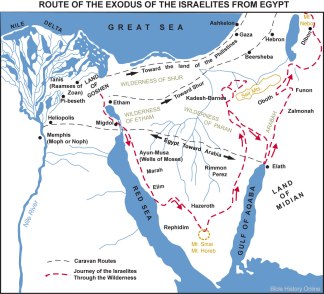




 Seek Grow Love