Real Places and People and Real God

June 20    1 Chronicles 7,8 and Proverbs 20

Shalom y’all. 😊 I was born and raised in small town Indiana, then lived in Israel for 25 years, now I am back in the States in the South. So, I will add some pictures and thoughts about Israel in each devotional this week to help give you a taste of it over there.  This year I have been reading through the Chronological Bible for my personal Bible reading and really enjoying it. In various ways, reading through the Bible is a great experience even though some parts are slower. 😊 It is interesting to note that the Hebrew Old Testament is arranged in a slightly different order than in English. In my Hebrew/English Bible the Old Testament ends with 1 and 2 Chronicles as a final summary of the Old Testament.

Although 1 Chronicles 7 & 8 are FILLED with Hebrew names and cities, it is amazing how familiar those names are to native Israelis.  Many people are still called those names today, especially religious Jews. AND many of those cities are STILL called that TODAY. At some places, the ancient ruins of the city are beside the modern one, sharing the SAME NAME! Also, amazing that we still have this record of people and places from about 2,800 years ago.  God’s Word has been preserved through all these years and one can still see the numerous same locations in Israel today.  Israel is a wonderful country and testifies of real places and a real God and Messiah Jesus. See the green patch towards the bottom of our picture, that’s ancient Shechem with the modern city built around it. It is listed among the many cities in 1 Chronicles 7 and 8 and is STILL an actual city in Israel today! Some ancient cities are only in ruins, but the name remains the same.

A picture containing outdoor, sky, nature, rocky

Description automatically generated

Over the years, it has been a great benefit to read the book of Proverbs and focus on a certain topic while reading it and marking that topic with a few letters, like shown in picture. So many good nuggets of wisdom to meditate on! Something interesting is that many times a “child” is mentioned it’s often referring to a “youth” in Hebrew. “Even a youth is known by his actions” (Proverbs 20:11) is how it translates into English, same word used for David when he killed Goliath. I encourage you the next time when you read the book of Proverbs to pick a topic that interests you or that you would like more wisdom in and initial each verse that applies.  Sometimes I have even made a list in a notebook of those verses and then meditated on them, and it has really helped me in that area that I needed more wisdom about.  “The hearing ear and the seeing eye, the LORD has made them both.” (Proverbs 20:12)

Text, letter

Description automatically generated

~ Cayce Fletcher

Read or listen to today’s Bible reading at Biblegateway.com: Job 1-2 and 2 Corinthians 2 .
Believing God in Tough Times

Acts 27

Paul’s journey to Rome in this passage is anything but simple. When those with Paul on the ship to Rome went days without seeing the guiding light of stars or the sun, they gave up hope of ever being saved. But then Paul spoke. He shared with them what the angel of God had told him. He assured them that although their situation seemed dire, they would be delivered. It was God’s plan for Paul to appear before Caesar and Paul, neither Paul nor those with him, were to be lost at sea before that could happen.

Although this situation and the knowledge that he was to be tried by Caesar when he reached Rome must have been difficult, Paul kept trusting God. When God sent word to him, Paul did not look at the situation and doubt what God was saying. He believed God’s word, and so much so that he shared what God had planned. From the passage we can see that Paul did not even question the way in which they were to be saved- a shipwreck! Here Paul is lost at sea, facing trial by the ruler of the Roman empire and now finds out he is to be preserved for that by being saved through a shipwreck. That is a lot to take in and yet, Paul remained faithful.

This made me think of a time in my own life when I was being driven to an airport on a major highway. A car sideswiped us, and we went across several lanes of traffic, nearly hit a concrete barrier and then swerved back over a few lanes. In that moment, it seemed the vehicle I was in was going to be hit again. The situation seemed taut and like there could be no good outcome. However, miraculously the vehicle I was in and the vehicle that had hit us suffered no injuries and were not hit a second time in the busy traffic. Even in a situation that seemed hopeless, God preserved us, and we even got to the airport on time.

Sometimes, though, in these moments it is easier to think of what could happen, like getting hit a second time or being lost at sea and not on what we should be thinking about- God. But we must look to Paul as an example and trust God in tough circumstances as he did.

-Hannah Deane

Today’s Bible reading passages can be read or listened to at BibleGateway here – 1 Kings 11-12 and Acts 27

Friend or Foe?

Don’t be Deceived!

Joshua 9-10

The lessons for us today just keep coming in the book of Joshua! In the last few days we’ve learned from Joshua: arm yourself daily with God’s word for strength and courage and success; God’s will, way and day leads to victory; and stop blaming God when we ought to be dealing with the sin amongst us which will then help us to overcome defeat.

Today we learn valuable intel on how to distinguish friend from foe, how to guard oneself from being deceived, and the all important how to get more hours added to your day. The answer to all three – Ask God. Don’t try to do it on your own. Trust His way and His understanding and His power, not your own.

The Canaanite neighbors have heard how Joshua and the Israelites have destroyed Jericho and Ai (on the second attempt). Some are ready to fight. Others find it easier to deceive. The sly Gibeonites, who live just over the next hill, came to Joshua. Pretending to have just made a long journey from a far off country, with worn-out clothes and old food, they convince the Israelite leaders to make a peace treaty with them. Three days later the Israelites learn they have been tricked. They have just signed a treaty protecting the lives of those who should have been their next targets.

What went wrong? They had been so careful. They had even tasted the Gibeonites’ stale bread! All their senses and intuition and prior knowledge told them this was safe and trustworthy and reliable and in their best interest. Scripture tells us, “The men of Israel sampled their provisions, but did not inquire of the Lord.” (Joshua 9:14 NIV).

I believe it is even harder today to distinguish friend from foe. Satan would love to have the world believe that what and who is actually an enemy of God is harmless, trustworthy or far-off. When actually this danger is at our doorstep, dressed in a disguise. And, since it looks good and convincing and seems to make sense Christians take the bait and sign the peace treaty and align themselves with the enemy. Because they did not inquire of the Lord.

Deception abounds on so many fronts. Who is God? Who is Jesus? What happens when you die? What is the value of a life? Who really has your best interest in mind? Who can be trusted? Who is on God’s side? And who is not?

God knows. And He wants to reveal the answers to you. Ask Him – not your own heart. Seek His wisdom – not man’s. Read His word. Spend time in prayer. Listen – to the Lord. Don’t sign the treaty without His okay.

Our reading in Psalms includes many great verses that would have been great refrigerator verses for the Israelites at that time – if only they had refrigerators.

“My soul finds rest in God alone; my salvation comes from him. He alone is my rock, and my salvation; he is my fortress, I will never be shaken.” Psalm 62:1

“My salvation and my honor depend on God; he is my mighty rock, my refuge. Trust in him at all times, O people; pour out your hearts to him, for God is our refuge.” Psalm 62:7-8

Don’t be deceived. Trust God alone.

-Marcia Railton

Today’s Bible reading passages can be read or listened to at BibleGateway here – Joshua 9-10 and Psalm 62-64

Numbers 21-22, Luke 1

The Israelites’ wilderness wanderings continue in Numbers 21-22. Even though they had chosen not to enter the Promised Land because of their perceived battles, the battles came to them in the wilderness. They faced the kingdoms of Edom, Arad, Amorites, and Ammonites. In all of these battles, the outcome of the standoff was based not in the strength of the Israelite people, but in the amount of trust they had in God. 

The Israelites were a stubborn people though. They had a tendency to forget the lessons they had just learned. In Numbers 21, they had just shown their trust in God when they defeated the king of Arad. But, in verse 4, they began to grumble and complain against God, asking why they had come out of Egypt to the wilderness. This is a recurring pattern with the Israelites. When they face difficult circumstances, they begin to complain. God always responds strongly to their complaints – sometimes strikingly so. It makes him incredibly angry each and every time they begin to act in this way. In this instance, he sent poisonous snakes among the people. At other times, he sent plagues, fire, or disease – anything to show his displeasure. 

We know that this action – the complaining and grumbling against God’s ordained path – causes God anger. But, as I am reading through the book of Numbers, it’s hard for me to really rectify the description of this wrathful, vengeful God and the God of the New Testament who sent his son to wipe away all sins. Why did it make God this angry? Is it really that bad to complain? 

To answer this question, we can turn to the other passage that we were looking at today: Luke 1. This is the story of the pregnancy announcements of both John the Baptist and Jesus – both of which happened before they got pregnant! John the Baptist parents were Zechariah and Elizabeth, another Levite from the line of Aaron. Zechariah was chosen to serve in the temple, a once in a lifetime opportunity for him, when an angel of the Lord appeared and told him, “Do not be afraid, Zechariah, because your prayer has been heard. Your wife Elizabeth will bear you a son, and you will name him John. There will be joy and delight for you” (Luke 1:13-14). After this, I would imagine that Zechariah would be jumping for joy – the desires of his heart, his deepest prayer, had been answered! But, that’s not the picture that we get. Zechariah responds, “How can I know this? For I am an old man, and my wife is well along in years” (Luke 1:18). Zechariah’s prayers were answered, but he wanted proof. He wanted God to prove himself to Zechariah. It seemed like an angel of the Lord appearing to Zechariah just wasn’t enough for him. 

In both the Israelites’ and Zechariah’s situation (as well as the situation with Balaam and his donkey in Numbers 22), they wanted God to prove himself to be God. The previous faithfulness God had shown them wasn’t enough; they wanted God to prove himself to be big enough and powerful enough in that moment for them to trust him. But – I don’t think, for any of these people, anything that God could have done in that moment would truly have caused them to trust him more. It wasn’t on God to prove himself to them. For the Israelites, he caused the plagues in Egypt, split the Red Sea, routed whole armies. For Zechariah, he sent a messenger to talk to him face to face and tell him that his greatest desire was answered. They had already received their signs. It was the people’s responsibility to soften their hearts enough to trust in God. They needed to believe that God was who he said he was and would do what he said he would do. 

We are required to trust in the same way. God has done tremendously more than we have ever deserved. He is currently doing more in our lives than we could ever hope for. It is our responsibility to trust him to be God. We just have to follow in obedience to him.

~ Cayce Fletcher

Read or listen to today’s Bible reading at Biblegateway.com: Job 1-2 and 2 Corinthians 2 .
Numbers 19-20, Psalm 51-52

Moses and the Israelites’ wilderness wanderings continue on in Numbers 19-20. In previous chapters as we’ve seen, God faithfully shows up for Moses, choosing him and the Levites as the priesthood to be the leaders and go-betweens between God and the Israelite people. In Numbers 20, Moses has to deal with the Israelites’ rebellious spirit again. They came fighting against Moses saying, “If only we had perished when our brothers perished before the Lord. Why have you brought the Lord’s assembly into this wilderness for us and our livestock to die here? Why have you led us up from Egypt to bring us to this evil place? It’s not a place of grain, figs, vines, and pomegranates, and there is no water to drink!” (Numb. 20:3-5).

Even though God continued to provide for the Israelites time and time again, the Israelites had yet to learn to trust in him. They questioned God’s purpose for them and even stated that they wished they had died with the Israelites who had been killed in the plague after Korah’s rebellion. One rebellion had just been resolved with the blossoming of Aaron’s branch, but the people were again questioning Moses’ leadership because of their circumstances in the wilderness. 

Moses responds as he normally does – by falling face down before God to beg God for help. God responds to Moses and Aaron and gives them specific instructions to follow: take your staff and speak to a rock. Then, water will flow out. However, Moses, heated in the moment, rashly gathers the assembly and says to them, “Listen, you rebels! Must we bring water out of this rock for you?” Then, he struck the rock twice and water gushed out (Numb. 20:9-11). In this pivotal moment of Moses’ leadership, he does not respond with level-headed humility. Instead, he responds rebelliously towards God because of his frustration with the people. By forcefully striking the rock and saying that it was him – Moses – who brought the water out, he took the glory away from God and placed it on himself. Moses decided that he was going to be the one to save the Israelites, and he forcefully showed them what he could do. 

I totally can identify and sympathize with Moses in this moment. He loved God. He loved the people. And, he truly wanted what was best for the people. But, he got frustrated. He was tired and probably thirsty. He was overwhelmed. Because of this, he made a mistake with dire consequences; he would not lead the people into the promised land. He got caught up in the feelings of the moment, the seeming impossibility of shepherding the Israelite people into a trusting, righteous way of living and into the promised land. When he looked at his situation, he may have felt trapped, may have felt hopeless, or may have just felt mad. The one thing he forgot to do was to view those feelings in light of the character of God. He forgot to trust in who God was – to remember that despite what the Israelites were saying, God was always in Moses’ corner. 

We all have times where the circumstances we are in cause us to be blinded by the feelings we have. We may feel stuck, tired, hopeless, mad. Maybe we feel like we just want to hit something. Or we just want to give up. But remember – God is in our corner. When we face those difficult times, we can trust that he will always come through. 

~ Cayce Fletcher

Read or listen to today’s Bible reading at Biblegateway.com: Job 1-2 and 2 Corinthians 2 .

Numbers 17-18, Psalm 49-50

Yesterday, we witnessed the rebellion of the Israelites against Moses. At this point, the Israelites had refused to enter into the promised land after focusing on the battles they would face rather than the rewards they would reap with God’s help. After that, the Israelites continued to not trust God when they spoke out against Moses. They didn’t realize that in doing so, they were – in effect – not trusting God. The rebellion that Korah instigated ended for the most part when he died. In Numbers 16, we see God choose Aaron and the tribe of the Levites as his priesthood. The twelve tribes all brought their staff to the temple to represent them. Aaron’s staff – which represented the Levites – sprouted, formed buds, blossomed, and produced almonds (Numb. 16:8). Interestingly, this isn’t the first time that almond branches and almond blossoms make their appearance in relation to the temple and the priesthood. In Ex. 25:31-40, the lampstand that was to be kept continually burning on the altar was supposed to be shaped like almond blossoms. This was the light that the priesthood was in charge of day and night. In the miracle of Aaron’s rod, God showed clearly which group of people he wanted as his priesthood, and he chose the Levites. 

Numbers 18 continues on with laws and requirements for the priesthood along with ways that the priesthood could be provided for by the Israelites people. Nestled in these verses is such an important truth for us today. Numbers 18:5-7 says, “You are to guard the sanctuary and the altar so that wrath may not fall on the Israelites again. Look, I have selected your fellow Levites from the Israelites as a gift for you, assigned by the Lord to work at the tent of meeting. But you and your sons will carry out your priestly responsibilities for everything concerning the altar and for what is inside the veil, and you will do that work. I am giving you the work of the priesthood as a gift.” 

Moses was clear in the last chapter that the laws and responsibilities given to him by God were not things that he was doing out of his own will. In this chapter, God is clear about his intentions to give as a gift the work of the priesthood. Yes, the ministry that they had would be challenging. They would face opposition from the people, and they would have to work hard in the temple. Some of their responsibilities included doing animal sacrifices, staying up all night to tend the lamps, dealing with skin diseases, and more. But, this work was a gift. A special provision and reward to be the light to the Israelites as they entered the promised land. 

In Christian circles, we talk often of the gift of Salvation. That is the first wonderful gift that we receive in our Christian walk, and we should always be grateful for that amazing grace. But, that is only the first of the many gifts that we receive as a believer in Christ. We are also given the gift of the priesthood, the gift of being a light to others. We will face the same opposition from others at times. And we will have to also take part in the grueling work of ministry. But, that is the work – the priestly responsibilities – that we have been assigned to do. 

As we head into another week, ask yourself: What is the ministry that you have been called to? Are you treating this ministry as a gift? 

Praise God that we can be partners in his work!

~ Cayce Fletcher

Read or listen to today’s Bible reading at Biblegateway.com: Job 1-2 and 2 Corinthians 2 .

Missing Jesus by an Acre

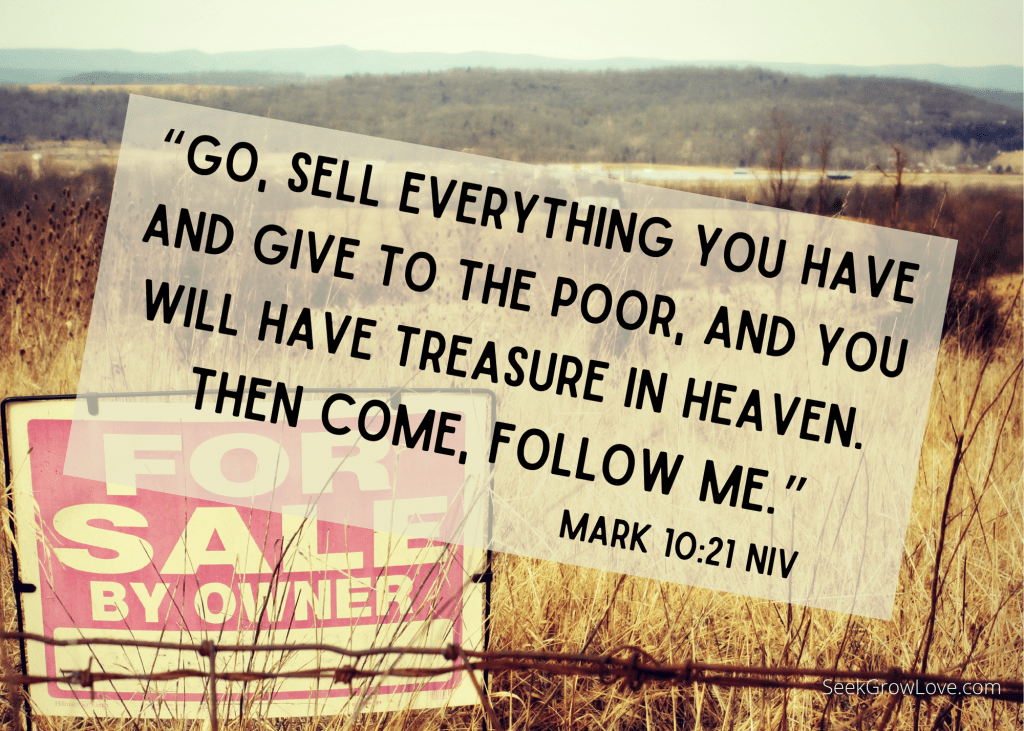
            In the book of Mark, chapter 10, we read this story about a devoted Jew, who understands that Jesus is someone special. He comes to Jesus and asks a really good question, “what shall I do to inherit eternal life?” (Mark 10:17). We know, having the luxury of being able to look back on all of Jesus’ teachings, that following Jesus and devoting our lives to him is what gives us the right to become children of God and heirs to eternal life. This is exactly what Jesus wants this unnamed man to do.

            Jesus asks this man to sell everything he had and give it to the poor, and then to come and follow him. Imagine being this man. Imagine owning 1,000 acres of land, filled with livestock, fields, barns and equipment. All of which would be worth millions of dollars. I mean, this is everything you have, maybe you inherited it from your father and plan on passing it to your children. This could have been in the family for generations, and with what we know of inheritance of Jewish property in the time of Jesus, it most likely was. Then Jesus asks you to sell all of it and give the money to the poor! Imagine what you would have done in his situation? Better yet, imagine what you have to lose?

            I don’t want you to miss Jesus by an acre. By that I mean, I don’t want you to miss following Jesus because of something that you’re holding onto in your life. The sad and ironic things is, later in the chapter Jesus says these words, “Truly I say to you, there is no one who has left house or brothers or sisters or mother or father or children or farms, for my sake and for the gospel’s sake, but that he will receive a hundred times as much now in the present age, houses and brothers and sisters and mothers and children and farms, along with persecutions; and in the age to come, eternal life” (Mark 10:29-30). There is nothing this unnamed man could have given up that he wouldn’t have received multiplied back to him in kingdom. The same goes for us, anything this world can offer, anything we have, is not even worth being compared to the riches of the kingdom.

-Josiah Cain

Links to today’s Bible reading – Exodus 25-26 and Mark 10

Humility

Romans 11-13

I am a fairly humble fellow.  I do not stand out in a crowd.  I do not try to draw attention to myself.  In fact I don’t like attention.  I don’t consider myself arrogant and  I am very aware of my flaws.  And yet, there are still times when I allow myself to feel superior to others.  Maybe we all do that at times?

No matter how many flaws we have, all of us are better at something than someone else.  And in those moments where we take notice of that, it is easy to allow our egos to puff up a bit, isn’t it?  Maybe that is even especially true for those, like me, that are more keenly aware of our shortcomings than our triumphs.

Paul touches on humility several times in chapter 12, and typically when I read these passages, I instantly think about people that are very arrogant, and think, “this doesn’t really apply to me,” or “I’m doing fine in this area.”  But then (sometimes) I think about the thoughts that I opened with.

Beginning in verse 3, Paul says, “For by the grace given me I say to every one of you: Do not think of yourself more highly than you ought, but rather think of yourself with sober judgment, in accordance with the faith God has distributed to each of you. For just as each of us has one body with many members, and these members do not all have the same function, so in Christ we, though many, form one body, and each member belongs to all the others. We have different gifts, according to the grace given to each of us.”

 There you have it.  Each of us should NOT think of ourselves more highly than we ought.  Well then how highly SHOULD we think of ourselves?  Frankly, I would say pretty high, because we are each pretty incredible creations of God.  And we have each been blessed with many abilities and talents.  But as Paul points out, we have all been given DIFFERENT abilities.  And it is key to remember that we have been given those abilities.  We didn’t do anything ourselves to acquire natural abilities.  Some people are born with great musical talent.  Others with sharp intellect.  Still others with amazing athletic skill.  Paul here is speaking primarily of spiritual gifts, but all abilities and talents are indeed granted by our Creator.  I really appreciate when I see gifted athletes giving credit to God for their abilities during post-game interviews.  I am not always sure how sincere they are, but the message is true regardless.

In verse 10, Paul says to Be devoted to one another in love. Honor one other above yourselves.  This is an outward extension of humility, and here, should be motivated by love.  How often do you honor others above yourself?

Finally, Paul comes back to humility again in verse 16.

“Live in harmony with one another. Do not be proud, but be willing to associate with people of low position.  Do not be conceited.”

We should not just be showing humility to the people we are comfortable being with, or the people that are “our kind of crowd.”  We should be showing humility to, and honoring above us those whom we would consider to be of low position. 

Again, this is the example Jesus left for us, and it is a humility that is motivated by love, which Paul sums up perfectly in verses 9-21.

So, think of yourselves very highly, as an amazing creation, but do not think of yourself more highly than someone else.  That is when you are thinking of yourself more highly than you ought.  It’s about recognizing that God has given each of us different gifts, to be used to His glory.

-Greg Landry

Today’s Bible reading passage can be read or listened to at BibleGateway here – Romans 11-13.

Tomorrow we will finish the book of Romans (chapters 14-16).

If God is for you…

Romans 8-10

I think Romans chapter 8 is one of the most encouraging sections of scripture.  And boy can we use some encouragement right now.

It is so sad to see so many suffering from the effects of the Covid virus.  Many, many people have lost work and income.  Many children are not able to attend school in person.  Abuse has increased.  And many people have died or have otherwise physically suffered from this virus.  It is very easy and very natural to be discouraged and worried right now.  But for Christians at least, we need to cling to the fact that present circumstances do not alter the future promise that God has made.

One day, there will be no need to fear death from a virus or anything else.  We will be made perfect in the coming Kingdom!  That is the hope talked about in Chapter 8, and it is a hope that can not be taken from us. 

Until that day comes, be encouraged, fellow believers, in the words Paul shares here.  Verse 28 says, And we know that in all things God works for the good of those who love him, who have been called according to his purpose. That’s encouraging!  That doesn’t mean everything will be perfect as we want it to be, but God, in His infinite wisdom knows what is best for our own good even if we do not.

Verse 31b – If God is for us, who can be against us?  That is a great statement.  What God has put in motion is unstoppable.  No one will stop God’s plans, and God’s plans include YOU!

Yes, this pandemic stinks.  And it doesn’t seem the end of it is super soon.  But we have a certain hope in that coming day, and nothing can take that hope away or prevent that day from coming.  Likewise, these momentary troubles can not separate us from the love of Christ.  Paul tells us  in verse 37 that in regards to these troubles we are “more than conquerors.”  We WILL get through these momentary troubles.  For that is all they are, in the bigger picture.

Finally, chapter 8 concludes with more incredible encouragement:

38 For I am convinced that neither death nor life, neither angels nor demons, neither the present nor the future, nor any powers, 39 neither height nor depth, nor anything else in all creation, will be able to separate us from the love of God that is in Christ Jesus our Lord.

I hope that is as encouraging for you as it is for me.  Take these passages to heart.  Remember them when the world seems to be against you or, as now, the world seems to be falling apart.  Remember that your creator, your Father, your God is FOR YOU!  And nothing can take that, or His future promise for you, away.

-Greg Landry

Today’s Bible reading passage can be read or listened to at BibleGateway here – Romans 8-10.

Tomorrow we continue with Romans 11-13.

My Sinful Nature

Romans 4-7

I’m skipping right to the end of chapter seven, to a dilemma that many Christians wrestle with.

Starting in verse 15, Paul says, I do not understand what I do. For what I want to do I do not do, but what I hate I do.  And if I do what I do not want to do, I agree that the law is good. As it is, it is no longer I myself who do it, but it is sin living in me. For I know that good itself does not dwell in me, that is, in my sinful nature. For I have the desire to do what is good, but I cannot carry it out. For I do not do the good I want to do, but the evil I do not want to do—this I keep on doing. Now if I do what I do not want to do, it is no longer I who do it, but it is sin living in me that does it.

So I find this law at work: Although I want to do good, evil is right there with me. For in my inner being I delight in God’s law; but I see another law at work in me, waging war against the law of my mind and making me a prisoner of the law of sin at work within me. What a wretched man I am! Who will rescue me from this body that is subject to death? Thanks be to God, who delivers me through Jesus Christ our Lord!

So then, I myself in my mind am a slave to God’s law, but in my sinful nature a slave to the law of sin.

Paul really nails what I and so many other Christians struggle with – the question of why do I continue to sin if I have turned my life over to Christ?  Certainly all Christians still sin.  I know my sins, and you know yours.  But why do we continue to repeat certain sins over and over, if we know they are wrong, and we want to change our behavior?  It’s frustrating.  Many new Christians especially think they have left sin behind once they have accepted Christ as their Lord and Savior, only to be discouraged to discover that their sin nature is alive and well within them, as Paul points out.

I cannot begin to attempt to explain or examine every facet of sin, and why Christians still find themselves caught up in various sins, but I can offer at least one strategy that has worked for me, dealing with a specific sin.  We should all have strategies for overcoming our biggest sin obstacles. 

The following is an excerpt from the marriage book From This Day Forward by Craig and Amy Groeschel.

-“I have a special software installed that, although it allows me to get on the internet when I need to, filters what sites I can get to.  And it sends reports of everything I see to my accountability partners.  Maybe this sounds extreme to you (which doesn’t bother me at all).  Maybe it sounds like a lot of trouble.  It is.   An obvious question might be, “So are you really that weak and vulnerable Craig?  That if nobody was watching, you’d look at things that were immoral or impure?”  I can honestly say the answer is, “No, not really.”  Right now as I’m writing this, and as I’m thinking about these things, I’m in a really good place.  My resolve is strong.  I’m confident in my relationship with Christ, and everything is going really well.  So why bother?  Because if you are honest, you know that not every single moment of your life looks like that.  Sometimes I get tired.  Sometimes my feelings get hurt, or I get angry, or I feel like I’m not getting everything I deserve.  And then, in those fleeting moments of weakness, every door to temptation that I might otherwise try to turn to is completely, thoroughly, securely locked.  Strong Craig of this moment is looking out for weak Craig of those other moments.”

This is great advice.  (By the way, the software he is speaking of is likely called Covenant Eyes, which we use in our house).  When we are strong, we often don’t think about our weaknesses.  But that is the best time to acknowledge them and plan what to do in case they return.  If we can cut off access to committing some of the sins we have struggled with, then do it, if at all possible.

But when we do sin, whether large or small, habitual sin or not, we need not be discouraged to the point of giving up.  Remember that Christ died for us while we were still sinners.  And Paul humbly acknowledged that even he struggled with continuing to commit sins after accepting Christ.   Our sin nature will not be completely shed until, Christ returns, and he delivers us from it.  Until that day, we should be working to sin less and less.  There are certainly strategies we can employ to try to accomplish that, as mentioned already.  But thanks be to God that Christ’s blood covers us, despite our sins. 

-Greg Landry


Today’s Bible passage can be read or listened to at BibleGateway here – Romans 4-7.

Tomorrow we continue with Romans 8-10.