Looking for Solutions in All the Wrong Places?

Isaiah 31-34

Life is full of challenges and problems, and people are always looking for a quick fix to get them by. But a quick fix that the world promises often turns out to be no fix at all, just another problem on top of all of our existing problems. When we leave off trusting in God, and put our trust in ourselves or the quick fixes that the world has to offer, we set ourselves up for disappointment.

In Isaiah 31-32 we see how the Israelites were afraid of the impending Assyrian army and were looking at Egypt as a solution for the protection they needed. But God said, “Woe to those who go down to Egypt for help, and rely on horses, and trust in chariots because they are many, and in horsemen because they are very strong, but they do not look to the Holy One of Israel, nor seek Yahweh!” (Isaiah 31:1, REV) At the time this was written, chariots were a big deal, the latest and greatest military technology. Placing their hopes and trust in these, the Israelites were essentially telling God, “Don’t worry God; we can take care of this; we don’t need you.” And, of course, this is all wrong. God is concerned and invested in his people, he wants to participate in their salvation, and they really do need Him.

The reality is, sometimes we are a lot like the Israelites of Isaiah’s time, we are looking for solutions in all the wrong places instead of trusting in God.  We are not threatened by the threat of an invading army, but we have plenty of challenges and problems that we need solutions for. We don’t look to chariots anymore, but we do depend on modern technology, like cars and cell phones to carry us through. But we should ask ourselves if we are putting our trust in God or in ourselves and the solutions of the world. It is a question about our hearts. Is your cell phone your tool for distraction, connection, and maybe a false sense of safety? Are you running away from something? Have you prayed to God about whatever it is that you are feeling, facing, or going through? Just like Egypt couldn’t provide the security the Israelites were searching for, neither can our devices or distractions fix what’s going on inside us.

God deals with the real problem, not just the symptom. “The Assyrian will fall, but not by the sword of people; and the sword that is not of humankind will devour him. He will flee from the sword, and his young men will become subject to forced labor.” (Isaiah 31:8) With Yahweh our massive problems are no problem at all. It’s not the situation itself, but where we place our trust that makes all the difference.

“The work of righteousness will be peace, and the effect of righteousness will be quietness and confidence forever.” (Isaiah 32:17, REV) Quietness and confidence really stand out to me in this verse. Regarding quietness, I think of how, when a city is quiet, generally nothing bad is going on. And regarding confidence, that’s a kind of safety you feel when you’re not afraid of an impending disaster.

I used to have an old Jeep Cherokee that routinely broke down and on more than one occasion left me stranded on the side of the road, waiting for a tow truck or laboring to fix it under the hot summer sun. Of course, after multiple episodes of this, the Jeep lost my trust and I eventually sold it and purchased a newer Toyota. Since then, I’ve had more confidence that I’ll actually make it to my appointments without breaking down. When I placed my trust in that old, unreliable Jeep, the result was disappointment.

When we choose to follow and obey God, we can experience the quietness and confidence that only he can give. It is fundamentally a heart issue. God wants us, and he is persistent again and again, calling His people back to Him for peace and safety. Just like his promise to the Israelites, when we look to God for salvation, he will be faithful to deliver us.

-Bridger Grable

Reflection Questions

  1. “But we should ask ourselves if we are putting our trust in God or in ourselves and the solutions of the world. It is a question about our hearts. Is your cell phone your tool for distraction, connection, and maybe a false sense of safety? Are you running away from something? Have you prayed to God about whatever it is that you are feeling, facing, or going through?”
  2. What, or who, have you put your trust in, and then were disappointed?
  3. What does it look like to put our trust in God?
  4. What do you think of Bridger’s statement, “God deals with the real problem, not just the symptom”? Where have you seen this to be true?
  5. If you desire to transfer your trust from self, others, things to God what steps could be helpful? What should you avoid? How can you work at this heart change?

When Blessings Lead to Spiritual Adultery

Hosea 10-14

Chapter 10 of the book of Hosea, implements an analogy of Israel as a thriving vine. The more fruit it bore, the more Israel used its prosperity to betray Yahweh, turning blessings into the means of idolatry. God gave them the Promised Land, and they used the blessing that he gave them to make other gods. Instead of gratitude, they responded with spiritual adultery.

The Israelites’ hearts were divided, pulled in different directions by possessions and self-interest. “You will seek me and find me when you search for me with all your heart.” (Jeremiah 29:13, REV). Israel never gave God their whole heart. And so they couldn’t find Him. God was ruled out of the life of Israel and now the same thing is happening here in our own nation. We see our country’s leaders supporting and encouraging sinful actions.

“How can I give you up, Ephraim? How can I hand you over, Israel? How can I make you like Admah? How can I make you like Zeboiim? My heart is turned within me; my compassion is aroused.” (Hosea 11:8, REV). Yahweh doesn’t want to destroy His people. He didn’t want to then, and he doesn’t now. But again and again, Israel turns elsewhere. In chapter 12, they make a covenant with Assyria looking for safety in the arms of another nation, not in God. Maybe that is the way we should treat some of the things in our lives. We tend to distance ourselves from the thought that we are creating an alliance with things daily like our phones instead of God. 

“I knew you in the wilderness, in the land of great drought.” (Hosea 13:5, REV). The idea from Hosea 13:5 is that when we have an abundance of conveniences it’s hard to see the things we need. In the States most of our problems are “first world problems” which is a polite way of saying they’re not problems at all, just inconveniences. Our abundance and ease of living is one of the many reasons that America is struggling morally in our present time. With too many conveniences, too many options, or too much time -it’s easy to forget what you need.

“According to their pasture, so were they filled. They were filled, and their heart was exalted, so they forgot me.” (Hosea 13:6, REV). Let us not forget our God and turn foolishly toward the things of this world. 

Application Questions:

Do you prioritize things like work, school, social media, TV, over your family, time reading God’s word, or time helping other people?

What are some distractions that are pulling you away from God?

Who are a couple people in your life who can keep you accountable in spending less time on the things of this world and more time on things of God?

-Bridger Grable

Separated

Hosea 5-9

In chapter 5 of Hosea, we see judgement pronounced over Israel.

“Listen to this, O priests! Listen, O house of Israel, and give ear, O house of the king! For the judgment is against you; for you have been a snare at Mizpah, and a net spread on Tabor.”
 (Hosea 5:1, REV)

Later in verse 14, Yahweh says:

“I myself will tear them in pieces and go away. I will carry them off, and there will be no one to rescue them.” (Hosea 5:14, REV)

Things are starting to look bleak for Israel. Yet some begin to consider returning to Yahweh:

“Come and let’s return to Yahweh; for he has torn us to pieces, but he will heal us; he has injured us, but he will bind up our wounds.” (Hosea 6:1, REV)

But in verse 4, Yahweh reveals a deeper issue – Israel is not loyal to its covenants. He compares them to a morning cloud or dew that vanishes early. Yahweh knows they won’t truly turn back, but will continue down a path of unrighteousness:

“The pride of Israel testifies to his face, yet they do not return to Yahweh their God, nor have they sought him for all this.” (Hosea 7:10, REV)

In chapter 8, Yahweh continues to speak on the corrupt mindset of Israel and the many reasons for their separation from Him. Midway through the chapter, we see what happens to Israel.

“Israel is swallowed up. Now they are among the nations like a vessel that nobody wants. For they have gone up to Assyria, like a wild donkey wandering alone. Ephraim has hired herself out to lovers.” (Hosea 8:8–9, REV)

Back in chapter 5, verse 4, it says that Israel cannot return to God because of their deeds. That verse reminds me how important it is to change our actions when we turn to God. We can’t claim to be pure in mind and soul while continuing in sin and partaking in things that bring us further from God.

Since working in the construction industry and expanding my social circle beyond the church, I’ve noticed something. When I talk to people about faith and religion, many say they follow Christ but in the same breath, they contradict that by showing allegiance to themselves. My prayer for them is that they would not follow the path that Israel took, but recognize this hypocrisy and take steps to correct it. If they are sincere, they will allow God to begin to move in their lives or maybe even discover who God truly is for the first time.

-Bridger Grable

Reflection Questions

  1. How would you describe Israel’s problem in Hosea’s day?
  2. Where have you seen similar problems?
  3. In your own life when has your love evaporated quickly, like the morning dew? How are you doing right now? Are your deeds taking you closer to God or further from Him? What might Hosea (speaking for God) say about your heart?

The Problem – and The Solution

Isaiah 23-27

Isaiah 23-27 tells of God’s judgement upon the earth, the peace that comes from God, and the redemption that we find in Him. Though these may seem in opposition to each other, each of these elements is a key facet to the overall theme of these chapters. In chapters 23 and 24, we read about the suffering, desolation, and punishment which is a result of the people’s wickedness. Isaiah 24:5 says that:

              [5] The earth lies defiled under its inhabitants; for they have transgressed the laws, violated the statutes, broken the everlasting covenant. (ESV)

My mind immediately recalls Romans 3:23 which says, “for all have sinned and fallen short of the glory of God”. All of mankind have done things that are displeasing to God and are deserving of the punishment which is talked about in Isaiah 23/24. Often when we sin, there is a conscious knowledge that what we are doing is wrong, yet we continue anyways. Our sin pushes us away from God’s presence and leads us down into some very dark places where we try to cover up or escape the last bad thing we did. This cycle of sin continues, and we draw further away from God and for our unrighteousness, God will punish us. However, there is hope that for those who trust in God and repent from sin, he will save us and deliver us from destruction.

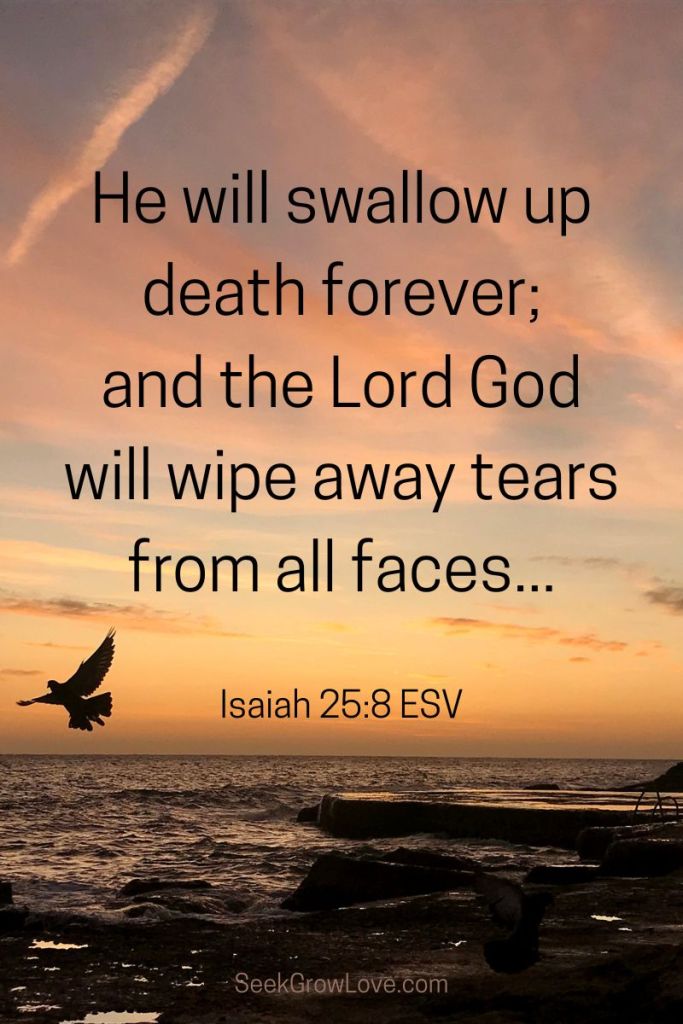
              [8] He will swallow up death forever; and the Lord GOD will wipe away tears from all faces, and the reproach of his people he will take away from all the earth, for the LORD has spoken. (ESV) – Isaiah 25:8

This passage gives me so much hope and encouragement for what is to come when there is no more pain, suffering, and death. Everyone at some point in their lives will experience hardship. Maybe that is the loss of a loved one, battling addiction, becoming seriously ill without any warning, or maybe going through a breakup. Maybe you’re in that time of life right now or maybe it is around the corner. Whatever it is, there is hope that someday, God will restore this earth to its rightful state, but in the meantime, we can set our eyes to the one who has the power to save and deliver.

Isaiah 26:3–5 says:

[3] You keep him in perfect peace whose mind is stayed on you, because he trusts in you. [4] Trust in the LORD forever, for the LORD GOD is an everlasting rock.

I’d like to end with this portion from our text as a final reminder to set your mind on God. This can be very difficult amidst the infinite distractions in our world, but when you set aside these distractions, you can see clearly through that business or pain and find everlasting peace.

Here are some application questions to ask yourself:

Are you building your life upon the God?

When was the last time you asked God to be your rock or firm foundation?

How can you encourage someone in your life and lead them to the hope of deliverance?

-Jeremiah Grable

Jehu is Different

2 Kings 9-11

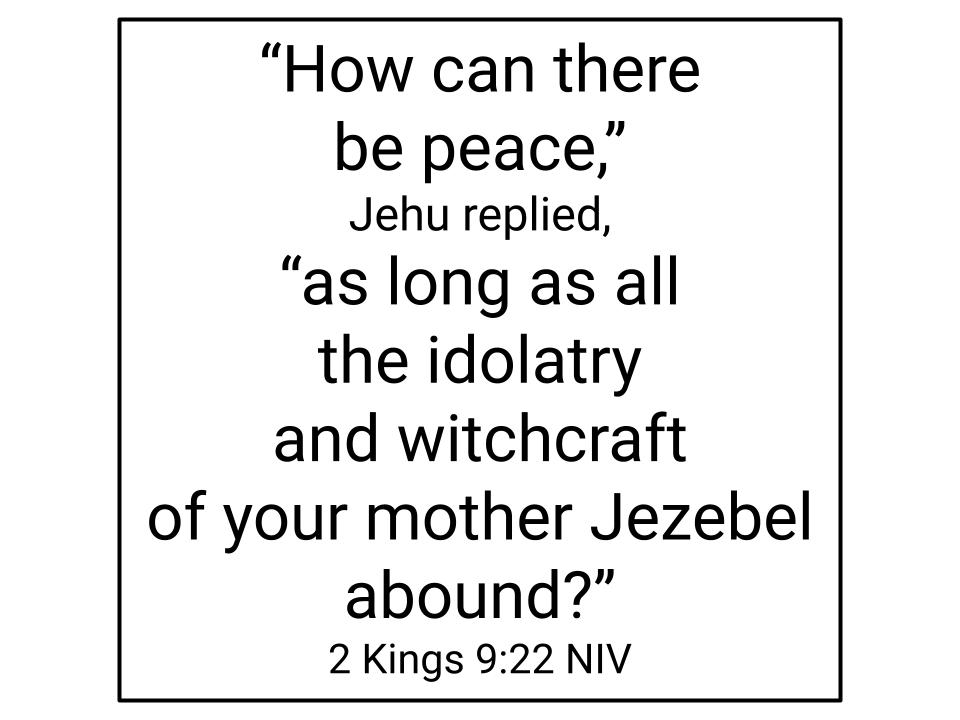
In Second Kings chapters 9-11 we read largely about the obedience of King Jehu in attempting to remove idolatry from Israel.  In the midst of that content there is an interesting concept that rings fairly true to today.  In Second Kings 9:22 Joram asks Jehu if he has come in peace.  Jehu responds, “How can there be peace as long as all the idolatry and witchcraft of your mother Jezebel abound?”  Jehu is clearly communicating that peace does not come between God and evil.  Our application should be a bit cautious, but clear.

Some would take a verse like this to somehow support a Christian committing an act of violence against an unbeliever.  This is not a proper application of this concept and should not be condoned.  Rather, it is important to recognize that there is a difference between the ways of God and the ways of evil, and those who support the ways of God will be different than those who support the ways of evil.  King Jehu recognized that the ways of Joram were opposed to the ways of God so there would be no peace between them.

In the New Testament we find language that concurs with this concept.  Philippians 3:20 says, “But our citizenship is in heaven.  And we eagerly await a Savior from there, the Lord Jesus Christ”.  First Peter 1:1 says in part, “To God’s elect, strangers in the world, scattered through Pontus…”  Once we become a believer, we align ourselves with God and His plan and ways.  This causes us to become strangers in the world, as we are different than the world.  Our citizenship is no longer of the world, but rather we become citizens of heaven.  Our eternity will be on the earth, after Jesus restores it through the millennial kingdom.  This is why Paul says at the end of Philippians 3:20, “And we eagerly await a Savior from there, the Lord Jesus Christ”.  However, our hearts and lives belong to God, who currently resides in heaven.  Our citizenship is with God in heaven, not of this earth.

Therefore, there is not peace between us and the world.  We are different.  Our lives should look different and we should be different than the world.  I believe this is the connection we can make to King Jehu’s response of clearly communicating that peace does not come between God and evil.

How should we respond then?  We should recognize that our lives are different from the world.  Sometimes that will cause awkwardness in our lives.  I attempt to hold pretty clear boundaries for the movies, shows, videos, or even reels I will watch.  If someone sends me a link of a video to watch I will ask about what it is and the content of it.  I sometimes ask if it includes any of the things I attempt to not visually consume.  This causes tension or awkwardness socially.  But I know it is best for me to be different in this way.


However, even though there is not peace between God and the world, we should still strive to live at peace with others.  Romans 12:18 says, “If it is possible, as far as it depends on you, live at peace with everyone.”  My response to King Jehu’s question should not lead me to go against God’s call to peace found here.  I live a different life than the world, but I also strive for peace with others, that I might show them the love of God each day of my life.  In doing this, I may win one for Christ!

-Michael Cisler


Reflection Questions

What are ways in which you can live more for God, and therefore not be at peace with the world?

How can you show others around you that you are intentional about living at peace with all people?

In what ways can we cope with the tension that sometimes is created by living at peace, but being different?

It’s Personal

1 Kings 17-19

I have appreciated the opportunity to read and share my thoughts with you across these seven days. We’ve traced the unfolding drama of the divided kings and kingdoms of Israel. We’ve watched the culture shift, the crowd move to and fro, and the pressure rise and fall, but through their stories, one truth rings clear: the faithful know that wisdom comes from God alone.

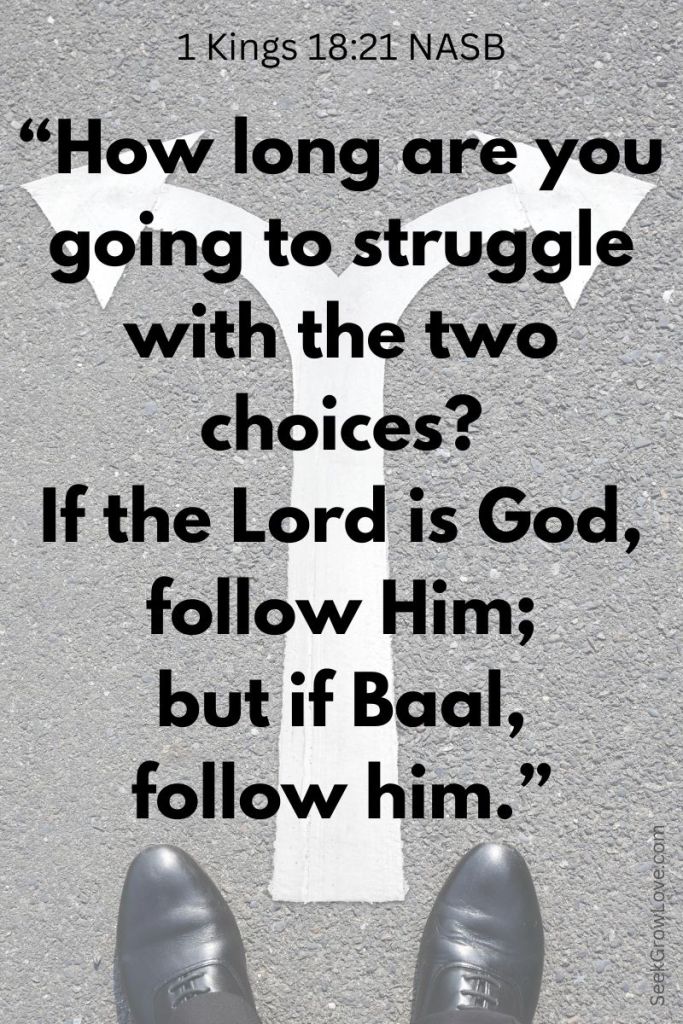
“How long will you waver between two opinions? If the Lord is God, follow him; but if Baal is God, follow him.” (1 Kings 18:21)

Looking momentarily at my own nation, America is a nation with deep Judeo-Christian roots, as many of our founding documents demonstrate a commitment to God as the architect of the law that governs us. Our motto makes mention of our trust in God, we proclaim His work in our patriotic songs, open government functions with prayer, and swear in our presidents with their hand on His Word. I am one of many who believe the blessings we enjoy as a nation—even in today’s troubling times—can be attributed to the enduring declaration that the God of Israel and the Father of Jesus Christ reigns here.  Sadly, more and more are living on borrowed blessings as the altars of moral revision, self-importance, and political convenience are being fashioned and raised.

Today, we look to the prophet Elijah, who lived as a lone voice for the Lord in a nation God had once richly blessed. Elijah wasn’t trendy or tribal. His conversations with God were authentic and intimate, and he took action as one who was swiftly obedient. His faith was so personal that he was often fully dependent on the Lord even for his next meal—fed by ravens and sustained by a jar of oil and flour that never ran dry. How ready would we be to fight off the enemies of God, to recite and rely on His promises, and even to expect miracles in His name, if we lived with this kind of faithfulness?

Each of us is called to that kind of personal, committed, lived-out faith. It may seem like faith is inherited—passed down through our nation’s heritage or through family and friends—but true faith is never proximal. Hanging with a spiritual crowd, attending high-energy worship services, or serving on a ministry team are not guarantors of a relationship with the Lord.  Personal faith is born in the discomfort of repentance, in the surrendering of fear, and in the offering up of our possessions. These are the intimate things God desires from us. In the abandonment of self, we begin to hear God’s call clearly—and are emboldened because we know our Creator personally.

“At the time of sacrifice, the prophet Elijah stepped forward and prayed: ‘Lord, the God of Abraham, Isaac and Israel, let it be known today that you are God in Israel and that I am your servant and have done all these things at your command. Answer me, Lord, answer me, so these people will know that you, Lord, are God, and that you are turning their hearts back again.” – 1 Kings 18:36–37

In this week’s reading, we’ve seen that change in a nation is inevitable. I pray that “In God We Trust” will continue to stand as a reminder of our nation’s steadfastness for the Lord. But however long it endures, let it always point us to something greater—our personal relationship with God, built through surrender, obedience, and faith. If the Lord is God, stand for Him—even if you stand alone. Because at the end of the day, it’s personal.

-Aaron Winner

Reflection Questions

  1. What character traits do you find in Elijah? Is there one you would like to have more of in your life? How would you go about adding more?
  2. What choices are before you today?
  3. Which one will you choose? Why?

Too Much Experience

1 Kings 15:1-24
2 Chronicles 13-16

I will be celebrating my 40th birthday in just a few short weeks. To be candid, I’m not exactly thrilled about this milestone—but one thing I am looking forward to is being able to say, “That was half a lifetime ago.” There’s something satisfying in acknowledging that with age has come experience.

One of the longest experiences I’ve had is playing guitar. For the last 1,352 weeks, I have averaged a few hours of play and have become masterful at my style. That’s not a gloat or a flex—just an illustration that I’m familiar with my craft. Much of what I do now is second nature, developed through repetition and refined over time. The same could be said of anyone who’s practiced a craft or trade for a significant portion of their life.

But experience is a double-edged sword. It gives us the ability to say things like, “I’ve seen this before,” or “We’ve already tried that,” or “We’ve made it through worse.” That can build confidence as we develop our approach. But when we rely solely on experience or live under the illusion there is nothing to learn, we may fail to consult the Word of the Lord. We make ourselves the master of our own fate, and in time, we are doomed to fail.

King Asa was a dependable leader. After the division of the kingdom, his reign represented a season of peace and prosperity.  These blessings came upon the whole of Judah because he “did what was good and right in the eyes of the Lord.” Asa tore down idols, repaired the temple, and called the people to return to God. He didn’t trust in his half-million soldiers alone.  He petitioned the Lord for help:

“Lord, there is no one like you to help the powerless against the mighty. Help us, Lord our God, for we rely on you, and in your name we have come against this vast army. Lord, you are our God; do not let mere mortals prevail against you.” – 2 Chronicles 14:11

As a result God delivered Asa and the people of Judah.  In gratitude and commitment, Asa responded in worship.  His people offered a tremendous sacrifice as a wholehearted oath to their Deliverer. Again, the Lord gave them a season of rest.

But in Asa’s 36th year—after decades of faithfulness—something changed. Faced with conflict, he no longer sought the Lord. Instead, he relied on his own strategy, forming a treaty with a foreign power. The prophet Hanani rebuked him:

“Were not the Cushites and Libyans a mighty army with great numbers of chariots and horsemen? Yet when you relied on the Lord, he delivered them into your hand. For the eyes of the Lord range throughout the earth to strengthen those whose hearts are fully committed to him. You have done a foolish thing, and from now on you will be at war.” – 2 Chronicles 16:8–9

The temptation to take matters into our own hands often comes not in times of scarcity, but in times of prosperity.  Our experience, knowledge, notoriety, or wealth can make us feel capable, but no matter our breadth or depth, we each have  blind spots and limitations that fall far short of the omniscience of our Heavenly Father.  This is the great irony: the more experienced we become in serving the Lord, the more we should rely on His voice. If anything, maturity should deepen our dependence, not diminish it.

God is ready to win battles for those who are whole-hearted committed to Him. May we be found among them—not only in our youth or our desperation, but even more in our decades of experience. Let us not confuse our  familiarity with faithfulness. And when we hear His voice—whether in instruction, correction, or comfort—may we respond with the same dependence that brought us to Him in the first place.

-Aaron Winner

Reflection Questions

  1. What did Asa do right? What did Asa do wrong? What might his thought process or motives been when he was doing right? And when he did wrong?
  2. Consider your own life – when did you seek the Lord and He blessed you for it? When did you NOT seek the Lord, but relied on your own strength, decision making skills, and human knowledge? What was the outcome?
  3. What does it look like to seek the Lord and rely on Him?
  4. In what areas are you currently relying on the Lord? Where are you in danger of falling into the “too experienced”, can-do-this-on-my-own trap?

God’s mercy (hesed) endures forever!!

2 Chronicles 6-7

Psalm 136

Psalms 136:1-9(NKJV) Oh, give thanks to the LORD, for He is good!
For His mercy endures forever.
2 Oh, give thanks to the God of gods!
For His mercy endures forever.
3 Oh, give thanks to the Lord of lords!
For His mercy endures forever:
4 To Him who alone does great wonders,
For His mercy endures forever;
5 To Him who by wisdom made the heavens,
For His mercy endures forever;
6 To Him who laid out the earth above the waters,
For His mercy endures forever;
7 To Him who made great lights,
For His mercy endures forever—
8 The sun to rule by day,
For His mercy endures forever;
9 The moon and stars to rule by night,
For His mercy endures forever.

(I quoted the above section in the NKJV version because of the familiarity of the phrase “His mercy endures forever” but encourage you to read it in a different version as the word “mercy” is translated many ways.)

The Hebrew word “hesed” is found about 250 times in the Old Testament.  It is translated “love and faithfulness,” “unfailing love,” “faithful love,” “steadfast love,” and “loyal love,” depending on the Bible version used.  It has a bigger concept than just God’s love or mercy.  His love for His people is an central and essential part of God’s character.  The core idea of this term communicates loyalty or faithfulness within our relationship. Hesed is closely intertwined with God’s covenant with His people Israel in the OT.  

We see this in our section of reading from 2 Chronicles today where Solomon is dedicating the Temple.  The Temple in the OT is the dwelling place of God, specifically at the holy of holies, in the ark of the covenant.  God’s “hesed” is in the perfect performance of His commitments expressed by the tablets that God gave Moses on Mt Sinai. 

2 Chronicles 6:7-11(NLT) Then Solomon said, “My father, David, wanted to build this Temple to honor the name of the LORD, the God of Israel. 8 But the LORD told him, ‘You wanted to build the Temple to honor my name. Your intention is good, 9 but you are not the one to do it. One of your own sons will build the Temple to honor me.’ 10 “And now the LORD has fulfilled the promise he made, for I have become king in my father’s place, and now I sit on the throne of Israel, just as the LORD promised. I have built this Temple to honor the name of the LORD, the God of Israel. 11 There I have placed the Ark, which contains the covenant that the LORD made with the people of Israel.”

After a dedication service in Chapter 6, in Chapter 7 we see where God approves and accepts the sacrifices made there by the people.  He does this by sending fire down, which we see as God’s approval of the sacrifice.  God’s fire and presence are put in this Temple building giving His presence to that place.

2 Chronicles 7:1-3(NLT) When Solomon finished praying, fire flashed down from heaven and burned up the burnt offerings and sacrifices, and the glorious presence of the LORD filled the Temple. 2 The priests could not enter the Temple of the LORD because the glorious presence of the LORD filled it. 3 When all the people of Israel saw the fire coming down and the glorious presence of the LORD filling the Temple, they fell face down on the ground and worshiped and praised the LORD, saying, “He is good! His faithful love endures forever!”

Think about the day of Pentecost at the start of the church that we are part of.  God’s fire came down and rested on each of the apostles showing God’s approval and acceptance of the sacrifice of Christ.  The holy spirit is given to those that follow Christ from that day.  We are the Temple of God’s building, the church of the body of Christ.  God’s enduring love is given to us with the same commitment and intensity as He has shown Israel in the OT.  Our relationship with God is based on the covenantal sacrifice of the blood of Christ which allows us into the place and presence of Him. 

Have a great day today with the mighty hesed of God watching over and keeping you in all you do!

-Tom Siderius

Reflection Questions

  1. What verses of Psalm 136 really stand out to you? Are there any surprising verses? What do you notice about God’s character?
  2. Where have you seen God’s hesed in Scripture? Where have you seen it in your lifetime? Are you confident it will endure forever?
  3. Are you living in the place and presence of God?

Sayings of the Wise

Proverbs 22-24

There have been countless attempts to condense all the complexities of life into a few simple and concise rules to follow. If the steps are practiced effectively then success will be rewarded. Variations of these lists are reiterated over time through experience of generations adapting to changing societies. Each one tries to improve upon the previous list, but there are often more similarities than differences. While there are some noticeable differences between many of these lists and Proverbs 22-24, as a whole these chapters are simply a list of sayings meant to be followed for success. It certainly wasn’t the first list nor last, but it accomplishes the same goal, with the added benefit of being God’s trusted word. 

These thirty sayings are introduced in chapter 22, and it is encouraged for all to hear and pay attention to. “Counsel and knowledge” are provided with a reward of increasing trust in God along with honesty and speaking the truth (NIV, Proverbs 22:17-21). They don’t necessarily promise to bring worldly success, though many do, but instead offer the opportunity to further develop a relationship with God. These sayings align with seeking wisdom. Following them will result in the growth of truthful actions, trust, and an increased ability to love God and others. 

Each of the sayings provide guidance on some aspect of life, though there is overlap. Some of the sayings teach how to interact with others and develop meaningful relationships. For example, avoid exploitation, consider the perspective of others, and don’t be associated with people who will only cause trouble and be a bad influence. Other sayings claim that righteous character and behavior will be rewarded socially, and even if there is no benefit in today’s society God will reward those in the future. Similarly, the opposite is warned against. Another common theme is to not get caught up in chasing money or other common indicators of success, as they aren’t as meaningful as they may initially seem. Lastly, these sayings teach the value in learning and the willingness to be taught.

Study the sayings of the wise and learn from them. These thirty sayings are included in the book most known for wisdom, so if wisdom is loved these sayings should be considered in daily life. The increase in wisdom associated with applying these chapters will encourage genuine care and love for others through truthful words and actions. Further, trust in God is strengthened by wisdom in knowing how God defines success. Although it is still just a condensed list, follow these sayings and success will naturally be rewarded.

-Josiah Railton

Reflection Questions

  1. How is the wisdom found in Proverbs 22-24 similar to wisdom literature from other times and cultures? How is it different from what “the world” today says is wise and profitable for success?
  2. In your relationships with others which of these sayings of the wise would you benefit from focusing on this week?
  3. How can you work towards the ultimate success of having a better, growing relationship with God?
  4. Which verses would be great on your refrigerator, desk, bathroom mirror or bedside table for the next month? Post them.

Love is the Greatest Motivator

Proverbs 19-21

Every chosen action is a result of a complex combination of a variety of motivations, but each one can be traced back to a source of love. Some form of love is at the base of every decision, as people prioritize what they love most. The recipient of love could be God, oneself, another person, a physical object, or even intangible concepts such as happiness or power. Loving God is a common commandment and suggested motivator throughout the Bible, but not every other object or concept is as desirable to love from a biblical perspective. Wisdom is needed to differentiate between what should be loved, and what shouldn’t be, which will ultimately have a great impact on what decisions are made and what actions are taken. 

Proverbs is known for describing wisdom and contains numerous examples of valid sources of love and others that should be avoided. Wisdom itself is a great concept to love according to the Bible, as Proverbs 4:7 commands to “Get wisdom. Though it cost all you have, get understanding” (NIV). Wisdom is so valuable that it is worth sacrificing all else. In other words, the love for wisdom should be greater than the love of money, material resources, fame, power, or anything else. All those concepts and objects are discouraged as primary sources of love throughout Proverbs. 

While there are many things not worthy of love, Proverbs and the rest of the Bible offer several suggestions to give one’s love to. Most notably, aside from God, are other people. The command to love others is present throughout the Bible, but it is even more meaningful and impactful than simply being nice to one another. Not only is some form of love at the root of all motivation, but the recipient of that love is commonly love itself. People love to be loved. God designed people to need to be loved, and Proverbs 19:22 claims that “what a person desires is unfailing love”. Many people are willing to sacrifice a lot to be loved. It is the greatest motivator and is often the force causing many actions and behaviors. While it is still beneficial to simply be kind to a neighbor or provide for the physical needs of others, genuinely loving others requires providing what is needed most—love. Building a strong and unselfish relationship on unfailing love increases the impact one can have in the lives of others. It makes it easier to spread God’s word and His Kingdom. 

As with all things, it might require some sacrifices to love others effectively. However, that isn’t a problem if love for others is greater than the love of whatever is put aside. Sacrifices will always be made for what is loved the most. Therefore, carefully prioritize what is loved. Love God and love others to use the natural motivation to encourage godly choices, behaviors, and actions to have the greatest impact in the world.

-Josiah Railton

Reflection Questions

  1. “Some form of love is at the base of every decision, as people prioritize what they love most.” – What do your decisions show that you love most?
  2. What do you WANT to love most? What is getting more of your love now than it deserves?
  3. What sacrifices have you already made for what you love most? What additional sacrifices might be ahead? What sacrifices have others made for you?