Loving the Things in the World

OLD TESTAMENT: Jeremiah 10-11

POETRY: Psalm 115

NEW TESTAMENT: 1 John 2

What do you love? Love is such a flexible word. I love God. I love my wife. I love my children. I love my favorite sports teams. I love eating a good fettuccine alfredo. I love ice cream. The way we use the word “love” varies widely on the context.

In 1 John 2, John spends some time contrasting the way that we love the things of the world with our love for God. And while his words may sound harsh, there is a great lesson for us in them:

1 John 2:15-17 (ESV)

15 Do not love the world or the things in the world. If anyone loves the world, the love of the Father is not in him.

16 For all that is in the world–the desires of the flesh and the desires of the eyes and pride of life–is not from the Father but is from the world.

17 And the world is passing away along with its desires, but whoever does the will of God abides forever.

John commands us to not love the world or the things in the world. Does this mean that we are not to love people, like Jesus commands us to? Of course not! John is using expansive language to remind us of a key point: we are not to love the evil things we find in the world.

There is evil all around us: in the media, on TV, in movies, and on the Internet. We are bombarded with images all day everyday. While they had evil imagery in the ancient world, our modern world far outstrips the ancient world in how easy it is to see evil things and how often we are assailed with these images.

So what is John asking us to do? He is asking us to love the things of God, which means that we should avoid the evil of the world. We all have innate desires in our flesh that are not godly. If we act on those desires, we are separating ourselves not only from God through our sin, but we are also consciously deciding that our way of living is better than living the way God says that we should.

Friends, that is a dangerous place to be. I know that I have walked in darkness at times, enjoying the desires of the flesh and of the eyes. But what I found is that those dark places lead nowhere good. God does not want us to avoid sin because we are good little trained creatures. It’s not like God is running a circus, and we get to play the part of the circus animals, just jumping through hoops of fire to prove to God that we love Him. That’s not it.

God designed life. God designed us. He loves us. He wants the best for us. Just like I tell my children “no” from time to time, that does not mean that I do not love them. I want what is best for my kids, even when something wrong or dangerous looks attractive to them.

Let’s avoid the evil things that our world is trying to sell to us. Let’s be examples of love and light instead. As we do so, we are examples to others of what life will look like in the coming kingdom of God. The kingdom of God and the things of God will abide forever.

-Will Barlow

REflection Questions

Do you have a love for the things of this world that is unhealthy? What can you do to return to a purer love for God?

    Have you ever noticed that when you feed your mind something, it focuses on that concept more and more? How can you guide your thoughts in a healthier direction?

    When people look at your life, can they recognize the kingdom of God? Can they see the fruit of the spirit, evidence of a changed heart and life?

    Where are you Walking?

    OLD TESTAMENT: Jeremiah 7-9

    POETRY: Psalm 115

    NEW TESTAMENT: 1 John 1

    Have you ever felt completely at home someplace? Maybe it was your family of origin, maybe it was your first home on your own, maybe it was the first home you shared with someone special, like your spouse or a close friend. I hope that you have experienced that feeling.

    We want to feel at home in our relationship with God and with our Lord Jesus (and of course, with each other!). But sometimes, our brokenness, shame, and guilt get in the way of our feeling “at home” with God and others. Thankfully, the Bible tells us how to remedy this situation.

    In the beginning of 1 John, John talks about this “at home” feeling using the word “fellowship.” The word for “fellowship” basically means to share together or to participate together or to have close friendship with someone. We want to feel close to God, to Christ, and to each other. Those of us in church communities want to feel this closeness especially with those we are in community with on a regular basis. Living this way brings a special sweetness to life that is unlike any other feeling.

    Unfortunately, we don’t really experience this fellowship or “at home” feeling to the fullest extent possible in this life. Why? One reason is because, when we sin, our sin makes us feel distant from God.

    1 John 1:6-10 (ESV)

    6 If we say we have fellowship with him while we walk in darkness, we lie and do not practice the truth.

    7 But if we walk in the light, as he is in the light, we have fellowship with one another, and the blood of Jesus his Son cleanses us from all sin.

    8 If we say we have no sin, we deceive ourselves, and the truth is not in us.

    9 If we confess our sins, he is faithful and just to forgive us our sins and to cleanse us from all unrighteousness.

    10 If we say we have not sinned, we make him a liar, and his word is not in us.

    Walking in darkness is having our lives saturated with sin. Christians should not live this way. Christians are called to become more and more like Jesus every single day through the power of the holy spirit. This is called “walking in the light.” Walking in the light does not mean that we will never sin again ever in this life, but rather that we will not practice sin.

    So, how do we restore this fellowship with God when we do sin? Verse 9 tells us to confess our sins. One often overlooked fact about verse 9 is that it says that God does not hesitate to restore us. It says instead that God is “faithful and just.” We can trust God to forgive us and restore us because He has been faithful through the ages. And when He does so, He is acting in a just way, because Jesus has paid the penalty for sin at the cross.

    Forgiveness by God is an act of justice accomplished through Jesus our Lord. 

    We have a lot to be thankful for!

    -Will Barlow

    Reflection Questions

    Have you ever experienced the “at home” feeling? What conditions made you feel safe and at peace?

      Do you have any parts of your life that are “walking in darkness”? What do you need to confess to bring them back into the light?

      What are the benefits to those around you when you are walking in the light?

      Standing for God

      OLD TESTAMENT: Jeremiah 1 & 2

      POETRY: Psalm 115

      NEW TESTAMENT: 2 Peter 1

      Have you ever thought that it was too hard to stand for God in the middle of this dark world? Have you ever feared ridicule that kept you from sharing your faith with someone? I know that I have thought both of these things at times in my life.

      One example in Scripture that serves to encourage us in this category is Jeremiah. Jeremiah served as a prophet in one of the darkest days for the people of God, beginning his ministry right before the exile into Babylon. Jeremiah 1 chronicles the “call” of Jeremiah to serve God.

      Jeremiah 1:4-5 (ESV)

      4 Now the word of the LORD came to me, saying,

      5 “Before I formed you in the womb I knew you, and before you were born I consecrated you; I appointed you a prophet to the nations.”

      God tells Jeremiah that He knew him before he was born! Not only that, God called Jeremiah to be a prophet before he was born. What an incredible calling! And Jeremiah would need this kind of encouragement and consolation, because the people of God at this point in history were not inclined to listen to the Lord’s instruction. In fact, Jeremiah’s whole life would be filled with heartache and sorrow as he fulfilled his role as a prophet to the people of Judah in this time before and during the exile.

      Jeremiah, just like Moses and many throughout the Bible (and perhaps some of us, too!), argued with God’s choice. God responds with the only words that Jeremiah needed to hear (and the only words that we often need to hear):

      “Do not be afraid of them, for I am with you to deliver you.”

      They continue talking — God shows Jeremiah some visions. At the end of the chapter, God reiterates this simple word to Jeremiah:

      “They will fight against you, but they shall not prevail against you, for I am with you, declares the LORD, to deliver you.”

      Jeremiah faced many challenges in his life. He was tempted to be discouraged at every turn. And yet, in his darkest moments, he could remember the simple words that God told him the day that he was called:

      “I am with you.”

      Today, you can rest knowing that God is with you, just like He was with Jeremiah. We may face different types of battles than Jeremiah did, but the same God that was with Jeremiah is with us. He will deliver us.

      -Will Barlow

      Reflection Questions

      What do you notice in your mind and body when you face opposition? Do you tense up, get angry, feel intimidated? How can you acknowledge and hold space for these feelings while also living your faith out the way that you desire to?

        What can you do to be more intentional to stand for God bravely as Jeremiah did?

        Have you ever argued with God when He has asked you to do something? What did you do? What can you learn from that experience?

        Using Your Gift

        OLD TESTAMENT: 2 Chronicles 33 & 34

        POETRY: Psalm 115

        NEW TESTAMENT: 1 Peter 4

        Have you ever wondered what gifts you have been given by God? Have you ever doubted that you even HAVE a gift from God? In the middle of 1 Peter 4, Peter gives a simple statement about gifts that should arrest our attention:

        1 Peter 4:10-11 (ESV)

        10 As each has received a gift, use it to serve one another, as good stewards of God’s varied grace:

        11 whoever speaks, as one who speaks oracles of God; whoever serves, as one who serves by the strength that God supplies–in order that in everything God may be glorified through Jesus Christ. To him belong glory and dominion forever and ever. Amen.

        We are first comforted (or perhaps surprised!) to hear that we have received a gift. What are we to do with our gift? We are commanded to serve one another in love — that is the way that we can use God’s grace appropriately.

        Peter also gives two large categories for gifts from God: speaking gifts and serving gifts. Unfortunately, in the modern Western church, most Christians think of the “speaking gifts” when they think of gifts. And so, when asked, “what is your gift?” so many are tempted to think that they do not even have one. But Peter does not teach this, nor do the rest of the Scriptures.  For example, giving mercy is listed as a gift in Romans 12, and administration is listed as a gift in 1 Corinthians 12. The gifts of God come in many shapes and sizes.

        If you are unsure what your gift is (or gifts are!), what can you do? I believe that Peter would encourage you to get more involved in a local congregation of Jesus followers. Try volunteering for a food drive, helping to set up for a special event, or working with the children’s ministry. Do you have any musical ability? Perhaps your worship team could use an extra instrument or voice. Has God put a desire for preaching or teaching in your heart? Ask your pastor how you can develop this desire into something more concrete. Do you have a heart for the homeless, those in prison, single parents, or another disadvantaged group of people in your community? The opportunities for exploration and service are virtually endless!

        Many times, I think we overcomplicate the idea of gifts. We are each unique people, valued by our infinite Creator. None of us are alike in every way. God has especially given you abilities that I may not have, and He has given me abilities that you may not have. And even if we have the same gift type, we will express it uniquely! This is the value and the beauty of the Body of Christ — we are both designed to fit in and belong to the church of Jesus Christ, AND we are designed to stand out in unique ways.

        Ask God to show you what desires He would like you to pursue. As you pursue those gifts, remember that it’s all about Him. It’s His ability, His power — even your life belongs to Him! So love Him with your whole heart and love your neighbor as yourself. As you do, you’ll learn more about Him and more about how He has uniquely gifted and enabled you to do good works that point back to Him. 

        -Will Barlow

        Reflection Questions

        1. Do you have any ideas about the gifts that you have? What can you do to learn more about yourself and about God?
        • What gifts of others do you especially appreciate? How does this practice of thankfulness for others’ gifts help us greater appreciate the Body of Christ?
        • What next steps are you going to take to develop an awareness of your gifts and how they can be used to serve others and glorify God?

        Will Barlow is the head pastor at Compass Christian Church in Louisville, KY. He lives near Louisville with his wife of 15 years (Becca) and three children (Liam, Hannah, and Isaac). Besides theology, he enjoys playing sports, watching sports, and spending time with his family.

        God’s People and His Clay

        OLD TESTAMENT: Isaiah 63 & 64

        POETRY: Psalm 113

        NEW TESTAMENT: 1 Peter 2

        Isaiah 63:7 (LEB):

        “I will make known the loyal love of Yahweh,

        the praises of Yahweh,

        according to all that Yahweh has done for us,

        and the great goodness to the house of Israel

        that he has done for them according to his compassion

        and according to the abundance of his loyal love.”

        Isaiah 64:8-9 (LEB):

        “Yet, Yahweh, you are our father;

        we are the clay, and you are our potter,

        and we all are the work of your hand.

        Do not be exceedingly angry, O Yahweh,

        and do not remember iniquity forever!

        Look! Behold, we all are your people.”

        Psalm 113:3 (LEB):

        “From the rising of the sun to its setting,

        the name of Yahweh is to be praised.”

        1 Peter 2:9-10 (LEB):

        “But you are a chosen race, a royal priesthood, a holy nation, a people for his possession,

        so that you may proclaim the virtues of the one who called you out of darkness into his marvelous light,

        who once were not a people, but now are the people of God,

        the ones who were not shown mercy, but now are shown mercy.”

        Isaiah 63 begins with a reflection on God’s loyal love and compassion. Despite Israel’s history of rebellion, the prophet praises God for His great goodness and mercy. This loyal love is not based on Israel’s worthiness but on God’s steadfast character. The passage recounts how God delivered His people, bore their suffering, and worked for their redemption throughout history.

        However, Isaiah 64 shifts to a cry for mercy and forgiveness. The people of Israel acknowledge their sin and unworthiness, likening themselves to clay in the hands of a divine potter. They plead with God not to remember their iniquity forever and ask for Him to show mercy once again. This chapter reminds us that no matter how broken or far from God we may feel, He remains our loving Father, and we are the work of His hands. He is able to mold us, forgive us, and restore us according to His mercy.

        Psalm 113 calls all creation to praise the name of Yahweh from the rising of the sun to its setting. This psalm exalts God’s sovereignty, lifting Him high above all the nations. Yet, despite His greatness, the Lord cares deeply for the lowly. He raises the poor from the dust and lifts the needy from their affliction. God’s majesty and compassion are held together in perfect harmony, and His name is worthy to be praised at all times and in all circumstances.

        This psalm challenges us to recognize God’s goodness, even in the midst of difficulty. From the moment the sun rises until it sets, His name deserves our praise. Whether in times of blessing or struggle, God’s compassion remains steadfast, and our response should be one of continuous worship and gratitude.

        In 1 Peter 2, we are reminded of the incredible transformation we experience through Jesus Christ. We, who were once in darkness, have been called into God’s marvelous light. Peter describes believers as a “chosen race, a royal priesthood, a holy nation, a people for His possession.” These titles reflect our new identity in Christ and the purpose for which we were called—to proclaim the virtues of the One who saved us.

        Peter contrasts our former state of not being a people with our new reality of being God’s people. Once, we were outside of mercy, but now we have received mercy. This passage is a powerful reminder that our identity is not defined by our past or our failures, but by God’s choosing and grace. As His chosen people, we are called to live in holiness, reflecting His light to the world.

        This week, reflect on God’s mercy in Isaiah 63-64 and His greatness in Psalm 113. Let these truths shape your understanding of your identity in Christ, as Peter describes. As God’s chosen people, live in His light, praising His name, and proclaiming His goodness to the world around you.

        -Jeff Ransom

        Reflection Questions:

        How does the imagery of God as a potter and us as clay in Isaiah 64 speak to your relationship with Him? In what areas of your life do you need to submit to His molding?

        How can you live out the call to praise God from the rising to the setting of the sun, even when circumstances are difficult?

        Reflect on your new identity as described in 1 Peter 2:9-10. How can understanding that you are a chosen and holy person shape the way you live and share your faith with others?

        In what ways can you proclaim the virtues of the One who has called you out of darkness into His marvelous light in your daily life?

        A Change of Heart

        OLD TESTAMENT: Isaiah 51 & 52

        POETRY: Psalm 107

        *NEW TESTAMENT: James 4:1-12

        In the margins on my Bible, I had the following notes for this section (presumably thoughts on a sermon or lesson I heard in the past):

        1. We cannot underestimate the seriousness of sin
        2. Jesus calls us to mourn our sins in acts of genuine repentance
        3. If our natural reaction isn’t to mourn, we should pray for God to change our hearts
        4. Our God deserves our full-hearted obedience & worship.

        #3 stuck out to me as I was reading – are there times that we don’t mourn our sin?  We try to make excuses for it, why it is ok for us to do it (and maybe not for someone else). 

        Usually, we try not to think about our own sin.  But we do need to take time to reflect on our lives so that if we do have sin, we can repent and be forgiven.

        I think in doing that, it can lead us better into #4.  If we are mourning our sin, repenting, and asking God to change our hearts, that can help mold us to what God desires which obedience comes from and further leads us into a deeper worship.

        In reading through these verses, I see how our selfishness and self-absorbedness can cause fights among one another, can lead us to seek out worldly pleasures, and to think too highly of ourselves.

        Instead, we need to humble ourselves and work on selflessness as we turn to God.  And there are some wonderful promises in this!

        “Come near to God and he will come near to you…Humble yourselves before the Lord, and he will lift you up.” (vs 8 & 10)

        I want to draw nearer to God, and He wants that too.  He isn’t looking for ways to avoid us – He is looking for us to come to Him, and He will be right there with us. 

        ~Stephanie Fletcher

        Reflection Questions

        1. Consider where in your life you have been/are friends with the world – thus making you an enemy of God. Are there times that we don’t mourn our sin? What excuses have you made for your sin?
        2. Where would you rank yourself on a selfishness meter – 10 being always selfish, 1 being always selfless? How is pride and humility related to selfishness and selflessness?
        3. What heart change might God be looking for from you? Will you pray for it?
        4. How can you work at submitting yourself to God? How can you work at resisting the devil?

        Consider the Great Love

        OLD TESTAMENT: Isaiah 48-50

        *POETRY: Psalm 107

        NEW TESTAMENT: James 3:13-18

        My family has a book at home called 52 Bible Words Every Kid Should Know by Carrie Mars, and this last week, we read about the word “Psalm.”

        One thing that I appreciate about reading things like this with my children or putting together lessons for young kids (teaching preschool is my favorite), is just stopping to examine simply defined truths.  When I personally go to classes, or small group, I do feel I gain things from those – a deeper understanding of things, an opportunity for discussion to hear other viewpoints, etc., but sometimes I miss the simple wonder like I had mentioned earlier this week.

        When I am working on kid lessons or readings, they aren’t filled with the in-depth explanations or discussions, they are just boiled down, trying to give kids a foundation to grow from, and circling back to those things as an adult often touches me in a simple way.

        In reading this book last week, it talked about how the Psalms show us how we can share all of our feelings with God.  We feel lots of things at different times, and there are psalms that fit so many different feelings.  We don’t have to just bring our good feelings before God – we can bring absolutely everything to Him.  It ends with a simple prayer “God, I’m so glad I can tell You anything.  I praise You for being so wonderful!”  God is wonderful for so many things, and us being able to bring anything before Him is just one of those things.

        So let’s look a little at this specific Psalm – the first verse is one that repeats in other psalms (and repeats slightly altered throughout this one), and is a popular (if somewhat older) song:

        “Give thanks to the LORD, for he is good; his love endures forever.”

        It is simple; it is basic.  But God is good!  And He isn’t good the way we might call someone a “good” person.  He is really, truly, and fully good, and one of the most amazing things is that He loves us and that love will last forever.  This isn’t a revolutionary concept if you have been a Christian for a while, but it is a simple truth that can astound you when you stop to think about that.

        If you were going to teach that to a child, you would break it down, emphasize how God’s good far surpasses ours, and emphasize how amazing His love is – get them excited about it!  As adults, I find we have heard those things so many times that we often gloss over them, but stop and think.  The great, amazing, good God of the universe loves you, and that love is perfect, and lasts forever.

        When I truly stop and think about that, it just blows my mind.  And thinking about that makes it so easy to give thanks to the LORD for who He is.

        The psalm ends with this verse:

        “Whoever is wise, let him heed these things and consider the great love of the LORD.”

        So this is my suggestion to you – slow down, view it through the simplicity of a child’s eyes, and consider the great love of the LORD.

        ~Stephanie Fletcher

        Reflection Questions

        1. What feelings will you bring before God today? Are there some feelings you have that you typically don’t bring to Him?
        2. Make a list of what God does in Psalm 107. In this psalm how do we see God displaying His love? Which ones apply to you? How else could you describe what God has done for you? How will you give thanks to God for His love and mercy?
        3. How many times does this Psalm tell us that the thankful redeemed tell others about God’s love and what He has done?
        4. How would you describe God’s love and mercy to a child you know? How would you describe His love to an adult? What and how can you share at church about God’s love? Outside of church, who and how can you tell about God’s love?

        Taming the Tongue

        OLD TESTAMENT: Isaiah 46-47

        POETRY: Psalm 107

        *NEW TESTAMENT: James 3:1-12

        Reading this passage is powerful to me.  It’s only 12 verses, so take the time and read through it if you haven’t.

        The imagery just really paints a picture in your mind of the kind of control being talked about.  And what has this control?  The tiny little tongue.

        It is so small, yet so powerful.

        The words you say have a powerful impact on others.  A kind word can lift someone from a valley, but a negative word can push someone down who may have already been knocked down.

        My 3-year-old son made the joyful revelation when talking and making faces at his baby cousin this summer – “If I’m happy at her, she’s happy at me!”  Life isn’t quite always like this, but typically, if you speak kindly to someone, you are much more likely to get a positive response from them whether it is a kind word back or help in an area you are looking for.

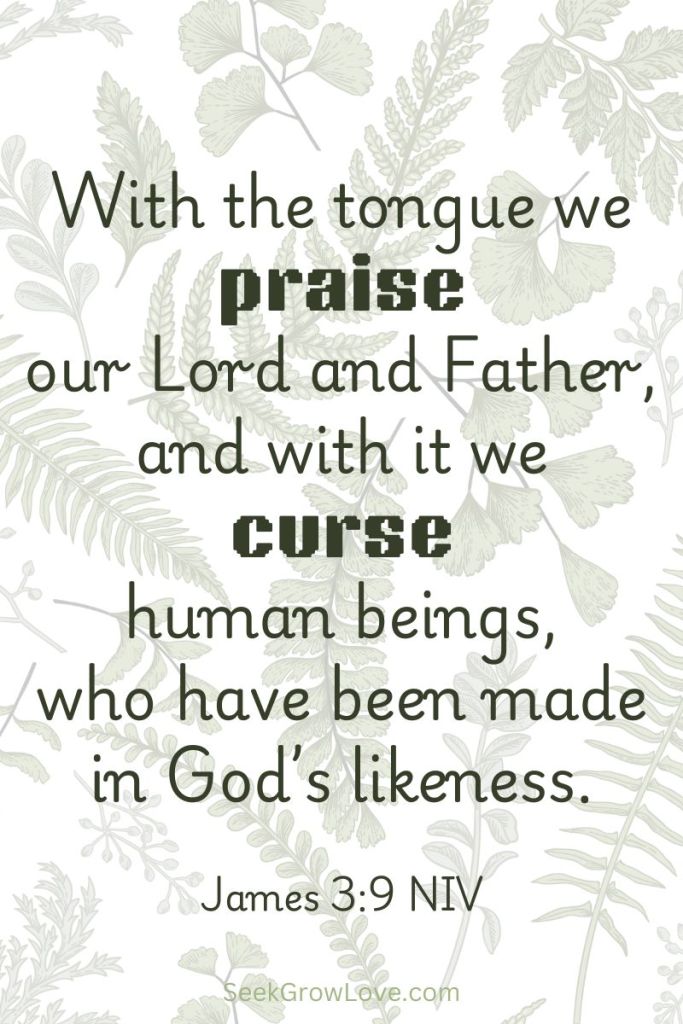
        Verses 9-10 read: With the tongue we praise our Lord and Father, and with it we curse men, who have been made in God’s likeness.  Out of the same mouth come praise and cursing.  My brothers, this should not be.”

        [italics added]

        How can we curse someone made in God’s likeness with the same mouth we praise our God with?  Those ideas are so contradictory, yet it is easy to put people down.

        For example, you may be aware that we have an election coming up soon.  There are so many negative things being said about politicians in all parties.  But how can we talk this way about someone made in the likeness of God?  I think what it boils down to is that is not how we are viewing them.  We are looking at them based on their actions or thoughts that we don’t agree with, but not looking at who they are as a person which is someone made in God’s likeness.

        Let us try to view everyone in this way in order that we might better praise God. 

        ~Stephanie Fletcher

        Reflection Questions

        1. What do you think God is thinking about those who praise Him and curse men?
        2. Watch your tongue today and see how many times you speak poorly of people – or catch yourself ABOUT to speak negatively of someone made in God’s likeness. Why do you think it is so common in the world?
        3. How can we be different? Is it possible to state your opinion about ideas without putting down people?

        Do You Know?

        OLD TESTAMENT: Isaiah 41-43

        POETRY: Psalm 107 (the rest of this week)

        NEW TESTAMENT: James 2:1-13

        I want to jump back to Isaiah today.  Chapter 40 was actually the scheduled reading from yesterday, but it ends with some of my favorite verses – Isaiah 40:28-31

        28 Do you not know?
            Have you not heard?
        The Lord is the everlasting God,
            the Creator of the ends of the earth.
        He will not grow tired or weary,
            and his understanding no one can fathom.
        29 He gives strength to the weary
            and increases the power of the weak.
        30 Even youths grow tired and weary,
            and young men stumble and fall;
        31 but those who hope in the Lord
            will renew their strength.
        They will soar on wings like eagles;
            they will run and not grow weary,
            they will walk and not be faint.

        I don’t have much of a devotion for you, but here is my suggestion.

        Read these verses again.  Let the amazingness, goodness, incredibleness of God wash over you.  Be in awe of Him.  And lean into the reminder that those who hope in Him will have their strength renewed.

        Sometimes, we read large chunks of chapters or verses, and for me at least, I fall into a traditionally schooled trained pattern of just trying to absorb information to be able to answer questions.  But the wonder can pass me by when I do this. 

        So stop.  Read this small section, and be amazed by the Creator.

        ~Stephanie Fletcher

        Reflection Questions

        1. Do you know that the Lord your God is the Creator of the world? What does that mean to you? What does it mean to you that He is everlasting?
        2. What can you not fathom about the Lord God’s understanding? When has He given you strength when you were weary? How would you use His strength today? Pray for it. Thank God for it.
        3. Where do you put your hope?
        4. How many times can you read this passage today? Whatever number you said, can you read it 5-10 additional times beyond what you thought you could.

        Religion that is Worthless

        OLD TESTAMENT: Isaiah 38-40

        POETRY: Psalm 107

        *NEW TESTAMENT: `James 1:19-27

        Have you ever spoken without thinking and hurt someone as a result?  Maybe you have seen this object lesson before, but think of a tube of toothpaste.  It is really easy to squeeze the toothpaste out (my kids are happy to do so in excess if they make it to the counter before me).  But once it is out, it is incredibly difficult, time consuming, and messy to get that toothpaste back in.  Once you speak, you can’t take your words back.  You can apologize, but that doesn’t change the fact of what you said.

        How quickly do you become angry?  I like verse 20 which gives us a reason why we should be slow to become angry – “for man’s anger does not bring about the righteous life that God desires.”

        It is easy to get angry, to speak rudely, to interrupt others’ speech.  But these things do not help us to live the life God wants us to.  It might make us feel better for a second to have an outburst, but usually, we feel worse afterwards and it has done nothing to improve our lives.

        But how do we go about avoiding this temptation that is easy to slide into?

        “get rid of all moral filth and the evil that is so prevalent and humbly accept the word planted in you, which can save you.”

        In a small group I was a part of in the spring, there was an idea that kept coming up from discussing the sermons – if you aren’t producing good fruit in your life, take a look – are you letting sin have a hold in your life?  We have to be constantly on the lookout for where sin seeps in and push it out in order that our fruit can show.

        Verse 22 – “Do not merely listen to the word and so deceive yourselves.  Do what it says[!]”  You have to act.  It is great to go to church, listen to sermons, classes, read the Bible on your own, etc.  All great things.  But if all you do is listen, it isn’t going to make a difference.  You need to actively push the sin out of your life and pursue the good.

        To circle back to the beginning of this section, here is what James writes in verse 26 “If anyone considers himself religious and yet does not keep a tight reign on his tongue, he deceives himself and his religion is worthless.” 

        That is strong language!  Do you thing about your words having such an impact as to make your religion worthless if you do not control your tongue?

        Think about your speech – do you need to work on controlling what you say?  Is there speech you need to ask for forgiveness for?  Is there speech you need to forgive someone else for?  What moral filth do you need to get rid of in your life in order to be able to accept God’s word?

        Silence has value.  In the words of Thumper “if ya can’t say something nice, don’t say nothing at all.”

        ~Stephanie Fletcher

        Reflection Questions

        1. Do you thing about your words having such an impact as to make your religion worthless if you do not control your tongue? When might you have questioned someone else’s religion because of what they said? When was the worth of your own religion decreased due to what you said?
        2. Think about your speech – do you need to work on controlling what you say?  Is there speech you need to ask for forgiveness for?  Is there speech you need to forgive someone else for? 
        3. What moral filth do you need to get rid of in your life in order to be able to accept God’s word?