Be humble. Paul says to count others as more important than yourselves. Selfish ambition and conceit have no place in a life of faith. Jesus doesn’t try to bypass God’s will and establish the Kingdom in his own timing; rather, he understands God’s redemption plan and the need for his sacrifice. He puts the lives of his friends and the future of the church ahead of his desire to escape pain. Succinctly put, he counted others as more important than himself. Contemplate what putting this into practice looks like day by day.
Don’t grumble. This may be hard to grasp, but grumbling and complaining are not spiritual gifts. I jest (kind of…), but if you have been around people for any length of time, even in the church, you have heard someone complain. Some people seemingly enjoy complaining or feel like it is their duty to point out everything that is “wrong” (maybe they were never taught how to channel those thoughts in a constructive way).
Sometimes we grumble and complain when things are tough and unpleasant, but other times we complain because we don’t like the way something is done. Maybe it’s due to our preferences, or maybe it’s because we think we could have done better (i.e., pride). Whatever the case may be, we should not be going through life with our default being set to complain about everything that does not go our way.
There are tons of things that I don’t like. I don’t like Mondays; I don’t like it to be over 72 degrees outside, and I am not enamored by the chorus “As the Deer”. Whether it is the weather, the way we feel about starting our work week (also, what is a weekend?), or our worship preferences, we are responsible for how we conduct ourselves: our attitudes, our actions, our responses to all stimuli. I can choose to roll my eyes or be grumpy, or I can choose to have a good attitude.
One mind. Paul’s desire is for the body to be of one mind. Being of one mind, Paul wants us to have the same mindset as Jesus. As we strive to work, worship, and live in unity, we should be following his examples of humility and conduct.
Fear and trembling. Paul says to work out your salvation with fear and trembling. All parts of our lives should be evaluated under this primary question: “Does this honor and glorify God?” This should impact our theology, our church structure, and our conduct toward others. There are lots of ways to live out our faith; some ways are correct, and some are not, but some are just flat out different than others and are equally useful for bringing God glory.
Reflection Questions:
How does my behavior reflect my faith?
What message does grumbling and complaining send?
How can we effectively navigate disagreements in churches and in other areas of our lives?
What does having one mind look like in practical terms?
Prayer
Dear God – You have so much You could complain about me. Forgive me for the times I am proud, selfish and complaining. I want to have the mind of Christ. Help me see myself and others as You want me to. Help me catch when I am going in the wrong direction and make the changes necessary to be pleasing to You in my attitude, words and actions.
Since June just ended, the grad party season is starting to wind down for everyone. As a recent graduate from high school, it has been fun to host my own grad party and invite my family and friends to join the celebration. Beyond all the gifts, great food, and endless photos, one question always comes up. “What’s next?” For some, it’s college at a university, trade school, starting/joining a business, or even taking time to reflect on one’s next steps. Regardless, the level of responsibility increases substantially for many young people across America.
In 1 Chronicles 28-29, we see a young Solomon having his responsibilities skyrocket, as he officially takes his father’s place as King. His task from the Lord: build a house worthy of God through the plans that David possessed. This wasn’t a simple task, as v. 11-18 describe exactly everything that he had in mind for the Lord’s house. These verses describe divisions of the priests, the chambers, the treasuries, and detail the exact weight of every lampstand, table, gold dish, silver bowl, and many more items! I can’t imagine the feelings that Solomon would have as his father put his trust in him for one of the most sacred structures in the Bible.
However, David says to Solomon in verse 20-21, “Be strong and courageous, and do the work. Don’t be afraid or discouraged, for the LORD God, my God, is with you. He won’t leave you or abandon you until all the work for the service of the LORD’S house is finished. Here are the divisions of the priests and the Levites for all the service of God’s house. Every willing person of any skill will be at your disposal for the work, and the leaders and all the people are at your every command (CSB).” Later, in chapter 29, David also prays for Solomon to give him an undivided heart for the work ahead.
David knew the task God had granted to Solomon was challenging. However, David’s words echo the need to trust in the LORD and to rely on one’s community. Today, we aren’t the kings of nations, but we are faced with increasing responsibilities and freedoms each day we live. My relevant example was for graduates, but that isn’t the only limitation. Maybe it’s something that we want to do, like take an extraordinary trip with our family. Our responsibilities might be difficult to fulfill, such as taking care of someone in your neighborhood who is experiencing a long-term illness.
Whatever your next task is, I pray you will ask God for guidance as you navigate the path you must follow. He might not answer everything instantly, but still trust our Father up above, even when your path is narrow. God can also reveal guidance through the people we interact with. David gave all his leaders to Solomon to help with any task that needed to be accomplished. For many of us, that group of people is our church community. Whatever your next step in life is, ask your pastors, teachers, and people inside the church body. The Holy Spirit can work in mysterious ways through people we don’t even expect.
We can see this sense of community also in Philippians 1. Here, Paul gives gratitude to the Philippian church for their support in spreading the gospel (especially during his imprisonment in Acts 16). Even the Bible’s greatest evangelicals needed support from fellow believers. This emphasizes the need to reinforce our fellow community members on the right steps or the right people to seek help.
Paul ends Chapter One with a wish to the church: “Only let your manner of life be worthy of the gospel of Christ, so that whether I come and see you or am absent, I may hear of you that you are standing firm in one spirit, one mind striving side by side for the faith of the gospel (v. 27 ESV).” Whatever the next chapter is for you, do it while still living with Christ as the center of action.
Reflection Questions:
The ideas of strength and courage are found in many Biblical leaders in power. Who are some of the people who stand out to you? In what ways can we live with the same biblical courage that these leaders had in our everyday tasks?
In both passages, we see leaders, citizens, and early church members supporting people doing hard tasks through prayer, giving, and service. How can we support our church leaders, missionaries, and young people through our own experience and skills?
How do you put Christ first in a new world where life is changing on all sides? What sustainable disciplines could you add to make the good news at the center of your heart?
Prayer:
Great and Mighty God,
Thank you for being our Father and for always letting us put our trust in you when we do difficult things. Please keep our hearts aligned with Christ in the center, wherever our next step is. Help us to be strong and courageous with you and our community supporting us.
1 Chronicles 26-27 are chapters that can be easy to skim past as you are reading through the Bible. However, hidden within these lists of names and positions, we can gain a glimpse of God’s order. The Israelites were a nation that were set apart by God. This can be seen in Leviticus 20:26 and 1 Chronicles 17:21. What separated Israel from the rest of the nations was God’s Law, which provided the Israelites with the order that they needed to live a holy life.
1 Chronicles 26-27 puts a focus on the specific structure and design that God engineered for the Israelites’ success. Within these chapters we see how King David is organizing the Levites to serve in the temple. 1 Chronicles 26:1-19 details the divisions of Levitical gatekeepers. It is specific to their leading men, which gate they are assigned to, and how each watch should run. 26:20-28 focuses on the treasuries of God’s temple, and the individuals responsible for them. 26:29-32 highlights the work of the Levites outside of the temple, who are assigned to be judges and overseers for the tribes of Israel. Each listing is detailed with their families and locations.
This is continued in chapter 27, starting with the military. From verse 1 we learn that the military is to be split into twelve divisions, with 24,000 in each division. 27:2-15 then lists the commanders of these divisions by name for their appropriate division. In 27:16-22, the heads of tribes of Israel are also listed by name. The chapter continues in 27:25-31 by listing those who were placed over the king’s various affairs and property. Finally, 27:32-34 lists the king’s counselors and the commander of the king’s army.
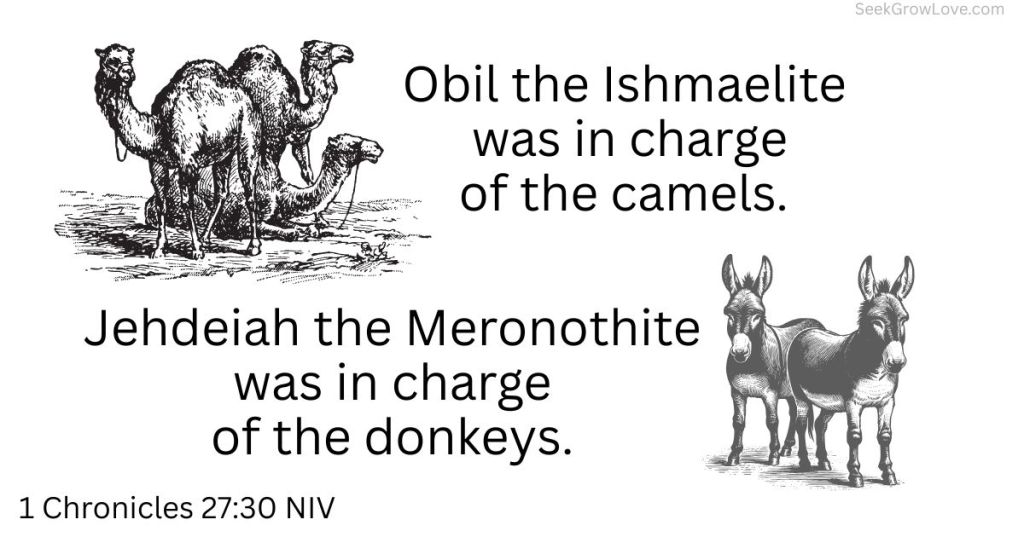
As I was reading through these lists, chapter 27 verse 30 stuck out to me. “Obil the Ishmaelite was in charge of the camels. Jehdeiah the Meronothite was in charge of the donkeys.” In the greater scope of the Bible, I would not think of these as particularly noteworthy roles that would need to be listed. But in the time of David, both camels and donkeys were vital to the success of the kingdom. Camels were of key importance for desert transport and trade. Donkeys were needed for their agricultural work and carrying heavy loads. While not particularly flashy jobs, both Obil and Jehdeiah’s work was needed within the Israelite nation.
We can apply these same concepts into our Church today. The Church needs members in different roles to thrive. We have all been given unique spiritual gifts for the purpose of serving our church. 1 Peter 4:10, “Each of you should use whatever gift you have received to serve others, as faithful stewards of God’s grace in its various forms.” Not everyone is called to be a pastor or musician, but we can still find ways to serve. God has given you gifts to better your church, even if it isn’t always in the flashiest positions. 1 Corinthians 12:21 reminds us that no part of the body of Christ should be looked down upon. “The eye cannot say to the hand, ‘I don’t need you!’ And the head cannot say to the feet, ‘I don’t need you!’” It is pivotal that we don’t lose faith by neglecting the gifts God has given us.
While 1 Chronicles 26-27 are not the most riveting chapters of the Bible, I believe they are truly just as important. God had a specific plan for the Israelites’ success, a clear order to ensure prosperity. Lists like these remind me that God used each of these individuals for a specific purpose, as hard as their names might be to pronounce. God used these people to orchestrate all the inner workings of complex bureaucracy that was David’s kingdom. In comparison to a kingdom, imagine how simple our own lives must be to him. Our God is a God of order, so why do we have such a hard time letting him lead? I pray that we will be able to let go and follow where God’s plan is taking us.
Reflection Questions
What did you find interesting in the description of the organization of the Levites and David’s kingdom?
Of the jobs listed in 1 Chronicles 26-27, which one(s) would you have applied for if you lived during David’s reign and why?
How has God gifted you for service? What role do you play in the church body? Why does it need to be done? What skills does it require?
Where have you witnessed the God of order at work?
Prayer
Dear God, I thank You for creating the church as a body – not because You need us, but because we need You and we need one another. Help us to serve You well as an active, talented, giving part of the body of Christ.
Judgment: the act or process of forming an opinion or evaluation by discerning and comparing.
Judging people is an inherent thing that everyone does. In the English definition, at least of the word, it’s not inherently a bad thing to do. For example, if I walk into my college class on a given day and notice there’s a different group of people, I might jump to a judgment, in this case, that this is not my class. Or you see something in front of you, it has two arms, two legs, a head, upright, and a human face, you make the judgment automatically that this is, in fact, a human. These are both judgments you’ve made, and they are both useful. It’s your brain distilling information into a conclusion that’s easier to work with.
On a larger scale, there are scenarios though, that we are in no place to be the judge of. In reality, even if we form judgments, we should think them through and not act upon those judgments. We are told in Matthew as well to be careful of our judgments and not to think too highly of our own judgment. For we have one whose judgment will always be just and always be right. Psalm 75 speaks of this. God is the ultimate judge, and he will judge without fault.
In many books I’ve read recently, this idea comes across of people making hard choices and having to live with the consequences. Whenever I read this, I am so grateful I am not the hero in those stories, having to make those calls and having to wonder if it was the right call. As the psalmist here does, I also thank God for being the judge. We do not have to worry about some of the hard judgments in life because we serve a God who will make the right judgments every time where we would not. We often thank God for the food he provides, or the home he gives, we should also thank him for this. Thank him for being the ultimate judge who judges with equity.
Reflection Questions
When have you made a false or poor judgment? What was the result? When do you feel you have been judged unfairly by others?
What qualities/characteristics of God make Him the perfect judge? What does God base all His judgments on?
What other things might you be able to thank God for beyond the normal ones you pray for?
Prayer
Dear Father and Judge – Thank You for Your love and thank You for Your right and just judgments. Please give me a piece of Your wisdom and discernment, Lord. Help me know what is right and what is wrong, what is of You and what is not. Help me to make good choices and speak words that are pleasing to You. Thank You for seeing me through the gift of Your precious Son. In his name I pray. Amen
In Ephesians 4, the second half of the chapter is entitled “The Christian’s Walk,” and it lays down some guidelines for us. There’s enough there to pull from that you could spend days just going through every sentence and applying it to your life. But there isn’t enough time for that now, so I’ll just focus on one section. Verses 26 and 27 read,
“Be angry, and yet do not sin; do not let the sun go down on your anger, and do not give the devil an opportunity.”
Anger can be a sore subject for many; it can lead to decisions and actions that cause divisions between people. That can be even more of an issue in the church itself. Yet the verse here highlights an aspect that can always be kept in mind: anger can lead to those actions, but it is not a direct indication that they will happen. I’m not a psychologist and won’t pretend to be an expert, but anger is a mental reaction to something unpleasant happening, but it is not external.
Healthy expression of anger is something we all can struggle with and it is the unhealthy expression of anger that this verse warns us against. Everyone has different methods that work well for them. In the end, though, we must all work to not let the anger drive us to sin. To not let it lead us to those actions that would harm others. A task easier said than done.
There is another part here to discuss as well, not letting the sun go down on your anger. This is not saying that you must get all anger out of your system before the sun goes down every day, but rather advising us not to hold on to our anger. Sometimes it might be easier to let anger sink somewhere where you can’t see it rather than address the cause of that anger. But we mustn’t let this be the case; you’re not resolving the issue, just pushing it off and potentially making it worse. Not that I’m saying you should hash it all the way out right away, that is situational, and if you’re not sure, asking someone wise who is disconnected from the situation can be useful.
Letting anger rule your actions is hazardous to you and everyone around you. Don’t let it lead you into sin, into those terrible situations. Today, I pray you can watch for the next time that anger might come about and not let it lead to sin, and resolve the conflict in a way that doesn’t leave the anger to fester.
Discussion Questions
At what times in your day do you often see your anger taking hold and leading to bad decisions?
Is there a recent time you might have gotten angry at someone? How could you go about letting that anger go?
What does the Bible teach us about God’s anger? In what ways could you work towards handling your anger in a godly manner?
Prayer
Dear God, I praise You for Your righteousness and love. Thank You for being a God who is slow to anger. Help me to learn from You, Your Son, and the words You have given in Your Word. Help me to be more patient with people and situations and when my anger does rise, help me to deal with it well, in healthy ways that do not lead to sin. In my anger and in my life help me stand strong against the devil and his schemes. In Your victorious Son’s name I pray. Amen
1 Chronicles has one of the densest “who begats” sections in scripture, and roughly 10% of the entire book is devoted to genealogy. Let’s talk about the genealogies for a second. These are admittedly some tough chewing at times, but that’s because they are so nutrient dense. Every single one of the names that we normally skim over is an entire novel or series of novels in it’s own right, and constitutes an entire lifetime of choices, decisions, and adventures but it’s hard to see that because all we see is a name and then it moves to the next. I used to completely skip over these as a kid because, well, let’s be honest: not a whole lot was going on that I could see, just a lot of “and Jed begat Bob who begat Bill who begat Frank who begat…”. I’d considered it as the literary equivalent of Ambien ™ at the time.
That perception changed for me when I did a deep dive into the genealogy listed in Matt 1, and I started taking genealogies seriously. Jewish folks take their genealogies very seriously, and for a very good reason, we touched on that just a little bit in yesterday’s devotion. What I discovered, quite by accident, is that genealogies are fascinating if you start digging. Think of every genealogy section in scripture as a dinosaur bone. You don’t always know what it’s going to look like when you start digging it up, but it’s always amazing what you find if you’re a good scriptural paleontologist. In fact, yesterday’s entire devotion was going to be done out of 1 Chronicles 1-3, but after I read Galatians 1 I rewrote the whole thing because it had such an important message in it.
Let me see if I can inspire your inner scriptural paleontologist with some interesting snippets from 1 Chronicles 1-6:
In 1Chron 1:1-4 there is a direct line from Adam to the sons of Noah. Which one of these men listed didn’t die, and purportedly has a “pseudepigriphal” (apocryphal) book that is quoted later in the New Testament but which is NOT included in the canon of the New Testament? (Hint: Gen 5:24, Jude 14-15. Also, if you get a chance, read the book in question, it’s interesting.)
In 1Chron 1:19 it states: “…the name of the one was Peleg, for in his days the earth was divided “. What does that mean? Is this a confirmation of the scientific theory of “Pangea”, or is it a reference to the tower of Babel? (Hint: Although also noted in Gen 11, it never clearly says why in the Bible, but a few apocryphal books including “The book of Jubilees” seem to imply the latter)
In 1 Chron 2:7, when it mentions “Achar, the troubler of Israel” it seems like there’s a gap in the genealogical listings between Zimri and Carmi, who’s missing, and why is Achar called that? (Hint: he’s also known as Achan, see Joshua 7 for both answers)
I don’t want to get too sidetracked from our devotion today, but I’ve listed the few snippets above to try and inspire you to dig scripturally every time you come across a genealogy. You never know what you’re going to find, but there are books and books worth of stories in genealogies that we normally just brush past. They’re fascinating, dig a little bit.
Moving on to our Galatians 2 reading today, we see a quick snippet in v1-2 that is pretty important for a number of reasons. In it, Paul, after being called by a revelation from Jesus, empowered by the holy spirit, and preaching to the gentiles for 14 years, humbly goes to the “authorities” (namely, some of the original apostles), to make sure he’s acting properly. Firstly, note that God has at this point in time already been performing miracles through Paul, and also keep in mind that prior to the events in Acts 10, the message was being delivered solely for and to the Jewish people.
The first “Church Council” is referenced here in Galatians 2, and actually takes place back in Acts 15. There are a number of very important things to take away from this council. Firstly, the gospel of salvation is approved to be given to the gentiles, fulfilling many prophecies (See in particular Is 49:6). This is huge, particularly if you’re a gentile (non-jewish person). Secondly, the content of the meeting is absolutely screaming down history at us about what it doesn’t say, or even question.
Keep in mind, the Jews are fiercely monotheistic ever since the return from the Babylonian exile. The gospel message of salvation has been being preached to the Jews by Jesus and by the apostles after Jesus was resurrected, and now is going to the gentiles for the first time. So let’s think for a moment: the content of this first, hugely controversial, church council is (in it’s entirety) this: can the gospel of salvation be preached to the gentiles, and if so, what must they do? The entire reason for the meeting was predominantly to question whether or not gentiles should be circumcised to be considered “of the faith” (A: no, see Acts 15).
You know what is NOT being questioned at this first church council, nor by any other church council until AD 325, hundreds of years after Jesus’ resurrection, and hundreds of years after converting many pagans and philosophers into Christianity? “Is Jesus God?”. It just never came up, because it’s such a foreign concept to the Jews of that time that it would never even be conceived of as a possibility. The apostles and all of the Jewish followers of Christ at that time wrote, suffered, and often died, to tell the world and to prove that Jesus of Nazareth was the Messiah prophesied about in numerous scriptures; nothing more, and certainly nothing less.
The Jews knew who God was, His name occurs almost 7000 times in scripture; Yahweh, the creator and sustainer of all life, who revealed Himself to Moses in Ex 3. The Jews fully understood the concept of “shaliah” (see 1/27 devotion), but they could also quote the Shema (Deut 6:4-5) by heart, and had it written beside their doors, and in boxes they tied to their hands, and in boxes they tied to their foreheads because it was so important to God that he commanded them to do so. If you have a more “complex” understanding about the nature of God than what is written, I urge you to“stand at the crossroads and look; ask for the ancient paths, ask where the good way is, and walk in it, and you will find rest for your souls. “ (Jer 6:16).
One thing to leave with; as obedient servants and slaves to our king, Gal 2:20 is a really good verse to memorize and keep in your defensive arsenal for when you are tempted: “I have been crucified with Christ, and it is no longer I who live, but Christ lives in me. And the life which I now live in the flesh I live by faith in the Son of God, who loved me and gave Himself up for me “ (LSB). Remember that we were bought by our God at a price, a very high price indeed, and allow our king, the Christ, to sit upon the throne of our hearts.
REFLECTION QUESTIONS
Are you (even slightly) inspired to dig a little next time you see a genealogy?
Why do you think Paul, after 14 years, went to check with the “authorities”?
If the “authorities” had told Paul “No, you can’t preach to the gentiles” do you think he would have listened based on the rest of the chapter? Either way, would that have been the right or the wrong call, and why?
How can we get off the throne of our hearts, and put Christ there? (It’s different for each of us, your answers will be unique to you)
PRAYER
Father God, forgive me of all sin and teach me to be holy. Circumcise my heart, father, and let me humbly serve you and bear good fruit to honor you. Thank you for sending your light to the nations, thank you for the high price which you paid for me, please grant that I can honor you in everything I say, do, or think. In Jesus name, amen.
The opening of Galatians is one of the (many) clear examples of Paul’s personal understanding of scripture, of the nature of the Most High God and of His Messiah, Jesus. The thing to keep in mind about Paul is that he was a “good Jewish boy” (just like Jesus was), and a Pharisee who trained under the renowned Gamaliel (and likely the “Hillel” school associated with Gamaliel) . The Pharisees were basically just what we’d call the “church leaders” of his time.
There were 4 predominant Jewish “philosophies” at the time, and it’s very important historically to understand them and their differences with each other in order to fully grasp what being a “Pharisee” meant. So here they are, in no particular order:
Pharisees-Devout Jews who emphasized strict adherence to the Torah and the oral law. They believed in resurrection, an afterlife, and divine providence.
Sadducees: A priestly and aristocratic group who accepted only the written Torah (Pentateuch) as authoritative, rejected the oral law, and did not believe in resurrection or an afterlife.
Essenes: A separatist, ascetic group that lived in communal settlements (like Qumran), practiced ritual purity, and are associated with the Dead Sea Scrolls. They believed in divine predestination and awaited a messianic figure.
Fourth Philosophy: A radical political and revolutionary movement advocating armed resistance against foreign rule, particularly Roman occupation. They opposed paying taxes to Rome, viewed submission to foreign powers as idolatry, and sought a theocratic Jewish state. This group is often identified with the Zealots and Sicarii (Remember Simon the Zealot? Yea, this is what they’re talking about: more stabby stabby, less “oh that guy was really zealous”. Look up “sicarii” for some really cool information about these guys.)
So here is the thing, the Pharisees were (as every branch mentioned) FIERCELY monotheistic; they believed in the one God, the God Most High, Yahweh. This particular sect was so fiercely monotheistic that they literally posted copies of The Shema (Deut 6:4-5) beside the doors to their houses, put it in little boxes and tied it to their hands, and tied them in little boxes around their foreheads to remind themselves: “Listen Israel! Yahweh God, Yahweh is one.” It was a big deal, so big that when Jesus was asked what the greatest commandment was in Mark 12:29-31 he quoted this (also note that the scribe agreed with him, and Jesus didn’t correct him). That’s just what every good Jewish boy knew. As good (Judeo-)Christians, we should know it too.
My point in bringing this up is simply this: if Paul had come to a more “complex” understanding of the nature of God and His Christ as some modern apologists have suggested it would have been a huge, earth shatteringly tremendous, shockingly big deal. It would have come up very clearly (not inferred) in conversation, and probably more than once. There would have been screaming bouts and yelling, probably violence. At least something in scriptures would have documented very clearly this huge diversion from an entire nation’s historical understanding of the nature of God, but it never comes up.
Gal 1:1-4, LSB:
1Paul,…not sent from men nor through man, but through Jesus Christ and God the Father, who raised Him from the dead…3Grace to you and peace from God our Father and the Lord Jesus Christ,4who gave Himself for our sins …according to the will of our God and Father, 5to whom be the glory forever and ever. Amen.
We see from the above that Paul believed that Jesus was The Christ (The “Messiah”, see May 8th devotional), that God raised Jesus from the dead, that Jesus gave himself for our sins, and that this sacrifice was done according to the will of our God and Father (to whom be the glory forever). It’s pretty hard to have a “complex” reading of this, Paul delineates firmly between his God and his Messiah (as does Jesus, see John 20:17). Almost all of Paul’s openings in his letters clearly delineate between God and His Christ, the man Jesus of Nazareth whom he believes is the Messiah (as did Jesus, see John 4:25). All of the new testament authors (and Jesus himself) identify Jesus as the Christ, the Messiah. It is not good to go beyond what is written (1 Cor 4:6), and that is what is written. He is the Messiah, the son of David, the son of the living God (Matt 16:15). He has to be, to fulfill the prophecies of the Messiah (see 2 Sam 7).
As we can see in our 1 Chronicles 1-3 reading today, the Jewish folks have a passion for genealogy, we might view it as almost more of an obsession. I never really understood that, but it’s simple, and very practical: the inheritance of the people was determined by ancestry. In the book of Numbers (which has quite a bit of this type of genealogy) in chapters 34-36 it gives the breakdown of these inheritances for the Jews. The obsession was because, simply, that determined where you lived, who you were, and what you got. Want to be a priest in the nation of Israel? Well, who’s your daddy? Let’s break out the genealogical scrolls and trace you backwards because if you can’t make a pretty straight genealogical line from you to Aaron, you aren’t qualified. This concept ended up being carried over generationally, because who you were determined your inheritance.
This type of genealogical thinking is entrenched in the Jewish mentality because of this, and that’s why 2 of the gospels make a point to break down the genealogy of Jesus in order to prove that he met the requirements of being the “Messiah” or “Christ” (Matt and Luke), but Jesus also exemplified the loving nature of God towards His creation. John the baptist (in Matt 3:9) warns the people not to think that because Abraham is “their father” that they’re safe, because it is faith that determines spiritual lineage (Rom 4:16, Gal 3:7) and not genealogy. In John 8:44 Jesus tells some of the religious leaders that “You are of your father the devil”. This is not to imply that their biological father was Satan, but to explain that true spiritual paternity is determined by behavior, actions, and attitude. So with that understood, let me ask you the question: who is YOUR daddy?
Our Father in heaven is the Most Gracious, the Most Merciful. He has given us blessings abundantly, even when we didn’t deserve them, and even when we were acting in opposition to His will. He forgives freely to those who ask, He is faithful, He is loving, He comes running to meet us along the path when we wake up and begin to return home from our own folly. Even when He is wronged, He stands waiting with outstretched arms for His children to return. He is patient, He is kind, He always keeps His promises, and He will make a way for those who love and seek Him. He LOVES YOU SO MUCH that He sent His only begotten son to die to make a way for you.
So, again: who is your daddy? Read the above paragraph very carefully. If you are reflecting all of those traits, then you too are a child of the living God. If you are not reflecting those traits listed above stop for a moment, and with fear and trembling consider your path and who your father is, and how to return to the loving arms of the God who made you.
REFLECTION QUESTIONS
What single thing can you do better to reflect the nature of God in your life?
What flaw do you personally feel is the most detrimental to you, and how can you fix it?
We are to regularly examine and test ourselves (2Cor 13:5): How do you normally do?
Who is your Father, today? What about yesterday? Tomorrow?
PRAYER
Father God, my father, please show me what I can do better. Please teach me Your ways, and let me humbly seek after You with all my heart. Please forgive me when I fail You, as I so often do, and cleanse my heart of all wrongdoing and wrong thinking. Guide me on the path that leads to Your kingdom. Thank you for sending Your son to teach us, grant us the wisdom to listen. In Jesus name, Amen.
There is so much going on in our 2 Kings reading today that it’s unlikely that we’ll have the chance to adequately cover it all. Of particular note, there are some hidden gems, or “easter eggs” as the kids say, strewn about that you have to be looking for carefully or you’ll miss (*An Easter egg is a message, image, or feature hidden in various forms of media). These were some of my favorite bible books to read as a child just because there was so much excitement and adventure going on, but looking closely you’ll find that there are quite a few nuggets of wisdom, but you have to dig for them sometimes. Some are laying right on the surface, though.
The first part of 2Ki 23:1-25 is detailing some of the things Josiah did as king. Keeping in mind that he was only 8 years old when he took office (2Ki 22:1), I was wondering how old he was when he realized that his father Manasseh had led the nation astray and started working to correct it. The closest I could come in the book of 2 Kings to finding that answer is in 2Ki 23:23 where it says “But in the eighteenth year of King Josiah, this Passover was celebrated to Yahweh in Jerusalem” (LSB), for the first time since the time of the judges (back in v22). So, is that in the 18th year of his life, or the 18th year of his reign? I found the answer over in 2 Chronicles 34&35, which states that in the 8th year of his reign he started to seek the Lord, and that in the 18th year of his reign (after significant reforms had already been made) they celebrated the Passover for the first time since the time of the judges. So, for you bible nerds out there, he became king at 8, was about 16 years old when he started seeking God, and was about 26 when he reinstated the Passover feast.
Oh, and in case you were wondering if grandpa Manasseh was really such a bad guy, the biblical writers remind us again and again whose fault it is in 2Ki 23:26 and also 24:3, squarely blaming all of the misfortunes about to befall them during this time on him. You know, in case you forgot, because apparently they did not: EVER. Keep in mind, this is an epic time in history; the Assyrian kingdom was in decline, Egypt was still a force to be reckoned with, and the Babylonian kingdom is on the ascension. Up until the time of the Babylonian exile, the ancient Jews had a real problem with idolatry (you’ll recall that’s #1 in the list of ‘thou shalt not’s). After the time of the Babylonian exile, you never hear about idolatry again in the land of Israel (at least on a national level). Think about that: just like when you got a spanking from your father as a child, God generally performs punitive actions to correct behavior. This time it absolutely worked, check it out if you don’t believe me: the Israelites never again returned to idolatry once they returned from Babylon (at least on a national level).
Here’s one “Easter egg” I found when doing a deep dive into this reading: I’d always assumed that the “idolatrous priests” (2Ki23:5) referred to, you know: priests who worshipped false idols or pagan deities. Reading closely in v5,6,8, and 9 however we can see that some of these were kohanim, Aaronite priests of God, particularly in v9 where it states “…but they ate unleavened bread among their brothers.” (LSB). We can infer from these passages that even if you’re the right guy, serving the right God, if you’re doing it in the wrong way or in the wrong place: you might be idolatrous. I’ve got a note in my bible that reads: “priests of God, but serving in the wrong place?”. Just a little food for thought, something to consider.
Do you like finding “Easter eggs” as much as I do? Well, lucky day, here’s another one: read carefully 2Ki 23:15-18, about the grave of the “man of God”. This is a great story, but to get the full scope of it, after you read the above verses, you’ll need to flip backwards over to 1 Ki 13. We sadly never get to know the name of the man of God, we do however get to learn a valuable life lesson: listen to God if He’s talking, and absolutely ignore men if they are saying something different.
A quick summary of the story is as follows: God sends a man, a prophet, to deliver a message to the king, which he does. This prophet is commanded to “eat no bread, nor drink water, nor return by the way which you came”. Then another prophet chases after him and says “uh, so God told me you’re supposed to come eat with me”, and he does. Then the prophet who invited the first one to eat then says “why have you rebelled against God?” and tells the guy he’s going to die, which he does shortly after he leaves (by a lion).
Then, to add insult to injury, when the second prophet realizes that the “man of God” has been killed (and while accepting absolutely no personal responsibility in this series of events as possibly overstepping by telling the first prophet that God had told him he should eat), he has him buried and mourns him saying “alas, my brother!”. Then, as if that wasn’t enough, this second prophet then tells his kids “When I die, bury me with that guy, because he was a prophet.” (paraphrased and summarised, but accurate, go and read it: 1 Ki 13)!? As a result, when all the other graves are defiled later on, the second prophet who misled and (indirectly?) caused the “man of God” to be killed was also left undisturbed when Josiah left the grave alone in 2 Ki 23:18. Ironic, isn’t it? The moral of that story is: ignore men, listen to God.
Now remember as we continue on, Manasseh was a really bad guy. So bad that even when Josiah did what was right in God’s eyes, God’s promise to Josiah was not that he would relent from His (righteous) wrath on the nation, but that Josiah would die before it happened so that he “would not see all the evil which I will bring on this place” (LSB, 2 Ki 22:20). This happens in 2Ki 23:29, when Pharaoh Neco (AKA Necho II, @610-595 BC) puts him to death at Megiddo. Does the name of that place sound familiar? It should, in Rev 16:16 the “final battle” prophesied is to take place in what is translated as “Armegeddon”, which is literally “Har Megiddo”, or the “hill” of Megiddo (an ancient city). Same place (insert dramatic sound effect here).
In 2 Ki 24, we see the beginning of the rise of Nebuchadnezzar and the ascension of the kingdom of Babylon. Later on in this chapter (v10) Judah goes into exile, and then in chapter 25 we see the fall of the last stronghold in Judah, Jerusalem. It is notably at this point that the temple is burned, Solomon’s temple, one of the grandest architectural structures of the time. The people had begun to think of themselves as untouchable, since they had the temple in their midst, even though idolatry was running rampant (See Jer 7:4 for the popular view of “the temple” at this time). This effectively ended the “First Temple” period, considered to be the “golden age” of Jewish prosperity and centralized worship.
REFLECTION QUESTIONS
Can you think of a time in your life when it felt like God was punishing you? Upon reflection and with the passing of time, were you able to see the lesson that was being taught? (I sure did.)
Has there ever been a time in your life when even if you were trying to do the right thing, you realized you were in the wrong place? Reflect on this quietly for a few moments, I can think of at least 3 personally (and I wasn’t even always trying to do the right thing). How could you have had a better outcome?
Why are we inclined to listen to men over God, sometimes?
PRAYER
Father God, please place me in the right spot. Purify my heart, and give me strength so that when I am there, I can do your will. Please let my ears hear Your whispering over the shouting of men, and guide my feet onto the path that leads directly to Your kingdom. Thank you most of all for sending Jesus to teach us and to be a role model. In his name we pray, Amen.
Today, we’re going to first examine an inconvenient truth, and then together examine a template for navigating back onto the proper path when we get lost. First, the inconvenient truth: just because you come from good stock doesn’t mean you’re good. I can speak for this directly first hand because while my parents were absolutely wonderful, fantastic, God-fearing, loving, and wise people; I took a hard turn off the proper path in my youth and kept running in that direction for most of my life (See 2/6 devotional for details). So here’s the thing, and I want you to memorize this because it’s really important: there is no corporate entry into the kingdom of God.
To elaborate on that statement: we are each held accountable for our own actions. Many of you know Dr. Joe Martin, my father. Understand well that in the day of judgment, when I am standing before the throne that if my defense of my actions is “But wait…You know Joe? He’s my dad, so…you know, *wink wink* I’ll just go ahead in and pick out one of the rooms…” I’m pretty sure the response would be along the lines of “Joe? Oh yea, we know him well, he’s a great guy. Let’s talk about YOU for a moment though…“. When you read that above bit of farce, you’ll probably chuckle a little bit, but stop for a moment and think about it seriously and with some trembling because there is no corporate entry into the kingdom of God.
Even if you go to an awesome church that not only feeds the homeless regularly but gives solid scriptural truths that are deeply insightful and applicable, even if your pastor is spirit filled and heals the sick with a touch and a prayer, even if there’s a lady in your church who you KNOW is an active and living prophet of the Most High God: what does that have to do with you? There is no corporate entry into the kingdom of God, you’re not going to slide into the kingdom on their coat tails. Some of the ancient Jewish folks were thinking exactly in that manner, when John the baptist explained to them in Matt 3:9 “and do not suppose that you can say to yourselves, ‘We have Abraham for our father’; for I say to you that from these stones God is able to raise up children to Abraham.” (LSB). We will each be judged according to our own actions: by our faith, by our love, and by our fruit. I pray to God that each of our names is found in the book of Life but understand fully that if it is, it’s not because of who you’re related to or which church you went to. There is no corporate entry into the kingdom of God.
For a good case in point of this very topic, let’s take a hard look at Manasseh and check off some of the boxes. Manasseh was not only a Jewish lad (check), but the son of Hezekiah (check) who is probably the most attested biblical figure in history (counting not only scripture but extra-biblical accounts of his reign). We know that God loved Hezekiah, just go back and read 2Ki 18-20, he’s blessed and highly favored. So Manasseh should have been an easy pick for being awesome, but that’s not at all what happened. We see in 2Ki 21:1-3 that Manasseh became king when he was 12, ruled for 55 years, and “did what was evil in the sight of Yahweh” (LSB). Keep in mind that dad (Hezekiah), did a lot of really good stuff: he tore down the false gods and altars, redirected the people to worship God, and humbly sought after and clung to the God who had rescued his fathers.
Manasseh, conversely, sounds like a bit of a jerk. All of the good things his father had done, he undid. In 2Ki 21:5-9 it gives an excruciatingly painful laundry list of offenses that Manasseh did, including setting up false idols in the actual temple, sacrificing his own son to a pagan deity, and then leading the entire nation astray to do more evil than the nations before. In v16 it says that in addition to all of this, he “shed very much innocent blood”.
At this point, God has had enough, and I’d like you to listen to the wording of 2 Ki 21:12: “therefore thus says Yahweh, the God of Israel, ‘Behold, I am bringing such calamity on Jerusalem and Judah, that whoever hears of it, both his ears will tingle.’ ” (LSB). This should be terrifying, these are not the words of one who is ‘a little upset’, but a potential extinction level event of anger from the Most High God. We can see from this example that it doesn’t matter who you’re related to or what group you belong to, but rather your own path, in the eyes of God.
Now let’s look at how to navigate back onto the proper path, if we ever get lost or go astray. Enter Josiah (2 Ki 22). Keep in mind that he’s the third generation in a line of truly terrible and evil kings, who “did what was evil in the sight of Yahweh” (see 2Ki 21 for details on Manasseh and Amon, grandpa and dad respectively). He’s just a kid when he takes office, 8 years old, but right away he starts back toward the right path. He sends Shaphan to the temple and makes arrangements for it’s restoration (2 Ki 22 3-7). Remember that wild idolatry and debauchery has been going on for two full generations, the temple itself has been defiled, and the people have been going in the wrong direction for 57 years.
Now it came about as the temple was being cleaned out and restored, that Hilkiah the high priest found the book of the law. It had been lost for a long time. Hilkiah gave the book to Shaphan, and Shaphan took the book back and read it to King Josiah (2 Ki 22:8-10). Pay close attention here, because this is the turning point: “Now it happened that when the king heard the words of the book of the law, he tore his clothes” (2Ki 22:11, LSB). In ancient Israel, this is how people exhibited deep regret or sorrow publicly. He sent people to “inquire of Yahweh” and seek what might be done (2Ki 22:12-20). He basically humbled himself, and sought the will of God.
God’s response to this honest sorrow and humility defines our template for returning: “because your heart was soft and you humbled yourself before Yahweh when you heard what I spoke against this place and against it’s inhabitants that they should become an object of horror, and a curse, and you have torn your clothes and wept before me, I truly have heard you“, declares Yahweh.” (2Ki22:18), and He then relents.
According to the above template, I would suggest the following if your path has led you astray: First, find the book of the law (the Bible), and read it. Then, when you have realized how far off path you have become, inquire of God. Repent, soften you heart, and weep before God. Clean out the temple (you are the temple 1 Cor 3:16), remove the idols (anything can be an idol) you’ve placed there, and do the work to restore God’s temple. Clean it out, purify it, and rededicate it to God. If you do this with honesty and dedication, God will truly hear you (See Jer 29:13 for verification).
REFLECTION QUESTIONS
Examine yourself deeply and honestly, because we all probably have some: What idols have you built inside the temple of your heart, and why?
Considering the above question, what is the best way to remove them? Being honest, do you want to remove them? Why or why not?
How often do we honestly inquire of God His will, as opposed to handing him a list of our demands when we pray?
PRAYER
Heavenly Father, thank you for all of the blessings you’ve given to us. Thank you for sending your son to instruct us. Please forgive us of the many times we fall short, and help us to become servants who please their master. Lead us and guide us, Father, and teach us the way you would have us go. In Jesus name, amen.
The beginning of our 2Ki 19-20 reading today finds our hero Hezekiah fiercely beset by a vastly superior armed force. Please take a moment to read 2Ki 18:13-37 to refresh yourself of the specifics. If you recall, back in chapter 17, Judah’s sister nation Israel has already been taken captive previously and forced into exile. In 2Ki 18: 1-13, we see that Hezekiah the king of Judah was spared this fate because he trusted God, he clung to God, he didn’t turn away from following God and obeying His commandments. So he’s still in power but right now there’s a massive army surrounding him that has already conquered everyone else around, gathered en masse outside the gates hurling taunts at the city, and they seem prepared to hurl much more dangerous bits as well.
First, let’s get an idea of the scale of things. This large, technologically advanced force was at the time part of the most dominant military power in the near east. Aggadah literature describes the army as composed of “45,000 ‘princes’ in golden chariots, 80,000 armored warriors, 60,000 swordsmen, and numerous cavalry”, in the rabbinic tradition. So far in the campaign, Sennacherib has conquered 46 other fortified cities. This estimate of forces is also backed scripturally and apocryphally in 2 Ki 9:35, Judith 14:11-12, and Is 37:36. Conversely, the population of Jerusalem (per wikipedia) during Hezekiah’s time was a whopping “up to about 25000” people, total.
So on one hand you’ve got a city with (around) 25,000 men, women, and children in it, and on the other hand an advanced army of armored warriors and cavalry numbering well over 185,000 (not counting camp followers). Things are looking, not to put too fine a point on things, “bad” for our heroes. With this picture in mind, now add the leader of these forces shouting up to the nervous inhabitants the taunting insults detailed in 2Ki 18:13-37. We would probably be hearing a much different historical account if not for a couple tiny little details: firstly, the commander shouting up at the walls insulted God. Secondly, Hezekiah was a man who trusted God, who clung to God, who loved God and God loved him back.
It should be noted that according to the events listed in 2Ki 19:2-8 that it appears as if God miraculously diverts the first attempted attack and causes the army to go home, but that then after an unspecified (but probably short) time has passed, the commander sends threatening letters back to Hezekiah and heads back with his troops to “finish business”.
At this point, Hezekiah “tore his clothes, covered himself with sackcloth, and entered the House of Yahweh” (19:1, LSB) and then prayed one of the most beautiful and humble prayers in scripture. Beginning in 2Ki 19: 14-19 (LSB translation): “Then Hezekiah took the letter from the hand of the messengers and read it, and he went up to the house of Yahweh and spread it out before Yahweh…and said “O Yahweh, the God of Israel, who is enthroned above the cherubim, You are the God, You alone, of all the kingdoms of the earth. You have made heaven and earth. Incline Your ear, O Yahweh, and hear; open Your eyes, O Yahweh, and see; and listen to the words of Sennacherib, who sent them to reproach the living God. Truly, O Yahweh, the kings of Assyria have laid waste the nations and their lands and have put their gods into the fire, for they were not gods but the work of men’s hands, wood and stone. So they have destroyed them. But now, O Yahweh our God, I pray, save us from his hand that all the kingdoms of the earth may know that You alone, O Yahweh, are God“.
In our reading today of Ps 68, we see in v17 that “The chariots of God are myriads, thousands upon thousands…” (LSB). Rev 5:11 states that (concerning angels) “the numbering of them was myriads upon myriads, and thousands of thousands“. We don’t really have an accurate number of how many angels serve God, but a very conservative guesstimate would be “lots and lots”. If today’s reading of 2Ki 19:35 has been transmitted and understood accurately, God sent 1 (one) of these innumerable angels to the enemy camp and that angel killed 185,000 men. Pause, digest, consider.One angel, and he wiped out almost an entire army, the most powerful of the time. One angel out a large force of angels (out of Millions? Billions? we really have no idea, just “myriads upon myriads”). Just one angel.
**An interesting side note is that Hezekiah is described as “the best-attested figure in biblical history,” due to the extensive documentation of his reign in biblical texts and external sources (notably Assyrian inscriptions), per Wikipedia. This entire story is documented both biblically and through a number of extra-biblical sources. There’s a wonderfully deep hole full of information on that you can fall down into if you’re interested in that sort of thing. I did, but for our intents and purposes it is only important to note that although in agreement in general about the number of men killed, some of the sources do give different accounts of the manner that the men actually died (but in all fairness it never said how the angel of Yahweh killed them, just that he had).
This bible story has always fascinated me. What a fantastic, miraculous, wonderful thing. It happened so long ago though, and that sort of thing doesn’t happen these days, right? Wrong.Reports from the Yom Kippur war in 1973 describe an incident on the Golan Heights where a Syrian tank commander reportedly told Israeli interrogators that his forces were halted by a vision of a whole host of white angels standing on the missile line, accompanied by a white hand from heaven commanding them to stop. This encounter allegedly occurred during the “Valley of Tears” battle, where a small Israeli force held off a much larger Syrian advance. According to the account, the Syrian commander said he could not proceed due to the supernatural presence, which instilled fear and caused his troops to retreat. This story is cited in multiple sources, including religious and historical commentary, as a supernatural turning point in the war. Look it up.
As humans, our senses are finite and limited. God is not. In 2 Ki 6:16-17 we see another example of this when Elisha tells his servant not to worry, that those with them outnumbered those that were against them, and then “Elisha prayed and said, “O Yahweh, I pray, open his eyes that he may see.” And Yahweh opened the eyes of the young man and he saw; and behold, the mountain was full of horses and chariots of fire all around …” (LSB). We often forget that our God, the God Most High, the Creator of the heavens and the earth is the most powerful being that exists. Myriads upon myriads of beings far more powerful than humans serve him currently, and just one of His angels can wipe out an entire army. This is not a weak king; this is the creator, ruler, and owner of the universe who will bring about his willed purpose no matter what, and He is awesome. This makes it all the more humbling when we realize how ferociously He loves you, and all that He has done for YOU specifically, and what price He paid for your redemption. A very high price indeed.
REFLECTION QUESTIONS
Do you constantly keep in the forefront of your mind the incredible, unstoppable power of the Most High God, or have you allowed yourself to be deceived by your limited senses?
Have you considered how silly pride is on our part, when we consider the magnititude of God?
Have you seen, or felt, divine intervention directly in your life? When?
Why do we worry, when we consider all of the above?
PRAYER
Lord God Most High, Mighty God, I humble myself before You. Forgive me, teach me, and open my eyes so that I can see. Open my ears so that I can hear You. Circumcise my heart and teach me to love you as fiercely as you have loved me, in Jesus name, Amen.