Iron Sharpens Iron

Proverbs 27-29

We read yesterday about how our fellowship with each other gives us an opportunity to help one another become more faithful in our walks with God.

Proverbs 27:17(NLT) As iron sharpens iron, so a friend sharpens a friend.

Now we also see wisdom that encourages us to take the long view of the things that we do.  God has a plan that spans centuries and generations.  Here in Proverb 27 Solomon shows us that we are to work and think with the goals of tomorrow and a new generation in mind.

Proverbs 27:23-27(NLT) Know the state of your flocks,
and put your heart into caring for your herds,
24 for riches don’t last forever,
and the crown might not be passed to the next generation.
25 After the hay is harvested and the new crop appears
and the mountain grasses are gathered in,
26 your sheep will provide wool for clothing,
and your goats will provide the price of a field.
27 And you will have enough goats’ milk for yourself,
your family, and your servant girls.

Could you put this proverb into a modern form and provide a current event comparison about investments and future outcomes?

In Proverbs 29 we find much wisdom about nations and rulers alternated with practical advice about children, jobs and possessions.  Proverbs has a poetic form which is different from the way that we mostly write today.  This rhythm and phrasing make it easier for the people to remember and recite.  Most of the faithful of that time memorized the Word and were able to speak it when needed.  We are spoiled by written Bibles and internet search engines to find the verses that we look for. 

Proverbs 29:2(NLT) When the godly are in authority, the people rejoice.
  But when the wicked are in power, they groan.

Proverbs 29:4(NLT) A just king gives stability to his nation,
but one who demands bribes destroys it.

Proverbs 29:12(NLT) If a ruler pays attention to liars,
    all his advisers will be wicked.

Proverbs 29:14(NLT) If a king judges the poor fairly,
his throne will last forever.

Proverbs 29:16(NLT) When the wicked are in authority, sin flourishes,
but the godly will live to see their downfall.

-Tom Siderius

Reflection Questions

How do these verses give simple instruction for complex questions of rulership and authority?

Could we write them in a modern version to say the same truth to our country and generation?

& See Bold Question Above about Proverbs 27

Praying God is with you today and this wisdom gives you light to guide your feet and path.
God at Work

Exodus 13-15

In our devotion yesterday Jeff Fletcher was describing the Dark Night of the Soul when it seems like God is distant. Certainly being enslaved for 400 years in a foreign land could have that effect. I wonder if even through all those years of painful toil if many or some Hebrew parents were still faithfully telling their children of the God of Abraham, Isaac and Jacob who had promised Abraham that his descendants would come out of that land of slavery after 400 years with great possessions and God’s judgment upon their former masters (Genesis 15:13). Was anyone still counting the years in anticipation? Were they talking to God about how He would show up? Were they watching to see how God might be acting on their behalf day after day while in slavery? I don’t know. But I hope so. In our reading today, there can be no doubt, God is at work and He shows up in some major ways – and also in some small surprising ways, too – but always faithful.

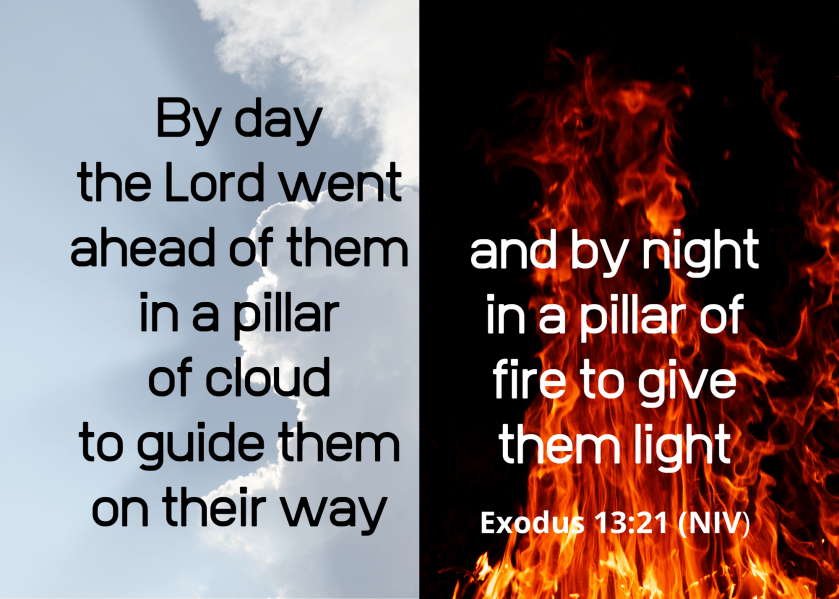
I will assume that you already have some knowledge of these events from Exodus 13-15. So, you already know of the amazing way God chose to lead the Israelites on their journey out of Egypt – with a pillar of cloud by day and a pillar of fire by night – spectacular! And you already know of God’s strong east wind that split the Red Sea with a wall of water on their right and a wall of water on their left as His cherished people crossed on dry land – astounding!

So, today I will focus on two of the smaller things – wheels and logs.

I don’t know about you – but I take great delight (maybe a little too much) in the picture of God at work in Exodus 14:25. Here the great God of the universe who has been directing the winds to create great mountains of water is watching from the pillar of fire/cloud which He specifically moved from in front of the Israelites where it had been guiding to the rear where it was protecting. So this great all-powerful God of the universe reaches down from on high to clog the chariot wheels of the advancing Egyptians who want to take back their slaves. Is there an adversary chasing you who wants to make you or someone you know a slave again? God is good at protecting His children, sometimes in ways I wouldn’t even think of. In big and small ways. God so loved the world. But we know everyone is not going to listen and play on His side. Some will play the role of adversary, but do not fear, our God knows how to clog their chariot wheels. Oh, and, make sure you are playing on the right team because the God who clogged their wheels also sent the mountainous walls of water crashing down on the Egpytians and none survived. His judgment is right and sure and coming at God’s perfect time not ours. And the whole world will know He is the Lord.

The second little example of God at work even in small ways in His big plans comes at the end of our reading today. The Egyptians are no longer a problem. Now, thirst is. They have traveled three days and have not found water. And when they finally reach water at Marah, they find the water is bitter, not just unpleasant to drink but likely unhealthy and perhaps deadly as well. The people grumble, Moses cries out to the Lord, and the Lord answers by showing Moses a log.

Thanks, God. This will help – if we want a campfire or need to start building a log cabin. But we really need water now. The Bible doesn’t record that Moses questioned God, but I might have. I love the partnership between Moses and God. God could’ve fixed the problem any way He wanted to. And if He wanted to sweeten the water with a log He could have easily picked up the right log and thrown it in himself – after all we just saw Him displace how many gallons of water and clog chariot wheels without any help from human hands. But more to His “normal” working – He shows Moses which log – and Moses simply steps up, pitches it in the water and God makes the waters sweet and healthy and life-giving.

Today, whether God is displacing the sea for you to walk through on dry land or clogging some chariot wheels to protect you, or showing you which log He wants you to pick up to sweeten your bitter surroundings – follow Him. He is at work, in big and small ways, guiding and protecting and sustaining.

-Marcia Railton

Reflection Questions

  1. What inspiring words did Moses have for the people at the edge of the Red Sea in Exodus 14:13 & 14? Which phrase do you need to hear today? What words does the Lord God have for Moses in Exodus 14:15? Where do you think God is calling you to go forward?
  2. Exodus 15 includes the first recorded hymn of the Hebrew people. If you were to create a hymn or worship song praising God for who He is and what He has done for you what would you include?
  3. Where do you see God at work – in big and small ways? Like Moses picking up the log God showed him – what might God be showing you to do to change bitter to sweet and help sustain the weary, thirsty children of God?

Trusting God’s Sovereign Plan

OLD TESTAMENT: Isaiah 53 & 54

POETRY: Psalm 108

NEW TESTAMENT: James 4:13-17

Isaiah 53:5-6 (LEB):

“But he was pierced because of our transgressions,

crushed because of our iniquities;

the chastisement for our peace was upon him,

and by his wounds we were healed.

All of us have wandered about like sheep;

we each have turned to his own way,

and Yahweh let fall on him the iniquity of us all.”

Psalm 108:1 (LEB):

“My heart is steadfast, O God;

I will sing and give praise, even with my glory.”

James 4:14-15 (LEB):

“Yet you do not know what tomorrow will bring. What is your life? For you are a mist that appears for a little time and then vanishes. Instead you ought to say, ‘If the Lord wills, we will live and do this or that.'”

Isaiah 53 paints a vivid picture of the suffering Servant, Jesus Christ, who bore our sins and took the punishment we deserved. It reminds us that God’s plan for salvation was in place long before we understood it. We were like wandering sheep, yet God sent His Son to rescue us and reconcile us to Himself. Isaiah 53 reminds us that God’s plan for our salvation was set in motion long before we even understood our need for it. We can trust His plans for our lives because He has proven His love through the sacrifice of Jesus.

Isaiah 54 shifts from the suffering of the Servant to the hope and restoration that follows. God promises to expand the tents of His people, signifying the growth and blessing that come through Christ’s sacrifice. This passage is a reminder of the immense love God has for us, His plan to redeem, and the restoration we experience in Him. In moments of doubt or difficulty, we can trust that God’s plans for us are rooted in His unfailing love and perfect wisdom. 

Psalm 108 calls us to have a steadfast heart before God. The psalmist’s heart is fixed on praising God regardless of the circumstances, declaring God’s greatness in the morning and in the midst of battle. Just as Isaiah speaks of the suffering and victory of the Servant, Psalm 108 reminds us that our response to God’s sovereignty should be steadfast praise. Even when we face trials or uncertainty, our hearts can be firm, trusting in His ultimate plan and offering Him our highest worship. Psalm 108 challenges us to maintain a steadfast heart of praise, even when life is uncertain. In every season, our hearts can be anchored in worship of God’s goodness.

James reminds us of the uncertainty of life and the importance of acknowledging God’s control over every aspect of our future. We often make plans assuming we are in control, but James challenges us to live with a heart of surrender, saying, “If the Lord wills.” This humility reflects a life that trusts God’s sovereignty in all things. James 4 reminds us to live with humble dependence on God, acknowledging that our lives are brief and that God’s will is sovereign. Our plans should always be made in light of His greater purpose.

As we consider the sacrifice of Jesus in Isaiah 53 and the promises of restoration in Isaiah 54, we should be moved to submit every part of our lives to God. Our days are like a mist, and we don’t know what tomorrow holds, but we can trust the One who holds tomorrow. Living with humility and dependence on God’s will is an act of worship and surrender.

This week, let the truths of Isaiah 53-54, Psalm 108, and James 4 inspire you to trust God’s sovereign plan for your life. Reflect on His immense love shown through Christ, cultivate a heart of steadfast worship, and live in humble surrender to His will.

-Jeff Ransom

Reflection Questions:

How does reflecting on Christ’s sacrifice in Isaiah 53 deepen your trust in God’s plan for your life?

In what areas of your life do you need to have a more steadfast heart of worship, as seen in Psalm 108?

How can you practice the humility and surrender James speaks about in your daily decisions and plans?

Are there areas in your life where you struggle to trust God’s sovereignty? How can you take steps to surrender those areas to Him?

Remember How He Told You…

Old Testament: 2 Kings 22

Poetry: Psalm 87

New Testament: Luke 24

The Resurrection Story is one of the most beautiful stories ever written, and the best part is, it’s even true! It is a part of a plan written by God and fulfilled through Jesus by his obedience to death on the cross all those years ago. There was purpose in this suffering: so that the sins of the world could be forgiven. There is purpose in every season. Likewise there was purpose in his life of ministry and ultimately purpose in his resurrection. All the seasons of his life brought about God´s perfect and pleasing will. God can use anything and everything for His good. Even pain and suffering. Even a blood-stained cross. Even the death of His precious son.

Jesus knew what he was called to do and he followed through, he died on the cross for our sins. For three days the world was without hope. At the time they all believed that a Savior would come with sword and shield to bring victory over the Romans. It would then make sense that they would reject Jesus as their Messiah because his entire life and tragic death was the exact opposite as how they expected their Savior to come. Thankfully though, God gives us what we need not what we think we want. 

Although Jesus´ disciples were plainly told all the things that were to take place including the hope of Jesus´ resurrection, there was no anticipation of his return because they had forgotten that God´s plans are larger than life- even larger than death, Jesus´ death. They hoped that Jesus would be the one to redeem Israel. Not only did he redeem Israel, but the world, just not in the way they believed it would happen. 

Someone asked me recently what my passions were. But it got me thinking, how do my passions and talents fit together into God´s grand plan? How do I fit into His story? The women who first found the tomb empty were staying focused on doing their ministry. Likewise the disciples all took part in the Great Commission, being witnesses of all that had happened. After Jesus´ ascension they set out to spread the gospel even to the point of becoming martyrs. How can I use where I am in life and who I am in Christ to further God’s plan?

Jesus entrusted his entire life- even life itself- into God´s hands. And it wasn´t without God´s response to Jesus´ obedience. The process is like the call and response section in the back of the hymn books. Back and forth between God and His people. It started in the beginning with God when he created the world and everything in it and brought forth the plan of salvation. Jesus already did his part by dying on the cross, and is now continually interceding for us to God. It’s our turn to call on God and turn our life into a living sacrifice in order for Him to respond in immeasurable ways. Jesus submitted to God´s will and God answered by raising him from the grave. In the same way I believe we as Christians are expected to follow the example Jesus set before us of obeying God’s calling for our life. Use the God-given talents and the passions he has placed on your heart to live for Him, serving Him wholeheartedly. And in God´s timing, His will and His ways will prevail.

-Makayla Railton

(originally posted for SeekGrowLove on April 4, 2021)

Reflection Questions

  1. Do you agree that the resurrection of Jesus is one of the best true stories ever?  What should your response be?
  2. Most of Jesus’ closest followers soaked up every word he spoke and were convinced he was the Messiah, but their faith faded fast when something seemed to go very wrong, and they forgot what he taught about his resurrection.  Is your faith strong enough to make it through the tough times? How can you work at remembering what he taught?
  3. Jesus’ resurrection can give people great hope about the future, but only if they believe.  The story is absolutely meaningless to those who haven’t made the decision to follow God.  Have you? Is there a loved one in your life that needs to hear about the good news?

By Choice, By Prophecy, By Lot

Old Testament: 1 Samuel 9 & 10

Poetry: Psalm 66

New Testament: 2 Corinthians 9

Before David, Saul becomes king of Israel. 

How does a person become king? 

Romulus, the “first king” of Rome, supposedly built Rome with his followers and then asked for the consent of the people who lived in the city. I guess being raised by wolves is helpful in courtly duties. 

Arthur Pendragon pulls a sword from a stone, whether his horse was simply two halves of a coconut or Merlin’s owl spoke. 

T’Challa took a heart-shaped herb and fought a Panther I think? I don’t quite remember that movie. 

“Charles the Third, by the Grace of God of the United Kingdom of Great Britain and Northern Ireland and of His other Realms and Territories, King, Head of the Commonwealth, Defender of the Faith”, boringly, inherited it from his mother. 

At least one of those kings is fake, the historicity of two others are greatly debated, and personally, I still have my doubts about Charles. 

How does someone become king?

In 1 Samuel 8:19-20, the people cried out for a king. 

In 1 Samuel 9, Saul is chosen by Samuel. 

In 1 Samuel 10:20-24, Saul is chosen by lot. 

In 1 Samuel 11:14-15, *Saul* is chosen by the people.

So, how did he become King? 

People’s choice award? 

Pulling the short straw?

One old guy’s decision?

Saul’s reign is not because the people demanded it, or because Saul got lucky at dice (or pot shards). God is involved in the process. In 1 Samuel 9:17 is was not Samuel but GOD who chose Saul. 

In every authority, in every government, this is true. “Let every person be subject to the governing authorities. For there is no authority except from God, and those that exist have been instituted by God.” (Rom. 13:1) It is clear that God does not approve of every leader and certainly not of their actions. God lets humans make their bad and destructive choices (including, in democracies, choosing bad leaders). Then he works with, and in spite of, those choices. God works to bring about glory for himself; he works toward the coming of the Messiah and his Kingdom. 

Saul was given an opportunity by God to be a person who would bring God’s plan into fruition. God took Saul from chasing donkeys to ruling a nation. God gave Saul every opportunity to be a ruler “after God’s own heart” and yet Saul chose to disobey. 

Kings, rulers, presidents, emperors are only ruling because God has given them the opportunity; the opportunity to obey or disobey, to listen to his voice and to his commands. The same choice he gives to each of us.

Remember, no matter who sits upon any throne, any seat, or behind any desk…

God is on his throne and in control.

-Jake Ballard

Reflection Questions

  1. Preempting “Godwin’s Law”: “What about Hitler?” “What about Mao?” “What about Pol Pot?” Yes those leaders were truly awful. Still, Paul wrote Roman’s to the people who were in the heart of one of the most powerful, most militaristic empires the world has ever known. Paul died by beheading in Rome, and yet he still was inspired by God to write Romans. What is the Christian response to wicked leaders? How much should we obey leaders who are acting against our values? (Maybe check Acts 5:27-32 to compare to Romans 13)
  2. The Lion from Benjamin?: From prophecy in Genesis (Gen. 49:10), it seems like a Benjaminite should never have been king. We see God chose Saul. Now a question for you to chew on for a long time, why Saul? David was a man after God’s own heart and a descendant of Judah. Was Saul always destined to failure? Why THIS choice? (There is not a clear cut reason in scripture, but having read through this chapter, what do you make of it?)

Crowd Pleaser

Old Testament: Deuteronomy 6

Poetry: Job 30

New Testament: Mark 15

We are nearing resurrection Sunday. Before we can talk about his resurrection, we must talk about his death. In our text in Mark 15 we are seeing Jesus facing his death out in the open for all to see. The Sanhedrin brought Jesus before the Roman governor, Pontius Pilate. He could not find any fault in Jesus, and he said so three times. Late in the trial, Pilate sought a way to free Jesus. It was a Passover festival custom that the governor release a prisoner to the people, so, in a ploy to satisfy the crowd of Jewish leaders who had gathered and to secure Jesus’ release, Pilate allowed them to choose between a convicted criminal named Barabbas and Jesus. Instead of choosing Jesus, as Pilate had hoped, the crowd chose Barabbas for release. Shocked that they would free a hardened criminal, Pilate asked, “What shall I do, then, with the one you call the king of the Jews?” (Mark 15:12). The crowd cried out, “Crucify him!” (verse 13).

Pilate was confused by the crowd’s reaction, for barely a week earlier the people of Jerusalem had welcomed Jesus into the city with the waving of palm branches and shouts of “Hosanna!” (Mark 11:1–11). What Pilate may not have known was the extent to which the religious and political leaders hated and opposed Jesus. Not only did Jesus point out their extreme hypocrisy on many occasions (Mark 7:1–14), but He also claimed to be the Son of God, which was blasphemy to the unbelieving teachers of the law (see Mark 14:60–64). The religious leaders wanted to destroy Jesus (Mark 3:6). Only His death would satisfy them. Over the course of Jesus’ ministry, his teachings had angered the Pharisees, the scribes, the Herodians, and the Sadducees.  But not the crowd. Not the ones who saw Jesus’ love. Who saw him heal, support, encourage, teach. Who gave dignity to those who were oppressed. How could they hear the cries of crucify him and betray him like this? How could they hear Pilate offer Barabbas and choose him over a man who has done nothing wrong? Jesus was no longer the crowd pleaser, but the scorned suffering servant spoken about in the Old Testament. They had no idea who was standing before them. They chose Barabbas. We too face the same decision these Jews had to make between Barabbas and Jesus. When I read this story its hard for me to understand why Jesus is even in this predicament. He is the son of God. Save him. Sometimes, I have a hard time understanding God. How could he let his perfect son suffer and die?

Have you ever expected Him to act in a certain way because of what you understood about Him and His nature—but He did not do things the way you thought they should be done? I have. If I were Jesus, I would be angry. All he ever did was follow what God wanted him to do and it got him killed. Have you ever been angry and disappointed in God? I have been all but convinced that He did not live up to His promise, for I was sure that I knew what He was going to do, and God let me down. My heart was filled with rage that God would act that way, even though God has told us all, again and again, ‘For my thoughts are not your thoughts, neither are my ways your ways,’ declares the LORD. ‘As the heavens are higher than the earth, so are my ways higher than your ways and my thoughts than your thoughts’ (Isaiah 55:8-9). We cannot figure out God. He will be true to Himself, He will never lie, He will never deceive us; but He is more than we can handle. He is bigger than we are. Jesus understood this. He understood the bigger picture. He understood the need for his death. While he did not want to die he gave up his will and took all of the suffering so that we might live. Sometimes I don’t understand God but then I remember God loved us so much that he gave His one and only son for a chance for us to accept his love and have a relationship with Him. Mark 12:10-11  “The stone that the builders rejected has become the cornerstone, this was the LORD’s doing and it is marvelous in our eyes.”  All these words to say, I don’t want to be like the crowd who didn’t understand God’s plan. I don’t want to live another life other than the one I can have with Jesus. I know I’m like the crowd more than I care to admit. And like this crowd, when I (we) get angry with God and don’t want to follow his son and turn from Him, there is always another Barabbas waiting in the wings for me (us) to choose. Another crowd pleaser. One that is a murderer. One that I know is not right, but I choose anyway because I don’t want to follow Jesus. But I’m thankful that God is patient and loving and I have his son as a mediator who draws me gently back to him. Who calms my fears. Who alleviates my doubts. One who is the great shepherd and high priest.

-Andy Cisneros

Reflection Questions

  1. When have you been upset with or disappointed in God’s plan or ways?
  2. When have you been reminded His ways are higher – and better – than yours?
  3. How does the path laid out for Jesus – and his willingness to walk it – remind us that God can be trusted even when we think it doesn’t make sense or isn’t “right”?

Peter Saved!

Old Testament: Leviticus 16 & 17

Poetry: Psalm 39

New Testament: Acts 12

You know that feeling when things are going so well that you question if you’re dreaming? Maybe you ask someone nearby to pinch you or maybe you pinch yourself. Either way, this is the feeling I imagine Peter had the night before Herod was going to bring Peter to trial. I’d encourage you to listen to Acts 12. As you listen, visualize what this could have looked like. Go ahead and use a little bit of imagination, as we’re not given pictures to accompany the stories in the Bible. If I’m being honest, I sometimes forget that the Bible is a literary text, but this chapter allows me to pick out some details and things that make me consider the (historical) story, and smile.

I’ll mention a couple parts that I really like about this chapter, but other parts might jump out at you.

v. 7 – Peter must’ve been a heavy sleeper! First the angel appeared, with a light. That didn’t wake Peter, so the angel struck (or smote) him. A gentle, “Hey Peter, time to wake up” with a rub on the shoulder didn’t cut it…

v. 9 – Peter didn’t know what was happening. He thought it was a vision. I like how he follows the angel’s instructions though. I think this is a good example for us to follow. Even when we may be a little confused about what God wants us to do, we should still obey and follow through with whatever it is.

v. 11 – “Now I know without a doubt”. I like how confident Peter is at this point. Before he thought it could be a vision. Now he knows that this is real life, and this is all part of God’s plan.

v.14-16 – I understand Rhoda was excited, but it makes me giggle how she didn’t even open the door for Peter. She was so excited that Peter had to keep knocking! 🙂

I like this chapter a lot. I will be working at being confident while following God’s plan for me and I will work at being as excited as Rhoda about what God is doing in my (and others’) lives!

-Moriah Railton

(reposted from SeekGrowLove – May 15, 2021)

Reflection Questions

  1. What do we learn about the early church in Acts 12? In what ways would you like your church to follow the example of the early church more?
  2. What do we learn about Peter in Acts 12? How do you think he could have been sleeping (chained between two guards) on the night before he would be brought to trial before Herod who had recently had James killed.
  3. What do we learn about Herod in Acts 12? What was the reason for his death? When have you been guilty of the same attitude?
  4. What do we learn about God in Acts 12 – remembering how Peter was saved and He handled Herod…but also, remembering that James was not saved. What is your response to God when He saves and when He crushes the wicked and when He doesn’t save the righteous?

The Purpose of Jesus

THEME WEEK – PETER – John 18

Old Testament: Ezra 6-8

Poetry: Psalm 16

This morning we read John chapter 18 – an emotional chapter that covers the arrest and trial of our Messiah, the King of the Jews. 

While the events we read about in this chapter and the next are completely unjust and cruel, they had to happen. Jesus knew what he was born for; he knew for what purpose he was sent to the world by God. He had already revealed his future several times in the gospels leading up to the crucifixion. Not only did Jesus predict his own death, but his life, ministry, and death was also prophesied in the Old Testament, beginning approximately 2000 years before his birth. This was God’s plan from the very beginning, and it was never supposed to be easy. 

God set his perfect plan in place long before Jesus was on earth, and when his time came he knew by whom he was sent and for what purpose, and he was determined to fulfill it, faith unwavering through every trial until death. He had many opportunities to walk away, and we know a part of him wished he could (Matthew 26:39), but our good and perfect Savior put his trust fully in God, and obeyed until the very end. This was no easy task. Though he remained without sin, Jesus of Nazareth was a human, just like us. He encountered countless trials that most anyone else would crumble under the weight of, and ultimately faced a gruesome death that most would run away from. 

We needed the sacrifice of a perfect human man to be saved. Through Christ we are redeemed. Without his tragic death, a sacrifice made both by God and by his Son, our fallen world would be doomed to live apart from God in sin and brokenness forever. But because we have a genius God who came up with the most perfect plan on our side, and because one man had unbreakable faith and steadfast love for the God he served and the world he was sent to save, we have the promise of a beautiful future – a kingdom not of this world (John 18:36). 

Then Pilate said to him, “So you are a king?” Jesus answered, “You say that I am a king. For this purpose I was born and for this purpose I have come into the world—to bear witness to the truth. Everyone who is of the truth listens to my voice.”

John 18:37

-Isabella Osborn

Reflection Questions

  1. Have there been times in your life that you were scared to do what you knew God was calling you to do? 
  2. What can we learn and apply to our own lives from the ultimate display of love and faithfulness in Jesus’ sacrifice?
  3. What are some reasons you think the Jews were so adamant that the savior sent to them by their God should be put to death? What do you think you would have done in that situation? What are some ways we can guard our hearts from the lies of this world that lead us away from God’s will for us?  

Time to Wake Up

Daniel 12

Thursday, November 3, 2022

Daniel played many roles in his life including a great prophet of God. We continue to be blessed, inspired and perhaps warned by the writings of Daniel. Not only did he share God’s insights with the kings and people of his time, but today we also see God’s plan unfold in Daniel’s writings. We see the future for those who faithfully follow God. It states, “many of those who sleep in the dust of the ground will awake, these to everlasting life, but the others to disgrace and everlasting contempt. Those who have insight will shine brightly like the brightness of the expanse of heaven, and those who lead the many to righteousness, like the stars forever and ever”.

We read about deliverance for everyone whose name is found written in the book. King David had written of this book of life in Psalm 69:28 and many years later we see the book mentioned again in Revelation 3:5. It states, “He who overcomes will thus be clothed in white garments; and I will not erase his name from the book of life, and I will confess his name before My Father and before His angels.”

These amazing truths were passed down from one group to the next, sometimes one generation to the next. Daniel faithfully served the LORD at the time and in the place that the LORD set for him. We have that same privilege today. Don’t feel that you are unable or are unqualified to share. You have the message from the LORD through the scriptures and when you walk closely with Our LORD, that is all you need. Share the Good News with those around us. We want to share in the assurance that Daniel had. It states, “then you will enter into rest and rise again for your allotted portion at the end of the age.”

-Rebecca Dauksas

Reflection Questions

  1. When you think of the future do you usually think about tomorrow, 5 years down the road, 25 or 50 years from now, or eternity? What part of the future excites you? What part scares you?
  2. How often do you consider the book of life? What are your thoughts and feelings when you do? How many familiar names do you expect will be found there?
  3. How can you lead many to righteousness by sharing the good news? What has God given you to do so?

The Creator’s Firstborn

Colossians 1

Wednesday, August 24, 2022

Before Adam, before the fall, there stood Christ. While his life wouldn’t begin for another 4000 years, God had already set salvation in motion.  It is why the stars and the sand could speak to Abraham. It is how Isaiah could see visions of one crying out, “prepare the way”.  It was the fabric that held two genealogies together to come crashing into miraculous birth in Bethlehem. It is the very dead Jesus being raised by His Father to be the firstfruits of the resurrection and giving him preeminence as a King in the life to come.  

The Son is the image of the invisible God, the firstborn over all creation. For in him all things were created: things in heaven and on earth, visible and invisible, whether thrones or powers or rulers or authorities; all things have been created through him and for him. He is before all things, and in him all things hold together.  – Colossians 1:15-17

Jesus Christ wasn’t Plan B because of a fall of man in the Garden of Eden. He wasn’t a contingency plan to be used in emergencies only.  He is the culmination of God’s love for man and the inevitability of the selfish nature of freewill.  In him, through him, and for him, ALL things were created. Things of heaven. Things of earth. Things we can see. Things we can’t.  And it all makes sense because of his life.  God, the Father of Jesus, is the author of providence and will.  Jesus Christ has been given the place as the executor, the head, the mediator, our way back to God after wandering in the desert, ritualistic religion, or feeling foreign in our own body.

Once you were alienated from God and were enemies in your minds because of your evil behavior.  But now he has reconciled you by Christ’s physical body through death to present you holy in his sight, without blemish and free from accusation— if you continue in your faith, established and firm, and do not move from the hope held out in the gospel. – Colossians 1:21-23a

The fullness of the word of God is revealed.  It isn’t a mystery. It is available to anyone, anytime. No matter the amount of struggle or hate we fortify and reinforce in our minds, our hearts are attuned to Jesus because he is stitched and woven into every creation, including each one of us.  Oh, how God was mindful of us. He knew. His creation surrounds us and testifies of His glory, which in turn, is distilled in Jesus Christ. My prayer is we all recognize that the glory of God can exist in each one of us when we live as Jesus lived, placing the Firstborn of Creation into our hearts, and embracing the very context for existence.

Lord, our Lord, how majestic is your name in all the earth! You have set your glory in the heavens. Through the praise of children and infants you have established a stronghold against your enemies, to silence the foe and the avenger. When I consider your heavens, the work of your fingers, the moon and the stars, which you have set in place, what is mankind that you are mindful of them, human beings that you care for them? – Psalm 8:1-4

-Aaron Winner

Questions for Reflection and Discussion

  1. How would you describe Jesus, The Creator’s Firstborn, to someone who has never heard of him before?
  2. What does creation teach you about the Creator and His plans?
  3. What does it mean to you to be reconciled to God through Christ?