To Pursue Holiness

2 Corinthians 5-9

2 Corinthians 7:1 “Therefore, having these promises, beloved, let us cleanse ourselves from all filthiness of the flesh and spirit, perfecting holiness in the fear of God.” (NKJV)

Devotion by Merry Peterson (Canada)

Do you remember the Sunday school chorus you may have learned when you were young that went something like this: ‘O be careful little eyes what you see, O be careful little eyes what you see.  There’s a father up above who is looking down in love. O be careful little eyes what you see.’ This simple song with several more verses served as a reminder to us that what we take into our minds and what we allow our bodies to do can either lead us in good directions or bad directions and that God was looking down on us lovingly wanting us to make the best choices for ourselves. 

There are bad directions we can go in that cause us to become filthy before God both in our inner spiritual life and how we outwardly conduct ourselves.   In this verse we, like those first Christian believers, are being encouraged to pursue holiness in a world that is full of temptations that bring filthiness before God.  In Corinth idol worship, temple prostitution and general perversion was normal in that day – all things that would be part of everyday life and could be a temptation to take part in unless you were of the new Christian faith. 

Unfortunately, we live in a similar kind of culture today but the temptations are different.  Today virtual reality, artificial intelligence interactions, violent gaming, tik-tok influences the whole pandora’s box on the internet present the most daily temptations to succumb to filthiness instead of pursuing holiness.  Don’t get me wrong – you are reading this on the internet so not everything is an invitation to filthiness – congratulations on choosing to view something that will encourage you to pursue holiness!  The Corinthians, and we, are faced with the same challenge.  To pursue holiness.  What does holiness look like in body and spirit anyway?  Glad you asked.  

Holiness means to be set apart – to choose differently.  Part of holiness is choosing to fill our hearts and minds with the things that will draw us closer to the Lord and to use our bodies in ways that would be pleasing and honoring to him.  A good way to keep your mind focused to pursue holiness is to follow Philippians 4:8 “Finally, brethren, whatever things are true, whatever things are noble, whatever things are just, whatever things are pure, whatever things are lovely, whatever things are of good report, if there is any virtue and if there is anything praiseworthy- meditate on these things.”  If we follow this advice we are less likely to fall into the trap of allowing ourselves to become filthy before God in our thoughts and consequently our actions. 

For Reflection:

Are there ways that I am allowing myself to be influenced towards pursuing filthiness before God instead of holiness?  Are there habits that I should give up?

What plan can I put in place to help myself pursue choices that will help me to live a life that points towards holiness in choosing God’s best in my life?

God Makes the Rules

Leviticus 20-22

Chapter 20 of Leviticus is perhaps the most difficult passage in the entire Bible for modern readers in the United States. In this chapter, the practice of homosexuality is condemned as strongly as cheating on a spouse, beastiality, and incest: the practice is condemned so harshly that it is punishable by death within Israel. While we generally still disapprove of the other inappropriate sexual unions listed in this chapter, homosexuality has taken a major swing in the opposite direction, being viewed as completely okay for people to pursue, even within the Church: in fact, the majority of Christians in the United States now view this once-condemned practice as totally acceptable for anyone, even Christians. For example, as recently as 2024, the Methodist Church voted to reverse its anti-LGBTQ+ positions, creating a major division within the denominations: they now allow for even their religious leaders to be openly practicing these once-condemned practices from the Bible.

So what is a Christian to do today? We have clear and strong prohibitions in Leviticus to avoid homosexuality and other inappropriate sexual practices, and yet, Christians today are completely divided on whether to be accepting of these practices or not. As people who believe that God gave us the Bible, and who take its commands seriously, how are we supposed to understand such difficult texts in 2025?

We come back to the discussion on “holiness”: God desired that His people would live differently than those around them. He says of His people:

I am the LORD your God, who has separated you from the peoples.” – Leviticus 20:24

Thus you are to be holy to Me, for I the LORD am holy; and I have set you apart from the peoples to be Mine.” – Leviticus 20:26

It is absolutely true that homosexuality has been a practice throughout the world for as long as humans existed: people were practicing it in the land of Canaan when this book was written (Leviticus 20:23), people were practicing it in the Roman world when Jesus and the apostle Paul were preaching, and people are practicing it around the world now. It has been and will likely continue to be a practice throughout the world until Jesus returns. However, does that mean Christians are allowed to participate in such things? Does the New Testament have anything to say about it, since we are under a new covenant than the Israelites?

The command for God’s people (Christians) is still to remain holy and not conform to the standards of the world: we are expected to live, speak, and act differently than those around us, just like the Israelites were commanded to do. Although some of the specifics are different, like the food laws, the standards on morals and sexuality still remain under the new covenant.

Do you not know that the unrighteous will not inherit the kingdom of God? Do not be deceived; neither fornicators, nor idolaters, nor adulterers, nor effeminate, nor homosexuals, nor thieves, nor the covetous, nor drunkards, nor revilers, nor swindlers, will inherit the kingdom of God.” – 1 Corinthians 6:9-10 NASB1995

… the law is not made for a righteous person, but for those who are lawless and rebellious, for the ungodly and sinners, for the unholy and profane, for those who kill their fathers or mothers, for murderers and immoral men and homosexuals and kidnappers and liars and perjurers, and whatever else is contrary to sound teaching.” – 1 Timothy 1:9-10 NASB1995

As someone who has friends and family members who are actively involved in homosexual lifestyles, it is extremely difficult for myself to read these passages because I love all of them: I want them to be in Paradise with me when Jesus returns. However, our deep desire for our loved ones to be saved in God’s Kingdom doesn’t change the standards that He has set forth for being accepted into that Kingdom, and we cannot choose to disobey those standards because we don’t want to agree in our hearts. God makes the rules, not us, and we are called to simply listen and obey His instructions: as God’s people, we are expected to live “holy” and different lives than the world around us. We cannot compromise on what’s clearly been commanded, even if it’s difficult in our world today to go against the new standards being taught to us by the world.

Therefore, I urge you, brethren, by the mercies of God, to present your bodies a living and holy sacrifice, acceptable to God, which is your spiritual service of worship. And do not be conformed to this world, but be transformed by the renewing of your mind, so that you may prove what the will of God is, that which is good and acceptable and perfect.” – Romans 12:1-2 NASB1995

Do not love the world nor the things in the world. If anyone loves the world, the love of the Father is not in him. For all that is in the world, the lust of the flesh and the lust of the eyes and the boastful pride of life, is not from the Father, but is from the world. The world is passing away, and also its lusts; but the one who does the will of God lives forever.” – 1 John 2:15-17 NASB1995

-Talon Paul

Reflection Questions

  1. What rules did you have growing up that you didn’t appreciate or always agree with? Did you only have to obey the rules that you would have written yourself?
  2. What characteristics of God make Him the best rule maker? What might He have been thinking when He created male and female and called them “very good”?
  3. What does God want His people to be separate from today? Why be holy? Who/what wins when Christians follow the ways of the world instead of God’s way? Who loses?
  4. How do you think God wants us to respond today to a world (and sometimes a church) that accepts and celebrates what God says is an abomination?

Set Apart

*Old Testament: Numbers 7 & 8

Poetry: Job 7

New Testament: Acts 21

During the building of the tabernacle, the tools and utensils were not holy. Everything was normal cloth or gold material until they were consecrated. Once Moses anointed and consecrated the tabernacle and the things that went in it, they were no longer normal objects.  Instead, they were objects of God. If God can turn a simple lamp stand into a holy object, then what can He do with us? We can be made holy and set apart by God to serve a great purpose. As we have said many times, through the book of Numbers God seeks holiness for Himself and His people. This desire didn’t disappear when Jesus came into the world. God desires for us to be holy. Although we sin, God can redeem us just like He did with the tabernacle in Numbers 7.

There is a moment after the tabernacle is consecrated that the people of Israel begin to bring sacrifices and gifts.  Among the gifts are six carts and 12 oxen that are going to be given to the Levites. Carts and oxen make moving things easier.  This would be a pretty handy gift during the time of the wilderness as they move everything they have across the desert by hand! In verse 9, we see the sons of Kohath weren’t given any of the oxen and carts – what kind of rotten deal is that? Why didn’t any of the carts go to the sons of Kohath? The sons of Kohath were in charge of carrying the holy objects on their shoulders. Each heavy object in the tabernacle, including the Ark of the Covenant, was built with places for poles to slide into so that they could be carried by pole on the shoulders of the sons of Kohath. You may remember the story of Uzzah in 2 Samuel 6 when the Ark was going to be moved back into the city of Jerusalem after being gone for a long time. Notice in 2 Samuel 6:3 they placed the Ark, “on a new cart”. This was a big no-no. The Ark was not supposed to be put on a cart, but instead carried on poles like we see in the law. Then what happens? The Ark begins to fall off the cart on the way into the city and Uzzah, who was just trying to help by catching the Ark, died right as he touched it. God’s holiness can’t be infringed upon. Albeit easier, you don’t put the Ark on a cart. This is why no carts where given to the sons of Kohath. They didn’t need carts to assist in the moving of the holy objects of the tabernacle. Isn’t it interesting how the Bible connects in such unique places? Who knew that around 400 years after God gave the command to not move the holy objects on carts that Uzzah would learn the severity of breaking the command.

The rest of chapter 7 sound maybe like Pete and Repeat wrote it. These aren’t particularly exciting verses and the gifts of each tribe are the same. Between verse 10 and 83, the tribes, their gifts and their offerings are listed. After 12 days of offerings the total was: 12 silver dishes, 12 silver bowls (a total of 2,400 shekels of silver), 12 gold pans (a total of 120 shekels of gold), 12 bulls, 12 rams, 12 male lambs 1year old, 12 grain offerings, 12 male goats, 24 bulls for peace offerings, 60 rams, & 60 male goats for peace offerings (a total of 192 animals). The Israelites would have given a total of around $16,000 in silver and around $71,500 in gold. What a great out pouring from the sons of Israel to God in celebration and honor of the new tabernacle.

After the anointing of the tabernacle and 12 days of offerings, one of the coolest things I can imagine happened to Moses in verse 89. God spoke to Moses from above the Ark of the Covenant. Finally, after all the effort that has gone into getting the Israelites out of Egypt, God now has a place to dwell with His people. The time has come when God speaks to Moses from among His people. No longer does Moses have to travel to the top of a mountain to speak to God. God has moved even closer to His people today. We don’t have to travel to a temple in Jerusalem to be with God because, as we see in the New Testament, we are God’s temple (1 Corinthians 6:19). God can now dwell among us in a more personal way; He has moved into the hearts of His people. We have been anointed and sanctified by the blood of Jesus to become the new temple that God dwells in. We see an ever moving forward march by God to be closer to His people. It started with the tabernacle, then into the hearts of men in the time of the New Testament and now. In the future, we have the hope of God dwelling with us in person in the kingdom! He is with us now in the power of the Spirit that moves among us but, at the time of the restoration of all things, God is going to be with us like it was in the garden of Eden. Revelation 21 says that God is going to dwell among men. There is no part of the Bible without significance. All of it is connected because all of it is the word of God. God’s desires don’t change and He desires to be with us. The creator of the universe, the creator of the estimated 1,000,000,000,000,000,000,000 stars wants to be with you. To me, the realization of this fact is humbling and inspiring.  Thank you, God!

Josiah Cain

(originally posted for SeekGrowLove on February 26, 2020)

Reflection Questions

  1. How does God set you apart and use you for His glory, and how can you better respond to His purpose for you?
  2. How does God dwelling within you impact your life and how can you further develop a closer relationship with God?
  3. How do you see the Bible as all working together as the word of God?

New Identity: Be like God

Ephesians 4

Caitie has been writing all week on our identity in Christ, but as a busy Bible College student she needs the day off to concentrate on her other Bible responsibilities. She’ll be back tomorrow to finish off her series.

Today, let’s look at Ephesians 4 with an eye for who we are created to be – and a little bit of who we are NOT created to be. We don’t have to go far to start creating our list. In verse 1 Paul reminds us he is a prisoner – not an identity we usually strive for – but he wears it rather proudly as a prisoner for the Lord. We must remember to not seek to fit in with what the world may tell us is good and proper and respectable – but what GOD says. Are we living worthy of the calling we have received from God? Even if it puts us in a position that the world doesn’t commend?

What does He call us to be? COMPLETELY humble, gentle, patient, bearing with one another in love (4:2), making EVERY effort to keep the unity of the Spirit through the bond of peace (4:3). In other words – be nice. Put away prideful, rough and rude, easily irritated selfishness. There is no place for it in the church family. In any group or partnership made up of individuals it is easy to have the individual needs, wishes, personalities, selfish desires dominate. And, pretty soon, people aren’t playing nice. Paul reminds us of all the things we have in common with the other members of the body of Christ. ONE body, ONE Spirit, ONE Hope, ONE Lord, ONE faith, ONE baptism, ONE God and Father of all, and that God is the biggest and the best – remember that! (4:4-6). All on the same team – the BEST team. Don’t destroy yourself. You, the church, are ONE body – take care of it.

You all have different roles to play: apostles, prophets, evangelists, pastors, teachers, etc… Don’t neglect yours. Do it the best you can, and appreciate others who are doing their role. Only when we are working together can we create a healthy, growing, maturing body becoming more and more like Christ. (4:11-13)

Wisdom will be needed. We don’t want to stay babes in the faith who are easily led astray. It will take work and wisdom to grow up. Beware of men and women (in and out of the church) who do not speak the things of Christ. Don’t let yourself, or your brothers and sisters, be deceived. Search for God’s truth. Know the truth – and share it – in a loving manner. “Speaking the truth in love.” (4:15).

Remember to ALWAYS keep Christ as the Head. It’s not about you – it’s about Jesus. Keep his mission, his vision, his voice, his dedication, his words, his wisdom, his passion, his love for God and others, his focus foremost. That’s the only way to be a church that brings glory to God. Keep God’s beloved Son as the Head. Do your part, support the other parts, and keep Christ as the Head. (4:15,16)

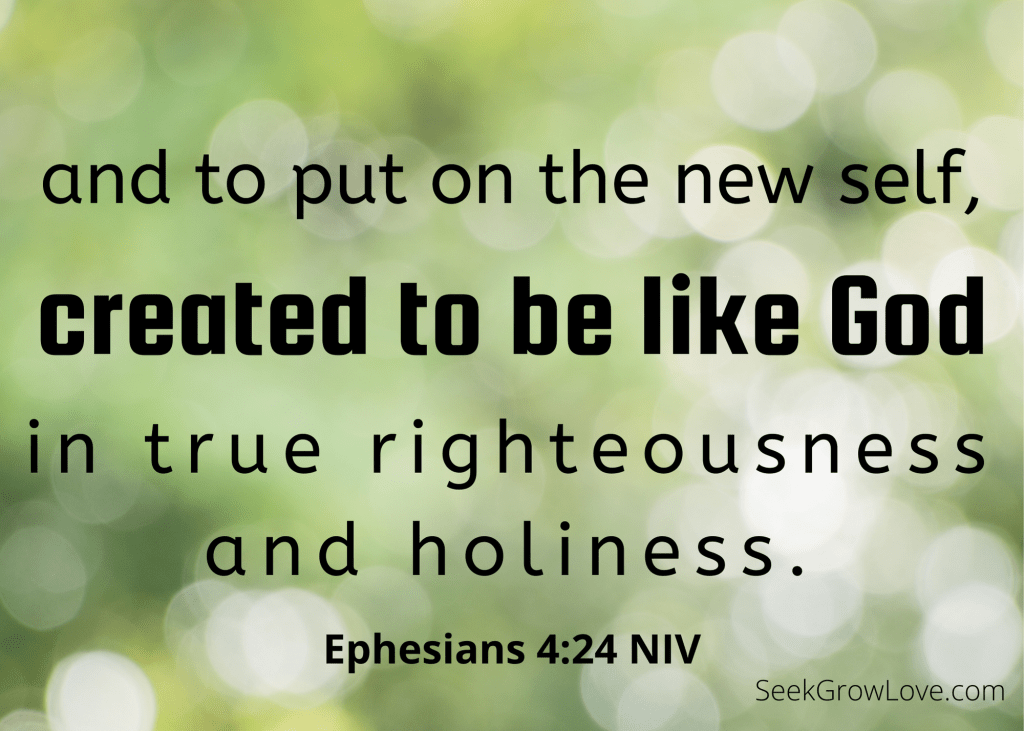
You will be surrounded by worldly people engaging in worldly ways. That is NOT who you are to be. Put off the old self with its wicked ways. Be the new person you were meant to be. Your new self was, “created to be like God in true righteousness and holiness.” (Ephesians 4:24) That’s huge! My new identity is to be LIKE GOD! First we were told to be nice. Then we were told to keep Christ as our Head. NOW, we are told that our new identity is to be LIKE GOD. Not to be like God in His supreme power, majesty and sovereignty. We are not expected to become all-knowing and all-powerful like the Creator. We are told our new self was created to be like God in true righteousness and holiness. Do what God says is right and set yourself apart from the world. How’s our righteousness and holiness looking today? What tweaks – or major construction projects – can you and I begin today to become more and more Godly – by doing the right thing and by being set apart from the world?

Paul gives some suggestions.

Is there an area where we need to practice being more truthful to our neighbor (perhaps even to save their life)? Do it. Become more like God and more set apart from this world.

Is there an area where your anger is controlling you and leading you to sin? Stop giving the devil a foothold. Become more like God and more set apart from this world.

Is there an area where we need to replace harmful habits and lifestyles with time and energy spent doing good to benefit others? Stop leaving the work for others. Get busy helping others. Become more like God and more set apart from this world.

Are there times when our mouths (and hearts) are full of unwholesome talk: put-downs, complaining, lies, swearing, negativity, coarse joking, or slander? What do we do and say that saddens God’s Holy Spirit? Stop it! Get rid of it! Replace it! Be nice. Be kind. Be compassionate. Forgive. Because you have also been forgiven. Become more like God and more set apart from this world.

“Put on the new self, created to be like God in true righteousness and holiness.” (Ephesians 4:24)

-Marcia Railton

Read or listen to today’s Bible reading passages at Bible Gateway here – Isaiah 1-2 (what can you find referring to the old and new self in Isaiah 1?) and Ephesians 4

Numbers 25-26, Luke 3

Almost 40 years had passed, and the Israelites were nearing the time when they would enter into the Promised Land. A generation had died in the wilderness because they failed to trust that God would guide them, protect them, and give them the good things he had promised. God had used the Israelites’ wilderness wanderings to teach them about his holiness and to teach them to trust in him more. However, not all of the Israelites were sanctified through this time. 

In Numbers 25, the Israelites are staying in the country of Moab. Because of intermarriage and lack of loyalty, they turn away from God and begin to worship Baal, a pagan god. Leading the way in this idolatry are several leaders of the people. God sends a terrible plague among the people that eventually killed 24,000 people and orders Moses to strike the idolatrous leaders down. So, Moses and Aaron’s great-grandson, Phinehas, gather the people together. The people are in mourning for the loved ones they lost in the plague, and all gathered together at the tabernacle, they are mourning in supposed repentance. However, Phinehas sees one of the Israelites blatantly bring a Moab woman into the tent of meeting! While the people are weeping in repentance, this person acts in a way that would indicate that he was not repentant at all. He was going to continue in his sin. The repentance was only caused by the negative experiences the Israelites faced, but it wasn’t true, heart-changing repentance that would cause them to change their actions. 

Phinehas, in a zealous passion, takes a spear and kills both the man and the woman who are doing this. Because of that harsh measure, the plague stops and God promises the priesthood would continue with Phinehas for generations. This seems like a brutal action. But, the reason why God praised Phinehas for doing it was because this action shows (1) Phinehas understood the concept of the holiness of God and his tabernacle and (2) Phinehas recognized how sin has to be stopped so it won’t continue to do its damage. Sin spreads like a plague, which, once it gets started, is very difficult to eradicate. If we recognize the importance of holiness and trying ourselves to live a lifestyle of holiness, we cannot continue to allow sin to spread in our lives. We have to be willing to act zealously to snuff it out. 

In Luke 3, we read about the ministry of John the Baptist in his own wilderness. He cries out to the people to ‘Repent, for the Kingdom of Heaven is near!’ He urges those who come out to see him to “produce fruits consistent with repentance” because “every tree that doesn’t produce good fruit will be cut down and thrown into the fire” (Luke 3:8-9). Recognition of the severity of sin and true repentance from that sin are crucial to producing good fruit. If we do not recognize and repent from sin, we will not produce good fruit. We will not live lives that glorify God. 

Evaluate your life. Is it characterized by a right understanding of sin? Of an understanding of the importance of holiness? What about true repentance and good fruit? As John and Jesus said, “Repent! The Kingdom of Heaven is near!”

~ Cayce Fletcher

Read or listen to today’s Bible reading at Biblegateway.com: Job 1-2 and 2 Corinthians 2 .

Numbers 17-18, Psalm 49-50

Yesterday, we witnessed the rebellion of the Israelites against Moses. At this point, the Israelites had refused to enter into the promised land after focusing on the battles they would face rather than the rewards they would reap with God’s help. After that, the Israelites continued to not trust God when they spoke out against Moses. They didn’t realize that in doing so, they were – in effect – not trusting God. The rebellion that Korah instigated ended for the most part when he died. In Numbers 16, we see God choose Aaron and the tribe of the Levites as his priesthood. The twelve tribes all brought their staff to the temple to represent them. Aaron’s staff – which represented the Levites – sprouted, formed buds, blossomed, and produced almonds (Numb. 16:8). Interestingly, this isn’t the first time that almond branches and almond blossoms make their appearance in relation to the temple and the priesthood. In Ex. 25:31-40, the lampstand that was to be kept continually burning on the altar was supposed to be shaped like almond blossoms. This was the light that the priesthood was in charge of day and night. In the miracle of Aaron’s rod, God showed clearly which group of people he wanted as his priesthood, and he chose the Levites. 

Numbers 18 continues on with laws and requirements for the priesthood along with ways that the priesthood could be provided for by the Israelites people. Nestled in these verses is such an important truth for us today. Numbers 18:5-7 says, “You are to guard the sanctuary and the altar so that wrath may not fall on the Israelites again. Look, I have selected your fellow Levites from the Israelites as a gift for you, assigned by the Lord to work at the tent of meeting. But you and your sons will carry out your priestly responsibilities for everything concerning the altar and for what is inside the veil, and you will do that work. I am giving you the work of the priesthood as a gift.” 

Moses was clear in the last chapter that the laws and responsibilities given to him by God were not things that he was doing out of his own will. In this chapter, God is clear about his intentions to give as a gift the work of the priesthood. Yes, the ministry that they had would be challenging. They would face opposition from the people, and they would have to work hard in the temple. Some of their responsibilities included doing animal sacrifices, staying up all night to tend the lamps, dealing with skin diseases, and more. But, this work was a gift. A special provision and reward to be the light to the Israelites as they entered the promised land. 

In Christian circles, we talk often of the gift of Salvation. That is the first wonderful gift that we receive in our Christian walk, and we should always be grateful for that amazing grace. But, that is only the first of the many gifts that we receive as a believer in Christ. We are also given the gift of the priesthood, the gift of being a light to others. We will face the same opposition from others at times. And we will have to also take part in the grueling work of ministry. But, that is the work – the priestly responsibilities – that we have been assigned to do. 

As we head into another week, ask yourself: What is the ministry that you have been called to? Are you treating this ministry as a gift? 

Praise God that we can be partners in his work!

~ Cayce Fletcher

Read or listen to today’s Bible reading at Biblegateway.com: Job 1-2 and 2 Corinthians 2 .

Be Holy

Leviticus 19-20

God’s message to the entire assembly of Israel was “Be holy because I, the LORD your God, am holy”. (Lev. 19:1) As we move through Leviticus, we are seeing that God is giving very specific instructions to show the people and priests how to be ceremonially clean. He is setting them apart from the other nations. He is forbidding horrendous behavior (like child sacrifice) and presenting them with the idea of being holy. As followers of Christ, we are asked to be holy as well. As 1 Peter 1:15 states, “just as He who called you is holy, so be holy in all you do”. And Paul’s writings state that God did not call us to be impure, but to live a holy life.

When we think about God’s holiness, we might feel overwhelmed because He is so awesome. But let’s consider how God is Holy. God’s supreme Holiness sets Him apart from His creation. He is unique. He is the Only True God (Jn. 17:3). He is perfect in every way. He is the Creator and Giver of all that is good, He is compassionate, gracious, slow to anger, abounding in love and faithfulness, forgiving, just, God is Love…

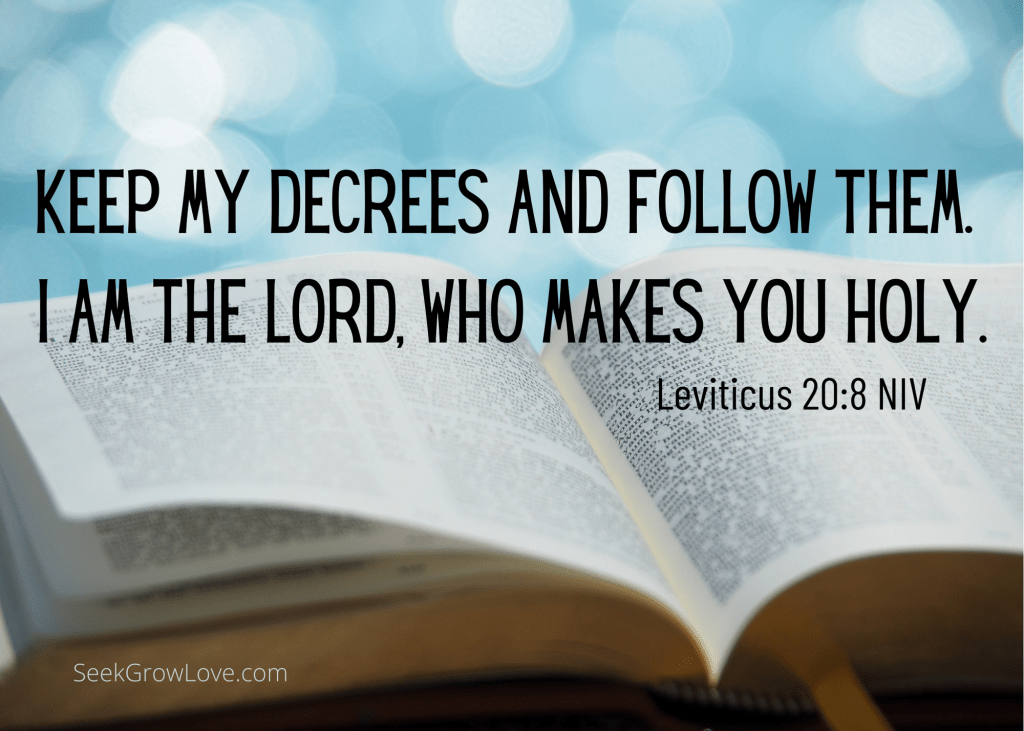
So how could the Israelites become holy? The LORD tells them to consecrate themselves-turn their lives over to the LORD. He states that they should keep and follow His decrees. Most important He said that He is the LORD who makes them holy. (Lev. 20:7-8) This was true for the Israelites, and it is true for us today. He is the LORD who can make us holy.

We need to offer ourselves to Him as living sacrifices (Rom.12:1) and accept God’s ultimate sacrifice of Jesus Christ. “We have been made holy through the sacrifice of the body of Jesus Christ once for all. For by one sacrifice he has made perfect forever those who are being made holy.” (Hebrews 10:10b and 10:14) 

-Rebecca Dauksas

Links to today’s Bible reading – Leviticus 19-20 and Psalm 25-26

The Lifting of the Zadokites: Ministerial Faithfulness

Ezekiel 44-45


“‘But the Levitical priests, who are descendants of Zadok and who guarded my sanctuary when the Israelites went astray from me, are to come near to minister before me; they are to stand before me to offer sacrifices of fat and blood, declares the Sovereign Lord. They alone are to enter my sanctuary; they alone are to come near my table to minister before me and serve me as guards. Ezekiel 44:15-16 (NIV)


Yesterday we discussed God’s holiness and how it must be separated from the common. Today we will continue along those lines but in terms of ministering in the presence of such holiness. The temple was the place where God’s presence was located on earth and was considered the holiest place on the planet; it was a sacred space. Not just anyone could visit the temple; Israel was ripped by God for allowing uncircumcised (of heart and body) non-Jews to go into the temple (Ez. 44:7). After laying out the dimensions for a new holy temple in the last few chapters, God turns Ezekiel’s attention to who gets to minister there and in what capacity. 


Israel had not taken seriously the holiness of God, even in the temple, where the Holy of Holies was found. The Levitical priests, despite being chosen to act as ministers in the temple, couldn’t fulfill their duties without corruption. They allowed the unworthy to come into the temple and served as priests to idols. These priests may not have been, but Yahweh certainly was serious about keeping His temple holy and having the right people ministering there. So, in this new temple, those who hadn’t appreciated the importance of the job would miss out. Those who remained firm, those who did not go with the crowd, those who did appreciate the holiness of the temple, the Zadokites (descendants of Zadok), would be lifted up as an example and given the jobs the less than faithful had forfeited.


Today there isn’t a grand temple complex where we must minister before God. We don’t have to make animal sacrifices, wear special clothes, or worry about remaining ceremonially clean. But that doesn’t mean God isn’t just as serious today about those who represent Him as ministers. The sacrifices of today are spiritual in nature and offered by those who have chosen to follow Christ as their High Priest. We are to act as royal priests who, following the example of our High Priest, surrender ourselves completely to the will of God and do the ministry He calls us to. Just like the Zadokites, who were lauded for their faithfulness despite Israel’s disobedience, we need to make sure we stay true to who we are as disciples of Christ and God’s representatives on earth, regardless of how others act–Christian or not. Our God still cares about holiness and has put His spirit within us, let us guard the new temple with the same (or greater) fervor and faithfulness as (than) the Zadokites did. 

-Joel Fletcher

Today’s Bible passage can be read or listened to at Biblegateway here –Ezekiel 44-45

Tomorrow we will finish the book of Ezekiel (chapters 46-48) as we continue on our

Rebel to Righteousness

Numbers 16 38 ESV

Numbers 16

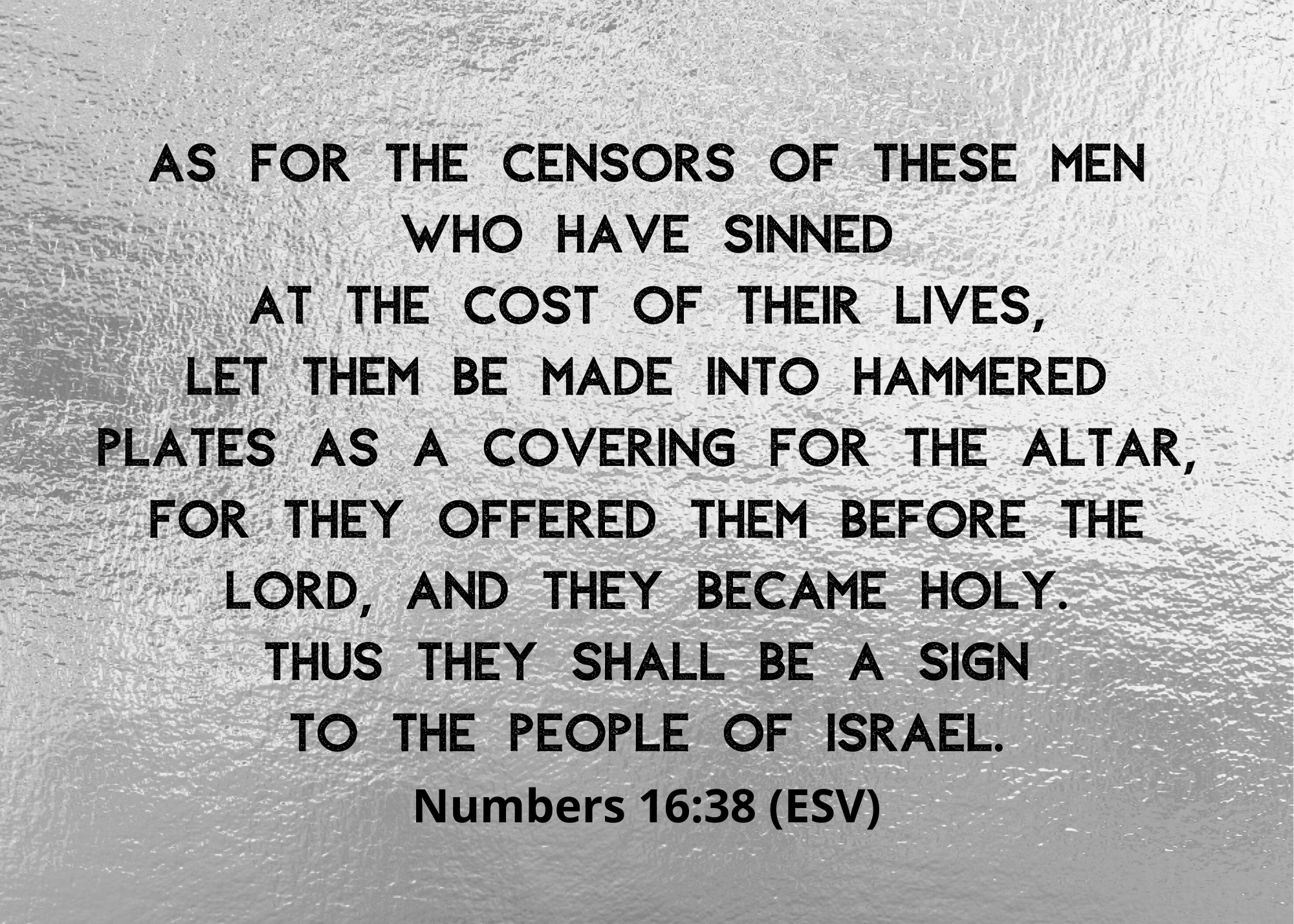
There was a man named Korah who led a rebellion against Moses’ leadership (Numbers 16:2-3). Moses instructed them to put fire and incense in censors before the Lord to let God decide what man would be in charge. Of course, God stayed faithful to Moses and made it clear that Korah and his men were sinning.
God, to punish the rebels’ sin and rid Israel of false leadership, caused the earth to open up and swallow Korah, his household, and his rebellion. Next, God redeemed the sinful situation into a holy one by turning the censors the men used to sin with into a covering for the altar that was holy.
This is a large part of what makes the Christian faith different than other beliefs. In order to be justified, or have right standing, with the gods of many religions, one must work their way into the god or goddesses’ approval; they need to pray enough, give enough, fast enough, and do enough good all with the hope of making the cut. Our God doesn’t work like that. Instead of accepting the good or holy, he seeks the sinful and makes them holy (Mark 2:17), having exchanged our sin with Jesus’ perfection (2 Corinthians 5:21). That is a fundamental difference, that he takes the sinful and makes him holy, instead of expecting the sinful to clean himself up and work his way into his favor which is impossible for man (Rom. 3:10-12). We serve a wonderful God who can turn rebels to righteous before God.

The God of Second Chances – Numbers 17

The story of the rod of Aaron.
The rod was like a stick and these twelve men carved their names on them, out of the twelve one of them sprouted. The one that sprouted was Aaron’s rod and he became the priest. God worked this miracle to prove to the children of Israel that they had been wrong in questioning whom the priesthood rightfully belonged to. God mercifully gave Israel another evidence of his will, to correct their judgment. The miracle was sufficient to silence the complaints of the Israelites. After they realized what they had done, they were terrified and said: “Behold, we perish, we are dying, we are all dying!” God asked Moses to place the rod in front of the alter so that it served as a reminder that they were wrong in questioning God’s authority.
How many times has God given us a second chance? If you haven’t noticed, every morning is an opportunity to serve Him, love Him, give yourself to Him, reconcile with Him, reconcile with your brother, love those around you, enjoy nature, be kind, serve others. My point is, God is merciful and loving, “The Lord, the Lord God, merciful and gracious, longsuffering, and abounding in goodness and truth, keeping mercies for thousands..”(Exodus 34:6-7). In His great love, he gives us second chances. However, there will come a day when we will have no more second opportunities.
Andy Cisneros
Today’s Bible reading can be read or listened to https://www.biblegateway.com/passage/?search=Numbers+16-17&version=NLT
Tomorrow’s reading will be Numbers 18-20 as we continue the 2020 Chronological Bible Reading Plan

His Tabernacle

Numbers 7 cain

During the building of the tabernacle, the tools and utensils were not holy. Everything was normal cloth or gold material until they were consecrated. Once Moses anointed and consecrated the tabernacle and the things that went in it, they were no longer normal objects.  Instead, they were objects of God. If God can turn a simple lamp stand into a holy object, then what can He do with us? We can be made holy and set apart by God to serve a great purpose. As we have said many times, through the book of Numbers God seeks holiness for Himself and His people. This desire didn’t disappear when Jesus came into the world. God desires for us to be holy. Although we sin, God can redeem us just like He did with the tabernacle in Numbers 7.

There is a moment after the tabernacle is consecrated that the people of Israel begin to bring sacrifices and gifts.  Among the gifts are six carts and 12 oxen that are going to be given to the Levites. Carts and oxen make moving things easier.  This would be a pretty handy gift during the time of the wilderness as they move everything they have across the desert by hand! In verse 9, we see the sons of Kohath weren’t given any of the oxen and carts – what kind of rotten deal is that? Why didn’t any of the carts go to the sons of Kohath? The sons of Kohath were in charge of carrying the holy objects on their shoulders. Each heavy object in the tabernacle, including the Ark of the Covenant, was built with places for poles to slide into so that they could be carried by pole on the shoulders of the sons of Kohath. You may remember the story of Uzzah in 2 Samuel 6 when the Ark was going to be moved back into the city of Jerusalem after being gone for a long time. Notice in 2 Samuel 6:3 they placed the Ark, “on a new cart”. This was a big no-no. The Ark was not supposed to be put on a cart, but instead carried on poles like we see in the law. Then what happens? The Ark begins to fall off the cart on the way into the city and Uzzah, who was just trying to help by catching the Ark, died right as he touched it. God’s holiness can’t be infringed upon. Albeit easier, you don’t put the Ark on a cart. This is why no carts where given to the sons of Kohath. They didn’t need carts to assist in the moving of the holy objects of the tabernacle. Isn’t it interesting how the Bible connects in such unique places? Who knew that around 400 years after God gave the command to not move the holy objects on carts that Uzzah would learn the severity of breaking the command.

The rest of chapter 7 sound maybe like Pete and Repeat wrote it. These aren’t particularly exciting verses and the gifts of each tribe are the same. Between verse 10 and 83, the tribes, their gifts and their offerings are listed. After 12 days of offerings the total was: 12 silver dishes, 12 silver bowls (a total of 2,400 shekels of silver), 12 gold pans (a total of 120 shekels of gold), 12 bulls, 12 rams, 12 male lambs 1year old, 12 grain offerings, 12 male goats, 24 bulls for peace offerings, 60 rams, & 60 male goats for peace offerings (a total of 192 animals). The Israelites would have given a total of around $16,000 in silver and around $71,500 in gold. What a great out pouring from the sons of Israel to God in celebration and honor of the new tabernacle.

After the anointing of the tabernacle and 12 days of offerings, one of the coolest things I can imagine happened to Moses in verse 89. God spoke to Moses from above the Ark of the Covenant. Finally, after all the effort that has gone into getting the Israelites out of Egypt, God now has a place to dwell with His people. The time has come when God speaks to Moses from among His people. No longer does Moses have to travel to the top of a mountain to speak to God. God has moved even closer to His people today. We don’t have to travel to a temple in Jerusalem to be with God because, as we see in the New Testament, we are God’s temple (1 Corinthians 6:19). God can now dwell among us in a more personal way; He has moved into the hearts of His people. We have been anointed and sanctified by the blood of Jesus to become the new temple that God dwells in. We see an ever moving forward march by God to be closer to His people. It started with the tabernacle, then into the hearts of men in the time of the New Testament and now. In the future, we have the hope of God dwelling with us in person in the kingdom! He is with us now in the power of the Spirit that moves among us but, at the time of the restoration of all things, God is going to be with us like it was in the garden of Eden. Revelation 21 says that God is going to dwell among men. There is no part of the Bible without significance. All of it is connected because all of it is the word of God. God’s desires don’t change and He desires to be with us. The creator of the universe, the creator of the estimated 1,000,000,000,000,000,000,000 stars wants to be with you. To me, the realization of this fact is humbling and inspiring.  Thank you, God!

Josiah Cain


Today’s Bible reading can be read or listened to at https://www.biblegateway.com/passage/?search=Numbers+7&version=NIV

Tomorrow’s Bible reading will be Numbers 8-10 as we continue the 2020 Chronological Bible Reading Plan