“This is Water”

John 5 

Devotion by Cayce Fletcher (SC)

David Foster Wallace, a popular modern literary author, gave a commencement address in 2005 that everyone should read at least once. Wallace wasn’t a religious person, but he was concerned about the search for meaning. His speech highlights a central truth about humanity while recognizing how this truth is realized in an increasingly secular world. 

He begins his speech with the story of a fish who greets two fish by asking, ‘How’s the water?’ After that fish swims away, the other fish turns to his friend and asks, ‘What the heck is water?’

Here is a quote, at length, from his speech: “Because here’s something else that’s weird but true: in the day-to-day trenches of adult life, there is actually no such thing as atheism. There is no such thing as not worshipping. Everybody worships. The only choice we get is what to worship. […]

“The whole trick is keeping the truth up front in daily consciousness.

“Worship power, you will end up feeling weak and afraid, and you will need ever more power over others to numb you to your own fear. Worship your intellect, being seen as smart, you will end up feeling stupid, a fraud, always on the verge of being found out. But the insidious thing about these forms of worship is not that they’re evil or sinful, it’s that they’re unconscious. They are default settings.

They’re the kind of worship you just gradually slip into, day after day, getting more and more selective about what you see and how you measure value without ever being fully aware that that’s what you’re doing. […]

“It is about the real value of a real education, which has almost nothing to do with knowledge, and everything to do with simple awareness; awareness of what is so real and essential, so hidden in plain sight all around us, all the time, that we have to keep reminding ourselves over and over:

“This is water.

This is a truth we all need to remind ourselves of. We are all predisposed towards following idols and worshipping things that ultimately are fruitless. 

In today’s readings, I see the same truth in Jesus’ words. In Jesus’ words to the Jews, he speaks of their reverence – their worship – for the law of Moses. But, he sees – and we see – how this reverence ultimately led them to reject the very thing that Moses was looking forward to: Jesus. 

In John 5:39-40, he says, “You study the Scriptures diligently because you think that in them you have eternal life. These are the very Scriptures that testify about me, yet you refuse to come to me to have life.”

Their worship caused them to become focused on the wrong things, and in so doing, they missed the true life that was in Jesus. 

We have the same option before us. We can choose to follow after all of these idols, thinking we will gain something from them. But, ultimately, that will simply lead to a fruitless life. 

Or, we can choose to come to Jesus and gain true life. 

In Wallace’s speech, his conclusion is that people should just live to be kind, but he rejects the idea that there is a greater religious implication for his worship. And, the tragedy of Wallace’s life is that he never came to Jesus himself. In 2008, he committed suicide.

What are you choosing to worship today? Come to Jesus, and gain true life. 

Cayce Fletcher writes and podcasts at amorebeautifullifecollective.com. Check out the blog and other resources to help you create a life you love and cultivate your heart for God. This free resource here will help you take your Bible study one step further with a Bible reading tracker, Bible study reflection page, and more.  

Reflection Questions

  1. What were the Jews worshipping? Why was this ultimately fruitless without Jesus?
  2. What are you choosing to worship today? Will it result in something lasting? 
  3. Jesus says, “Come to me, and you will have life.” How does Jesus grant life now – in addition to eternal life? 

SGL.2025.SeptemberFullPageDownload

Idolatrous Attachments

Ezekiel 5-8

Devotion by Pastor Jeff Fletcher – originally posted for SeekGrowLove on March 20, 2017, for Ezekiel 5-9.

This portion of Ezekiel is, admittedly, difficult to read.  It’s a pretty graphic account of God impending judgment against the city of Jerusalem and his people, Israel.  God tells Ezekiel to shave his head and beard.  This would have been an act of mourning for most people, but it was double disturbing for Ezekiel, since he was a priest and normally forbidden from shaving his head or beard.  Ezekiel was told to burn, take a sword to, and scatter his cut hair.  This was to symbolize what was to happen to Israel.  A few hairs were kept back, symbolic of the remnant who would not be destroyed.

God accuses his people, Israel, the chosen nation, of being worse than the other nations.  They broke the law more than the nations that did not have the law.  God was bringing his judgment against His own people.  The description of the siege almost defies comprehension, including cannibalism of both parents and children.  This was to serve as a warning to the other nations: if this is how God treats his own people for their idolatry, beware of what he will do to you.

In Ezekiel six God makes it clear that their judgement is upon them because of their idolatry. However, there is a remnant that will be spared and live in captivity and will come to repentance.

In Ezekiel seven, a special emphasis is made regarding their idolatrous attachment to gold and silver.  This wealth that they turned to and fashioned into idols will be unable to save them from the coming judgment.  All the money in the world can’t save you from judgment.

In Chapter eight Ezekiel has a vision of the temple in Jerusalem.  This includes the “Idol of jealousy” which we discover is the pagan god Tammuz.  Tammuz was the Sumerian god of food and vegetation.  At the summer solstice there was a period of mourning as the people saw the shortening of days and the approaching drought.  Sacrifices were made to Tammuz at the door of the Jerusalem Temple.  This was an absolute abomination to Israel’s God, YHWH as He made it clear that He alone was to be worshipped as God (see Deuteronomy 6:4-5).

In Chapter Nine an angel is sent out to put a mark on all of the people of the city who did not commit idolatry and worship Tammuz.  They would be spared.  But then all those who did not receive a mark would be destroyed.  This is reminiscent of the story of Exodus, when the doorposts of the Israelites were to be marked with the blood of the sacrificial lamb, and those with the mark were spared their firstborn sons dying when the Angel of Death passed over their houses.  It also points to the future (See Revelation 13) when the beast will cause people to have a mark on their forehead or they would not be able to buy or sell.  This is contrasted with those in Revelation 14 who have the name of God and of the lamb on their foreheads.

God is a God of love and mercy.  God has provided a means for us to be rescued from the consequences of sin.  There is a way for each of us to be spared the final judgment of God that is coming.  Jesus Christ, the lamb of God is the only means by which we can escape judgment.  Along with God’s mercy is His holiness.  God will not allow sin and rebellion to continue on earth forever.  A day of judgment is coming for all the earth just as it did for the nation of Israel.  God tolerated their sin for only so long, and then came the time for judgment.  Mercifully, God spared those who repented by placing His mark upon them.  God has been tolerating sinful rebellion on earth, but a day is coming when He will destroy sin and sinners who have not repented and turned away from their sins and turned to him through Jesus Christ.  Ezekiel’s harsh imagery should remind us that we must not forget that God’s wrath is coming from which we all need to escape, and we need to warn others.  This won’t make us popular, but doing God’s will is seldom popular among the rebellious.

Reflection Questions

  1. What idols are present in the world today? And in your life?
  2. How does God’s love and mercy work with His justice?
  3. Has popularity ever been an idol for you over God’s will? When have you chosen popularity over God’s will? When have you chosen God’s will over popularity?

“An Object of Extreme Devotion”

Jeremiah 35-37

The Israelites were still heading in the wrong direction. Jeremiah 35:15 reads, “Again and again I sent all my servants the prophets to you. They said, ‘Each of you must turn from your wicked ways and reform your actions; do not follow other gods to serve them. Then you will live in the land I have given to you and your ancestors.’ But you have not paid attention or listened to me.”

Is there an area of our lives where we need to pay closer attention and listen to God more? Sometimes the sins of the Israelites can seem so unrelatable at first glance. They engaged in idol worship? We might safely conclude,  “None of that going on here, but how foolish of the Israelites!” Then I think about modern day idol worship. Does it look like overconsumption of social media, doom scrolling, adoring celebrities, etc.? Sometimes our idol can be right in the palm of our hands. Do we have a fit of panic when we are getting ready to go somewhere and we can’t find our phones? Merriam Webster’s dictionary defines an idol as “an object of extreme devotion.” Do we have idols we need to clear out of our lives so that God becomes our number one priority? God makes it very clear we are to have no other gods before Him. 

I worked at a Catholic school for a number of years and the faculty and staff worked hard to come up with a school motto that embodied the school’s mission. One of the teachers exclaimed, “God calls, we answer!” and everyone unanimously agreed. That simple, succinct, yet oh so powerful statement really resonated with me and it dovetails nicely with the last sentence in 35:17:

“Therefore this is what the Lord God Almighty, the God of Israel, says: ‘Listen! I am going to bring on Judah and on everyone living in Jerusalem every disaster I pronounced against them. I spoke to them, but they did not listen; I called to them, but they did not answer.’”

When God calls, we want to be sure to answer, but first we must make sure we are truly listening and not letting the superficial cares or distractions of life drown out His voice. Perhaps it’s time to put Psalm 46:10 into practice:

He says, “Be still, and know that I am God;

    I will be exalted among the nations,

    I will be exalted in the earth.”

-Kristy Cisneros

Reflection Questions

  1. Do we have idols (“objects of extreme devotion”) we need to clear out of our lives so that God becomes our number one priority?
  2. What distractions keep you from listening to God’s voice? How can you tune in better to the voice of God?
  3. When you hear God calling – how will you answer?

Not So Amazing

2 Kings 14 & 2 Chronicles 25

Everyday when I get home, my sweet dog Brynleigh greets me at the door. She usually gives me a few little barks of hello and then follows me around as I settle in. This darling little corgi is so full of love and devotion, but I am not the object of her affection. When she greets me at the door, she has her orange and blue ball either in her mouth or very close by. While I’m settling in, she’s not worried about me being comfortable. She’s impatiently waiting for me to drop everything and play ball with her. She is 100% devoted to her ball and loves it more than anything or anyone on the planet. Sure she loves me or at least tolerates me in her way, but she practically worships her ball.

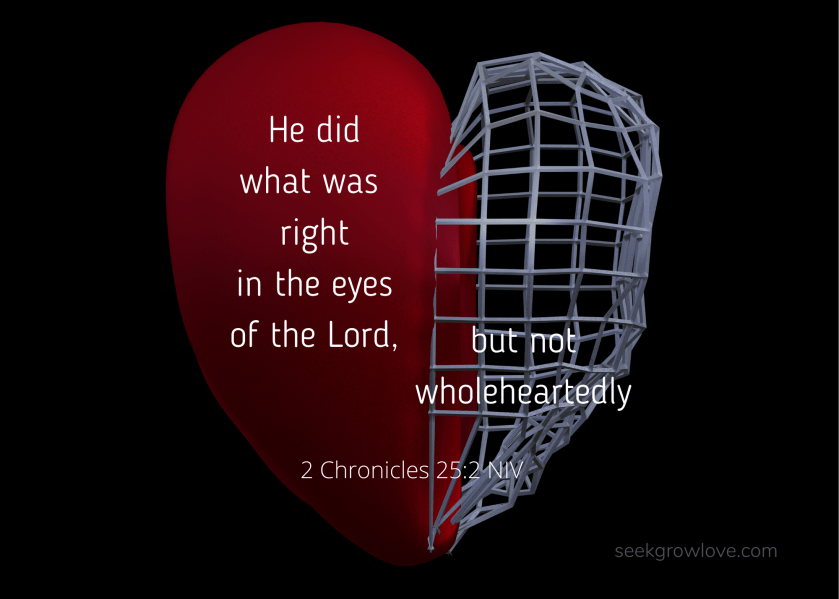
King Amaziah is not so different from my beloved corgi. When I see the name Amaziah, I correlate it to the word “amazing,” but we find that he wasn’t the amazing king we would hope for. It says that although Amaziah generally did right in the sight of God, he didn’t do so with a full heart. We see him go through the motions and even make some good decisions, but because his heart is not completely rooted in being a faithful follower of God, we see him fall away. We see him become proud and seemingly believe that he is, in fact, an amazing king.

After Amaziah and his army came home from battle, he didn’t give glory to God or seek His wisdom. Instead, he brought home idols that represented the gods of the sons of Seir. He didn’t just bring them home as plunder or decoration though, he actually started worshiping them. God sends a prophet who confronts him and asks in 2 Chronicles 25:15, “Why have you sought the gods of the people who have not delivered their people from your hand?” But, the amazing king just tells the prophet to stop talking. He didn’t want to hear wisdom and he certainly didn’t want to make any changes in his life.

At the pinnacle of his reign, Amaziah decides to pick a fight with King Jehoash of Israel. Jehoash dishes some major shade his way in return. Here is how I would imagine part of Jehoash’s response if it were in modern times. “Look, thanks to your massive ego, I know you think you are amazing and unstoppable but why don’t you just stay home and polish your trophies. I could crush you and all of Judah too, so don’t embarrass yourself.” In truth, I don’t know if King Jehoash’s reply to King Amaziah was meant to be as sarcastic as I’ve implied or if it was meant to be a more sincere rebuke but either way, the amazing king didn’t listen. His army was defeated, his city was plundered, and he was captured. He really should have just stayed home.

Before we start pointing a finger at King Amaziah’s downfalls and inflate our egos, let’s take a minute to see how similar we might be. Are there times that we go through the motions but don’t give our whole selves to God? Have we ever pushed away wisdom and then suffered the consequences? Of course we have. We have all fallen short, just like the amazing king.

Unlike Amaziah, my hope is that when we fall short that we would seek wisdom. When an idol gets between us and our relationship to God, my prayer is that we would be rooted firmly enough in God’s love to cast it aside. Let’s strive to be whole heartedly devoted to God who truly is amazing.

-Lacey Dunn

Reflection Questions:

• If you were King Jehoash, how might you have responded to King Amaziah’s message?

• What is a potential idol that you might have? How did it become an idol and what can you do to remove it?

• What does it look like to give your whole heart to God? Set aside some time to dig in to scripture, meditate, or have a discussion with a Godly friend about what it means to give your whole heart to God. 

The Error of Innovation

1 Kings 12-14

If you’re like me, you’ve purchased an “assembly required” item and unpacked the contents without thumbing through the instructions. “How hard could it be to turn a few screws and boards into a bookshelf?” Halfway through the build, you realize you used the wrong board in one section, another is fitted upside down, and in your haste, you’re now down at least one screw. Necessity may be the mother of invention, but sometimes innovation comes from darker places—with consequences far greater than a shoddy IKEA build. Pride and fear can quickly lead us into folly as we try to adjust and adapt without seeking counsel. Likewise, our spiritual life was never meant to be self-driven, self-led, or self-defined. To build our relationship with God, we are called to be faithful to His instructions and selfless in their pursuit.

In today’s reading, King Jeroboam is appointed as the new leader of Israel. As he takes the reins, he surveys the political pieces of a recently split kingdom. His people had long worshiped in Jerusalem, which remained part of the rival kingdom of Judah. Jeroboam feared that his people’s loyalty would ultimately shift back to Rehoboam, king of Judah, from the anointed house of David. Instead of consulting the God of Abraham, Isaac, and Jacob or one of His prophets, Jeroboam devises his own solution to keep the people close to home.

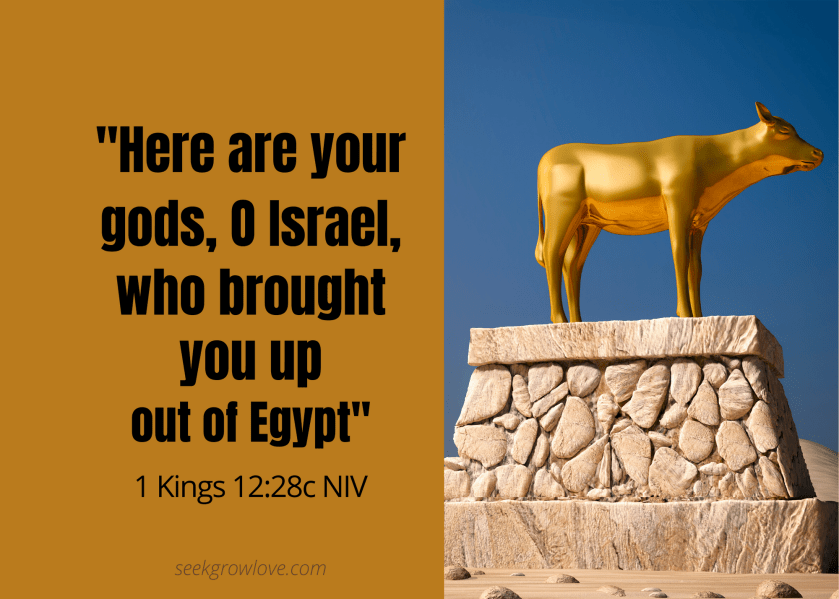
“Jeroboam thought to himself, ‘The kingdom will now likely revert to the house of David…'” So the king made two golden calves. He said to the people, ‘It is too much for you to go up to Jerusalem. Here are your gods, Israel, who brought you up out of Egypt.'” (1 Kings 12:26, 28)

Jeroboam took up his place as both the political and spiritual leader of Israel, but motivated by fear and a desire for control, he led God’s people astray. He created false idols, counterfeit altars, and bogus festivals—all in an attempt to keep his people from returning to the holy city of Jerusalem. Leaving behind the moral clarity of God’s commands, it became easier and more accessible to engage in a made-up religion that appeared similar on the surface to what they knew to be true. They were working with the same pieces, but some were flipped upside down, some placed in the wrong spot, and others lost along the way. As their worship moved farther from Jerusalem, the distance between Israel and God grew greater.

There is a stark warning here for the adjustments and innovations we see in the Church today. We must be careful that our worship, ministry, and evangelism do not favor convenience over obedience or comfort over conviction. If we fail to heed this warning, we may end up with well-developed systems that contain many of the same pieces—but are no longer building the Kingdom of God. Instead, we risk creating idols and events that offer no eternal hope. Granted, we may not be fashioning golden calves, but when we prioritize comfort over truth, we risk building spiritual lives rooted in fear, insecurity, and pride—lives that are void of God’s instruction.

It has never been about innovating what works for us or embracing a “you do you” mentality. God demands surrender and faithfulness in our daily worship, which means we will likely find ourselves worshiping in the city of our enemies from time to time. Resist the urge to craft a god who fits us. Instead, let us be molded to fit His purpose and to build His Kingdom according to His Gospel instructions.

-Aaron Winner

Reflection Questions

  1. What problems do you think God saw in Jeroboam? Do you think God ever sees these same problems in you?
  2. What does God desire from us – in our worship and in the way we live our lives?
  3. What are your thoughts about the following: “If we fail to heed this warning, we may end up with well-developed systems that contain many of the same pieces—but are no longer building the Kingdom of God” ? Have you seen this occur? How can we better heed this warning for our lives and for our church and for the Kingdom of God?

God’s Truth and Way – Not Ours

Deuteronomy 11-13

Chapter 12 is the beginning of a new set of comprehensive laws that take up the bulk of the book of Deuteronomy.  Today we read about the specific ways in which God desired His people to worship. He called them to worship in His good and perfect way, not in the ways of the surrounding nations. The Israelites were instructed to destroy any false altars and worship only where God had chosen. This was about doing what was right in God’s eyes, rather than every man acting on his own whims or false morals.

You shall not worship the Lord your God in that way. But you shall seek the place that the Lord your God will choose out of all your tribes to put his name and make his habitation there. There you shall go. – Deut 12:4-5

You shall not do according to all that we are doing here today, everyone doing whatever is right in his own eyes, for you have not as yet come to the rest and to the inheritance that the Lord your God is giving you. – Deut 12:8

Chapter 13 issues a strong warning against abandoning their commitment to the one true God for a false god. It is warned that there will be false prophets and dreamers who can perform signs or wonders, but that they must not fall for such tricks and deception. It is even warned that if your family member whispers to you suggesting that you serve other gods, you must not listen to them. In fact they were instructed to kill them. Fortunately for us, such violence is no longer expected in these cases, however, discernment and steadfast loyalty to our Creator are expected of us. In today’s age, we are instructed to be aware of false prophets, and even false messiahs, as Jesus warns in Matthew,

Then if anyone says to you, “Look, here is the Christ!” or “There he is!” do not believe it. For false christs and false prophets will arise and perform great signs and wonders, so as to lead astray, if possible, even the elect. – Matt 24:24

Today, we may not have physical altars to tear down or false priests to execute, but our hearts can easily become divided. We are tempted to blend worldly influences with our worship, allowing distractions, personal desires, or cultural norms to shape our devotion rather than the truth of God’s word. In a world full of voices claiming to speak truth, it is imperative that we remain anchored in scripture. Even generally positive things, such as success, relationships, or even religious experiences, can become idols if they pull our hearts away from God. True devotion means prioritizing Him above all else, not in the ways we see fit, but in the ways He has commanded us.

-Isabella Osborn

Reflection Questions:

  1. Are there any influences in your life—cultural, personal, or societal—that may be shaping your faith or outlook in ways that are not aligned with God’s Word?
  2. How can you actively practice discernment in recognizing false teachings or influences that lead you away from total devotion to God?
  3. In what ways can you ensure that your worship and daily life reflect God’s truth, rather than personal preferences or societal norms?

No Other God Can Rescue

OLD TESTAMENT: Daniel 3

POETRY: Psalm 136

NEW TESTAMENT: John 8:1-30

It’s not easy going against the flow. 

If the teacher or professor accidentally leaks the answers for the upcoming final, and EVERYONE (it seems) is going to ace would you look too? Isn’t that cheating?

If EVERYONE at your job takes home free items, like drinks, or food, or sauces, and just call them “perks”, would you also do it? Isn’t that stealing?

If EVERYONE is going to the party, and it would tank your social standing to miss it, but you know there are going to be… less than savory activities, would you go? Is that really wise?

It’s that much harder when these things are encouraged by leadership. If your manager also takes stuff from the store, even encourages it… how wrong can it be?

In today’s story in Daniel 3, King Nebuchadnezzar sets up a statue, and every powerful person is going to participate in worshipping it. Not only that, but all these leaders will lead all peoples, all nations, all languages, to bow down and worship at the command of the King and the music he calls for. And so everyone does. In a world where there are easily too many gods to keep track of (seriously, two- to three-*thousand* gods), what’s the difference if you bow to one more? 

But not so with Hannaniah, Azariah, and Mishael. They have one God and no more; that’s all the God they need and all the worship they give. It makes Nebuchadnezzar hopping mad, with him declaring “Who is the god who will deliver you out of my hands?” He throws them in a super-heated furnace and they are delivered and saved by their faith. 

There are a few things that stand out to me:

1. The King told “the boys” what they must worship. The world and the devil continue to tell people what they must worship. The gods of Babylon and Egypt and Rome all had different names and different stories, but in their core, these gods are really the same. Whether it was Enlil, or Ra, or Jupiter, *power* and *strength* have always been worshipped, and the power of the military or the force of personality of leaders is still worshipped in our day. Beauty is worshipped, and her sister, Lust. Money. Fame. Wealth. All these gods are simply humans worshipping the things we most desire for ourselves. Satan wants you to worship these same gods, and even better if you don’t believe in the supernatural while you do it! How much better to be a person worshipping science, knowledge, and the arrogance they can produce while thinking that gods and angels and demons are all old fables for weak minds; or, a person who worships celebrities and the fame they embody while not thinking at all! And as soon as you tell the devil exactly what you think of his puny fake “gods” that gets *him* and his minions mad. 

2. The King said “what god can deliver you from my hand?” Satan whispers that question into the ear of believers as well, “what god can save you from the consequences of turning your back on…” and then fill in the blank. But what Nebuchadnezzar and Beelzebub mean for intimidation, for those who know their God, it becomes a rather simple question. YHWH, the God of Abraham, Isaac, and Jacob, the God who can do all things, he can. 

3. “BUT EVEN IF HE DOESN’T.” The most amazing thing about this entire encounter, for me, is not necessarily the walking around in the fire and not being singed (though that is really cool) and not the Babylon stamp of approval on God (though that did help out with Daniel and the boys). It is that Rack, Shack, and Benny say, in essence, “God can save us, we trust he will, but even if not, we will not serve other gods.” (3:16-18) This is belief in the power of God, it is trust in the compassion of God, and it is loyalty to the worth of God. They recognize that it would be better for them *to die* than to betray their commitment to the worship of YHWH. THAT is a faith that changes the heart of Kings and can overcome Empires. Which, coincidentally, is exactly what happens. 

4. God sends an angel (3:28) to protect and deliver his people. Not only does God protect them from the harm of the fire, he protects them from even the smell of the smoke, even the smallest amount. God protects his people, even in the midst of chaos, he can and still does, deliver them. 

Praise God for his protection, for his worth and his empowering so we can remain committed and faithful, and for the beautiful truth that he is a saving and powerful God, greater than anyone or anything else that we could worship. 

Questions:

  1. While we live in a world with a growing number of those who do not believe in a god or the supernatural, we are not less worshipful. What are the golden idols of our world today? Who is telling us to “bow down and worship” these different idols? How many are roped into worship, even if they might not see their dedication as worship?
  2. If you are not a believer or are a new believer, does the faith of the boys intimidate you? Could you see yourself ever saying “even if he doesn’t, we will still not bow”?
  3. If you are a long time believer, does the faith of the boys intimidate you? Or does it inspire you? Pray that you won’t have to say something similar, but also pray that in the face of whatever fire you might be thrown into, you will remain faithful
  4. While God sent an angel to help Hananiah, Azariah, and Mishael, God has now sent truly the “son of God”, Jesus, to help God’s people know him, and has sent his spirit into our hearts. Do you believe God will protect his people and send help in the form of angels and the Holy Spirit in this age, in the name of Jesus? How can Jesus help us in those moments when we are called to remain true to God?

-Jake Ballard

Today’s Idols

OLD TESTAMENT: Jeremiah 5 & 6

POETRY: Psalm 115

NEW TESTAMENT: 2 Peter 3

Have you ever stopped to think about idolatry? In the ancient world, many groups of people would literally make statues out of wood or metal. They would sacrifice animals to these idols. They would pray to these made up, created things.

The Psalmist talks at length about the silliness of such behavior, especially in the context of worshipping the actual Creator of the Universe:

Psalm 115:3-7 (ESV)

3 Our God is in the heavens; he does all that he pleases.

4 Their idols are silver and gold, the work of human hands.

5 They have mouths, but do not speak; eyes, but do not see.

6 They have ears, but do not hear; noses, but do not smell.

7 They have hands, but do not feel; feet, but do not walk; and they do not make a sound in their throat.

The point is clear: idols look like they can speak, see, hear, smell, feel, walk, and talk, but they cannot. They offer something that is not real. It’s a mirage. It’s a false comfort. Worshipping that way is meaningless.

What does this have to do with us, you might ask? I don’t have an idol in my house. I don’t worship to anything made with hands.

Friends, I wish that was true. We still have idols today. They don’t frequently look like human images made of silver or gold. Perhaps they are other people. Perhaps they are the rectangular boxes we carry around in our pockets. Perhaps it’s our favorite sports team. Maybe it’s our job or our family. There are always things that vie for our allegiance and our attention.

Unlike the ancient idols, many of these things are not bad in themselves, as long as we walk in a balanced way. The balance begins, however, with total devotion to King Jesus. Full stop. End of story.

When we live unbalanced lives, we might find ourselves feeling more and more unsettled, anxious, or depressed. Living the way that God wants us to live does not guarantee a life free from those things, for sure, but the point remains: when our life is unbalanced, we get negative results. Just like the ancient people sacrificing to blind and mute forms of their own creation, we sometimes get too caught up in worldly things that take our minds in directions that are unhealthy and unhelpful.

As the Psalmist reminds us, the Lord is our help and shield. The Lord is the One who blesses us. The Lord is the one who is worthy of worship and honor. We shall praise the Lord!

-Will Barlow

Reflection Questions

Do you have things in your life that are idols or cause you to be unbalanced? What can you do to get back in balance?

    Can you think of a time when you came out of a longer period of darkness and into light? How did that feel?

    Can you think of a friend that has an obvious idol in their life? What can you do to help them find better balance? (Maybe telling the story from your answer in #2 could be a place to start.)

    God Won’t Give You Anything Beyond…

    OLD TESTAMENT: Isaiah 36-37

    POETRY: Song of Songs 8

    *NEW TESTAMENT: James 1:1-18

    Do you feel joy when you go through trials/temptations? I would guess not as it is opposed to our natural inclinations.

    But when we go through hard times, we can come out on the other side stronger. 

    Have you heard Christians say that God won’t give us anything beyond what we can handle?  That is a perversion of the truth. 

    We weren’t created to be able to handle this life on our own.  We were made with a need for God.  The trouble comes when we recognize our need for something beyond ourselves but turn to something or someone besides God and become dependent on that.  That is when idols are created.

    God won’t put things in our life that can’t be handled with His help.  But there likely will be things in your life that you can’t handle on your own.  That is your reminder, if you aren’t already, to depend on God.

    1 Corinthians 10:13 is where people get the wrong idea.  But they just read part of it.  They read “he will not let you be tempted beyond what you can bear.”  The verse continues though to say “But when you are tempted, he will also provide a way out so that you can stand up under it.”  He will provide a way!

    When we try to do things on our own, we can quickly become prideful – thinking we are great, or, become depressed because we can’t do what we tried to. 

    We can come out of the other side of trials and temptations with a stronger faith if we leaned into God during this time.  It should allow us to become more mature in our faith and deepen our relationship with God.

    ~Stephanie Fletcher

    Reflection Questions

    1. What is a past trial you have gone through with God’s help? How did He help you? How did your perseverance grow during this experience? How did you mature through the process? What joys can you take away from that past trial?
    2. What joy can you find in your present trial?
    3. Consider some of the Christians that you most look up to. Have you ever met a really strong Christian who has had a really “easy” life?
    4. What will you say the next time you hear someone say, “God won’t give us anything beyond what we can handle?”

    Delight in the Lord

    xr:d:DAF9a3RP5Z8:7,j:6617333126820609679,t:24022111

    Old Testament: Leviticus 6 & 7

    Poetry: Psalm 37

    New Testament: Acts 7

    Almost the entirety of Act 7 is Stephen’s response to the charges brought against him from our previous reading. Stephen gives a beautiful sermon, outlining the history of the Israelite people. His sermon shows how time after time, the Israelites were unfaithful and persecuted the prophets. He asks the leaders of the high council when they will stop resisting the truth. Stephen forms a sound argument with the tools of a great orator utilizing ethos, logos and pathos. However, I want to just focus on one small line today.

    Stephen retells the story of when Moses went to Mount Sinai and the Isrealites rebelled. He says the Israelites, “made an idol shaped like a calf, and they sacrificed and celebrated over this thing they had made.” (Acts 7:41 NLT). Celebrated this thing they had made. That caught my attention.

    How often do we get carried away with our own success? How often do we put value in material things? How often do we forget Christ’s words to seek first the Kingdom of God? (Matt 6:33). We live in an age where knowledge, entertainment, and relationships are literally at our fingertips. Not to sound like a broken record, but it is so easy to get wrapped up in our own lives, the things we can make, things we can buy. God needs to be made a priority in our lives. He is someone we need to communicate with daily, thank and praise. Otherwise, we run the risk of celebrating over the things we have made and turning those things into idols.

    These things may not be physical. They also may not always be bad or wrong. Sometimes the thing we are trying to make is a dream or notion of something. Maybe a job promotion, an engagement, a family. It’s when these desires become our only focus a problem occurs. The Greek term used in Stephen’s statement is the word euphrainó which literally means to “cheer, make merry.” Our happiness should not be placed solely in these things.

    The Israelites made the golden calf when Moses went to talk to God at Mount Sinai. Moses was their leader and connection to God. Suddenly, to the Israelites, God felt distant. It is then they began to see what joy they could offer themselves and celebrate with their own idols. Sometimes, God may feel distant. At times we may face periods of loneliness, sadness, even anger. When this happens, we MUST heed the words in Psalms 37:4 “Take delight in the LORD.”

    The rest of that verse in Psalms offers us a promise: “Take delight in the LORD, and he will give you your heart’s desires.” I am not saying God always answers prayers for those who put their true delight in following Him. He does not. I know many godly people who have given their lives in faithfulness to Him and still face difficulty and unanswered prayers. However, I do sincerely believe when we start to delight in the LORD, when we celebrate Him, something in our hearts begins to change. We still have dreams and goals, but our heart’s desire becomes wanting a true connection with God, a deep relationship with our creator, the one who gave us those very dreams we have.

    Several times in my life I have felt defeated, lost, and alone. I have had to grieve lost dreams, goals, relationships. I’ve had to mourn a life I imagined for myself. The lyrics to Phil Stacey’s song “You’re Not Shaken” describes this feeling of helplessness perfectly: “When every little thing that I have dreamed would be/ Just slips away like water through my hand.” That’s what brokenness can feel like at times. Like reaching out your hand and trying to cling to something that isn’t there. In these moments it’s imperative we take our delight in the LORD. Slowly, He will fix our gaze on something better than what we had lost. Even when that thing we lost was good.

    Here’s a link to a playlist of some of my favorite songs when dealing with loss and grief: https://open.spotify.com/playlist/3QAs1OUWTnwSbRClTaV51T

    -Emilee Ross

    Reflection Questions

    1. What in your life have you made (or are trying hard to make), but in the process you have celebrated it so much, and raised its priority above seeking God’s Kingdom, that it has gained idol status?
    2. When have you felt God was distant?
    3. What does it look like for you to “Take delight in the Lord”? Is this a priority to you? How could you do it more often or more deeply?