God Wins

OLD TESTAMENT: Ezekiel 6 & 7

POETRY: Psalm 121

*NEW TESTAMENT: Revelation 20

The title of this post is unassuming. Two words: a noun, the subject, and a verb in the future tense. 

I am in the business of speaking, teaching, training, sermonizing. And sometimes (less often than I’d like to admit) I may have a sermon that God uses in spite of all my failures and faults. But if I were to have all the power of the greatest speakers, the powerful conviction of Billy Graham, the clarity and precision of Andy Stanley, the dedication of pastors from Martin Luther to Martin Luther King Jr. and beyond, more than a thousand eloquent sermons could not compare to the truth of the future of the world summed up in these two words. 

God wins. 

I don’t want to take away from that truth, but I do want to flesh it out a bit. 

In the earlier parts of Revelation, the beheaded souls have been calling out from beyond the grave to the God who will give them justice (Rev. 6:9-11). God promised the victors that they would have reward upon reward (Rev. 2:7, 11, 17, 26-28; 3:5, 12, 21). When God wins, those who placed faith in God above even their own lives have the incredible promises. For time out of mind (1000 years) they will reign with Christ, they will not be hurt by the second death. While the language of two resurrections is not common in the rest of the NT*, the truth is that they are SO ASSURED of their salvation its as if they cannot possibly be brought to judgment. The joy of this resurrection is that we who are powerless, weak, poor, and oppressed will one day win, be victorious and live forever with God and his Christ, because God wins. 

And Satan can’t win. The dragon’s wings are clipped, and the serpentine body is prepared for the flames. In this world, God has power to throw the serpent of old, the devil and Satan, and bind him for 1000 years. During that time, his temptation and power are cast down. In the end, the devil who deceived the world was thrown into the lake of fire and brimstone. This is a threat and a promise. Moreover, Satan KNOWS this is his end. The battle between God and Satan is not a cinematic, climactic masterpiece. There is no worry about who will win. Satan is not trying to win, because he can’t. He IS trying to make YOU LOSE, because that is a possibility. But God will help you overcome sin, fight temptation, and come through faithful. God can protect you from the defanged, declawed, clipped-wing dragon, because God wins. 

In some sense, part of the glory of God, part of his winning, is allowing humans to choose their outcomes. God allows people to determine their final state. While we are only and forever able to be saved by the glory and grace of God, God both does not force his salvific will upon us and does not preclude us from choosing him. God gives people what they desire. The books are opened; the dead are judged. Christ is our hope (Col. 1:27), our peace (Eph. 2:14), our resurrection and life (John 11:25). If any person has rejected Christ, what have they done but rejected peace with God and people? Rejected hope of eternal life? Rejected the resurrection and the life? God gives them exactly what they demanded. God doesn’t put up with those who were rebellious against him in this life. Because…

God wins.

No ifs, ands, buts. 

No amount of persuasive words will make it less true. 

No force of hell can stop Him, not a dragon or an atheist. 

The promise is true:

God wins. 

– Jake Ballard.

* There are hints of two resurrections in the rest of the NT, but nowhere is it explicitly stated like here in the apocalyptic work of Revelation. 

(originally posted Dec 5, 2022 for SeekGrowLove)

Reflection Questions

  1. How significant is the phrase “God wins” to you? To elaborate, in what areas of your life are you losing? Temptation and sin? Suffering and pain? Anxiety, depression, stress? What would it mean for you to stop trying to fix it all yourself, and let God win, allowing him to be victorious where you haven’t been yourself?
  2. In the ultimate sense, Satan is powerless. While we might be attacked, tormented, and tempted by evil today, that is not the way the world will be forever. How does it make you feel to know that all evil and wickedness are going to be overcome by the power of God? Will you allow God to protect you, so the battle is one-sided in your favor today?
  3. There is no peace, hope, resurrection or life without Christ. Have you given him control of your life, allowing him to be your savior and lord?

Dear Church in Ephesus – and You

OLD TESTAMENT: Jeremiah 27 – 29

POETRY: Psalm 119:25-32

NEW TESTAMENT: Revelation 2:1-7

Rev. 2:1-7 – Letter to Ephesus

Hello all!  Although the other material is just as wonderful, we will be taking a focused look on the Revelation passages, exploring the Letters to the Churches.  Let’s dive in!

Each letter has a general pattern of a greeting and introduction, praise for their behavior, a warning or correction, plus a reminder of what is to come (hint, it’s the Kingdom!)

For some context, the church in Ephesus was visited and established by Paul back in Acts 18 & 19. We know from these passages that the silversmith Demetrius, and his shrines or idols to the goddess Artemis, were popular opposers of the message of Jesus the Messiah.  From the book of Ephesians, we know that Paul believed the Ephesians loved all of God’s people, but still needed guidance on how to daily live out the Christian walk.  Knowing this can impact how we read the letter John transcribed to them in Revelation 2, and how we can take that message and apply it to our own churches and lives.

After greeting the church in Ephesus, through John, Jesus writes to the church of Ephesus and commends them on their hard work, perseverance, and holding fast to doctrinal truths diligently (v.2-3).  But their correction is that they have forsaken the love they had at first (v.4).  Some people debate the exact meaning this has, but personally, when paired with the information we have from Paul’s writing, I believe this means they have lost the love they had for God’s people. 

Back in Paul’s time, they were a church in the middle of a dark, secular, perverse community.  Yet, they were growing and evangelizing in a way that was drawing people away from worshiping other gods, and bringing them to repentance.  Clearly they were doing something right at this time to be so appealing to people in such a community, so much so that those trying to make a profit off of sinful practices started a riot!  And THAT is what I believe they lost.  

This church seems to have swung the pendulum to the side of practicing truth without love.  While we can only speculate, I do think this likely looked like church leaders who were so focused on ensuring their church stood out from the worldly crowds, they lost the compassion for those outside of their own doors.  They lost the zeal and vigor for spreading the gospel, and became too heavily focused on trying to maintain the doctrinal ‘purity’ they had built.  

Notice how Jesus doesn’t say in these verses they should stop holding fast to those important practices, but rather they should do them in combination with what they did at first, loving others in their community so well that they were attracted to the church.  In fact, right after this reminder, he even says that he appreciates that they hate the same detestable practices he does!  Jesus was never saying to disregard the importance of true and accurate teaching of the Gospel message.  But he was challenging a church who had been a beacon of light to their community, to remember how they felt in those early days when they received the Holy Spirit, and go back to the same energy and passion for the people they were surrounded by.

Well-established churches or believers, especially those who hold tightly to doctrinal truths, must be on guard for this same loss of love in their own communities and hearts.  Not compromising on the biblical truths they hold, but never losing sight of the greatest commandment, to LOVE one another.  We all may have a bit more Ephesus in us than we think… which isn’t always a bad thing, but is something we must be cognizant of to make sure we are still remembering the love we must show, in order to have the opportunity to experience the “paradise of God” (v.7).

Reflection Questions:

  • Consider yourself and your church, have you lost your first love?  If you have, what steps can you take to revitalize that passion?  
  • Think of someone you care about deeply.  Have you shared the truth of Jesus Christ with them in a loving way?  If not, how can you start that conversation?
  • Reread Psalms 119:29-32 from today’s reading.  Clearly we see throughout all Scripture the importance of holding fast to God’s commands, just like the church in Ephesus.  Are you truly “setting your heart” on God’s laws as in these Psalms verses?

-Sarah (Blanchard) Johnson

Perfect Love

OLD TESTAMENT: Jeremiah 14 & 15

POETRY: Psalm 117

NEW TESTAMENT: 1 John 4

There are some pretty confusing messages about love out there in the world. I’m sure you’ve seen some of them. Oftentimes it’s defined as an emotion, a feeling. (How vague and disappointing a definition.) Some say it’s something you cannot help. You fall in and out of it, with little to no control. (Yikes. No accountability there.) Some say it’s something you have to work at, and that love takes effort. (Ok, I have to agree with that one a bit.) The Greeks separated love into 8 categories: eros, ludus, philio, agape, storge, mania, pragma, and philautia. (Talk about complicated.) I very clearly remember listening to a lot of DC Talk as a kid in the 90’s and they told me that love is a verb. (Or maybe that was Luv. It has been a long time since I was “d-d-down with the DC Talk.”) And then there’s the currently popular, on bumper stickers everywhere, “Love is love.” (Not super helpful, thanks.) 

John here tells us God is love. And if that doesn’t tell you how amazingly wonderful and powerful real, actual love is, then I don’t know what will. And fortunately for us, John goes into this a bit more.

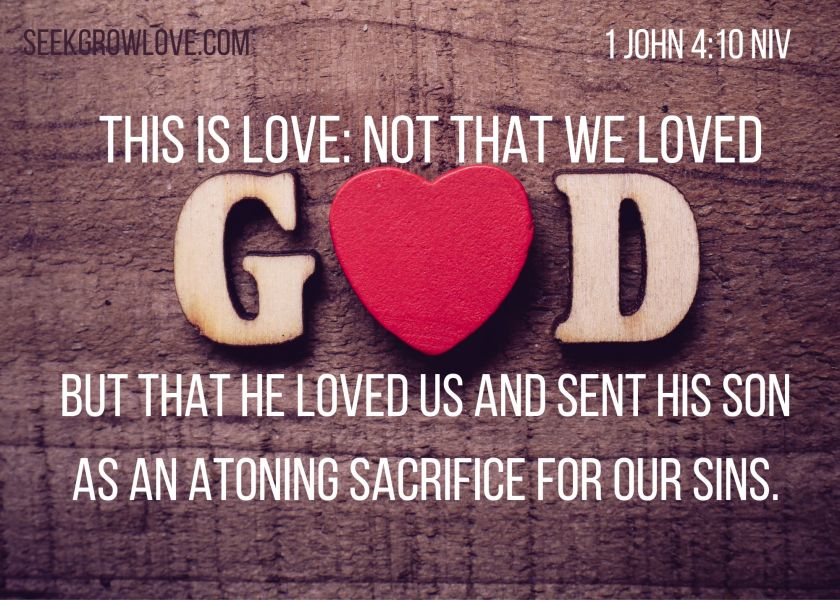
 “Dear friends, let us love one another, for love comes from God. Everyone who loves has been born of God and knows God.  Whoever does not love does not know God, because God is love.  This is how God showed his love among us: He sent his one and only Son into the world that we might live through him.  This is love: not that we loved God, but that he loved us and sent his Son as an atoning sacrifice for our sins.”

We know what love is when we know God. And we know God by listening, and learning, and understanding exactly what kind of sacrifice was made in order that he could have a relationship with us. I think we sometimes miss the gravity of this. When you sit and truly contemplate it, it sits heavy on your chest and chokes you. This love is devastating. 

I have a son. I love him dearly. I would die for him without hesitation. And there’s not a person on this planet that I want a relationship with badly enough to put my son through the torture and death that Christ suffered. I can’t fathom it. My heart breaks with the thought. 

God did not love his son any less than I love my little Oliver. In fact, God, in his perfect love, loves his son more, I’m sure, though that’s hard for me to understand or admit because I feel like I love my boy without end. But God is love, and God is perfection, and God loved his son Jesus. And yet he offered his son as a sacrifice. 

WHY!? Why would he do that!? If he loved his son so much, HOW could he do that!? 

That same perfect love extends to each of us as well. Though we are imperfect, ungrateful, selfish, and sinful, God’s perfect love covers us. He loves us SO MUCH, that he gave us his son. Jesus Christ was the model of all things good and perfect and brought us hope of a kingdom and eternal life with God and then he willingly suffered and died to make that future a possibility for all of us. And God allowed it. God gave us everything. And that is real Love, with a capital L. That is God’s Love. 

And God asks us to show that Love to others. I’ll admit immediately that I’m not capable of that kind of perfect Love. It hurts. It’s difficult. I don’t always understand it. My imperfect self, with my petty thoughts and frustrations and impatience… I’m only capable of love with a lowercase l. I’m not sure I can Love like God Loves.

But even when I’m not able to Love like that myself, I am VERY capable of sharing God’s Love with others. My version of love fails, but my God never does. 

“This is how we know that we live in him and he in us: He has given us of his Spirit.  And we have seen and testify that the Father has sent his Son to be the Savior of the world.  If anyone acknowledges that Jesus is the Son of God, God lives in them and they in God.  And so we know and rely on the love God has for us.”

We must know and rely on the Love God has for us. We are not capable of this kind of Love on our own, but God grants us his Spirit, and we know what his Love looks like. Share His Love with others. Love your neighbors enough to share God’s true and perfect Love with them. 

Reflection:

Who do you struggle to love? Do you have any relationships in your life where you find it difficult to love your neighbor? 

With whom can you share God’s perfect Love? Who do you know that desperately needs to see that Love in action? Who do you know that needs to hear that they are loved SO MUCH that God wants a personal relationship with them? 

Do those around you see God’s Love in your actions and in your words? Do they recognize God’s Spirit working in you? If not, or if not often enough, how can you do a better job of allowing God to work in you? 

My friends, I hope that this was a message of Love to you today. I pray that God’s perfect Love overcomes you this week. I pray that it overwhelms you so much that you have to share it with others.

– Jenn Haynes

Together in Christ

Old Testament: 2 Kings 24-25

Poetry: Psalm 89

New Testament: Philippians 2

The second chapter of Philippians is a lesson in unity and behavior. 

Conflict happens. Any time there are people gathered, there will be a difference in thinking. God gave us beautiful brains and the ability to reason and rationalize in different ways. He blessed us with the ability to form opinions. And those opinions are bound to differ. 

Too often, though, we give our own opinions too much power. We allow them to shoulder their way into our relationships with great force and little apology and we let them overshadow the important things like love, compassion, tenderness, and humility. 

Humility. It’s such an underrated quality in society. But which is more important: having your way, or being more Christ-like? Sounds like an easy answer, but it’s SO DIFFICULT to practice. 

Have you ever allowed your opinions too much power? Have they ever kept you from displaying the humility of Christ? Is there a current relationship that could be improved if you showed more humility in the name of Jesus? 

Verses 1-4 lay out such a heartfelt plea from Paul to the believers in Philippi. He begs them to be united. 

He tells them, and now us, that if we have any blessings from being united with Christ, from his grace and his salvation, then we must be united with each other as believers. Value others above ourselves. We must lay our opinions to the side and focus on our job as Christians: to show others Christ and further his message. 

In verses 5-11 he lays out the mindset of Jesus Christ – the one who had the ability to ask anything of God and have it granted to him, but instead chose to make himself a servant to others. Because Jesus loved that hard. 

I lay aside my own opinions and preferences for my family all the time. It’s easy because I love them more than I love myself. I frequently do the same for my friends. But what about the church member or coworker or acquaintance or family member that I find “difficult”? Am I so willing to lay aside my opinions or preferences on how things “should be done” for them? Are you? 

 And yet that is what Christ asks of us. As a church body we are called to unite. And so many churches and Christians struggle with this. I struggle. I struggle so hard. When I should be loving hard. Like Jesus. 

Do you get distracted by doing things your way? Does your method really matter in the grand scheme of spreading the gospel message? What relationships could be improved if you showed more humility? How could your faith and relationships be better if you placed Furthering the Kingdom over Getting Your Way? 

Verses 12-30 sting a little bit for me. “Do everything without grumbling or arguing.” I like to call it “venting” but it’s really complaining. And I’m told not to. We are called to be united as Christ followers so that when we are out in this wicked world we can “shine among them like stars in the sky.” 

The world is full of darkness and we are called to be stars. Paul asks us to show others love and humility, like Timothy and Epaphroditus. He asks that rather than look after our own interests, we look after the interests of Jesus Christ. 

That’s so powerful: look after the interests of Jesus Christ. 

My prayer for you today is that you are able to examine your relationships with others in full humility and see how you can place others before yourselves. I pray that we, as believers, can interact with one another in a way that will show the world Jesus Christ. I pray that we can all stop letting our differences get in the way of our purpose, and that we would instead focus on furthering the gospel message in unity. Blessings and love from your sister in Christ! 

-Jenn Haynes

Reflection Questions Given aBove

The Unfortunate Separation of Books

Old Testament: 1 Samuel 29-31

Poetry: Psalm 69

New Testament: Galatians 5:1-15

1 Samuel and 2 Samuel are, in your Bible and maybe in your mind, two different books. 

However, they are one story. We should not really end 1 Samuel without going on to 2 Samuel, the same way ending your movie marathon of the Lord of the Rings after just watching “The Fellowship” is lacking. 

1 Samuel ends with Saul and Jonathan and the other sons of Saul dead on Mount Gilboa, their bodies first desecrated and then given a proper burial by the men of Jabesh-gilead. 

But it is David’s response that is striking, and that comes in 2 Samuel. Forgive me for reading ahead, but look at what David does in 2 Samuel 1. 

He kills the man who claimed to kill Saul (even though we know Saul killed himself) because this man did not respect the Lord’s anointed. 

He laments, not only over Jonathan, but over Saul his enemy. 

His heart is broken because of this man who really and truly hated him. 

1 Samuel has been a journey, and I am glad you have allowed me to go on it with you over the last two weeks. Here has been my take-away:

Be David and do not be Saul. 

Saul did not start off wrong. He began as a shy, possibly humble, man who was given the gift of kingship. But instead of living up to that role, he first consistently and then later constantly rejected the will of God. He offered sacrifices on his own, he directly disobeyed the commands of God so the people would be impressed by his power. He lifted his hands against the Lord’s anointed constantly. When he couldn’t get an answer from God, he turned to demons. As a friend of mine said, Saul is the cautionary tale. 

David started off right. A humble young man who worked the field, he was also given kingship. He was found to be a man after God’s heart, who obeyed God. He made mistakes, but he sought God’s forgiveness. He sought to do God’s will, to bless those who blessed him, but to let God give justice to those who cursed him. He gave compassion to the Lord’s anointed, but fought against the enemies of God. At his best, he is a model king, a model disciple, and a model man. Even in his failings, he repents and turns towards God. 

My brothers and sisters, 

May you start off from this moment right. God can and will forgive you for everything in your past and start you off with the salvation offered through the death of Christ. By “putting on” Christ in baptism, you become a son or daughter of God, a child of the King of the Universe. You are given a type of kingship, and the power of God, the spirit of God, to do all that this kingship requires. You are training to reign with Christ in his Kingdom, and so you are to show love to all people, to show justice to sinners (telling them of God’s justice), to show compassion to all repentant (expressing God’s mercy), and to show honor to God’s anointed, the Lord Jesus Christ. 

Bless you as you become “Davids”, following the son of David. Amen

-Jake Ballard

Reflection Questions

  1. In what ways or times have you had a touch of Saul in you? What did it look like? What did God want to see instead? Have you confessed and repented?
  2. How do you treat God’s anointed?
  3. What does it take to become a David? What will you do today to make is so?

——————————

Jake Ballard is pastor at Timberland Bible Church. If you’d like to hear more from him, you can find Timberland on Facebook (https://www.facebook.com/TimberlandBibleChurch/ ) and on Instagram (https://instagram.com/timberlandbiblechurch?igshid=t52xoq9esc7e). The church streams the Worship Gathering every Sunday at 10:30. Besides studying and teaching God’s word, he is raising three beautiful children with the love of his life, plays board games and RPGs, and believes it was fine that Tom Bombadil was not in the LotR movies. If you’d like to reach out to talk Bible, talk faith, or talk about how the LotR movies might be an improvement on the books, look Jacob Ballard up on Facebook (https://www.facebook.com/jacob.ballard.336) or email him at jakea.ballard@yahoo.com
God bless you all!

“But can God Love Me?”

Old Testament: 1 Samuel 11 & 12

Poetry: Psalm 67

New Testament: 2 Corinthians 10

If you’re like me, that is, *if you are human*, then you have made mistakes. Some of those mistakes are major; not just a small white lie, but sins that harm others and put us out of sync with God. Sometimes, when we make those big sins, we feel like God could never forgive us, could never love us. The words of Samuel to the Israelites from the end of 1 Samuel 12 should give us hope in those moments.

“Do not fear.” “It is a dreadful thing to fall into the hands of the living God” (Hebrews 10:31), and we should not excuse the sins we commit. The first command given to the Israelites is to not let fear make them flee from the Lord. Instead, we should listen more closely to God than ever. If we recognize our sin, we also recognize that God’s ways are higher than our own, and  his ways are better than the ways of the world. If we flee from God, we turn toward things that cannot give us hope, cannot give us a future, cannot redeem us. As Samuel says, they cannot profit or deliver. They are futile. 

This all seems very good. “Maybe our sin wasn’t so bad”… we might say, foolishly. God does not ignore your sin because he is ignorant of it, or because he doesn’t care. Instead, “God will not abandon His people *on account of His great name*.” God has chosen a people to be his own possession. In the ancient world, it was Israel, those who were born from the line of Abraham, Isaac, and Jacob, children of the promise. Today, he has also chosen a people, also those born according to a promise, but now, it is all who have a faith like Abraham’s, who trust God like Isaac, who believe and wrestle with the Lord like Jacob, those who choose to trust in the final and ultimate descendant of the Patriarchs, Jesus Christ. God has made you a part of his people when you trusted in Jesus. Now, the reality is that we are not merely performing the law, but the law of God has been enacted in the life of Jesus, and by connecting with him, we both enact the law and go beyond it to the truth Christ taught! Christ taught us the truth of God, Christ showed us the life that God wants us to live, Christ died so that we might have life. “Consider the great things the Lord has done for you.” It is now more true than ever. Our sin was nailed to the cross with Christ. It was so terrible it cost Christ everything and he willingly paid it all. 

We are called to avoid sin, and we are warned by Christ himself that if we live wicked lives, his words will judge us in the last day. But now, if we do sin, we do not need to fear because we have an advocate who loves us, who gives us a spirit who can change us from the inside out, so we might stop sinning and stop desiring to sin. That is the glory and the power of living in the age of grace, of living in the shadow of the cross. 

“As for me, far be it from me that I should sin against the Lord by ceasing to pray for you.”

And so, this day and every day, may you be blessed as you “Seek, Grow, Love”. Far be it from me to cease praying for you!

-Jake Ballard

Reflection Questions

  1. Do Not Fear: We are commanded “do not fear” again and again in scripture. We are even told that perfect love drives out fear. But the fear of the Lord is the beginning of wisdom. Moreover, Jesus did not encourage his disciples out of their fear when they were in awe and terrified when the winds and waves obey him. With all those confusing passages in mind, what is the Christian relationship with fear? What should we fear? What should we not fear?
  2. Consider the great things the Lord has done for you: Make a list throughout the day today of all the blessings that God has given you. What are the big, great amazing things, and what are the small, everyday good. Consider them all and see that the Lord is good. 
  3. Far be it from me…: Would you take the next few minutes, and pray earnestly, for those who are reading Seek Grow Love. Pray for the blessings of God to be upon them. Amen. 

Refuge

Old Testament: Joshua 19 & 20

Poetry: Psalm 51

New Testament: 1 Corinthians 9

In today’s reading in Joshua we see the establishment of cities of refuge for those needing a safe place to dwell, whether Israelite or soujorner. The Israelites had been instructed to sanctify these cities, consecrating them and declaring them cities of refuge for the innocent. I am always impressed in the attention to detail and proactive instructions for so many scenarios when I read through the Old Testament law.  For example, in this chapter we have very concrete directions for what to do for those who “accidentally kill someone.” It is clear God had a detailed plan, and the instructions He gives us are not flippant or derived from the latest child-rearing or leadership self-help book. They are put in place by a holy, sovereign Father who knows all and wants the best for His children.

The Matthew Henry Commentary points out the Hebrew meaning of the names of these cities of refuge we read about in Joshua 20 and some potential correlation to the place of refuge we as Christians find in Jesus.

Kedesh:           holy

Shechem:        shoulder (e.g. the government is upon his shoulder)

Hebron:           fellowship

Bezer:              fortification

Ramoth:          high or exalted

Golan:             joy or exultation

In the same way God planned for safe dwelling places in the time of Joshua, He planned the same for us in the gift of His son who came to preach the gospel of the coming kingdom and died and was resurrected as a sacrifice for us. Not just for those who “accidentally” did something wrong, but for us who have done wrong knowingly. Time and time again. For those like David who plotted a murder, committed adultery, and whose words we read again today in Psalm 51. David seemed to live much of his life seeking safe dwelling places, but he ultimately claimed his safety in God as his refuge. In fact, if you scan the Bible for uses of God as a refuge, you’ll definitely find yourself in Psalms! Like David, we won’t find safe dwelling places regarding what matters to God in the caves, suburbs, America, or by stockpiling weapons and descending into underground bunkers. We find our safe dwelling place in God through Christ.  Hebrews 7:23-25 states this very nicely:

            “Now there have been many of those priests, since death prevented them from continuing in office; but because Jesus lives forever, he has a permanent priesthood. Therefore he is able to save completely those who come to God through him, because he always lives to intercede for them.”

With current events exploding with more and more people living in such turmoil from the Middle East to every corner of the globe it seems, safe dwelling places are not things to take for granted. If we are a follower of Christ, we have been reconciled to God finding immediate safety today as well as the most beautiful hope in the coming kingdom and eternal life with Jesus. Only then will true refuge be found.

            “God is our refuge and strength, an ever-present help in trouble. Therefore we will not fear, though the earth give way and the mountains fall into the heart of the sea, though its waters roar and foam and the mountains quake with their surging.” – Psalm 46:1-3

-Jennifer Hall

Questions:

  1. Are there things in the world you seek or believe to be sources of refuge outside of God and His sources of refuge?
  2. What encouragement can you find in today’s reading or God’s word regarding His promises to be our source of refuge?
  3. What do you look forward to in God’s coming kingdom where we will have perfect safety and an eternal dwelling place?

Underdogs Unite!

Old Testament: Joshua 7-8

Poetry: Psalm 48

New Testament: 1 Corinthians 3 

Kung Fu Panda 

Peter Parker (Spiderman)

Cinderella

Frodo Baggins

Luke Skywalker

King David

Jesus’ disciples

What an eclectic list of characters! Any guess on what they have in common? 

They were all underdogs, devalued by society, and yet through some combination of luck, magic, leadership, divine appointment, and/or wise counsel, they went on to do mighty things. Though some characters in that list are fictional, there are plenty more true accounts in the pages of your Bible and in ancient and recent history of people overcoming opposition and obstacles to become the Greats we know today.  

In I Corinthians 1, we read about how we were nothing special before we were saved by God’s grace and grafted into his family, that He often chooses the “underdogs” to do His work. In chapter 2, Paul reiterates that we need the wisdom and power of the Spirit in order to understand and speak the things of God; Paul clarifies that even he, who we now know as one of the greatest missionaries of all time, “did not come with eloquence or human wisdom as I proclaimed to you the testimony about God… My message and my preaching were not with wise and persuasive words, but with a demonstration of the Spirit’s power, so that your faith might not rest on human wisdom, but on God’s power” (verses 1, 4-5). Now, in the third chapter, while recapitulating to the Corinthians how we are all foolish without God, Paul is addressing quarrels and jealousy among the believers, reminding the Church how important it is to be united. 

I bet that a lot of the same words he wrote to the people back then would also be penned to us today; we humans can still tend to think we’re all that and a bag of potato chips with no need for God, and division still dominates our fleshly nature. As a mom, I’ve broken up more quarrels than I can count; it seems that my kids will find a reason to argue with each other about anything and everything! And as the wife of a pastor, I’ve seen division rear its ugly head in the church too many times. Churches have even split over petty things such as decor. It seems silly that we find trivial things to bicker about when there are bigger issues plaguing the world today such as war, poverty, and human trafficking. 

In this chapter, Paul emphasizes that we are all working together for God, but God is the real Force that makes anything happen. Paul reminds us that we are all on the same team, building on the foundation laid by Jesus Christ. In typical Paul fashion, he keeps us humble by reminding us of our foolishness; in modern-day terms, though we might have thick wallets or a string of letters behind our names indicating our importance in this world, we are all nothing without God. 

I’m always encouraged when I see Christians set aside their differences to work as one unit for a good cause, or when churches with very different doctrines join hands to reach their communities for Christ. We are meant to be one body: the body of Christ. It is crucial that we as believers unite hands and hearts for God’s eternal mission. 

-Rachel Cain

Reflection:

– Consider ways that you can help create unity and decrease division within your own church family. (A good place to start is to not participate in gossip). 

– Are there any local organizations with which your church or your own family could join to show the love of Jesus to your local community? State? The world? 

By No Means!

Old Testament: Deuteronomy 21 & 22

Poetry: Job 38

New Testament: Romans 6

Today, we get to say hi to the same hypothetical objector that Paul seems to address in the first handful of chapters in the book of Romans.  Paul opens up chapter six with the question, “Are we to continue in sin that grace may abound?” (Romans 6:1 ESV).  He asks the same question in verse 15 as well.  In chapter 5, Paul talked about the great work that God and Jesus were able to accomplish through the cross.  The cross is only needed because of sin in the first place.  If there was no sin, then there would be no need for Jesus to die on the cross.  Therefore, in a sense, our sin led to the incredible, world-altering power that was experienced on the cross of Jesus.  Should we continue in that sin then to show the incredible power and grace of God?  Paul’s answer is quite clear both times this question is raised: “By no means!” (Romans 6:2,15). 

Paul goes on to talk about the baptized believer being united with Christ Jesus in his death and resurrection.  While being united with Jesus in his death, “our old self was crucified with him in order that the body of sin might be brought to nothing, so that we would no longer be enslaved to sin.  For one who has died has been set free from sin… Let not sin therefore reign in your mortal body,” (Romans 6:6,7,12).

We live in a broken world that is cursed and broken by sin.  It seems everywhere we turn we can see sin.  Since we live in a world that is broken by sin, sin is to be expected in the life of a Christian, right?  Well, that’s what many may expect, but that is not what Paul seems to indicate in chapter six.  Paul states on multiple occasions in chapter six that we are both set free from sin and that we are dead to sin.  This does not sound like someone who just expects a Christian to keep on with their sinful ways.  Paul expects the Christ follower to no longer be enslaved to the great enemy of sin.  Christ Jesus has set us free from that strong entanglement!

For too long, too many Christians have had a lax stance towards sin.  When we expect a Christian to continue in sin, I believe that we are belittling the work that was accomplished on that cross.  Before chapter 6, Paul has showed us that Christ’s death enabled us to experience forgiveness, justification, and reconciliation with God.  From my personal experience, these seem to be the central focus of the church when discussing the salvation that is offered to us through the cross.  However, it does not stop there.  Christ didn’t die just so that we could be forgiven of our sins; it’s bigger than that.  Christ didn’t die just so that we could be justified; it’s bigger than that.  Christ didn’t die just so that we could be reconciled to God; it’s bigger than that. 

I appreciate the work of Alva Huffer in his book Systematic Theology.  In his book, he details the “Seven Doctrines of Salvation”.  Huffer advocates for the fact that through Christ’s death, we have been saved seven-fold from the consequences of our sin.  On top of forgiveness, justification, and reconciliation, we also experience sanctification, adoption, redemption, and newness of life.  It is the newness of life that Paul describes here in chapter six.  Because Christ died, we can experience new life as Christians – a life that is free from sin and dead to sin.  As followers of Christ, let’s cherish this new life that we have access to.  Let’s show the world what it looks like to live a new life that is free and dead to sin!  That’s exactly what this world needs.

-Kyle McClain

Reflection Questions

  1. What does God’s grace mean to you?
  2. What is your stance on sin? And on sinners?
  3. Have you accepted the salvation God has made available through the death of His Son? If so, thank God for each of the seven doctrines of salvation! If not, what questions do you have?

Crucified for Us

Old Testament: Deuteronomy 7 & 8

Poetry: Job 31

New Testament: Mark 15 – again

In Jesus’ time, crucifixion was reserved for the worst of criminals. The torture a person endured on a cross would last for hours, and killing Jesus in this manner likely appealed to the religious leaders who hated Him so deeply. In an effort to hide their move against Jesus from His many supporters, the Jewish leaders arrested and tried Jesus in the middle of the night. When Jesus was brought before Pontius Pilate—the only one with authority to order a crucifixion—it was still early in the morning (Matthew 27:1–2). When Pilate presented Jesus and Barabbas to the people, the chief priests whipped the crowd into a frenzy, encouraging them to call for Barabbas’s release (Mark 15:11). When Pilate asked what they wanted done to Jesus, the crowd, again influenced by the chief priests, shouted, “Crucify Him!” Pilate, the people-pleaser, gave them what they demanded. He had Jesus flogged and then turned Him over for crucifixion. After the scourging, the entire battalion of soldiers gathered around this faint and bleeding man, put a scarlet robe on him, pressed the weight of a scarlet robe onto his torn shoulders, set a reed in his right hand, knelt down before him, and mocked him, “Hail, King of the Jews.” They struck him with their hands. They spit on him. They wove a crown out of thorns—probably not the kind of thorns you see on rose bushes, but the longer kind that are more like needles. Then they not only put the crown on his head, but hit him over the head—to drive the thorns into his skull (Mark 15:17-19).

At the beginning of the week, there was a crowd in Jerusalem celebrating Jesus as the Messiah; by Friday, there was a crowd crying, “Crucify Him!” The incredible change of the people naturally causes some confusion. It’s good to remember that not everyone at the Triumphal Entry was celebrating Jesus. Most of the city was puzzled: “When Jesus entered Jerusalem, the whole city was stirred and asked, ‘Who is this?’” (Matthew 21:10), and the Jewish leaders were resentful (verse 15). Some of the same crowd who shouted, “Hosanna!” may also have been part of the crowd shouting “Crucify Him!” but we can’t be sure. If some people did join both crowds, it may be because they had grown disillusioned with Jesus when they discovered he was not going to set up the kingdom immediately—or perhaps they disliked Jesus’ insistence that they repent. Also, it’s quite possible that the crowd gathered before Pilate at that early hour had been assembled secretly to do an unlawful thing by the Jewish leaders.

In the end, it wasn’t the crowd’s cries of “Crucify Him!” that put Jesus on the cross. Our sin did that. From the very beginning, when Adam and Eve disobeyed God, the Lord had promised to send a Savior who would crush the reign of sin and death (Genesis 3:15). Throughout the ages God worked His plan to send a Savior, and that plan culminated in Jesus Christ: God’s own Son who became the perfect offering so he could take upon himself the punishment for sin. Although wicked men were involved in Jesus’ death on the cross, His sacrifice was ultimately the will of God (Isaiah 53:10; John 10:18). The shedding of Jesus’ blood fulfilled God’s promise to mankind to provide a Savior and sealed the New Covenant (Luke 22:20). Jesus would then defeat the power of death and the grave by rising again three days later and ascending to His Father’s right hand in heaven.

Do you feel the heaviness of his death? Do you understand that he died for you so you may have a chance at a new life? My hope and prayer for you this morning is that you have accepted Jesus Christ as your Lord and Savior. That because of his death you live for him. Your sin killed Jesus. But his righteousness saves you. May that truth motivate you and give you peace of mind knowing that God loves you so much that he gave his son to die for you. What will you do with this information?

-Andy Cisneros

Reflection Questions

  1. Do you feel the heaviness of his death? Do you understand that he died for you so you may have a chance at a new life?
  2. Have you accepted Jesus as your Savior?
  3. What questions do you have for God? What praise and thanks to Him and His Son? Spend some time in prayer today.