Sunday – June 19th, 2022

2 Corinthians 2

Growing up around a group of girls, I’ve definitely had my fair share of girl drama. You know the kind: Side eyes, lack of confrontation, passive aggressive comments, and lots of gossip. Basically, this drama is the basis for the movie Mean Girls and a lot of hurt and pain in young girls everywhere. Most of these conflicts were caused by a simple misunderstanding that snowballed into a big ol’ mess. But, in every instance, the only way that we were able to get over the issues and become friends again was to truly forgive each other. That forgiveness generally required one person to repent of what they had been doing – gossiping about someone else, for instance – and then another person to acknowledge their repentance and move on. We read about a similar, but more serious, situation in 2 Corinthians today.  

2 Corinthians is a letter written from a place of vulnerability as Paul defends his mission and apostleship to some who thought the grace he showed to them was a sign of weakness. The fourth letter written to the Corinthian church (see more info here), it is a letter filled with the personal pains and testimony of Paul. 

Today’s reading begins with Paul referencing a letter (lost in history) where he addressed some concerns that he had with the Corinthian church. Most of the issues that Paul is discussing in verses 5-11 are most likely about the man in 1 Corinthians 5 who was living immorally with his father’s wife (his stepmom). Pretty gross, right? In 1 Corinthians 5, Paul tells the church that they should not associate with this man anymore because he claimed to be a believer but was acting in a way that was totally opposite from that. By 2 Corinthians 2, the man had apparently repented, but the Corinthian church was refusing to associate with him still. In verses 7-8, Paul says, “Now instead, you ought to forgive and comfort him, so that he will not be overwhelmed by excessive sorrow. I urge you, therefore, to reaffirm your love for him.” After he had repented, Paul encouraged the people in the church to welcome the sinner back into their community. 

Even though the man had committed a serious sin, Paul recognizes what’s at stake in this conflict. In verses 10-11, he goes on to say, “Anyone you forgive, I also forgive. And what I have forgiven—if there was anything to forgive—I have forgiven in the sight of Christ for your sake, in order that Satan might not outwit us. For we are not unaware of his schemes.” Paul encourages them to forgive the man not just for the man’s sake, so he would be welcomed back into the family of God. He also encourages them to forgive so that ‘Satan might not outwit us. For we are not unaware of his schemes.’ When we deal with conflict in the church, we are not just working through the conflict for our own benefit. We are working to maintain the witness and effectiveness of the church. Conflict in the church is part of the spiritual battles that we face in this life (Eph. 6:10-11, 2 Cor. 10:4-5, James 4:7). When we work through our conflict towards forgiveness and unity with people who have truly repented from sin, we are working against Satan’s schemes. He comes to kill and destroy (John 10:10) and to cause divisions among believers. But, we can take heart and stand against it through the power of the Holy Spirit. 

~ Cayce Fletcher

Questions for Application: 

  1. When was the last time you faced a conflict? Did you try to resolve that conflict with the other person? How? 
  2. What is the meaning of true forgiveness? How should forgiveness characterize how we interact with our friends and family as believers in Jesus? 
  3. Are there situations where we should be hesitant to forgive? Look up the following verses to read more about forgiveness: Eph. 4:32, Matt. 6:14-15, Luke 17:3-4, Mark 11:25. 

2022 SeekGrowLove Bible Reading Plan DOWNLOAD

How I Do It

2 Corinthians 1

June 18

When people find out what I do for a living (Funeral Director/Embalmer and Deputy Coroner) they usually respond with some variation of the following: “I don’t know how you do it”.  “How do you get used to it?”  Or “I don’t think I could do your job.”  I have never known quite how to respond to those statements.  Saying  “Oh, I think you could”, doesn’t  seem quite right.  Neither does “You’re probably right about that.”

I’ve decided that I’m going to start asking what part of my job, specifically, they think they would not be able to handle.  If they mean they don’t know how I get used to the smells, my answer would truthfully be “I don’t”…  It’s a tough part of the job.  My tongue-in-cheek answer would be “Mouth breathing and repeated formaldehyde exposure have helped.”  (I think I’ve partially embalmed my olfactory over the years of inhalation of embalming chemical fumes).   If they mean they don’t know how I can be a comforting presence when people are grieving, I have an answer for that too.  It is because God has comforted me.

In 2 Corinthians Chapter 1, Paul writes:

“Praise be to the God and Father of our Lord Jesus Christ, the Father of compassion and the God of all comfort, who comforts us in all our troubles, so that we can comfort those in any trouble with the comfort we ourselves receive from God.” (verses 3&4)

When I was 7 years old my infant brother, Zachary, died a few short hours after birth. He was born with a hernia of his diaphragm. I never got to see him alive.  I never got to hold him.  We had a place ready for him at our house,  but we never got to bring him home from the hospital.   Despite what people said, I knew he certainly didn’t get to go to “a better place”.  The first and only time I ever saw him was in a tiny casket in the back of the Oregon Church of God.  Pastors Hollis Partlowe, and a new young minister at the church by the name of Michael Hoffman, co-officiated my brother’s funeral.  Pastor David Cheatwood of the Blessed Hope Bible Church also counseled and  comforted our family in the years that followed.

God,  through the ministry of these three Pastors, my Sunday school teachers and several other  faithful brothers and sisters in our church like Alan and Darlene Shaw,  Dave and Bertha Hixon and Rita Gillette  comforted me.  Through that experience, I learned the fullness of the gospel.  I learned that the gospel was not  merely that there was a perfect man who lived 2000 years ago who was falsely accused and  died on a cross.  The gospel is that, that man, CHRIST JESUS, only needed to borrow a tomb for a few days.  The gospel is, that I will have an opportunity to see my brother Zachary alive someday and walk with him on streets made of gold!   

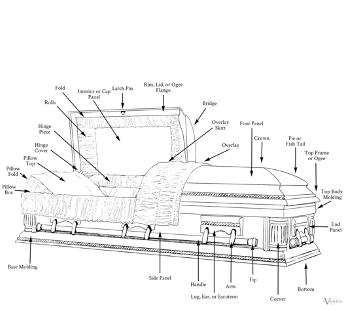
In mortuary school I learned a lot about caskets.  I learned a lot about how they are made and the proper terminology for each of their different parts.  We had to be able to identify and differentiate between the “ogee” and  the  “overlay”.  We had to be able to explain why a person may want or not want a casket with a gasket.  (Every time I say that, it reminds me of the Dr. Seuss  book “Wocket in my Pocket.”). It would all be very depressing If I didn’t know that in the end, a casket is just a time capsule to be opened at the ribbon cutting of the new Jerusalem.  I picture graves bursting open right before the wedding supper of the lamb.  When I get a person dressed and placed in their casket, I’m really helping one of the wedding guests get their socks on for the party!

In this same Chapter Paul also writes “we do not write you anything you cannot read or understand.” Sometimes we just need to think about that.  If our message is something that cannot be understood, it just might not be Biblical. 

God created perfect people in a perfect garden on a perfect earth.  Sin caused those people to be cast out of the Garden and they lost access to the tree of life.  Therefore we all die.  We all need to consider casket gaskets. 

The entire Bible lays out plainly God’s plan to restore the perfection of his original creation and our access to Him and his tree of life.  The good news is just as Jesus arose from the grave, no casket on the market will be able to hold us when the last trumpet sounds.  We shall rise. 

That is how I am able to do what I do.  Next time you have to make funeral arrangements ask your funeral director about their long term lease programs on caskets.  We won’t be needing them forever!

-Brian Froehlich

Application Questions

  1. When you think of the word “comfort” what comes to mind?
  2. What brings you comfort in times of stress?
  3. What are some jobs you would not want or could not do?
  1. We know we won’t be needing our caskets forever.  If we could lease one until Resurrection day, how long do you think we would need it? 
  2. Are you living like you are expecting the imminent return of Christ?  What would you do differently today if you knew the date of his return?

A Scary Word

1 Corinthians 2

June 3

Here at the Oregon church we have really been focusing on evangelistic outreach. No other word puts quite the fear in the heart of a Christian like the world evangelism. There are many anxieties that come with the idea of evangelism: sharing the good news of Jesus Christ. There is the fear of rejection. There is the worry that you might look foolish. There is maybe a concern that you won’t say the right things. Maybe there’s a worry that you don’t know enough about the Bible and therefore you aren’t qualified to reach out to people about Jesus and the kingdom. There is just a lot of worry that goes into it.


A lot of the fear and anxiety that comes from sharing the good news of Jesus Christ with people is that we can make it about us. Look above at what was said about the fear of sharing the gospel: every fear and anxiety that was mentioned about sharing the gospel is because we focus on how it affects us. We make it about our rejection, or our feelings or our knowledge. God has made the gospel so simple and yet we can be so afraid of it. And when I say we are afraid, I’m talking about me too. Just because I’m a pastor doesn’t mean that I don’t have fear and anxiety about sharing the gospel. You don’t need a PhD in theology to share the gospel with people. You don’t need to have a deep understanding of Levitical dietary laws, or a complete understanding of ancient Greek. The gospel was made understandable so that no matter who we talk to they can grasp it. We tend to make it more complicated than it has to be.


Paul makes this very point in 1 Corinthians 2. He says: “And I, when I came to you, brothers, did not come proclaiming to you the testimony of God with lofty speech or wisdom. For I decided to know nothing among you except Jesus Christ and him crucified. And I was with you in weakness and in fear and much trembling, and my speech and my message were not in plausible words of wisdom, but in demonstration of the Spirit and of power, so that your faith might not rest in the wisdom of men but in the power of God” (1 Corinthians 2:1-5).


Paul was an extremely well educated man. He was well studied and well read. He knew the Hebrew Bible in profound detail. He was someone that could have really made the gospel presentation more complicated than it should have been. But instead of making a mess of things he says to the Corinthian church that he didn’t come with lofty speech or wisdom. He decided to know nothing besides Christ and him crucified. What Christ accomplished on the cross is of chief importance. Christ died as a substitute for you and me and he rose on the third day. He did this so that one day we can be in the kingdom of God forever. The components of the gospel are easy to remember this way: the kingdom, the cross and the resurrection. The other doctrines of the Bible are important but only believing the gospel is what saves us. The good news of the kingdom of God and our entrance being purchased by the death and resurrection of Jesus is what matters above all else.


Paul continues in the section by saying that we don’t use lofty wisdom and persuasive arguments in order that we aren’t relying on the wisdom of man. Wisdom is important, but ultimately the best and truest wisdom comes from God. The gospel is simple in order that we can fully rely on the power of God to work through us to share to those around us. God is saving the world through His gospel and we should want to be a part of that.


We don’t need to make the gospel more complicated than it is. The simple message of the death and resurrection of Jesus purchasing our gift of eternal life if we believe in him is as easy as it gets. Sharing the gospel doesn’t have to be scary either. It comes from the concern and urgency of wanting people to be in God’s kingdom. It comes from the outpour of our lives as a demonstration of the saving power of God working wondrously through us. Let’s choose to know nothing but Christ and him crucified and share that to a hurt and broken world. Let’s be the people that God works through to reconcile His creation back to Himself.

-Nathan Massie


Application:

  1. To remember that the gospel has been made simple so that we can share with everyone: the kingdom, the cross and the resurrection.
  2. To realize that God is the one who is working through us to share the gospel to the world. It’s His power and not our wisdom that makes the gospel effective.
  3. To realize that the gospel is the power of God and it is of chief importance since believing the gospel is what saves us.
  4. To pray about our anxieties and fears about sharing the gospel and to ask God to give us the strength to share even when we are afraid.
  5. To recognize that when we share the gospel we are making an eternal difference in the life of the hearer.

Be A Good Neighbor

Romans 13

May 29

For most of my adult life I’ve lived in an apartment and one of the biggest realizations is this: it can be difficult to have neighbors that are so close to you. Rarely have I had quiet neighbors that have totally kept to themselves. I’ve heard the intricacies of arguments that I wish I could unhear. I’ve smelled cooking that was not appealing. I’ve been awakened in the middle of the night to a barking dog or to a loud crash of pots and pans falling out of a cabinet unexpectedly.


It isn’t always fun being a neighbor.


Sometimes it’s challenging to want to be a good neighbor to people because of the way they act. On the other hand, it’s not always as obvious to us that we might be the neighbor that needs some improvement. Being a good neighbor should not be something that we do because it is reciprocated by another person. Being neighborly to others is what God asks us to do despite the way they might treat or think of you.


The biblical concept of being a neighbor goes beyond those who are in our immediate vicinity. It is not just someone who lives in your apartment building or on your street. A neighbor is not limited to someone that looks like you, talks like you, or acts like you. A neighbor is not just someone who is a Christian. A neighbor is not just someone who shares citizenship in the same country as you. The Bible is clear that all fellow humans are our neighbors. This is a concept that Jesus really drove home in a conversation with a Pharisee.


The expert lawman approaches Jesus and asks “what must I do to inherit eternal life?” (Luke 10:25). Jesus then asks for the man’s opinion on what the law has to say about it. The man responds with “Love the Lord your God with all your heart and with all your soul and with all your strength and with all your mind and, ‘Love your neighbor as yourself’” (Luke 10:27). Jesus affirms the lawyer’s answer, but the lawyer had a follow up question: “Who is my neighbor?” (Luke 10:29). The question: “Who is my neighbor?” is not a
question of identifying who his neighbors are but rather who they aren’t. The question that the man is really asking is this: who am I allowed to not be loving towards and still get away with it? Jesus explains in the parable that follows this interaction that being a good neighbor means loving other people regardless of who they are.


Paul in Romans 13 really drives the point home on what it means to love our neighbors.

He says this:

“Let no debt remain outstanding, except the continuing debt to love one another, for whoever loves others has fulfilled the law. The commandments, “You shall not commit adultery,” “You shall not murder,” “You shall not steal,” “You shall not covet,” and whatever other command there may be, are summed up in this one command: “Love your neighbor as yourself.” Love does no harm to a neighbor. Therefore love is the fulfillment of the law” (Romans 13:8-10).

Paul begins his thought on neighborly love by speaking about debt. Paul wants to make it clear that the only thing we truly owe one another is to love one another continually. What a remarkable thought. That’s a type of debt that even Dave Ramsey can get behind!

Paul continues with a list of familiar commandments. The “shall not” list is a list of bare minimums of how we should treat one another. We shouldn’t be killing each other, or stealing from each other, or desiring one another’s possessions. But if we seek to love one another we are truly fulfilling what is required of us: not just scraping by on what’s minimally expected. That’s why Paul finishes up with this thought: “Love does no harm to a neighbor”. We should look to fulfill the highest good to those around us by never seeking to do harm in any capacity. Let us seek the good of those who might not seek our good in return. Let us not repay negatively for what negative things people might have done to us. Let’s take the higher path and accept the greater calling that God has called us to: to love others with no bounds.


Let’s strive to be good neighbors by seeking out the good to those around us. Let us be as loving as possible to others who are different from us. Let us fulfill what God has called us to: to love people no matter who they are or how different they might be. Let’s continually aim to fulfill the high calling of loving others as we love ourselves.


A lot has been said about loving others and seeking the good of those around us, but that is more of an ideal than something to do. Loving those around us in a neighborly way is extremely practical. It could be meeting the needs of someone in your community – whether physical, spiritual or emotional. It could be volunteering at your local food pantry to sacrifice some of your time to help the hungry. It could be spending time after school tutoring someone who is struggling in a subject. It could be performing a service for someone that isn’t physically capable of doing it. It could be spending time with a shut-in who is lonely. It could be discipling someone to follow Jesus. Loving people is an extremely practical act.


Being a good neighbor means meeting the needs of those around you regardless if they return the favor to you. Loving people is an endless job that will never have an end. The world needs strong examples of what it means to be a good neighbor, and it starts with us.

-Nathan Massie


Questions:

  1. What does it mean to be a good neighbor?
  2. Who are some neighbors in your community that need help, and how can you
    help them?
  3. How does being a loving neighbor positively impact your community?

Roots

Romans 11

May 27

I have never really pondered the meaning behind the politically-charged term “grassroots.” I have only thought about it in the most basic of terms.   The people are basic, grass is basic, so as an organization or movement made up of basic people; this must be their connection. These past few weeks creating a garden in a space that was previously untamed ground has really changed the direction of my contemplation on this term. I had taken a great deal of time to till up the ground, remove the vegetation, make a raised bed, and amend the soil.  We sowed new vegetable seeds and waited.  And waited.  And WAITED. To our horror, we watched the most beautiful patch of grass within our entire yard form but not a single seed germinate and reach the surface.  Together my wife and I removed the newly formed grass, this time with great care to remove as much of the roots as possible. We sowed the seed again and waited. This time the vegetables plants grew alongside the grass.

This is when I began rethinking “grassroots.”  There is and was so much of it.  It was impossible to get rid of, to stamp out (at least for the novice gardener). The roots run in so many directions and are intertwined.  Momentarily getting rid of the green is possible, but the grass comes back stronger, greener, and flourishes even more from the pruning.  Culturally and politically, grassroots make a deep connection to this extended metaphor.  As regular folk, we can be part of big ideas or shared values with expectations that are entrenched and hard to amend or move.  However, we are not the root, we are just the greeny growth that thrives off the vine.

“Consider this: You do not support the root, but the root supports you.” – Romans 11:18b

I am the true vine, and my Father is the gardener. He cuts off every branch in me that bears no fruit, while every branch that does bear fruit he prunes so that it will be even more fruitful. You are already clean because of the word I have spoken to you.  Remain in me, as I also remain in you. No branch can bear fruit by itself; it must remain in the vine. Neither can you bear fruit unless you remain in me. – John 15:1-4

Romans 11 makes an ever deeper root connection (this is a pun, and you’ll see why in a moment).  In this case, the gardener is not a novice. Grafting branches onto a tree takes an experienced hand.  The metaphorical botanical in this passage is an olive tree. But why? Because they live an insanely long time. They are a millennial perennial. Additionally, the roots of an olive tree can grow deeper under the surface than above.  It is extremely hard to extinguish some of these species.  Impossible, when you consider the species specifically spoken about here: Jesus Christ.  His Father is the Gardener, He is the vine, and we are the branches. We are grafted by God into the Savior, which predates His arrival.  It is the oldest, deepest promise of God.  “After all, if you were cut out of an olive tree that is wild by nature, and contrary to nature were grafted into a cultivated olive tree, how much more readily will these, the natural branches, be grafted into their own olive tree!” Romans 11:24

No longer is there a single type of branch budding on the tree, but the Good Gardener has chosen a variety.  Each one is equal to the other because none can be supported without the vine.  This makes us all part of the same faith, intertwined in the same hope, which strengthens and flourishes the whole plant, (or body – 1 Corinthians 12)  These roots run from the origins of the universe and the branches are fruiting, growing, and reaching towards Kingdom Come.  Are you accessing the sap of the Spirit? Utilizing your provision to make fruit? Allowing the gardener to prune the dead bits? Tap into the power and the promise that most assuredly lies in the deepest root.

-Aaron Winner

Questions for Discussion and Reflection

  1. Reading Romans 11, what do we learn about the Gardener who grafts in branches? How would you describe Him? What is His purpose?
  2. How does the Doxology (an expression of praise to God, sometimes sung) in verses 33-36 tie in with the rest of the chapter?
  3. How is your grafting process going? How have the roots supported you? How are you getting along with the other branches?

Hopelessly Lost – Until…

Romans 3

May 19

In continuation from chapter 2, Romans chapter 3 describes the dire predicament we, the human race, find ourselves in. We are hopelessly lost, together guilty of every evil. And not one of us is truly good. Not one of us is righteous, not one of us deserves to be saved. 

“For by works of the law no human being will be justified in His sight, since through the law comes knowledge of sin.” Romans 3:20

These verses are pretty devastating. Ever since Romans 1:18, Paul has been making it clear that this world is in a gruesome state of being. Jews and Gentiles alike, we all are held accountable for our actions, and we all fail miserably at living up to God’s standards.

 But then comes the good part. The system God put in place doesn’t require us to earn anything. We couldn’t possibly earn the gift of salvation on our own. That’s why it’s a gift. Salvation and a relationship with our Father is not something we get for being good – no one on earth is “good,” not by God’s definition. 

“For all have sinned and fall short of the glory of God, and are justified by His grace as a gift, through the redemption that is in Christ Jesus, whom God put forward as a propitiation by his blood, to be received by faith.” Romans 3:23-25

This is such a powerful verse. Jesus is the only way to righteousness, eternal life, and ultimately, God. And we can only accept Christ (and God’s gift He gives to us through Christ) by faith. Jesus said in John 14:6, “I am the way, and the truth, and the life. No one comes to the Father except through me.” And in Acts 4:12, Peter, filled with the Holy Spirit, declares, “There is salvation in no one else, for there is no other name under heaven given among men by which we must be saved.” 1 Timothy 2:5 also lays it out pretty clearly, saying, “For there is one God, and there is one mediator between God and men, the man Christ Jesus.” The list goes on and on. God clarifies in abundance throughout His word that as messed up as we are, He wants us to be saved, and Jesus is the way He’s given us to receive salvation. It’s not by our own goodness or worthiness, for none of us are good or worthy. 

As one final note to think about today, this ↑ does not in any way contradict what the last couple of chapters have expressed. In order to accept this gift, we also have to live in accordance with God’s word. Obedience displays both our appreciation and acceptance. Constant disobedience and rejection of God, neglecting the whole repentance part, only stores up His wrath for the day of judgement (Romans 2:3-11). It is such a joy to be loved by a God who so tremendously desires to have a relationship with His children, and provides an amazingly in-depth book of guidelines to receive His promises and live both now and forever in fellowship with Him.

Discussion Questions:

  1. As discussed in verses 5-8, how does our unrighteousness show the righteousness of God?
  2. Is the idea that evil is justified if it brings about good a biblical idea? What would Paul’s response be? 
  3. If the gift of grace is free, then why must we accept it and live for a purpose greater than ourselves?

Our Hope in God’s Promises

Acts 26

May 14

Once again, Paul has a chance to give his testimony.  He is respectful.  He boldly states “it is because of my hope in what God has promised our fathers that I am on trial today.” v.6

God promised the Israelites blessings. 

Genesis 12:3 -I will bless those who bless you, and whoever curses you I will curse; and all peoples on earth will be blessed through you

God promised the Israelites redemption. – A savior messiah who would be the once and forever sacrifice for sin.    

Deuteronomy 18:15 – The Lord your God will raise up for you a prophet like me from among you, from your fellow Israelites. You must listen to him.   

Romans 3:23-25 “for all have sinned and fall short of the glory of God, and all are justified freely by his grace through the redemption that came by Christ Jesus. God presented Christ as a sacrifice of atonement, through the shedding of his blood—to be received by faith. He did this to demonstrate his righteousness, because in his forbearance he had left the sins committed beforehand unpunished.”  

Psalm 16:10  – Because of this, all men have the hope of eternal life. 

Titus 2:14- who gave himself for us to redeem us from all wickedness and to purify for himself a people that are his very own, eager to do what is good.

Paul stayed focused.  And so must we.

God promised the Israelites land. 

Deuteronomy 34:4 – the Lord said to him, “This is the land I promised on oath to Abraham, Isaac and Jacob when I said, ‘I will give it to your descendants.’ 

Blessings, redemption, eternal inheritance in the kingdom on earth.  These promises are ours as well.

-Annette Osborn

Questions for Reflection and Discussion

  1. Reading Paul’s testimony in Acts 26, what are you most impressed by?
  2. What promises of God give you great hope?
  3. How can you share that hope with others?

One Goal

Acts 21

May 9

Unlike many Jewish leaders, James and the elders were not jealous of Paul’s success among the Gentiles.  But they were aware that not everyone was so accepting.  To head off problems, the elders asked him to pay the costs of men completing a vow.   Likely a Nazirite vow, this voluntary, temporary commitment to total dedication to God required extensive sacrifices, including a female lamb, a male lamb, unleavened bread, loaves of bread, crackers, oil, and a grain and drink offering.   

Paul wasn’t buying acceptance. In 1 Corinthians 9 he writes “19 Though I am free and belong to no one, I have made myself a slave to everyone, to win as many as possible. 20 To the Jews I became like a Jew, to win the Jews. To those under the law I became like one under the law (though I myself am not under the law), so as to win those under the law. 21 To those not having the law I became like one not having the law (though I am not free from God’s law but am under Christ’s law), so as to win those not having the law. 22 To the weak I became weak, to win the weak. I have become all things to all people so that by all possible means I might save some. 23 I do all this for the sake of the gospel, that I may share in its blessings.”  He had one and only one goal….to win others to Christ.  Let’s be as focused as Paul.

-Annette Osborn

Questions for Reflection and Discussion

  1. If people who knew you were to guess what your main goal was, what might they guess? Would they be right?
  2. How have you become “like others” (while remaining true to Christ’s law) in order to be able to share the good news with them?
  3. What group(s) of people would you want to be accepted by, so that they are willing to hear from you about Jesus Christ? How can you go about this mission?
  4. What was Paul willing to do, and willing to give up, in order to reach more people with the saving gospel? What are you willing to do, and willing to give up, for the same purpose?

At the Feast

John 7

April 4

A bunch of years ago, when my boys were younger, we did a study on Biblical holidays. We were homeschooling at the time, so we incorporated it in that way, but this study would make phenomenal family devotions as well (or even a Sunday school class!).

The book we found was dense with activities for all ages as well as full of interesting information. For example, I hadn’t known that among Biblical holidays, the spring celebrations pointed towards Jesus’ first coming, while the fall holidays point to his second coming.

Spring Holidays

Passover and the Feast of the Unleavened Bread Passover remember the deliverance from Egyptian bondage. An unblemished, firstborn male lamb was sacrificed. Leaven symbolizes sin. Unleavened bread speaks of sanctification. Jesus was slain on Passover as our sacrificial lamb, releasing us from bondage. He is the ‘bread of life’.

The Day of Firstfruits reminded the Jews that God gave them the land, and the harvest belonged to him.  1 Corinthians 15 tells us that Jesus is the Firstfruits, his resurrection was the first of the harvest. And the Feast of Weeks (Pentecost) is a remembrance of the giving of the law took place. It’s celebrated fifty days after the Feast of Firstfruits.  Fifty days after Jesus arose, the Holy Spirit came upon believers, writing the law on their hearts.

Fall Holidays

The Feast of Trumpets (Rosh Hashanah) and the Day of Atonement are two separate holidays, but celebrated just 10 days apart. These are the holiest days of the Jewish year. Unlike other holy days, they don’t celebrate a season or historical event, but are a time to look inward towards spiritual growth. We are told that Christ’s return will be with the blowing of trumpets, and on that day, atonement will be made for sin.

The Feast of Tabernacles (or the Festival of Booths) was historically kept as a remembrance of the Israelites dwelling in tents in the wilderness as they wandered on their way to the promised land. When Christ returns and establishes his Father’s kingdom on earth, God’s covenant with Abraham to give his descendants the promised land will be fulfilled.

John 7

And this is where we find Jesus in John chapter 7: at the Festival of Booths. The Hebrew name for this holiday was Sukkot (which means tabernacles). Tabernacles were portable, like a tent.

Jewish families build a temporary little hut or shelter in their yard called a sukkah. The roof covering must be made of something that used to grow in the earth. It can be made of palm leaves or bamboo sticks. The walls can be made of any material that can hold up to the wind. (Leviticus 23:33-43) It is traditional to eat meals in the sukkah. Some people even sleep in them during the week-long celebration.

When John wrote this, he would have known that Jesus was the fulfillment of all the Jews hoped for. It’s interesting that he highlights in this text the conflict between those that accept Jesus and those that do not. It’s interesting because, really, that’s what our ultimate choice is, isn’t it? The choice that will determine our eternal future.

The fact that this happens at the Festival of Booths, which looks ahead to the fulfillment of God’s promise to establish his permanent kingdom on the earth (ie: no more wandering) I don’t think was a coincidence. Those who accept Jesus will get that permanent place in the kingdom and those that do not…well, they won’t.

Living Water

Jesus’ words were never said without purpose, and he often used the environment around him to teach. One part of this celebration at the time of Jesus was a water ceremony. Priests would gather water from the Pool of Siloam into a golden pitcher and walk to the Temple while the crowds recited Isaiah 12:3: “With joy you will draw water from the wells of salvation.” They would then pour the water out on the altar.

Knowing that makes Jesus’ words in John 7:37-38 even more meaningful:

On the last day of the festival, the great day, while Jesus was standing there, he cried out, “Let anyone who is thirsty come to me, and let the one who believes in me drink. As the scripture has said, ‘Out of the believer’s heart shall flow rivers of living water.’”

When Jesus revealed himself as Messiah to the Samaritan woman at the well in John 4, he told her about the living water too:

“Everyone who drinks of this water will be thirsty again, but those who drink of the water that I will give them will never be thirsty. The water that I will give will become in them a spring of water gushing up to eternal life.”

Her response was perfect:

The woman said to him, “Sir, give me this water”

-Susan Landry

Questions for Reflection and Discussion:

  1. Why do you think there was so much skepticism about Jesus and his teachings?
  2. Do you think you would have been a skeptic, or instantly on board with Jesus and his teachings? Why do you think that, and are you satisfied with that response? If not, what needs to change?
  3. Why do you think God instituted the Biblical holidays/feasts/festivals? While we are not required to celebrate them, what might the value be in understanding them better?

Spend your Light on the Eternal

John 6

April 3

Jesus had just fed 5000 people with 5 loaves of bread and 2 fish. Pretty amazing. It’s no wonder the crowds tracked him down the next day:

When they found him on the other side of the sea, they said to him, “Rabbi, when did you come here?” Jesus answered them, “Very truly, I tell you, you are looking for me, not because you saw signs, but because you ate your fill of the loaves. Do not work for the food that perishes, but for the food that endures for eternal life, which the Son of Man will give you. For it is on him that God the Father has set his seal.

John 6:25-27

Isn’t that the truth of human nature? We are led by our cravings, our desires. Paul frequently refers to this as ‘the flesh’. Another way to say that is just doing what comes naturally to us. Jesus is telling the crowds (and us) in this short exchange that the things that come naturally to us will perish. But, he adds, there is something that lasts.

He’s calling for a perspective shift.

Another time he did that was in the home of his friends, Mary and Martha (Luke 10). We’re told that Martha was distracted by her many tasks, and she is a little put out that her sister is simply sitting with Jesus, listening to him.

Jesus doesn’t scold Martha, he sees her. He acknowledges all she’s doing, even validating what she was feeling  distracted. He says, “You are worried and distracted by many things, there is need of only one thing.” He’s telling her to focus on what’s most important now…the rest is a distraction from what really matters.

Martha wanted to serve the Lord with her actions, but it seems that she was striving to do that at the expense of simply spending time in his presence. And at that moment, just being with him was the most important thing, it’s what would last.

…Do not work for the food that perishes, but for the food that endures for eternal life…

This isn’t an instruction to not do jobs that provide our groceries. Paul, after all, tells the Thessalonians that “Anyone unwilling to work should not eat.” What it is, is an instruction to hone our focus, to pay attention, to look up.

Sometimes we need to take our eyes off of the busy-ness, off of the tasks (even really important and valuable tasks) and take a moment to look for the eternal. Sometimes the eternal may be in the tasks, perhaps with an attitude shift. Other times the things that matter most might include being still for a time.

I love this poem by John Milton:

When I consider how my light is spent,

   Ere half my days, in this dark world and wide,

   And that one Talent which is death to hide

   Lodged with me useless, though my Soul more bent

To serve therewith my Maker, and present

   My true account, lest he returning chide;

   “Doth God exact day-labour, light denied?”

   I fondly ask. But patience, to prevent

That murmur, soon replies, “God doth not need

   Either man’s work or his own gifts; who best

   Bear his mild yoke, they serve him best. His state

Is Kingly. Thousands at his bidding speed

   And post o’er Land and Ocean without rest:

   They also serve who only stand and wait.”

Milton began going blind in his early 40’s and this poem is a bit of a lament at his fate. Maybe you’ve felt like that before…wondering how you could possibly serve God in the circumstances you find yourself in.

The wisdom of the last few lines of the poem is just the perspective, I think, Jesus was pointing us to. God doesn’t need our gifts, he’s the King. We can serve him in our running around without rest; and we can also serve him in our stillness. The key is our perspective, it’s the considering of the moment rather than simply doing, simply being. Living intentionally.

Jesus wanted the crowd to pursue him because of who he was and how their lives, their eternity, could be changed because of him…not because their stomachs were empty. He was asking them to consider what they were spending their light on.

He wanted Martha to take a breath and just be with him, instead of being distracted by other things (even well-intentioned, important things). She needed to consider if she was, in that moment, spending her light on the eternal.

Today: Consider how your light is spent.

-Susan Landry

Questions for Reflection and Discussion:

  1. Do you find it easy or difficult to be intentional in the way you live? Why do you think that is?
  2. Are you in a season of serving God with a lot of busyness/tasks or a time of serving him in the standing and waiting? How can you be more purposeful in whichever season you find yourself?
  3. Consider taking out your calendar or planner and praying over it, asking God to show you ways you can be more intentional in the way you spend your time. (It’s been said that our true priorities will always be seen on the pages of our planners/calendars – how could this work similarly for screen time?).
  4. Try starting your day with a short prayer asking God to help you focus on what matters that day.