One thing that surprised me recently when our church was going through a study of Acts, was thinking about the timeline. I don’t know that I ever realized (or maybe I just forgot), that Stephen’s story doesn’t take place just right after Jesus ascends into heaven and the Holy Spirit is poured out. Depending on different sources I looked at, it was 5-7 years later that Stephen’s story here in Acts 6-7 takes place.
Why that sticks out to me here is that when Stephen gets into a debate with some men, and they are essentially embarrassed and then get people to lie about him in order that he can be arrested, it isn’t happening right in time after Jesus’ ministry. It is years later, but groups of people are still seeming to be freshly bothered by the impact of his ministry. This isn’t something that died down – it only got stronger through the faithfulness of those in the early church.
So Stephen is falsely accused, and does he go into a heated defense of himself? Nope. He launches into a history lesson of the people who accuse him, reminding them of God’s relationship and covenant with the Jews over time, and of the failures too of these people. And then he says to them
51 “You stubborn people! You are heathen at heart and deaf to the truth. Must you forever resist the Holy Spirit? That’s what your ancestors did, and so do you! 52 Name one prophet your ancestors didn’t persecute! They even killed the ones who predicted the coming of the Righteous One—the Messiah whom you betrayed and murdered. 53 You deliberately disobeyed God’s law, even though you received it from the hands of angels.” (Acts 7:51-53)
Never in his defense is Stephen trying to argue for himself. Through all of it, he is focused on God’s righteousness and as this group stones him, he is rewarded by getting to see the glory of God and Jesus standing in the place of honor at God’s right hand.
And despite this stoning, Stephen’s final words are “Lord, don’t charge them with this sin!” which is so reminiscent of Jesus’ words of “Father forgive them, for they don’t know what they are doing.”
This is such a great example and reminder of forgiveness and loving others that are treating you wrong/hold different beliefs. Advice that I have heard before when dealing with difficult people is to ignore them or not focus on what they are doing and God will “make it right” or enact justice in the end. But Stephen didn’t try to ignore the fact that they were stoning him. Instead, he chose to ask for them to not have his death on their hands which is just so much more loving than the concept of not taking things into your own hands but still looking forward to people receiving “justice” for wrongdoing. As he was literally murdered, he asked for them to be forgiven. Can we offer this much love to people in our lives that probably aren’t trying to murder us, but are doing things that we don’t like?
Reflection Questions
What impresses you about Stephen?
What do you do when you feel you are being falsely accused? What happens when we are quick to defend ourself?
What can we learn from what God allowed Stephen to see and share right before his death?
Why do you think Stephen chose to forgive them? What do you think is the hardest part of forgiving someone who has/is hurting you? Pray about who God wants to see you forgive.
Prayer
Dear Lord God, I thank You for Your Son Jesus, and his follower Stephen. Forgive me of the times I have not shown the faithfulness, wisdom, courage, love and forgiveness Stephen displayed. Help me forgive, Father, so I can be forgiven. I pray for Your Spirit and wisdom to guide my decisions and words. May I be focused on You and not myself. Show me how You want me to be a faithful witness of You and Your Son today and in the future, and help me do it whatever the cost.
As we start off in Acts 4 today, the priests, the captain of the guard, and the Sadducees came up to Peter and John “greatly agitated” because they were teaching and proclaiming in Jesus (Yeshua) the resurrection from the dead. If you recall the breakdown of the “4 Philosophies” at that time, the Sadducees were “A priestly and aristocratic group who accepted only the written Torah (Pentateuch) as authoritative, rejected the oral law, and did not believe in resurrection or an afterlife.” So of course they were greatly agitated, because as a group they did not believe in resurrection…”So they were sad, you see?” (that bad joke was stolen from Sean Finnegan’s wonderful and highly recommended podcast on Restitutio.org, which you really should give a listen to, seriously).
The chapter goes on to tell that the religious authorities of the day grabbed them, detained them and questioned them fiercely, then released them but not before threatening them to stop talking about such things. Their response is telling: “Whether it is right in the sight of God to hear you rather than God, you be the judge; for we cannot stop speaking about what we have seen and heard.” (Acts 4:19, LSB). Bear in mind, these were not just some guys, these were the religious leaders of the day, the authorities, the high priest (and his descendants, Acts 4:6) and represented the final say in spiritual matters at the time. It’s no wonder that they were marvelling at their confidence (Acts 4:13), this sort of behavior was unheard of amongst the Jews, you just didn’t defy the priests typically.
After they are released, they went to their own people and offered praise to God. Please pay special attention to their wording, because it clearly defines the doctrine of the earliest church here in Acts 4: 24-31. Without belaboring this beyond the last 2 days devotionals, please note that there is a clear delineation here, and a tiered level of authority that is clearly demonstrated with God (YHVH, the Creator, the Most High God) in authority over His servant Yeshua, Ha’Mashiach (Jesus, the Christ, the Anointed One) who is in turn in authority over his servants, us (the ecclesia, or church). We serve God through Yeshua, His servant and our King, whom God has anointed and established over humanity. This is repeated throughout scripture and succinctly restated in 1 Cor 11:3. It is highly problematic to insist on any other doctrinal statement, at least if you don’t want to stand in opposition to scripture. Peter and John confidently stood firmly against the religious giants of their day, the religious authorities who had gotten off course, and continued to speak the word of God. We face our own giants today, don’t we?
Here’s an interesting thing. Even if you have a map, even if you plan your route well, even if you have a compass; if you get even just a tiny bit off course you don’t end up where you wanted. A matter of just 1 degree off, and you could end up hundreds of miles away from where you wanted to be. The farther you go, the greater the error becomes. In my youth, I had gotten off course (see the Feb 5th devotional for some of the sordid details). I was in genuine fear for my life, because I was facing giants, and I knew that I could not win. I had resigned in my mind that the best I could hope for was to inflict maximum damage in return on my way into death and was quite prepared to do so. Psalms 35 really reminds me of that time, and of the mercy of God, who saved me. I won’t go into detail here, but know that this Psalm is an intensely personal one for me because it accurately sums up a time when I faced giants, and lived. Not by my actions, but by the grace of God alone and because God intervened in ways I could not have predicted or understood to remove the threat from my path (literally and physically, in some instances). Then, in an overwhelming display of unwarranted love, he corrected my path. I don’t even have the words to express my appreciation. Praise God!
As we dip into our Joshua reading today, we’re going to focus on a couple things that a lot of folks just skim over. Remember the old song, “12 men went to Canaan land (10 were bad and 2 were good!)”? That story is detailed in Numbers 13 and 14, and gives us a bit more understanding. In Num 13:33 it says “There also we saw the Nephilim (the sons of Anak are part of the Nephilim); and we became like grasshoppers in our own sight, and so we were in their sight.” (LSB). There’s a very simple and straightforward reason for this, and it’s because those guys were giants! So who were the Nephilim? Great question! Flip back over to Genesis 6:4 where it says: “The Nephilim were on the earth in those days, and also afterward, when the sons of God came in to the daughters of men, and they bore children to them…” (LSB)**. So the Nephilim were the offspring of “the sons of God” (ie, angels or some other form of heavenly being which God created) and humans, according to scripture. **For an extremely interesting apocryphal account of this, read the book of Enoch (it’s quoted in the book of Jude, but didn’t make it into the cut for “canonical”).
So, when the Israelites encounter ACTUAL GIANTS on the way in to the promised land, they got scared, rebelled, and as a result ended up wandering in the wilderness for another 40 years until the voices of dissension had (quite literally) died out (see Num 13&14 for the full story). In Joshua 12, we’ve returned after 40 years to “try again”. Now, when the Israelites are doing as God commanded and taking the promised land, it states: “Then Joshua…cut off the Anakim…(and) devoted them to destruction. There were no Anakim left…only in Gaza, in Gath, and in Ashdod some remained” (Joshua 12:21-22, LSB). In Josh 12:4, “Og king of Bashan” seems to be another one, “one of the remnant of the Rephaim”. Remember where Goliath was from, by the way? See there (I slipped in another cross reference)? Do you think he was larger or smaller than the others of his kind like him? Trivia aside though, the point is: this time they obeyed God, and they succeeded.
My point in bringing up these things is this: in our lives, sometimes we are given tasks that seem daunting. Sometimes, we are called upon to fight giants. Giants are, by their very nature, big and scary. Many times they will stand and taunt us. I’d point out in counterpoint that we’ve got a great big God; much bigger than any giant, and He fights for us, when we are doing His will. It doesn’t matter how big your particular giant is, God is bigger. As I write this devotion, it is the Sabbath before Easter Sunday. When I consider the overwhelming love and power of our God, and the generous offer of salvation to us gentiles, I am truly humbled. When I think about what His Anointed One suffered on my account, I am overwhelmed. When God raised up His servant Jesus again, it let me know that there is no giant that can overwhelm me. I may go down into the dirt, but I will stand again. God has this.
REFLECTION QUESTIONS
Did you ever realize, or even think about, where the actual biblical “giants” came from?
Each of us have our own metaphorical “giants”. What are yours?
How many times has God conquered a giant for you; a problem you just couldn’t see a way around, a danger that you couldn’t escape, an intimidating moral dilemma? Reflect on them all for a moment, and consider the goodness of God.
Why is it that when we see a “giant” we forget how big God is sometimes?
PRAYER
Father God, Creator and Sustainer of all life, thank you. Please help me to remember that I am not my own and that you bought me, and that the price paid for me was far too high. Please forgive me when I am scared, and give me the strength to do your will, even if it’s to conquer giants. Thank you for sending Yeshua, my King. Thank you for life, breath, and all things. In Jesus name, Amen.
Without belaboring the point too much beyond yesterday’s devotion on Acts 2, we see again in Acts 3 the clear doctrinal understanding of the earliest church in Peter’s 2nd sermon after Pentecost. “11 And as he held Peter and John, all the people, being greatly amazed, ran together to them in Solomon’s portico. 12 And when Peter saw this, he answered the people, “Men of Israel, why are you amazed by this? Why do you stare at us, as if we had made him walk by our own power or godliness? 13 The God of Abraham and of Isaac and of Jacob, the God of our fathers,has glorified his Servant Jesus …15…whom God raised from among the dead, of which we are witnesses. 16 And by trusting in his name, his name has made this man strong, whom you see and know. Yes, the trust that is through his name has given him this perfect health, as you all can see.” (REV).
Miracles are being performed through Peter and John, the servants of Jesus the Christ, who is himself the servant of God, whom God has glorified. There is one God (Mark 12:29-31, Deut 6: 4-5) and one mediator between God and man, the man Christ Jesus (1 Tim 2:5) and “3… the head of every man is Christ, … and the head of Christ is God. ” (1 Cor 11:3, REV). So according to scriptures, our “corporate flowchart” looks exactly like this:
God >Jesus >The Church.
There is never once an implied equality in this flowchart throughout scripture: we are the servants of Jesus the Christ, who is himself the servant of God. To state anything else is to change the scriptures, which cannot be broken (John 10:35).
The Jews understood very well that all blessings come from God. Keep in mind that once they leave the fiercely monotheistic folks in Israel and the message begins to get spread to the gentiles the immediate reaction from the gentiles when they see miracles is to say “the gods have become like men and come down to us!” (Acts 14:11), because that is a theme that is repeated constantly in their mythology (see the greek mythological stories of: Philemon and Baucis, Zeus and Semele, Hermes and Phanes, to name just a very few). As more and more of these gentile converts are brought into the church, they brought their mythologies with them and began to change the narrative from “The God who gives blessings to men” to “the God who becomes man and performs blessings” starting especially in the 4th century when the gentiles became dominant numerically in the church. Please note the reaction and horror of the servants of the Christ when this occurs in Acts 14.
Moving on to our reading in Joshua 9-10, there are a couple key things to take away today. Firstly, whether or not you agree with how the Gibeonites acted (craftily), because they did so enabled them to survive. Granted, they became indentured servants, but they lived. Had they not acted craftily their only other survivable option was relocation (see Josh 9:24 for their rationale on their actions). Secondly, because the Jews had sworn by Yahweh to them, they acted in good faith and protected them when their neighboring kingdoms decided to attack them. It should be noted that during this defense of the Gibeonites, God himself took part in the battle; causing the sun to stand still for a time (Josh 9:13), and destroying the majority of the opposing armies with large hailstones (Josh 9:11). It should also be noted that the book of Jashar is mentioned in Josh 9:13 (and also in 2 Sam 1:18), a lost non-canonical book of the old testament.
Psalms 34 has an interesting header beneath the chapter number in my bible. It says “Of David. When he feigned madness before Abimelech, so that he drove him away and he departed“. This is in itself one of those just really weird stories you come across occasionally in old testament, and takes place in 1 Sam 21:10-15. When you look, it is actually talking about Ahimelech (with an h) in 1-9, tells the story of how David grabs Goliath’s sword, and then feigned madness before Achish. It’s just one of those really weird one-off stories that seems as if it may be incomplete.
Psalms 34:1-3 (REV) states: “1 I will bless Yahweh at all times. His song of praise will always be in my mouth. 2 My soul will boast in Yahweh. May the afflicted hear it and may they rejoice! 3 Oh magnify Yahweh with me! Let’s exalt his name together!” The words of David, the man of God. We are often afflicted by the trials of life, and tend to forget that we are to give thanks at all times, and that the trials that we are going through are probably God’s way of developing us and purifying us so that we can be better servants (James 1:2-4).
Psalms 34: 4-9 (REV) states: “4 I sought Yahweh, and he answered me, yes, he delivered me from all my fears. 5 Look to him and be radiant. Then their faces will never be ashamed. 6 This afflicted person cried out and Yahweh heard him, and delivered him out of all his distress. 7 The angel of Yahweh encamps around those who fear him, and delivers them. 8 Oh taste and see that Yahweh is good. Blessed is the person who seeks refuge in him. 9 Fear Yahweh, O you his holy ones, for those who fear him have no lack.”. Like David, God delivered me as well. I would venture to say that at some point He delivered you, too. I love the poetry of v5, it reminds me of the times when Moses was in the presence of God and when he returned his face was glowing. The hedge of protection we pray over people at times is clearly illustrated in v7. I can say truly that I have tasted and seen that Yahweh is good, I am alive because of it.
Psalms 34: 10-15 (REV): “11 Come, you children, listen to me. I will teach you the fear of Yahweh. 12 Who is the person who desires life, loving many days to see good?13 Guard your tongue from evil and your lips from speaking deceit. 14 Turn away from evil and do good. Seek peace, and pursue it. 15 Yahweh’s eyes are toward the righteous. Yes, his ears listen to their cry for help. “. This is a blueprint set of verses on how to live a long life. Do you want to live? Well: Fear Yahweh, turn away from evil, do good. Seek peace and pursue it. When you do these things, God’s eyes are towards you and He will hear you when you cry out.
Psalms 34:16-22 “16 Yahweh’s face is against those who do evil, to destroy the memory of them from the earth. 17 The righteous cry out and Yahweh hears, and delivers them out of all their distresses. 18 Yahweh is near to those who have a broken heart and he delivers those who have a crushed spirit. 19 Many evils happen to a righteous person, but Yahweh delivers him out of them all. 20 He keeps watch over all of his bones. Not one of them is broken. 21 Evil will kill a wicked person. Yes, those who hate a righteous person will suffer punishment. 22 Yahweh redeems the soul of his servants. Indeed, none of those who seek refuge in him will suffer punishment.” This set of passages warns clearly that God is against those who do evil, and will destroy them so thoroughly that even their memory will be gone from the earth. The one who does evil and hates the righteous will suffer punishment, but Yahweh redeems the soul of his servants. As proof, consider Jesus the Christ, the servant of Yahweh, whom God has glorified and redeemed from the dead.
REFLECTION QUESTIONS
The book of Acts is filled with miracles that God performed through His servants. Can you recall any miracles that have happened in your lifetime?
When miracles occurred in your lifetime, did you notice if you were trying to seek God with your whole heart at the time? Consider this.
Can you think of a time when God saved you from an impossible situation, and did you consider why at the time?
PRAYER
Father God, my creator and my sustainer, thank you for my life. Please guide me and protect me, keep me from looking upon evil and keep my lips from speaking deceit. Help me to be a servant that pleases you. Please work miracles through me, may all of your creation offer you praise and glory. Thank you, in Jesus name, Amen.
There’s one very critical point that we often (and intentionally at times) overlook that’s clearly highlighted in our Joshua 7-8 reading this morning: if you don’t listen to and obey God, you should have no reasonable expectation that God will bless you (quite the opposite, in fact). Romans 8:31 states “If God is for us, who can be against us?” (ESV), but keep in mind that the converse is also quite true as well: “If God is against you, who can save?”. Just think about it; it’s illogical to assume God’s favor if you are not living according to God’s expectations, so “…consider your ways.” (Hag 1:7).
Now let’s move on to 1st century Jerusalem, where we find the apostles and believers gathered, about 120 people, praying constantly (Acts 1:13-15). I’ve recently heard a theory by Dr Roy Blizzard (who actually took part in the archaeological excavation of this site in 1968) that states that they were probably meeting on the Temple stairs near one of the cleansing pools (called Mikveh or Mikvah), and based on the size of the assembly (and comparing it to the average dwelling size in Jerusalem at this time), I believe that may be correct. Dr Blizzard postulates that “house” in this instance referred to “The House” (as in “of God”, ie, the Temple). The Southern Steps, specifically, were a significant meeting and teaching place. These steps were about 200 feet wide and featured a raised platform on the side, known as the “Rabbi Steps” or Teaching Steps, where Jesus and other rabbis are believed to have taught and given announcements to crowds, so it doesn’t seem unreasonable to me.
Furthermore, The Royal Stoa, a massive public meeting building located just above the Southern Stairs, functioned as the primary gathering area for large assemblies, such as the estimated 30,000 to 100,000 people who may have gathered for the event of Pentecost, so this may be the “upper room” referred to. The stairs themselves were designed with uneven widths to prevent running and maintain decorum, while the broad landing and adjacent Mikvehs (ritual baths filled with “living water” brought in via aquaduct from the pools near Bethlehem) facilitated large-scale gatherings, teaching sessions, and baptisms for pilgrims entering the Temple Mount. So, if this is correct, there’s a very good chance that when Peter in his 1st sermon said “Repent and be baptized…”, he was actually pointing at one of these Mikveh.
Acts 2:1-4 is one of the most impressive and amazing demonstrations of the holy spirit ever displayed. When they then began to speak the word of God, the people (who were from all over) heard the words in their own language, and they were all amazed. This is the promise fulfilled from John 15:26-27: “But when the helper comes that I will send to you from the Father, the spirit of truth that comes from the Father, it will testify about me, and you also must testify, because you have been with me from the beginning.” (REV translation).
So we can see a couple key points that need to be reiterated: 1-Jesus will send the helper from the father, 2-it is a “spirit of truth” that comes from the father and it will testify about Jesus, and 3-you also must testify. So when Peter, filled with this spirit of truth, stands up to do just that (testify) in his first recorded sermon, we should really pay close attention as this constitutes the earliest (and most accurate) “doctrines” of the church here in Acts 2:22-24.
Peter, filled with the spirit of truth, the holy spirit, preaches to his fellow Jews: “Jesus of Nazareth, a man…”. Peter explains that this man Jesus was “pointed out to you by God by miracles and wonders and signs, which God did through him…”. God performed those miracles, through Jesus, and then God raised him up. According to Peter, Jesus was not the “God-man” as men began to theorize in the late 4th century, but was in fact “God’s man” as explained and prophesied in scriptures from the beginning of creation. The Christ, or anointed one.
Now pay attention because this is important: Looking through the scriptures we see that from the beginning God has told us of Messiah: that the seed of the woman shall crush the serpent (Gen 3:15), that God will raise up a prophet like Moses from among your brothers (Duet 18:18), who will be a descendant of David (2 Sam 7:12). This does show a progressive revelation through scriptures: human, Israelite human, Israelite human descended from David (in that order, note that each additional revelation shows clarification without changing the base information). The Jews understood this completely, because the Shema (Deut 6:4,5) was given to them early on, and it was quoted by Jesus later in Mark 12:29 as the “Most Important Commandment”. The only problem comes when we go beyond what is written, and add theories to the scriptures that aren’t there to start.
To become a member of the original church, in the book of Acts, here are the requirements (in their totality): “And Peter said to them, ‘Repent and be baptized, every one of you, in the name of Jesus Christ for the forgiveness of your sins, and you will receive the gift of the holy spirit.’ ” (Acts 2:38 REV). Let me break that down for you: 1- Repent, 2- be baptized (in the name of Jesus the Christ), and 3- receive the gift of the holy spirit (the spirit of truth). That is it, full stop.
Recently it was just a “membership sunday” at one of the churches I attend here locally. To join as a member, you had to agree with all of their articles of faith. Here are the first 2 on the list (of 14): WE BELIEVE 1:In the verbal inspiration of the bible (ok, check, strongly agree, no problem). 2-In one God eternally existing as 3 persons namely the Father, Son, and Holy Spirit (Um..where does it say that?). Here’s the thing; I love these guys, but I just don’t see that second one written explicitly (or even conceptually) in scripture. In my own personal interpretation of the scriptures, agreeing with item 1 precludes agreement with item 2. I think that these folks are truly my brothers and sisters, because they seek to serve God to the best of their ability and strive to live a holy life, but I disagree (in love) with some of their interpretation of scripture. I also feel as if I am already a member of the church, based on what Acts says, but I can’t be a member of their church (and that’s a little bit hurtful).
Another church I attend on the Sabbath has told me something similar. WHY? The bible clearly lays out what we need to do in Acts 2 to become members of the church (3 steps). We need to restore our faith to that of the original church, the faith “once for all delivered” (Jude 1:3), and take the traditions that we’ve added away (Mark 7:7). PLEASE note that if you disagree with anything I’ve pointed out: I am just a man, your brother in Christ. What you believe is between you and God. I tell you with love that you will however at some point answer to our God, and He is seeking people who will worship him in spirit and in truth (John 4:23-24), so it behooves each of us to study scriptures, divide them wisely, and live in a manner which glorifies God.
REFLECTION QUESTIONS
To repent is to not only regret actions, but to change course. If we keep committing the same sins, we have not changed our course. To repent is the first requirement of being a part of the church, so ask yourself: have you fully repented?
Have you received the gift of the holy spirit? If so, in what manner did it manifest? (this could be a whole series of study sessions on it’s own)
Has reading scriptures ever changed the way you believed about something?
PRAYER
Father God, Thank you. Please cleanse my heart of wrongdoing, please help me to circumcise my heart before You, and grant me the spirit of truth to teach me. Father, please grant me wisdom, and humility, and allow me to be a servant who pleases his master. In Jesus’ name, amen.
Both the US and Israel have fought some amazingly strategic and successful battles in recent times, but none have been so strategic and successful as Israel’s victory over the city of Jericho! Who would have thought marching around the city every day, and then seven times on day seven would have brought the walls tumbling down? Some believe the city was built upon a fault, and that the marching disrupted the stability of the earth. Could be! Of course, it was God’s strategy, God’s instructions, God’s victory! It’s one of the most amazing and most loved battle stories in the Bible. We also see here the fulfillment of the promise two spies had made to Rahab, to save her and all her people that were safely within her home. They had offered her salvation, upon adherence to the terms. She followed it exactly, and they were saved.
Read again Psalm 33. Notice again we’re commanded to worship the LORD in numerous ways. Consider again the reasons he’s worthy! His word is right! He is always faithful! He loves righteousness! The earth is full of his love! He created merely by speaking his word! His plans stand firm! He watches over those who fear him! I suppose we’re all impatient at times, but we can always trust God will absolutely do as he says. It doesn’t matter how long it may take; He will always do as he says. Here are the last three verses, “We wait in hope for the LORD; he is our help and our shield. In him our hearts rejoice, for we trust in his name. May your unfailing love rest upon us, O LORD, even as we put our hope in you!” (Psalm 33:20-22)
Acts 1 is a beautiful introduction to a new era. It was written by Dr. Luke, who had also written the gospel of Luke. In the gospel he had reported all that Jesus began to do and to teach. He now reports much of the history of the very early church, especially featuring two great apostles – Peter and Paul. We’ll here note just a few highlights from chapter 1.
Verse 3 tells us what Jesus did with his followers for the 40 days he remained on earth after his resurrection. He spoke about the Kingdom of God. That should come as no surprise. The good news of the Kingdom of God (sometimes referred to as the Kingdom of Heaven – same thing) was his absolute favorite topic. He began his ministry preaching the KOG, continued his ministry preaching the KOG, and wrapped up his ministry focusing on the KOG! We ought to follow his lead in our ministry today. In fact, I would suggest that any gospel message that does not focus on the KOG is inadequate, incomplete, and insufficient.
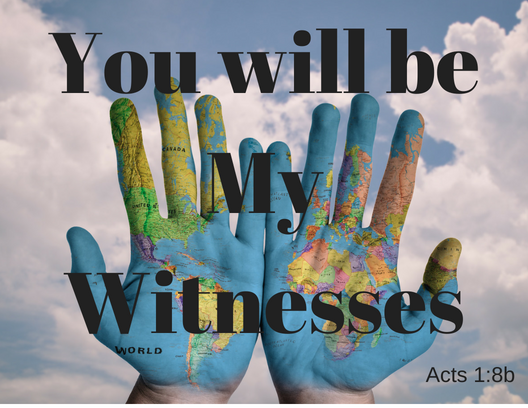
Verses 4-8 include a lot. He told his men to stay in Jerusalem until they were baptized (filled, immersed) with the holy spirit. In a sense that is the power of God, and it would enable them to be witnesses for Jesus. Numerous other purposes for the holy spirit are given, especially in the book of John. Verse 6 is interesting. It’s no surprise his disciples asked if he would immediately restore the kingdom to Israel, because it must have seemed that’s all he talked about. Again, this would suggest the meat of our ministry and message must focus on the KOG! Verse 8 is for all intents and purposes, an outline of the book of Acts.
Verses 9-11 report the ascension of Jesus into heaven, and the promise that this same Jesus would return in the same manner. That is as sure a promise as any. Every New Testament writer at least mentions the return of Jesus. Verses 12-14 then make note that his men returned to Jerusalem (as instructed) and that they joined together constantly in prayer. This would suggest their dedication to the Lord and the task at hand. They must have been at a loss, with Jesus disappearing on them, and needed direction. The rest of the chapter talks about the foolish reaction of Judas when he realized what he’d done, as well as Pater’s recommendation they they replace Judas with another.
Reflection Questions
Have you ever fought a battle, enjoyed a victory, and felt the Lord was behind it all?
Following the lead of Psalm 33, name some of your own observations as to why God is worthy of our worship. What are some specific ways you worship?
If the book of Acts is about the acts of the Apostles, or perhaps the acts of Jesus through his apostles, what acts for the Lord are you doing? If someone wrote about your ministry, what would be included?
Prayer
“Heavenly Father, thank you for the victories we can have when we trust and obey you. Help me to worship you in numerous ways, in new ways. Thank you for the hope of the Kingdom of God! Thank you for those who shared that good news with me and those who’ve taught me about it. Use me to do that for others. Help me to be an agent for your coming kingdom. Help me to be a witness for Jesus, for the message of the kingdom. Help me to bring it into conversations. In Jesus’ name I pray. Amen!”
“Be strong and courageous!” Those were the words of God himself to Joshua in the first chapter which we read yesterday. In fact, God there challenged him three times with those exact words. At the end of the chapter, when the whole nation committed themselves to Joshua and his leadership, they too encouraged him with those same words, “Be strong and courageous!”
Joshua’s courage, and that of all the Israelites was tested in chapters 3 and 4. God was about to lead them into the promised land, but it meant getting to the other side of the Jordan River. There was no bridge and the river was at flood stage. A most amazing miracle was about to happen! The priests were to carry the ark of the covenant into the river. As soon as their toes got wet, the flow of the river was disrupted. The current, flowing from the north to the south, completely stopped, and the water heaped up to their right. It was an invisible dam, accomplished by the almighty power of God. There’s no way to know how high that wall of water heaped, but it must have been quite a sight! No water flowed to the left. People downstream must have wondered what happened to the river? Not only did God stop the flow, but the whole nation then walked across the riverbed into the promised land. Not only did they walk across the riverbed, but it says they walked on dry ground! You can imagine the mud and muck at the bottom of the Jordan. How long would that have taken to dry up naturally? A few years ago, I baptized a young lady in a pond. After immersing her, we attempted to return to shore, but my feet were quickly sinking into the mud, so much so that I began to sink. We both needed help getting out of the water. God not only stopped the flow of the Jordan, but he instantaneously dried up the riverbed. A miracle indeed!
One more thought before we move on. Joshua 4:24 says, “He did this so that all the peoples of the earth might know that the hand of the LORD is powerful, and so that you might always fear the LORD your God!” To fear God is to have a holy revere for him, that is, a deep respect and admiration.
Psalm 33 is a Psalm of praise and acknowledgment of who the LORD is, what he has done, his obvious worthiness of worship. Notice especially the teaching in V. 8, “Let all the earth fear the LORD; let all the people of the world revere him!” See also V. 18, “But the eyes of the LORD are on those who fear him, on those whose hope is in his unfailing love . . .” This reveals the call, and good reason for all people to respect and worship the LORD!
As you read Mark 16, you’ll probably see a note that verses 9-20 are not included in the most reliable early manuscripts. That’s not to suggest that those events never happened, nor that those words were never said. They may, or may not have happened or been said, but there’s doubt that they were originally part of Mark’s gospel. Most of these references are verified in other scriptural accounts. I will mention that some suggest a diminished importance for water baptism since Jesus’ words in verses 15 & 16 may or may not have ever been put quite like it’s worded here. One should never propagate a teaching or position based solely on one questionable passage. However, this questionable passage does not negate the numerous other scriptures that teach water baptism and its significance as a step in the process of salvation.
Reflection Questions
Joshua was clearly called and equipped to serve the LORD. In what ways do you feel called and equipped to serve?
Have you ever needed the encouragement to be strong and courageous when you knew you needed to do the right thing?
Have you yourself submitted to the waters of baptism as taught and practiced in the book of Acts, as symbolically explained in Romans 6, and with the promise of Galatians 3?
Prayer
“Heavenly Father, thank you for the historical record of men and events such as we read in the book of Joshua. Thank you for the teaching and challenge we find in Psalm 33, that we should fear, revere you, that we should put our hope in you, and that your eyes are upon those who do. Thank you again for your son Jesus, and for the hope we can have in the kingdom because of him! In his name. Amen!”
Moses, representing the law, was very much a great man and leader. He led the Israelites out of slavery in Egypt, through the wilderness, and eventually right up to the promised land. He saw it, but was himself denied entrance because of his own failure to perfectly obey God. This illustrates the weakness of the law, which in reality is the weakness of all people who are absolutely incapable of perfect obedience to that law. No one can enter God’s rest, the promised land, the kingdom of God on their own merit.
Joshua, who’s name means “The LORD saves” succeeded Moses and did in fact lead the Israelites into the promised land. Fast forward to Gabriel’s announcement to Mary that she was to give birth to a son. He told her his name would be Jesus, which is the Greek version of Joshua. When an angel appeared to Joseph in a dream, he explained the significance behind Jesus’ name. It was “because he will save his people from their sins!” Joshua was a type, or picture of Jesus, leading the Israelites into the promised land.
Psalm 32, written by a repentant King David, is a beautiful reminder of the weight of guilt, the necessity of confession, the blessing of forgiveness, and the joy of being right with the LORD! Read here the first two verses, and the last, but be sure to read the entire short Psalm. “Blessed is he whose transgressions are forgiven, whose sins are covered. Blessed is the man whose sin the LORD does not count against him and in whose spirit is no deceit!”“Rejoice in the LORD and be glad you righteous; sing, all you who are upright in heart!” (Psalm 32:1,2 & 11)
Now we come to Mark 16. We’ve been reading about the last supper, prayer in the Garden of Gethsemane, Judas’ betrayal, Jesus’ arrest, his trial, Peter’s denial, Jesus’ crucifixion, death, and burial. Mark’s climax to all this is his short, sweet, and factual report of the resurrection of Jesus from the dead! It was early Sunday morning when three women went to Jesus’ tomb, taking spices to anoint his body. The Jewish community neither then nor now practice embalming. The women evidently had no idea Joseph of Arimathea and Nicodemus had already treated Jesus’ body with 75 pounds of myrrh and aloes. Nor did they even hope or suspect that he might be resurrected from the dead! Who would have thought?
“He has risen! He is not here!” Those were the words of the angel who was seated in the tomb. What a shock! What an announcement! It seemed too good to be true! In fact, Mark’s version tells us they ran away, fearful, and told no one! “He has risen! He is not here!” According to the Apostle Paul, our hope rises and falls on the resurrection of Jesus from the dead. Paul states clearly that this truth is one of the several things one must believe in order to be saved. “He has risen! He is not here!”
Reflection Questions
Are you solid in your conviction that Jesus was raised from the dead, that he is alive, at the right hand of God? Is your lifestyle a testimony to that conviction?
Is there any sense in which you’ve dozed off when you should have been watching? Betrayed Jesus, as did Judas? That you’ve denied him, as did Peter? That you’ve doubted, as did Thomas?
Are you clear in understanding that you will not enter the kingdom of God on your own merit? That it is only through the resurrected Jesus that you have hope?
Have you experienced the weight of guilt, the necessity of confession, the blessing of forgiveness, and the joy of being right with the LORD?
Prayer
Heavenly Father, thank you so much for your love, your plan from the very beginning to cover our sin, and for Jesus whom you sacrificed on the cross. You allowed him to become sin, so that we might become righteous. Thank you for raising him to live again, to live forever, the firstfruits of eternal life. Thank you for wanting me in your kingdom, and for making a way for it to happen. Help me to make you proud. Help me to live like Jesus. In his name I pray. Amen.
I have never had trouble falling asleep. This is not meant as a brag, but as an acknowledgment of a blessing. If I am tired, anytime, anywhere is fair game. I once slept for a week of church camp on a wooden church pew without a pillow or blanket. I slept on the couch in my classroom (after school, of course). I have fallen asleep in conversations, while holding children, and even while writing devotional blogs. I often joke that my conscience is either incredibly clear or non-existent because I so rarely lie awake in bed. This is the sleep of life—the kind that repairs, restores, and brings rest, and I enter it so easily.
Some fifty times, the Bible refers to death as a differing kind of sleep. Moses is described as entering into rest with his fathers. Daniel foretells that multitudes who sleep in the dust of the earth will awake (Daniel 12). When Jesus speaks of Lazarus in John 11, He tells His disciples that he is sleeping. In 1 Corinthians 15, Paul repeatedly refers to those who have died in Christ as asleep, and that what has fallen asleep is the firstfruits of the dead. Death is an eventuality, but it is not a finality. Though the sleep of death brings decay, it is not this death that brings ultimate destruction.
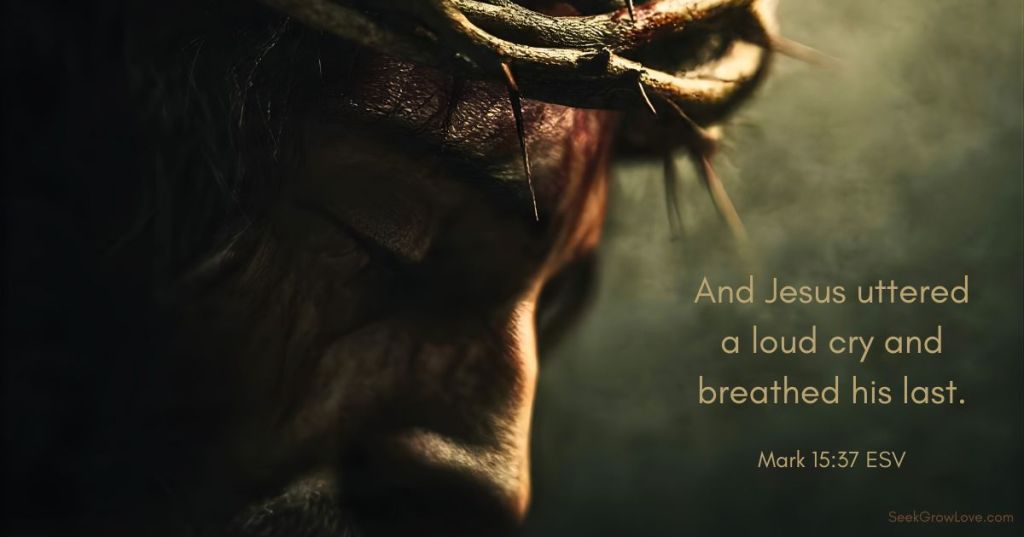
“With a loud cry, He breathed His last.” — Mark 15:37
Jesus fulfilled the will of the Heavenly Father to the point of death. Where there was once healing, there was now stillness. Where there was once preaching, there was silence. The Savior, once full of life, entered into the sleep of death for three days.
We tell this story over and over again, but have we ever imagined what it would be like to be a disciple of Christ during those three days? If I were ever to lie awake, it would be on those nights—replaying the Gospel, recalling the prophecies, searching every word I had heard for hope, fraught with fear over the fate awaiting me as His follower, and asking:
What does the death of Christ mean for me?
On this side of the resurrection, I can answer. If Jesus Christ is raised, then death is not the end. The sleep of death can, in fact, repair, restore, and bring rest. It does not simply mark the end of excruciating pain—whether from a cross, a battle with cancer, or the unexpected loss of someone we thought was “too young.” Instead, it becomes the completion of this life and the beginning of the next. Christ died for our sins, and we can rest assured of this—not only as we one day enter that sleep, but even now as we live in the fullness of faith.
“Blessed is the one whose transgressions are forgiven, whose sins are covered. Blessed is the one whose sin the Lord does not count against them and in whose spirit is no deceit.” — Psalm 32:1–2
In the final hours of His life, the suffering of Jesus became the answer to the problem of sin. We do not overcome this world by striving harder or fighting in our own strength. It is through Christ’s propitiation, the sacrifice of His Heavenly Father, and our willingness to take up our own cross and follow Him. In Jesus, we find that we can rest in peace even now, because the sacrifice has been made. Though our transgressions are many, our slate has been made clean.
What was once feared is no longer final. To fall asleep in Christ is to awaken to the assurance of things not yet seen. Christ has finished the work, so we can fully, faithfully, and freely embrace that finish.
Death, where is your sting? For even in you, we can rest in peace.
Reflection Questions
Where in my life am I resisting rest—striving for control instead of trusting God?
How would my perspective change if I truly believed that even death—and every ending—is held securely in God’s hands?
Prayer
Thank You for the rest that comes through forgiveness. Thank you for the stillness and quieting of my soul that comes in the tomb of Jesus, for even death has been transformed.Help me release what I continue to carry—my guilt, my striving, my need for control—and rest in the finished work of Christ. Teach me to trust You not only with my life, but with every ending, every unknown, and every moment of surrender.Because of your plan, I can rest in peace in life and death.
As a new parent, there is little you are truly prepared for. You are not prepared for the noise—the deafening cry of a child who is wet, hungry, or simply needs to be held in the middle of the night. In those moments, exhaustion sets in, emotions wear thin, and clear thinking feels out of reach. No one expects a sleep-deprived, emotionally fatigued parent to make calm, selfless decisions; yet, this is exactly where trust is formed. In the noise, in the uncertainty, in moments where no clear solution seems apparent, you respond in faith, in commitment to your child.
“I will be glad and rejoice in your love, for you saw my affliction and knew the anguish of my soul. You have not given me into the hands of the enemy, but have set my feet in a spacious place.” Psalm 31:5-8
“I will proclaim the name of the Lord. Oh, praise the greatness of our God! He is the Rock, his works are perfect. and all his ways are just. A faithful God who does no wrong, upright and just is he.” Deuteronomy 32:3-5
In Mark 15, the noise reaches a deafening level. Jesus stands before Pilate as accusations are hurled and expectations rise. The crowd grows louder, more insistent, crying out for crucifixion. The pressure is relentless. There is no reasonable path forward that leads to life. Yet in the pulling undertow, as the hope of exoneration moves further and further away from the shore, Jesus trusts his Heavenly Father to deliver him. In the piercing, the crushing, the beating, the bruising, and the relentless barrage of physical and emotional punishment, Jesus still quenches the requirement of His offering, trusting God will not only deliver Him, but is acting divinely, doing no wrong, and showing an infinite love.
Reflecting on this model of Jesus, when tensions are high or we watch life unravel around us, are we ready to stand firm, trusting our Heavenly Father’s nature?
This is the God who rescued mankind on the darkest day of human history. The day that each of us condemned Christ, the only innocent life to walk on earth, is the day we call Good.
Reflect on this: God can redeem ANY day and call it good.
The loud, life-altering noise can be victory if we are obedient.
What I realized in our second go around with an infant is that the cry that was disconcerting and dissonant can also confirm that a child is alive and well. Often we pray that God will take away the noise so we have a moment to catch our breath, to think, to sleep, to figure out a plan. The Creator of the universe needs no assurances from us other than assured obedience: to act in love for those who despise us and to feed his sheep. Who we are as parents or followers of Christ is defined in the presence of pressure, not in the absence
Jesus trusted his Father even when none of what was happening made sense, or the outrage and consequences felt unmerited and unjust. That same faithfulness is cutting through the noise and calling us today.
Reflection Questions
What noise, pressure, fear, or frustration tempts your faithfulness?
What is the Good of Good Friday? How can God redeem ANY day and call it good? What good have you seen come from noise, pressure, fear or frustration in the life of others? What about in your own life?
Aaron wrote Jesus is “trusting God will not only deliver Him, but is acting divinely, doing no wrong, and showing an infinite love.” What do you trust about God and His character, even on the noisiest, hardest day?
Prayer
In the noise of life—when everything feels loud, overwhelming, and uncertain—teach me to trust You. When exhaustion sets in and my thoughts are unclear, help me respond not out of fear or frustration, but out of faith and commitment. Thank You for Jesus, who stood in the noise of accusation and suffering and chose to trust You. When the pressure was relentless and the path forward made no sense, He remained faithful.
Help me to see that even the noise has purpose. Just as a child’s cry is a sign of life, remind me that You are still working in the tension, still present in the uncertainty, still faithful in every moment. Teach me to follow Jesus—to trust You when I do not understand, to stand firm when life feels overwhelming, and to believe that You are redeeming even what feels broken.
In The name of Your Son who poured out Himself as a sacrifice, Amen.
Other than being selected for jury duty and settling a speeding ticket—both nearly twenty years ago—I have very limited courtroom experience. Most of my perception of trials comes from cinema. Films like To Kill a Mockingbird, Miracle on 34th Street, and A Few Good Men often portray the defense similarly: counsel advises the defendant to remain quiet, not allowing emotion to lead to self-incrimination through testimony or reaction.
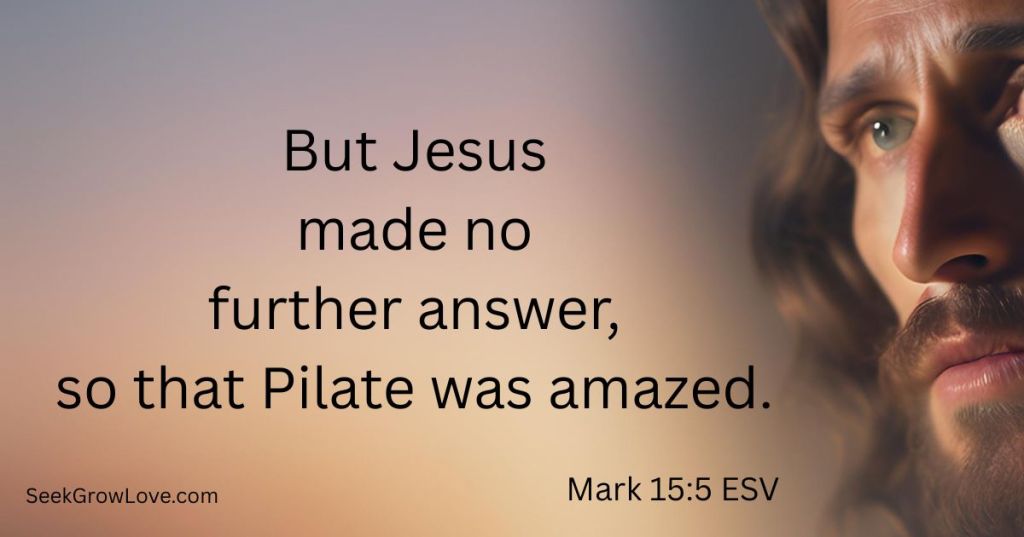
In Mark 15, we see Jesus standing trial. Though not advised by earthly counsel, He embodies perfect restraint. Blameless, perfect, and fully justified, He stands before Pontius Pilate, accused for declaring the truth—that He is the Son of the living God. Every defense was at His disposal. He could have commanded, cajoled, or called down divine power. But instead, “Jesus made no further answer, so that Pilate was amazed” (Mark 15:5). The only One who could offer a true testimony chose silence on behalf of our guilt.
This frames the words of Deuteronomy 30 in a different light. “I have set before you life and death, blessings and curses. Now choose life” (Deuteronomy 30:19). Yet before us stands Jesus, choosing the path that lead to crucifixion in order to spare us. He bore our sins, knowing He would be justified by the Father and raised to eternal life. Moses calls God’s people to choose life, but that life is not found in preserving ourselves.
In Psalm 31, we hear the cry that echoes both David and Christ: “Into your hands I commit my spirit; deliver me, Lord, my faithful God” (Psalm 31:5). To live in the Spirit of God is to entrust ourselves fully to His care. It means we do not grasp for every opportunity to justify ourselves or defend our image. When pride rises and we feel compelled to prove our righteousness, we may be stepping away from the cross we are called to bear. After all, it was Barabbas—the guilty—who was released, while Jesus, the innocent, accepted his date.
This is the paradox of the Christian life: “Whoever wants to save their life will lose it, but whoever loses their life for me will find it” (Matthew 16:25). Our heart, soul, mind, and strength are not meant to empower self but to surrender fully. Jesus knew that accepting His sentence would yield eternal glory. Likewise, we stand before our Heavenly Father not with arguments, merits, or credentials, but with a desperate plea for mercy—relying on Jesus Christ, our mediator and counselor
Choosing death is not choosing despair. It is the daily decision to lay down our rights, our pride, and our need to justify ourselves—and instead trust fully in the example of Jesus Christ. We choose conviction. We choose meekness. We choose death.
Reflection Questions
Can you think of a time when you chose to not defend yourself even though you would have been justified to do so? Can you think of a time you did defend yourself but it might have been better if you had not? Why was Jesus silent?
What could it look like to today live out Psalm 31:5 – “Into your hands I commit my spirit; deliver me, Lord, my faithful God”? What do you want God to deliver you from? What does God want to deliver you from? In what ways have you been trying to hold onto your own spirit, your rights, your way of doing things?
How many times do you think you could read Mark 15 today?
Prayer
Dear God, I praise You for Your amazing love for me and the whole human race, a love so deep you gave us the greatest gift, at the cost of the life of Your perfect Son. I thank You for Jesus who teaches us how to life in obedience to You and how to die to self. I thank You for Deuteronomy, Psalms, and Mark 15. Thank you for the written record of Your love and faithfulness and Your plan unfolding. Help me to love You and Your Son Jesus well today. In his precious name I pray.