What to do with the Difficult Times

Ecclesiastes 3

Wednesday, July 20, 2022

Whether you know it or not, you’re probably familiar with the first few verses of Ecclesiastes 3:

1 There is a time for everything, and a season for every activity under the heavens:

2  a time to be born and a time to die, a time to plant and a time to uproot,

3  a time to kill and a time to heal, a time to tear down and a time to build,

4  a time to weep and a time to laugh, a time to mourn and a time to dance,

5  a time to scatter stones and a time to gather them, a time to embrace and a time to refrain from embracing,

6  a time to search and a time to give up, a time to keep and a time to throw away,

7  a time to tear and a time to mend, a time to be silent and a time to speak,

8  a time to love and a time to hate, a time for war and a time for peace.

I like about half the things listed, and would rather not have the other half, but life just doesn’t work that way.  We have to take the bad with the good.

I was at a funeral last Saturday when these verses were read.  It seems like this passage is mostly referenced during difficult times – because we don’t need to be reminded about these things during happy times.  When someone is born, we don’t want to be reminded that they will eventually die.  But when someone dies, we need to be reminded that this world has both good and bad, and we can’t just pick and choose what happens in life.

Verse 11 goes on to say, “He has made everything beautiful in its time.  He has also set eternity in the hearts of men…”.  

Does this mean that death is beautiful?; that cancer is beautiful?; that problems are beautiful?  No, not in themselves.  But the rest of the verse goes on to say that God has set eternity in the hearts of men.  I think that means these experiences make us long for the time when these problems will be a thing of the past.  When there will be no more death, or mourning, or crying, or pain – in the Kingdom of God. 

We mentioned Romans 8:22-23 a couple of days ago, which says, “We know that the whole creation has been groaning as in the pains of childbirth right up to the present time. Not only so, but we ourselves, who have the first fruits of the Spirit, groan inwardly as we wait eagerly for our adoption to sonship, the redemption of our bodies.”

In addition to pain and suffering being consequences of the Curse (Genesis 3) as a result of sin, I believe God uses these to help us long for His coming kingdom.  This longing helps us refocus our lives on following Him.  It also helps us not place too much importance on the temporary things this world has to offer.

James 1: 2-4 says, “Consider it pure joy, my brothers and sisters, whenever you face trials of many kinds, because you know that the testing of your faith produces perseverance. Let perseverance finish its work so that you may be mature and complete, not lacking anything.”

I believe this points out that difficulties we face in life can produce perseverance, helping us mature in our Christian walk, and helping us become more persistent in living for the Lord.  And if we finish strong – living our lives for the Lord – we will be in His kingdom, experiencing delight for eternity.  

So because difficulties can draw us closer to God, which will cause us to live more dedicated lives for Him, with the ultimate result of being in His kingdom, in this sense, everything works together for our ultimate good, and is therefore beautiful.  Even though it might seem like something stinks at the time, it can be beautiful – but only if it makes you long for the Kingdom of God and then live your life devoted to following Him.

If difficult times make us resent that God permitted these times, and if we reject God as a result of this, then we can look forward to Ecclesiastes 3:17 which says, “…God will bring to judgment both the righteous and the wicked…”

I’d like to challenge you to let the difficult times draw you closer to God.  But it’s entirely up to you how you respond.

–Steve Mattison

Application Questions

  1. What difficult times have you been through? What good times have you enjoyed?
  2. What can be learned through the good times? What can be learned through the difficult days (and seasons)?
  3. Looking back on your own life (or the example of someone else) can you see times when the trials and hardships have prompted spiritual growth and perseverance and a re-focusing on what truly matters, including of course eternal life with God and Jesus in the coming Kingdom of God?

Trust

Proverbs 3

Sunday, July 17, 2022

There are so many great nuggets in Proverbs 3, each of which could have a devotion centered on it.  Some of these include:

  • Proverbs 3:3, “Let love and faithfulness never leave you…”
  • Proverbs 3:5-6, “Trust in the Lord with all your heart and lean not on your own understanding; in all your ways acknowledge him and he will make your paths straight.”
  • Proverbs 3:9, “Honor the Lord with your wealth, with the first fruits of all your crops.”
  • Proverbs 3:11-12, “.. do not despise the Lord’s discipline and do not resent his rebuke, because the Lord disciplines those he loves, as a father the son he delights in.”
  • Proverbs 3:27, “Do not withhold good from those who deserve it, when it is in your power to act.”
  • Proverbs 3:33, “The Lord’s curse is on the house of the wicked, but he blesses the home of the righteous.”

Today, I’d like to focus on Proverbs 3:5-6.  “Trust in the Lord with all your heart and lean not on your own understanding; in all your ways acknowledge Him, and He will make your paths straight.”

It’s easy to praise and thank God when things are going well.  And when life is sailing along smoothly, its hard to even think about having to trust in (rely on) God.  But when times get rough, that’s when the rubber meets the road for our faith.

So what does it mean to trust in God when you face financial hardships?  When you’ve lost a loved one?   When you face serious health problems?  When life seems to just stink? When you’re dying?

1 Peter 5:7 says, “Cast all your anxiety on Him because He cares for you.”

In Matthew 11:28, Jesus said, “Come to me, all you who are weary and burdened, and I will give you rest.”

I know from personal experience that it is easy to, “Cast my anxiety on Him” by crying out to God, telling him all my problems, asking Him to solve them, and asking Him to give me peace.  I also know it’s hard to not pick up those problems again and try to shoulder them myself.

In other words, this passage is easy to acknowledge as right, but very hard to really put into practice.

Jesus passed along some wisdom about how to accomplish this in Matthew 6:24-34.  This section starts with Jesus telling us not to worry about our lives, what we’re going to eat, or wear, or anything else.  And the reason he gave was:  God knows what you need, and will take care of you.  Instead, Jesus gave us something else to focus on in Matthew 6:33, “But seek first his kingdom and his righteousness, and all these things will be given to you as well.”

So the trick to not focusing on our problems is to instead focus on God’s promises.  In Revelation 21:4, we’re told that in the Kingdom of God, God himself ‘… will wipe every tear from their eyes. There will be no more death or mourning or crying or pain, for the old order of things has passed away.”

Think about the Kingdom of God and the conditions there.  Obsess over it.  Long for it.  Accept Jesus as your Lord and Savior and then live your life in such a way as to be in God’s kingdom.

I have learned from personal experience that the closer we draw to God during our tough times, the more he seems to lift us up and help us through – in situations where it seems we couldn’t have gotten through on our own.

And while we’re talking about problems, have you ever thought that God may allow problems in our lives to help us focus more on Him and his kingdom?  Romans 8:22-23 says,” We know that the whole creation has been groaning as in the pains of childbirth right up to the present time. Not only so, but we ourselves, who have the first fruits of the Spirit, groan inwardly as we wait eagerly for our adoption to sonship, the redemption of our bodies.”

So, while you’re experiencing loss and pain, focus on God and on his kingdom.  Long for it.  Draw close to God.  In doing this, you will learn to trust in the Lord with all your heart.  And then He will direct your life.

–Steve Mattison

Application Questions

  1. How has God shown Himself to be trustworthy so far – in the Bible? In the lives of people you know? In your own life?
  2. How does remembering God’s promises help get you through tough times?
  3. What does it mean to you to not have to rely on your own understanding?
  4. Would you like to be known as a person who puts their trust in God? How can you work towards increasing your trust in God?

Even on My Hardest Day

Psalm 22

Friday, July 9, 2022

Ever have a bad day? Maybe there were relationship troubles. Maybe a conflict or difficult day at work. Maybe all the little things just added up to having a no fun day. I know I’ve had days like that. But, when I read Psalm 22, I realized maybe my days aren’t that bad.

I’ve never been poured out like water with all my bones out of joint. There have never been lions and bulls all around me. ALL the people that saw me didn’t mock me and hurl insults at me. I have never been encircled by a pack of villains that pieced my hands and feet. Now, granted, the lions and dogs and bulls are metaphors for the enemies, but I wouldn’t describe the boy in kindergarten who told me I couldn’t cut well, or the girl who pushed me on the playground, as bulls or lions.

According to the notes in my study Bible, this psalm is the most quoted psalm in the New Testament. And, it fits Jesus’ circumstances, hence Jesus quoting the first part of it while on the cross. He was tortured and tormented for things he didn’t deserve, and I’m sure it hurt more than rude kids on the playground.

This psalm goes on, with David mentioning many hardships, but he doesn’t just ask God to magically fix his circumstances instantly. Instead, the end of the psalm talks about praising the LORD. That’s pretty impressive, and I think it should be a goal of mine, to take hard situations and continue to praise God and tell others about Him.

I’m going to use this psalm as a reminder of the no pain, no hardships time of the Kingdom. And to go about my days, whether difficult or seemingly easy, praising God and knowing that it’ll just get better in the Kingdom, because of what Jesus did for us and the plan God has for us.

-Moriah Railton

Application Questions

  1. Looking at Psalm 22 what descriptions do you find of the pain and agony Jesus endured while carrying your sins to the cross? Why do you think God chose this way to draw you close to Him?
  2. Why do you think Jesus quoted this Psalm on the cross?
  3. How can you focus on praising God even on the hard days?

The Peoples Plot

Psalm 2

Wednesday, July 6, 2022

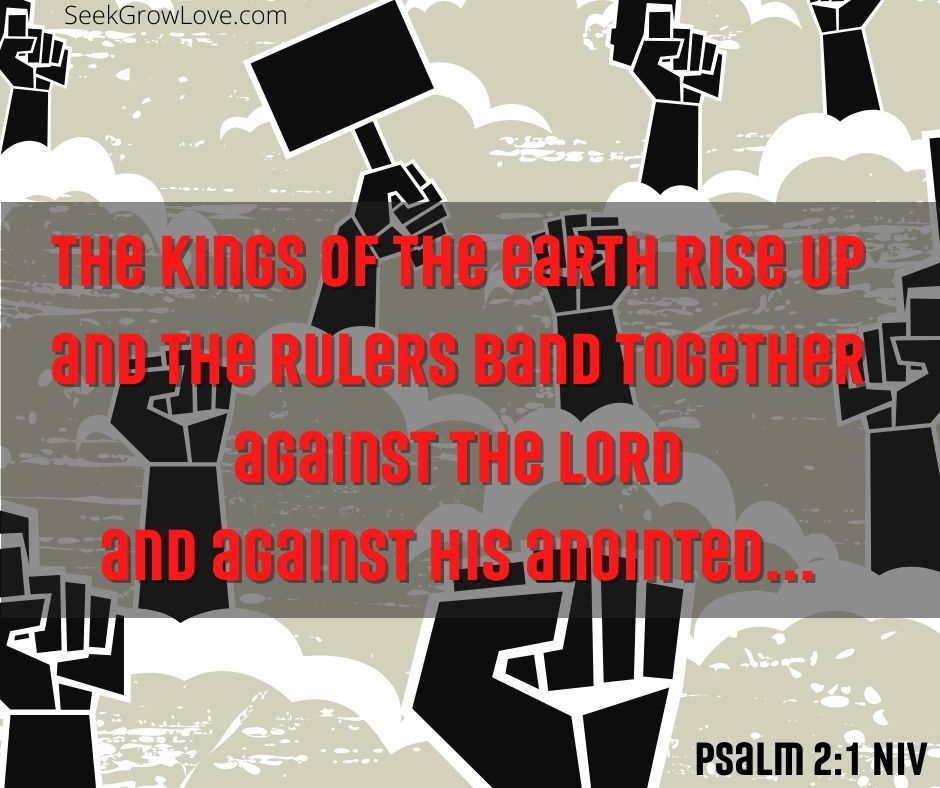
A desire for fame, power, or wealth has led numerous nations, peoples, kings, and rulers to disregard God’s word, and commit evil acts. These acts are questioned by the author of Psalm 2, likely David. He asks, “Why do the nations conspire and the peoples plot in vain?” (Psalm 2:1). Further, the “kings of the earth” and “rulers” are against not only God, but against “His anointed” as well (Psalm 2:2). Those that God anoints, ultimately and most significantly referring to Jesus, share a common desire and goal with God, so those that go against God’s anointed ones go against God Himself. 

David continues the Psalm by describing how pointless it is for the earthly rulers to act against God. Back in verse one he mentions how the plotting is in vain, so the people are constantly unsuccessful in overthrowing God’s plans. David suggests that God even laughs at them for trying (Psalm 2:4), as He is omnipotent and already had a plan for a new king. God’s plan involved David as King and his eventual descendants. He promised to David that “[his] house and [his] kingdom will endure forever before [God]; [his] throne will be established forever” (2 Samuel 7:16). David paraphrases this prophecy in verses 6-9 of Jesus coming as a descendant of David to rule over the world. There will be a time when evil is destroyed, and God and Jesus will reign forever in the Kingdom of God. 

Most of the rest of the chapter is a warning to kings, rulers, and leaders to follow God and those he anoints: specifically, Jesus, the Son of God. Following God requires dedicated service to God and His Son. David uses the phrase “Serve the LORD with fear” (Psalm 2:11), which could be interpreted as genuine service to God with knowledge of His amazing power, mercy, and grace, and not simply an action to check off a list. The idea of serving God is modified to include serving and following God’s Son who would come after David.

The chapter ends with a reflection of the beginning of Psalm 1. The book of Psalms begins by stating “Blessed is the one who does not walk in step with the wicked or stand in the way that sinners take or sit in the company of mockers, but whose delight is in the law of the LORD and who meditates on His law day and night” (Psalm 1:1-2). Psalm 2 questions the logic of the nations and kings that don’t follow God, but rewards those that do follow God by explaining that “Blessed are all who take refuge in Him” (Psalm 2:12). 

Psalm 2 was written mainly as a reminder for the people in the time of David to follow God and “take refuge in Him” (Psalm 2:12), but it has many applications to other people. For example, in Acts 4, believers quoted the first two verses of Psalm 2 after Peter and John were told by the Sanhedrin to not “speak or teach at all in the name of Jesus” (Acts 4:18). They recognized that those in charge of the Sanhedrin were going against God’s word, and Peter and John decided to continue following God’s way. They, and all the believers with them, prayed for God to “consider their threats and enable [God’s] servants to speak [God’s] word with great boldness”, in addition to prayers for healing and miracles (Acts 4:29-30). God quickly responded to their prayer and “the place where they were meeting was shaken. And they were all filled with the Holy Spirit and spoke the word of God boldly” (Acts 4:31). God gave them the courage and strength to continue serving Him, even with threats against them. 

In today’s society, there are some who “conspire”, “plot in vain”, “rise up”, and “band together against the LORD and against His anointed” (Psalm 2:1-2), but it is still possible to remain faithful to God. Prayer can help to develop a relationship with God and “take refuge in Him” (Psalm 2:12). Those that do will be blessed and the nations will be the inheritance received according to Psalm 2:8. Similar wording is used in Revelation 2:26-27 when Jesus states that, “To the one who is victorious and does my will to the end, I will give authority over the nations – that one ‘will rule them with an iron scepter and will dash them to pieces like pottery’” (Revelation 2:26-27). Following God and Jesus throughout persecution while others are rebelling against God will result in a blessing in the Kingdom of God of eternal life ruling under God and Jesus after evil has been destroyed.  

-Josiah Railton

Reflection Questions

  1. At whom or what do you think God may currently be laughing – scoffing at their actions? (In other words, what in today’s world is evil, rising against God? And is God scared?)
  2. How will you serve the Lord with fear amongst those who rise up against the Lord?
  3. How will the story end?

A Scary Word

1 Corinthians 2

June 3

Here at the Oregon church we have really been focusing on evangelistic outreach. No other word puts quite the fear in the heart of a Christian like the world evangelism. There are many anxieties that come with the idea of evangelism: sharing the good news of Jesus Christ. There is the fear of rejection. There is the worry that you might look foolish. There is maybe a concern that you won’t say the right things. Maybe there’s a worry that you don’t know enough about the Bible and therefore you aren’t qualified to reach out to people about Jesus and the kingdom. There is just a lot of worry that goes into it.


A lot of the fear and anxiety that comes from sharing the good news of Jesus Christ with people is that we can make it about us. Look above at what was said about the fear of sharing the gospel: every fear and anxiety that was mentioned about sharing the gospel is because we focus on how it affects us. We make it about our rejection, or our feelings or our knowledge. God has made the gospel so simple and yet we can be so afraid of it. And when I say we are afraid, I’m talking about me too. Just because I’m a pastor doesn’t mean that I don’t have fear and anxiety about sharing the gospel. You don’t need a PhD in theology to share the gospel with people. You don’t need to have a deep understanding of Levitical dietary laws, or a complete understanding of ancient Greek. The gospel was made understandable so that no matter who we talk to they can grasp it. We tend to make it more complicated than it has to be.


Paul makes this very point in 1 Corinthians 2. He says: “And I, when I came to you, brothers, did not come proclaiming to you the testimony of God with lofty speech or wisdom. For I decided to know nothing among you except Jesus Christ and him crucified. And I was with you in weakness and in fear and much trembling, and my speech and my message were not in plausible words of wisdom, but in demonstration of the Spirit and of power, so that your faith might not rest in the wisdom of men but in the power of God” (1 Corinthians 2:1-5).


Paul was an extremely well educated man. He was well studied and well read. He knew the Hebrew Bible in profound detail. He was someone that could have really made the gospel presentation more complicated than it should have been. But instead of making a mess of things he says to the Corinthian church that he didn’t come with lofty speech or wisdom. He decided to know nothing besides Christ and him crucified. What Christ accomplished on the cross is of chief importance. Christ died as a substitute for you and me and he rose on the third day. He did this so that one day we can be in the kingdom of God forever. The components of the gospel are easy to remember this way: the kingdom, the cross and the resurrection. The other doctrines of the Bible are important but only believing the gospel is what saves us. The good news of the kingdom of God and our entrance being purchased by the death and resurrection of Jesus is what matters above all else.


Paul continues in the section by saying that we don’t use lofty wisdom and persuasive arguments in order that we aren’t relying on the wisdom of man. Wisdom is important, but ultimately the best and truest wisdom comes from God. The gospel is simple in order that we can fully rely on the power of God to work through us to share to those around us. God is saving the world through His gospel and we should want to be a part of that.


We don’t need to make the gospel more complicated than it is. The simple message of the death and resurrection of Jesus purchasing our gift of eternal life if we believe in him is as easy as it gets. Sharing the gospel doesn’t have to be scary either. It comes from the concern and urgency of wanting people to be in God’s kingdom. It comes from the outpour of our lives as a demonstration of the saving power of God working wondrously through us. Let’s choose to know nothing but Christ and him crucified and share that to a hurt and broken world. Let’s be the people that God works through to reconcile His creation back to Himself.

-Nathan Massie


Application:

  1. To remember that the gospel has been made simple so that we can share with everyone: the kingdom, the cross and the resurrection.
  2. To realize that God is the one who is working through us to share the gospel to the world. It’s His power and not our wisdom that makes the gospel effective.
  3. To realize that the gospel is the power of God and it is of chief importance since believing the gospel is what saves us.
  4. To pray about our anxieties and fears about sharing the gospel and to ask God to give us the strength to share even when we are afraid.
  5. To recognize that when we share the gospel we are making an eternal difference in the life of the hearer.

Watch Out!

Romans 16

June 1

One of the best ways to say “I love you” in the midwest without using those words specifically is to say, “Watch out for deer” when someone is leaving your house in the evening. This is a phrase that is so common, especially in the summer months when deer are more willing to wander further distances before there are plenty of crops to munch on. Ask anyone who has ever hit a deer: the damages to any vehicle can be severe. It is devastating. So, although it is obvious that it is not ideal to hit a deer, nor would anyone want that, we still remind one another to watch out for them. It’s a simple way to show concern to something that is an all too common experience.


The Apostle Paul does just this when he is closing out his letter to the Romans. In Romans 16 he says to the church, “I urge you, brothers and sisters, to watch out for those who cause divisions and put obstacles in your way that are contrary to the teaching you have learned. Keep away from them. For such people are not serving our Lord Christ, but their own appetites” (Romans 16:17-18). We all know instinctively that division is not a good thing. Division causes pain and strife in any family, but we see this specifically in the family of God. Just like in the summer months we ought to watch out for deer, so we need to be on guard against people whose goals are to cause divisions and create obstacles. This type of behavior is found in a person who is not interested in growing God’s kingdom by sharing the gospel. Rather, this type of person is interested in dividing God’s kingdom into different sections. Paul further explains the type of people who are always dividing: they are interested in serving themselves and not the Lord Jesus.


We live in a time where politics and culture are always in the forefront of people’s minds. It is hard to take in any form of media without having some type of political statement attached to it. The division that is caused by the polarizing view of politics is something that can be avoided in the church almost altogether. I say almost altogether because there are issues that Christians should vocally stand for such as being pro-life. A majority of political issues fall under the category of “opinion” however. I heard it said well recently that the Apostle Paul could have filled his letters with news concerning the Roman empire. But he didn’t. He spent his time and efforts sharing the good news of the kingdom of God and the Lord Jesus. We need to be on guard from anything that divides the body of Christ, and to seek unity in the body of Christ. Especially when the divisions are created over opinions, and not because of a dissent in sound doctrine. Division should be avoided as best as we can. We should never roll over because it is easier, nor should we have a church split because it would be easier. We should make every effort to keep the family of God in a unified stance. We are stronger and better together. The kingdom grows because of our common faith. Let’s grow God’s kingdom together and not divide it into smaller pieces.

-Nathan Massie


Application:

  1. Seek to build in unity with those around you and don’t become divided away from other people on the basis of opinions.
  2. Watch out for people who seek to make divisions in the church for their own gain.
  3. To remember Christ wants us to be unified in his body and to rejoice in the unity
    in faith that we all share.

So Much to Share

Acts 20

May 8

Paul has so much to share and so little time to share it.  His ministry has taken him from Ephesus to Macedonia, to Greece, to Troas.  It’s a farewell tour.  He preaches all night, knowing it’s his last chance to convey the essentials of salvation.

I’m struck by the caring urgency that Paul has.  He’s spent weeks (even years) with these people and developed relationships.  Shared joys and sorrows.  He wants to be sure they “get it”; the truth of the kingdom of God.   The shared hope of eternal life binds us together over time and distance.

Blessings abound when God’s people gather.  Whether for a long weekend at a retreat, a few days at a camp or a conference, we build friendships that last. “What grieved them most was his statement that they would never see his face again.”  We’ve all experienced that pang of parting.    But oh the joy of knowing we WILL see each other again as we reign with Christ in his glorious kingdom.

Feel the urgency!

-Annette Osborn

Questions for Reflection and Discussion

  1. What do you most admire about Paul?
  2. What attachments have you made to Christian brothers and sisters that have bound you together through time and distance?
  3. How would you rate your “Caring Urgency”? If it’s a little low, what can motivate you to bump it up?

Scatter and Preach It

Acts 8

April 26

Acts 8:4 – Those who had been scattered preached the word wherever they went.

I once went on a mission trip that included an evening of street evangelism. It was one of the most overwhelming and intimidating experiences I’ve had. For some people, walking up to strangers and asking them “How’s your relationship with God?” is exciting and effortless. For me, it was incredibly awkward – I stumbled over my words, I felt panicked and I just wanted to run back to our bus. 

As I read through Acts chapter eight, verse four caught my attention. My imagination runs wild with scenes of the disciples speaking with random people at the market, or attending a synagogue to share the radical gospel of Jesus Christ, or even standing at the center of the town square and preaching to anyone and everyone who passes by. 

I don’t think that I would employ similar evangelism tactics as the disciples did back in the day or even as some continue today in our modern culture. 

For me, it’s about building authentic relationships with others. Getting to know others and letting others get to know me. And while this is much more in my zone of comfort, I still sometimes get hung up on how much I share with others about my faith. I greatly admire people who seamlessly weave the gospel into their daily conversations with others. It’s an area of growth for me, I know. But if I genuinely care about others, I must get over my own insecurities in order to share the best news of all – the gospel of Jesus Christ and the kingdom of God! 

We have been scattered into the workplace, schools, community organizations, as well as our online associations with others for a purpose. Let’s not waste the opportunity to preach the word wherever we are!

-Bethany Ligon

Questions for Reflection and Discussion

  1. Why share the gospel? Is that just a preacher’s job?
  2. How would you rate yourself when it comes to how often or how well you share the gospel? If you want to improve in this area, what 2-3 specific steps can you take?
  3. Consider your circles (work, school, family, church, community & online). How can you share God’s love, what Jesus means to you and your kingdom hope in each of these circles?

Object Permanence

John 16

April 13

Object permanence is a milestone babies hit when they begin to understand that an object still exists when they can’t see or hear it. When their mother leaves the room, she still exists; when their favorite toy is hidden under a blanket, it still exists, too. 

Object permanence is a skill Jesus reinforced in his disciples on their final night together, before his arrest and subsequent death. 

Jesus went on to say, “In a little while you will see me no more, and then after a little while you will see me” (John 16:16).

The disciples mourned Jesus’ death, and they rejoiced at his resurrection just three days later. Even though they could not see Jesus, he wasn’t gone forever. Just like a baby’s favorite toy hidden under a blanket, Jesus was merely out of sight for a little while. 

You and I have never seen Jesus, yet the disciples’ hope is our hope, too. We can’t see Jesus now, but we will someday—when he brings his Father’s Kingdom down to Earth. We have faith that even though we cannot see him, he is real and he is working. After all, faith is the certainty of the things we cannot see (Hebrews 11:1). 

Although we’ve never seen Jesus, we can see the impact of his life all over our own lives—the freedom of forgiveness, peace in unfathomable situations, victory over temptation and sin. 

Therefore we do not lose heart. Though outwardly we are wasting away, yet inwardly we are being renewed day by day. For our light and momentary troubles are achieving for us an eternal glory that far outweighs them all. So we fix our eyes not on what is seen, but on what is unseen, since what is seen is temporary, but what is unseen is eternal (2 Corinthians 4:16-18). 

We have the same hope as the disciples. We can’t see Jesus now, but we will soon. 

Jesus is coming soon. 

We will see Jesus face to face. 

-Mackenzie McClain

Discussion Questions: 

  1. Even though you’ve never seen Jesus, have you seen evidence of his existence in your life? How so? 
  2. How would you live your life differently if you were constantly reminded of Jesus’ coming return? 

Who Gets the House?

2 Samuel 7

March 9

I love David’s heart to serve and honor the Lord. He decides it is time to build an impressive temple for God to replace the tabernacle tent which had been the symbol of God’s dwelling since the time of Moses. He tells Nathan the prophet his thoughts and Nathan gives him the go-ahead. It truly sounds like a generous and highly appropriate way to honor God. Both the king and the prophet agree – it’s time for God to get a house!

However, that night God revealed to Nathan that, no, that was not what God needed, wanted or had planned. Rather than David providing a house for the Lord God, God said “the Lord himself will establish a house for you (David):  When your days are over and you rest with your ancestors, I will raise up your offspring to succeed you, your own flesh and blood, and I will establish his kingdom.  He is the one who will build a house for my Name, and I will establish the throne of his kingdom forever.  I will be his father, and he will be my son. When he does wrong, I will punish him with a rod wielded by men, with floggings inflicted by human hands.  But my love will never be taken away from him, as I took it away from Saul, whom I removed from before you.  Your house and your kingdom will endure forever before me; your throne will be established forever.” (2 Samuel 7:11b-16 NIV).

That’s an unexpected twist.

God doesn’t want David to build him a house. David could be disappointed or even a bit offended at God rejecting his offer and plan. Except that, God revealed a bigger and better plan. David’s son would build the house for God, but even greater, the house, kingdom and throne of David, passed down to his son would endure – forever! This was big news! A king certainly has dreams of creating an impressive dynasty – but none of them expect it to last forever. Not too many years ago David had been a shepherd boy, the youngest and least of his family line. And now he was being told he and his descendent would have a kingdom and throne that would endure forever. That’s a plan of God you don’t argue with. David gets the house.

And the really great news is that this forever house and kingdom and throne wouldn’t just benefit David and his son – but all generations could be blessed by this, including you and I and our children. For this promise for David (often referred to as the Davidic Covenant), was pointing to the coming of Jesus the Messiah, the Son of God and the Son of David. His coming was prophesied as fulfilling this covenant (Isaiah 9:6,7). The virgin Mary was told, “You will conceive and give birth to a son, and you are to call him Jesus.  He will be great and will be called the Son of the Most High. The Lord God will give him the throne of his father David,  and he will reign over Jacob’s descendants forever; his kingdom will never end.” (Luke 1:31-33). Born in the line of David (Matthew 1:6), Jesus was worshiped as a king by the wise men (Matthew 2:2, 11). He taught of a kingdom, and he was crucified as the King of the Jews. But that is not where the story ends. Forever is still coming.

Before his death, Jesus said – “When the Son of Man comes in his glory, and all the angels with him, he will sit on his glorious throne.” (Matthew 25:31). The disciples were looking forward to this time and after his resurrection, just before his ascension, they asked him if that was when the kingdom would be restored. Jesus replied that the time was not for them to know – but that in the meantime they were to be his witnesses. Then Jesus ascended to heaven in the clouds, and the angels promised he would return in the same way. (Acts 1:6-11)

We are still waiting for the return of the Son of David/Son of Man who is also the Son of God. At Jesus’ spectacular return to earth, all the final steps will be set into motion – resurrection of the dead, judgment, the defeat of the Evil One, and the beginning of the perfect kingdom prepared for the resurrected, faithful children of God which will last forever. Can you imagine the smile on resurrected David’s face and the joy in his heart when that day comes? God’s plan and timing is always better than man’s. No – David didn’t build a house for God as he wanted. But, God is building a house through David’s family line, through Jesus Christ. Will you have a place in this house, in this kingdom that will last forever?

-Marcia Railton

Questions for Reflection and Discussion

  1. Can you think of any time (past or present) where you were wanting to honor God, but perhaps it wasn’t the way He wanted you to be serving Him at that time? How do we avoid serving God the way WE want to serve Him, rather than the way HE wants us to serve Him?
  2. Do a little Bible research on the kingdom that will last forever. Where will it be? When? Who is reigning? Who is included? Who is not included? (If you want some specific verses to start your research, leave a note in the comments.)
  3. As we wait for Jesus’ return, how will you be a witness? Who else needs to hear about the fulfillment of the Davidic Covenant?