See Clearly

Matthew 7

January 7

“Do not judge, or you too will be judged.” (Matthew 7:1 – NIV) Its a loaded statement. We don’t like to feel judged and told that we are wrong, so we won’t judge and tell other people they are wrong. And so this single verse is used to justify, and even demand, blind acceptance of others and all their deeds. You are free to be gay – I have no right to judge. You are free to have the right to an abortion – I have no right to judge. You are free to believe you are a woman when God made you a man – I have no right to judge. You are free to hook up with anyone anytime you want – I have no right to judge. And that is what some would have us believe a good Christian should do. Let them be them and accept them for it. Their way is just as good as my way.

Only trouble is – the rest of this passage continues.

“For in the same way you judge others, you will be judged, and with the measure you use, it will be measured to you.” (Matthew 7:2 – NIV) If you use a yard stick to measure yourself but a meter stick to measure others, they will always be coming up short. It is not a fair and right judgment or measure. It is skewed in your favor to make others look less than. They just don’t measure up to your greatness.

Here’s a little true story example – I have been known to be put out and upset when someone I am waiting for is running late. How could they inconvenience me by not operating more according to my clock and my time schedule? Only trouble is, yesterday I was caught by a train (it happens here in northern Indiana – the crossroads of America) and I didn’t show up exactly when someone else was expecting me, but of course my tardiness was excusable, because it wasn’t my fault, I didn’t know a train was going to be coming, etc…. It is not my right to condemn, chastise, be upset with others if I am not willing to be measured in the same way. Late is late. And, in actuality, it’s not my clock or their clock that really matters anyway – but what does God’s clock or measuring stick or word say? That is what matters.

The passage continues, “Why do you look at the speck of sawdust in your brother’s eye and pay no attention to the PLANK in your own eye?…You hypocrite, FIRST take the plank out of your own eye, AND THEN you will see clearly to remove the speck from your brother’s eye.” (Matthew 7:3, 5 – NIV). If a brother has a speck in his eye and there was something loving you could do to help him get that irritating, painful thing out, wouldn’t you want to? Wouldn’t God want you to? But, how much help could I be in this delicate operation if my own eye has a beam sticking out of it? I can’t see clearly to help others out of sin when I am swimming in it myself. That sin in my own life is first priority. I must deal with it. Get rid of it. It may hurt like crazy to pull that beam out – but until I do, my usefulness to help guide and correct others is gone. Pull it out. Heal. See Clearly. Then, I can help others, with the same word of God, same guidelines, same measuring stick and same mercy and compassion that saved me.

It is very true I am not the judge and the jury. God is and He will share that job with His Son. But I DO have a responsibility to watch myself closely, to hold myself accountable to the Word of God, and to be very aware of what is happening around me – including the sin that so easily entangles.

All paths are not created equal. Some – the narrow ones that not many people are willing to stay on – lead to life. Others – the wide, easy, popular ones where the majority are – leads to destruction. It would be foolish of me to not be judging which path I am on at all times. See clearly the two paths.

We are told, “Watch out for false prophets. They come to you in sheep’s clothing, but inwardly they are ferocious wolves” (Matthew 7:15). This will require VERY keen eyesight and insight. We will have to be wise in judging what may at first seem right and true but in fact is cleverly disguised, dangerous, deadly lies which are leading many down the wrong path. Watch out! See clearly those who are deceiving and being deceived. Blind acceptance will take you somewhere you do not want to go.

Make sure you are not sitting in the house of the foolish builder as the wind picks up. Many in that house have heard the word of God. They may profess Christianity and call him Lord and even seek to serve him. But they are not acting any different from the world. They are not doing the will of God. They have grown comfortable with the plank in their eye. They have befriended the wolf in sheep’s clothing. They have failed to put Jesus’ words into practice. They are on the wide path approaching the wide gate that leads to destruction.

Get out and move to the house of the wise builder before the downpour comes! Hear Jesus and listen. Do what he says. Take the plank out of your eye. See clearly. Help your brother take the speck out of his. Don’t make friends with the wolf just because he dressed up like a sheep.

See clearly. All paths are not the same. All houses will not stand. All choices are not okay. All churches will not be saved. Some will lead to life. Some will lead to death. Use the same measuring stick – God’s Word and the teachings of Jesus. And put it into practice! See clearly. Judge roads and gates and houses and wolves wisely. Your life truly depends on this.

-Marcia Railton

Questions for Reflection and Discussion

  1. What was the difference between the wise and foolish builder? What fate awaited each? How can you put into practice the words of Jesus from Matthew 7 today?
  2. When we were introduced to John the Baptist and to Jesus we were told what they were preaching – see Matthew 3:2 and 4:17 to remember. Are any lessons from Matthew 7 connected to this preaching theme? If so, how?
  3. Is it easier for you to see your own sins or the sins of others? What advice does Jesus give? Pray to see clearly your own sins first so you can deal with them.
  4. How do you feel when you read Matthew 7:21-23? How does it relate to the rest of the chapter? How can we live now to avoid hearing these words from Jesus?

Which Fate will You Choose?

Revelation 14 – 15

Even though Revelation 14 was part of yesterday’s reading, I waited to comment on it until today so we could contrast the fate of those who submit to the antichrist from Revelation 14 with the fate of those who resist the antichrist in Revelation 15.

Rev 14: 9-12 tells us, “…If anyone worships the beast [the antichrist] and his image and receives his mark on the forehead or on the hand, he too will drink of the wine of God’s fury, which has been poured full strength into the cup of his wrath.  He will be tormented with burning sulfur in the presence of the holy angels and of the Lamb.  And the smoke of their torment rises for ever and ever.  There is no rest day or night for those who worship the beast and his image, or for anyone who receives the mark of his name.  This calls for patient endurance on the part of the saints who obey God’s commandments and remain faithful to Jesus.”

In a nutshell, no matter how bad it will get for Christians, including being martyred for their faithfulness to Jesus, the punishment for the wicked will be infinitely worse.  This will call for patience and endurance on the part of Christians – when given the choice between “the good life” of following the antichrist, or torture and death for remaining faithful to Jesus.

By contrast, we read in Revelation 15:2-3, “And I saw what looked like a sea of glass mixed with fire, and standing beside the sea, those who had been victorious over the beast and his image and over the number of his name.  They held harps given them by God and sang the song of Moses the servant of God and the song of the lamb:  “Great and marvelous are your deeds, Lord God Almighty.  Just and true are your ways, King of the ages.””

Every one of us has a choice to make.  Usually these choices are in little things – would God approve of this or that that I’m doing?  As we consistently choose to live for God, it gets easier to make the right choices.  Eventually, making the right choices will be really tough.  If we don’t develop the discipline now, we’ll never be able to endure when times get tough.

This reminds me of Moses’ challenge to the Israelites just before his death, as recorded in Deuteronomy 30:15, “See, I set before you today life and prosperity, death and destruction.”

Which will you choose?

-Steve Mattison

Read or listen to today’s Bible reading plan passages at BibleGateway.com here – Zechariah 1-2 and Revelation 15

Listen Carefully

Ezekiel 3 & 4

Yesterday, I was sitting at my desk, reading an article for work, and I found myself nodding off. Which isn’t funny, unless you know that I sit on a physioball rather than a traditional office chair…which means I lost my balance when my body relaxed and I almost fell off…then it’s hilarious! 

As I woke up and caught myself, I refocused on the article and realized that I hadn’t comprehended a word of the article. I had to reread it several times before I could understand the point the author was making. 

Have you ever found your eyes moving across the page, but not reading? Have you sat through a lecture (or gasp, a sermon!) but not hearing? 

As if Ezekiel’s vision of a four faced creature wasn’t extraordinary enough to hold his attention, God specifically says, “Listen carefully and take to heart all the words I speak to you”. 

This is pretty much the same thing that happens when adults are speaking to children and when we want to be assured of their attention we say, “Look at me when I am talking to you.”

The message that God was giving to Ezekiel was that important. The task that Ezekiel had to obey was literally the difference between life and death. God wanted to make sure that he had Ezekiel’s full attention.

Throughout both the Old and New Testaments, Scripture tells us to “listen carefully”. Obeying God’s Word is a matter of life and death. Whenever we open up our Bibles, we need to read, not just with our eyes, but with our hearts. When we do so, that is when our lives are transformed into Christlikeness. 

Let’s be extra attentive today as we read the Word of God.

-Bethany Ligon

Today’s Bible reading passages can be read or listened to at BibleGateway.com here – Ezekiel 3-4 and 1 Peter 3

Battlefield of the Mind

Jeremiah 21-22 and Hebrews 2

Going to God is easy when it’s something good. It’s easy when it’s something you are proud of, but what about those times when you are going through something hard or you did something wrong? Why is it so hard to go to Him then? We shouldn’t feel scared or ashamed to admit when something bad happens, we should feel comfortable telling God all, the good and the bad.

In Hebrews 2:7-8, it says, “You made them a little lower than the angels; you crowned them with glory and honor and put everything under their feet.” These two verses specifically talk about how God created humans just a little lower than his angels. He created us with glory and honor. That glory and honor doesn’t go away because we made a mistake.

Jeremiah 21 is all about God rejecting Zedekiah’s requests. Just because God rejects a request doesn’t mean he thinks you are a horrible person. Going along with telling God all, people aren’t built for guilt. God didn’t create humans to be guilty; he expects us to tell him everything. And when I say not feel guilty I mean he knows we aren’t going to be perfect human beings. Failure is normal. A lot of the greats in the Bible failed but God still held them to a high power. An example of this is David who committed a lot of sins and God still said he was a good man. Peter denied Jesus 3 times but he’s one of the greatest apostles. The reason being was they still came to God in their bad situations. Many of the people in the Bible did bad, but they came to God and did more right by him. People aren’t wicked just because they did one thing wrong. It’s okay to be weak as long as you admit to it and repent.  Turn from your sin and return to God. God was still giving Zedekiah another chance to turn from his sin before judgment came. Will he take it? Will he choose life or death? Remember that the devil can get to you easily, it’s the battlefield of the mind. 

-Genesis Dylewski

Today’s Bible reading passages can be read or listened to at BibleGateway.com here – Jeremiah 21-22 and Hebrews 2

Detestable Practices

2 Chronicles 33-34

I have two dramatically different directions I’d like to go with today’s reading, and decided I’d share them both.

In 2 Chronicles 33:1-2, 6, we find, “Manasseh was twelve years old when he became king, and he reigned in Jerusalem fifty-five years.  He did evil in the eyes of the Lord, following the detestable practices of the nations the Lord had driven out before the Israelites. … He sacrificed his sons in the fire in the Valley of Ben Hinnom, practiced sorcery, divination, and witchcraft, and consulted mediums and spiritists.  He did much evil in the eyes of the Lord, provoking him to anger.”

Did you catch that, he sacrificed his sons in the fire.  As repulsive as everything else is that he did, in my mind, nothing can compare with that.  That sounds horrible, and in my mind, he deserved a horrible punishment.

2 Kings 24: 1-4 tells the end of that story.  It goes like this, “During Jehoiakim’s reign, Nebuchadnezzar king of Babylon invaded the land, and Jehoiakim became his vassal for three years. But then he turned against Nebuchadnezzar and rebelled. The Lord sent Babylonian, Aramean, Moabite and Ammonite raiders against him to destroy Judah, in accordance with the word of the Lord proclaimed by his servants the prophets. Surely these things happened to Judah according to the Lord’s command, in order to remove them from his presence because of the sins of Manasseh and all he had done, including the shedding of innocent blood. For he had filled Jerusalem with innocent blood, and the Lord was not willing to forgive.”

God annihilated the nation of Judah because of all the innocent blood Manasseh had shed.  God wasn’t willing to forgive.   As I read this, I have to agree that God was right in his judgement against Judah.  They deserved everything they got.

But this makes me wonder, how are we different from Judah?  We may not sacrifice our children in the fire, but we do have rampant abortion in our nation.  I wonder, in God’s eyes, how do those two ways of shedding innocent blood differ?  Which makes me wonder how much we are provoking God to anger, and what will be the end of our story as a nation.  I see parallels, and they concern me. 

The second thing that jumps out at me from today’s reading is that Manasseh was born during the additional 15 years that God had extended Hezekiah’s life.  If Hezekiah had died when he was originally very sick, Manasseh would not have been born, and someone else would have been king.  It may have been that Judah would have existed as a nation far longer.  In this case, I think we can agree that for the greater good, it probably would have been better if Hezekiah had died young, so Manasseh would not have been born.

I know probably more than most, how we long to have life extended, and how we may plead with God to spare life.  But I’m reminded of Isaiah 57:1-2, “The righteous perish, and no one ponders it in his heart, devout men are taken away, and no one understands that the righteous are taken away to be spared from evil.  Those who walk uprightly enter into peace; they find rest as they lie in death.”

We don’t often think that sometimes the righteous die, basically for their own good.  We view death as the enemy, and rightly so, but this life isn’t our final reward.  This life is the test to see which eternal reward we will receive, life or death.  It’s easy to say, but hard to put into practice that we should live so sold out for God, that we shouldn’t be concerned about our life or our death.  We need to seek first God’s kingdom, and God will take care of everything else.


–Steve Mattison

Today’s Bible reading passages can be read or listened to at Bible Gateway here – 2 Chronicles 33-34 and Romans 16

Less than a Week before Dying

Today’s Bible Reading – Matthew 21 and Genesis 41 & 42

What would you do if you knew you would die in less than a week? Is there anywhere you would want to go? What changes would you make in your schedule and priorities? Less TV, pinterest or social media? More meaningful interactions with those who mean the most to you? Would your tone change? Would you give more hugs? Are there any difficult conversations you wouldn’t put off any longer? If there was anything you could do to prolong your life would you do it?

Jesus was in a very unique situation as he was coming into Jerusalem in Matthew 21. He knew he was quickly approaching both the time and place for his agonizing death by crucifixion. Many would run in the other direction. Maybe if he laid low and avoided Jerusalem longer the chief priests and leaders of the law would forget about him and find some other religious teacher to get mad at and crucify. Think of how many more people he could heal and teach if he could stay away from them just another month? Wouldn’t it be worth it?

But, Jesus didn’t hide or try to dodge the bullet. If anything he boldly intensified his work and purpose. Previously he had mostly stuck to the smaller towns and villages rather than camping out in Jerusalem – the holy city of all Jews. Often he had told those he healed to be quiet about it. He was never trying to draw a crowd – but the crowds still had a way of finding him anyways. Now, as he made preparations to enter Jerusalem on the back of a donkey (to fulfill Zechariah’s prophecy) he knew the crowds couldn’t be held back any longer. On this day they would shower Jesus with shouts of praise, but in a few days they will cry out for crucifixion.

We don’t know the day or hour or location of our death. We also don’t know how long the tomb will hold us. But, like Jesus – and because of Jesus’ resurrection and God’s promise to send Him to earth again – we can be sure of a resurrection to come. How will that impact the intensity of your ministry today – how you spend your time, what conversations you have, what passion you have for the Father’s work and will?

May we not be like the fig tree that had life but failed to bear fruit for Him.

May we not be like the son who said he would do the Father’s work – but then didn’t.

-Marcia Railton

Jesus Talks with a Samaritan Woman

John 2-4

You may be familiar with the story of the “Good Samaritan”.  But do you know the story of the “Bad Samaritan”?  You might know this better as the story of the woman at the well.

In Jesus’ day, Jews thought very little of Samaritans.  It may not be an overstatement to say the Jews hated the Samaritans.  The origin of this animosity dated back to the Assyrian invasion of Israel around 721 BC.  The Samaritans were of mixed race, partially Jewish, and partially who-knows-what.  They weren’t welcome in the Temple in Jerusalem, so they worshiped in their own temple in Samaria.  And, as Jesus pointed out, they worshiped what they didn’t even understand.

In John 4, we find Jesus arriving at a well near Sychar around noon.  Jesus waited at the well, while his disciples went into town to buy some food.  As Jesus waited, a woman came up to draw water.  I’ve heard this would have been a very unusual time to draw water – and she probably came then to avoid having to interact with others – because even the people in town would have looked down on her.

Anyway, Jesus started up a conversation with the woman, asking her for water.  In doing this, Jesus cut across all the social norms of his day.  First, Jesus was a Jew, and the woman was an “inferior” Samaritan.  Second, as I understand it, men of the day felt superior to women, and again, wouldn’t typically strike up a conversation.  Finally, Jesus was holy and the Samaritan woman wasn’t.  And religious leaders of his day felt superior to common sinners, and wouldn’t associate with them.  Jesus cut through all of those norms to interact with this woman.  The obvious reason given was because Jesus was thirsty, and the woman could draw water from the well.  I believe the ulterior motive was to share salvation with this woman and ultimately with the whole city.

Right from the beginning of the conversation, the woman was surprised that Jesus would even talk with her, since he was a Jew.  Jesus pointed out that if she understood who it was she was talking with, He could offer her something amazing – water welling up to eternal life.  Jesus told her to get her husband, to which she replied, “I don’t have a husband.”  When Jesus told her that she had had 5 husbands and that she wasn’t married to the man she was living with then – she recognized Jesus was a prophet. She said, “I know that Messiah is coming.  When he comes, he will explain everything to us.”  Jesus told her directly, “I who speak to you am he.”  The woman left her water jug and immediately went into town to tell everyone that she had found the Messiah.  The whole town came out and ultimately believed – first, because of the testimony of the woman, then eventually because of their experience with Jesus.

Often, when we read a story like this, we associate with Jesus.  We may think, “I should follow Jesus’ example, break social norms, and associate with those who are “inferior” to me.”  

While this may be true, I’d like to focus on the woman, and see what we can learn from her.  Although presumably “unworthy”, and probably a social outcast, Jesus revealed Himself to her – little by little.  She first recognized he was a Jew, then a prophet, and finally the messiah.  Once she recognized that Jesus was the messiah, the savior, she immediately dropped what she was doing to go tell everyone about her experience with Jesus. Then she literally led the people of the town to meet Jesus.  Think of how little theology she knew – how few spiritual truths.  But she had found the Lord, and she wanted to tell everyone. Her enthusiasm and eagerness to tell others of her experience with the Lord puts us to shame. 

When you were introduced to Jesus, what was your reaction?  Did you tell everyone you knew about Jesus, and what he had done for you?  Did you do everything you could to bring as many people as possible to encounter Jesus?

Jesus pointed out to his disciples, “Open your eyes and look at the fields!  They are ripe for harvest.”  He wasn’t talking about agriculture, he was talking about a crop for eternal life – people needing to come into a saving relationship with the Lord.

I challenge you to first, truly develop a relationship with Jesus.  And once you do, tell everyone you know about the good news, so they can be saved too.  The consequences are literally life and death – for eternity.  What are you waiting for?

–Steve Mattison

Today’s Bible passage can be read or listened to at BibleGateway here – John 2-4

Tomorrow we will read Mark 2 as we continue Seeking God, Growing our Faith, and Increasing our Love on our 2020 Bible reading plan.

Seduced by Temptation

Proverbs 7

Proverbs 7 25 26

The first five verses of this chapter again talk about how important it is to have wisdom.

My son, keep my words
And treasure my commandments within you.
Keep my commandments and live,
And my teaching as the apple of your eye.
Bind them on your fingers;
Write them on the tablet of your heart.
Say to wisdom, “You are my sister,”
And call understanding your intimate friend;
That they may keep you from an adulteress,
From the foreigner who flatters with her words

This is re-iterating what a lot of chapter 1 talks about.  It is not enough to just know the commands and teachings.  You must consider them as some of the most important things you know.  Following the commands and having wisdom will allow you to live.  This implies that a lack of wisdom will bring death.  The rest of the chapter details how this can lead to serious harm, and death.

The rest of the chapter can be a literal case of a man being seduced by a woman, or it can be symbolic of any person being tempted and falling to that temptation.  This shows a pattern of falling.  The first step is going to a place where the temptation is found.  This is in verse 8 where it talks about passing near her corner, and then going all the way to her house.  Wisdom would show that we should avoid going around things where we know we will be tempted.

Then, verse 9 says that this is being done in the darkness, or when we don’t think people can see us.  In most cases, if we are going to sin, it is going to be when people are not watching, or at least people that we know would be bothered by what we are doing.  Again, if we are wise, we will surround ourselves with people who will help us avoid temptation and stay away from those who draw us in to sin.

Then, when we are close to temptation, the sin can look very appealing, and it appears that we won’t get caught – so it is okay.  Verses 17-21 are showing this when talking about the couch and bed being adorned, and when it talks about the husband being gone for a long period of time.

With all of this, the man being talked about in this passage falls into temptation and sins.  He does not know this will cost him his life according to verse 23.  This is not saying that falling into temptation once and sinning means death, but when we fall into a temptation and are not wise enough to run from that in the future, we are going to fall into that same temptation again and again.  Then, we will escalate the sin, and get sucked into it until it is a lifestyle.

Wisdom, specifically Godly wisdom, is critical to both avoiding unnecessary problems in this life and in having eternal life in the kingdom.  This can only be accomplished by treasuring scriptures and a relationship with God.

Andrew Hamilton

A Job to Do

2 Corinthians 5

2 Corinthians 5 19


I recently watched Finding Hope Now (also more recently titled Streets of Hope) based on the true story of the ministry of Roger Minassian and his book Gangs to Jobs: Faith-Based Gang Intervention for Your City.  At 53 Roger left his comfortable pastorate to create a ministry to gang members (something he knew nothing about at the time – except that they needed help – even though they often didn’t want it).  I won’t share too much about the movie because I hope you see it for yourself.  But at one point a gang member is before a judge who has the power to convict the young man for crimes he did commit and deliver him to a punishment he did deserve.  But, Roger was there at the teen’s side – even though this kid had personally caused Roger much personal pain, heartache and property damage.  Roger was speaking for the troubled teen.  Telling the judge of the change he saw – the old was gone, the new had come.  Roger was deep in the ministry of reconciliation – both to reconcile this young man with the court system and his community – as well as to reconcile him to God.  Now, you have to watch the movie to see what happened next.


Reconciliation is “the restoration of friendly relations”.  And, the world is much in need of it – particularly as it pertains to restoring a relationship with God.  Paul says it best here:


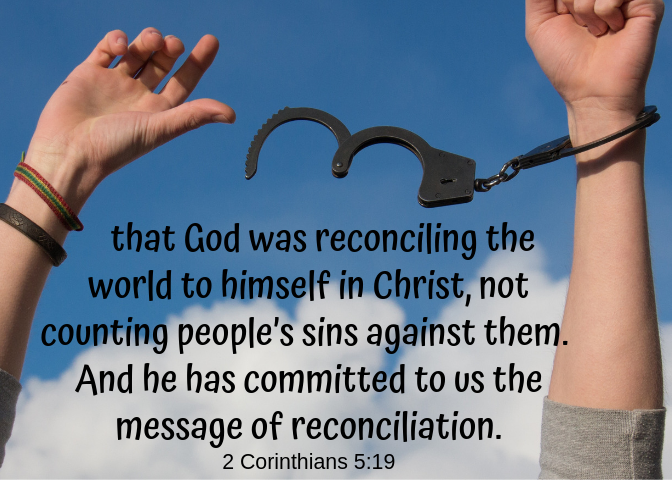
Therefore, if anyone is in Christ, the new creation has come: The old has gone, the new is here! 18 All this is from God, who reconciled us to himself through Christ and gave us the ministry of reconciliation: 19 that God was reconciling the world to himself in Christ, not counting people’s sins against them. And he has committed to us the message of reconciliation. 20 We are therefore Christ’s ambassadors, as though God were making his appeal through us. We implore you on Christ’s behalf: Be reconciled to God. 21 God made him who had no sin to be sin for us, so that in him we might become the righteousness of God.                   (2 Corinthians 5:17-21 . NIV)


God seeks restoration and “friendly relationships” with His creation.  So much so that He sent His sinless Son to carry our sins to the cross so we could become new, righteous creations who could draw near to God.  Previously our mountain of baggage and sins we were carrying was keeping us from embracing God.  But God made a way for us to set it all down – at the foot of the cross.  Because Jesus spoke for us God is not holding our sins against us – if we are in Christ – and have asked for forgiveness, accepted Jesus as Lord, been baptized to demonstrate the putting off of the old self, and are living a life of obedience.


If you aren’t there yet – in Christ – why not?  “We implore you on Christ’s behalf.  Be reconciled to God.” (vs. 20).  Please talk to your pastor or Sunday School teacher or youth group leader or Godly parents or me.  You don’t have to wait until you are perfect or you know the whole Bible – none of us Christians fall into either of those categories.  You just need to be ready to put the old behind.  Drop the junk you are holding onto, accept the sacrifice the Son made for you as he was speaking to his Dad for you and put on a new friendly relationship with God.  Be reconciled to God.


If you are there – in Christ – Congratulations!  Best choice ever!   Daily enjoy that friendly relationship with God that was opened for you by Christ.  And, get to work – you have a job to do!


“God has committed/given to us, the ministry/message of reconciliation.” (vs. 18 and 19).  Saying it once wasn’t enough for Paul.  So, I will repeat it, too.  “God has committed/given to us, the ministry/message of reconciliation. (vs. 18 and 19)”.  Do it!


If you’ve got the priceless gift of reconciliation with God through His Son – give it to others.  It won’t subtract what you have, but it will only multiply as you follow God’s command.   Maybe you will bring the message to gang members and in the process save a whole town!  Maybe you will boldly speak to a neighbor, family member, friend, co-worker, or church youth and be instrumental in that priceless person’s decision to be reconciled to God.  And all of heaven will rejoice with you.  Pray for God to show you where to start – and then start!


People are listening.  People are looking for hope in a hurting world.  Yesterday my heart hurt to hear of a girl in Malaysia who posted an Instagram poll – should she live or die?  Tears are falling as I type that she received a 69% response to die – and she took her own life.


The enemy is alive and well and we have a job to do!   Spread life and hope and reconciliation.  You won’t convince everyone.  Paul didn’t.  Roger didn’t.  But they did change lives because of their ministry of reconciliation.  And, we can, too.  People need reconciliation with God – even if they don’t know it yet.  How will you share it?


In Christ and Reconciled With a Job to Do,

Marcia Railton

Treasures in Jars of Clay

2 Corinthians 4

2 corinthians 4 5

It’s a beautiful chapter – make sure you give it a read, it won’t take long.

While I read, various people came to mind as Paul was describing his ministry.  People I know who have – and are currently – serving faithfully, carrying on the work Paul had given his life to 2,000 years ago.

One of the key repeated themes in this chapter is the task of pointing others to God, rather than to ourselves.  It requires humility and relying on God’s strength and mercy.  It means realizing that this priceless treasure of the message of God’s glory is housed in our plain, everyday, unglamorous, and sometimes frail bodies.  As Paul says: “We have this treasure in jars of clay to show that this all-surpassing power is from God and not from us” (vs. 7). It’s not about us – it’s about Him and His greatness.  It involves letting God’s light shine through us – so others will see God when we share about His Son.  After a conversation with others, do they know more about me – or about my God and my Lord?

And – it’s about the work of being a servant to those you minister to – for Jesus’ sake.  Growing up as a pastor’s kid I was privileged enough to see the beauty of servanthood Pastor Ray Hall lived out daily.  Numerous weekly Bible Studies at church, at the adult foster care homes or at the breakfast restaurant with the men’s group.  Countless counseling sessions in his office, at the jail, or the hospital or even in the garage. Up extra early to drive the man in need of a fresh start to his new job, writing and delivering sermons and SS classes, taking breaks to fix the neighbors’ bikes or paint a welcome home sign for returning snowbirds, teaching the little kids’ VBS class and taking all the late-night phone calls.

Being a servant doesn’t leave a lot of time for piddly pursuits.  In fact, it can be downright demanding, and sometimes discouraging.  Paul knew.  He writes, “We are hard-pressed on every side, but not crushed; perplexed, but not in despair; persecuted, but not abandoned; struck down, but not destroyed…so then, death is at work in us, but life is at work in you.” (vs 8, 9 & 12).  In order to share the life-giving message with others – it was going to require taking up his cross and dying to his own will – just as Jesus did.  It would be hard, but not without help (God’s power at work) or hope. “Because we know that the one who raised the Lord Jesus from the dead will also raise us with Jesus and present us with you in his presence.” (vs. 14).

Even as Paul was following in Christ’s footsteps, he was encouraging those who would follow in his own footsteps with these words (repeated twice in this short chapter) – “We do not lose heart.” (vs. 1 & 16).  God needs people with heart – and lots of it!  You don’t have to be a full-time pastor to be taking on the role as a servant for Jesus’s sake.  Some of the people I thought of when reading this chapter were not pastors but full-time mothers and dedicated Sunday School teachers or amazing pastors’ wives.  Whether you are a student or a mother or a plumber or a truck driver or a teacher – you can also be called to be a servant – for Jesus’ sake.

On the sad flip side, other faces and hearts were brought to mind when Paul wrote about those for whom the gospel was veiled – those who were perishing.  Some family.  Some friends.  Some from years of church and youth work.  Indeed, “The god of this age has blinded the minds of unbelievers, so that they cannot see the light of the gospel.” (vs. 4).  Satan is still very much alive and kicking.  The battle is real.  And real lives are perishing – unbeknownst to those with blinded minds.  Pray for veils to be yanked off.  Pray for our families to flee Satan.  Pray for the light of the gospel to shine through the darkness.

Thank God for the light.  Thank God for those who have been a servant to you to show you the light.  Pray that through you God’s light will shine.  Pray that you do not lose heart.  Pray that you will be worthy of the title of servant – for Jesus’ sake.

Thankful and Praying,

Marcia Railton