3 Devotions from Mark 14

Deuteronomy 27-28

Psalm 30

Mark 14

Today we are pulling up three previously shared devotions on Mark 14, and these are just a few of several posted over the last 9 years at SeekGrowLove.com. You may read one, two or three – or even go find some more. Today, may we consider what Jesus did for us, as we also contemplate what we will do for him, this day.

A BEAUTIFUL THING

-Devotion by Andy Cisneros (SC)(originally posted 3/28/2024 for SGL)

In Mark 14 we see the story of Jesus being anointed with  perfume. Jesus takes this beautiful moment and shows us just how great this event truly was. Mary’s actions may signal more than she knows. But, although she may not fully comprehend the messianic significance of her anointing, she appreciates Christ’s worth more than anyone else at the table. But Jesus receives the woman’s gift as a selfless act of love and devotion—an appropriate way to honor the Messiah. Jesus reveals that He will not be with them much longer, which references His soon death and burial.

Jesus says five things about it that mark it as an extremely beautiful act. First, he says, “she has done a beautiful thing to me”. The beauty of it lay in its extravagance. This woman did not spare any of the costly perfume but broke the flask and poured the whole quantity out on him. Judas, with his practical and corrupt mind, counted it up as worth three hundred denarii. A denarius was the day’s wage for a laborer. Three hundred days’ wages would be a tremendous sum. In the eyes of Judas, this woman wasted an enormous amount of money when she poured out the perfume on Jesus. It was such a lavish over the top act, and there lies the beauty of it. When have you done something extravagant and beautiful for Jesus?

Second, He said that it was a timely thing she had done. It was something that could only be done now. Any time you want to do good to the poor you can, because they are always around. And it is right to help the poor. But there are opportunities that come in our life that must be seized at that moment. Mary had sensed this and seized the moment to offer this gift, for such a time would never occur again. It was out of the sensitivity of her heart that she realized that the timing was right, and Jesus recognized this. I’m sure you’ve heard the phrase timing is everything. Mary is preparing Jesus for his death. The timing was now.

Third, she did what she could. She could not fix Him a meal; there was no time for that. She could not make a garment for Him; there was no time for that. There was nothing else she could do to show her love but this. She did what she could. I am sure Jesus has called our attention to that because it is so practical for us. Someone said, “I can’t do everything, but I can do something. And what I can do I ought to do. And what I ought to do, I’m available to do”. Are you doing what you can? Or are you doing what’s easy? Are you doing at least what you are capable of for God and his son?

The fourth element of this act was that it was insightful. Jesus says she has anointed my body beforehand for burying. Many times, Jesus said to these disciples that He was going to die. Not one of them believed or understood him–except maybe Mary of Bethany. She could have understood that he was heading for burial. And since she could not be sure she would ever have the opportunity later to find his body and anoint it for burial, she did it now, as a loving act of service. Of all these friends who were around Him at this time, only this one had the sensitivity of heart to understand what was happening.

Finally, what she did was deserving of being remembered. It was memorable. Jesus said, the story of this beautiful act will be told in memory of her wherever the gospel is preached in the whole world. Here we are today, two thousand years later, fulfilling this very word, telling again of the act of Mary of Bethany when she anointed our Lord’s head and feet.

I hope we can be as understanding and extravagant as Mary was. What can you do today to show your love and appreciation of Jesus? Something extravagant. Something with meaning.
FEAR TAKES OVER

-Devotion by Melissa New (AR) – (originally posted 8/3/2019 for SGL)

Jesus told the disciples that they would all abandon him. It was bad enough that he knew the agony he would endure on the cross, but the emotional sorrow of the betrayal of his closest friends would be gut-wrenching. All of the disciples were saying they would never leave him, no matter what. Peter insisted, “Even if I have to die with You, I will not deny You.” (14:31) Jesus told Peter that not only would Peter abandon him, but that very night he would also deny him three times.

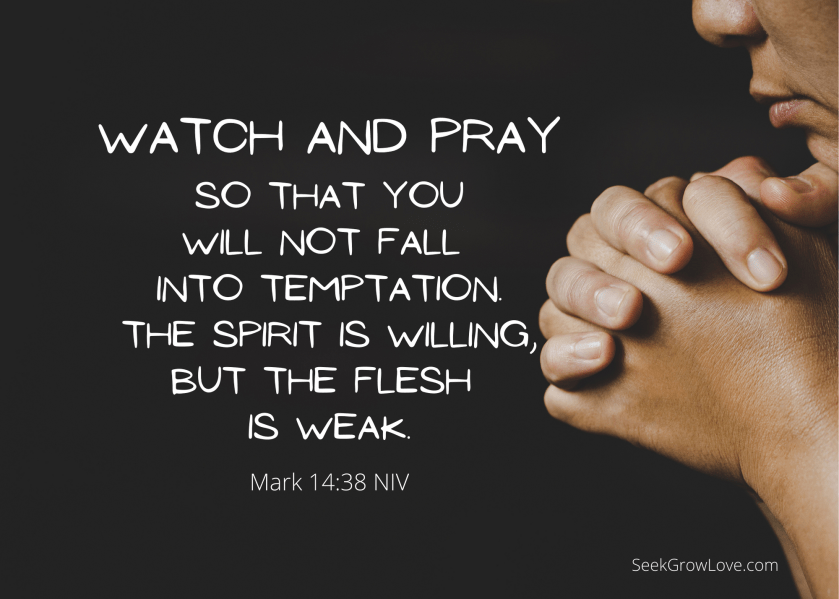
Later, in the Garden of Gethsemane, Jesus asks the disciples to keep watch and pray. They keep falling asleep. I imagine the impending situation has them exhausted from worry and dread. Jesus acknowledged that “the spirit is willing, but the flesh is weak.” (14:38)

When Judas comes to betray Jesus the tension is at an all-time high. The disciples want to fight, but Jesus stops them. Apparently, they  immediately realized they were overwhelmed and that’s when fear kicked in. They all ran. One was slow enough that he was seized, but that fear was coursing through his veins so strongly that he left his clothing and ran away naked. That was better than sharing the fate of Jesus. We might see this as utterly shameful. How could they? And how could Peter deny Christ three times especially after Jesus said he would? Did he not remember Jesus’ words after the second denial?

Fear is such a powerful thing. It can be crippling. Fear can shut our mouths, stop us from going and loving others, and keep us from fulfilling God’s will for our lives. More often I see that fear holds God’s people back, but it can also provoke us to act as we shouldn’t just as the disciples did. The naked man and Peter are a clear warning to us. Let’s not let fear have the power to encourage us to expose ourselves shamefully or deny Christ even. In I John 4:18 we are told “perfect love casts out fear.” Let’s pray for perfect love. When we feel fear creeping in, let’s pray for our love to be stronger than the fear.

A DAY TO REMEMBER

-Devotion by Mason Kiel (IN) (originally posted 8/5/2022 for SGL)

It’s a story we’ve heard a thousand times – Mark chapter 14. Jesus predicts that one of his disciples will betray him, one will deny him, and they feast for one last supper. He’s arrested and, in the face of threat of death, commits to remaining non-violent; even going as far as to heal those who oppose him. The archetype of betrayal, prophecy, and endurance coming together in one of the final chapters of Jesus’s time on earth. So, what more could we take away from these things after hearing it repeated our entire lives? There is always something new to be learned or applied if you’re willing to try to find it.

Starting at the beginning of the passage, a woman approaches Jesus with an exorbitantly expensive container of perfume. She takes this jar of perfume and dumps it all over Jesus, to which she receives backlash. Those in the company ridicule her for not utilizing the perfume for something better, like helping the poor. Admittedly, this would be a very honorable thing to do. But surprisingly, Jesus stands up for her and tells them to not shame her for doing a good thing to him. “The poor you will always have with you, and you can help them any time you want. But you will not always have me.” Mark 14:7.

This is an interesting thing for Jesus to say, as I would imagine him having the mindset of ‘do everything to help those in need,’ but this circumstance seems to be different. There will always be the poor and needy, there will always be the hurt and the wicked. Jesus is the light in darkness, as darkness is the default state, only interrupted by the presence of light, not vice versa. If we spend all of our energy trying to eliminate the darkness, we will lose sight of the light that sustains us incipiently.

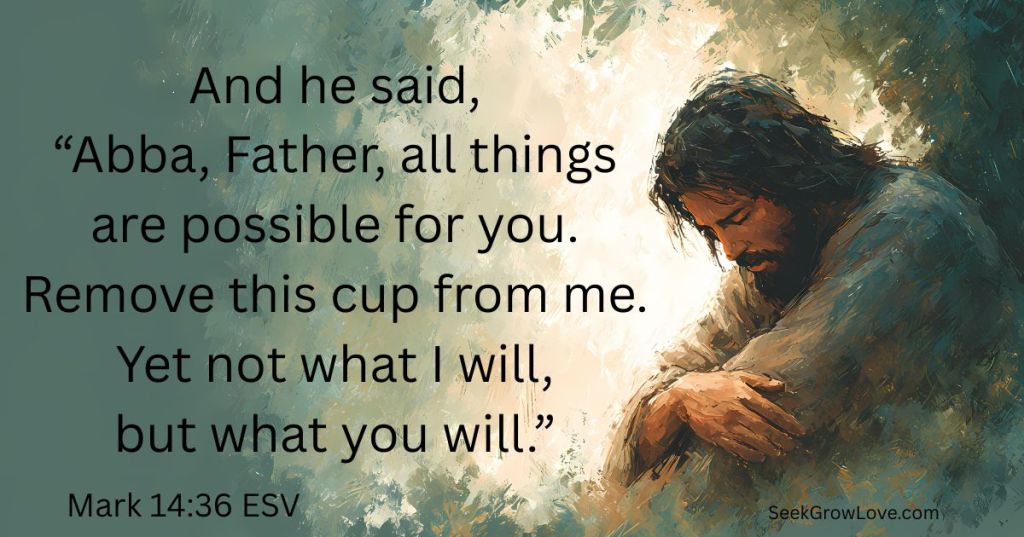
Jesus is well aware of this, as the light that sustains and empowers him is God. He cries out “Abba, Father, everything is possible for you. Take this cup from me. Yet not what I will, but what you will.” Mark 14:36. Jesus is crying out in the most passionate and sincerely affectionate way imaginable to his father, begging that his death be made unnecessary, that this burden will be taken from him. However, he takes the proper mindset of being able to accept that what he wants may not be what God wants. When you pray to God for an answer, are you able to accept what He responds with in the same faith Jesus could? It’s no mere feat, but then again Jesus is no mere man.

Not only does he accept what needs to happen, but he also stands firm on what he teaches. If you remember from yesterday, Jesus specifically said to not be afraid when we are brought before the court for our faith, but to answer as the Spirit guides you to, as it is the voice of the Spirit that will talk for you. When they had arrested him and grilled him with questions, “… Jesus remained silent and gave no answer.” Mark 14:61. He needed not respond to their trickery but waited until he knew what he was saying to tell them the truth. For this, they killed him. Could you stand for truth until the end? Could you stand with what you believe and know to be true even if every person would hate you for it? If so, you would be stronger than Peter. He lacked this ability, and defied Jesus 3 times—to which end it destroyed him.

“Immediately the rooster crowed the second time. Then Peter remembered the word Jesus had spoken to him: ‘Before the rooster crows twice you will disown me three times.’ And he broke down and wept.” Mark 14:72. Have you ever gotten to the point in your sin where you don’t even recognize who you are anymore? For Peter, he had been spending the past couple years of his life devoted to following Jesus to the end. And yet, when it mattered most, he denied even knowing him. He had become so distraught by his sin that he had nothing else to do than weep at what he’d done.

Sometimes, when we recognize that we’ve fallen so far from the righteous path laid before us, and become so wrapped up in our sin, all we can do is weep and pray that God can forgive us. In fact, it’s often in these moments that we convince ourselves that there’s no way God could possibly forgive us for what we’ve done… but that would be missing the whole point of the story! Jesus died so that even in the midst of our most egregious pain from sin, we have the opportunity to be forgiven. Even Paul, who was a Christian-slaying murderer found salvation! Do not waste this opportunity that Christ has given to you, but rather repent for your sins and devote your life toward serving his purpose. Amen.

Application Questions

  1. Even if you’ve read Mark 14 many times before – what stands out to you today?
  2. How can you extravagantly love and honor Jesus?
  3. What does it mean to pray, “Not my will but yours be done”? What do you need to surrender and give up to God?
  4. In the past, how have you deserted or denied Jesus? How has fear kept you from doing what God wants you to do?

PRAYER

Dear God,

We thank You for the gift of Your Son. We are not worthy of such a perfect gift. Forgive us of the times we have acted in fear not faith, for the times we have passed up the opportunities to give extravagantly in response to the gift given for us. Help us see Jesus for who he is, and respond with total commitment and devotion today and everyday. I love you, Lord God.

In Your Son’s sweet name, Jesus, I pray.
Thy Will

*Deuteronomy 23-24

Psalm 29

*Mark 14

-Devotion by Jeremy Martin (TN)

            Today’s reading has a number of gems in it, that not only teach us about God’s character but also the character of His son.  In our Deuteronomy readings today we see a number of statutes; take a moment to read them all carefully and consider them as a group (note that we could spend a lot of time here, but there is a huge, critical, overwhelmingly important theological revelation in Mark 14 that we will spend a lot of our time on ).  God is holy (Deut 23: 9-14,17-18,21-24), and will be treated as such when in His presence.  God will judge each of us individually (Deut 24:16), we won’t be held responsible for the sins of another.  God wants us to treat each other with mercy and love (Deut 23:15-16, 25, and chapter 24 in it’s entirety).  The equity (or, ultimate fairness) of God is something that always amazes me.  God’s will for His people is that they honor and revere God, and treat each other with love and respect.

            We humans have a will too, but since we are human beings and not God, we have limited perceptions and because of this we tend to make poor decisions at times.  Think of it this way: as human beings walking along the road of time we can see moderately clearly where we are standing, looking backwards we can see a narrow view of where we have been (but even so it grows fainter in the distance), and looking ahead we are essentially just guessing how the path will go based on the path we’ve walked so far.  This doesn’t really highlight how limited our perceptions are, so now let’s imagine that this road is almost completely dark, and as we walk we are holding a candle that faintly illumines a tiny area around us as we walk; but there are vast worlds and other paths aside from the one that we walk that we can’t see which others are walking.  That’s what it’s like to be human. 

            My whole point is this: our perceptions are very, very limited.  Our tiny human brains can only perceive so much, the limitation of the human eyeball only accepts a very specific very tiny range of light frequencies, the human ear only hears a very specific very small range of sound frequencies,  and all of our senses have limitations built into them.  God, on the other hand, our Creator, is not limited in this fashion.  He sees the thousands upon thousands of potential paths that we all walk on, fully illumined, and from the beginning of the trail of our birth to the end of the trail at our demise.   The God who made us does not suffer from our inherent limitations, and as such, has a much clearer macroscopic picture.  It is only logical that His will is superior to ours, since He has a much clearer perception of not only us, but our neighbor, and the world (all of which He created).  The God who made your heart knows it better than you do yourself. 

            This is why the wise person submits himself to the will of God, because God has better information and therefore can make better decisions with better outcomes (Hillary Scott has a great song out called “Thy will” which I recommend).  We tend to be very limited and narrow in our vision, and tend to make poor decisions with poor outcomes when we rely on our own will because of our inherent limitations.  The more you rely upon your own will, the poorer the decisions and the worse the outcomes (and trust me, I’m speaking from painful experience on this one).

            When we come to our reading in Mark 14 today, our savior Yeshua (Jesus), our future king,  is having a crisis of faith.  You see, having been born a man; a nice Jewish boy from the line of David (Matt 1,), even though God both knit (Luke 1:35) and sent Jesus (according to Jesus, 32 times in the book of John), even though he was the prophesied and anointed Messiah (the son of David, the son of God, the king who will rule forever: 2 Sam 7), Jesus still self-identified as a son of man (a human, about 72 times in the gospels).  So even though God had knit and sent this man to be the savior of Israel (and the world), and even though Jesus was given a portion of the holy spirit that allowed him to perform signs and wonders in the name of the Most High God, he was in fact (by his own words, John 8:40) still a man. 

            Every human, when they are faced with their own mortality, has some serious thinking to do, even if you have been given a large portion of the holy spirit.  We know that God had revealed to Jesus that he was about to die because we can see from the passage here in Mark 14:32-42 that he is agonizing over his upcoming gruelling death.  I believe that one of the main reasons that our God revealed this to Jesus is that our God is, overwhelmingly, fair and equitable.  He wanted to allow a choice to His chosen Messiah; a final act of complete trust and obedience (reminiscent of the one he offered Abraham when he was asked to sacrifice his only son from Sarah to determine his faith).

            “…Abba! Father!  All things are possible for you; remove this cup from me; yet not what I will, but what You will.” ( Mark 14:36 LSB).  Jesus knows that God can do all things, and hopes there is another way and asks God to provide it, but he also completes that request with an obedient submission to the will of the Most High God, YHVH.  If you have accepted some of  the later traditions of men in understanding of the nature of God, this will create some serious questions for you; because we see clearly that Jesus is subordinate to the Father and one of the primary tenets of many groups is to insist on their equality, but that’s just not what the scriptures say.

            Jesus has his own will and it’s to not die, just as Abraham’s will was not to sacrifice his son, but he obediently complies and submits to the will of God, just like his ancestor Abraham.  This is not the act of an equal, but a loyal subordinate.  If you acknowledge this clear scriptural understanding then you are going against a lot of “traditional” requirements in many churches and you might just get kicked out of band camp if you bring it up, because that conflicts with some of the other later ‘developed’ traditions of men that have come to be traditional requirements.  Please remember though: you are the one that will stand before God to account for yourself, not your church group or pastor, but you.  Trust God.

            So what do you do if scripture doesn’t agree with your doctrinal theology?  Change your doctrinal theology, of course; we are under the scriptures and not above them.  Scripture is our guideline, the word of God transmitted in written form, and if we are going to be obedient children of God, like our Messiah, King Jesus, then we must submit to God’s authority.  When God speaks, we listen, period.  Is a servant greater than his master? “Verily, verily, I say unto you, The servant is not greater than his lord; neither he that is sent greater than he that sent him.”  (John 13:16 KJV).  In the book of John alone, Jesus explicitly states that the Father has sent him over 30 times, and also states “As the Father has sent me, I am sending you” (John 20:21 LSB).  The Christ is under the authority of God, the Father, and we are under the authority of the Christ.  It’s a pretty straightforward corporate organizational chart, if you believe scripture and hold to it as authoritative. 

REFLECTION QUESTIONS

  1. Why do we often follow our own will and not God’s?
  2. Have you ever changed something you believed because scripture indicated something different?
  3. God sent Jesus, Jesus sent us: are you being a good representative and can you improve?

PRAYER

Abba! Father!  Not my will, but Yours be done.  Show me Your will, Father, and grant me the perseverence and humility to submit to it.  Help me to be a servant who pleases you, Father.  All things belong to You, and all of the blessings that I’ve received have come from You, even my life.  Lead me and teach me, please.  Thank you, in Jesus name, Amen.

A Beautiful Thing

Old Testament: Deuteronomy 5

Poetry: Job 29

New Testament: Mark 14

“Leave her alone, said Jesus. Why are you bothering her? She has done a beautiful thing to me.” Mark 14:6

In Mark 14 we see the story of Jesus being anointed with  perfume. Jesus takes this beautiful moment and shows us just how great this event truly was. Mary’s actions may signal more than she knows. But, although she may not fully comprehend the messianic significance of her anointing, she appreciates Christ’s worth more than anyone else at the table. But Jesus receives the woman’s gift as a selfless act of love and devotion—an appropriate way to honor the Messiah. Jesus reveals that He will not be with them much longer, which references His soon death and burial.

Jesus says five things about it that mark it as an extremely beautiful act. First, he says, “she has done a beautiful thing to me”. The beauty of it lay in its extravagance. This woman did not spare any of the costly perfume but broke the flask and poured the whole quantity out on him. Judas, with his practical and corrupt mind, counted it up as worth three hundred denarii. A denarius was the day’s wage for a laborer. Three hundred days’ wages would be a tremendous sum. In the eyes of Judas, this woman wasted an enormous amount of money when she poured out the perfume on Jesus. It was such a lavish over the top act, and there lies the beauty of it. When have you done something extravagant and beautiful for Jesus?

Second, He said that it was a timely thing she had done. It was something that could only be done now. Any time you want to do good to the poor you can, because they are always around. And it is right to help the poor. But there are opportunities that come in our life that must be seized at that moment. Mary had sensed this and seized the moment to offer this gift, for such a time would never occur again. It was out of the sensitivity of her heart that she realized that the timing was right, and Jesus recognized this. I’m sure you’ve heard the phrase timing is everything. Mary is preparing Jesus for his death. The timing was now.

Third, she did what she could. She could not fix Him a meal; there was no time for that. She could not make a garment for Him; there was no time for that. There was nothing else she could do to show her love but this. She did what she could. I am sure Jesus has called our attention to that because it is so practical for us. Someone said, “I can’t do everything, but I can do something. And what I can do I ought to do. And what I ought to do, I’m available to do”. Are you doing what you can? Or are you doing what’s easy? Are you doing at least what you are capable of for God and his son?

The fourth element of this act was that it was insightful. Jesus says she has anointed my body beforehand for burying. Many times, Jesus said to these disciples that He was going to die. Not one of them believed or understood him–except maybe Mary of Bethany. She could have understood that he was heading for burial. And since she could not be sure she would ever have the opportunity later to find his body and anoint it for burial, she did it now, as a loving act of service. Of all these friends who were around Him at this time, only this one had the sensitivity of heart to understand what was happening.

Finally, what she did was deserving of being remembered. It was memorable. Jesus said, the story of this beautiful act will be told in memory of her wherever the gospel is preached in the whole world. Here we are today, two thousand years later, fulfilling this very word, telling again of the act of Mary of Bethany when she anointed our Lord’s head and feet.

I hope we can be as understanding and extravagant as Mary was. What can you do today to show your love and appreciation of Jesus? Something extravagant. Something with meaning.

-Andy Cisneros

Reflection Questions

  1. What is Jesus Christ’s worth to you? When have you done something extravagant and beautiful for Jesus? How can you – and will you – honor him?
  2. Are you doing what you can? Or are you doing what’s easy? Are you doing at least what you are capable of for God and his son?

Preparing with Your Actions

* Theme Week – Jesus: Mark 14

Old Testament: Joshua Intro below

Psalms Reading: Psalm 94

This entire chapter is full of various preparations for the crucifixion of our Savior. 

It starts with a simple act of pure love and devotion. Jesus was in Bethany, eating with Lazarus and his sisters. And after this meal, a woman (John’s account tells us that it was Lazarus’ sister Mary) comes in with an expensive alabaster jar of fragrant oil and anoints Jesus. She has brought Jesus only the best and has complete disregard for its monetary value. Jesus tells us that what she is actually doing is anointing him for his burial. She isn’t giving to Christ for her sake, or out of guilt or in a rush of emotion. She prepared an offering of the best of what she had and gave. Jesus says that “She did what she could,” and she did it without direction or suggestion. She thought and found a way to serve her Lord and Savior whom she loved. 

In a different act of preparation we see the disciples taking direction from Jesus to go and prepare the passover meal. Jesus gives them all the direction they need, and when they follow those directions all is provided for them. They were given a mission, and all they had to do was follow – the means to complete it was supplied. 

And yet after the supper, when Christ asked a few of them to go with him and help him prepare for his coming death through prayer and fellowship, they couldn’t follow through. They fell asleep time and again. They fell short three times. Three times he checked on them, and reminded Peter to pray because the flesh is weak. Three times he came back and woke them and asked them to stay watchful and pray. Three times they proved themselves weak. Just as Peter would deny him three times. 

Take some time to prepare yourself with me by examining your actions and intentions today. Ask yourself: 

What can I do to show my love and appreciation for my savior? Am I too concerned with how others see my devotion to Jesus? How can I show my devotion as purely as Mary did?

When I’m given a task by God, do I follow through? Do I have faith that he will provide for my needs and give me a way to complete any task he gives me? 

My spirit is willing and like Peter I refuse to believe that I could ever deny or disobey my savior. But is my flesh weak? In what areas of my life am I sleeping rather than remaining watchful?

My prayer for you today is that you are able to look over your life and the decisions you’re making and analyze your motives and intentions. Take stock of how you are serving. Are you able to serve in faith and without worrying about whether or not you’ll be given what you need? Are you able to serve with the purest of intentions? I pray that you find a way to serve and follow and do it in a way that is pure and devoted. 

Jenn Haynes

Having finished Deuteronomy yesterday in our Old Testament reading, here is our introduction to the book of Joshua which we will begin reading tomorrow.

Joshua Introduction

The book of Joshua details the time from immediately following Moses’ death through the conquest of the land of Canaan.  We’re not told, but it is likely that Joshua himself wrote most of the book, since it sounds like a first-hand account of the events that happened and were recorded at the time.  At least the end of the book that records Joshua’s death had to have been written by someone else.

This book details the fulfillment of God’s promise to Abraham that his descendants would be slaves in Egypt, but afterward would return to the promised land – the land of Canaan.  A promise God repeated to Moses.  We see this from the very beginning of the book, where in Joshua 1:2-3, God told Joshua, “Moses my servant is dead.  Now then, you and all these people, get ready to cross the Jordan River into the land I am about to give them – to the Israelites.  I will give you every place where you set your foot, as I promised Moses.”

The first 12 chapters detail the miraculous crossing of the Jordan River, the battle of Jericho, the sun standing still over Gibeon for about a whole day during the battle with the Amorites, and the conquest of all of the land of Canaan.  Chapters 13-22 discuss the division of the land among the tribes of Israel.  Chapters 23-24 close with a challenge to worship God alone.

Some well-known verses in Joshua include:

Joshua 1:7-8, “Be strong and very courageous.  Be careful to obey all the law my servant Moses gave you; do not turn from it to the right or to the left, that you may be successful wherever you go.  Do not let this Book of the Law depart from your mouth; meditate on it day and night, so that you may be careful to do everything written in it.  Then you will be prosperous and successful.”

Joshua 23:14, “…You know with all your heart and soul that not one of all the good promises the Lord your God gave you has failed.  Every promise has been fulfilled; not one has failed.”

Joshua 24:14, “But if serving the Lord seems undesirable to you, then choose for yourselves this day whom you will serve, whether the gods your forefathers served beyond the River, or the gods of the Amorites in whose land you are living. But as for me and my house, we will serve the Lord.”

This is an exciting book.  As you read it, consider the blessing and successes of Joshua, who faithfully followed God, contrasted with the punishment of people like Achan for disobedience.

Interestingly, the Hebrew name Joshua is the same as the new testament name Jesus.

-Steve Mattison

A Day to Remember

Mark 14

Friday, August 5, 2022

It’s a story we’ve heard a thousand times – Mark chapter 14. Jesus predicts that one of his disciples will betray him, one will deny him, and they feast for one last supper. He’s arrested and, in the face of threat of death, commits to remaining non-violent; even going as far as to heal those who oppose him. The archetype of betrayal, prophecy, and endurance coming together in one of the final chapters of Jesus’s time on earth. So, what more could we take away from these things after hearing it repeated our entire lives? There is always something new to be learned or applied if you’re willing to try to find it.

Starting at the beginning of the passage, a woman approaches Jesus with an exorbitantly expensive container of perfume. She takes this jar of perfume and dumps it all over Jesus, to which she receives backlash. Those in the company ridicule her for not utilizing the perfume for something better, like helping the poor. Admittedly, this would be a very honorable thing to do. But surprisingly, Jesus stands up for her and tells them to not shame her for doing a good thing to him. “The poor you will always have with you, and you can help them any time you want. But you will not always have me.” Mark 14:7.

This is an interesting thing for Jesus to say, as I would imagine him having the mindset of ‘do everything to help those in need,’ but this circumstance seems to be different. There will always be the poor and needy, there will always be the hurt and the wicked. Jesus is the light in darkness, as darkness is the default state, only interrupted by the presence of light, not vice versa. If we spend all of our energy trying to eliminate the darkness, we will lose sight of the light that sustains us incipiently.

Jesus is well aware of this, as the light that sustains and empowers him is God. He cries out “Abba, Father, everything is possible for you. Take this cup from me. Yet not what I will, but what you will.” Mark 14:36. Jesus is crying out in the most passionate and sincerely affectionate way imaginable to his father, begging that his death be made unnecessary, that this burden will be taken from him. However, he takes the proper mindset of being able to accept that what he wants may not be what God wants. When you pray to God for an answer, are you able to accept what He responds with in the same faith Jesus could? It’s no mere feat, but then again Jesus is no mere man.

Not only does he accept what needs to happen, but he also stands firm on what he teaches. If you remember from yesterday, Jesus specifically said to not be afraid when we are brought before the court for our faith, but to answer as the Spirit guides you to, as it is the voice of the Spirit that will talk for you. When they had arrested him and grilled him with questions, “… Jesus remained silent and gave no answer.” Mark 14:61. He needed not respond to their trickery but waited until he knew what he was saying to tell them the truth. For this, they killed him. Could you stand for truth until the end? Could you stand with what you believe and know to be true even if every person would hate you for it? If so, you would be stronger than Peter. He lacked this ability, and defied Jesus 3 times—to which end it destroyed him.

“Immediately the rooster crowed the second time. Then Peter remembered the word Jesus had spoken to him: ‘Before the rooster crows twice you will disown me three times.’ And he broke down and wept.” Mark 14:72. Have you ever gotten to the point in your sin where you don’t even recognize who you are anymore? For Peter, he had been spending the past couple years of his life devoted to following Jesus to the end. And yet, when it mattered most, he denied even knowing him. He had become so distraught by his sin that he had nothing else to do than weep at what he’d done.

Sometimes, when we recognize that we’ve fallen so far from the righteous path laid before us, and become so wrapped up in our sin, all we can do is weep and pray that God can forgive us. In fact, it’s often in these moments that we convince ourselves that there’s no way God could possibly forgive us for what we’ve done… but that would be missing the whole point of the story! Jesus died so that even in the midst of our most egregious pain from sin, we have the opportunity to be forgiven. Even Paul, who was a Christian-slaying murderer found salvation! Do not waste this opportunity that Christ has given to you, but rather repent for your sins and devote your life toward serving his purpose. Amen.

-Mason Kiel

Application Questions

  1. Even if you’ve read Mark 14 many times before – what stands out to you today?
  2. How can you extravagantly love and honor Jesus?
  3. What does it mean to pray, “Not my will but yours be done”? What do you need to surrender and give up to God?
  4. In the past, how have you deserted or denied Jesus? Have you accepted Jesus’ forgiveness?

Finding Ourselves in Scripture

Mark 14

            Have you ever read scripture and thought to yourself, “That is definitely me”? I know I have, and every time I read Mark 14 I get that same feeling all over again. In Mark 14:32-42 we find the scene were Jesus takes his disciples to Gethsemane to pray before his arrest. Jesus sets a few of his disciples on watch while he goes away to pray. When Jesus returns, he finds them sleeping and says these piercing words in verse 37, “’Simon, are you asleep? Could you not keep watch for one hour?’” Ouch! How bad would you have felt if you were Peter right then? Well, I’ve felt almost exactly like this once.

            One night, while I was in high school, one of my best friends was doing a late night shift in a 24 hour prayer campaign. He had the duty of praying for an hour in the middle of the night. I can’t remember for certain, but it was something like 3am – 4 am. He asked me and one of our other best friends if we would be willing to stay up with him to help him pray and be alert during this shift. We both happily agreed! After all, how often does your best friend ask you to stay up and help him pray? This is something we could not turn down. So we are all hanging out, sitting on the couches in my living room, waiting for his shift to begin. The next thing I remember are my two friends walking inside after his prayer shift was over. In that moment, I felt a lot like Peter. I couldn’t even stay awake for one night to help my friend pray. To be honest, I was a little bit embarrassed and disappointed in myself. I can’t believe I had let my best friend down.

-Josiah Cain

Links to today’s Bible reading – Exodus 33-34 and Mark 14