Living for the One who Died for your Sake

2 Corinthians 5-7

verse-of-the-day (2)

Friday, June 23

For the love of Christ compels us, because we have concluded this: that one has died for all, therefore all have died; and he died for all, that those who live might no longer live for themselves but for him who for their sake died and was raised.   2 Corinthians 5:14-15


Has anyone ever done something really nice for you and you then feel like you just want to do something nice in return for that person? That is how Paul views the love of Christ. Elsewhere, Paul declares that “for one will scarcely die for a righteous person—though perhaps for a good person one would dare even to die” (Rom. 5:7). Christ exemplified God’s selfless love in that he gave his life for us when we were nothing but unworthy sinners. We were not good people, or righteous people. We were sinners. But in spite of our rebellion and sin, Christ gave his life for us, and through that demonstration of love, we have been united with Christ in his resurrection and have new life inside us. Christ’s act of love and grace changed everything in Paul’s world, and it does in ours too.


Is the new life we have not the kindness and most generous thing anyone has ever done? Christ died for everyone so that everyone might have the chance to have true life in him. Therefore, for those who have put their trust in Christ and have received new life, the question becomes, “How should we respond to that act of kindness and love?” Do we feel like we want to do something nice in return? If we have the natural response to return kindness to our fellow neighbor for such a small favor of finite value, how much more should our response be to one who has shown the greatest kindness the world has ever seen?


Paul says that “the love of Christ compels us” (v. 14). He finds the rationale for this attitude in the fact that Christ’s gift of sacrificing himself on the cross is so moving and profound that it causes him to respond in humility and service to the Lord. Christ’s love is so deep and awe-inspiring that Paul describes it as a force that urges him to continue in his ministry and to live for the sake of Christ rather than his own self. The word translated “compels” means “to be pressing in” or “to constrain.” In Paul’s mind, he has “concluded” or “become so convinced” of the love that Jesus has shown him in his death that it has now become the controlling force that influences every single choice he makes in life.


What would make you not live for yourself but for someone else? Would someone dying in your place compel you to change your life? How do you repay someone who is responsible for saving you, for pulling you out of the death that so pervades the world and giving you a hope of a future and a joy and peace in your heart that exceeds anything the world can offer?


What is your response to such an act of love? Would you give up your selfish desires in response to that love? Would you live a life that glorifies and honors someone else and settle for being hated by the world? If Christ’s love compels you, ask in prayer how you should respond to the love of the savior? You might just find the most fulfilled life you never thought possible—living for the one who died for your sake.


-Jerry Wierwille


(Photo Credit: https://biblia.com/bible/esv/2%20Cor%205.21)

Is it Eternal or Eternally Useless?

2 Corinthians 1-4

All+that+is+not+eternal,+is+eternally+useless.

Thursday, June 22

For this light momentary affliction is preparing for us an eternal weight of glory beyond all comparison, as we look not to the things that are seen but to the things that are unseen. For the things that are seen are transient, but the things that are unseen are eternal.            2 Corinthians 4:17-18


Each day is a new day to live, work, and accomplish new things. Everyone has goals and ambitions for what they would like to do and achieve. But it is important to remember that all our earthy success and money and goods are not long-lasting—they are not eternal. As C. S. Lewis remarked, “All that is not eternal is eternally useless.” Now, is it true that money and goods and other physical things are completely “useless” in all respects? No, not exactly. But what Lewis is getting at is that when it comes down to what really matters—only eternity matters. And as such, only those things which will last for eternity are of any true significance.


Paul exhorts his readers to realize that everything we suffer and go through in this life is just the precursor to the beautiful glory that is to come. There is a glory that is “beyond all comparison” waiting for God’s people. Everything that is in this world is perishable and will be destroyed one day when a new heavens and earth will be formed in its place (2 Pet 3:11-13). And the glorious, resurrection bodies and heavenly city of Jerusalem that God has prepared for his people surpasses any imagination of such glory that we could ever have (Phil 3:21; Rev 21:10-11).
But while on this earth during the present age, what do we get from all the hard work we labor in? The author of Ecclesiastes has a rather pessimistic outlook on all the hard work of life.


Ecclesiastes 5:15-16

As he came from his mother’s womb he shall go again, naked as he came, and shall take nothing for his toil that he may carry away in his hand. This also is a grievous evil: just as he came, so shall he go, and what gain is there to him who toils for the wind?


What do we get for all our “toils”? Ultimately….nothing! It would be a terrible mistake to make prosperity, success, or fame the goal to which you set you eyes in life. These things have no eternal value, everything we have earned and accomplished in this life will come to nothing in the coming age. 1 John 2:17 says, “And the world is passing away along with its desires, but whoever does the will of God abides forever.”


The popular slogan, “Live for Today!” has both truth and error in it. While we don’t want our mind to be anxious and preoccupied about tomorrow that we forget to live in the moment and enjoy what is happening in our lives “now,” the problem is if all a person ever does is live for the “here and now.” Life is ultimately not about the “here and now” but about the destination of where everything is going. If we never raise our eyes to the horizon, then we will never gain an eternal perspective on life and understand the final objective to everything in life.


We must work and live in this world, but that is only what we are doing now. Life is not only about “now” but also about “then.” And “then” is what is truly important and eternal. So while we “toil” in this life, let us keep our eyes on the horizon and realize what actually is the true meaning of life. It is not what we see, but what we do not see. The unseen is eternal. If we live by faith, and not by sight, we will come to know the everlasting glory that is beyond all compare to anything in this world. Look to the things that are unseen and the spiritual reality of the life we have in Christ, awaiting the “riches of the glorious inheritance in the saints” (Eph 1:18).


-Jerry Wierwille


(Photo Credit: http://slideplayer.com/slide/6811229/)


Keep at It!

1 Corinthians 14-16

1-corinthians-15-58

Wednesday, June 21


Therefore, my beloved brothers, be steadfast, immovable, always abounding in the work of the Lord, knowing that in the Lord your labor is not in vain.      1 Corinthians 15:58


Do you ever wonder if what you are doing for the Lord is having any effect at all? Ever wonder if your efforts are having any impact, or if they really matter? Sometimes it might feel like we are just “spinning our wheels” doing things for the Lord because we are not seeing any noticeable difference.


What can happen is that we set our expectations as the sole metric for gauging whether we are being successful in our endeavors for the Lord. It is almost as if when we don’t see the fruit we are looking for, we conclude that we must not be doing a very good job. But nothing could be farther from the truth.


Back in chapter 3 of this letter, Paul described how he viewed himself as contributing to the spread of the gospel as one among many workers laboring for the Lord. He saw his labor as only one part of a system comprised of many other laborers, which all culminated in the advancement and increase of the gospel message as God caused the labor to bear fruit.


1 Corinthians 3:6-8

I planted, lApollos watered, but God gave the growth. So neither he who plants nor he who waters is anything, but only God who gives the growth. He who plants and he who waters are one, and each will receive his wages according to his labor.


It wasn’t Paul’s personal effectiveness that mattered; it wasn’t how good he was at winning souls to the Lord, or building up and strengthening believers on his own effort alone. What mattered was how his efforts were part of a larger picture of the way the Lord is at work in what he has called each person to do in order to bring others to faith or to help them grow in their faith. And most times, one’s efforts do not produce visible fruit immediately but take time to cultivate and grow in a person’s heart. That is why Paul saw himself as part of a system where soil is prepared, seed is sown, and the earth is watered and then from that comes the growth of a seedling that must be nurtured further so that it can grow tall and strong and bear fruit.


Therefore, we must never discredit how important the work is we do for the Lord no matter how insignificant it might seem in our eyes. God has need of each of us, and he calls us to serve him in specific ways that are unique. But we have to remember that our labor is not the end-all-be-all. We might be performing the first stage of preparing the soil, or we might be watering a seed that was sown by someone else long before our time.


Paul declares that our labor in the Lord is not in vain because every act that we do in love and with humility and meekness is an act that the Lord can use to produce growth in that person that ultimately glorifies him. So don’t be quick to judge that what you do for the Lord is not working if you don’t see the results you think you should expect to see. Continue serving and giving and be proud to be a worker in God’s vineyard, knowing that your work all contributes to the Lord’s harvest and the glory of his kingdom.


-Jerry Wierwille


(Photo Credit: http://www.dailylifeverse.com/posts/2016/03/1-corinthians-15-58)

Let’s Talk About Temptation

1 Corinthians 10-13

verse-of-the-day (1)

Tuesday, June 20

No temptation has overtaken you that is not common to man. God is faithful, and he will not let you be tempted beyond your ability, but with the temptation he will also provide the way of escape, that you may be able to endure it.  1 Corinthians 10:13


Let’s talk about temptation. Everyone is tempted, and everyone has succumbed to temptation at some point in their life, and probably numerous times. I will be the first to admit that fact in my own life. The first thing Paul does is acknowledge the universality of temptation—temptation is ubiquitous. Temptation is a common experience for all humankind. Some people might think that they are experiencing a unique type or degree of temptation, but Paul overwrites that attitude by confirming that no one is alone in experiencing any form of temptation, for every possible sort of temptation has been shared by other individuals.


We all struggle with temptation, that is the common thread that unites the human race. But unlike individuals who do not trust in God, the experience of temptation for believers can be different. Those who believe in God are not in a position of helplessness.


Some people have told me about their experience facing temptation, “I couldn’t help it. It was too appealing. I got tired of resisting. I just couldn’t stop myself.” The idea that there was nothing that could have been done to prevent sin is calling God a LIAR.


Paul says, “God is faithful!” What is God faithful for? He is faithful to: 1) limit the power of the temptation in your life, and 2) provide strength to endure or a possibility to remove the temptation. These are two promises of God when it comes to facing temptation. Either they are true or God is a liar. The problem many people face is that they doubt God is able to actually help them overcome temptation. They feel like it is all a matter of the will to resist temptation, and when their will weakens (as everyone’s does at some point), they feel like they just couldn’t continue to stand against the temptation and decide to just give in.


Satan is constantly battling for our mind and to entice our flesh. Elsewhere, Paul describes this battle in terms of “the schemes of the devil” and the “flaming darts of the evil one” (Eph. 6:11, 16). To combat these threats, Paul encourages believers to equip themselves with the “armor of God” (Eph. 6:11-17) in order to stand firm against the devil and his tactics and influence. While Paul describes a set of defensive armaments to be prepared to engage in spiritual warfare with the devil in Ephesians 6, his point in 1 Corinthians 10:13 is that of trust and reliance upon God to keep one’s foot from slipping and falling into sin.


It takes a resolved heart and mind to build the confidence that God will come through and be there in your time of need. Furthermore, there are two practices that can be of great help in overcoming temptation: 1) knowing Scripture (like verse 13) can turn the tables in the struggle against temptation, and 2) prayer.


If you are able to bring to mind what God has revealed about a particular temptation, it has the power to release the grip of the temptation to the point that you can endure it or eliminate the cause of the temptation altogether. That is the reason Paul calls Scripture the “sword of the spirit” (Eph. 6:17). It has the ability to defeat thoughts, attitudes, and desire that contend against the knowledge and will of God and to free a person from feeling like there is no other way out.


Secondly, prayer is always helpful and necessary when facing temptation. Temptations can come from our own desires or as a spiritual attack from the devil. Whichever it is, we can go to God in prayer asking for strength and wisdom to allow his will to prevail and to help us bring our body into subjection to what is godly and be led by the spirit away from the temptation. James writes in his letter, “If any of you lacks wisdom, let him ask God, who gives generously to all without reproach, and it will be given him” (Jas. 1:5).


If you struggle with a certain temptation, ask God for wisdom, and he will give it to you. And remember that we all have temptations, and nothing is new that we might encounter. God has seen it all before, and he has helped people through it all before. He promises to help you too, if you will but trust him and look to him for deliverance from it.


God is faithful, but do we have the courage to let him prove it?


-Jerry Wierwille


(Photo Credit: https://biblia.com/bible/niv/1%20Corinthians%2010.13)

Your Body?

I Corinthians 5-9

1Corinthians.6.20_lg

Monday, June 19


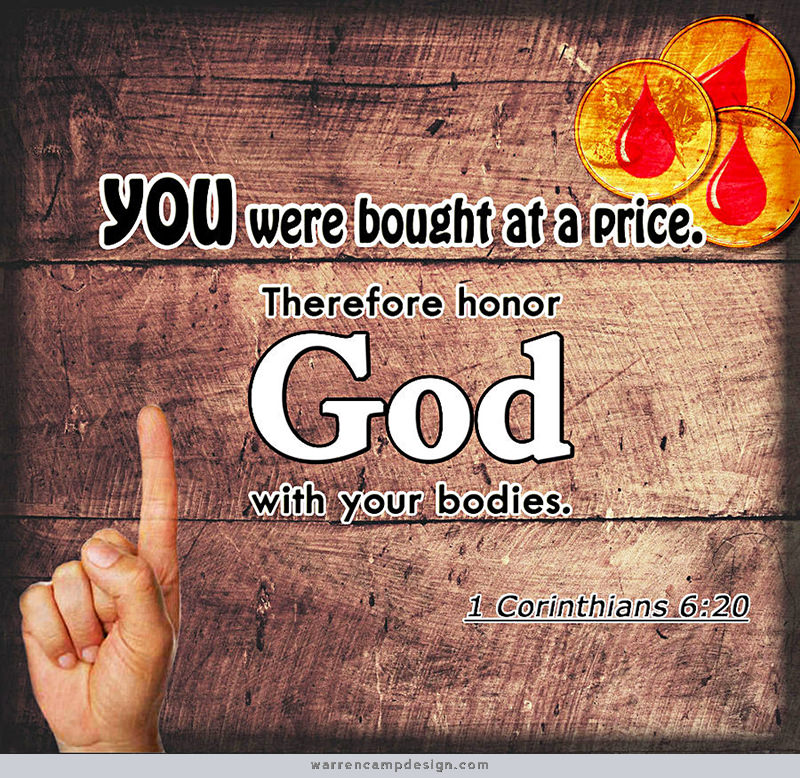
Or do you not know that your body is a temple of the holy spirit within you, which you have from God? You are not your own, for you were bought with a price. So glorify God in your body.                                                 I Corinthians 6:19-20


Paul’s discussion on sexual immorality in the second half of chapter 6 can be difficult to hear. Even though Paul uses the example of being “joined to a prostitute” (v. 16), he is talking about sexual intercourse outside of the marriage covenant in general (i.e., before marriage or with someone not our spouse).


Paul’s reasoning is that our body is a temple of his spirit that he has given us, and that joining ourselves to (i.e., having sex with) someone who we are not married to defiles our body. And since we are members of Christ’s body, we defile Christ as we each have become “one spirit” with him (v. 17).


Now what is the point of Paul’s injunction except to say that you should not have sex before marriage? In a beautiful declaration to conclude this section of his letter, Paul proclaims, “You are not your own, for you were bought with a price. So glorify God in your body” (v. 20). What does it mean that I am “not my own”? Am I not a person, do I not have a mind, am I not free? Paul’s language here is couched in the language of being purchased as a household servant was purchased in the ancient biblical culture, and it communicates the value that is inherent in each person’s life.


Something was sacrificed and given in order to be claimed by God as his. In Paul’s metaphor, he is portraying the crucifixion of his son, Jesus Christ, as a price that was paid in order for us to be purchased by God. So if we are not our own, what does that mean for my life? We are not our own because our life has been rescued from the power of darkness, but not by our own doing. We were dead and helplessly lost in sin. But because God loved us so much, he sent Jesus to die and redeem us and reconcile us back to God.


Therefore, our life is not ours to do with whatever we want. We are not free to live in whatever way we please. Being purchased by God and given new life in Christ means that our life should reflect that reality. We don’t get to decide what is right and wrong, or good and bad. If we choose to follow our fleshly desires and every inclination of our heart, we would be living no differently than an unbeliever, and our life would not be a testimony to God’s love and mercy. It would be mocking and making fun of God’s love by treating it as a trifling thing of no importance at all.


So rather than making the mistake of living however we feel, Paul exhorts his readers to “glorify God in our body” (v. 20). Glorifying God is more than the duty of one who believes in God, it is a response of worship and thanksgiving that recognizes the life we now have and the fellowship we enjoy with God and the Lord Jesus Christ is all because of the cost that God paid by sacrificing his son on the cross.


In conclusion, think upon the words of Paul in his letter to the Galatians as he considered himself to be joined to Christ both in his death and also in his resurrected life.


Galatians 2:20

I have been crucified with Christ. It is no longer I who live, but Christ who lives in me. And the life I now live in the flesh I live by faith in the son of God, who loved me and gave himself for me. I do not nullify the grace of God, for if righteousness were through the law, then Christ died for no purpose.


If we live in ways that are contrary to being united with Christ, then nothing has really changed in us, and it would be as if Christ died for no purpose. How can our lives can be a living sacrifice that brings glory to God and is a light to the world? How can we demonstrate that we are connected to Christ and united with him in one spirit?


-Jerry Wierwille

(Photo Credit by: http://www.warrencampdesign.com/graphicDesign.html .  Found at http://www.warrencampdesign.com/heartyBoys/corinthians/letter1a/week8.html)


The Wisdom of This Age?

1 Corinthians 1-4

1 Corinthians 2-5 Faith In The Powe Of God blue

Sunday, June 18


Yet among the mature we do impart wisdom, although it is not a wisdom of this age or of the rulers of this age, who are doomed to pass away.  (I Corinthians 2:6)


Paul has been describing how the message of the cross is God’s wisdom and power (1:18, 24), but it is a wisdom that this world cannot offer. And while Paul asserts that his message is not with “lofty speech” or “wisdom” (2:1), the cross is, in fact, wisdom—wisdom from God. It is a “hidden wisdom” (2:7) that contains an ancient message with the power to save those who believe.


Every period of history, there has been a conflict between the popular wisdom of the day and the wisdom of the cross. Paul refers to the popular wisdom of the day as the “wisdom of this age.” It is the wisdom that is espoused by the culture and times where one lives. But the wisdom of the age is contrary to the wisdom of the cross. Everything that the world claims to be wisdom is in fact foolishness compared to the cross, and everything God has revealed through the cross is deemed to be foolishness according to the world.


Have you ever wondered why the message of the cross receives such resistance by the world? Paul declares that the wisdom of the cross is radically different than the wisdom of the world because the wisdom of the age is diametrically opposed to the wisdom that is offered through the cross. And not only is the wisdom of the cross contrary to the wisdom of the world, the message and power of the cross cannot be understood by the world. In the eyes of the “natural man,” the wisdom of God is foolishness (2:14). It takes the spirit of God to discern the spiritual truth resident in the message of the cross. By all natural means, the despicable death of a false prophet from Nazareth upon a dishonorable and humiliating cross must surely be devoid of any real wisdom, for there can be nothing of value by following the teachings of some obscure, washed-up rabbi, who was thought to be born illegitimately and who did not follow the customs and traditions of the ancestors as was expected of a Jewish teacher of the Law.


This is exactly the appeal that the “wisdom of the age” proposes. It will contradict and distort the meaning of the cross or just out right deny its truth and power. Concerning the denial of the wisdom of the cross and the very existence of a God who sent his son to die upon it, I am reminded of a scene in the autobiographical allegory of C. S. Lewis, Pilgrim’s Regress, when John (Lewis’ main character) is portrayed as being imprisoned by despair that is imposed by a worldview that rejects any notion of a Creator (i.e., Naturalism). As Lewis personifies the antagonism of this worldview, he shows the perversions and absurd deductions of a worldview that tries to make sense of life apart from God and the wisdom he offers.


“Then I [John] dreamed that one day there was nothing but milk for them [the prisoners] and the jailer said as he put down the pipkin: ‘Our relations with the cow are not delicate—as you can easily see if you imagine eating any of her other secretions….’


John said, ‘Thank heavens! Now at last I know that you are talking nonsense. You are trying to pretend that unlike things are like. You are trying to make us think that milk is the same sort of thing as sweat or dung.’


[Jailor]: ‘And pray, what difference is there except by custom?’


[John]: ‘Are you a liar or only a fool, that you see no difference between that which Nature casts out as refuse and that which she stores up as food?”


Don’t let the wisdom of the age undermine the wisdom of God and the power of the cross. Life will not make sense without the wisdom that is found in the truth revealed by it.


My hope is built on nothing less

Than Jesus’ blood and righteousness;

I dare not trust the sweetest frame,

But wholly lean on Jesus’ name.

On Christ, the solid Rock, I stand;

All other ground is sinking sand.


Devotion by Jerry Wierwille


Beware of Bad Company

Romans 14-16

1stCor15

Saturday June 17


Romans 16:17-19

17 Now I urge you, brethren, keep your eye on those who cause dissensions and hindrances contrary to the teaching which you learned, and turn away from them.

18 For such men are slaves, not of our Lord Christ but of their own appetites; and by their smooth and flattering speech they deceive the hearts of the unsuspecting.

19 For the report of your obedience has reached to all; therefore I am rejoicing over you, but I want you to be wise in what is good and innocent in what is evil.

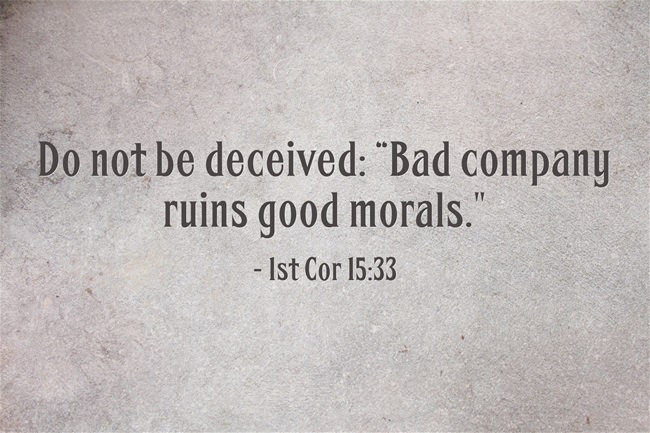
When I was a teenager, I explored many different groups of friends.  I would get really close with a circle of people and then move on to the next, checking out different types of people.   Over the years in high school, I formed an eclectic group of friends and I found this verse to be true: “Do not be deceived, ‘Bad company corrupts good morals.’” I Corinthians 15:33.  The Bible talks a lot about this.  Whatever you are watching or reading, it will get into your mind and come out of your mouth.  The same goes with who you surround yourself.  If your friends are loose morally, your attitude and standards will be affected negatively.  Often, we can get into a trap of thinking we are stronger than those around us…but more often than not, this is not true!

Paul understood this when he admonished the Romans to watch those who caused trouble and said things against what they had been taught.  He knew that those people had not made Jesus Christ their lord and only cared about their own selfish desires.  Those types of people can deceive you away from the truth and cause all sorts of evil.  Paul wanted them to be wise in the things of God which are good and have no knowledge of evil.

I remember a time during my sophomore year in high school that I hung out with some kids who were drinking.  I didn’t know how much they had to drink but I ended up in the back seat of a car packed with kids and quickly became aware that the driver was drunk by his erratic driving.   I was scared!  I remember praying desperately to God to save me and protect me.  He did and I made it home safely but I was shaken up.  I shouldn’t have been in that situation or hanging out with the kind of kids that would drink and then drive putting many lives at risk.  The friends I had at that time had loosened my convictions and I was in uncharted, ungodly territory.

What I have learned over the years of my life is that you want people that will bring you up and not down.  Choose friends that will make you better for God and stronger, ones that will admire your solid convictions and morals.  I married my husband, Sean, because he did this for me.  He pushed me in areas that I was weak and inspired me to work harder and be better for God.  Below are some verses that talk about the consequences of the company you keep.

Proverbs 13:20

He who walks with wise men will be wise, But the companion of fools will suffer harm.

1 Corinthians 5:11

But actually, I wrote to you not to associate with any so-called brother if he is an immoral person, or covetous, or an idolater, or a reviler, or a drunkard, or a swindler–not even to eat with such a one.

Proverbs 14:7

Leave the presence of a fool, Or you will not discern words of knowledge.

Psalm 26:4-5

I do not sit with deceitful men, Nor will I go with pretenders. I hate the assembly of evildoers, And I will not sit with the wicked.

Psalm 1:1-4

How blessed is the man who does not walk in the counsel of the wicked, Nor stand in the path of sinners, Nor sit in the seat of scoffers! But his delight is in the law of the LORD, And in His law he meditates day and night. He will be like a tree firmly planted by streams of water, Which yields its fruit in its season And its leaf does not wither; And in whatever he does, he prospers.

Proverbs 22:24-25

Do not associate with a man given to anger; Or go with a hot-tempered man, Or you will learn his ways And find a snare for yourself.

1 Corinthians 5:6

Your boasting is not good Do you not know that a little leaven leavens the whole lump of dough.


Ruth Finnegan


(photo credit: http://www.patheos.com/blogs/christiancrier/2015/06/23/top-7-bible-verses-about-morality/)


What’s Yours?

Acts 24-28

purpose

Monday, June 12


In this section of scripture, I was most impressed with Paul’s focus on his purpose, to preach the kingdom of God and to teach the things concerning the Lord Jesus Christ (Acts 28:31) all through confrontations, imprisonments, and wild storms at sea.  Throughout these major crises, Paul kept his cool and stuck to his mission.  He saw every crowd, every Jewish leader or government official as an opportunity to share the good news.


Many times in our lives, we face overwhelming situations or things that aren’t fair and each time we have a decision to make.  Do you lose yourself to the circumstances that surround you or do you stay focused on your mission?  Have you made a conscious realization or decision about your purpose in life? If not, take a moment to write down and define your purpose.  Here are a few scriptures that might help:


Matthew 22:36-40

“Teacher, which is the great commandment in the Law?”

And He said to him, “ ‘YOU SHALL LOVE THE LORD YOUR GOD WITH ALL YOUR HEART, AND WITH ALL YOUR SOUL, AND WITH ALL YOUR MIND.’

“This is the great and foremost commandment.

“The second is like it, ‘YOU SHALL LOVE YOUR NEIGHBOR AS YOURSELF.’

“On these two commandments depend the whole Law and the Prophets.”


Matthew 28:19-20

Go therefore and make disciples of all the nations, baptizing them in the name of the Father and the Son and the Holy Spirit, teaching them to observe all that I commanded you; and lo, I am with you always, even to the end of the age.”


These sections of scripture give a basis for our purpose.  Love God, love your neighbor, go and preach the gospel to all creation and baptize them, and teach them all that Jesus taught.  Paul was entirely focused on this, so much so, that being accused by leaders in the Jewish community did not deter him, nor did he get shaken when the governor imprisoned and questioned him.  He still maintained his calm and focus as he appealed to Caesar.  He used each situation as an opportunity to speak truth.  I found this section to be confrontational personally because there are times when I do lose my focus.  I only see what is happening around me and start to feel overwhelmed instead of putting my attention on God and the purpose He has given me!  We have power through the holy spirit just as Paul did.


We can harness our minds, no matter what our situation whether it is good or bad, to accomplish our mission.  We may be unjustly accused, people may lie and scheme against us, or we may even be imprisoned or face major storms in life…but we can look beyond the surface and fulfill our purpose by loving people enough to share the gospel and spread the truth.  Go be a Paul!

-Ruth Finnegan


Giving – the Very Best

Acts 20-23

act-20-35-ww-mf-9x

Sunday, June 11

I would like to start off this post with a short introduction.  My name is Ruth Finnegan and I am married to Sean Finnegan and we have four sons, who range from age 11 to 1 month old.  It is my joy and pleasure to be a stay-at-home mom!  When Sean and I first got married we had a lot of discussion about “how are we going to be.” We decided to set a few tenets or standards for our life together.  These were:  seek righteousness; don’t be cheap, tip generously, only use good toilet paper, and be given to hospitality.  Recently, I went to the store to stock up on toilet paper and they were out of our usual brand.  I bought a cheap package to tide us over until I could go to the store again.  Oh man! Mistake!!  Sean started declaring, “Have we lost all of our principles?? What is this, sandpaper?! Should we stop tipping too?” I burst out laughing when he said this because I was instantly brought back to that conversation early on in our marriage.  I went out and bought good toilet paper for the house and got rid of the cheap stuff.


Sean and I have been married for almost 14 years and we have always been passionate about being given to hospitality (Romans 12:10).  Over the years, we have had many people come stay with us.  Some come for just a night and some for many months.  We feel that God has given us much and blessed us abundantly and that it is our joy to bless others with our home (and with our good toilet paper).   I have found that you discover a lot about people when they stay with you in your home.  I thought about this as I read Acts 20:17-38.


When Paul was in Ephesus, his mission was certain.  He served and lived among the people, he kept back nothing, teaching them “repentance toward God and faith toward our Lord Jesus Christ” (Acts 20:21).  Paul was a true shepherd who cared for his flock and was very clear about his purpose.  He made sure that he was not a burden.  He took care of himself and those with him and he used every opportunity to teach and shepherd the flock there.  He truly cared for people and genuinely wanted the believers to be protected from the wolves that were sure to come.  Paul knew he had to leave and wouldn’t see them again.  He implored them with these final words:


35 In everything I showed you that by working hard in this manner you must help the weak and remember the words of the Lord Jesus, that He Himself said, ‘It is more blessed to give than to receive.’”


And with that, he knelt down with them and prayed for them.  When Paul left, they did not breathe a sigh of relief because he had inconvenienced them.  No, they had deep sorrow in their heart because he had been a blessing to them.


We have had people stay with us that were all about what they needed or being served so when their time of departure came, we were thankful!   We have also had the pleasure of having guests that infused our home with light and eternal blessings!  They had eyes to see and wanted to be a blessing and help.  When we go about our lives and come into contact with others, let’s strive to be like Paul.  He was all about teaching the eternal things of life like the Kingdom of God.  He was not a burden but a blessing to the believers and sincerely cared for them.  He didn’t complain about his lot as a missionary, he was driven by the holy spirit even when it came to his own discomfort and sacrifice.  Let’s strive to encourage others and remember it is more blessed to give than to receive!

-Ruth Finnegan

(Photo Credit: http://www.alittleperspective.com/acts-20-2016/)


JOY!

Acts 13-16

acts 16 joy

Friday, June 9

I love listening to missionary stories.  I love hearing how bold men and women have carried the good news of God’s love and plan of salvation to others, sometimes meeting with great success, eager ears, and saved lives, while other times being faced with disappointment, ridicule, shunning or great danger.  The book of Acts delivers all this and more as the great missionary Paul along with Silas, Barnabas, John Mark and others worked tirelessly to teach, preach, baptize and encourage churches and individuals through many towns and countries – growing the Kingdom of God.

One word that caught my attention in these chapters was JOY.  Acts 13:52 records, “And the disciples were filled with joy and with the Holy Spirit.”  Sounds great, doesn’t it!!   Things must have been going very well for our faithful missionaries to be experiencing such JOY.  But, wait, what were the verses just previous . . . “But the Jews incited the God-fearing women of high standing and the leading men of the city.  They stirred up persecution against Paul and Barnabas, and expelled them from their region.  So they shook the dust from their feet in protest against them and went to Iconium.” (13:50-51).  Trials, persecutions, and hardships, being expelled, cast out – these can easily bring up lots of human emotions.  Anger, rage, depression, hopelessness, fatigue, giving up.  But instead it says the disciples were filled with JOY – and with the Holy Spirit.  That is the joy that I want to have.   A deep joy that comes not from everything going as planned, but from knowing you are doing the Father’s Will – even when it is hard, even when it hurts.  A joy that comes hand in hand with His Holy Spirit.


JOY is used again in Acts 16:34 – this time at a truly JOYOUS occasion.  “The jailer…was filled with JOY because he had come to believe in God – he and his whole family.”  Can you imagine the scene – middle of the night, jailer hears singing from the cell as Paul and Silas praise God and pray.  Then – EARTHQUAKE!!!!  Prison doors thrown open and the jailer prepares to kill himself, since he would be executed if any of his prisoners ever escaped, and what prisoners wouldn’t escape if the prison doors were thrown open.  But then a shout is heard, “Don’t harm yourself!  We are all here!”” (16:28).  The astounded jailer needs to know more about these men and the Jesus they profess.  Paul and Silas gladly teach – and baptize – the changed jailer and his family.  The jailer takes them into his home and gives the missionaries a meal.  And there is JOY.  The baptism of a new believer is certainly one of the most joyful events.  But, what events were necessary to proceed this baptism?  In this particular case, the jailer would not have heard the gospel message if it weren’t for several catastrophes and trials: an earthquake, a mob attacking Peter & Silas (because they had healed a slave girl) which led to them being stripped and severely beaten and thrown in jail.  And, even then, if Peter and Silas had reacted differently to these crisis situations (perhaps with anger and selfishness rather than with praise and joy), the jailer would most likely have committed suicide instead of asking how to be saved.

I don’t know what you are going through today.  But, how can you face it with praise and joy and the Holy Spirit?  It just might lead to the saving of a life – maybe your own, and maybe somebody else’s.


-Marcia Railton