One King One Lord

OLD TESTAMENT: Zechariah 13-14
POETRY: Psalm 146
NEW TESTAMENT: John 18:28-40

Zechariah 14:4-9 4 On that day his feet will stand on the Mount of Olives, east of Jerusalem. And the Mount of Olives will split apart, making a wide valley running from east to west. Half the mountain will move toward the north and half toward the south. 5 You will flee through this valley, for it will reach across to Azal. Yes, you will flee as you did from the earthquake in the days of King Uzziah of Judah. Then the LORD my God will come, and all his holy ones with him.
6 On that day the sources of light will no longer shine, 7 yet there will be continuous day! Only the LORD knows how this could happen. There will be no normal day and night, for at evening time it will still be light.
8 On that day life-giving waters will flow out from Jerusalem, half toward the Dead Sea and half toward the Mediterranean, flowing continuously in both summer and winter.
9 And the LORD will be king over all the earth. On that day there will be one LORD—his name alone will be worshiped.

Psalm 146:5-10(NLT) But joyful are those who have the God of Israel as their helper,
whose hope is in the LORD their God.
6 He made heaven and earth,
the sea, and everything in them.
He keeps every promise forever.
7 He gives justice to the oppressed
and food to the hungry.
The LORD frees the prisoners.
8 The LORD opens the eyes of the blind.
The LORD lifts up those who are weighed down.
The LORD loves the godly.
9 The LORD protects the foreigners among us.
He cares for the orphans and widows,
but he frustrates the plans of the wicked.
10 The LORD will reign forever.
He will be your God, O Jerusalem, throughout the generations.
Praise the LORD!

John 18:33-37(NLT) Then Pilate went back into his headquarters and called for Jesus to be brought to him. “Are you the king of the Jews?” he asked him.
34 Jesus replied, “Is this your own question, or did others tell you about me?”
35 “Am I a Jew?” Pilate retorted. “Your own people and their leading priests brought you to me for trial. Why? What have you done?”
36 Jesus answered, “My Kingdom is not an earthly kingdom. If it were, my followers would fight to keep me from being handed over to the Jewish leaders. But my Kingdom is not of this world.”
37 Pilate said, “So you are a king?”
Jesus responded, “You say I am a king. Actually, I was born and came into the world to testify to the truth. All who love the truth recognize that what I say is true.”

The amount of prophecy and it’s meaning in these passages we read are amazing.  We don’t begin to have the space and time here to do them any justice.  The pictures of Jesus standing with the authority of the king and also the priest which intercedes for us is amazing.  The picture of the water going over the earth is life giving and symbolic of God’s love.  Jesus’ kingdom is one of worship of the God Yahweh and His love and light which comes to all the earth and it’s people.

Look also at the section of the Psalms from 146:7-9:

7 He gives justice to the oppressed
and food to the hungry.
The LORD frees the prisoners.
8 The LORD opens the eyes of the blind.
The LORD lifts up those who are weighed down.
The LORD loves the godly.
9 The LORD protects the foreigners among us.
He cares for the orphans and widows,
but he frustrates the plans of the wicked.

Where else in the Word do we see these wonderful words of promise of life in Christ Jesus?

Luke 4:16-19(NKJV) So He came to Nazareth, where He had been brought up. And as His custom was, He went into the synagogue on the Sabbath day, and stood up to read. 17 And He was handed the book of the prophet Isaiah. And when He had opened the book, He found the place where it was written:
18 “The Spirit of the LORD is upon Me,
Because He has anointed Me
To preach the gospel to the poor;
He has sent Me to heal the brokenhearted,
To proclaim liberty to the captives
And recovery of sight to the blind,
To set at liberty those who are oppressed;
19 To proclaim the acceptable year of the LORD.”

This is a quote from the scroll of Isaiah found in chapter 61 but also in chapter 49.  Please read these today if you have time. 

Our prayer today:  Father God we thank you for your love and mercy bringing us to this time and place.  Let the truth of your Word go out to all the earth today and always.  Give us the bread of our need this day to keep us strong.  Show us your paths of righteousness to give direction to all we do.  In the wonderful name of Jesus Christ we pray.

-Tom Siderius

Reflection Questions:

Who are the blind, the captives or the broken hearted of today?

How does our gospel change the equation for those we witness to?

What are the truths we need to tell the world?

God Shows Us His Love and Mercy

12/15/24

OLD TESTAMENT: Zechariah 1-2

POETRY: Psalm 143

NEW TESTAMENT: John 16:17-33

Zechariah 1:16-17(NLT) “‘Therefore, this is what the LORD says: I have returned to show mercy to Jerusalem. My Temple will be rebuilt, says the LORD of Heaven’s Armies, and measurements will be taken for the reconstruction of Jerusalem.’ 17 “Say this also: ‘This is what the LORD of Heaven’s Armies says: The towns of Israel will again overflow with prosperity, and the LORD will again comfort Zion and choose Jerusalem as his own.’”

Psalms 143:7-11(NLT) Come quickly, LORD, and answer me,
for my depression deepens.
Don’t turn away from me,
or I will die.
8 Let me hear of your unfailing love each morning,
for I am trusting you.
Show me where to walk,
for I give myself to you.
9 Rescue me from my enemies, LORD;
I run to you to hide me.
10 Teach me to do your will,
for you are my God.
May your gracious Spirit lead me forward
on a firm footing.
11 For the glory of your name, O LORD, preserve my life.
Because of your faithfulness, bring me out of this distress.

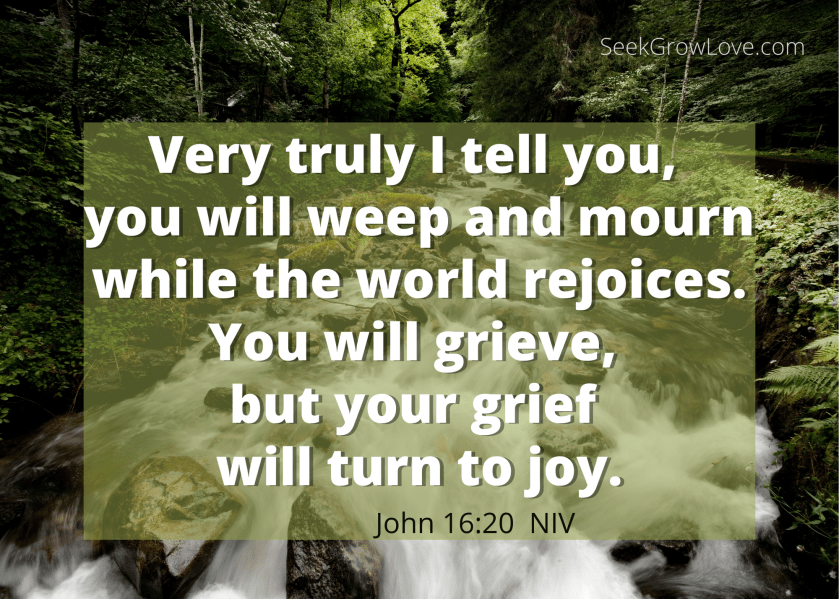
John 16:17-24 (NLT) Some of the disciples asked each other, “What does he mean when he says, ‘In a little while you won’t see me, but then you will see me,’ and ‘I am going to the Father’? 18 And what does he mean by ‘a little while’? We don’t understand.” 19 Jesus realized they wanted to ask him about it, so he said, “Are you asking yourselves what I meant? I said in a little while you won’t see me, but a little while after that you will see me again. 20 I tell you the truth, you will weep and mourn over what is going to happen to me, but the world will rejoice. You will grieve, but your grief will suddenly turn to wonderful joy. 21 It will be like a woman suffering the pains of labor. When her child is born, her anguish gives way to joy because she has brought a new baby into the world. 22 So you have sorrow now, but I will see you again; then you will rejoice, and no one can rob you of that joy. 23 At that time you won’t need to ask me for anything. I tell you the truth, you will ask the Father directly, and he will grant your request because you use my name. 24 You haven’t done this before. Ask, using my name, and you will receive, and you will have abundant joy.

How many times do we think to ourselves “I wish I could ask Jesus about what he said in a passage?”. Here in John 16 Jesus sees that question in the hearts of his disciples without them even asking.  He then answers that question of their hearts. 

I was able to witness the birth of all four of our children who are now in their 30’s and 40’s.  I was a participant in the event, Lamaze called me a coach, but really the events were all focused on the effort it took my wife Sandy to birth the children.  Labor for her started many hours before the actual birth event.  The start of the contractions was usually strong but the effort and pain at the end when the child is birthed became almost overwhelming for her.  Thanks be to God that she is so tough and resilient that all were born without complications and were beautiful children when born.  The intensity of the birth process is still embedded in my mind forever.

Jesus tells the disciples about the events that are going to occur in the near future for all of them.  God has showed Christ by the Old Testament scriptures and by revelation what he will have to endure.  Jesus compares these events to the birth of a child, where the pain and effort are replaced in the end by the joy of the new child and her or his coming into the world.  My wife and I had great joy at the birth of the children when we were able to hold them in our arms and enjoy the blessing of the new child.

Jesus tells the disciples that in the future they will rejoice about the events of the cross.  Jesus sees and knows what’s coming for him, but they do not yet at this time understand.  But he is getting them ready for the future message of hope that will come from the resurrection and the ascension.  This leads to the day of Pentecost and the founding of the church of the body of Christ. 

Zechariah 1:16-17 (NLT)

Therefore, this is what the LORD says: I have returned to show mercy to Jerusalem. My Temple will be rebuilt, says the LORD of Heaven’s Armies, and measurements will be taken for the reconstruction of Jerusalem.’ 17 “Say this also: ‘This is what the LORD of Heaven’s Armies says: The towns of Israel will again overflow with prosperity, and the LORD will again comfort Zion and choose Jerusalem as his own.’”

As we read through Zechariah it will become clear to us that the visions he sees about the building and construction that God shows him are immediately fulfilled in the physical rebuilding of Jerusalem and the temple. The books of Nehemiah and Ezra give us the history of this rebuilding.  But the really big picture is of the future building of the millennial kingdom and the city of Jerusalem by the Messiah.  As we read through Zechariah try to look at the immediate fulfilling of his prophecies, but more importantly look at how they fit together at the end of the Tribulation and the establishment of the Millennial kingdom.  The judgement of wrath which judges Israel and Judah are turned to the great blessings of all the promises to Israel fulfilled in the righteous kingdom.  Jesus Christ is the head of both government and religion in this future rulership.  Almost all prophecy has a near fulfillment and then a future truth of God’s promises.  As you read Zechariah and the words from Psalms and John this week look for the immediate fulfillment but more importantly see the message that God shows of the future.

-Tom Siderius

Reflection Questions:

What are the great anticipations of your heart for your life?

How does our hope in Christ grow as we live today but look forward to the fulfillment of prophecy?

He is the LORD

OLD TESTAMENT: Ezekiel 38 & 39

POETRY: Psalm 132

NEW TESTAMENT: John 5:16-30

Have you ever taken a sneak peak to the end of a book? I don’t do it often, but when I do, it may be just a quick glance to see if a character is still alive at the end. In today’s reading, we have some exciting, confusing stuff! Ezekiel 38 and 39 have it all…..new characters, epic battles, armed horsemen, plundering, hailstones and burning sulfur, crumbling cliffs, overturned mountains, and all people and creatures (even fish!) trembling.  If you were to illustrate this section….you’d need quite the mural.

As one can imagine for such exciting material, there are many studies, teachings, commentaries, and beliefs associated with which modern day peoples/nations might be associated with Gog and Magog, how this prophecy ties in with end time prophecies, etc.  I learned a lot studying it, and thought it was interesting that just a few weeks ago, in an adult Bible class I attend, the teacher asked us our thoughts on these chapters and Gog and Magog and what was going on in the world today. A question I had certainly never been asked before. I’m pretty sure I’ve been asked “what are your thoughts on God”….but “what are your thoughts on Gog?!”…that one was a new one for me!  But, I’m confident that as things continue to unfold with devolving world relations, new alliances, political turmoil in so many places, these chapters will continue to prove interesting. And no matter our age or place in life, current events and awareness of Biblical prophecies and a worldview based in scripture matters.

 I remember as a kid visiting my great-grandma in her nursing home (Pinecrest Manor in good old Mt. Morris, Illinois!) and being struck by how worked up she was when she (at the age of 100, legally blind and hard of hearing by then) was listening to my mother chat about the news at the time. The Berlin Wall had recently come down and the Soviet Union had just collapsed -which I realize makes me sound ancient to many of you reading this. But, I distinctly remember looking up from my book to watch her face as she said so emphatically to my Mom, “Why don’t they TELL us these things here?!”  She was fascinated because she knew her Bible, she was interested in Biblical prophecy and how they relate to current events, and I’d imagine at the age of 100….she liked to consider the coming kingdom of God!

Regardless of precisely who all these characters are in these chapters, we see the purpose of the story clearly stated. Clearly stated numerous times. When I was reading through Ezekiel, I noticed that I had read the phrase “know that I am the LORD” a few times. Enough times that it caught my attention and I ran the phrase through Logos to see how many times it was used.  Umm…..more than a few! More like that specific Hebrew phrase is found 88 times in scripture and 76 of them are in the book of Ezekiel. 76 times this prophet reminds us of the importance of knowing that He is the LORD!

When battles rage and we are persecuted, when landscapes crumble and fires burn, when enemies pursue and God’s name is profaned, He is the LORD!

We live in a world of increasing disrespect toward the LORD, but that doesn’t change the fact that He is who He is.  If I ever need a reminder again of who He is, who will win and be alive in the end, and whose promises for a coming kingdom and eternal peace I need to rely on….I think these chapters will be great ones for me.

So I will show my greatness and my holiness and make myself known in the eyes of many nations. Then they will know that I am the LORD.” (Ezekiel 38:23)

I will send fire on Magog and on those who dwell securely in the coastlands, and they shall know that I am the LORD.”

“And my holy name I will make known in the midst of my people Israel, and I will not let my holy name be profaned anymore. And the nations shall know that I am the LORD, the Holy One in Israel[1]  (Ezekiel 39: 6-7)

-Jennifer Hall

Questions:

  1. Make a mental list of ways God has shown you He is the LORD.
  2. Are there ways you have seen the LORD’s name being profaned recently? How can you honor Him today? How do you picture Him being honored in the coming kingdom?
  3. So, what are your thoughts on Gog?!

Feasting on a Dish of Hope

OLD TESTAMENT: Isaiah 10-12

POETRY: Psalm 106

NEW TESTAMENT: Hebrews 4

A skill that I picked up from my teaching days was the complement sandwich. Whenever you needed to email a parent or correct a student, you nestled your criticism between two things that were good. It was a way of taking ‘a spoonful of sugar to help the medicine go down.’ There have been studies that it takes 5 positive interactions to overcome 1 negative interaction. From marriage to parenting to work relationships, we have to fight to notice the good so that we don’t become too negative with our words. 

Interestingly, as I read through the first few chapters of Isaiah, I noticed that God does the same thing with his prophecies. The people of Israel and Judah were told in no uncertain terms that they needed to repent and turn back to God, or they would face destruction. As we’ve read, this is a pretty bleak picture. 

Isaiah 10:16-18 says, “The Light of Israel will become a fire, their Holy One a flame; in a single day it will burn and consume his thorns and his briers. The splendor of his forests and fertile fields, it will completely destroyed, as when a sick person wastes away. And the remaining trees of his forests will be so few that a child could write them down.”

When we read this, it’s easy to think of God just as the vengeful and wrathful God that sometimes culture depicts him as. And, it’s true that God is a just God; this destruction happened in the past and will happen again in the last days. 

But, to just describe God in this way misses the full picture of who he is. With all of our readings this week, we haven’t been left with destruction. In the midst of these prophecies, there is always hope. God may not give his criticisms in a compliment sandwich, but he does serve up a solid dish of hope. 

Right after God describes the destruction coming in Isaiah 10:18, he then describes how a remnant will be left that will be led by the shoot from the stump of Jesse (Is. 11). We then have this beautiful picture of what the coming kingdom looks like. 

Some of the descriptions of the kingdom that we get: 

  • A king who is righteous, faithful, and good
  • Characterized by peace and nonviolence, not just between the nations but also between predator and prey
  • An Earth that is full of the knowledge of the Lord 
  • Nations that have left between jealousy and strife and are full of brotherly love towards each other 

As we read through Isaiah, we should feel convicted to look deeply at our lives and be sure that we are living them righteously. But, we should also be reminded of the ever-lasting faithfulness and love of our Father. Yes, God is a holy, just God, but he also is a loving God who has good things in store for us. 

With each picture of hope, we are moved to praise just like Isaiah. We say along with him, “Surely God is my salvation; I will trust and not be afraid. The Lord, the Lord himself, is my strength and my defense; he has become my salvation. With joy you will draw water from the wells of salvation” (Is. 12:2-3).

-Cayce Fletcher

Cayce Fletcher is a teacher-turned-SAHM mom of two. She blogs and podcasts at A More Beautiful Life Collective where she focuses on how you can create a life you love and cultivate your heart for God. Currently, she is working through a systematic theology series on her podcast. You can find her latest post on Bibliology here

REFLECTION QUESTIONS

  1. A common theme throughout Isaiah is the tendency of the people to oppress the poor, widow, and fatherless. James 1:27 says that pure religion is to take care of these people. Describe God’s heart for those who are oppressed. How are you serving them in your life? 
  2. Do you view God as a wrathful judge or a loving Father (or a little of both)? How do you think the world views God? What is the correct view of God? 
  3. How do the prophecies of the kingdom that we read in Isaiah move you to praise? 

Against You

Nahum 2

Thursday, November 10, 2022

While deciding what to write for each day this week I was quite confused about the second chapter of the prophet Nahum. The book at face value is a prophecy of a military assault on Nineveh. Verses one and two call the people of Nineveh to battle. Verses three through seven go through the visions of the battle. Using phrases like “Chariots rage in the streets” and “The palace is dissolved” or my personal favorite, “They run like lightning.” Close to the end of this section is the phrase “She shall be led away captive.” Nahum saw the outcome of the battle and knew that Nineveh would eventually fall to the hands of this mighty army. In verses eight through twelve, is the prophecy of Nineveh crumbling and being looted after the war. “Take spoil of silver! Take spoil of gold! There is no end of treasure, or wealth of every desirable prize.” Nineveh was seriously gone.

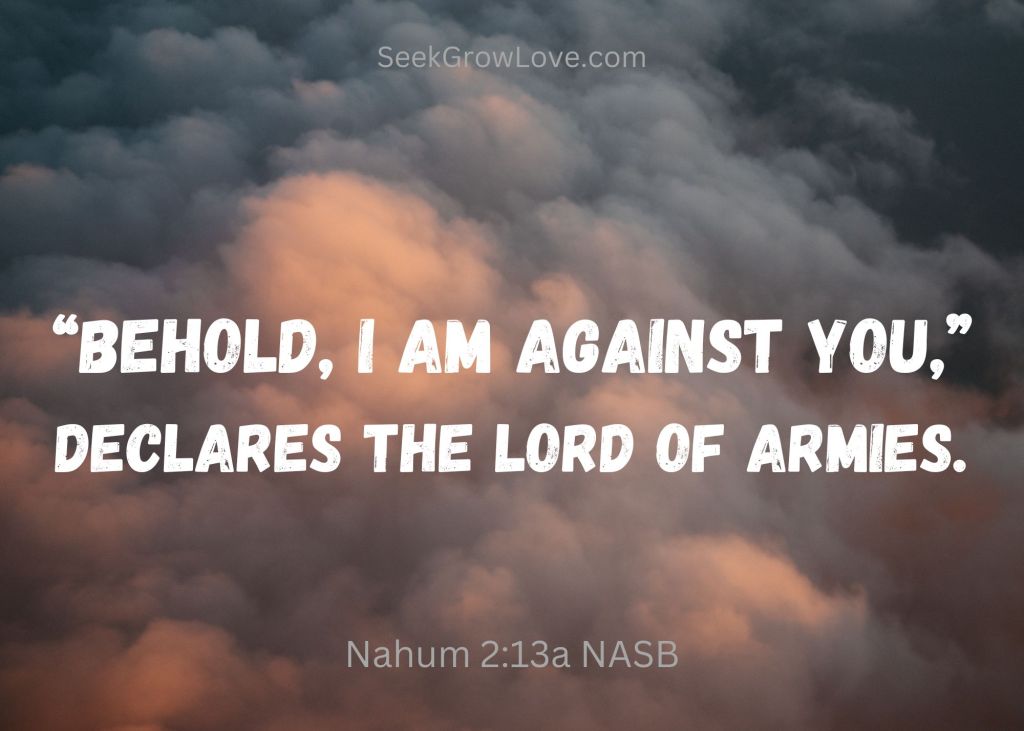
“I am against you,” declares the LORD Almighty. “I will burn up your chariots in smoke, and the sword will devour your young lions. I will leave you no prey on the earth. The voices of your messengers will no longer be heard.”

That was Nahum 2:13. The direct quote from God, the LORD Almighty, was that he was against Nineveh. While reading a commentary about this, the author quoted Romans 8:31 “…If God is for us then who can stop us.” The author followed it up with the question “If God is against you, who can be for you?”

This small chapter of the Bible is one that may not be entertaining at first glance but there at the end, ask yourself the question; “Would God have a reason to be against me?” 

Pray for discernment of all things in your life, and repent. Get right with what rules God has laid out for us to follow, so that God will be for us.

-John Evans

APPLIcation

  1. Really, ask yourself the question, “Would God have a reason to be against me?” Pray for discernment, examine yourself and repent.
  2. Are there any of God’s rules that you need to work a bit harder at following? Which ones
  3. How would you answer question 1 in light of Romans 3:23? What does Jesus’ sacrifice for your forgiveness mean to you? Does this mean you can sin now?

Numbers 27-28, Luke 4

As the book of Numbers draws to a close, Moses begins to make preparation for his death. God tells him he will not enter the Promised Land with the Israelites, but he will be able to see it before the Israelites enter in. Moses is (very understandably) concerned for the Israelite people. He has had to intercede for them and guide them away from idolatrous actions again and again. In Numbers 27, Moses passes on the leadership torch to Joshua so that the Israelites will not be like a “sheep without a shepherd” (Numb. 27:17). Joshua would become the next leader who would guide, command, and take care of the Israelite people as they enter into the land of Canaan. 

Luke 4 describes the beginning of Jesus’ ministry. Moses had spent years building up trust and confidence from the Israelite people, and Joshua benefited from that. He was able to build on the legacy of leadership that Moses left behind. Unlike Joshua, Jesus had to start from square one when building confidence and trust with the Jewish people. We see him begin this process in Luke 4. After the temptations in the wilderness, he begins preaching in the synagogues. At one point, he reads a passage from Isaiah that begins with “The Spirit of the Lord is on Me, because he has anointed me to…” and then lists out all the actions the God has sent him to do (Luke 4:18). Jesus did not have a Moses that told all the Jewish people to listen and follow after him. But, Jesus had something better to establish his authority. Not only did God speak over him after he was baptized, “This is my beloved Son. I take delight in him!” (Luke 3:22). He also had all of the Old Testament scriptures that spoke about him! 

Even so, the Jewish people did not accept him as a leader, because he challenged the way that he led and thought about the world. Just like the leadership example set by Moses, Jesus knew that the Jewish people needed someone to guide them, protect them, and care for them. They needed a shepherd. But, being led by a shepherd sometimes includes being corrected by a shepherd. The Jewish people, especially those in positions of power, were resistant to this. In fact, this section of Luke ends with the Jewish people doing this: “They got up, drove Him out of town, and brought Him to the edge of the hill, intending to hurl Him over a cliff” (Luke 4:29). 

Jesus is the “good shepherd” (John 10:14). His sheep “follow him because they recognize his voice” (John 10:4). When Jesus is leading us, do we follow? Are we resistant and stubborn to correction, choosing to go our own way? Or do we trust that our good shepherd will guide us on the right paths? How do we view Jesus’ leadership? 

My prayer is that we will trust in Jesus as our good shepherd. That his leading, both in guiding and correcting, will be a “comfort” to us as he lets us “lie down in green pastures,” leads us “beside quiet waters,” and “renews our life” (Ps. 23:1-4). 

~ Cayce Fletcher

Read or listen to today’s Bible reading at Biblegateway.com: Job 1-2 and 2 Corinthians 2 .

Revelation and Double Fulfillment

Revelation 17

Revelation 17 14 .png
Today is a bit longer. Please bear with me to the end.
Before we start this devotion, please go read Isaiah 7:14. 
Is that verse about Jesus? 
According to Matthew 1:23, the answer is a clear and resounding yes. Now, go back and read Isaiah 7:14, 16-17, 8:3-4, 10. It would seem that Immanuel is also a reference to Isaiah’s son, Maher-shalal-hash-baz, who is the child of a/the young woman, and his title (Immanuel) shows the people that God is with them (Immanuell literally means “with us is God”). 
I know that may be some new information for you, but this is what I want you to see : When Isaiah gave the Immanuel prophecy, he wasn’t JUST talking about something that would happen hundreds (700+) of years in the future. He was talking about something that was going to happen SOON, that would impact King Ahaz’s life in just a few years time. Did he speak about the future as well? Matthew says yes, but that’s not all he speaks about.
This bit of insight is helpful to have in mind as we read Revelation 17 (or if you have already read it, as you go now and re-read it). Many who read the text of Revelation focus on the future aspects of the book. When will it happen? (Some people say : “Always just around the corner!”) Who are Gog and Magog? (“Always enemies of our country, like Germany, China or Russia!”) Am I prepared? (“Buy your food kit now!”) But, just as the prophecies of Isaiah meant something for the people of his day, we MUST recognize that the prophecy and revelation of John meant something to readers of John’s day.
And John’s readers knew what he meant. There are things that are hard to understand about the scene he saw, but he made it clear enough that they would have understood at least SOME of it. The picture is of a prostitute/harlot/whore sitting upon a beast. She commits sexual immorality with kings, she rides upon a beast, gets drunk on the blood of the saints. She has many names.
Woman who rides upon the beast, through hints we see in this text, is Rome (and by extension, the Roman Empire). Rome is a city sat upon seven hills (v.9). Rome is the great city that has an empire over the kings of the earth (v.18). Rome, like Babylon the Great before her, destroyed the Jewish Temple, and therefore Rome was acting in the “spirit of Babylon”. (v.5) The sexual immorality committed by the kings of the Earth is their worship of the Emperor as “the son of the gods” and “god-in-flesh”, which was discussed in an earlier devotion on Revelation, when the author spoke about the imperial cult. (v.2) Most importantly for the first readers, this woman was drinking the blood of the saints; that is a poetic description of what they were experiencing under the persecution of Rome.(v.6) 
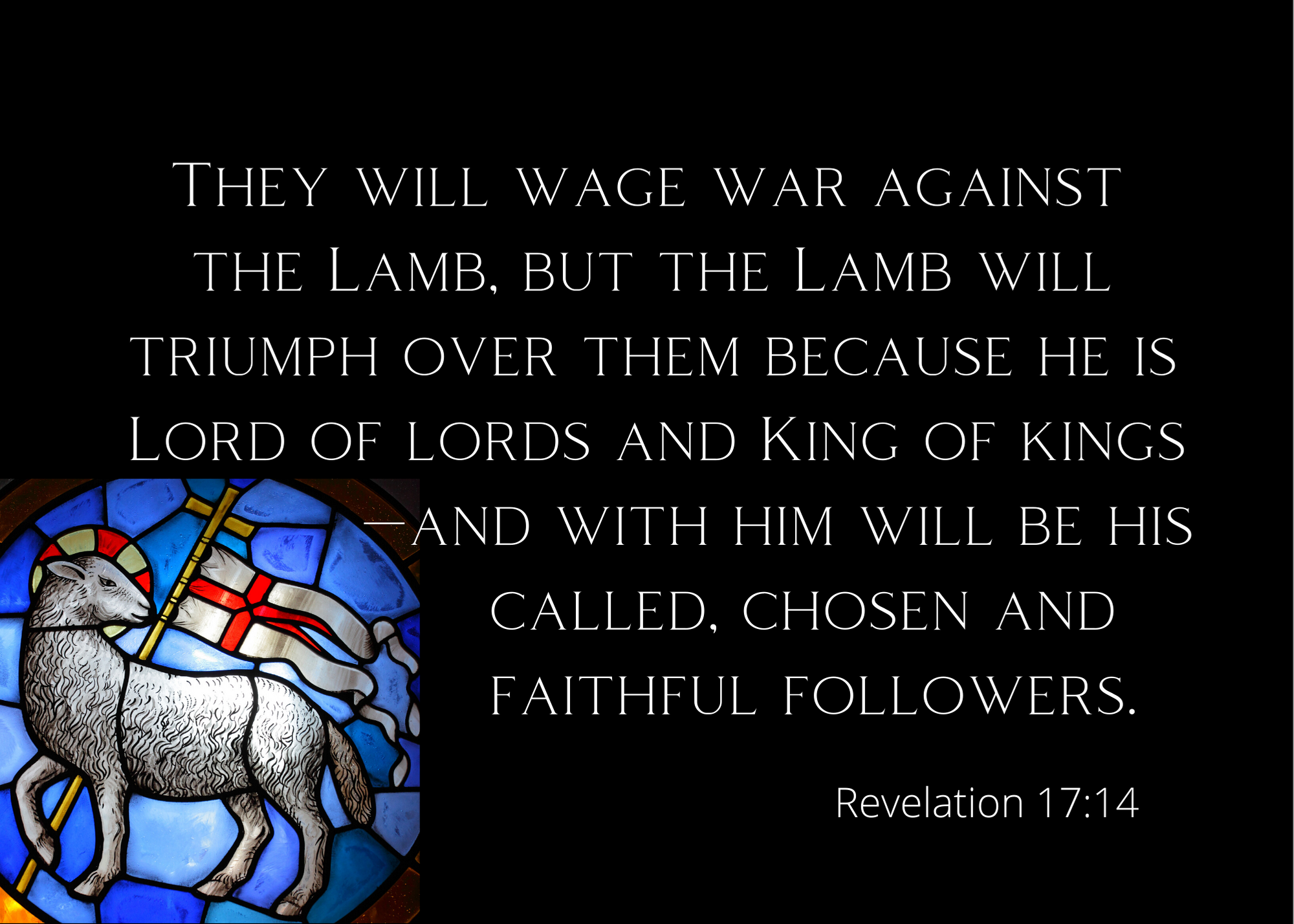
When John uses all these images, we are given a powerful picture of the spirit of any empire that moves against Christ. And that is true in every age and in every place where there are empires drinking deeply the blood of saints and worshipping that which is not God. What we must always realize is that both in the day of John and our own, the truth is that Christ will conquer them all. Verse 14 says “These will make war against the Lamb, but the Lamb will conquer them because He is Lord of lords and King of kings. Those with Him are called, chosen, and faithful.” 
Could there be another city that will sit upon 7 hills, with kings, and be Babylon the great? Maybe. All of Revelation 17 could happen again in the future, with other systems, empires, and rulers. But verse 14 will be always and forever clear : whoever makes war against the Lamb will be defeated. The Lamb will conquer them by his power.
 

Brothers and sisters, we stand with him. We are called. We are chosen. No matter the persecution of the Dragon, the Beast or the Harlot, let us remain faithful. (v 14)


Jake Ballard
(Jake Ballard is Pastor at Timberland Bible Church in South Bend, IN. He lives in the Michiana Area with his wife and daughter. If you’d like to say hi you can find him on Facebook at https://www.facebook.com/jacob.ballard.336  You can also hear more teachings at https://www.youtube.com/channel/UCs_awyI1LyPZ4QEZVN7HqKQ Otherwise, he is available on all hailing frequencies, by using the Palantir, and via carrier pigeon, though it’s getting colder in South Bend. God bless you all!)

Be An Overcomer

Revelation 1 3

The Old Testament has 17 books of prophecy (5 Major Prophets and 12 Minor Prophets).  It is here that God’s messengers gave many warnings of what troubles and destruction would come to those who didn’t repent and live a life pleasing to God.  Many (though not all) of the prophecies recorded in these books have already taken place: destruction of ancient Israel and Judah, restoration for a remnant and the coming of the Messiah.

Similarly, the New Testament ends with one book of New Testament prophecy –  the book of Revelation.  And in it we read many warnings to those who don’t repent, accept Jesus and live a life pleasing to God.  Most of the prophecies recorded in this book have yet to come: destruction of the ungodly, the 2nd Coming of the Messiah, and restoration for the godly in the Coming Kingdom.

God sends this series of revelations to John (by way of Jesus and an angel).  He writes of what must soon take place and says, “Blessed is the one who reads the words of this prophecy, and blessed are those who hear it and take to heart what is written in it, because the time is near.” (1:3).

In chapters 2 & 3 the seven churches in Asia are individually commended for what they were doing right (hard work, perseverance, not tolerating wicked men, etc…).  And, they were then challenged to work on other issues which required repentance and renewed commitment to truth and purity (not allowing false teachers and immorality, etc…).  These words are very applicable to us today.  We would be wise to consider what we as a church are doing well, as well as what we need to repent of and change.  Each church is challenged to listen well to what the Spirit has to say to the church, and promised that overcomers would be rewarded.

Then the vision turns to the throne room of God where a lamb, looking “as it had been slain” (5:6) breaks 7 seals from a scroll unleashing war, famine, and other disasters on the earth.  A dragon and two beasts, allied against God, arise to demand the worship of earth’s people who have not been killed in the earlier catastrophes.  Seven bowls of the wrath of God (reminiscent of the plagues on Egypt) bring disasters such as darkness, the most severe earthquake ever and huge hailstones.  The upheaval destroys Babylon the Great.  Next, the heavens open and the Savior, Messiah, King Jesus, also called the Word of God, appears on a white horse ready to lead heaven’s armies in destroying evil.  For 1000 years Christ reigns on earth while Satan, “that old serpent” (20:2) is bound and kept from deceiving more.  At the end of the 1000 years, Satan is released briefly to instigate a worldwide war, but never fear – it says as they surround the camp of God’s people fire from heaven will devour the enemy and Satan will be thrown into the lake of fire.  God unveils a new heaven and a new earth.  The new Jerusalem comes down from heaven, and God will dwell with men.  “He will wipe every tear from their eyes.  There will be no more death or mourning or crying or pain, for the old order of things has passed away.” (21:4).  There are so many more beautiful descriptions of the coming Kingdom on earth found in the last 2 chapters of Revelation.  It is truly something you don’t want to miss.  But, we know that many will, because of the decisions they are making today.

Just as Moses laid out for the people blessings and curses depending on what the people did, so too, John’s Revelation includes good news and bad news.  What will you do today to prepare for a Coming Kingdom?

Be an Overcomer

Marcia Railton


Peace in Our Time

 IMG_0034

Daniel 10-12

I am no expert on Biblical Prophecy, or on anything for that matter. So I’m not going to try to explain the prophecies in Daniel 10-12. Instead I want to share three things we can learn about God from Biblical Prophecy and three implications of those things for our own lives.

(1) Biblical Prophecy illustrates that God is not in time. This means that God is not bound by the same time constraints as we are. You and I can only deal with the present. We may have memories of the past and fantasies of the future, but we can see what is really happening only while it is actually taking place. God is not like this. He can see all of history at a glance; this is how He could reveal to people like Daniel the goings-on of the future.

(2) Because God is not in time He is the greatest of planners. The people we think of as planners (people like my wife) tend to have a focus on the future. This is why they plan—to be prepared for what is coming in the future. Since God can see the future He is able to plan things out in such a way as to generate best possible result. And because God loves us, those plans promote our welfare.

(3) Not only does God make plans, but those plans happen just as He promises. There are hundreds of prophecies throughout the Bible, some of which have already been fulfilled. Many of the prophecies in the Old Testament predicted that a Messiah would come. They foretold of the place of his birth, the characteristics that would define him, and the ultimate sacrifice he would have to make. When Jesus came, he was the embodiment of these promises—although many didn’t recognize this. When God makes a promise, you can bet your bottom dollar that He will come through.

(4) Because of God’s track record in promises department, we can trust that the prophecies in the Bible that haven’t yet happened will eventually happen. While it is very easy to lose trust in the empty promises of politicians, we can rest assured that God won’t let us down.

(5) Our trust in the promises of God should give us hope for the future. While the Bible does prophesy that in “the end” difficult and trying times will come, after that there will be no more pain, no more tears, and we will be with our God in His perfect Kingdom.

(6) What all this really means is that right now, in the time we are constrained to, we can live at peace. Despite the craziness of the world around us, however terrible and unbearable it may become, our hope can anchor us so that we can stand firm and live in serenity. So look at the promises God has made, see that He keeps them and that they are good, and live in peace, with hopeful expectation for the culmination of all the prophecies in the Bible.

– Joel Fletcher

From Dry Bones to Streets of Gold

Ezekiel 37-39

Ezekiel 37 amber 

Friday, March 31

What a powerful passage.  If you would like a visual of the valley of dry bones, I recommend checking out this minute and a half Youtube clip (https://www.youtube.com/watch?v=6dafYxu8cQQ).


While we can pull out hundreds of things to say about this passage, I am going to stick to two simple ideas.  Ezekiel 37 acts as a double prophecy.  In other words, we can expect two different things to happen:

  1. God will restore Israel and make a nation again from the scattered people. He will bring his chosen people back to the promised land.
  2. God will establish His kingdom on Earth. We know that Jesus is coming back to Earth again to reign until God Himself reigns above all men.


We see in Ezra and Nehemiah that prophecy number one is fulfilled as the temple is rebuilt.  In the New Testament we also get a glimpse at prophecy number two.  When Jesus died on the cross we know that the curtain was torn and we have hope in the future Kingdom! After all, Jesus did preach most about the kingdom of God during his time on earth.


As my dad says, he has two major goals in life: 1. To be sure he maintains a strong relationship with God, and 2. To get as many people into the Kingdom as possible.  I don’t know about you, but I cannot wait to live forever on the streets of gold glorifying God and Jesus all day long! How are you furthering the Kingdom cause through your everyday actions?


Revelation 21:1-4: Then I saw “a new heaven and a new earth,” for the first heaven and the first earth had passed away, and there was no longer any sea.  I saw the Holy City, the new Jerusalem, coming down out of heaven from God, prepared as a bride beautifully dressed for her husband.  And I heard a loud voice from the throne saying, “Look!” God’s dwelling place is now among the people, and he will dwell with them.  They will be his people, and God himself will be with them and be their God.  ‘He will wipe every tear from their eyes.  There will be no more death or morning or crying or pain, for the old order of things has passed away.”

-Amber McClain