The Words of the Preacher

Ecclesiastes 1-6

Ecclesiastes 1:1-5(NKJV)  The words of the Preacher, the son of David, king in Jerusalem.
2 “Vanity of vanities,” says the Preacher;
“Vanity of vanities, all is vanity.”
3 What profit has a man from all his labor
In which he toils under the sun?
4 One generation passes away, and another generation comes;
But the earth abides forever.
5 The sun also rises, and the sun goes down,
And hastens to the place where it arose.

“Ecclesiastes” comes from the Greek “Ekklesiastes” which is from the word “ekklesia” which in the NT is translated into “assembly” or “church”.  Solomon is the writer, and the book is the “Speaker to the Assembly”.  Or we could say “Preacher”.  These are words that the church needs to hear.

Ecclesiastes 1:14-17(NKJV)  I have seen all the works that are done under the sun; and indeed, all is vanity and grasping for the wind.
15 What is crooked cannot be made straight,
And what is lacking cannot be numbered.
16 I communed with my heart, saying, “Look, I have attained greatness, and have gained more wisdom than all who were before me in Jerusalem. My heart has understood great wisdom and knowledge.” 17 And I set my heart to know wisdom and to know madness and folly. I perceived that this also is grasping for the wind.

Our readings for today and tomorrow are wisdom from Solomon about the meaning of life.  He explores wisdom, wealth, work, art, and faith throughout the book.  The word “vanity” used in many versions of the Bible is the Hebrew word “hebel”.  It is translated in different versions as vanity, meaningless, or futility.  It is a word which is not easily translated directly to English.  The meaning comes from the idea of “breath” or “vapor” like the breath of steam from your mouth on a cold day.  It cannot be grasped with your hands or put into a bottle or jar.  Meaning in our lives without God being involved is like trying to grab ahold of that breath or vapor.   People desire for their lives to have meaning and purpose.  We also want to be remembered as doing things that are useful and lasting.  Solomon certainly did all that a man could do in his life and had God given wisdom to work from.  Yet he says that all is meaningless without the purpose of serving God.  Even our Christian religious activity doesn’t have meaning without true godliness at its base.  This fallen world needs to find Christ in order to find meaning.  Only God in His wisdom knows what we need and has provided it for us.

Reflection Questions

Do you feel like you are grasping the wind or vapor when trying to understand life?

How does the Word of God change that?

Are you sometimes frustrated by your study of the Bible?

How does the perspective of Ecclesiastes change your thinking?

 Enjoy reading Ecclesiastes today and tomorrow and try to look for the purpose of your life in the reading. 

God Bless!  Tom Siderius

It’s All Good Now

Old Testament: Deuteronomy 25 & 26

Poetry: Job 40

*New Testament: Romans 8

 “And we know that for those who love God all things work together for good, for those who are called according to his purpose.”  – Romans 8:28 (ESV)

Of all the books of the Bible, Romans is my favorite. Chapter 8 may very well be my favorite chapter in the book for many reasons. It starts with the declaration that there is no condemnation for those who are in Christ Jesus, and it ends with the encouraging reassurance that there is nothing in all of creation that can separate us from the love of God. In between, however, is a great life verse that provides comfort and hope regardless of your situation or circumstance.

Romans 8:28 says, “And we know that for those who love God all things work together for good, for those who are called according to his purpose.”

It is just as important to understand what is not said as it is to understand what is said. Paul does not say that all things are good but rather all things work together for good. It is often a matter of time and/or a change of perspective to see that the bad things that happen end up working for your good. I can speak specifically to that being the case. My salvation story depends on it.

On Easter Sunday in 1995 I was invited to come to church and help the men cook breakfast for the congregation. It was a tradition that had been going for a while and continues to this day at Pine Grove Bible Church. I was not a member or even a Christian at that time but as a former short order cook and someone who enjoys hanging around with other guys I agreed to come and help.

As a result of me driving in early to help cook, we had two vehicles at church and then two vehicles at my in-laws as we celebrated Easter dinner. When it was time to leave, my wife Amy and our two children were going to get in the car she was driving and I would get in mine to head home. I asked my almost 7-year-old son David if he wanted to ride with me and he said no. I told him we could beat mom home and he could ride in the front seat (this was pre-airbag times) and so he agreed to hop in with me. This was not a common occurrence as he often would sit in the middle of the back seat loosely buckled and leaning forward between the front bucket seats to entertain his incredibly crabby sister. As fate would have it, we made a stoplight that Amy and Stephanie did not, so we did indeed arrive home first.

I was busy unpacking the leftovers and Easter baskets (at that point we had the only two grandchildren, so it was always a bonanza for them) when I noticed a message blinking on the answering machine. It was Amy, calling from someone’s cell phone (very few people had them back then) letting me know that she had been in an accident and the car had flipped and she was very shaken up. I couldn’t hear Stephanie crying in the background (if any of you reading this were around at that time you know that she was always crying in the background) so I grabbed David and raced back to the accident site.

When I got there, I saw her mangled car in the ditch on its side facing the wrong way. I recall heading to the squad car and then desperately clinging to my 18-month-old daughter as tears ran down my face. I came to find out that a car traveling in the opposite direction had a blowout, lost control, and ended up hitting them almost head on. Thankfully, Amy was able to turn quickly enough to have the car hit her by the driver door, slide down the side to the rear wheel well where it caused the car to flip 180 degrees over and backwards. It was an Easter miracle that neither Amy nor Stephanie was seriously injured.

The accident was not good, in fact it was bad, very bad, as Amy still suffers neck pain as a result. But, given the ability to look back, I can honestly say that it worked for the good. I was working in a sales job where I was gone most nights and the realization that what mattered most to me could have been lost in the blink of an eye caused me to quit that job that next week. Wanting to spend more time with my family caused me to start attending church and Wednesday night Bible study and eventually I gave my life to Christ.

Now, nearly 29 years removed from that horrible accident I can see God’s hand working through all things, even accidents, for the good of those He has called according to his purposes. Trust in His timing, God is good!

Todd Blanchard

Reflection Questions

1. Can you identify a specific time in your life that seemed devastating at the time (i.e. job loss, death, relationship ending) but now you can see how it shaped you into who you are today?

2. Who do you know that is going through a tough time that you can share your story with?

3. How can you remind yourself to trust in God’s timing for your life?

Purpose

Old Testament: Deuteronomy 1

Poetry: Job 25

New Testament: Mark 10

This morning I am sitting here preparing for a message at church on the Triumphal Entry. It worked out perfectly that the verses we are using for today’s devotion is from Mark chapter 10:32-34. This set of scriptures focus on Jesus telling his disciples a third time he will die and be resurrected. The disciples are becoming fearful. Because it’s clear that many in the crowd want him dead. And Jesus is moving closer and closer to more dangerous areas.

Based on information given in Matthew, Luke, and John, we know quite a bit happened between Mark chapters 9 and 10. Included in that time frame are an attempt by the Pharisees, chief priests, and temple guards to arrest Jesus (John 7:32–52), an attempt by the Jewish leadership to stone Him (John 8:58–59), yet another attempt to either stone or arrest Him (John 10:22–39), and the decision of the Sanhedrin to figure out a way to kill Him (John 11:45–54). Even Herod Antipas wants to kill Jesus, although vaguely and without much effort. (Luke 13:31). In addition, Jesus tells the Jewish leadership their father is Satan (John 8:44) and some of them counter by claiming Jesus is possessed (John 10:21).

So, it’s no surprise that Jesus’ followers would be afraid as they walk toward Jerusalem. The wording, however, leaves us confused as to who “they”—the fearful followers—are. They may be the Twelve, trailing behind Jesus as is appropriate for disciples. But they may be other disciples following the Twelve. While Jesus had warned the disciples before that He would be killed (Mark 8:31–33; 9:30–32), this is the first time he gives the location. Combining this with the threats that have been building against Jesus, all of Jesus’ followers have reason to be afraid. Jesus, however, continues his movement toward his purpose.

Jesus shows determination, not fear. The night before the crucifixion, resolve will combine with anguish (Mark 14:34–38). Many people wonder why Jesus agonizes over the crucifixion if he knows He will come through it alive and glorified. Certainly, with the knowledge that his sacrifice will be accepted by God and cover the sins of millions – that should give him the courage to walk to Jerusalem. But he knows what is coming (Mark 10:33–34). No sane person would face mocking, spitting, flogging, and death by crucifixion without dread. Even worse than the physical pain, the betrayal by his friend Judas, his friends leaving him. Jesus must watch His Father turn away, abandoning him to the sins of the world (Mark 15:33–39). Jesus knew and understood his purpose. He knew what the father needed from him. And he did not waver from that point.

Do you know your purpose? Do you know the things that God has called you to do? Has God-given you a significant calling? I’m certain he has. Does that make you scared? Are you taking the steps that God has measured out for you? Knowing that it’ll be hard. Knowing people might not understand. But being faithful to a God who loves you and wants to use you for his good purposes. Yes it’s scary but God has called you. God has given you a purpose. You can answer it one of two ways. You can be like the disciples who tried to avoid it, ignore it. Or you can be like Jesus and be obedient, even to death. God is giving you a great purpose, a great meaning and he loves you. You can be sure the God “who has begun a good work in you will be faithful to complete it”. Whatever your purpose is, whatever your job, whatever goal you might have. May you move towards it with the renewed sense of dedication to your heavenly father. I know it’s hard sometimes, but the reward of accomplishing God’s purpose in you is greater than anything you can imagine. “Well done good and faithful servant” are the words we want to hear on that day of Christ’s return. Jesus returns victorious because he was faithful when it was hard. May we be faithful as well.

-Andy Cisneros

Reflection Questions

  1. What was Jesus’ purpose?
  2. Do you know your purpose? Do you know the things that God has called you to do?
  3. Does that make you scared? What can relieve your fear? How can you replace fear with determination?
  4. Are you taking the steps that God has measured out for you?

Wednesday – June 22nd, 2022

2 Corinthians 5

Most of our lives are spent trying to make sure that we are doing all we can to live bigger and better. We spend years in school so that we can get a good job and make good money. Then, we can buy a nice house/car (which we may sell later on to get a bigger and better house/car). We accumulate lots of stuff that we can eventually pass on to our kids – which may not actually want any of it. It seems kind of pointless when you describe it this way, but this is truly what we talk about when we say we are pursuing the American Dream. It’s a materialistic pursuit of wealth and things… that ultimately prove meaningless when held against the gospel of Christ. 

Though the concerns of the Romans and Jews were different than what we worry about today, we still see the distractions that can come from the pursuit of things other than God. These idols could be wealth (and Rome had its own version of the American Dream), but it could also be power, status, or a legalistic self-righteousness. All of these idols are forms of the old self that should have been put to death with Christ. 

In 2 Cor. 5:14-15, Paul says, “For Christ’s love compels us, because we are convinced that one died for all, and therefore all died. And he died for all, that those who live should no longer live for themselves but for him who died for them and was raised again.” This is such a counter-cultural statement. We are not living for ourselves anymore. We are not trying to pursue lives that are bigger and better according to the world’s standards. We have “died” to that pursuit and are raised again. We no longer live for ourselves but instead we live for Christ. 

This is what it means to be a new creation. In verse 17, it says, “Therefore, if anyone is in Christ, the new creation has come: The old has gone, the new is here!” When we are raised with Christ, our concerns change to the concerns of Christ. What is the concern of Christ? Verses 18-19 say, “All this is from God, who reconciled us to himself through Christ and gave us the ministry of reconciliation: that God was reconciling the world to himself in Christ, not counting people’s sins against them. And he has committed to us the message of reconciliation.” We are being reconciled to God so that we can become the righteousness of God. Praise God! We have been made new! 

~ Cayce Fletcher

Questions for Application: 

  1. What are some of the things that you spend time pursuing? What are things that distract you from God? 
  2. Do you believe that these distractions are idols? 
  3. If you are a believer, you are a new creation in Christ. Do you live in a way that shows that you are a new creation? How? 

Tuesday – June 21st, 2022

2 Corinthians 4

Growing up, I loved to run in races. I never had the fastest time, but I loved the sense of community that came from everyone pursuing the same goal: finish the run. Even though I don’t run as much as I used to, I still see the power of pursuing a unified goal in my family, my job, my church, and my community. We encourage one another to set our eyes on the more important things even when we may not feel like doing so on our own. 

In today’s reading, Paul continues to give a defense of his ministry. He tells the Corinthian church, “Rather, we have renounced secret and shameful ways; we do not use deception, nor do we distort the word of God. On the contrary, by setting forth the truth plainly we commend ourselves to everyone’s conscience in the sight of God” (2 Cor. 4:2). Paul speaks plainly about the gospel and does not try to manipulate or somehow warp the message of the cross to be more pleasing to others. Even so, this message is so winsome that it wins people over anyway. 

This being said, just because the message itself is convincing and life-changing, it doesn’t mean that Paul became rich and famous, living a life of ease. His life was difficult and the only thing that kept him going was the reminder of his purpose and his commitment to reaching his goals. During Paul’s ministry which started with him being blind for three days, he was almost stoned to death, bitten by a snake, shipwrecked, and kept under house arrest. He left for Rome towards the end of his life knowing that he was going to be killed there. A martyr, he was beheaded by the Roman emperor Nero. Despite the difficulties of his life, he recognized that the message that he was speaking was too important to keep hidden. In 2 Corinthians 4:16-17, he says, “Therefore we do not lose heart. Though outwardly we are wasting away, yet inwardly we are being renewed day by day. For our light and momentary troubles are achieving for us an eternal glory that far outweighs them all.” The troubles that he faced did not destroy him. Instead, they renewed him day by day because Paul recognized that through his troubles the gospel was being spread even more effectively! 

So, how can we grow to have the same mentality as Paul? In verse 18, he says, “So we fix our eyes not on what is seen, but on what is unseen, since what is seen is temporary, but what is unseen is eternal.” Just like a runner in the race, we have to keep our eyes set on the finish line. We need to keep our mind set on the eternal. If we do that, the distractions of the present day start to fade away. What are your eyes fixed on? Live life in light of eternity. 

~ Cayce Fletcher

Questions for Application: 

  1. What do you say the goal, mission, or purpose of your life is? 
  2. Are you facing difficulties that keep you from reaching this goal? 
  3. How might these difficulties be renewing you day by day? What could be some of the lessons or benefits from these difficulties?

Our God is an Awesome God

Isaiah 41-42 and 1 Timothy 2

Good morning! (Or afternoon, or evening…)

Our God is an awesome God, and He has no problem telling us that!  Isaiah 41 is all about God telling the nations who is in charge.  In certain places, it can seem a little harsh… calling the Israelites weak worms, putting them in their place knowing that their work is worthless compared to God, etc.  HOWEVER, there are also multiple verses where God’s comforting love shows through as he reminds the Israelites not to fear, and that He is there to help and strengthen them (v. 10, 13, 17).  While the passage can be blunt at times, it ultimately is God simply speaking truth to a group of individuals that He cares deeply about.  He wants them to understand how great He is, and how much He cares for them!

In chapter 42 God provides a little more reasoning behind his passionate words towards the Israelites, He reminds them that they are a chosen people dedicated to being a light to the nations (v. 6).  Isaiah has been tasked with sending this message to the Israelites despite the way they continue to reject God.  I can almost feel his exasperation as he does his best to help them understand that they have a purpose, that God has a plan, and that they keep ignoring it! (v. 20) Do you ever feel like Isaiah trying to convince people that God has the best plan for their life?  It can be difficult to speak truth into the lives of others who are not receptive, and it can be hard to see them ignore the need for God in their life.  We must know that it is not our job to convince individuals they need God, He can do that all His own!  Our job is to share the information, model how God can change a life, and continue to pray for their eyes, ears, and hearts to be opened to the truth.

In reality, I think we end up being most like the Israelites ourselves!  We continue to disobey, ignore, or rebel against the purpose God has for us even though we may know exactly what God wants from us.  We all have sin in our lives.  It looks different in everyone!  That is why it is so incredible that God still includes us in His chosen people, and that we all have the same opportunity for salvation and an eternal life with Him in the Kingdom. 

Unlike Isaiah, we are fortunate to live in the time that we don’t have to just tell people salvation is yet to come; we get to share that a Savior has already come, already been put to death for our sins, and has already rose from the grave with a promise of eternal salvation!  We are told in 1 Timothy 2 that God wants everyone to be saved, to come to the knowledge of the truth (v. 4) and that Jesus was a human who gave himself as a ransom for all (v.5-6).  Who can you share some knowledge with today?

-Sarah (Blanchard) Johnson

Today’s Bible reading plan passages can be read or listened to at BibleGateway here – Isaiah 41-42 and 1 Timothy 2

4 Benefits for Christians in This Age


Out in the world today, we see a lot of bold claims made by companies. They promise you weight loss, happiness, wealth, status, and anything else that you can think up. What is their purpose in making these bold claims? They want your money. Many of the times the claims are flat out lies and at best they deliver only a fraction of what was promised. What about Christianity? Does the Bible make big claims like companies do?

Personally, I think the Bible makes a lot of claims about those who put their faith in God. But the logical follow up question to that statement is  – are they true? So in this blog post I want to set out to show you four claims the Bible makes about the benefits a Christian receives in this age. The fact that we are talking about this age is important. Obviously a Christian has a major benefit in the age to come with eternal life and the kingdom. However, I want to focus on this life and how being a Christian makes our lives better, now. The four benefits to being a Christian are peace, purpose, perspective, and people.

Peace is a commodity of which the world is in short order. It seems that mental illness is all over the news with illnesses like depression and anxiety sweeping over our nation. Christianity promises to those who put their faith in God that they can find peace. Look at Philippians 4:6-7, “6 Be anxious for nothing, but in everything by prayer and supplication with thanksgiving let your requests be made known to God. 7 And the peace of God, which surpasses all comprehension, will guard your hearts and your minds in Christ Jesus.” Paul, talking to the people of Philippi, is saying that if we hand over our anxiety to God through prayer and thanksgiving in return we will receive peace that surpasses all comprehension. I love how Paul makes the point to say that this peace will guard our hearts and our minds in Christ Jesus. I think Christianity has the best solution for finding peace in this life.

1 Peter 2 9

Purpose is an elusive things that some people spend their whole lives searching out. I truly think that people thrive the most when they are living a life after the purpose for which God created them. If you are looking for purpose look at 1 Peter 2:9-10 which says, “9 But you are a chosen race, a royal priesthood, a holy nation, a people for God’s own possession, so that you may proclaim the excellencies of Him who has called you out of darkness into His marvelous light; 10 for you once were not a people, but now you are the people of God; you had not received mercy, but now you have received mercy.” First look at verse 10 where it says, “you once were not a people, but now you are the people of God”. In other words, once you had no identity and no purpose but now you are the people of God and you have a purpose. The purpose statement is at the end of verse 9, “so that you may proclaim the excellencies of Him who called you out of darkness into His marvelous light”. I think when we are giving the good news to people, and that is our driving purpose, we find fulfillment with our lives. What could be better than helping someone change their life forever?

Perspective can be a tricky thing to find, especially perspective that is trustworthy and true. Let’s talk about the world’s perspective on one of the most difficult things we deal with in life, death. To the world, death is crushing, scary, oppressive, breaking, and most of all final. The world has no hope when it comes to death but the Bible offers a better perspective on death. 1 Thessalonians 4:13-18 says, “13 But we do not want you to be uninformed, brethren, about those who are asleep, so that you will not grieve as do the rest who have no hope. 14 For if we believe that Jesus died and rose again, even so God will bring with Him those who have fallen asleep in Jesus. 15 For this we say to you by the word of the Lord, that we who are alive and remain until the coming of the Lord, will not precede those who have fallen asleep. 16 For the Lord Himself will descend from heaven with a shout, with the voice of the archangel and with the trumpet of God, and the dead in Christ will rise first. 17 Then we who are alive and remain will be caught up together with them in the clouds to meet the Lord in the air, and so we shall always be with the Lord. 18 Therefore comfort one another with these words.” If you are a Christian, you are offered a perspective on death that doesn’t include fear but instead centers on hope. Don’t get me wrong, death is still a painful and difficult event but it isn’t crushing for Christians. To me, 1 Thessalonians 4 is a clarifying and liberating passage. Because of the Bible I am freed from the fear of death. Christianity offers us a better perspective on death and a whole multitude of other things.

People, who doesn’t want a people to call their own? Community is an essential part of human flourishing and Christians absolutely crush the competition when it comes to community. Look at what Jesus says in Mark 10:29-30, “29 Jesus said, ‘Truly I say to you, there is no one who has left house or brothers or sisters or mother or father or children or farms, for My sake and for the gospel’s sake, 30 but that he will receive a hundred times as much now in the present age, houses and brothers and sisters and mothers and children and farms, along with persecutions; and in the age to come, eternal life.’” In this present age we will receive 100 times the family that we currently have. This doesn’t mean that all of a sudden our family multiples by 100. What it means is that those who are Christians become our family. You are probably familiar with the term family of God. It is short hand for the community of believers that form one large family all around the world. When I walk into church I know that those people have my back, they love me, they support me, and they are my family.

Maybe now you are asking how can I be sure that these claims actually hold up under pressure? Are these claims made by the Bible like the false claims made by big companies? If you are curious about the validity of the Bible, just ask a long time Christian that you know. They will tell you about the peace they have felt in their lives when there should not have been peace. They will tell you about the purpose they have found. They will tell you about how the Bible has shifted their perspectives for the better. They will tell you about the community that they have in the family of God.

If you are looking for peace, purpose, perspective, or a people I think you should give Christianity a serious look. Maybe you have been on the fence about dedicating your life to Christ or maybe you have fallen away and aren’t where you want to be with God. Either way there is a better life out there, it just takes commitment. You need to commit to following God wherever He leads and you need to put your trust in Jesus. If you are thinking about dedicating or rededicating your life to Christ find a pastor or Christian you trust and talk to them about how following God can change your life for the better.

-Josiah Cain

God’s Presence at Creation

Hello Readers!  If you have been reading along with us everyday in 2019 – you have now read all of the gospel of Matthew.  Well done!   We will cover the other three gospels later in the year (John in April, Mark in August and Luke in December). This week we are going to take a little theme break and investigate the topic of the Presence of God.  Every day there will be a Bible passage to read, but they won’t be consecutive New Testament chapters.  Then, next week (starting Sunday, February 10) we will begin a chapter by chapter daily walk through the book of Acts.  Remember, stick with us all year and we will cover the whole New Testament – as well as lots of other golden nuggets as well.  And so we begin – – – The Presence of God at Creation!

Text: Gen 1:1 – 2:3
Isaiah 66 1 a

This week, I want to lead you in some thoughts, taking a tour through scripture to highlight some big moments in the story of God’s presence among us. Today we are going to start this journey in Genesis 1, with creation.


But why creation? I think that is an important question, if not the biggest question Genesis 1 aims to answer. Probably hundreds of times I came there preoccupied with questions about who, what, when, where, and how, but forgot to ask why. And the answer to the “why” question is intimately tied to God’s presence.


When we think about “why” questions, we’re starting to think about purpose. Teleological questions. We’re going places scientific inquiry doesn’t (and can’t) go. We’re starting to ask the questions God wants us to think about most.


The opening verses of Genesis paint a picture of a wasteland. God is hovering over the deep, or the waters (a recognized symbol of chaos). The earth is said to be without form and void. It has no purpose. God begins his work to shape it all into order.


But why? If you are God, do you need the heavens or an earth? Do you need plants, animals, and people? I’d guess that no, God doesn’t require any of those things. He’s God, right? It seems that if God doesn’t need anything, he was motivated by something to create.


The earth was set up as a space for us to live, and rule with God, or be stewards, over the rest of creation (this is at the core of what it means to be made in God’s image). The earth is a gift to us. The first six days of creation are the account of God separating, naming, and giving function and purpose to all the moving parts of his cosmos, really for our benefit.


God calls what he did “good” after each day, and then after he is finished, he calls the whole thing “very good.” In other words, all the parts come together and work like a well-oiled machine. Thank God the earth functions beautifully for us, but there is something more going on here, particularly when we talk about day seven.


Day seven is something we usually mention as an aside to creation. We say things like, “now God kicked back to relax, and he did it to admire his creation and be an example for us so that we remember to take a day off.” And we might be correct in saying something like that. But let’s be real, God doesn’t need rest. There is something more going on here.


First, “rest” in this context probably doesn’t mean God is tired and needs to recharge. It means he now has stability and order in his creation. You can see this idea of stability and security come up many times in scripture when it talks about God giving rest (see Exodus 33:14, 1Ch 22:9, 2Sa 7:11).


Second, it is understood among the Israelites and other ancient Near Eastern cultures that when deities rest, they rest in temples. And a temple isn’t finished until a deity rests in it. This is a strange idea to us, but it was understood in those cultures (we can see a similar thing happening in the ancient Babylonian creation epic, Enuma Elish, for example). They would know right away from the text of Genesis 1:1-2:3 that it has a temple theme, and that God rests in it on day seven.


Third, the number seven carries with it a symbolic meaning of completion. We think of numbers strictly as representing quantities. Ancient Israelites aren’t as strict with their use of numbers, and use them in ways that qualitatively symbolize things. This is why you see numbers like 7, 12, and 40 all over the place in the Bible.


But where was the temple in the story, though? Did you miss it? So did I. Ever seen Indiana Jones and the Last Crusade? It’s the best Indiana Jones movie, by the way. There is a part in that movie where they are in an old church that was converted to a library, and they’re trying to match Roman numerals from a stained glass window with locations in the building. They are stuck on finding the location of 10, until Indiana walks up a staircase to a balcony overlooking where they were standing. Lo and behold, there is a giant X across the whole floor. They didn’t see it, because they were standing on it the whole time.


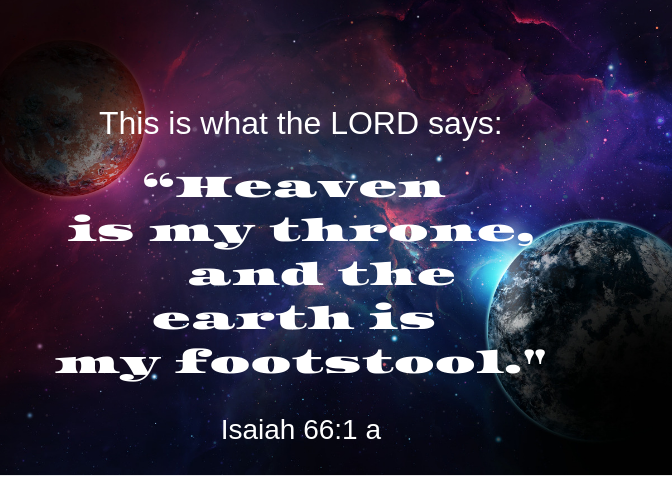
If you are looking for the temple in Genesis 1, it’s been under your nose the whole time. In Isaiah 66:1, God declares, “Heaven is My throne and the earth is My footstool.” The whole cosmos is God’s temple. God spends the first six days of creation naming and giving purpose to the different parts of the heavens and the earth, to provide a place where we can thrive, but the dual purpose is that these parts are being inaugurated and paraded in as pieces of his temple.


But to just build a temple out of materials doesn’t make it a temple. A temple isn’t a temple until God rests in it, otherwise it’s just a structure. Day seven is when God rests in and inhabits his temple. It’s when he moves in with us. This is part of why it was important to the Jews to observe the sabbath, to celebrate his stability and presence in their lives.


Day seven isn’t the aftermath of creation, it is the completion, the crown, like the shiny star or angel on your Christmas tree. God could have made this beautiful place, put us in it, and moved on, never to have contact with us again, and it would still be amazing! But no, God didn’t just wind up the clock and step away, as some people mistakenly believe he did. He decided to be involved with his creation, especially us, in real and intimate ways. He decided that he would be present in his temple, living among us.


The why of creation, the purpose, is that God wanted to make his home with us.


Next, we’ll travel to the garden.


Just a quick note to give credit where it is due. The idea of creation being a temple isn’t mine. First of all, it is God’s idea. But if you are interested in reading more about it from scholars who can articulate and support it much better than I can, check out The Lost World Of Genesis One by John Walton, or The Temple and the Church’s Mission by G.K. Beale.

— Jay Laurent

Where’s the Truth?

John 17 17


Building off of what a very wise woman shared yesterday in this same FUEL Bible Reading blog, I would also like to focus on the truth of the Bible.

This is what I appreciate most about God’s word. We can trust that it is true.

Culture, morals and laws are always changing. Things that were once taboo, largely in part because of God’s word, are now celebrated. How can we know if those things should be accepted morally or not? God’s word.

Many scientists believe that the entire universe exists only because of an accident, billions of years ago, and that each one of us is a result of billions of small built-up accidents over the last several hundred million years. In other words, there is no purpose or thought behind our existence. How sad is that sentiment? How can we know how we were created and if we truly have a purpose? God’s word.

There are many today that say that once you are dead, that is the end of your existence, and thus, we have no hope for a better future. And there are any numbers of world-ending scenarios that exist as well. But how can we know what our future truly holds? God’s word.

Truth, in the secular world, is always changing, always “evolving.” What is “truth” for one person may not be “truth” for another. That should clearly reveal that at least one person’s “truth” is not truth at all. We obviously need to all have a standard of truth when it comes to such things as morality, our origin and purpose, and our future hope. Thanks be to God that He was so wise as to have others write down and keep for all time the truths of His word.

How can we know that scripture is true? Proverbs 119:160 says that all of God’s words are true. Jesus confirms that God’s word is true in John 17:17. And we can know that Jesus does indeed exist and that God’s word is indeed truth because it has stood up under historical scrutiny, it has correctly predicted hundreds of specific prophecies, and as Hebrews 4:12 says, “…sharper than any double-edged sword, [God’s word] penetrates even to dividing soul and spirit, joints and marrow…”

As yesterday’s devotion pointed out, we need to constantly be in God’s word so that we KNOW the truth that it contains. This is both for our benefit, and for others that we can then share that truth with, as God’s word instructs us. I encourage you to begin and end each day in God’s word, so as to not be swayed by the untruths of this current age.

-Greg Landry


Today, we are pleased to have Greg Landry writing on the importance of God’s Word.  Greg and his wife Susan (who wrote yesterday) are active in many ministries.  Greg has a great passion for researching and teaching on the lies of evolution.  His website, https://onegodsixdays.com/, offers readers many opportunities to become better informed on this important topic, which has sadly become a great stumbling block for many young Christians.  Susan has a great blog (https://thesparrowshome.com/) with a good variety of content for faith, family, food, games and homeschool. She has also started a website called http://onelegacy.net/ where she works to provide resources for Biblical Unitarian homeschoolers, families and churches working to actively instill a Godly worldview in their children.  Greg and Susan are a delight as they love and apply God’s Word in their own lives – and help grow that love in others.

We Have a Purpose

Rom 8 28

Life can become difficult. It may seem that you are facing battles everyday that you think you cannot overcome. You may be experiencing pain, loss, or suffering. Each day seems like nothing is getting better. We all have been in a situation similar and thoughts run through our minds making us question our life’s purpose.

I have proof that we all have a purpose!

“But you are a chosen people, a royal priesthood, a holy nation, God’s special possession, that you may declare the praises of Him who called you out of darkness into His wonderful light.” -1 Peter 2:9

“For in Him all things were created: things in heaven and on earth, visible and invisible, whether thrones or powers or rulers or authorities; all things have been created through Him and for Him.” -Colossians 1:16

“And we know that in all things God works for the good of those who love Him, who have been called according to His purpose.” Romans 8:28

Throughout the Bible, God’s Holy Word, we can see and understand that we have a purpose. Time and time again it is shared that God has a purpose and a plan for our lives. We were created through God and for Him. We are a chosen people. He has called us out of darkness and into His wonderful light. God wants good for all who love Him and have been called according to His purpose.

When life becomes difficult, pray and God will help you through the tough times. God never says that our lives will be perfect or that we will be happy all of the time. He does say that He will always be there for us. Keep strong faith in God and He will do wonders in your life.

“Have I not commanded you? Be strong and courageous. Do not be afraid; do not be discouraged, for the LORD your God will be with you wherever you go.” -Joshua 1:9

If you’re going through a rough time, remember that you have a purpose and God will always be with you.

Today I encourage you to embrace your purpose or if you are unsure, seek and pray and God will deliver.

-Brenan Dominguez