Good morning! Yesterday we meditated on Psalm 16:4. Where David underlines his radical preference for God by putting it negatively. He values God so highly, he will not dare to run after other gods. “The sorrows of those who run after another god shall multiply; their drink offerings of blood I will not pour out or take their names on my lips.” In other words: it is sheer stupidity to turn away from the all-satisfying God only to embrace gods that leave you sorrowful in the end. No, I will never do that. I won’t even put their names on my lips.
Then in Psalm 16:5, he returns to the declaration of verse 2: “I have no good apart from you.” Here he puts it positively: “The Lord is my chosen portion and my cup.” In other words, if there are a hundred portions of food and drink spread out on the table, and one of them is the LORD himself — he is my choice. Nothing satisfies; nothing nourishes and sustains — the way he does. He is my greatest good. My treasure of all treasures. My highest pleasure. My chosen portion of sirloin. My cup of finest wine.
Then later in verse Psalm 16:5, he returns to what he has said in verse 2. He said, “I say to the LORD (Yahweh), ‘You are my Lord (Adonai).’” He declared that God was his master and higherup or sovereign. Here in verse 5 he does the same: “You hold my lot.” In other words, when the dice are rolled, and the straws are drawn, and the wheel is turned — whatever happens to us comes from the hand of God. God holds my lot. God decides it. God rules over it. God is my sovereign, and I am glad to have it so. I don’t just affirm it nonchalantly; I live in it with excitement.
In Psalm 16:6, he shouts out what this means for him. Because God holds his lot, “The lines have fallen for me in pleasant places; indeed, I have a beautiful inheritance.” The “lines” here are probably borderlines, the borders or boundaries God has appointed for him. They may be figurative, or literal, or maybe both. I tend to say the borderlines may be figurative because the phrase “pleasant places” is a single Hebrew word that means “pleasures.” It’s the very same word as the one in Psalm 16:11 translated “pleasures”: “At your right hand are pleasures forevermore.” The translation here in Psalm 16:6 should maybe be: “The lines have fallen for me in pleasures, I have a beautiful inheritance.” The “pleasant places” (of verse 6) may be not so much good acreage in Palestine, but the place at God’s right hand, as verse 11 says. “The lines have fallen for me in pleasant places” would then be: “Your sovereign goodness has fenced me in to God himself. The borders of my life are boundaries around where God is.” And when he adds, “I have a beautiful inheritance,” the ultimate meaning would be: God. God is my inheritance, and He is beautiful. That’s where Psalm 16:11 leads us. Where are you being led today?
Reflection Questions
Is God your inheritance? If so, why is that a beautiful inheritance? If not, why not?
What does it mean to you to say, “The LORD is my chosen portion and cup”?
How would you describe your relationship with God, how valuable He is to you, and what benefits you receive because of your relationship with Him?
Prayer
Dear Lord God, help me to see how incredibly worthy You are to receive my praise, worship and adoration. Help me to see, but never experience, where I would be without You. Help me to not take You and my relationship with You for granted. May my life show that You are my portion and my cup – I chose You and You sustain me and give me all I need for life. I rely on You. Thank You for being my God.
I am pleased today to share words from Jeffrey Fletcher, a pastor, chaplain, husband, father and regular writer for SeekGrowLove and Church of God publications. We mourn the death of Pastor Jeff, we look forward to celebrating with him at the resurrection, and we are thankful that his Godly words of wisdom and his example of faith live on for us today. The following is part of an article titled True Abrahamic Faith which was published in the July-Sept 2025 edition of The Restitution Herald (Vol 114 No 3).
If we say we have the faith of Abraham, shouldn’t we understand what that really means? The fact of the matter is … when we study the life of Abraham, we find very little spoken about what he actually believed in a structured, systematic way. Abraham left behind no creed or statement of belief about God. So to understand what faith meant to Abraham, we have to look at what he did by way of response to God.
First, we see in Genesis 12 that Abraham took his wife, his nephew, and his servants, left Haran, and went down to the land of Canaan, where he pitched his tent and built an altar to the LORD who had appeared to him. From this, we discover three things about the faith of Abraham:
1. He had a personal relationship with God – Abraham believed that God was a personal God.
Abraham was not an atheist, who doesn’t believe in God.
He wasn’t an agnostic, who won’t say one way or another if there’s a God.
He wasn’t a deist, who believes that God is a kind of higher power who simply wound up the universe at the beginning and then pretty much left us on our own to do as we please.
He wasn’t an animist, who believes that an immaterial force called nature — Mother nature, Gaia, etc. — inhabits the universe and occupies all living things (had he believed that, he never would have killed an animal and offered up a sacrifice at the altar). If you want to know more about animism, just watch the Disney film Pocahontas, which reflects a prevalent 90s animistic belief that things like trees have spirits.
He was not a pantheist, who believes in and worships all gods. This popular belief holds that all religious truth is equally valid. All gods are equally valid and can justly be worshipped – whether they be called Buddha, Lord Krishna, or YHWH.
Abraham believed in God and God alone as the true God. Not a higher power, which is a kind of politically correct term for God among many 12-step groups. Yes, God is a higher power, but He is more than pure power, energy, or even impersonal spirit. God is a personal being with whom we can enter into a real, personal relationship.
We know these things about Abraham not because of what he said to others about God, but because of the way he responded to God.
2. He made worship a priority – notice that wherever Abraham settled, he built an altar. He came to Shechem; he built an altar to worship God. He went to Bethel; he built an altar to worship God. Later, he moved to Hebron; again he built an altar to God. Everywhere he settled, he built an altar to God. Worship was a priority to him. And remember too – this was not because of some religious law or empty ritual Abraham was following. The laws of Moses, which prescribed the type and frequency of offerings to God, were not given until over 400 years after the time of Abraham. Abraham selected animals from his flocks as a way of recognizing that everything he had was from God and really belonged to God. Abraham was willing to offer up his best as an act of worship to God.
This priority of worship was demonstrated when Abraham, after being victorious in battle against the confederacy of kings from Sodom and Gomorrah, as an act of worship, brought to Melchizedek, a priest of God, a tenth of the spoils of war. The very first tithe in the Bible does not come as a result of an ecclesiastical law, but as an offering of worship and display of faith on the part of Abraham. Abrahamic faith makes worship a priority and demonstrates it through sacrificial giving and tithing.
3. He believed God – he packed up his tents and moved based on a promise that God had given him. He believed God and demonstrated that belief by his actions. Had Abraham stayed in Haran, would he have had true faith? What if he had said to everyone in Haran, “Listen, I believe in God, I believe God keeps His promises, I believe that God will give me the land of Canaan and make a great nation out of me” and then never packed up his tents, never loaded up his camels and donkeys, never tightened his sandals, never pulled out his walking stick and never journeyed south to Canaan? Would that have been true faith?
You see, so much of what passes for “faith” these days isn’t really faith at all. Part of the problem is that faith in the English language is a noun.
Listen to the Dictionary – faith (fEth) n.
1. Confident belief in the truth, value, or trustworthiness of a person, an idea, or a thing.
2. Belief that does not rest on logical proof or ma-terial evidence.
3. Loyalty to a person or thing; allegiance.
4. The theological virtue is defined as secure belief in God and a trusting acceptance of God’s will.
5. The body of dogma of a religion.
6. A set of principles or beliefs.
A noun is a person, place, or thing, whereas a verb is an action. English is one of the only languages that has the word “faith” as a noun. In other languages, it is a verb. Why is that significant? Because Abrahamic Faith is a verb. Abrahamic Faith requires action. There’s no room for couch potatoes in Abrahamic Faith. Abrahamic Faith is not a spectator sport.
One of the problems with American religion today is illustrated by the weekly football game, where we have 22 exhausted men who desperately need some rest being observed by thousands of spectators sitting around eating junk food and drinking beer, who desperately need some exercise.
Abraham set down his beer, put down the remote control, packed up his stuff, and began a journey that would last for the rest of his life. He didn’t know how many stops, how many detours, how many frustrations, how many dis-appointments, how many battles, how much pain there would be on the journey. But then again, none of us on this journey of faith knows what we will encounter along the way. We travel out on faith, trusting that the God who has called us to the promised land will never abandon us on that journey, and that the land that awaits us is truly a good land.
The complete article can be found here, starting on page 7. THE RESTITUTION HERALD is owned and published by the Church of God General Conference, a nonprofit Christian corporation located at 2020 Avalon Parkway, Suite 400, McDonough, GA 30253, which is also the site of Atlanta Bible College.
Reflection Questions:
What is involved in having a personal relationship with God? How is that the same or different from what you have seen in religion today? Do you have a personal relationship with God? It is healthy to continually look for ways to improve relationships. How can you improve your relationship with God?
How do you worship? How might God want to see you worship, in addition to what you typically do now? What happens when we don’t make worship a priority? Would God say that you make worship a priority?
Do you generally think of faith as a noun or a verb? Who have you seen live out their faith? What have done or currently do to demonstrate your faith? What might God be asking you to do next?
Prayer
Dear Heavenly Father, we praise you because you are a real, personal God who desires a relationship with your creation. We thank you for the examples of faithful fathers, for the men and women recorded in your Word, as well as the ones who have lived since then, who though not perfect, go beyond talking about faith to demonstrate a living, breathing, moving, active faith in you. Help me to have a faith that gets me off the couch and even beyond my comfort zone. Show me, Father, how you want me to live out my faith next. May my worship of you be pleasing to you and a priority in my life. I pray these things in Your Son’s name. Amen.
Have you ever noticed that when you’re in familiar surroundings, you don’t require all of your senses to function? For example, if you wake up in the middle of the night, can you make your way into the bathroom without turning on a light? Or have you ever found yourself “watching” something on the television while simultaneously scrolling on your phone. You look up to watch the television when you hear the music swell because you know something important is about to happen?
But in unfamiliar environments, you require most of your senses, even if it doesn’t make sense? Am I the only one who turns down the volume of the radio while I’m driving when I am looking for a specific street sign? It’s like the brainpower used to listen to music needs to be redirected towards my sense of sight. Or when I am about to enjoy the first taste of something delicious, I don’t want any distractions; all I want is to savor the flavors in my mouth. Don’t talk to me, don’t have me look or study something, just let me appreciate what’s happening with my tastebuds.
In today’s Psalm, the author is appealing to God in a time of national territorial struggle. Outside enemy forces are making their presence known and the nation of Israel is seeking God’s protection and restoration.
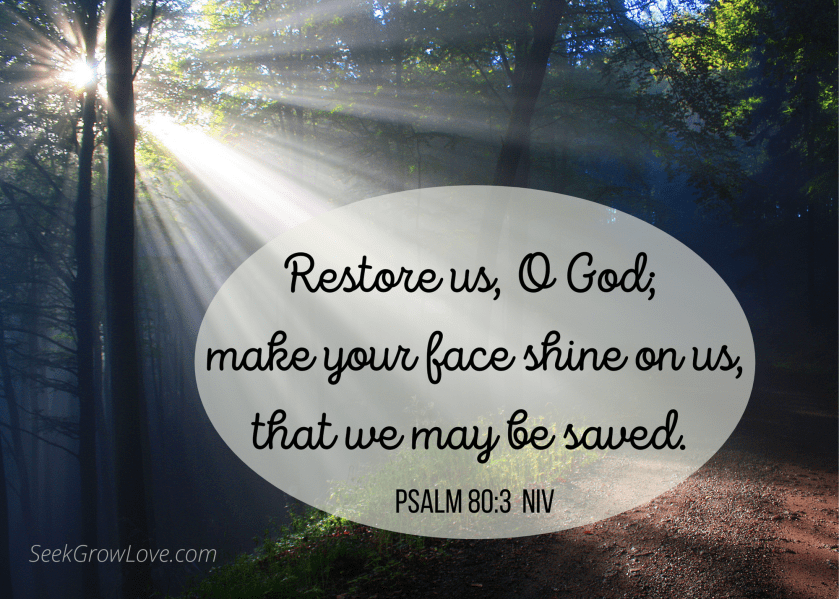
Three of the nineteen verses are identical. Verses three, seven, and nineteen all say, “Restore us, O God; make your face shine upon us, that we may be saved.” Let’s break this repeated appeal down.
Restore us, O God – make us right, heal us, put us back to where we were. Because of the disobedience of the people, their relationship with God has been broken or gotten off track. The petition to God for restoration acknowledges this.
Make your face shine upon us – this phrase calls back to the Priestly blessing that is recorded in Numbers 6:24-26. When God’s face is shining upon His people, His blessings, His approval, His favor makes life more peaceful. But this can only be experienced when we are in right standing with God. When we are not in right standing with God, it’s like His face is hidden from us. It’s like the lights in the room are on, but we still cannot see; the volume on the television is turned up high, but we still cannot hear; we can add all the seasoning to food, but we still cannot taste it. We walk through our daily lives like it’s unfamiliar territory. We’re seeking for something to make sense and may even turn to external (and ungodly) sources for relief. But nothing can substitute the experience of God’s face shining upon those He loves and who are in right standing with Him.
That we may be saved – When God’s people have been restored and are in right standing with Him, and His favor is among the people, salvation from threats of the enemy is at hand.
The next time you find yourself in an especially challenging trial, mimic King Hezekiah who literally laid his problem out before God and made his appeal that God take action against the enemy. Ask God if there is anything that needs restoration in your life. Request God to make His face shine upon you. And then believe with all of your heart that God will act on your behalf. The course of action that God may take may not make sense and His timing could be very different than what you would like, but know that God sees those who love him and are committed to remain in right standing with Him. And even in the midst of the hard times, you can find peace to enjoy with all your senses the life God has planned out for you.
Reflection Questions
Describe a time when you felt God’s favor, peace, or presence in a tangible way. What was happening in your heart and life during that season?
What distractions – mental, emotional, digital, or physical – are keeping me from noticing or experiencing God’s presence fully?
How might I align myself with God today so that I am in ‘right standing’ with Him?
There are simply some things you have to see with your own eyes to understand what all the hype is about. To stand at the edge of the Grand Canyon or to gaze from the helm of a ship in the middle of the ocean are images that have been perpetuated as pinnacle experiences through pop culture. While it’s possible to be in awe while reading a description or gazing at a photo, the real deal—being present in these places—has left me in wonder at the work of the Almighty.
In a similar manner, the stories of Solomon’s wisdom had spread like wildfire, reaching as far as the Horn of Africa—which, in ancient historical terms, was viral. The tale of a singularly wise leader whose work had led Israel into a time of ultimate prosperity made all the hype seem too good to be true. The Queen of Sheba, having received these reports, had to hear and see for herself. What she found was that the blessings were abundant and beyond even what was reported. The sights and sounds of Israel were breathtaking, but none more than the wisdom of King Solomon. After taking it all in, the Queen acknowledged that the sovereign God of Israel had placed Solomon on the throne to rule at such a time.
“Praise be to the Lord your God, who has delighted in you and placed you on the throne of Israel. Because of the Lord’s eternal love for Israel, he has made you king to maintain justice and righteousness.” —1 Kings 10:9
In contrast, in the very next chapter of 1 Kings, we watch the eyes of Solomon shift—from service of the Most High to service of his own flesh. From my own speculations, taken from the perspective in Ecclesiastes, it seems that for a season Solomon focused more on the gifts of God than on his relationship with Him. Israel began looking more like the king and less like its God under Solomon’s direction. He established altars for the gods of his wives and concubines, reshaping not only the physical locations but also the worship of the people. The evidence was in: the splendor of this kingdom, which once pointed to the protection of an undefeated Most High God, was now showing signs of the waning wisdom of a compromised king calling his own shots.
As we read these contrasting moments in Solomon’s life, we should turn and reflect on our own. We may not have the accolade of being the “-est” of anything, but there are tales that could be reaching far and wide about us. When we are visited, our “place settings inspected,” and people look at our sacrifice, what does all our effort and show point to? Are we encouraged—or offended—by those who look at the catalogue of our life’s work and give God the credit?
When God has His hand upon us, it can be recognized and sought by strangers from a distant land who hunger or thirst for answers to their questions. The truth is, sometimes from the outside looking in, the beauty of God’s hand in our lives is more clearly seen. Conversely, from the inside looking out, we may gaze upon the gifts of the Lord and mistakenly see them as our own handiwork, when it is by God’s glory that we are richly blessed. The warning given to us by Job is that the One who gives and multiplies can also take away and divide.
The hype of God has been—and will continue to be—acknowledged by those who look at it from afar in awe. However, the goodness of God is best experienced firsthand, through encountering Him with every thought and action. Let us not forget that He is the provider of grace and the bestower of the fruits of His Spirit; we could never attain these through our own effort. Don’t be so entangled in the blessing that you forget the intention with which it was given: to demonstrate the glory of our Heavenly Father.
-Aaron Winner
Reflection Questions
What thoughts, feelings, desires, or motives do you think led Solomon astray? Which of these same thoughts, feelings, desires, or motives do you see in yourself?
In what ways would you like to be like Solomon? In what ways will you work at not being like Solomon?
Are there gifts God has given you that you have mistakenly viewed as your own handiwork? What happens when we focus on the gifts rather than the Gifter? How can we better see what God has given and in return give to Him the credit, thanks and glory for all His wonderful gifts.
God’s covenant with His people is a continued theme throughout the Bible. It is confirmed with some of the greatest Old Testament leaders, such as Abraham, Moses, and David. Generations have been taught about God and all He has done for them. Though they have some faults, they have remained faithful to God as His people. The completion of the temple by Solomon further signifies a desire to worship God and be His people. After years of planning and construction the temple is finally used for its intended purpose and the glory of God fills the temple. In dedication, Solomon offers a prayer and addresses the people of Israel regarding the relationship between God and the people.
His prayer is a powerful plea for the LORD to remember His people and be their God. He begins by praising God and thanking Him for keeping His promises. Solomon prays that God will remain with them and hear their prayers. More importantly, he urges God to forgive them when they mess up. Solomon was wise enough to know that even if they tried their best they would sin and require God’s forgiveness. This applies to a variety of situations Solomon covers in his prayer, such as drought, famine, plague, war, and captivity. He argues that they have been God’s people for years and that He should continue to remember them for God’s glory.
Then Solomon turns to the Israelites with him and requests that they keep their side of the covenant. Speaking to the people, Solomon says, “may your hearts be fully committed to the LORD our God, to live by His decrees and obey His commands” (1 Kings 8:61). God has fulfilled his agreement of the covenant in the past, so it is up to the Israelites to follow the covenant they agreed to. They must remain faithful to God to enjoy the benefits of being God’s people and having a hope for the future. There are many false gods that can be worshiped, but Solomon’s desire is that the LORD who brought their ancestors out of Egypt remains their God.
That is easy to agree to in good times, but history has proven that is not always the case. There are numerous examples of the Israelites turning away from God for a period of time. Although Solomon’s reign was successful for the Israelites, they would not enjoy the same prosperity and unity for long. Solomon prayed that God be with them in all situations and advised the people to remain faithful to God. No matter what happens, wisdom suggests making a conscious decision to develop a relationship with God and be a people for Him.
-Josiah Railton
Reflection Questions
What do you find in Solomon’s Dedication Prayer that would be wise to add into our prayers today?
When did you last make a conscious decision to develop a relationship with God and be a person for Him? How is it going?
Solomon was wise to know we would and will all need forgiveness. When have you veered off the fully committed and living by his decrees path? Have you experienced His forgiveness? What did that look like?
There have been countless attempts to condense all the complexities of life into a few simple and concise rules to follow. If the steps are practiced effectively then success will be rewarded. Variations of these lists are reiterated over time through experience of generations adapting to changing societies. Each one tries to improve upon the previous list, but there are often more similarities than differences. While there are some noticeable differences between many of these lists and Proverbs 22-24, as a whole these chapters are simply a list of sayings meant to be followed for success. It certainly wasn’t the first list nor last, but it accomplishes the same goal, with the added benefit of being God’s trusted word.
These thirty sayings are introduced in chapter 22, and it is encouraged for all to hear and pay attention to. “Counsel and knowledge” are provided with a reward of increasing trust in God along with honesty and speaking the truth (NIV, Proverbs 22:17-21). They don’t necessarily promise to bring worldly success, though many do, but instead offer the opportunity to further develop a relationship with God. These sayings align with seeking wisdom. Following them will result in the growth of truthful actions, trust, and an increased ability to love God and others.
Each of the sayings provide guidance on some aspect of life, though there is overlap. Some of the sayings teach how to interact with others and develop meaningful relationships. For example, avoid exploitation, consider the perspective of others, and don’t be associated with people who will only cause trouble and be a bad influence. Other sayings claim that righteous character and behavior will be rewarded socially, and even if there is no benefit in today’s society God will reward those in the future. Similarly, the opposite is warned against. Another common theme is to not get caught up in chasing money or other common indicators of success, as they aren’t as meaningful as they may initially seem. Lastly, these sayings teach the value in learning and the willingness to be taught.
Study the sayings of the wise and learn from them. These thirty sayings are included in the book most known for wisdom, so if wisdom is loved these sayings should be considered in daily life. The increase in wisdom associated with applying these chapters will encourage genuine care and love for others through truthful words and actions. Further, trust in God is strengthened by wisdom in knowing how God defines success. Although it is still just a condensed list, follow these sayings and success will naturally be rewarded.
-Josiah Railton
Reflection Questions
How is the wisdom found in Proverbs 22-24 similar to wisdom literature from other times and cultures? How is it different from what “the world” today says is wise and profitable for success?
In your relationships with others which of these sayings of the wise would you benefit from focusing on this week?
How can you work towards the ultimate success of having a better, growing relationship with God?
Which verses would be great on your refrigerator, desk, bathroom mirror or bedside table for the next month? Post them.
I recently had a baby boy, who decided, after about 3.5 weeks of false labor contractions and me walking around 4cm dilated for a week, he would grace us with his appearance 2 days after his due date. For comparison, my firstborn came a week early with only those pesky Braxton Hicks contractions leading up to his debut. Anyone who has known me over the past 9 months knows that I was fully convinced this second baby was coming early. It felt like my entire mind was consumed by thinking about going into labor every moment of every day! I was grouchy, distracted, and mentally exhausted. My yearning brought me no closer to my baby, and really only made me more distant from everything positive going on around me.
The sons of Korah write in Psalm 84:2 “My soul yearns, even faints, for the courts of the LORD; my heart and my flesh cry out for the living God.” (NIV). The NET translation phrases it as “with my whole being, body and soul, I will shout joyfully to the living God”. This verse paints a picture of absolute, consuming, desire for closeness with God. The chapter continues on to describe a blessed happiness that can be found when focused on praising the Almighty, when trusting in the Lord of Hosts! (v. 4, 12).
Psalm 85 continues this picture of desiring closeness with God, but takes a slightly different perspective. In Psalm 84, I get this imagery of excitement, anticipation, energized passion for God, whereas Psalm 85 depicts an image of peace, protection, and righteousness in relationship. There is still a deep longing for a connection, but it’s like comparing the honeymoon, “puppy-love” phase of a new marriage, to a secure, content, lifelong covenant marriage.
Verse 9 describes this type of relationship through salvation by fearing God. This “fear” is derived from the Hebrew word “yare”, which means to revere, or be afraid of because of profound respect . It’s not meant to be a fear that causes us to avoid approaching the throne, but rather a fear that places us in rightful, humble, submission to an awesome God, worthy of being revered, and yearned for. One that should make us say, “my whole source of joy is in you” (Ps. 87:7).
Even though babies are one of the greatest gifts, my yearning to deliver my son began to impact my relationship with God (and others!) as I began to prioritize birth over my spiritual relationship with the One who made life. I wanted to control the timing, and I wanted it to be now! But, when I started to misplace my priorities, I felt less joy, less excitement, and less peace about the whole situation. How often does this happen in our lives? We begin to place closeness to someone or something above our desire for closeness with God… and unsurprisingly, we don’t get the same satisfaction we may have been hoping for. We can become bitter, resentful, stressed, you name it… anything but joyful. Yearning with such intenseness for the wrong things in life, even when they are good things, will never lead to a joy-filled life. BUT, when we keep ourselves yearning intensely for a relationship with God, and when we humble ourselves to Him, we experience true joy, true peace, and true satisfaction, only He can deliver!
(And baby boy arrived healthy and happy, just when God intended him too 🙂)
Sarah (Blanchard) Johnson
Reflection Questions
Evaluate your faith walk right now – would you describe yourself as yearning for a relationship with God? What other aspects in your life might you be misplacing above your relationship with Him?
What steps can you take to practice fearing, or revering, God today?
Being raised as a pastor’s kid, I probably took for granted the accessibility of all things church related. Being a Christian was something that was easily practiced because of the environment I was constantly in. I asked Jesus to come into my heart when I was 5 years old. I was baptized the summer before my eighth grade. But it wasn’t until I went off to college that I really realized that my faith was my own responsibility. If I was going to have Christian friends, I needed to find them on my own. If I was going to attend a mid-week Bible study, I needed to find it on my own. If I was going to attend a Sunday morning service, I needed to find it on my own. Mom and Dad weren’t there to guide and direct me. If I wanted to continue to build up my faith, it was now up to me.
As we read through King Saul’s life, we see that he was hand selected and groomed to take on the role of leading Israel – everything was handed to him. And as a result, he never really owned the responsibility of the position he was put in. He never connected the dots of being the leader of God’s people and having a relationship with God himself.
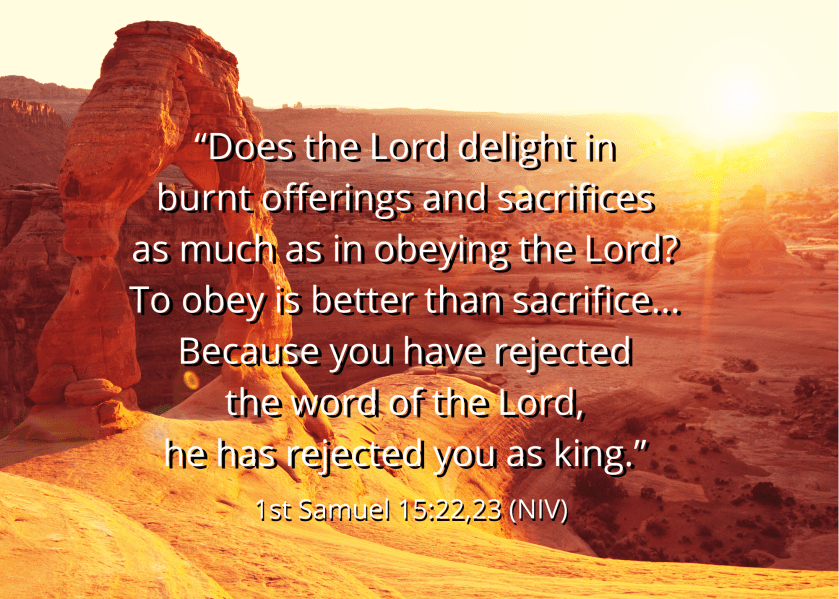
This is particularly evident in 1 Samuel 15. Saul has carried out God’s instructions of taking up arms against the Amalekites. Once Israel wins the battle, they were supposed to destroy everything: man, woman, child, cattle, sheep, camels and donkeys. Nothing was to be spared. But…that’s not what Saul did. He kept the best of the spoils. He claims that he was going to use the prime plunder as a sacrifice.
Here’s how I know that Saul didn’t own his relationship with God: in verses 21 and 30 of chapter 15, Saul refers to the LORD as Samuel’s God.
“…the best of what was devoted to God, in order to sacrifice them to the LORD your God at Gilgal.” (v 21)
“…come back with me, so that I may worship the LORD your God.” (v 30)
Saul didn’t understand his disobedience because he hadn’t bothered to grow a relationship with the One who made him king of Israel.
More than anything God desires to have a relationship with us. He wants us to seek Him more than any other person or pursue any other passion. When we grow our relationship with Him, we come to know the things that please Him as well as the things that displease Him. As we grow our relationship with God, our hearts swell with love for Him, His word, and His people. And when our hearts are full of love, obedience comes naturally.
Bethany Ligon
(originally posted for SeekGrowLove April 11, 2020)
Reflection Questions
Why is obeying Him important to God?
Have you ever felt like God is just someone else’s God?
“Then I looked, and behold, the Lamb was standing on Mount Zion,
and with him were one hundred forty-four thousand who had his name
and the name of his Father written on their foreheads.
And I heard a voice from heaven like the roar of many waters
and like the sound of loud thunder.
The voice I heard was like the sound of harpists playing on their harps,
and they were singing a new song before the throne
and before the four living creatures and before the elders.
No one could learn that song except the one hundred forty-four thousand
who had been redeemed from the earth.”
Habakkuk concludes his book with a powerful declaration of faith, despite the dire circumstances he outlines. He paints a vivid picture of loss and despair: the fig tree not blossoming, the fields yielding no food, and the flock cut off from the fold. Yet, even in the bleakest of situations, Habakkuk chooses to rejoice in Yahweh. This radical joy is rooted not in external circumstances but in the unchanging nature of God.
This passage challenges us to examine our own responses to adversity. Are we quick to rejoice in the Lord even when life is hard? Habakkuk’s resolve reminds us that true joy comes from our relationship with God. When we focus on who God is—our strength, our salvation—our hearts can remain anchored in hope, regardless of our circumstances.
The psalmist expresses a profound reverence for God’s word, even amidst persecution. Despite the challenges posed by those in authority, the psalmist finds joy and peace in God’s law. His love for God’s commandments fuels his praise and steadfastness.
This passage underscores the power of God’s word to provide stability and comfort during turbulent times. The psalmist’s commitment to praise God seven times a day illustrates the importance of a continuous relationship with Him. By immersing ourselves in scripture and seeking God’s guidance, we cultivate peace in our hearts. In doing so, we can stand firm against the chaos of the world around us.
In Revelation 14, we witness a scene of triumph and celebration in heaven. The Lamb stands on Mount Zion, surrounded by the redeemed, signifying victory over sin and death. The new song sung by the one hundred forty-four thousand is a testament to their redemption and unwavering faithfulness to God. This passage serves as a powerful reminder of the ultimate hope we have in Christ.
As believers, we are called to anticipate this glorious day when we will stand with the Lamb, rejoicing in his victory. The new song symbolizes the joy and gratitude we will express for our salvation. While we may face trials and tribulations on earth, this passage encourages us to keep our eyes fixed on the promise of eternal life with Christ.
-Jeff Ransom
Reflection Questions:
In what areas of your life are you struggling to rejoice in the Lord? How can you shift your focus from circumstances to God’s character?
How can you cultivate a deeper love for God’s word in your daily routine? What specific actions can you take to incorporate scripture into your life?
Reflect on the ultimate hope found in Revelation 14. How does the promise of redemption encourage you in your faith journey?
Consider the significance of singing a new song in your life. What is your personal testimony of God’s faithfulness that you can share with others?
When’s the last time you paid God a compliment? We all like to be complimented, even if it’s just about our new shoes, nice watch, or friendly smile. In Psalm 119:129 we see a beautiful example of a compliment to God. The psalmist says, “Your statutes are wonderful…” What a beautiful place to connect with our God in relationship. Often the distractions that infiltrate every aspect of our lives, push out what should be a natural response to the greatness and goodness of God.
What naturally follows from the fact that God’s statutes are wonderful is that we obey them. That is what the Psalmist says, “… therefore I obey them.” This is something I have found hard to do with all that the world has to offer. On the outside the world’s handouts appear innocuous, but they are often a distraction that take us off course from following God, or even acknowledging Him. Is God our priority? Do we love and cling to his word? Are we ready to obey him?
“The unfolding of your words gives light; it gives understanding to the simple.” (Psalm 119:130 NIV) The first part of the verse uses the well-known example of light representing good. (Sorry Star Wars fans, the light versus dark paradigm predates George Lucas by a few thousand years.) We also see that God’s word can be understood by the simple-minded. You do not need your PhD to discern the light that the Bible contains. All you need is a heart longing for God and a willingness to open his word.
In verse 131 the psalmist uses the metaphor of opening one’s mouth and panting to show the severity of how much he longs for God’s commands and authority. And yet, it is more than just commands and rules to be followed but it is about a relationship with God.
In verse 132 we see that he imparts grace to those who love him. Earlier in the Old Testament we see examples of when people did not love his name but rather chose to follow a path without God. A doozy being Sodom and Gomorrah when God not only withheld grace but also doled out punishment for the sin of the city by obliterating the whole place.
The psalmist shows his heartbreaking emotion for the people who do not keep his law. Everyone who has experienced God’s changing power within them knows the heart aching emotion the psalmist is going through. God is the center of all creation, the source of true happiness, and the one we should be living for.
-Bridger Grable
Reflection Questions
How does the Psalmist compliment God? How can you compliment God today?
What is the Psalmist’s response to God? What is your response to God today?
Which verse in today’s section of Psalm 119 would you like to post in your home and work on memorizing?







 Seek Grow Love