An Invitation to be Yoked

Matthew 11

Devotion by Shelly Millard (Nebraska)

Take a look around you.  You might see people who are exhausted and depleted by life and all the challenges it brings.  You may hear phrases like “I never have enough time”, “There is always too much to do”, “I’m always stressed about money”, “I am feeling so isolated and lonely”, “My anxiety is paralyzing me”.  Those common phrases bear witness to people who are struggling to manage life burdens and feeling continually overwhelmed with no relief in sight. All of us feel the weight of life at times whether it be physical exhaustion, emotional depletion, or spiritual unrest.   Jesus had been teaching his disciples and followers that the law only brought burdens, but a relationship with him provides the freedom and lightness that comes with shared burdens.  The passage we will explore out of Matthew 11 offers hope in the midst of life challenges.  

It begins with an invitation from Jesus to “come”.  It’s a simple imperative statement. It’s not a question or a plea—it is a gentle command to connect with him and to create a relationship with him.  It is an invitation to bring whatever is weighing you down and share the burden with him without shame, guilt or fear.  He is inviting us into a safe space where he will share the burden and offer some respite to you from bearing it all yourself. 

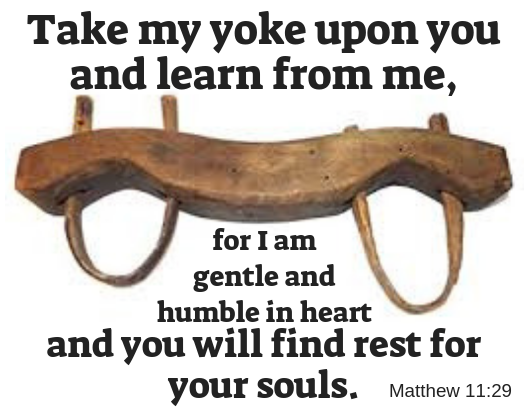
With this invitation comes the metaphor of putting on a yoke with him, which at first glance, may feel like even more of a burden and more constrictive.  He uses a yoke as a metaphor to help us picture the beauty of that “shackling”.  A yoke joins two animals, such as oxen, together so that the animals can share the workload and become more productive. The farmer may choose to shackle an older ox with a younger one or an unruly one with one that is steadier in order to help them both in the work.  The biblical scholar William Barclay describes the creation of a yoke by a carpenter who measures the ox and followed by several fittings, creates a customized yoke that gives the ox comfort while he works.  He also says that there is a legend about Jesus which may or may not be true, that as a carpenter, Jesus had a reputation of making some of the best yokes in the region and had a sign about his door that said, “My yokel fits well”!  Fact or fiction, this is the type of yoke that he is inviting us to take on with him—one that is comfortable, that allows him to lead and gives us relief from bearing burdens by ourselves.   

In the book, The Ragamuffin Gospel, Brennan Manning addressed a specific audience, and as it happens, the same audience Jesus’s invitation is for. He said that the “ragamuffin gospel” is for:

The bedraggled, beat-up, and burnt-out. It is for the sorely burdened who are still shifting the heavy suitcase from one hand to the other. It is for the wobbly and weak-kneed who know they don’t have it altogether. It is for inconsistent, unsteady disciples whose cheese is falling off their cracker. It is for poor, weak, sinful men and women with hereditary faults and limited talents. It is for earthen vessels who shuffle along on feet of clay. It is for the bent and the bruised who feel that their lives are a grave disappointment to God. It is for smart people who know they are stupid and honest disciples who admit they are scalawags.

What would it look like if we actually did this?  We wake up in the morning knowing that we can’t bear the burden of the day and just simply asked him to share the burden?  How would your life be different?

This is an invitation to join with Jesus who describes himself as gentle and humble in heart so that we might find rest for our souls.  In this, he will equip us, teach us, support us, relieve us and guide us as we live our lives. It is a clear path. . . Come to him, Take his yoke, learn from him, and find rest for your weary soul. 

Questions for reflection

What is your initial response to the command to “come”?  What then is your initial response to be “yoked”?

Why do you think we tend to handle our burdens by ourselves?  Why might we hesitate to share the burdens with Jesus?

When you think about being “yoked” together with Jesus, does that feel constrictive or freeing? How do you think you could more intentionally share your burdens as a result of this invitation?

The Lord of the Sabbath

Matt 12:1-21

Mark 3

Luke 6

Devotion by Cayce Fletcher (SC)

Every morning, I like to take a little bit of time after my bible study to read a few pages in a book. Currently, I am working my way through Jesus the King by Tim Keller (also called King’s Cross). This book is a compilation of Keller’s sermons on the gospel of Mark, and I’ve enjoyed it so far. Interestingly, my reading today lined up perfectly with today’s passages.

In each of the passages today, we read of Jesus doing the work of God on the Sabbath. The Pharisees were outraged, saying, ‘Who does this guy think he is?’ And, each time, Jesus responded, ‘I am Lord of the Sabbath.’

Before we can dive into what Jesus is teaching here, we have to ask: “What is the Sabbath?”

The Sabbath was instituted in the dawn of time when God rested from his work of the world and then reinforced with the Mosiac law. Why did God need to rest? 

Keller answers this question in his book: “What does that mean? Does God get tired? No, God doesn’t get tired. So how could he rest? A different reason to rest is to be so satisfied with your work, so utterly satisfied, that you can leave it alone. Only when you can say about your work, “I’m so happy with it, so satisfied – it is finished!” can you walk away. When God finished creating the world, he said, “It is good.” He rested.” (Jesus the King, p. 45)

God didn’t need to strive anymore after his creation was made. It was very good, and he could cease from striving. Sabbath in Old Testament times shows a dependence upon the provision of God. The Israelites had to trust that God would provide enough manna so that they could rest on the sabbath. They had to trust that God would provide abundantly with their crops when they let their land rest every 7 years. 

But, by Jesus’ time, the Sabbath had become so distorted that it turned from being a testament to God’s very good creation and provision to being a heavy load carried on the backs of his people. 

As Keller says, Sabbath means ‘deep peace, deep rest.’ When Jesus says he is Lord of the Sabbath, he is saying that “he is the source of the deep rest we need” (p.44). 

Hebrews 4:9-11 says, “There remains, then, a Sabbath-rest for the people of God; for anyone who enters God’s rest also rests from their works, just as God did from his. Let us, therefore, make every effort to enter that rest, so that no one will perish by following their example of disobedience.”

Because of Jesus’ work on the cross, we can experience the same type of Sabbath rest. We can cease the striving, lay down our heavy burdens, and rest in what is already done. 

Cayce Fletcher writes and podcasts at amorebeautifullifecollective.com. Check out the blog and other resources to help you create a life you love and cultivate your heart for God. This free resource here will help you take your Bible study one step further with a Bible reading tracker, Bible study reflection page, and more.  

Reflection Questions

  1. What is the point of the Sabbath? Why did God institute the Sabbath?
  2. Do you think believers are still called to observe the Sabbath? What does that look like under the New Covenant? 
  3. What does it mean that Jesus is Lord of the Sabbath? What does that say about Jesus? What does that say about the Sabbath?

SGL.2025.SeptemberFullPageDownload

Holy Holidays

Numbers 28-30 

The biblical holidays are wonderful and believe me, I knew almost nothing about them growing up in Indiana until I lived in Israel. 🙂 I bite my tongue from saying, “Jewish” holidays as they are biblical holidays. So much meaning behind them, more so than most pagan based American holidays. One of the harder parts about leaving Israel was leaving the holidays.

In our passage today many sacrifices are named with the holidays, which no one is doing now. Also, the holidays were days of rest, set apart from other days. These holidays are still celebrated without sacrifices but with rest, stores close down!! I’m going to briefly give you a taste of these biblical holidays and how they’re celebrated today.

Shabbat: Late every Friday afternoon public transportation, sport games, and stores CEASE, yes, the MALL included, to usher in the shabbat a day of REST. Families eat a nice meal together having leftovers for the next day so no one has to cook/work.

Passover: Feast of Unleavened bread is the first month of the biblical year, which makes sense the new year starts in the spring with new growth blooming. It’s the oldest holiday still celebrated in the world, over 3,400 years! And it’s the BIGGEST holiday, (like Christmas is in America).

Feast of Weeks: Seven weeks after Passover the firstfruits are celebrated. Kids wear white and carry a small decorated basket of fruit to share with others.

Day of Blowing: People blow shofars (ram horns) throughout the day. It’s a warning to repent for the next 10 days before the Day of Atonement.

Day of Atonement: A day of repentance with fasting. The whole country SHUTS DOWN, no flights, vehicles on the highway, EVERYTHING is CLOSED… to REPENT. It’s quite amazing to experience such a national “holiday.”

Feast of Booths: A week long holiday of eating and sleeping in a booth outside. Kids often decorate them with paper chains and pictures.

God appointed these holidays for a reason and for our good. Take a moment to reflect on them. It’s hard to implement them in a society that doesn’t acknowledge them, but it’s still good to be aware of these biblical holidays and their meaning. Maybe the modern sacrifice would be to take time out and rest on these holidays and think about and thank God for what He has done. The first three have been fulfilled in the first coming of Jesus, and the last three with his second coming!

“For the Lord himself will descend from heaven with a cry of command, with the voice of an archangel, and with the sound of the trumpet of God.” 1 Thes. 4:16

-Stephanie Schlegel

REFLECTION QUESTIONS:

1. Which holiday do you like the best? Which one would you like to celebrate?

2. What’s one way your Shabbat rest day could be changed/improved to make it more restful?

3. A holiday of repentance and fasting?! Maybe pick a day within the next week that you could fast a meal and pray for forgiveness to God and others possibly offended.

Let Us Find Our Rest in Thee

OLD TESTAMENT: Malachi 3-4

POETRY: Psalm 150

NEW TESTAMENT: John 21:15-25

Our bodies were designed to rest. It is a precedent set by the Heavenly Father on the seventh day and continued through the Law on the Sabbath. Whether it is sleep, a cup of coffee at work, or a walk between sets, taking a break gives us refreshment, repair, and a chance to catch our breath. Without this all-important pause, our bodies and minds suffer, leading to exhaustion, reduced cognitive function, and weakened resilience. But like all things, even our rest must be found in Jesus Christ.

In today’s reading, Peter has emerged not only from a day of hard labor but easily his most tumultuous season of life. He took up arms for Jesus, denied Him, went into hiding, grieved, and then saw his Risen Savior. Now, a moment to rest presents itself with a warm meal, a fire, and friends. Jesus seizes this restful moment to restore and recenter Peter. Rest and relaxation do not always go hand-in-hand.  A volley of questions and the allusion to a martyr’s death may seem more stressful than restful, but Peter receives His commission in a fireside chat—not in the labor of picking up loaves and fishes or walking on water. We need time to unpack the hard things away from the hard labor so our weary, heavy-laden souls can respond to the kindling of Christ’s call.

One of the most important elements of this rest is stillness. Unfortunately, distraction, coping, or physical stillness alone is incomplete when compared to God’s command of stilling oneself. Many times, we choose spiritual brain rot to fill our thoughts, keeping our minds occupied and leaving no vacancy for our Heavenly Father to speak. Today, in the repeated reading of Psalm 150, we have an opportunity to be still in the words and to meditate upon them. Just as sleep provides an opportunity for our brain to repair—removing waste, mitigating damage, regulating our mood, and increasing immune activity—meditation upon the words of God doesn’t ignore life’s challenges. Instead, it reframes our circumstances within the glory of God, offering many of the same benefits.

Finally, in God’s rest, there is peace—which is like rest, but sustainable alongside the most dire of circumstances, experienced by His treasured, faithful remnant. In the chaos of Judah and Israel’s departure from God, there is still a promise that our Heavenly Father will send His messenger to prepare the way for the Lord – and he did.  Now, we are now the messengers who battle with our own time and culture. Because we too have been filled with the Holy Spirit, we receive one of its many gifts, a peace that passes understanding. We can stand as the harbinger for the return of Christ in the unfair, the overwhelming, and the disastrous, because these things run parallel to our peace. Thank you, God, for standing as a defense and a mighty tower, so we can retreat into Your promises and find our rest in the arms of Jesus Christ.

-Aaron Winner

Reflection Questions

  1. How do you give your body rest? What can you do to improve in this area?
    How do you give your mind rest? What can you do to improve in this area?
  2. How can you/do you find rest in Scripture?
  3. If Jesus met you on the beach after one of your biggest failures what questions and directions do you think he would have for you?
  4. How can you tend/feed/shepherd Jesus’ sheep?

BE WATCHING FOR ANOTHER POST/EMAIL TO COME LATER TODAY WITH THE 2025 SeekGrowLove BIBLE READING PLAN! One little teaser word: chronological. Thank you for reading in 2024! May we continue to Seek Him, Grow in our faith, and Love the Almighty God, His Son, His people and His word – more and more!

Giving God the Best – Even our Rest

Old Testament: Leviticus 22 & 23

Poetry: Job 1

New Testament: Acts 15

Today we had several scriptures on our journey to read through the Bible in a year. The ones that resonated in my heart were from Leviticus 22 and 23. Chapter 22 talks a lot about sacrifices, being clean for them and what you are able to sacrifice. What comes to mind for me at first is that God wants our best. He lays out the things that need to be done in order to come before Him.

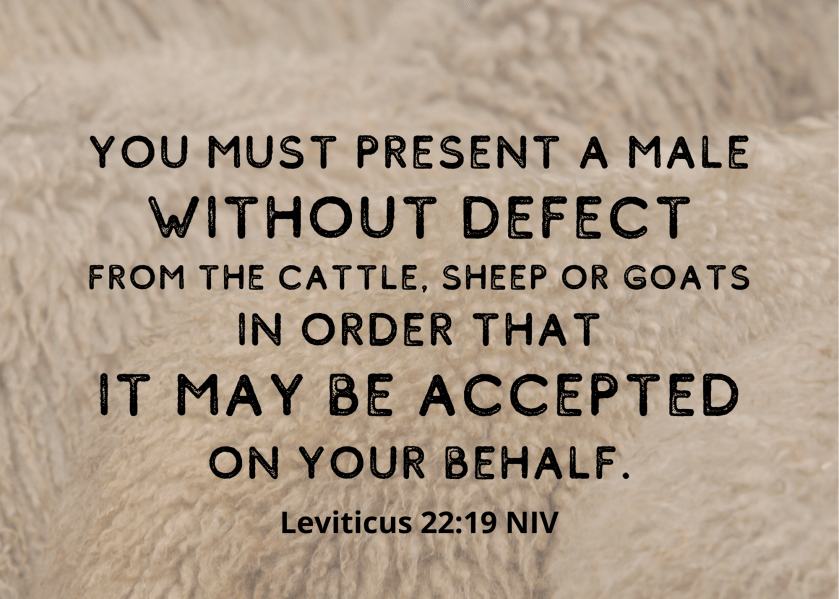
The scripture also tells us what can be sacrificed – and what can not be sacrificed. It says in 22:19 & 20 “you must present a male without defect from the cattle, sheep, or goats in order that it may be accepted on your behalf. Do not bring anything with a defect, because it will not be accepted on your behalf.” This makes me think of when I buy fruit or veggies at the grocery store, I stand in front of the strawberries looking for the best container I can get, no mold, nice and red, not soft and squishy, the best. God wants our best, unfortunately, sometimes it is hard to give him our best. We work or go to school all day, do homework, laundry, cook dinner…and the list goes on and on. The beauty of this is that Jesus died for us, we don’t have to be perfect to come to God. We just need to be children of God, have a relationship with Him, love Him and then love others. We should try to give Him our best, but we will fail (at least I do) and that is okay. We just need to keep trying.  

Leviticus 23 talks about Festivals. The thing that stuck out to me was verse 3 “There are six days when you may work, but the seventh day is a day of sabbath rest, a day of sacred assembly. You are not to do any work; wherever you live, it is a sabbath to the Lord.” During each of the festivals mentioned rest is a big part of it. Making sure you take the sabbath day to rest. The rest He is speaking about is not a nap. Although I love naps, and I think they are a great thing to do, He is speaking about resting in Him. Spend time with God. I will be honest with you; this is something that I need to work on. First,I need to slow down and rest, but most importantly, I need to rest in Him. Taking some time to stop your day to give your brain a break is great but are you giving Him your time?

-Jeani Ransom

Reflection Questions

What can you do to bring your best to God?

What does sabbath rest mean to you?

How do you rest in God?

Resting in Unfailing Love

Old Testament: Job 11 & 12

Poetry: Psalm 36

New Testament: John 16

There are few moments as peaceful as gazing at the stars on a clear evening.  While it is easy to feel insignificant as you consider expanse and distance of space, it can, ironically, make you feel closer and connected.  I contemplate how Abraham looked at the same stars as a promise of a nation, David pondered the same heavens in the Psalms, and wise men looked to the same sky to follow the sign that a Savior had been born.  While this backdrop has slightly changed since its inception from God, it is a constant source of contemplation of our Creator.

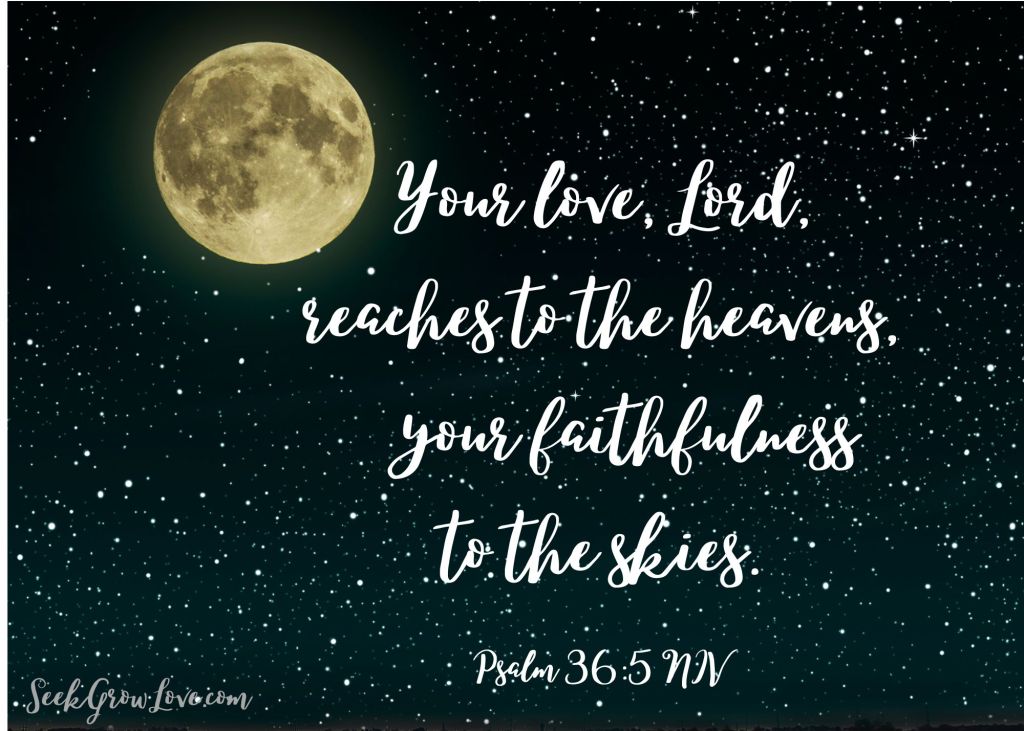
“Your love, Lord, reaches to the heavens, your faithfulness to the skies. How priceless is your unfailing love, O God! People take refuge in the shadow of your wings.” – Psalm 36:5, 7

How wonderful to know that our God’s love reaches to the heavens. It literally can find us up in a plane, on a rocket, or wherever the technology of our generation takes us; moreover, his love reaches as far as the heavens, meaning it can find us in any location at any time.  The same is true for his faithfulness.  It endures in any situation, setting, or circumstance.  This combination creates not only a love that can find us, but also a love that can sustain us.  The Love of God is our refuge.  He is our shelter from the storm and the sustenance through scarcity.  Jesus Christ speaks to the weariness of living in the present evil age when he pleaded, “Come to Me, all who are weary and burden, and I will give you rest (Matt 11:28).” In the ransom of our Savior, and in the comfort of the Spirit of God, we can find rest.

“”I have told you these things, so that in me you may have peace. In this world, you will have trouble. But take heart! I have overcome the world.” – John 16:33

Rest isn’t shut-eye.  It isn’t “me” time.  Finding rest in the unfailing love of God means spending time walking and talking with our Father.  If you want rest, set your alarm a few minutes early to pray over your day and your mission field.  If you want rest, offer praise to God in the middle of the night in the exhaustion of new parenthood.  If you want rest, spend your break at work reading a devotion.  If you want rest, ask for direction in your next steps under the stars. Even though we are guaranteed trouble in this life, when we live in the shadow of our God, we can solace in His enduring love in any time, in any condition, and in any place.

-Aaron Winner

Reflection Questions

  1. What do you already know about the stars and heavens God has created? You might enjoy doing even just a few minutes of research on the stars. What impresses you most about the starry night sky God created?
  2. Have you experienced the rest and peace Jesus the Son of God offers? If you have, how would you explain it to someone who hasn’t? If you haven’t, how can you put yourself in a position to come to Jesus, listen to him and receive his peace and rest?
  3. How can you arrange your day – and night – to find more opportunities to find rest in the unfailing love of God?

(I am sorry this is arriving so late in your email inbox. I thought I had published this morning – but apparently had shut the computer before it completed. My apologies.)

Enter His Rest

Hebrews 4

Thursday, September 22, 2022

Rest is such a basic need of every living thing. When it comes to people, we need to rest and sleep every day. If we neglect sleep for more than a handful of days, we will die the same as if we are starving or dehydrated. In the animal world, horses are used for their speed and stamina for racing these days and in the past they were used for travel. Despite their endurance, it is possible to run them so hard that they will die. Horses need rest the same as a human does. No living thing can survive without proper rest. So when you hear that God swore in his wrath that some will not enter into his rest, you should be very scared. This consequence is equivalent to a death sentence.

When God created the world, he labored over his work for six days straight and finally rested once his work was finished (Genesis 2:2,3). I think of how satisfying it is to have a good night’s sleep after completing a very hard workout at the gym the day before. The effect of experiencing rest after hard work is like a glass of water on a hot summer day. The converse is also true, if I spend all day laying on the couch and don’t get any work done, I feel terrible. Being that I’m not Jewish, I don’t have a good frame of reference for what the Sabbath is like, but it makes a lot of sense in concept to me. Working non-stop just isn’t healthy, but neither is resting without working. God’s rest is the right kind, the kind that is satisfying and comes after hard work. So the Sabbath was supposed to be God’s way of telling his people to work hard, but not too hard. Everything after that was just legalistic nonsense. We see this in Jesus’ teaching about the Sabbath. The rest of the Sabbath is supposed to be for the benefit of mankind, not for its detriment. It’s in this context that Jesus claims to be Lord of the Sabbath (Mark 2:27, 28).

Jesus, the Lord of the Sabbath, promises to give rest to all who come to him (Matthew 11:28). I believe that the rest that Jesus promises is like the rest in Hebrews 4, but it is different, a precursor to the ultimate rest that we will enter into in God’s presence. The rest that Jesus talks about is the rest that you can have in your soul today. Jesus is our high priest, the one who speaks on our behalf to the God most high. Jesus lived on earth and experienced the weariness that comes from hard work. He knows all of the struggles and burdens that we carry and he wants us to enter into God’s rest. Here in Hebrews we have so many promises that we should take heart. “We who have believed are entering that rest” (Hebrews 4:3). In our belief, we have a piece of that rest for today, and the totality of that rest tomorrow.

-Nathaniel Johnson

Questions for Reflection

  1. How is your work-rest balance? Do you more often have too much rest, or too much work?
  2. What do you think is the best thing about God’s rest available now? Do you feel like you are receiving it?
  3. Reading through the chapter, what are some reasons given for not receiving God’s rest?

Entering God’s Rest

Hebrews 4

Hebrews 4 10

Most of us have been brainwashed since birth with a false concept that we must be in constant activity. When overloaded, we get clever and create ways to save us time. Think of how much time we have saved with inventions like the automobile, microwave and internet. Our travel, cooking, communications and ability to attain knowledge are so much faster than they had been previously. Unfortunately, with each time saving invention, we have used that extra time to add something else into our schedule to become even more overwhelmed and time crunched than before.


Any guesses what is the most common response to “how have you been?”  I usually hear and say: Busy! I sometimes look at my calendar and when there is a date that has nothing on it, I stress and wonder what I forgot to put on it. The constant schedule of something to do, places to go and people to see is causing enormous amounts of stress and anxiety in our world. From the beginning, God knew that his creation needed rest and he set the example by resting on the seventh day.


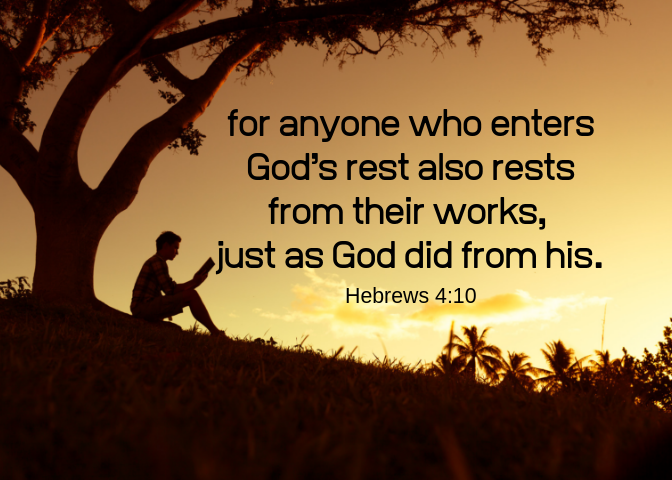
9 There remains, then, a Sabbath-rest for the people of God; 10 for anyone who enters God’s rest also rests from their works, just as God did from his. 11 Let us, therefore, make every effort to enter that rest, so that no one will perish by following their example of disobedience.


I love the language here: “make every effort to enter that rest.” With our health in mind, God urges us to slow down. Actually, he commands it. Before you excitedly brush off responsibilities for a God prescribed day of relaxation alone on the couch with Netflix and social media, it is more than that.


Notice vs. 10, “For anyone who enters God’s rest also rests from their works.” – it is a specific time set aside for God and with God. He is telling us he wants us to make him a priority. He wants us to step away from our busy life focused on us to spend some regular scheduled time with Him.


How is your rest time with God? Are you making every effort? Slow down! Take a break and make some time for God in your busy schedule.


John Wincapaw

God’s Presence at Creation

Hello Readers!  If you have been reading along with us everyday in 2019 – you have now read all of the gospel of Matthew.  Well done!   We will cover the other three gospels later in the year (John in April, Mark in August and Luke in December). This week we are going to take a little theme break and investigate the topic of the Presence of God.  Every day there will be a Bible passage to read, but they won’t be consecutive New Testament chapters.  Then, next week (starting Sunday, February 10) we will begin a chapter by chapter daily walk through the book of Acts.  Remember, stick with us all year and we will cover the whole New Testament – as well as lots of other golden nuggets as well.  And so we begin – – – The Presence of God at Creation!

Text: Gen 1:1 – 2:3

Isaiah 66 1 a

This week, I want to lead you in some thoughts, taking a tour through scripture to highlight some big moments in the story of God’s presence among us. Today we are going to start this journey in Genesis 1, with creation.


But why creation? I think that is an important question, if not the biggest question Genesis 1 aims to answer. Probably hundreds of times I came there preoccupied with questions about who, what, when, where, and how, but forgot to ask why. And the answer to the “why” question is intimately tied to God’s presence.


When we think about “why” questions, we’re starting to think about purpose. Teleological questions. We’re going places scientific inquiry doesn’t (and can’t) go. We’re starting to ask the questions God wants us to think about most.


The opening verses of Genesis paint a picture of a wasteland. God is hovering over the deep, or the waters (a recognized symbol of chaos). The earth is said to be without form and void. It has no purpose. God begins his work to shape it all into order.


But why? If you are God, do you need the heavens or an earth? Do you need plants, animals, and people? I’d guess that no, God doesn’t require any of those things. He’s God, right? It seems that if God doesn’t need anything, he was motivated by something to create.


The earth was set up as a space for us to live, and rule with God, or be stewards, over the rest of creation (this is at the core of what it means to be made in God’s image). The earth is a gift to us. The first six days of creation are the account of God separating, naming, and giving function and purpose to all the moving parts of his cosmos, really for our benefit.


God calls what he did “good” after each day, and then after he is finished, he calls the whole thing “very good.” In other words, all the parts come together and work like a well-oiled machine. Thank God the earth functions beautifully for us, but there is something more going on here, particularly when we talk about day seven.


Day seven is something we usually mention as an aside to creation. We say things like, “now God kicked back to relax, and he did it to admire his creation and be an example for us so that we remember to take a day off.” And we might be correct in saying something like that. But let’s be real, God doesn’t need rest. There is something more going on here.


First, “rest” in this context probably doesn’t mean God is tired and needs to recharge. It means he now has stability and order in his creation. You can see this idea of stability and security come up many times in scripture when it talks about God giving rest (see Exodus 33:14, 1Ch 22:9, 2Sa 7:11).


Second, it is understood among the Israelites and other ancient Near Eastern cultures that when deities rest, they rest in temples. And a temple isn’t finished until a deity rests in it. This is a strange idea to us, but it was understood in those cultures (we can see a similar thing happening in the ancient Babylonian creation epic, Enuma Elish, for example). They would know right away from the text of Genesis 1:1-2:3 that it has a temple theme, and that God rests in it on day seven.


Third, the number seven carries with it a symbolic meaning of completion. We think of numbers strictly as representing quantities. Ancient Israelites aren’t as strict with their use of numbers, and use them in ways that qualitatively symbolize things. This is why you see numbers like 7, 12, and 40 all over the place in the Bible.


But where was the temple in the story, though? Did you miss it? So did I. Ever seen Indiana Jones and the Last Crusade? It’s the best Indiana Jones movie, by the way. There is a part in that movie where they are in an old church that was converted to a library, and they’re trying to match Roman numerals from a stained glass window with locations in the building. They are stuck on finding the location of 10, until Indiana walks up a staircase to a balcony overlooking where they were standing. Lo and behold, there is a giant X across the whole floor. They didn’t see it, because they were standing on it the whole time.


If you are looking for the temple in Genesis 1, it’s been under your nose the whole time. In Isaiah 66:1, God declares, “Heaven is My throne and the earth is My footstool.” The whole cosmos is God’s temple. God spends the first six days of creation naming and giving purpose to the different parts of the heavens and the earth, to provide a place where we can thrive, but the dual purpose is that these parts are being inaugurated and paraded in as pieces of his temple.


But to just build a temple out of materials doesn’t make it a temple. A temple isn’t a temple until God rests in it, otherwise it’s just a structure. Day seven is when God rests in and inhabits his temple. It’s when he moves in with us. This is part of why it was important to the Jews to observe the sabbath, to celebrate his stability and presence in their lives.


Day seven isn’t the aftermath of creation, it is the completion, the crown, like the shiny star or angel on your Christmas tree. God could have made this beautiful place, put us in it, and moved on, never to have contact with us again, and it would still be amazing! But no, God didn’t just wind up the clock and step away, as some people mistakenly believe he did. He decided to be involved with his creation, especially us, in real and intimate ways. He decided that he would be present in his temple, living among us.


The why of creation, the purpose, is that God wanted to make his home with us.


Next, we’ll travel to the garden.


Just a quick note to give credit where it is due. The idea of creation being a temple isn’t mine. First of all, it is God’s idea. But if you are interested in reading more about it from scholars who can articulate and support it much better than I can, check out The Lost World Of Genesis One by John Walton, or The Temple and the Church’s Mission by G.K. Beale.

— Jay Laurent

Hold Firmly

Hebrews Chapter Four

Hebrews 4_14

There is a belief in the Christian world that some hold to called “once saved, always saved.”  Basically this means that if you come to a saving relationship with God and Christ, then you can never lose your ticket to eternal salvation.  This can be a dangerous perspective because it enables Christians to become complacent with where they are at if they believe they can never lose their salvation.  Worse yet, it can lead people to a life of sin and destruction if they do not take seriously the consequences of sin.  Verse six of Hebrews chapter four discusses this doctrine of once saved, always saved a bit by stating, “Since therefore it remains for some to enter it, and those who formerly received the good news failed to enter because of disobedience.”  The author is stating that some who receive the good news/gospel fail to enter rest because of their disobedience.  They initially accepted the promises of the gospel, but they failed to enter because of their disobedience.  In other words, they were once considered saved when they accepted and received the gospel, but they lost it when they disobeyed.  This verse suggests that maybe the doctrine of once saved, always saved is not founded in the Bible.

This should provide a wakeup call for us!  We need to take the sin in our lives very seriously.  We are to be sanctified and set apart from this world, so let’s act like it!  Let’s not become complacent and degrade the consequences of sin.  God hates sin.  The hardening of our hearts can lead us to sin, and again the author warns us of hardening our hearts in verse seven.  We should take this warning seriously since the author has repeated it three times in chapters three and four.

The concept of rest is repeated a lot in this chapter.  What exactly is the author referring to when he is talking about rest?  Let’s take a look at what this rest is described as in chapters three and four:

  1. Israelites unable to enter God’s rest because of their disobedience and unbelief (3:18-19)
  2. The promises of entering God’s rest still stand (4:1)
  3. We who believe enter the rest (4:3)
  4. God swore that some will not enter his rest (4:3,5)
  5. God rested on the seventh day (4:4)
  6. Remains a Sabbath rest for the people of God (4:9)
  7. Whoever enters God’s rest also rests from his works (4:10)
  8. Strive to enter the rest (4:11)

Here’s what I get from all of this.  God offered the Israelites during the exodus a chance to rest, but they were not able to enter God’s rest because they were disobedient.  The author then compares the rest that was offered to the Israelites to the coming Kingdom.  I come to this conclusion because the promises of entering God’s rest still stand.  There is still a chance to enter God’s rest.  However, not everyone will attain that rest, only the people of God.  In fact God swore that not everyone will enter his rest.  If we are disobedient and unbelieving, then we will not enter God’s rest.  However, if we are a people after God’s own heart, then we surely will enter God’s beloved rest in the coming Kingdom.  Hallelujah! Praise God! Amen!  Therefore, continue to strive toward the Kingdom and bring as many people with you as possible because one day you will enter God’s rest in the Kingdom.

Chapter four ends with talk of Jesus being the great high priest.  We truly do have a great high priest in Jesus.  One of the awesome things about Jesus being our high priest is that he is able to sympathize with us.  Jesus was tempted just like we are, but fortunately he did not sin.  He knows what we go through when we are faced with trials and temptations.  He is no stranger to struggle and suffering.  We can seek refuge in our high priest when we face these temptations because he is able to sympathize with us and plead our case to our Heavenly Father, YHWH.  Jesus being tempted is also more great proof against the trinity.  James 1:13 states, “God cannot be tempted with evil.”  If Jesus were God as well, then James and the author of Hebrews would be contradicting one another.  It cannot be possible for the word of God to contradict itself.  Jesus can’t be tempted, and never have been tempted at the same time.  It doesn’t work that way.  It logically does not make sense.  Jesus was indeed tempted like us, and being our high priest, he is able to sympathize and help us.

To close out today’s devotion, I want to point out Hebrews 4:12, “For the word of God is living and active, sharper than any two-edged sword, piercing to the division of soul and of spirit of joints and of marrow, and discerning the thoughts and intentions of the heart.”  I hope you have gotten benefit from reading these posts.  However, if you don’t get anything else, I want you to know and fully understand that the word of God is living and active.  We are beyond blessed to have the Bible today.  If it weren’t for God’s supervision, there would be no stinking way that we should have it because of the numerous attempts to rid the world of the Bible.  The Bible has only flourished though.  It is truly a divine miracle that we all have access to a Bible, God’s word.  I want to encourage you to keep up the awesome work in delving into God’s word through these devotions.  You are truly doing a great deed.  Keep up the awesome work, and truly believe in your heart that these words are living and active.

-Kyle McClain