This morning, I would encourage you to read Psalm 16:1-4. When you are done reading those verses focus on this question. Do you think of the consequences of your choices? Psalm 16:4: “The sorrows of those who run after another god shall multiply; their drink offerings of blood I will not pour out or take their names on my lips.” What happens if we choose another god besides the true God? Another ultimate good, another Lord, another delight, another treasure? What happens is multiplied sorrows. “The sorrows of those who run after another god shall multiply.” David has already found his good; he’s already found his delight; he’s already found his treasure. He’s not on a search anymore. Are you? David’s quest is over. Is yours? It’s over. I have found him. I have found my Good. I have found my Lord. I have found my delight. I have found my treasure. It’s over. I’m not running anymore after anything else. There’s nothing but trouble there. “I have no good apart from you.” The Lord is my good. I’m not shopping around. My quest is over.
What happens when you make your choice to follow God but the temptation to return to old gods is there. “Here’s another god; here’s another good; here’s another delight; here’s another treasure.” David’s response is, “I won’t even drink it. I won’t even take their name on my lips.” “Their drink offerings of blood I will not pour out. I will not even take their names on my lips.” These alternative gods, these alternative delights, these alternative toys. I’m not going to touch them. I’m not even going to get close or talk about them. I have found the all-satisfying treasure. Why would I choose multiplied sorrows?
I think verse 4 is what David was asking to be preserved from in verse 1. When he said, “Preserve me, O God,” what’s he asking to be preserved from? And the answer is verse 4. “Preserve me, O God.” I take refuge in you. I’m running to you as my good. I’m running to you as my treasure. I’m running to you as my delight. I am running to you. Preserve me from being drawn away to these other gods. Preserve me from failing to be satisfied in you this morning.
“This is the battle of the believer’s life: to have God as our good, to have God as our delight.”
I wonder if you pray like that. I wonder if you fight like that. That is just about all I do. This is the battle of real and satisfying life: to have God as our good, to have God as our delight, to have God as our treasure. And the world is saying, “No, I’m better!” So what else is there to do but fight? Verse 4 is what he’s pleading. “Preserve me, O God.” Don’t let me be drawn away to these other gods.
Psalm 90:14 is on my lips just about every morning. “Satisfy me in the morning with your steadfast love!” Is that your steady prayer? “Your steadfast love is better than life” (Psalm 63:3). Oh, don’t let me be more satisfied with anything else than with you. That’s the battle. Verse 1 calls out to persevere; verse 4 states the danger. You make the call on which road you will live. Be blessed today.
Reflection Questions
What other goods, lords, treasures, delights have you found yourself running after? How is God better than each of these?
What multiplied sorrows result in following after any of these others?
What has God already preserved you from?
Today, what do you specifically ask God to preserve you from?
Prayer
Dear God Almighty, “You are my Lord; apart from you I have no good thing.” Help me to say it, believe it and live it every day. Thank you for preserving me from _______. Save me, Lord, from the sorrows and dangers of following after anything else the world dangles in front of my eyes and heart. Help me see clearly You, Your wisdom and truth and what You desire for my life. Make me strong in You against the temptation of _____________.
Smooth, delicious chocolate, sometimes with crunchy nuts or gooey caramel (instead of the nutritious salad fixings abandoned in my fridge). Or really sugar in just about any form.
A “well-deserved” social media break, just for a few minutes, that turns into much longer.
On-line shopping to find just the right pair of shoes for a trip, or maybe I need pants, or what about that sweater, would that color look good on me?
Those were three temptations I caved in to just last night when I was supposed to be writing this devotion! Yikes! When my sleepy husband asked why I was so late in getting to bed, I said something like I had been busy falling into temptation. No, I hadn’t spent the late night hours murdering my neighbor, stealing from the bank on the corner, or bowing down to carved idols. But, I had said ‘Yes’ to my own selfish, meaningless, unhealthy pursuits instead of being and doing what God most desired for me – what was best for me.
Perhaps, I should not be the one writing the devotion today. I am obviously not a specialist in standing up to temptation. I need an example to follow, I need to learn from a master – Ah, yes, thank God, He DID indeed provide the perfect example who longs to be my master. He gave us His human Son Jesus. And right after the baptism of Jesus, and right before Jesus begins his years of ministry, God’s Holy Spirit led Jesus, God’s own beloved, pleasing Son, into the wilderness where he fasted for 40 days and 40 nights.
As we are looking for clues on how Jesus faced temptation so successfully, there’s a couple great ones right there. Jesus was already open to and actively being led by the Spirit. What did God’s spirit want for him? That’s what He wanted too, even when it meant willingly going into a difficult, sometimes even dangerous space.
Compare Jesus’ location and circumstance with Adam and Eve’s when they were also confronted with choices to make. The first son of God was surrounded with God’s bounty and beauty and provision in the spectacular garden. Good, healthy, God-honoring fruit literally surrounded them when they instead listened to the deception of the serpent and chose to eat of the tree that God had already clearly said “No” to. Jesus didn’t use his harsh surroundings or difficult circumstances as an excuse to be weak. Instead, he found strength in using that time to fast and pray and draw closer to God which indeed made him even stronger and better prepared to face his adversary. Don’t get so comfortable in your pleasant surroundings that you become weak and don’t recognize temptation for what it is. Don’t fear the time spent in the harsh wilderness, but use the opportunity to cling closer and closer to what really matters – the God who is always there.
After the 40 days of fasting Jesus gives us the next big answer of how he faced each one of Satan’s three temptations in the wilderness – with the very words of God His Father, each and every time. In fact, the first Scripture Jesus quotes to Satan are strong words about the sustaining power from the words of God, and our need for God’s word, from the book of Deuteronomy: “‘Man shall not live by bread alone, but by every word that comes from the mouth of God.’” (Matthew 4:4) If we try to face temptation without the power of God’s word we will be weak. Matthew 4:4 is a great verse for me to remember today when I sit down to work on tomorrow’s devotion! Here’s a few more:
For the word of God is alive and active. Sharper than any double-edged sword, it penetrates even to dividing soul and spirit, joints and marrow; it judges the thoughts and attitudes of the heart. – Hebrews 4:12
Stand firm then, with the belt of truth buckled around your waist, with the breastplate of righteousness in place, 15 and with your feet fitted with the readiness that comes from the gospel of peace. 16 In addition to all this, take up the shield of faith, with which you can extinguish all the flaming arrows of the evil one. 17 Take the helmet of salvation and the sword of the Spirit, which is the word of God. – Ephesians 6:14-17
God’s word: read it, learn it, use it – and live (better and stronger today and also for eternity).
God’s word: neglect it, forget it, try to do life your own way – and die (but first, you will likely waste a lot of time, have a lot of self-made sorrow, and miss out on doing God’s will).
His Words are not just for gaining knowledge, they are for fighting temptation, finding truth, for making strong and giving life. Don’t miss out!
Let’s review what we have seen from Jesus about successfully facing temptation: Jesus was willing to be led by the Spirit. He used his time in the wilderness well. He fasted and drew closer to God. He recognized Satan for who he was. He discerned the lies and empty promises of the deceiver and actively chose what God said and promised instead. He wanted God’s will, not his own. He knew God’s Word. He used God’s Word as a sword to do battle against untruth, temptations and the tempter. He said, “Away with you Satan!” And he was victorious!
What about you? Do you know what temptations you face regularly? What do you crave? What do you covet? What are you jealous of? What leads you astray? What do you feel guilty about? Where do you lose self-control? What good do you neglect and why? How do you waste time? What do you say ‘Yes’ to that God wanted you to say ‘No” to? And, what do you say ‘No’ to that God wanted you to say ‘Yes’ to? What is Satan whispering in your ear or in your heart? What do you worship (with your time, money, devotion, or decisions)?
Realize you have choices, decisions to make. Big ones and little ones. It’s not just about not murdering your neighbor and not bowing down to carved idols. It’s also about how you treat the gift of the miraculous body God gave you. It’s about how you choose to spend the gift of the time God gives you. It’s about how you treat the people God surrounds you with. It’s about if you choose what you want, or what God wants.
And Satan (as well as the world and marketers today) can make the bad choice, or the selfish one, or the unhealthy one, look pretty good, that’s what makes it tempting. If it looked like the garbage it is, we would gladly turn from it. Don’t be fooled by the stone that looks like bread, the impressive view, and Satan’s promises.
God gives the perfect example of His Son. Follow that example – not mine.
God gives His Word, the Scriptures – the sword to do battle with the tempter. It worked for Jesus. I need to use it better!
God gives knowledge, wisdom and discernment – ask for it and use it.
God gives the spirit of self-control – that’s the one I want.
God gives forgiveness and new beginnings.
Prayer
Dear God – I am sorry. Please forgive me of the many times I fall to temptation. Help me do better, Lord God. Help me follow the example of your Son when I am in the wilderness and also when I am in the garden. Help me go where Your Spirit is leading. Help me forsake what I want and choose instead what You want, which is indeed the best for me. Help me see garbage for what it is, and turn from it to you and your gifts, again and again. I ask for wisdom and discernment to see what is from You and what are deceptions from the deceiver. Help me use your Word well to be strong against temptation. Thank you for your Word, your forgiveness, love and mercy and a new day to work at doing Your will better. Help me use all that you give me to stand strong against temptation. Thank you for the example and sacrifice of your Son Jesus. In his name we pray to You the Almighty. Amen.
Reflection Questions
Compare and contrast when Satan came to the garden and when he came to the wilderness? What similarities do you see? What differences? Is Satan still making visits? What does it look like?
Consider the paragraph of questions regarding what are temptations for you. What do you see about your own temptations? What temptations do you sometimes fall to?
Eating chocolate isn’t always a sin or temptation is it? But is it sometimes? When? Why? What makes the difference?
What scriptures can you find (and put in your home and in your heart) to help you face your temptations better armed with the Sword of the Spirit?
Have you ever tried fasting when facing a particularly difficult time of temptation?
It’s hunting season here in Ohio! All around the countryside, hunters are sneaking though the fields, climbing tree stands, and checking their trail cams. The deer are careful and on alert, listening and sniffing the air for the sign of trouble. Failure to sniff out the enemy can have deadly results for the hunted.
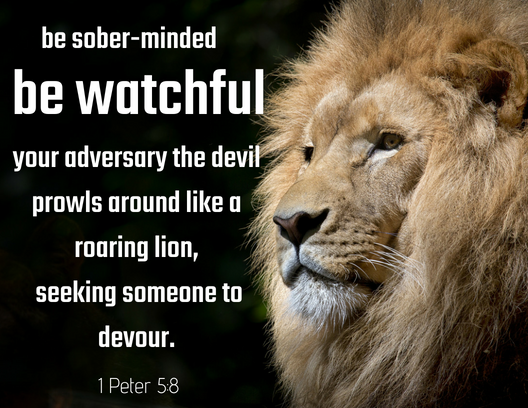
As Christians, we have to be on guard against temptations and situations that can cause us to fall away from the Lord God. 1 Peter 5:8 warns us to “Be alert and of sober mind. Your enemy the devil prowls around like a roaring lion looking for someone to devour”. Peter, in his letter to the Christians across Asia Minor (modern Turkey), has tried to encourage the believers to stand firm in the face of persecution. Instead of getting revenge or lashing out against people who have hurt us, Peter encourages us to rejoice in our sufferings and be thankful for the opportunity to do good to those who hurt us (1 Peter 3:8-12).
It is easy to want to strike back, to say something hurtful, or to defend ourselves. But God has a higher purpose in mind behind our suffering. He wants to shape and mold us into mature Christians. Sometimes, we have to endure hard times to allow that change towards maturity to occur. It is tempting to want to respond in kind to those who hurt us. We have to stand firm and resist the urge to take the bait!
Peter reminds the Christians that this is a sneaky trap, set by our enemy, the devil. We have to be on the alert, and watchful to avoid falling into the traps set by the enemy. Like deer trying to avoid the hunter, we avoid the traps of temptation by seeking to do God’s will. Peter asks us to be alert and sober minded. Resisting the temptation to lash out at our enemies or to hurt other people is not easy. But the more we resist, the easier it is to stand firm against the schemes of the devil. God wants us to trust Him. As we obey Him, He will “restore you and make you strong, firm and steadfast” (1 Peter 5:10).
2 Corinthians 7:1 “Therefore, having these promises, beloved, let us cleanse ourselves from all filthiness of the flesh and spirit, perfecting holiness in the fear of God.” (NKJV)
Devotion by Merry Peterson (Canada)
Do you remember the Sunday school chorus you may have learned when you were young that went something like this: ‘O be careful little eyes what you see, O be careful little eyes what you see. There’s a father up above who is looking down in love. O be careful little eyes what you see.’ This simple song with several more verses served as a reminder to us that what we take into our minds and what we allow our bodies to do can either lead us in good directions or bad directions and that God was looking down on us lovingly wanting us to make the best choices for ourselves.
There are bad directions we can go in that cause us to become filthy before God both in our inner spiritual life and how we outwardly conduct ourselves. In this verse we, like those first Christian believers, are being encouraged to pursue holiness in a world that is full of temptations that bring filthiness before God. In Corinth idol worship, temple prostitution and general perversion was normal in that day – all things that would be part of everyday life and could be a temptation to take part in unless you were of the new Christian faith.
Unfortunately, we live in a similar kind of culture today but the temptations are different. Today virtual reality, artificial intelligence interactions, violent gaming, tik-tok influences the whole pandora’s box on the internet present the most daily temptations to succumb to filthiness instead of pursuing holiness. Don’t get me wrong – you are reading this on the internet so not everything is an invitation to filthiness – congratulations on choosing to view something that will encourage you to pursue holiness! The Corinthians, and we, are faced with the same challenge. To pursue holiness. What does holiness look like in body and spirit anyway? Glad you asked.
Holiness means to be set apart – to choose differently. Part of holiness is choosing to fill our hearts and minds with the things that will draw us closer to the Lord and to use our bodies in ways that would be pleasing and honoring to him. A good way to keep your mind focused to pursue holiness is to follow Philippians 4:8 “Finally, brethren, whatever things are true, whatever things are noble, whatever things are just, whatever things are pure, whatever things are lovely, whatever things are of good report, if there is any virtue and if there is anything praiseworthy- meditate on these things.” If we follow this advice we are less likely to fall into the trap of allowing ourselves to become filthy before God in our thoughts and consequently our actions.
For Reflection:
Are there ways that I am allowing myself to be influenced towards pursuing filthiness before God instead of holiness? Are there habits that I should give up?
What plan can I put in place to help myself pursue choices that will help me to live a life that points towards holiness in choosing God’s best in my life?
At the beginning of Jesus’ ministry, we read of his baptism. This is a special moment of God clearly anointing Jesus with his spirit as he says, “This is my son, with whom I am well pleased.” Jesus is anointed and commissioned in that moment to go and preach the gospel of the Kingdom – which is what he does in Matthew 4:17.
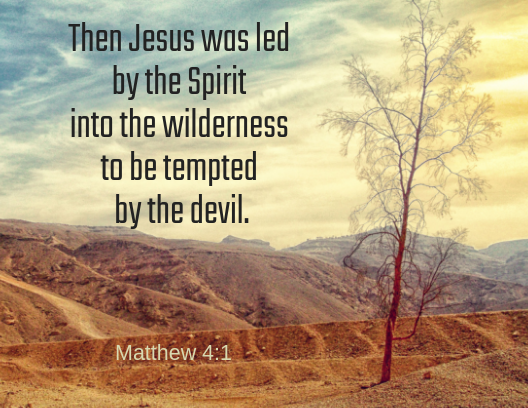
In between the anointing and commencing of his ministry, we read of a curious episode in Jesus’ life. He is led by the Spirit into the wilderness to be tempted by the devil.
The devil shows Jesus three things to entice him to reject God in disobedience. He tells Jesus to turn the stones to bread, to command the angels to come and rescue him, and to elevate himself physically and figuratively so that the world will bow down to him.
Interestingly, these things aren’t necessarily the same struggles we may be tempted by. In one Bible Study I was teaching about this passage, one of my friends looked puzzled and mentioned that he would think that Jesus would have been tempted with ‘the lust of the eyes’ because that is such a ubiquitous struggle for our society. But, I think that this instance is more than Jesus staying strong against the seven deadly sins – though he does and remains sinless throughout his temptations.
In each instance, the devil says, ‘Just show your power to do these things. Show yourself to be like God.’ The devil knows that Jesus has the authority to do the things that he is tempting Jesus with. Jesus also has the power to do those things. But, Jesus knows that he must remain obedient. Jesus is not God, and Jesus knows that the only reason he has the power and authority to do supernatural things is because God has granted him that authority.
These temptations echo the first temptations in the garden. The ancient serpent also tempted Adam and Eve with the chance to become ‘like God.’ Instead of trusting in God and remaining obedient to his word, Adam and Eve trusted the serpent and grabbed at the chance for the knowledge of Good and Evil. Of course, the serpent’s promises were empty and brought death, not happiness.
We are also tempted. Yes, temptations mean that we have to be sure to follow the law of God and live righteously. But, more than that, temptations mean that we have to trust that God knows what is best for our lives. Jesus could have looked at his situation in the wilderness (that he was led to by God) and decided that he knew best. In that moment, he could have rejected God, acted disobediently, and sinned.
But, he didn’t.
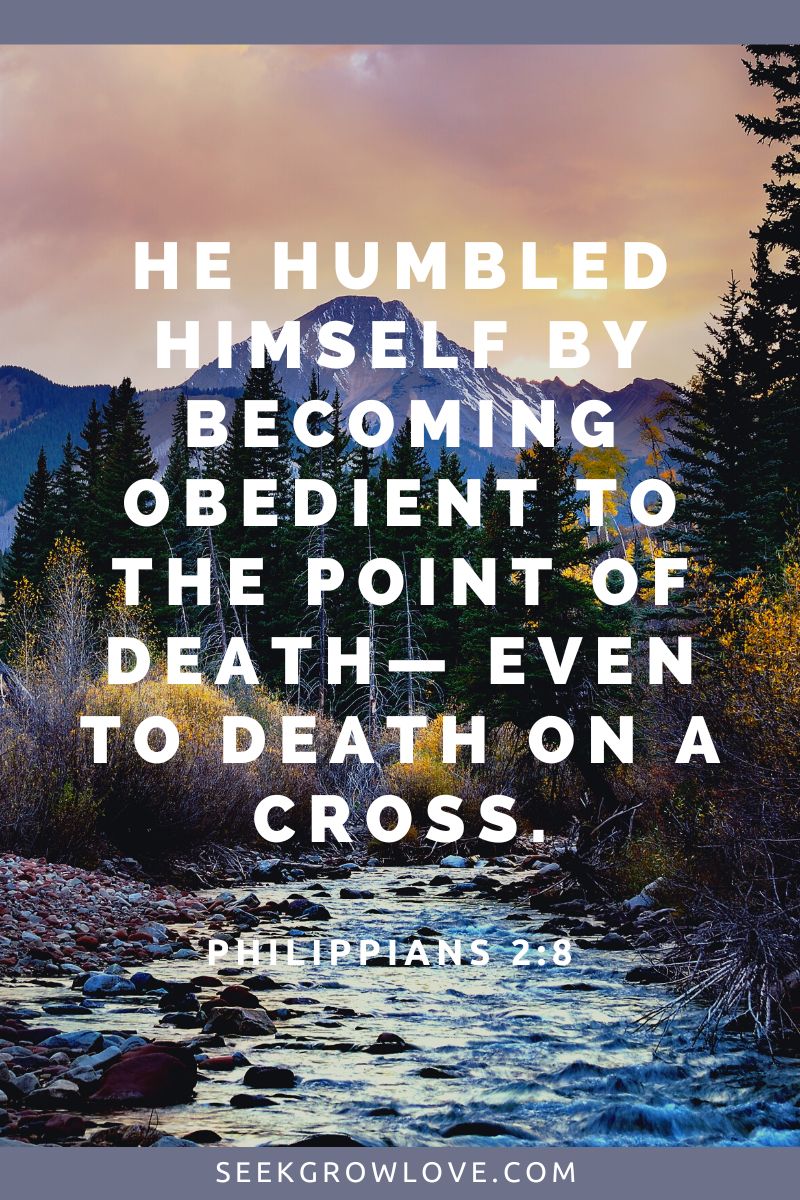
Instead, his obedience required him to humble himself and trust God. Ultimately, this proved to be a training ground for what would be required of him later on. Philippians 2:8 says, “He humbled himself by becoming obedient to the point of death — even to death on a cross.”
We have to take the same path. We don’t know best. We have to trust God and his word.
We can take comfort in the end of the story, too. Jesus wasn’t exalted by the devil, but we know that the thing the devil tempted him with will come true because Jesus was obedient. One day, every knee will bow and every tongue confess that Jesus Christ is Lord.
We wait in hope for that day, and we live in obedience today.
Cayce Fletcher writes and podcasts at amorebeautifullifecollective.com. Check out the blog and other resources to help you create a life you love and cultivate your heart for God. This free resource here will help you take your Bible study one step further with a Bible reading tracker, Bible study reflection page, and more.
Reflection Questions
How are the temptations of Jesus in the wilderness similar to and different from the temptations of Adam and Eve in the garden?
How does Jesus fight against temptation? How can you better equip yourself to fight against temptation?
Why did God lead Jesus to the wilderness? How was Jesus’ time in the wilderness preparation for the rest of his ministry?
Do you ever find yourself looking at someone else’s situation or decisions and think, “I would have done that completely differently”? Of course you have. We all have. The world is full of armchair quarterbacks and side seat drivers. It’s so much easier to look at someone else’s situation and evaluate it as an outsider without the pressures of personal consequence.
In the heat of the moment, standing at our own crossroads, however, we get wrapped up in the “what ifs” and the worries about whether or not we are making huge mistakes. So how do you know when you’re doing something wise or foolish?
Chapters 7 and 8 of Proverbs personify danger/foolishness and wisdom as two women. The first woman is the strange or adulterous woman, luring in a simple youth. She uses “smooth talk” and “persuasive words” to seduce him. I feel it’s worthy to note that sexual sin is being used in this personification, probably because it’s the most common and most dangerous. And her opposite is wisdom, who doesn’t use tricks or wordplay, but speaks plainly. She promises no shortcuts, but offers instruction, knowledge, and truth.
Both women have some similarities though. They are both crying out to those around them, trying to persuade others to follow them. They are both offering up benefits to listening to their words. So how do we know which to listen to?
It seems obvious when we read the chapters, right? It’s less obvious in our own realities, though. Less obvious, but it’s still possible to make the correct choice. As in all decisions, we should test our options against scripture. If you want to know if your actions are wise or dangerous, test them against God’s word. Discernment, the ability to judge well, is a skill that everyone can, and should, develop through practice. The more we know of God’s word, the better equipped we will be to look at the paths before us and choose the wise one, the one that aligns best with scripture.
When wisdom calls out to you, don’t you want to be familiar with her voice?
My prayer for you is that you become so familiar with the voice of wisdom, the words of God, that you are not easily fooled or led astray. I hope you will love instruction so that you will continue to grow in wisdom and righteousness. I pray that you find the benefits of wisdom listed in chapter 9: “For through wisdom your days will be many, and years will be added to your life. If you are wise, your wisdom will reward you.”
-Jenn Haynes
Reflection Questions:
What decisions do you face right now? Have you placed your options up against scripture?
How is your scripture study? In what ways can you make yourself more familiar with God’s word, and the voice of wisdom, so that you can easily recognize it?
Are there any voices of temptation in your life right now that are trying to call out to you? Take a moment to honestly analyze and reflect. Often we want to shy away from facing the hard truth that there are likely things in our lives that we enjoy but that we should give up because they are unwise. Does that hold true for you?
And in the spring of the year, at the time when kings go out to battle, David sent Joab, and his servants with him, and all Israel, and they laid waste the children of Ammon and besieged Rabbah, but David stayed at Jerusalem. – 2 Samuel 11:1 (REV)
In today’s reading, we see two realities. Both happened, but at different times and represent different things. In 2nd Samuel, we see David, king of Israel. Where do we see David? At home. Sitting on his keister and not doing what a king would normally be doing: overseeing his generals as they go out to battle.
David is not where he is supposed to be. He should be meeting with his generals. He should be motivating his armies. He should be praying and fasting and seeking out God’s direction for the safety and prosperity of Israel, but he’s back in Jerusalem. Twiddling his thumbs? Playing his harp? We don’t know what he was doing at all hours of the day when he held up in his palace. We do, however, know what he was doing on one specific evening.
David is out walking on the roof, where he shouldn’t be, and he sees Bathsheba bathing. David does not turn away from seeing the nakedness of this woman whom he is not married to. He stares. He dwells. He obsesses. She’s beautiful. He needs to meet her. To be with her.
David ends up having her come into his home, and he has sex with her and gets her pregnant. We may have seen this story happen in the lives of some people we know, but this is high profile. This is a problem. A bunch of people are going to know what has happened, and this is going to be hard to explain to Bathsheba’s husband, Uriah, who is out at war, where he is supposed to be: fighting for the armies of the people of Yahweh. While the king is out preying upon the wife of his soldier.
David finds himself in a sticky situation, so he sends for Uriah and does his best to get Uriah to go have sex with his wife and cover his… keister. Uriah, however, cannot fathom such a thing while his comrades are off fighting a war. He refuses to even go visit his wife. This poses a major problem. People are going to know that Bathsheba is expecting, and they are going to know that Uriah hasn’t been with her in months, maybe longer. David tries multiple times, but no dice. Uriah is a man of honor and conviction, and that is not going to fly in this situation. David needs an out. David essentially puts out a hit job on Uriah. David cannot control his urges, so a good man dies.
The story unfolds. Uriah is dead. David marries his baby mama, and then the baby dies. Nathan the prophet comes to confront David and gets David worked up with a parable. David wants vengeance for the perpetrator in the story, but then the tables are turned when David is revealed to be the bad guy in the tale. David grieves, David repents, but the baby does not survive. It’s rough.
In 1 Chronicles 20, we see that it is the time when kings go out to war. And David goes out to war. And his armies thrive. He gets an awesome new crown. God blesses the armies of a king who acts in good faith. David is more than capable of doing the right thing, but even a man after God’s own heart can allow himself to fall off the rails.
Here’s the rub: Sometimes we get complacent. Sometimes we get lazy. Sometimes we do things, go places, consume content that we know we shouldn’t, but we’ve allowed ourselves to be in the wrong place at the wrong time, and we fall victim to the allure of the temptations of sin around us.
We’ve all allowed ourselves to be in bad situations that we could have avoided. Sometimes we may come out on top, but given enough opportunities to sin in the situations we create, we are bound to fall. We play with fire… and you know the cliché, but it’s true, we get burned.
-JJ Fletcher
Reflection Questions
Can you recall some times you allowed yourself to be in a place you shouldn’t have been? What was the outcome? How could you have avoided putting yourself in that situation? What did you learn from it?
What do you think of Nathan’s tactics of getting David to see the gravity of the wickedness that he had perpetrated?
What does the story of David and Bathsheba teach us about grace, repentance, and forgiveness?
If David can be forgiven for this travesty, who can you forgive that may have done much less harm in the way that they have wronged you?
How does the contrast of 2 Samuel 11-12 and 1 Chronicles 20 sit with you? Does it give you any insight or change the way you perceive David’s sin?
Do you have good days? Days when you feel God’s hand moving in your life. Days when you feel protected. Days when you feel good about doing what is right.
David wrote this Psalm on a good day. On a day that God delivered him from his enemies. Here is a small sample of what David faced:
Vs 4 – the cords of death encompassed me
Vs 16 – he drew me out of many waters
Vs 17 – rescued me from my strong enemy, from those who hated me
Vs 18 – they confronted me in the day of my calamity
Vs 48 – my enemies, the man of violence
I’m guessing most of us don’t face literal enemies who are trying to kill us. However, we do face the enemy every day. Does that sound crazy to you? Do you consider that Satan is attacking you on every front every day?
Here are some ways Satan attacks each one of us: temptations, deception & lies, discouragement, fear, doubt, and the list goes on. But, as I often ask, what does that look/sound like? I believe it’s different, specifically, for each of us. What tempts me might not tempt you at all. Here are some examples:
A group of friends or co-workers are talking about someone you know. They are suggesting this person is doing some really bad things. You feel included when you are part of the conversation and you like that feeling. You feel important being “in the know” when you see others later and share the details discussed. Information is power and you like holding that power.
Things haven’t been going well for you. Maybe it’s being overlooked for a job promotion. Maybe it’s relationships falling apart. Maybe it’s an illness. You begin to be discouraged. You start to doubt God’s goodness and love for you. You listen to the voice telling you that you will always be a failure, you won’t ever get well, God doesn’t care, nobody cares….
So what did David do when he faced all of these enemies? He called out to God (vs 6 “In my distress I called upon the Lord; to my God I cried for help”). That should be our first response to any attack by the enemy.
In verses 20-24 David tells us how he made the right choices, followed God’s rules, and was blameless before him. I know I can’t say that about myself. But, looking at what we know of all people, and what we know about David later in his life, we know no one always does what is right (except Jesus, but this was long before his time…). David wanted to do what was right. I want to do what is right. David expresses in this Psalm that his strength to be blameless (forgiven?) comes from God; that his support comes from God; that God rescues him from his enemies. We, having the same God as David, can trust in God’s strength, in His support and in His deliverance.
Amy Blanchard
Reflection Questions
Do you call out to God FIRST when your enemies attack? Think of a time you called out to God for his help (even if it was as a last resort) and you saw His deliverance. Share that with someone who is struggling (maybe that’s you).
Cross check your thoughts against God’s Word. We often “hear” what we want to hear when it is really the enemy speaking, not God. God will never tell you something or lead you somewhere that contradicts Scripture.
On your good days, don’t forget to thank God. Did you call out to God for help, clarity, protection, strength, etc. today? What can you thank Him for, even while you wait for other answers?
Do you feel joy when you go through trials/temptations? I would guess not as it is opposed to our natural inclinations.
But when we go through hard times, we can come out on the other side stronger.
Have you heard Christians say that God won’t give us anything beyond what we can handle? That is a perversion of the truth.
We weren’t created to be able to handle this life on our own. We were made with a need for God. The trouble comes when we recognize our need for something beyond ourselves but turn to something or someone besides God and become dependent on that. That is when idols are created.
God won’t put things in our life that can’t be handled with His help. But there likely will be things in your life that you can’t handle on your own. That is your reminder, if you aren’t already, to depend on God.
1 Corinthians 10:13 is where people get the wrong idea. But they just read part of it. They read “he will not let you be tempted beyond what you can bear.” The verse continues though to say “But when you are tempted, he will also provide a way out so that you can stand up under it.” He will provide a way!
When we try to do things on our own, we can quickly become prideful – thinking we are great, or, become depressed because we can’t do what we tried to.
We can come out of the other side of trials and temptations with a stronger faith if we leaned into God during this time. It should allow us to become more mature in our faith and deepen our relationship with God.
~Stephanie Fletcher
Reflection Questions
What is a past trial you have gone through with God’s help? How did He help you? How did your perseverance grow during this experience? How did you mature through the process? What joys can you take away from that past trial?
What joy can you find in your present trial?
Consider some of the Christians that you most look up to. Have you ever met a really strong Christian who has had a really “easy” life?
What will you say the next time you hear someone say, “God won’t give us anything beyond what we can handle?”
In today’s passage in Galatians, 5:23, we read of the rest of the fruits of the spirit: gentleness, self-control; against such things there is no law. (NASB 1995) The spirit of self-control is a quality that would have served David well in today’s passage in 2 Samuel 11. What can we learn from the story of David? Sin can have a domino effect. One sin can easily lead to another. David’s first sin was probably just looking at Bathsheba longingly while she was bathing. Jesus tells us that for a married person to even look upon someone else with lust is equivalent to adultery. Ideally, David should have looked away immediately once he realized she was not clothed. We can probably safely assume his self-control did not kick in at that moment to prompt him to quickly avert his gaze, which then led to feelings of lust multiplying in him. Then, as the story goes on, we see David actively pursuing her, impregnating her and then frantically trying to figure out how to clean up his mess. David’s struggle with temptation is obviously not unique. We only have to look around to see we have many temptations competing for our attention. Pornography is more accessible than it has ever been and has been named as a major public health crisis due to the impact on individuals and their marriages and families.
Abiding in the living vine is our best defense against the onslaught of temptation that we face on a daily basis. Self-control is not easy to come by naturally because temptations are considered to be temptations because they are powerful and tap into our carnal desires and stimulate our senses. Whether it’s overindulging in alcohol or food, taking drugs that aren’t prescribed to us or abusing prescription drugs, sexual sin, etc., temptation comes in many forms. Thankfully we don’t have to rely on our own strength to resist them. Abiding in Christ helps us to cultivate that fruit of the spirit that includes self-control. Of course, like any plant, a vine must be tended to. We cannot ignore it and expect it to thrive. It is a choice that must be made daily, sometimes hourly, at times even minute by minute, to abide in Christ.
-Kristy Cisneros
Reflection Questions
Besides in this chapter, where else have you seen sin’s domino effect in action?
What temptation grabs your attention and pulls you away from where you should be? Where does it lead to next?
What does it look like when your temptation wins over your lack of self-control? What does it look like when your self-control wins over temptation? How do you feel in each instance? How are others affected in each case? What do you imagine God is thinking or feeling in each scenario?
What specific actions can you take this week to abide in Christ more and more? What will it cost you? What will the benefits be?





 Seek Grow Love